
Arterial Blood Gas Analysis Kathleen Guentner Ph D
Arterial Blood Gas Analysis Kathleen Guentner, Ph. D, RN, CNE Amber Kolesar, MSN, RN UPMC Shadyside School of Nursing
ABG Analysis • Three parameters must be assessed during interpretation of an arterial blood gas result – Oxygenation – Acid – Base status – Degree of Compensation
ABG Analysis • Oxygenation – Evaluate the Pa. O 2 • Pa. O 2 < 80 mm. Hg • Consider age related alterations • End result = Hypoxemia – Evaluate the Sa. O 2 • Sa. O 2 < 93% • Inadequate amount of oxygen is bound to hemoglobin for transport to tissues. • End result = Hypoxia
ABG Analysis • Acid Base Balance – Evaluate the blood p. H (normal, increased or decreased) – Evaluate the Pa. CO 2 (increased, decreased or normal) – Evaluate the HCO 3 (normal, increased, or decreased)
ABG Analysis • Blood p. H – The optimal blood p. H is 7. 40 – The body tolerates a narrow margin of normal p. H of 7. 35 – 7. 45 – A p. H lower than 7. 35 = Acidosis – A p. H greater than 7. 45 = Alkalosis
ABG Analysis • Blood p. H – If the p. H is within normal range, it is important to assess which side of 7. 40 it falls. – This may indicate that the patient may be acidotic or alkalotic, but compensating. – 7. 35 – 7. 39 = Acidosis – 7. 41 – 7. 45 = Alkalosis
ABG Analysis • Pa. CO 2 – A Pa. CO 2 less than 35 is indicative of respiratory alkalosis – A Pa. CO 2 greater than 45 is indicative of respiratory acidosis
ABG Analysis • HCO 3 – A HCO 3 level less than 22 is indicative of metabolic acidosis – A HCO 3 level greater than 26 is indicative of metabolic alkalosis

The Arrow Method of ABG Analysis
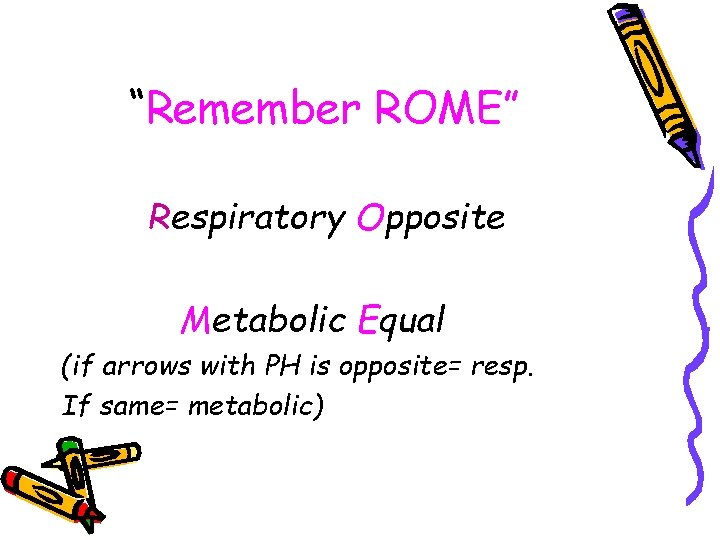
“Remember ROME” Respiratory Opposite Metabolic Equal (if arrows with PH is opposite= resp. If same= metabolic)
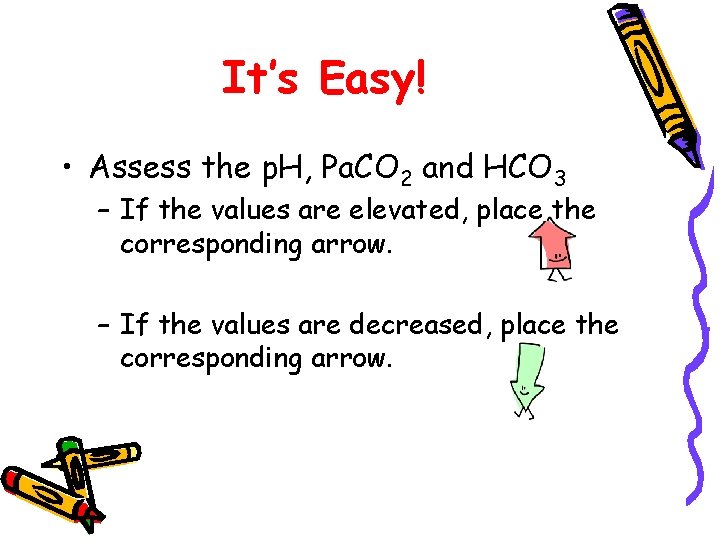
It’s Easy! • Assess the p. H, Pa. CO 2 and HCO 3 – If the values are elevated, place the corresponding arrow. – If the values are decreased, place the corresponding arrow.
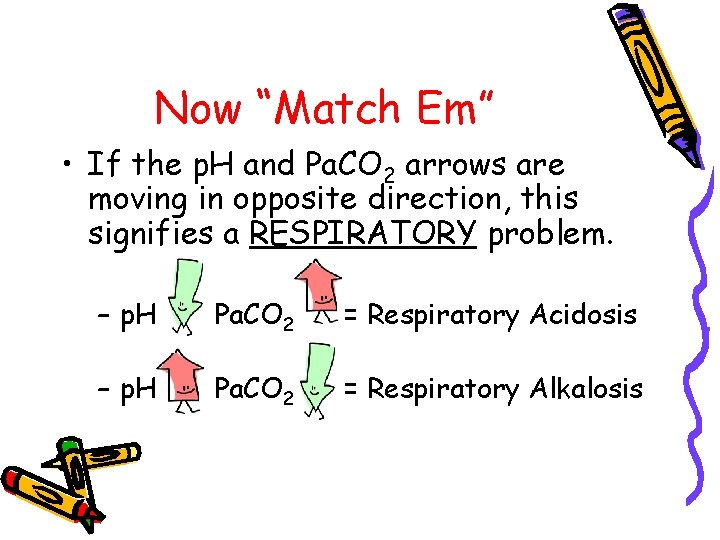
Now “Match Em” • If the p. H and Pa. CO 2 arrows are moving in opposite direction, this signifies a RESPIRATORY problem. – p. H Pa. CO 2 = Respiratory Acidosis – p. H Pa. CO 2 = Respiratory Alkalosis
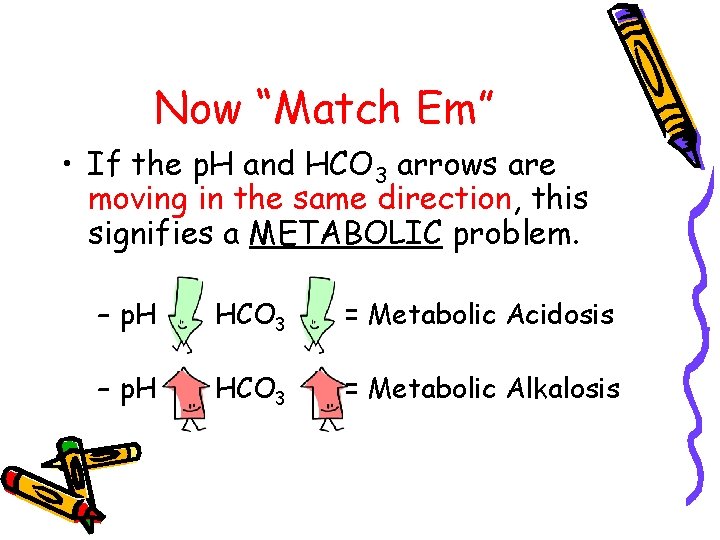
Now “Match Em” • If the p. H and HCO 3 arrows are moving in the same direction, this signifies a METABOLIC problem. – p. H HCO 3 = Metabolic Acidosis – p. H HCO 3 = Metabolic Alkalosis
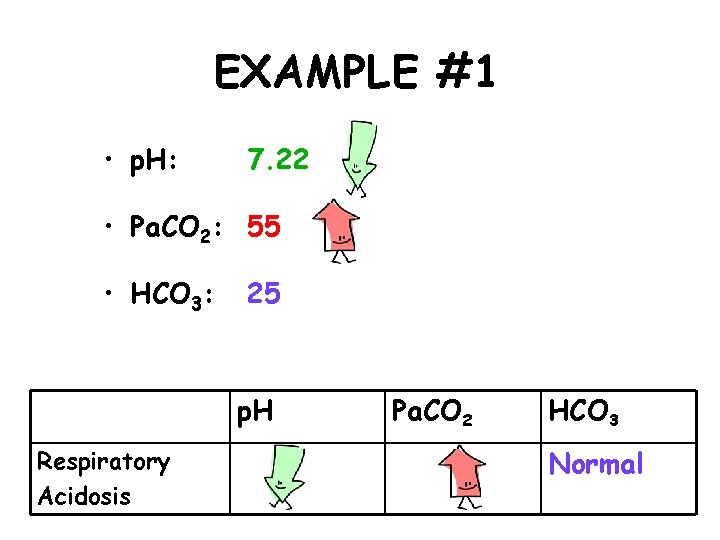
EXAMPLE #1 • p. H: 7. 22 • Pa. CO 2: 55 • HCO 3: 25 p. H Respiratory Acidosis Pa. CO 2 HCO 3 Normal
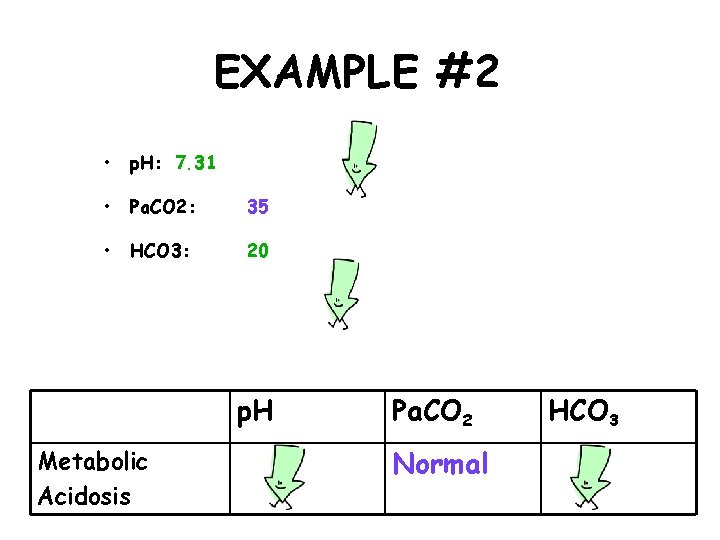
EXAMPLE #2 • p. H: 7. 31 • Pa. CO 2: 35 • HCO 3: 20 p. H Metabolic Acidosis Pa. CO 2 Normal HCO 3
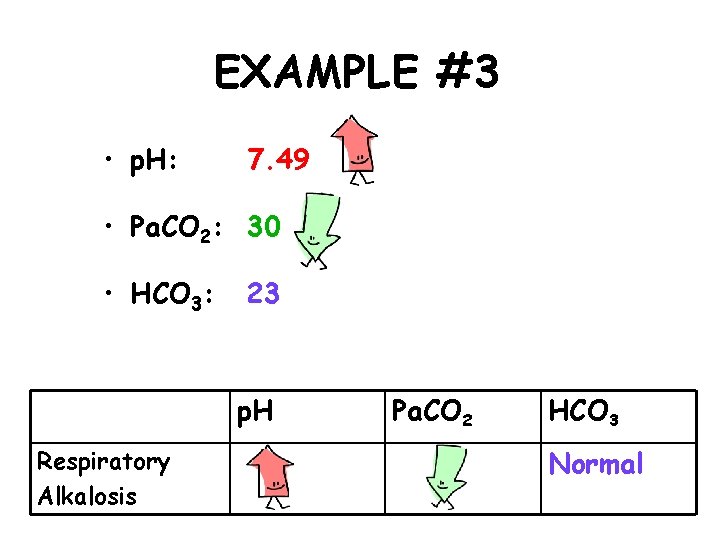
EXAMPLE #3 • p. H: 7. 49 • Pa. CO 2: 30 • HCO 3: 23 p. H Respiratory Alkalosis Pa. CO 2 HCO 3 Normal
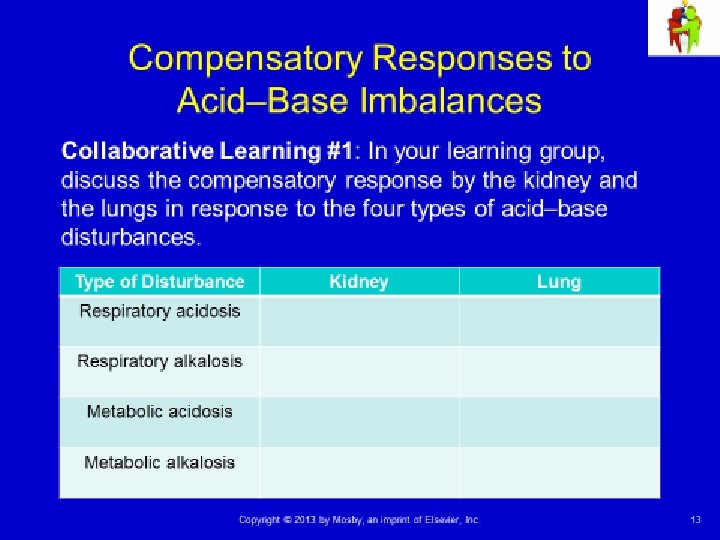
Evaluate for Compensation • When a patient develops an acid-base imbalance the body will typically attempt to compensate for the abnormality. • If the buffer systems within the body are unable to maintain a normal p. H, the lungs & the kidneys will attempt to compensate.
Evaluate for Compensation • If the problem is respiratory in origin, the kidneys will work to correct it. • If the problem is metabolic in origin, the lungs will work to correct it.
Evaluate for Compensation • Determine the degree of compensation: – Uncompensated (if PH abnormal, and one other abnormal) – Partially compensated (all 3 abnormal) – Fully compensated (p. H normal, but others both abnormal)
Consequences: Impaired Cellular and Organ Function • When compensatory mechanisms fail, the following physiologic consequences occur: – Altered cell function, especially in the brain when CO 2 crosses the blood–brain barrier – Change in intracellular enzyme activity resulting in cell dysfunction – Acidosis: decreases the level of consciousness (LOC) – Alkalosis: decreases the LOC and has other neurologic manifestations; may cause dysrhythmias
Evaluate for Compensation • Uncompensated • p. H is abnormal, & either the Pa. CO 2 or HCO 3 is also abnormal • There is no indication that the opposite side has tried to correct for the other.
Evaluate for Compensation • Partially Compensated • p. H is abnormal, & both the Pa. CO 2 and HCO 3 are also abnormal • This indicates that one system has attempted to correct for the other but has not been completely successful.
Evaluate for Compensation • Fully Compensated • p. H is normal, & both the Pa. CO 2 & HCO 3 are abnormal • The normal p. H indicates that one system has been able to compensate for the other.
Steps for Evaluating Compensation • Assess the p. H, determine acidosis or alkalosis. – Remember, even if the p. H is normal, determine whether the p. H falls on the acidotic or alkalotic side of 7. 40. – Place the corresponding arrow next to the p. H
Steps for Evaluating Compensation • Assess the Pa. CO 2 and the HCO 3 – Place the corresponding arrows next to the values. – Continue the matching game: Which value matches with the p. H? – The other component should be moving in the opposite direction, which indicates compensation.
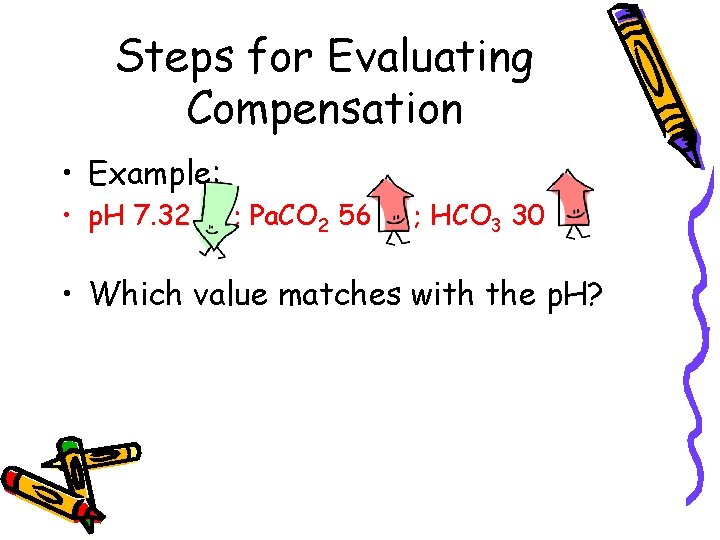
Steps for Evaluating Compensation • Example: • p. H 7. 32 ; Pa. CO 2 56 ; HCO 3 30 • Which value matches with the p. H?
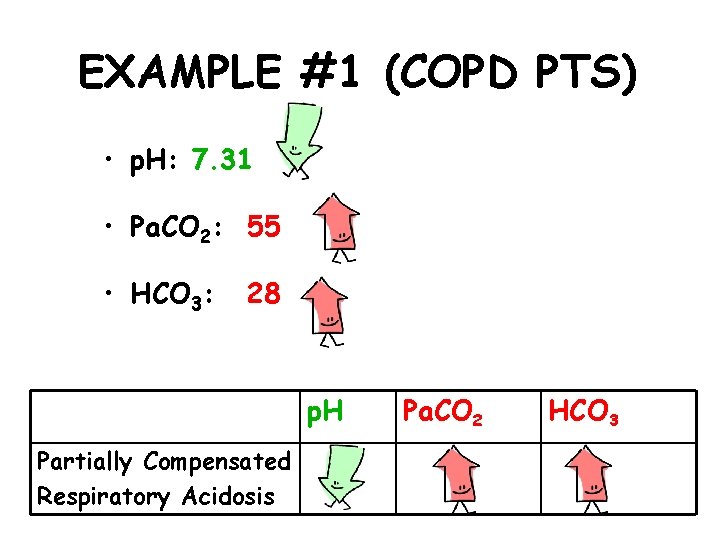
EXAMPLE #1 (COPD PTS) • p. H: 7. 31 • Pa. CO 2: 55 • HCO 3: 28 p. H Partially Compensated Respiratory Acidosis Pa. CO 2 HCO 3
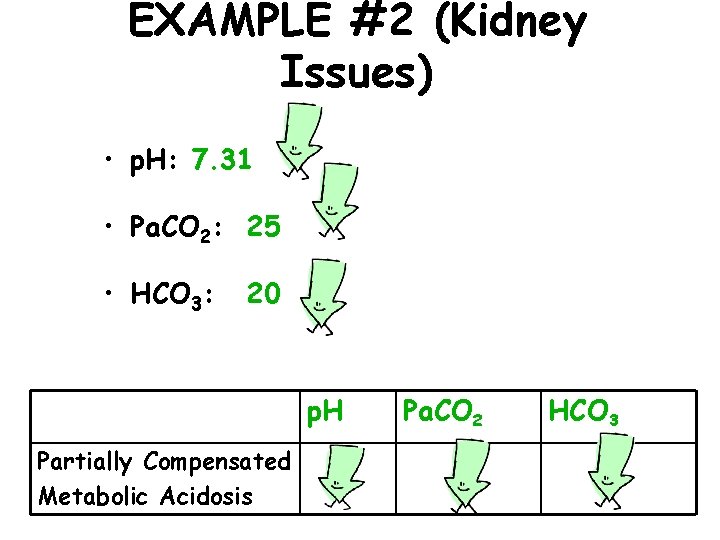
EXAMPLE #2 (Kidney Issues) • p. H: 7. 31 • Pa. CO 2: 25 • HCO 3: 20 p. H Partially Compensated Metabolic Acidosis Pa. CO 2 HCO 3
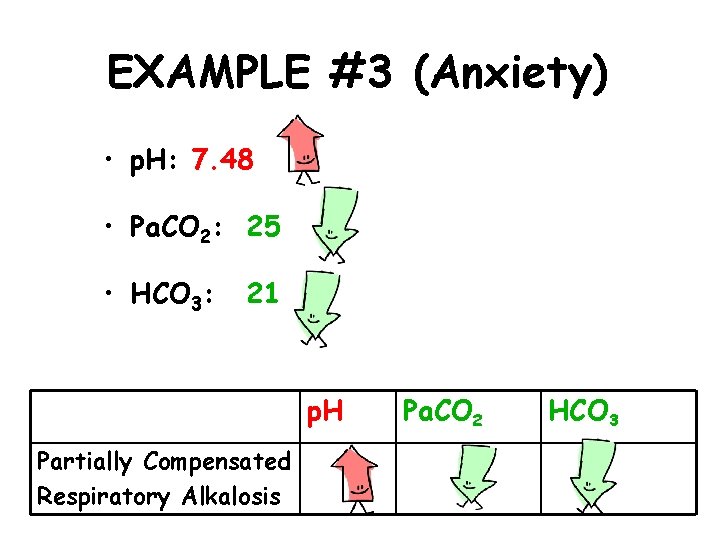
EXAMPLE #3 (Anxiety) • p. H: 7. 48 • Pa. CO 2: 25 • HCO 3: 21 p. H Partially Compensated Respiratory Alkalosis Pa. CO 2 HCO 3
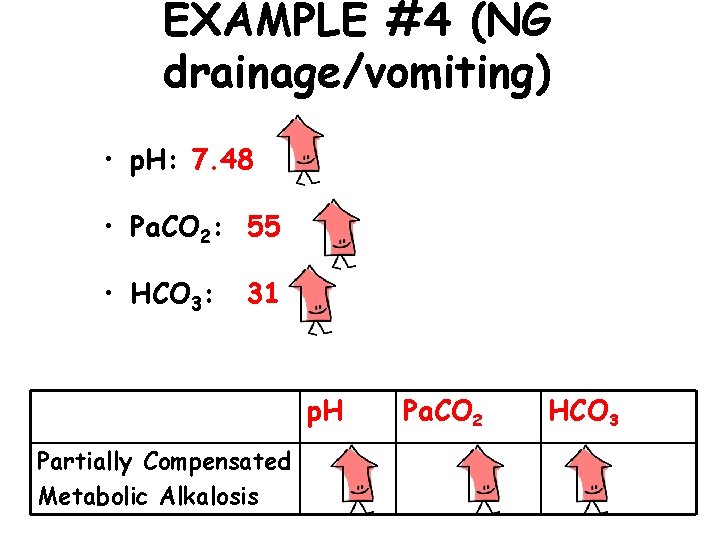
EXAMPLE #4 (NG drainage/vomiting) • p. H: 7. 48 • Pa. CO 2: 55 • HCO 3: 31 p. H Partially Compensated Metabolic Alkalosis Pa. CO 2 HCO 3
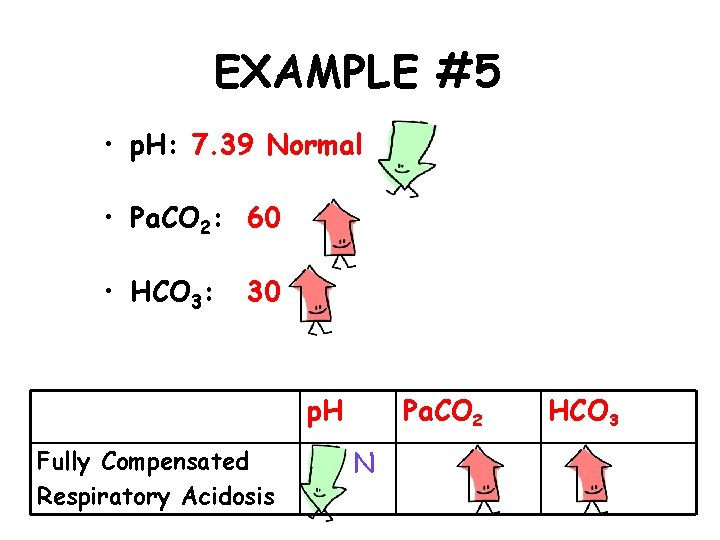
EXAMPLE #5 • p. H: 7. 39 Normal • Pa. CO 2: 60 • HCO 3: 30 p. H Fully Compensated Respiratory Acidosis Pa. CO 2 N HCO 3
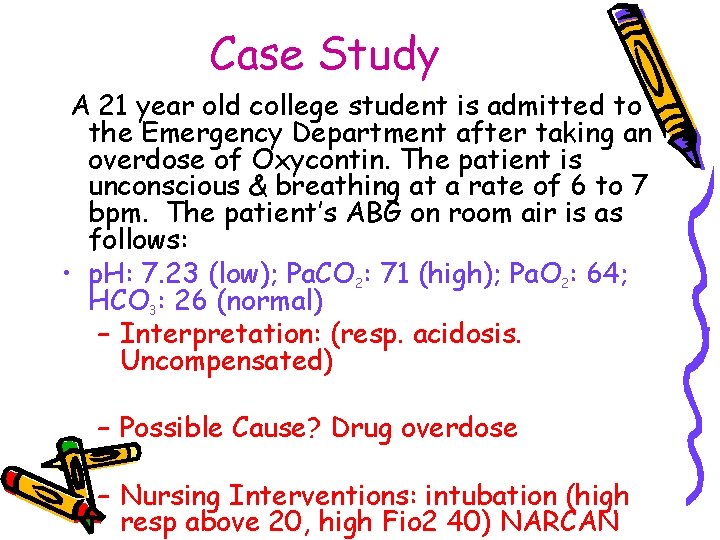
Case Study A 21 year old college student is admitted to the Emergency Department after taking an overdose of Oxycontin. The patient is unconscious & breathing at a rate of 6 to 7 bpm. The patient’s ABG on room air is as follows: • p. H: 7. 23 (low); Pa. CO 2: 71 (high); Pa. O 2: 64; HCO 3: 26 (normal) – Interpretation: (resp. acidosis. Uncompensated) – Possible Cause? Drug overdose – Nursing Interventions: intubation (high resp above 20, high Fio 2 40) NARCAN
Case Study A woman with a history of panic disorder arrives at the Emergency Department complaining of not being able to “catch her breath”. The woman is crying, shaking and breathing rapidly. An ABG is obtained: • p. H: 7. 52 (high); Pa. CO 2: 28 (norm); HCO 3: 22 (norm); Sa. O 2: 90% – Interpretation: Respiratory Alkalosis uncompensated, hypoxia – Possible Cause? Hyperventilating – Nursing Interventions: Calm down, paper bag, pain
Case Study A teenager is being evaluated at the emergency room for complaints of muscle weakness and twitching. Her mother reports “she is always on a dieting” The patient is 5’ 6 and weighs 102 lbs. Among the teenager’s lab results are the following ABG values: • p. H: 7. 50 (high); Pa. CO 2: 45 (normal); HCO 3: 30 (low); Sa. O 2 94% – Interpretation? Metabolic alkalosis uncompensated (difficult to treat) – Possible Cause? – Nursing Interventions? Deep breaths, positioning, 2 L NC O 2, nutrition education, replace electrolytes, MONITOR
Case Study A patient has been mechanically ventilated for the past two days in the ICU. The ventilator settings are as follows: AC, rate of 16, FIO 2 50%, and TV 600. The patient’s 6 am ABG results are as follows: • p. H: 7. 49 (high); Pa. CO 2: 29 (low); Pa. O 2: 70; HCO 3: 25 (normal): – Interpretation? Respiratory alkalosis uncompensated – Possible Cause? Hyperventilation, slow rate/tidal volume – Nursing Interventions? Pain control, increase PEEP,
Case Study A 53 year old patient presents to the Emergency Department with complaints of weakness, nausea, and shortness of breath. The patient’s STAT ABG results are as follows: • p. H: 7. 29 (low); Pa. CO 2: 32 (normal); HCO 3: 18 (normal); Pa. O 2 80 – Interpretation: partially compensated metabolic acidosis – Possible Cause? – Nursing Interventions?
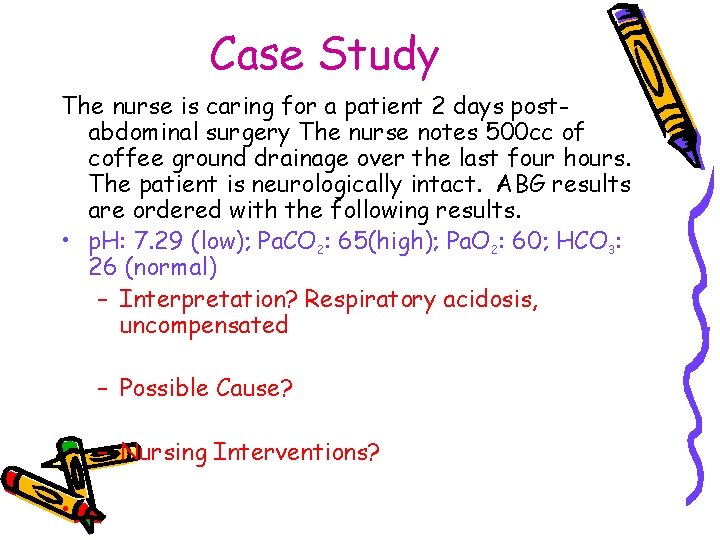
Case Study The nurse is caring for a patient 2 days postabdominal surgery The nurse notes 500 cc of coffee ground drainage over the last four hours. The patient is neurologically intact. ABG results are ordered with the following results. • p. H: 7. 29 (low); Pa. CO 2: 65(high); Pa. O 2: 60; HCO 3: 26 (normal) – Interpretation? Respiratory acidosis, uncompensated – Possible Cause? – Nursing Interventions? •

• Thank you for your participation
- Slides: 39