
ART THE COLOR WHEEL By Angelica Gilchrist Lower
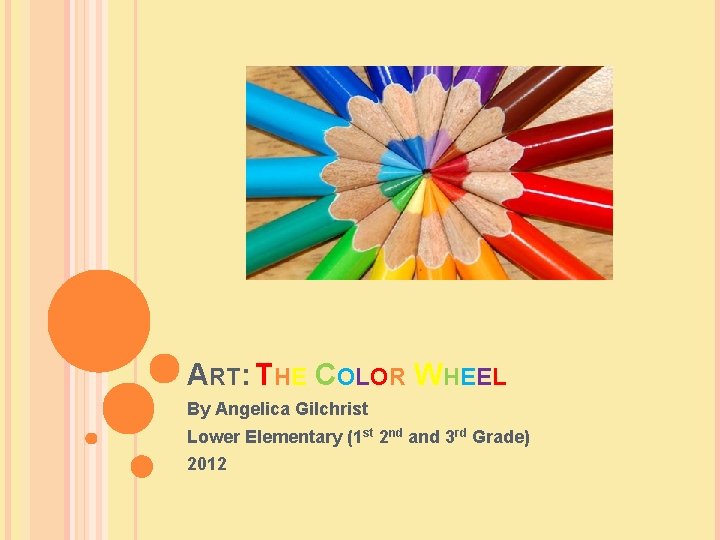
ART: THE COLOR WHEEL By Angelica Gilchrist Lower Elementary (1 st 2 nd and 3 rd Grade) 2012

INTRODUCTION Welcome. Do know about colors and how they relate to each other? In a way, colors have feelings, and they are expressed when we use them in combination with each other. Today we are going to learn about the color wheel. It can greatly help you while doing art because it shows you which colors “whisper” and which colors “shout”. You can then apply the colors to your work of art, based on what mood you are trying to create.
OBJECTIVES By the end of this lesson you will be able to: A. )Create your own color wheel. B. )Understand how the colors on the color wheel relate to each other, and effectively apply them to your artwork.
LESSON PAGE 1 Within the color wheel, there are specific vocabulary terms you need to know: Primary Colors: Any of a group of colors from which all other colors can be obtained by mixing. (red, yellow, blue) Secondary Colors: A color resulting from the mixing of two primary colors. (orange, green, purple/violet) Tertiary Colors: A tertiary color is a color made by mixing one primary color with one secondary color. (yellow orange, red violet, blue green, yellow green) Complementary Colors: Colors that are opposite each other on the color wheel. These colors “shout” to each other, creating a vibrant mood. Analogous Colors: Colors that are next to each other on the color wheel. These colors “whisper” to each other, creating a neutral mood.
LESSON PAGE 2 The color wheel can help us understand the relationship between colors. It shows us which colors we need to use in combination with each other in order to create a specific mood. Aside from using the color wheel for your artwork, you can also use it for your wardrobe, or anything else in which you are combining colors. The color wheel is an everyday tool available to you when making your color decisions.
LESSON PAGE 3 Let’s say you are trying to create a work of art in which you want the colors to really stand out against each other. You would look at your color wheel and see which colors “shout” at each other. In other words, look at your color wheel and see which colors are across from each other, rather than next to each other. These complementary colors that are across from one another will be the colors for you. Examples of “shouting” colors are purple (violet) and yellow. The high contrast of complementary colors creates a vibrant look especially when used at full saturation.
LESSON PAGE 4 Let’s say you are creating a work of art in which you want the colors to “whisper” to one another. Look at your color wheel and see which colors are next to each other. These analogous colors will be the colors for you. Examples of “whispering” colors are red and red-orange. Analogous color schemes are often found in nature and are harmonious and pleasing to the eye.

RESOURCES FOR YOU http: //www. color-wheel-artist. com/ http: //www. tigercolor. com/color-lab/colortheory/color-theory-intro. htm http: //en. wikipedia. org/wiki/Color_wheel
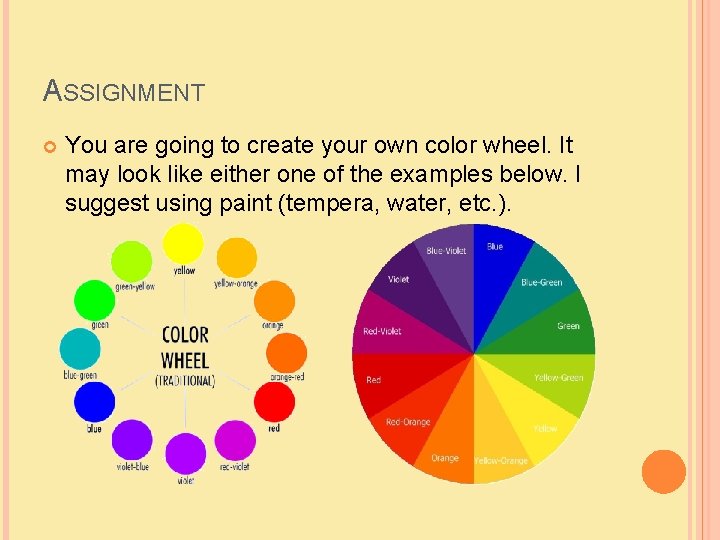
ASSIGNMENT You are going to create your own color wheel. It may look like either one of the examples below. I suggest using paint (tempera, water, etc. ).
PRE-REVIEW In review, the color wheel can help us by showing us how the colors relate to each other. There are Primary, Secondary, Tertiary, Complementary, and Analogous colors. Based on their description, you can use them to create specific color combinations in your artwork.
ASSESSMENT QUIZ What are Primary Colors? (definition). Then list the Primary Colors. What are the Secondary Colors? (definition). Then list the Secondary Colors. What are the Tertiary Colors? (definition). Then list the Tertiary Colors. What are Complementary Colors? (definition) What are Analogous Colors? (definition) How can the color wheel help us? Now you are going to make your final color wheel (of your choice, given the two examples).
POST-REVIEW After learning about the color wheel, and everything it includes, you should now be able to create your own color wheel, and use its colors based on what kind of mood you are trying to create in your art. Remember, there are Primary Colors (red, blue, yellow), Secondary Colors (yellow, green, purple/violet), and Tertiary Colors (yellow orange, red violet, blue green, yellow green). The colors that are next to each other are Analogous Colors that “whisper” and the colors that are across from each other are Complementary Colors that “shout”. These simple rules will help you with your future masterpieces!
CREDIT/REFERENCES http: //colourlovers. com. s 3. amazonaws. com/blog/wpcontent/uploads/2007/12/color_wheel_pencils. jpg http: //nhsdesigns. com/images/color_wheel_traditional. jpg http: //dimeonadime. com/web/wp-content/uploads/2011/08/colorwheel. jpg http: //www. google. com/#hl=en&q=primary+color&tbs=dfn: 1&tbo=u&sa=X &ei=shn. UNz. RBI 6 a 9 QT 5 z. YHYAw&ved=0 CBw. Qk. Q 4&bav=on. 2, or. r_gc. r_pw. r _qf. &fp=55 cc 286424706 d 63&biw=1280&bih=653 http: //www. google. com/#hl=en&q=secondary+color&tbs=dfn: 1&tbo=u&sa =X&ei=4 cdn. UN 3_GIfk 9 ASioo. Do. BA&sqi=2&ved=0 CBw. Qk. Q 4&bav=on. 2, or. r_gc. r_pw. r_qf. &fp=58 cd 1 a 128 b 75 a 554&biw=1280&bih=678 http: //www. google. com/#hl=en&q=tertiary+colors&tbs=dfn: 1&tbo=u&sa= X&ei=KMhn. UPzc. Ko. OQ 9 g. Sj 5 YG 4 DQ&ved=0 CBw. Qk. Q 4&bav=on. 2, or. r_g c. r_pw. r_qf. &fp=58 cd 1 a 128 b 75 a 554&biw=1280&bih=678 http: //www. tigercolor. com/color-lab/color-theory/color-harmonies. htm
- Slides: 13