
Art of India After 1200 By Athena Rivas
Art of India After 1200 By Athena Rivas
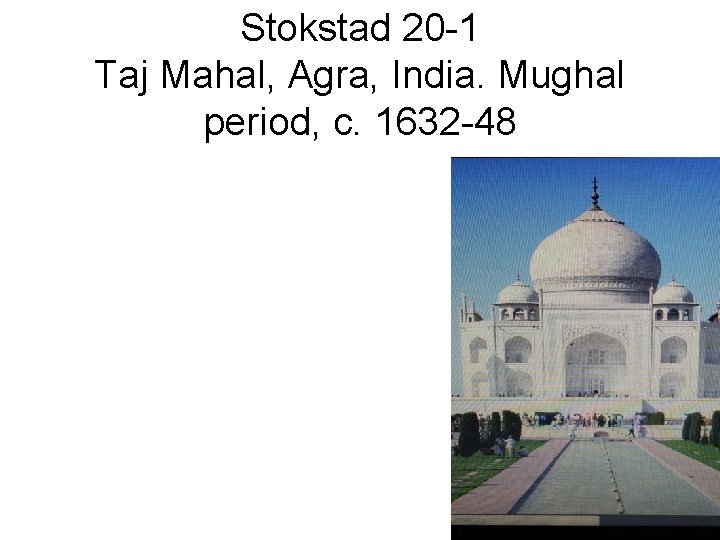
Stokstad 20 -1 Taj Mahal, Agra, India. Mughal period, c. 1632 -48
-The building shimmers in the pools of the garden, which meant to evoke a vision of paradise in the Koran. *Koran- Holy Book of Islam -Facades delicately inlaid with inscriptions and arabesques in semi-precious stonescarnelian, agate, coral, turquoise, garnet, lapis, and jasper. -Built in the 17 th century -Built by Mughal ruler Shah Jahan as a mausoleum for his favorite wife.
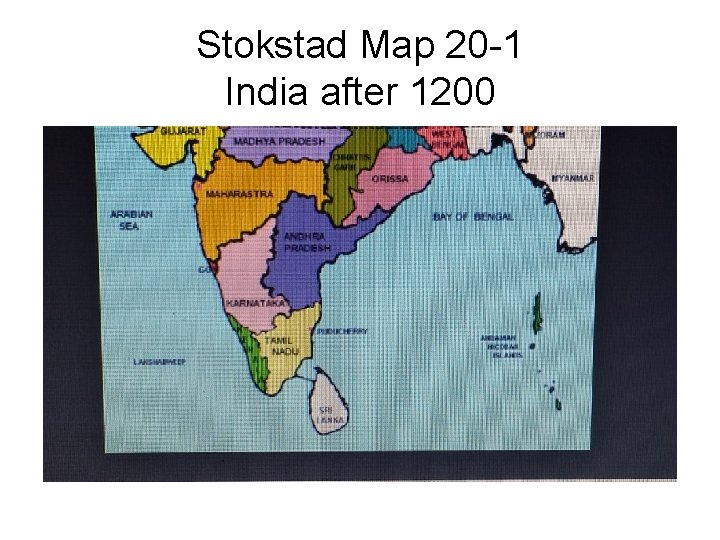
Stokstad Map 20 -1 India after 1200
* The Indian Subcontinent was subject to continual invasions that caused the boarders of its kingdom to contract and expand until the establishment of modern-day India in the 20 th century.

• 1200, India was already among the worlds oldest Late civilizations. Medieval Period • The art that still survived from its earlier periods are almost exclusively sacred. • Most art was inspired by 3 principle religions: Buddhism, Hinduism, and Jainism. • The late medieval period extends roughly from 1200 to about 1600.
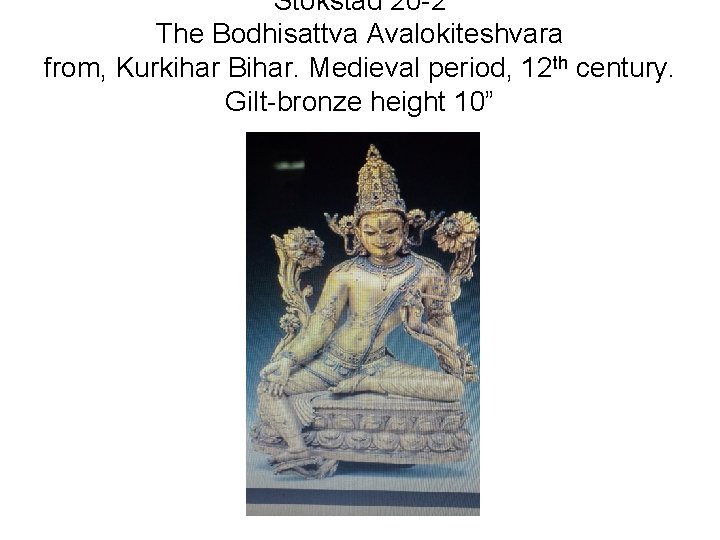
Stokstad 20 -2 The Bodhisattva Avalokiteshvara from, Kurkihar Bihar. Medieval period, 12 th century. Gilt-bronze height 10”
Buddhist *Vocabulary Words* Art • At the beginning of the Late Medieval period, the principle Buddhist centers *iconographic were concentrated in the images: techniques northeast. for visualizing deities • Avalokireshvara the buddhisttva of greatest compassion, became one of *Bodhisattvas: are the most popular saintly beings who are well beings in India and East Asia. advanced on the path to Buddhahood and • Avalokiteshvara can be who have vowed out shown in the posture of of compassion to relaxed ease known as the help others achieve royal pose. enlightenment.
• need more formal and contextual analysis of 20 -2
• Jian religion traces it roots to a spiritual Jain Art leader called Mahavria(599 -527 BCE) • There is a series of twenty-four saviors known as the pathfinders, or tirthankaras. • what does the religion believe followers should do? • In western India, primarily in the region of Gujarat, created many illustrated manuscripts • tell us that Musim control caused more private than public expression
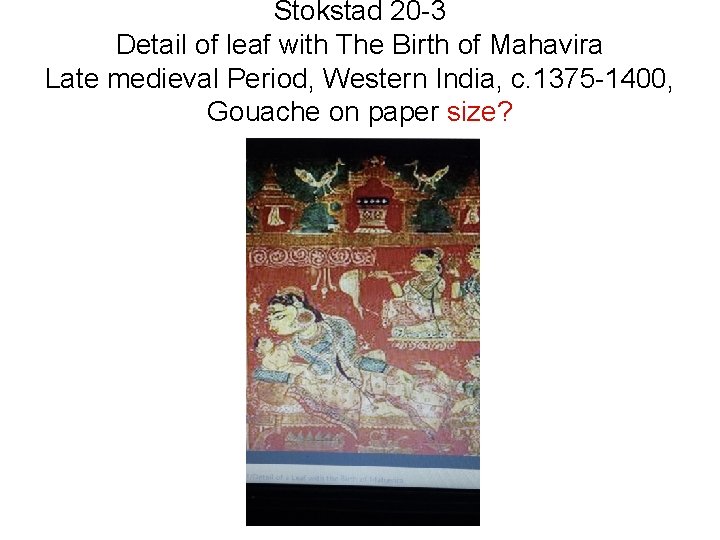
Stokstad 20 -3 Detail of leaf with The Birth of Mahavira Late medieval Period, Western India, c. 1375 -1400, Gouache on paper size?
*calligraphy: decorative handwriting or handwritten lettering. • Produced in the fourteenth century. • One of the first Jain manuscripts on paper rather than palm leaf. • The birth of Mahavria. • Is shown cradled in his mothers arms as she reclines in her bed under a canopy, attended by 3 ladies in-waiting. • Decorated pavilions and a shrine with peacocks on roof suggest a luxurious palace setting. • Everything appears two-dimensional against the red and blue ground. • Vibrant colors • drawing is closely linked to the calligraphy; as if the words had suddenly flared into color and image
• what about box “Foundations of Indian culture”? • BTW--general comment--I like the vocabulary you put on the side where it appears
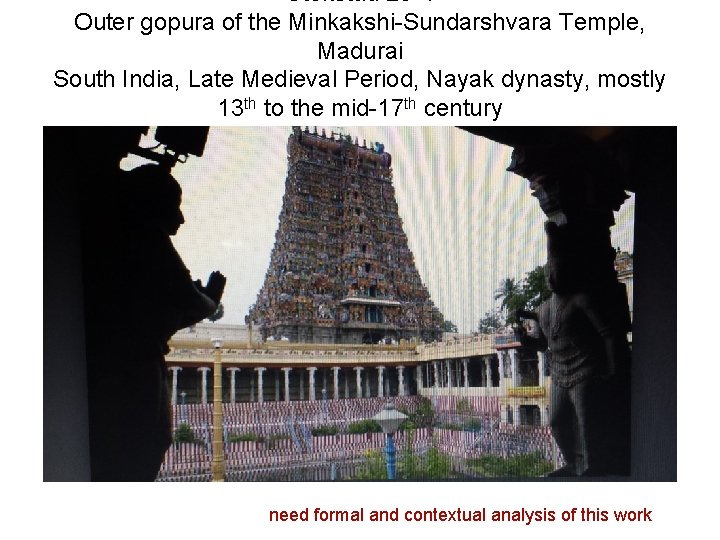
Stokstad 20 -4 Outer gopura of the Minkakshi-Sundarshvara Temple, Madurai South India, Late Medieval Period, Nayak dynasty, mostly 13 th to the mid-17 th century need formal and contextual analysis of this work

Hindu Art period Hinduism became the dominate religious tradition of India. • Late Medieval period emphasized on monumental individual temples. no, it says that his gave way to Vocabulary: *Temple complexmoderately scaled ornamented temples. *gopuras- entrance gateways. *vimana- the • pyramidal tower characteristic of the seventh-century southern temple style. vast temple complexes and ore moderately scaled yet more richly ornamented individual temples Vijayanager kings lavished donations on sacred shrines.
Mughal Period • Islam first touched the South Asian Subcontinent in the eighth century. Vocabulary: • Muhammad Zahir-ud-Din was the first emperor of • Mausoleums – a India(ruled in 1526 -30) building, a large and stately one, • He emphasized the Turkic heritage. housing a tomb or tombs. • He amassed am empire stretching from Afghanistan • Mosques- a to Delhi. Muslim place of worship. • The Mughal empire lasted until 1858.
Mughal Architectur e Vocabulary: • Cenotaphs-a tomblike monument to someone buried elsewhere • Minaret-a tall slender tower, typically part of a mosque • Chattri-dome-shaped pavilions used as an element in Indian architecture • Chamfered- cut away to make a symmetrical sloping edge. • Finial-a distinctive ornament at the apex of a roof, pinnacle, canopy, or similar structure in a building. • Iwan-a rectangular hall or space, usually vaulted, walled on three sides, with one end entirely open. • Drum-something resembling or likened to a drum in shape, in particular. • Mughal architects were heir to a 300 -year-old tradition of Islamic building in India. • Architects had introduced two fundamental Islamic structures, the mosque and the tomb, and the arch and the dome. • Drawn freely on Indian architecture using both decorated and structural elements to create a variety of hybrid styles
Mughal Architectur e Vocabulary: • Cenotaphs-a tomblike monument to someone buried elsewhere • Minaret-a tall slender tower, typically part of a mosque • Chattri-dome-shaped pavilions used as an element in Indian architecture • Chamfered- cut away to make a symmetrical sloping edge. • Finial-a distinctive ornament at the apex of a roof, pinnacle, canopy, or similar structure in a building. • Iwan-a rectangular hall or space, usually vaulted, walled on three sides, with one end entirely open. • Drum-something resembling or likened to a drum in shape, in particular. You have to show and tell us plate 12 -5 and talk about these items on the left in the context of the Taj mahal Also, where is info on box “Technique: Indian Painting on Paper” on p. 793?
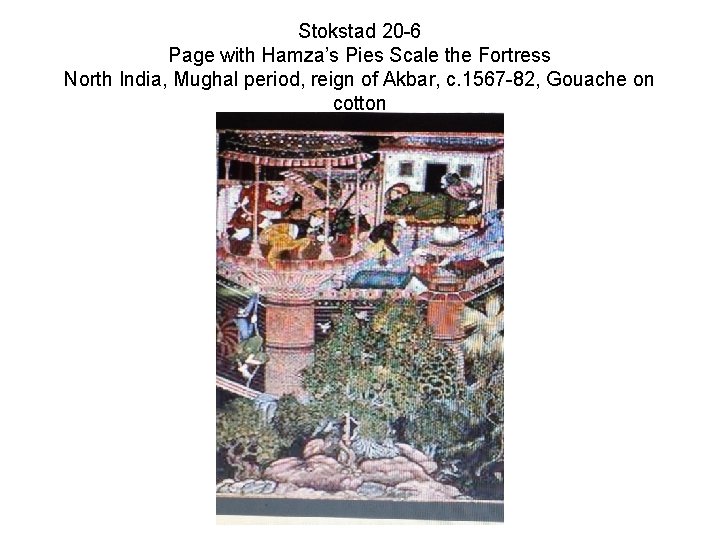
Stokstad 20 -6 Page with Hamza’s Pies Scale the Fortress North India, Mughal period, reign of Akbar, c. 1567 -82, Gouache on cotton
• One man climbs a rope; another has already beheaded a figure in yellow and lifts his head aloft • what is story about? • Realistic details are never avoided in panting from the Mughal atelier. • Richly variegated geometric patterns of tile work, which are painted as though they have been set flat on the page. • Each tree species is carefully distinguished. • Painting from the reign of Jahangir. • What about Persian style and Mughal school
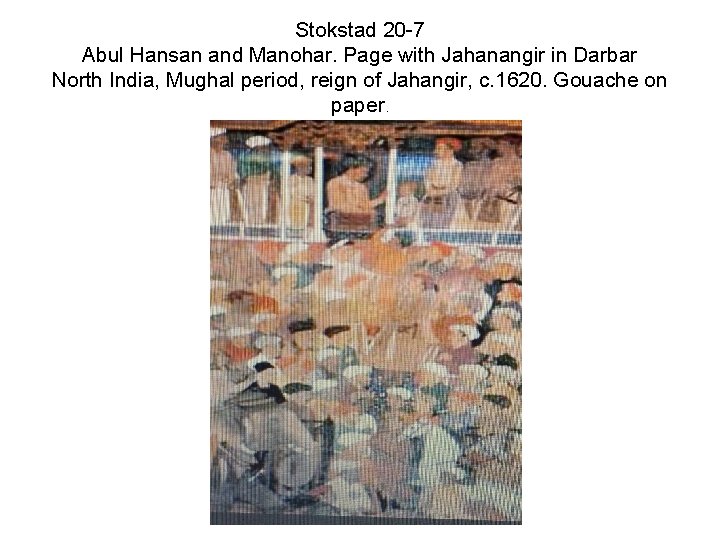
Stokstad 20 -7 Abul Hansan and Manohar. Page with Jahanangir in Darbar North India, Mughal period, reign of Jahangir, c. 1620. Gouache on paper.
• Shows emperor holding an audience at court. • Jahangir himself is depicted at top center, seated on a balcony under a canopy. • Figures lined up in profile or three-quarter view. • Foreground, an elephant and a horse complete the symmetrical format. • Figures in audience are a medley of portraits. • Represent a symbolic gathering rather than an actual event. • Scene is formal. • It is two-dimensional. • Fresh colors with varied range of pastel tones. • Finest paintings of Jahangir's time.
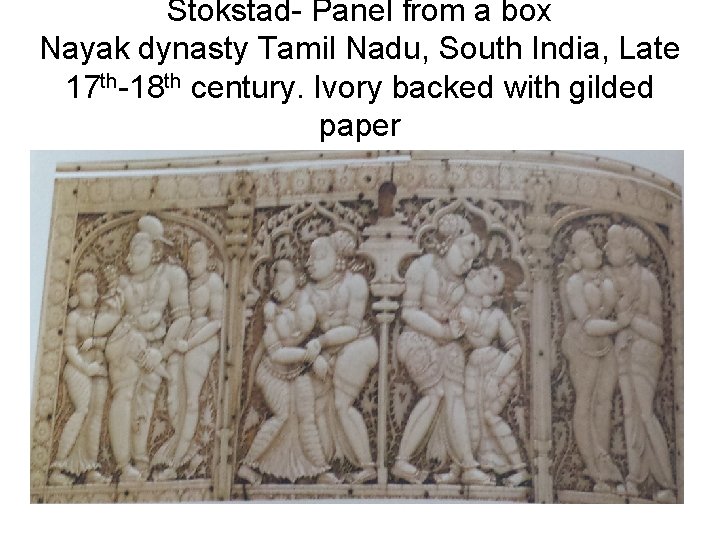
Stokstad- Panel from a box Nayak dynasty Tamil Nadu, South India, Late 17 th-18 th century. Ivory backed with gilded paper
Good for you! You did the box on p. 796! • Container for personal belongings such as jewelry, perfume, or cosmetics. • Ivory relief is a brilliant example if south Indian secular arts. • Decorative arts of India represent the height of opulent luxury. • Metalwork and work in rock crystal, agate, and jade, carving, in ivory, and intricate jewelry are all characteristics Indian arts. • Many pieces, like the carved ivory panel illustrated, have no date or record of manufacture or ownership
• Their huge eyes under heavy brows suggest the intensity of their gaze, & choice of profile shows of their long noses and thick lips. • Hair is tightly controlled; men have huge buns and women have long braids hanging down their backs. • Rich jewelry and well-fed bodies of the couples indicate a high station in life. • Voluptuous figures- rounded buttocks thighs, tummies hanging over jeweled belts, and sharply intended slim waists that emphasized seductive breasts. • Jewelry- bracelets, armbands, necklaces, huge earrings, & ribbons.
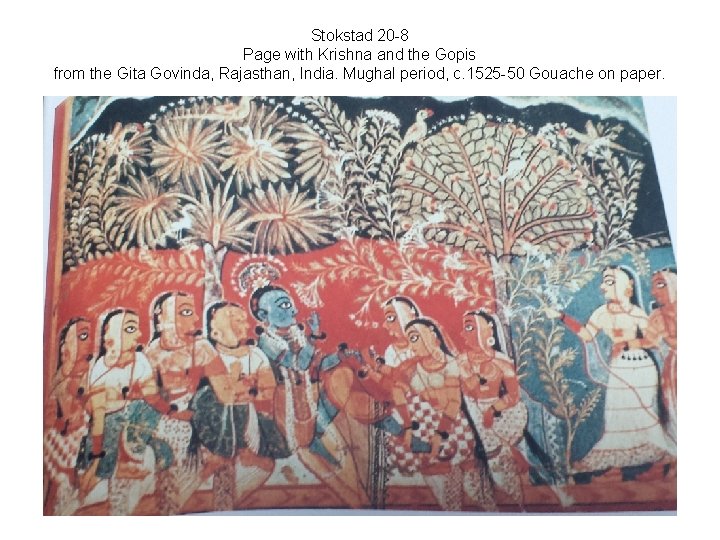
Stokstad 20 -8 Page with Krishna and the Gopis from the Gita Govinda, Rajasthan, India. Mughal period, c. 1525 -50 Gouache on paper.
• Illustration is from a manuscript of the Gita Govinda produced in the region of Rajasthan about 1525 -50. Tell us about Rajput Painting and Bhakti movement • Blue god Krishna sits in dalliance with a group of cowherd women. • Radha peers through the trees, overcome by jealousy. Here feelings are indication by the cool blue colors. • Flowering vines and trees express springtime. • Birds, birds, and flowers, are brilliant as fireworks against the black, hilly landscape edged in the undulating white line. • Figures are of a single type, with plump faces in profile and oversized eyes.
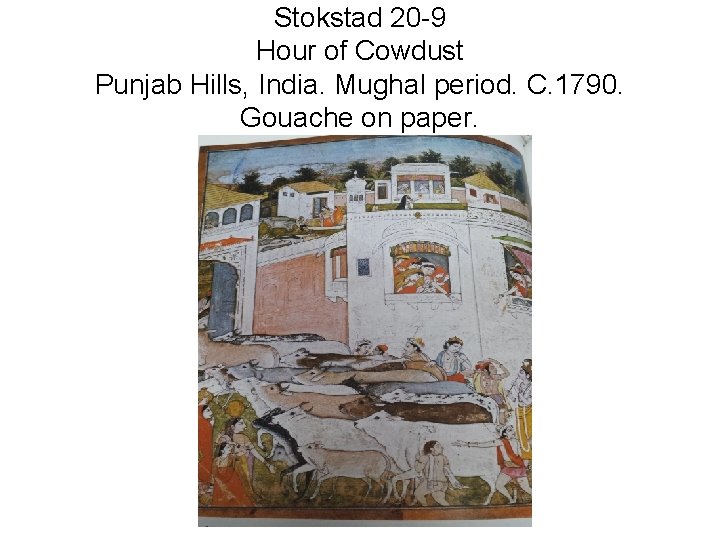
Stokstad 20 -9 Hour of Cowdust Punjab Hills, India. Mughal period. C. 1790. Gouache on paper.
• contrast this with previous paining • where is format analysis? • He returns to the village with his fellow cowherds and there cattle. • All eyes are upon him as he plays his flute • Said to enchant anyone who heard it
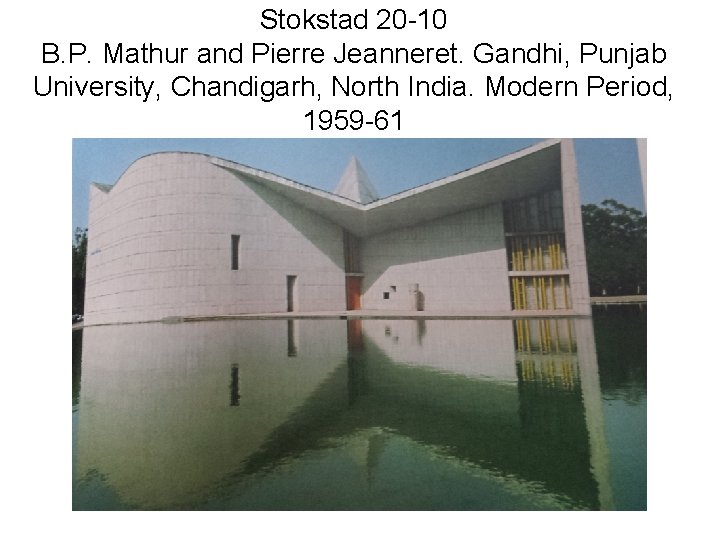
Stokstad 20 -10 B. P. Mathur and Pierre Jeanneret. Gandhi, Punjab University, Chandigarh, North India. Modern Period, 1959 -61
modern period--tell us background, history, and politics • Hall was designed in the late 1950’s by Indian architect B. P. Mathur in collaboration with Pierre Jeanneret. • Gandhi Bhavan’s three-part, pinwheel plan, abstract sculpture qualities. • Fluid use of planes reflect the modern vision of international style. • The surrounding pools represent Mughal tombs. • Ritual-bathing pools of Hindu temples. • Abstract style is free of specific religious associations. • Caught between sky, earth, and water.
- Slides: 31