
Art In Communism Group Members Yao Jiaxin Chen
Art In Communism Group Members: Yao Jiaxin Chen Zirui Zhao Xiang Yu
Thesis Statement Propaganda posters are the main and most important factor in shaping identities, cultivating desired values and defining one’s role and relationship to the state under Mao’s rule.
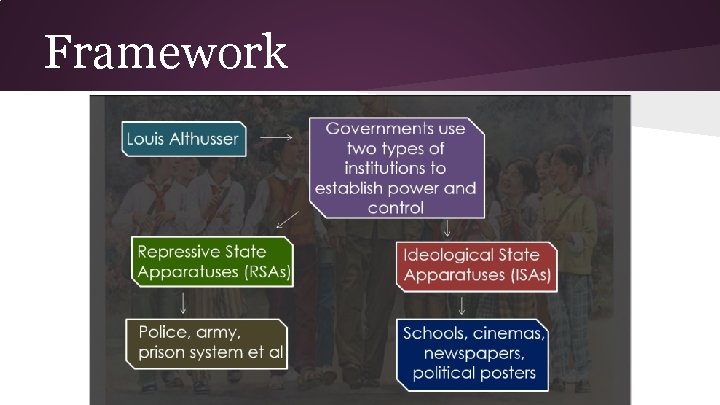
Framework
Framework ● Mao’s Yan’an conference ● Essentially not forcing people to believe in Maoism and allow criticism, but promotes one-sidedness in short messages, such as propaganda
Scope ● ● 1958 -1976 -Cultural Revolution -Great Leap Forward Propaganda Posters -Lei Feng -Chairman Mao Communist China Effects of the propaganda on the people of China
Research Questions ● ● ● What are the trends can be drawn from the posters of Lei Feng and Mao during the Great Leap Forward and Cultural Revolution? How has these posters impacted the lives of the people living under Mao’s rule? Why were posters used as a tool of propaganda by Mao instead of other mediums? What messages are conveyed as a result and how are people’s perception changed? How did the posters help in consolidating power for Mao and the communist party?
Literature Review Definition of Art “Art is generally defined as intentionally made by their makers with a significant degree of aesthetic interest, often surpassing that of most everyday objects. It may also have a non-aesthetic purpose behind it, such as ceremonial or religious or propagandistic purpose” (Adajian, T. 2007). “However, art can also be defined not just by its ability to express form and beauty, but also its ability to communicate concepts of morality” (Scott, A. 2002).
Literature review “Propaganda messages during Mao’s era was filled with militant expressions such as “overthrow”, “thoroughly destroy” and “strike hard” and are often filled with militant images of war, horses, muscular workers and peasants in heroic postures. ”(Murong X. , 2013) “Many chinese posters feature heroic, cartoon like figures with political slogans to rally the masses. The images are triumphant, even if the events they depict were often disasters. ” (Langfitt, F. 2012) “ The goal of these poster was to show the Chinese people what sort of behavior was considered morally correct and how great the future of Communist China would be if everyone followed the same path towards utopia by uniting together. ” (Landsberger, S. 2011) “Mao believes that the people cannot force people to accept Marxism, and he can only persuade them” (Zedong, Mao 1957). “Criticism would be hampered if everyone were required to look at problems in an absolutely all-sided way. ” (Zedong, Mao 1942)
Literature Review ● ● ● Chen Xiaomei, an individual who had survived Cultural Revolution, has said “Posters remembered, talked back, and also constructed and reconstructed who I was and what was socially expected of me. ” Li Cunxin also said that he wanted to be a hero like Lei Feng and his spirit of ‘forgetting himself to help other’s was his living motto. (Cunxin, Li 2003) “The brilliant spirit of Lei Feng and his stories influenced my perception of this world and my life choices. Should one’s achievements and fruit of labour belong to oneself or the people? (Jian Wei, Wang 2011)
Analysis of posters
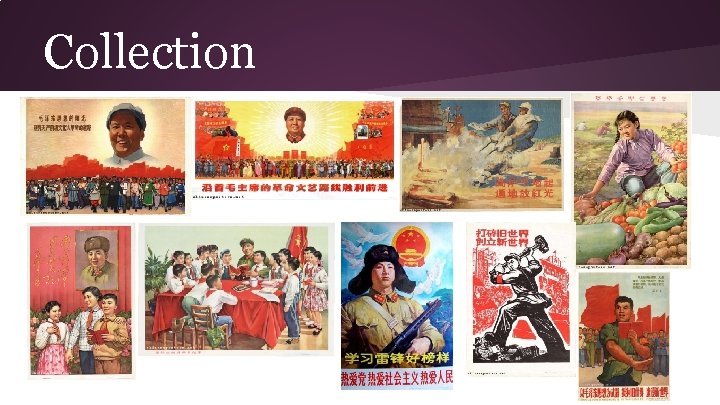
Collection
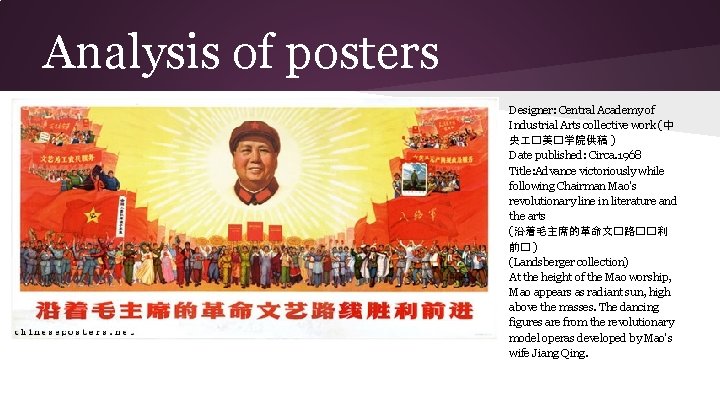
Analysis of posters Designer: Central Academy of Industrial Arts collective work (中 央 �美�学院供稿 ) Date published: Circa. 1968 Title: Advance victoriously while following Chairman Mao's revolutionary line in literature and the arts (沿着毛主席的革命文�路��利 前� ) (Landsberger collection) At the height of the Mao worship, Mao appears as radiant sun, high above the masses. The dancing figures are from the revolutionary model operas developed by Mao's wife Jiang Qing.
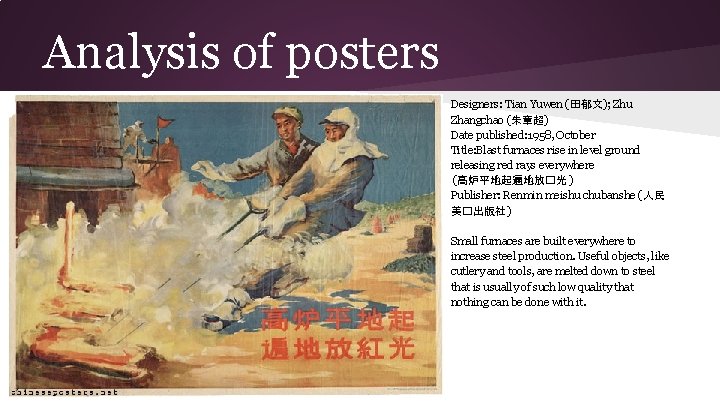
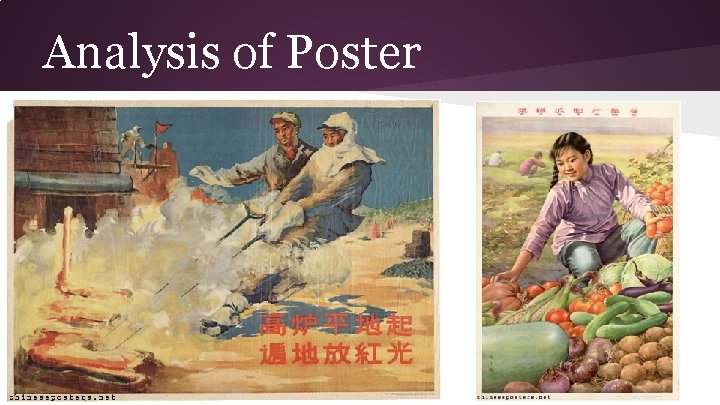
Analysis of posters Designers: Tian Yuwen (田郁文); Zhu Zhangchao (朱章超) Date published: 1958, October Title: Blast furnaces rise in level ground releasing red rays everywhere (高炉平地起遍地放�光 ) Publisher: Renmin meishu chubanshe (人民 美�出版社 ) Small furnaces are built everywhere to increase steel production. Useful objects, like cutlery and tools, are melted down to steel that is usually of such low quality that nothing can be done with it.
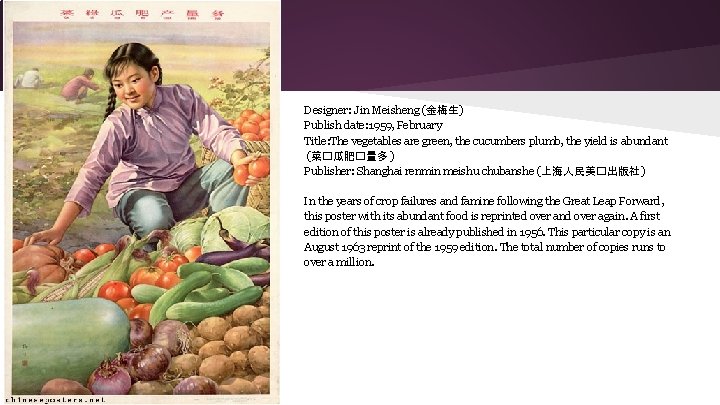
Designer: Jin Meisheng (金梅生) Publish date: 1959, February Title: The vegetables are green, the cucumbers plumb, the yield is abundant (菜�瓜肥�量多 ) Publisher: Shanghai renmin meishu chubanshe (上海人民美�出版社 ) In the years of crop failures and famine following the Great Leap Forward, this poster with its abundant food is reprinted over and over again. A first edition of this poster is already published in 1956. This particular copy is an August 1963 reprint of the 1959 edition. The total number of copies runs to over a million.
Analysis of Poster
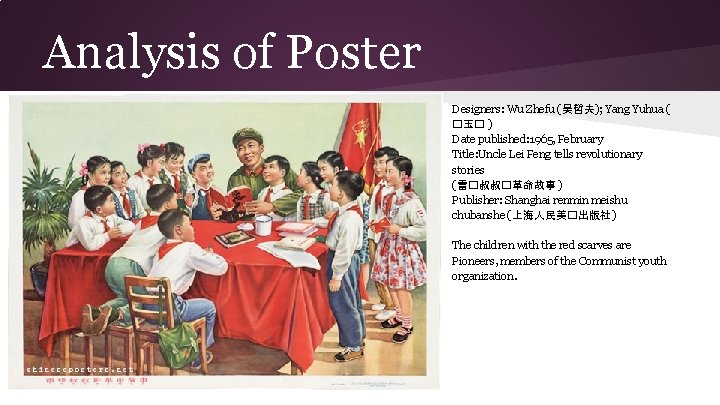
Analysis of Poster Designers: Wu Zhefu (吴哲夫); Yang Yuhua ( �玉� ) Date published: 1965, February Title: Uncle Lei Feng tells revolutionary stories (雷�叔叔�革命故事 ) Publisher: Shanghai renmin meishu chubanshe (上海人民美�出版社 ) The children with the red scarves are Pioneers, members of the Communist youth organization.
Interview Conclusion: ● Posters of Lei Feng coupled with stories taught the people what it meant to be a model citizen. ● Posters were chosen as a medium because it was cheap, effective and easy to understand. ● The role of posters during Mao’s rule was of utmost importance and it helped Mao consolidate power. ● All the people who were interviewed have seen propaganda posters in public areas such as schools, telephone poles, walls and in other people’s homes. ● These propaganda posters were useful in cultivating values of a “model citizen” in the people. These changes in the people’s perception were genuine at the start but the layers of false information and indoctrination began to peel away as they were opened up to the world
Discussion ● ● ● “Posters were used as a medium of propaganda alongside with radio, speeches and education. However, posters were the most impactful method. They played a significant role in ‘attacking revisionists such as Liu Shaoqi and Deng Xiaoping’”(Ozensoy, D. C. 2015). Posters were cheap and easily distributable. Other methods were unfeasible For example, speeches were unable to be delivered daily which could help influence the citizens. Education is a process that will take over 10 years to instill desirable traits into the youths, although it will pay off in the longrun. Over time, exposure to such posters does result in indoctrination of ideologies resulting in the adoption of values that Mao wanted his citizens to instill in his citizens.
Discussion ● ● ● Youths are more susceptible to indoctrination as they are more impressionable It is impossible for the parents to teach values independently that are against the norms of the society Education played a role, by helping youths adopt Maoist ideals. The education and posters worked together to bring across the values that Mao wants in his people Characters in the posters are the most significant part of the propaganda posters, they resonated often with the individuals. Personification of the characters results in lasting memories of the character in certain individual’s minds, leaving behind deep impressions of the values these characters portray.
Discussion ● ● ● However, the effect of these posters are not ever-lasting Exposure to the outside world and sacrificing certain deep-rooted ideologies for economical gains, such as transitioning China into a more capitalist society to allow for greater growth, appears to be able to completely erode the previously deep-rooted beliefs invoked by the posters Posters are known to change their message from time to reflect the historical situation and serve different purpose Constant introduction of new posters could have been the key to maintaining or bring around political stability Posters were therefore an essential tool in maintaining social and political stability.
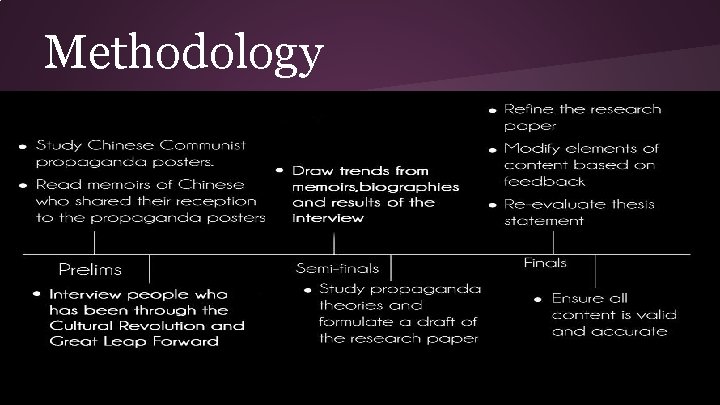
Methodology
Bibliography • Adajian, T. (2007, October 23). The Definition of Art. Retrieved June 1, 2015, from http: //plato. stanford. edu/entries/art-definition/ • Alex Scott (2002 ). Tolstoy’s What is Art? . [ONLINE] from http: //www. angelfire. com/md 2/timewarp/tolstoy. html. • Michael Mc. Carty (2000). THE HISTORICAL ROOTS OF CHINESE COMMUNIST PROPAGANDA. [ONLINE] from http: //www. baylor. edu/content/services/document. php? id=19565. • Murong Xuecun (2013). The New face of Chinese propaganda. [ONLINE] from http: //www. nytimes. com/2013/12/21/opinion/sunday/murong-the-new-face-ofchinese-propaganda. html? _r=0.
Bibliography Mao Zedong (1957). SPEECH AT THE CHINESE COMMUNIST PARTY'S NATIONAL CONFERENCE ON PROPAGANDA WORK. [ONLINE] from https: //www. marxists. org/reference/archive/mao/selected-works/volume 5/mswv 5_59. html. • Anne-Marie Brady. Guiding Hand: The Role of the CCP Central Propaganda Department in the Current Era. [ONLINE] from https: //www. westminster. ac. uk/__data/assets/pdf_file/0015/20148/5 -Bradyinterim_2_. pdf. • Frank Langfitt (2012 ). The Art Of Chinese Propaganda. [ONLINE] from http: //www. npr. org/blogs/pictureshow/2012/11/16/164785930/the-art-of-chinese -propaganda.
Bibliography • Adajian, T. (2007, October 23). The Definition of Art. Retrieved June 1, 2015, from http: //plato. stanford. edu/entries/art-definition/ • Andrew Bozio (2006, June 1). Interpreting Power in the Political Poster. [ONLINE] from http: //www. uky. edu/Centers/Asia/SECAAS/Seras/2006/Bozio. htm ● Tania branigan. (2013). The Guardian. Retrieved 3 July, 2015, from http: //www. theguardian. com/world/2013/mar/27/china-cultural-revolution-sons-guiltzhang-hongping ● ● 解放��( 2015,June 10). 陶克:人民���何雷�多. Retrieved July 3, 2015, from http: //theory. people. com. cn/n/2015/0610/c 40531 -27131636. html 王建�( 2015,March 15). 雷�精神影响了我的一生. Retrieved July 3, 2015, from http: //www. wenku 1. com/view/2 FC 7 E 704 D 04367 C 4. html
Bibliography ● ● ● 六羽毛儿(2011, January 12). 雷�精神的�面影响. Retrieved July 3 rd, 2015, from http: //blog. sina. com. cn/s/blog_4 bb 00 f 450100 nylu. html Chineseposters. net(2015, January 15). Lei Feng Gallery. Retrieved June 7 th, 2015, from http: //chineseposters. net/gallery/theme-15. php Chineseposters. net(2015, January 15). Great Leap Forward (1956 -1960). Retrieved June 7 th, 2015, from http: //chineseposters. net/gallery/theme-04. php Chineseposters. net(2015, January 15). Cultural Revolution (1966 -1968). Retrieved June 7 th, 2015, from http: //chineseposters. net/gallery/theme-07. php
- Slides: 25