
Art and Color Choice Board Triarchic Intelligences Target

Art and Color: Choice Board (Triarchic Intelligences) Target: I can analyze the use of color in painting.
Analytical After you have looked at Monet’s Paintings 6. 24 and 6. 25 in your book. Select one painting and write a paragraph describing and analyzing it’s tone. Tone is associated with the feeling that Monet has about the scene, how he conveys the feeling to the viewer, and how he encourages the viewer to respond with emotions to the scene, First make a list of adjectives for the colors and forms in the painting. Then begin a paragraph using your list of words and make specific references to the painting. Practical Make a painting or a collage that focuses on major events in your life. Use color to indicate the emotional connection you have with the specific event. Creative Poets use color in their poetry, sometimes to describe objects but also as metaphors of feelings, moods, or scenes. Look in Bartlett’s Familiar Quotations for literary references to each color. You will find under red, a reference to Percy Bysshe Shelley’s “Ode to the West Wind. ” Find a copy of the poem and locate his description of autumn leaves. Write your own color metaphors.

Physical Education: Choice Board (Triarchic Intelligences) TARGET: I can communicate, cooperate, be a member of a team and enjoy participating in physical activity.
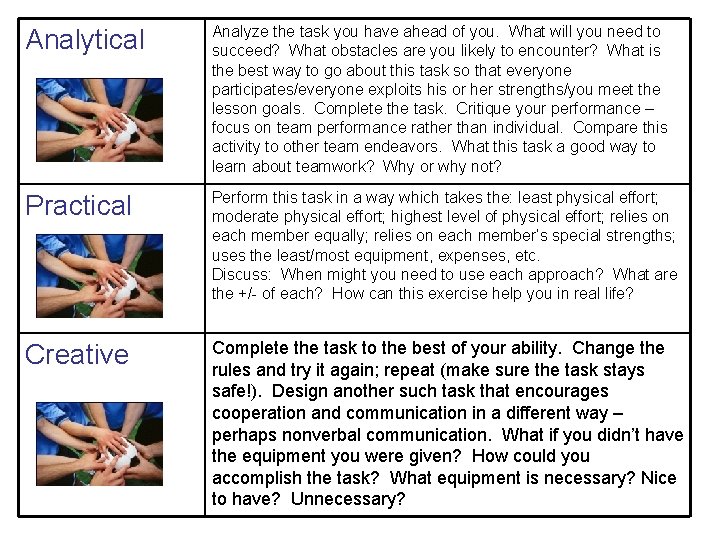
Analytical Analyze the task you have ahead of you. What will you need to succeed? What obstacles are you likely to encounter? What is the best way to go about this task so that everyone participates/everyone exploits his or her strengths/you meet the lesson goals. Complete the task. Critique your performance – focus on team performance rather than individual. Compare this activity to other team endeavors. What this task a good way to learn about teamwork? Why or why not? Practical Perform this task in a way which takes the: least physical effort; moderate physical effort; highest level of physical effort; relies on each member equally; relies on each member’s special strengths; uses the least/most equipment, expenses, etc. Discuss: When might you need to use each approach? What are the +/- of each? How can this exercise help you in real life? Creative Complete the task to the best of your ability. Change the rules and try it again; repeat (make sure the task stays safe!). Design another such task that encourages cooperation and communication in a different way – perhaps nonverbal communication. What if you didn’t have the equipment you were given? How could you accomplish the task? What equipment is necessary? Nice to have? Unnecessary?
Food Pyramid: Choice Board (Triarchic Intelligences) TARGET: I can explain the changes in the food pyramid.
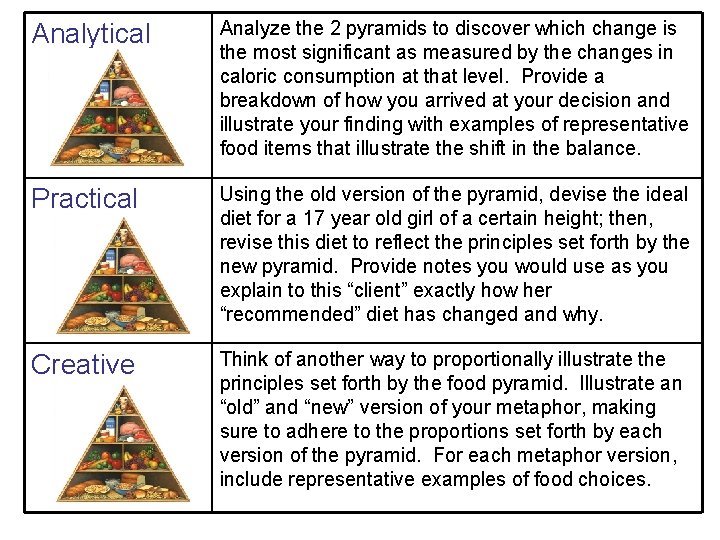
Analytical Analyze the 2 pyramids to discover which change is the most significant as measured by the changes in caloric consumption at that level. Provide a breakdown of how you arrived at your decision and illustrate your finding with examples of representative food items that illustrate the shift in the balance. Practical Using the old version of the pyramid, devise the ideal diet for a 17 year old girl of a certain height; then, revise this diet to reflect the principles set forth by the new pyramid. Provide notes you would use as you explain to this “client” exactly how her “recommended” diet has changed and why. Creative Think of another way to proportionally illustrate the principles set forth by the food pyramid. Illustrate an “old” and “new” version of your metaphor, making sure to adhere to the proportions set forth by each version of the pyramid. For each metaphor version, include representative examples of food choices.
Tic-Tac-Toe Board (Multiple Intelligences) Target: I can explain color and/or color theory.
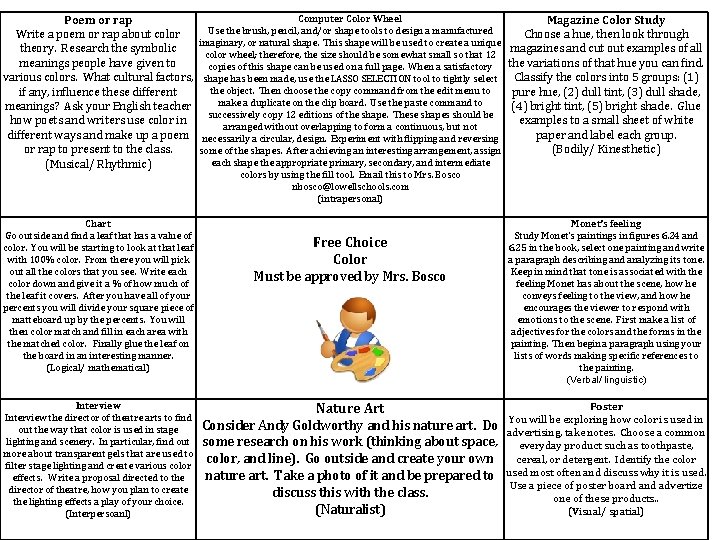
Poem or rap Write a poem or rap about color theory. Research the symbolic meanings people have given to various colors. What cultural factors, if any, influence these different meanings? Ask your English teacher how poets and writers use color in different ways and make up a poem or rap to present to the class. (Musical/ Rhythmic) Chart Go outside and find a leaf that has a value of color. You will be starting to look at that leaf with 100% color. From there you will pick out all the colors that you see. Write each color down and give it a % of how much of the leaf it covers. After you have all of your percents you will divide your square piece of matteboard up by the percents. You will then color match and fill in each area with the matched color. Finally glue the leaf on the board in an interesting manner. (Logical/ mathematical) Interview the director of theatre arts to find out the way that color is used in stage lighting and scenery. In particular, find out more about transparent gels that are used to filter stage lighting and create various color effects. Write a proposal directed to the director of theatre, how you plan to create the lighting effects a play of your choice. (Interpersoanl) Computer Color Wheel Use the brush, pencil, and/or shape tools to design a manufactured imaginary, or natural shape. This shape will be used to create a unique color wheel; therefore, the size should be somewhat small so that 12 copies of this shape can be used on a full page. When a satisfactory shape has been made, use the LASSO SELECTION tool to tightly select the object. Then choose the copy command from the edit menu to make a duplicate on the clip board. Use the paste command to successively copy 12 editions of the shape. These shapes should be arranged without overlapping to form a continuous, but not necessarily a circular, design. Experiment with flipping and reversing some of the shapes. After achieving an interesting arrangement, assign each shape the appropriate primary, secondary, and intermediate colors by using the fill tool. Email this to Mrs. Bosco nbosco@lowellschools. com (intrapersonal) Free Choice Color Must be approved by Mrs. Bosco Nature Art Consider Andy Goldworthy and his nature art. Do some research on his work (thinking about space, color, and line). Go outside and create your own nature art. Take a photo of it and be prepared to discuss this with the class. (Naturalist) Magazine Color Study Choose a hue, then look through magazines and cut out examples of all the variations of that hue you can find. Classify the colors into 5 groups: (1) pure hue, (2) dull tint, (3) dull shade, (4) bright tint, (5) bright shade. Glue examples to a small sheet of white paper and label each group. (Bodily/ Kinesthetic) Monet’s feeling Study Monet’s paintings in figures 6. 24 and 6. 25 in the book, select one painting and write a paragraph describing and analyzing its tone. Keep in mind that tone is associated with the feeling Monet has about the scene, how he conveys feeling to the view, and how he encourages the viewer to respond with emotions to the scene. First make a list of adjectives for the colors and the forms in the painting. Then begin a paragraph using your lists of words making specific references to the painting. (Verbal/ linguistic) Poster You will be exploring how color is used in advertising, take notes. Choose a common everyday product such as toothpaste, cereal, or detergent. Identify the color used most often and discuss why it is used. Use a piece of poster board and advertize one of these products. . (Visual/ spatial)
Physical Education: Tic-Tac-Toe Board (Multiple Intelligences) Target: I can think about how I do a drill and improve it.
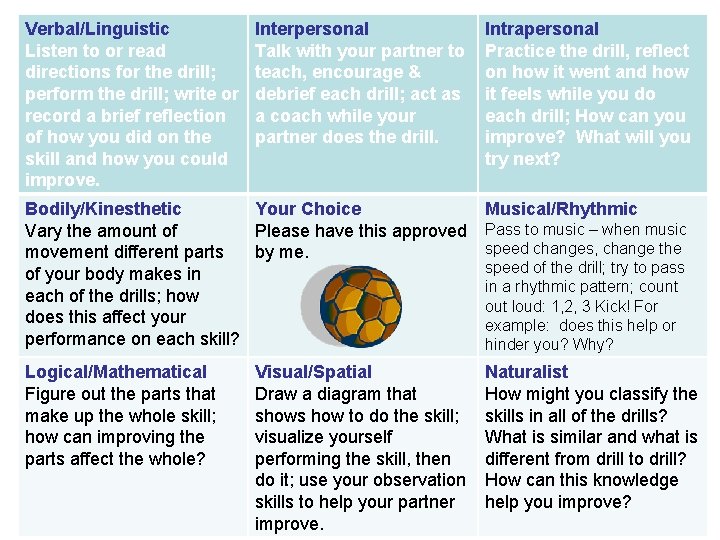
Verbal/Linguistic Listen to or read directions for the drill; perform the drill; write or record a brief reflection of how you did on the skill and how you could improve. Interpersonal Talk with your partner to teach, encourage & debrief each drill; act as a coach while your partner does the drill. Intrapersonal Practice the drill, reflect on how it went and how it feels while you do each drill; How can you improve? What will you try next? Bodily/Kinesthetic Your Choice Vary the amount of Please have this approved movement different parts by me. of your body makes in each of the drills; how does this affect your performance on each skill? Musical/Rhythmic Logical/Mathematical Figure out the parts that make up the whole skill; how can improving the parts affect the whole? Naturalist How might you classify the skills in all of the drills? What is similar and what is different from drill to drill? How can this knowledge help you improve? Visual/Spatial Draw a diagram that shows how to do the skill; visualize yourself performing the skill, then do it; use your observation skills to help your partner improve. Pass to music – when music speed changes, change the speed of the drill; try to pass in a rhythmic pattern; count out loud: 1, 2, 3 Kick! For example: does this help or hinder you? Why?
Pizza Builder Choice Board Orchestra Task: Build a ‘Pizza’ that represents a genre or style of music that is interesting to you
Pizza Builder!! Crust Choices: (Select one) • Thin Crust: A solo work for an unaccompanied instrument or voice • Hand Tossed Crust: A work for a chamber ensemble of 2 -15 performers • Deep Dish Crust: A work for large ensemble, over 16 performers • Gluten Free Crust: A work for mechanical or computer based sound generators
Pizza Builder! Sauce Choices: (Select one) • Red Sauce: represents music created for no specific occasion but simply as entertainment. • White Sauce: represents uplifting music created for a specific purpose or cultural event. • Pesto Sauce: represents somber music created for a specific purpose or cultural event. • Barbeque Sauce: represents music created for a festive occasion or cultural event.
Pizza Builder! • Toppings: (Select your favorite!) • The Middle Ages: A delicious pizza topped with the sounds of singing Monks, recorders, shawms, and citterns. Note: peasants will be served on traditional wooden utensils; nobles will be served on gold plates. • The Renaissance: A very festive pizza topped with the sounds of crumhorns, hurdy-gurdies, lutes, and essence of sackbut. Note: some toppings have been aged to preserve their potency.
Pizza Builder! • Toppings – Con’t: (Select your favorite!) • The Baroque: More refined than the Renaissance, this pizza includes the sounds of the viol family and the harpsichord. Depending on your sauce, you may detect a note of certain brass instruments. Note: This pizza served by a celebrity impersonator dressed as J. S. Bach • The Classical: Very formal in design, this square pizza features the sounds of strings and woodwinds with percussion and occasional brass instruments. You must wear a powdered wig when ordering this pizza.
Pizza Builder! • Toppings – Con’t: (Select your favorite!) • The Romantic: A house favorite, this super-sized pizza features your traditional orchestral instrument family – but in twice the proportion. Earplugs recommended. • The Modern: an unusual pizza, this pie pushes forms and shapes to an extreme. Order it with any combination of toppings. Note: crust will be asymmetrical. • The Jazz: you may order the ‘big band’ or ‘combo’ version of this pizza. Each features excellent rhythm and improvised solos. Note: this pizza may not be available if the chef is between sets.
Pizza Builder! • Bake and Deliver Your Pizza: • You may use the media center as your information ‘Oven’. Use the media sources available to you to find a piece of music that represents the pizza you have created. You will be preparing your pizza for consumption by the class. When you ‘Serve’ your pizza, be prepared to play either an audio or video with audio clip of the music.
Pizza Builder! • Assessment Rubric: • Meets or exceeds expectations: – Crust, sauce, and toppings well thought out to produce a representative piece of music with an example that includes the ingredients. Pizza well baked and arrives hot! • Some expectations met: – Crust, sauce, and toppings do not combine in a completely logical way – representative music difficult to categorize, and ingredients not well represented. Pizza may have been baked for too short a time. • Expectations not met: – Pizza was missing a major ingredient, or was not baked sufficiently.
Show-And-Tell Boards All students have the same TASK, but have a choice of SHOW AND TELL. Top row – what they could show Bottom row – what they could tell Need 1 SHOW & 1 TELL
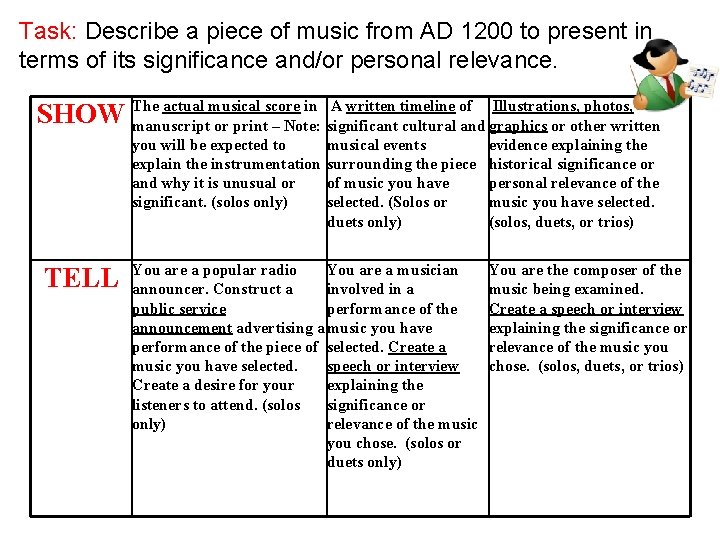
Task: Describe a piece of music from AD 1200 to present in terms of its significance and/or personal relevance. actual musical score in A written timeline of Illustrations, photos, SHOW The manuscript or print – Note: significant cultural and graphics or other written you will be expected to explain the instrumentation and why it is unusual or significant. (solos only) TELL musical events surrounding the piece of music you have selected. (Solos or duets only) You are a popular radio You are a musician announcer. Construct a involved in a public service performance of the announcement advertising a music you have performance of the piece of selected. Create a music you have selected. speech or interview Create a desire for your explaining the listeners to attend. (solos significance or only) relevance of the music you chose. (solos or duets only) evidence explaining the historical significance or personal relevance of the music you have selected. (solos, duets, or trios) You are the composer of the music being examined. Create a speech or interview explaining the significance or relevance of the music you chose. (solos, duets, or trios)
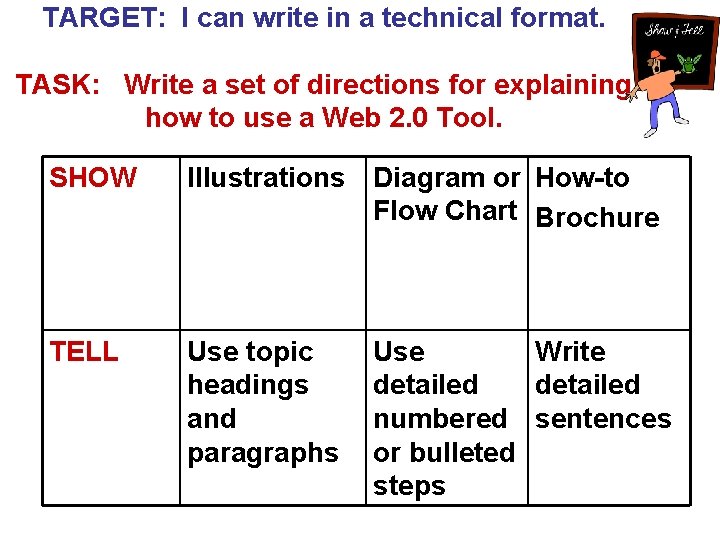
TARGET: I can write in a technical format. TASK: Write a set of directions for explaining how to use a Web 2. 0 Tool. SHOW Illustrations Diagram or How-to Flow Chart Brochure TELL Use topic headings and paragraphs Use Write detailed numbered sentences or bulleted steps
Painting – Choosing a Subject: Multiple Intelligences : Choice Board TARGET: I can choose a subject to paint and explain my reasons for selecting this subject.
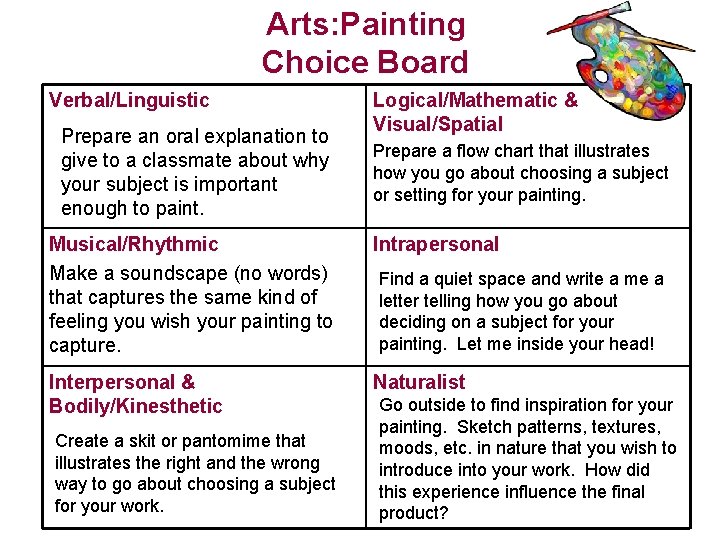
Arts: Painting Choice Board Verbal/Linguistic Prepare an oral explanation to give to a classmate about why your subject is important enough to paint. Logical/Mathematic & Visual/Spatial Prepare a flow chart that illustrates how you go about choosing a subject or setting for your painting. Musical/Rhythmic Make a soundscape (no words) that captures the same kind of feeling you wish your painting to capture. Intrapersonal Interpersonal & Bodily/Kinesthetic Naturalist Create a skit or pantomime that illustrates the right and the wrong way to go about choosing a subject for your work. Find a quiet space and write a me a letter telling how you go about deciding on a subject for your painting. Let me inside your head! Go outside to find inspiration for your painting. Sketch patterns, textures, moods, etc. in nature that you wish to introduce into your work. How did this experience influence the final product?
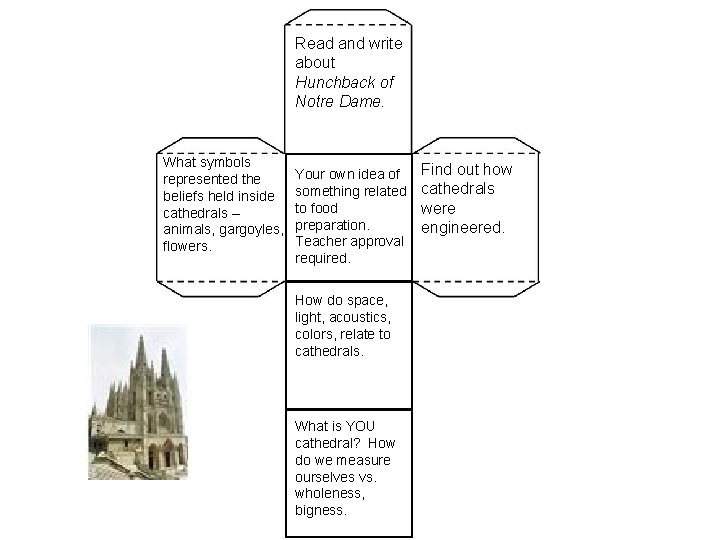
Read and write about Hunchback of Notre Dame. What symbols represented the beliefs held inside cathedrals – animals, gargoyles, flowers. Your own idea of something related to food preparation. Teacher approval required. How do space, light, acoustics, colors, relate to cathedrals. What is YOU cathedral? How do we measure ourselves vs. wholeness, bigness. Find out how cathedrals were engineered.
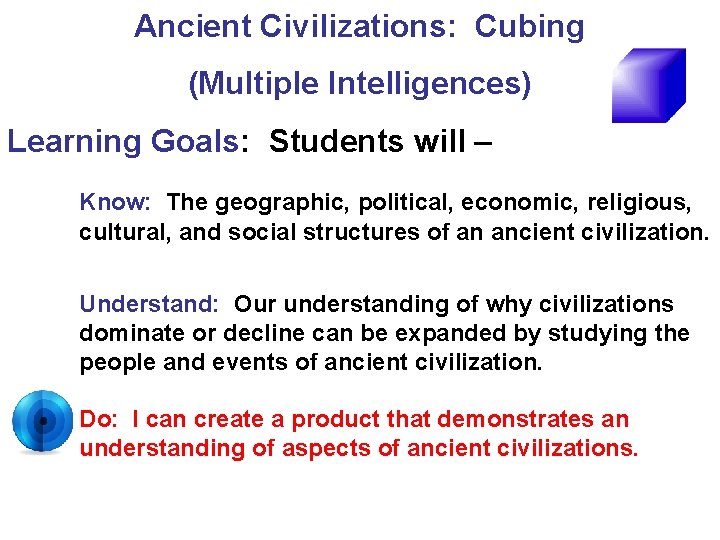
Ancient Civilizations: Cubing (Multiple Intelligences) Learning Goals: Students will – Know: The geographic, political, economic, religious, cultural, and social structures of an ancient civilization. Understand: Our understanding of why civilizations dominate or decline can be expanded by studying the people and events of ancient civilization. Do: I can create a product that demonstrates an understanding of aspects of ancient civilizations.

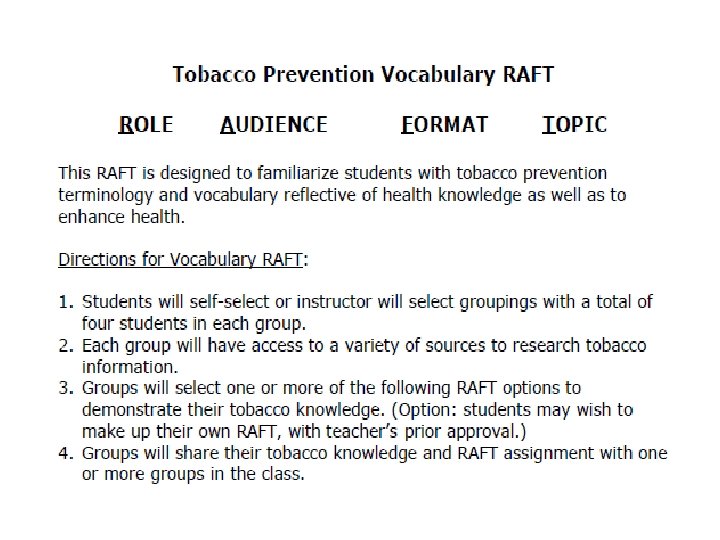
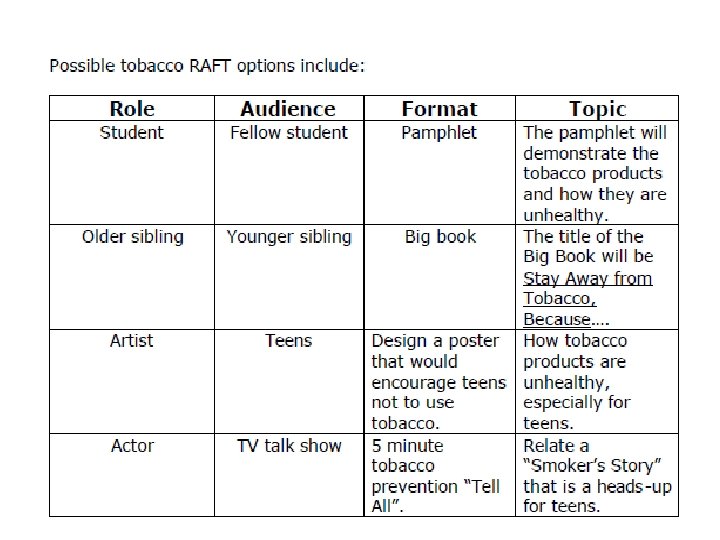
Tobacco Prevention: RAFT TARGET: I can research information about tobacco prevention that has to do with enhancing health.
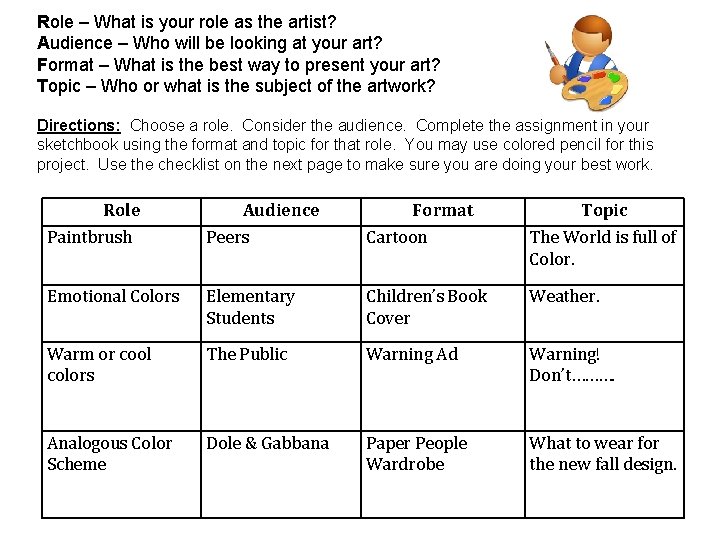
Role – What is your role as the artist? Audience – Who will be looking at your art? Format – What is the best way to present your art? Topic – Who or what is the subject of the artwork? Directions: Choose a role. Consider the audience. Complete the assignment in your sketchbook using the format and topic for that role. You may use colored pencil for this project. Use the checklist on the next page to make sure you are doing your best work. Role Audience Format Topic Paintbrush Peers Cartoon The World is full of Color. Emotional Colors Elementary Students Children’s Book Cover Weather. Warm or cool colors The Public Warning Ad Warning! Don’t………. Analogous Color Scheme Dole & Gabbana Paper People Wardrobe What to wear for the new fall design.
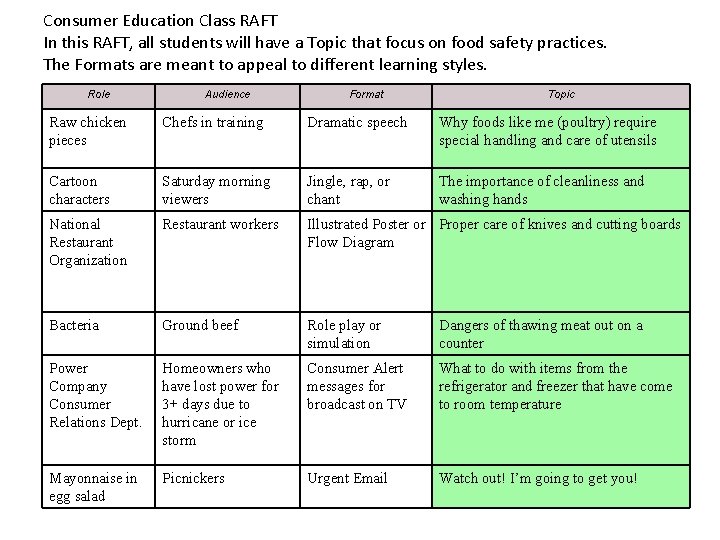
Consumer Education Class RAFT In this RAFT, all students will have a Topic that focus on food safety practices. The Formats are meant to appeal to different learning styles. Role Audience Format Topic Raw chicken pieces Chefs in training Dramatic speech Why foods like me (poultry) require special handling and care of utensils Cartoon characters Saturday morning viewers Jingle, rap, or chant The importance of cleanliness and washing hands National Restaurant Organization Restaurant workers Illustrated Poster or Proper care of knives and cutting boards Flow Diagram Bacteria Ground beef Role play or simulation Dangers of thawing meat out on a counter Power Company Consumer Relations Dept. Homeowners who have lost power for 3+ days due to hurricane or ice storm Consumer Alert messages for broadcast on TV What to do with items from the refrigerator and freezer that have come to room temperature Mayonnaise in egg salad Picnickers Urgent Email Watch out! I’m going to get you!
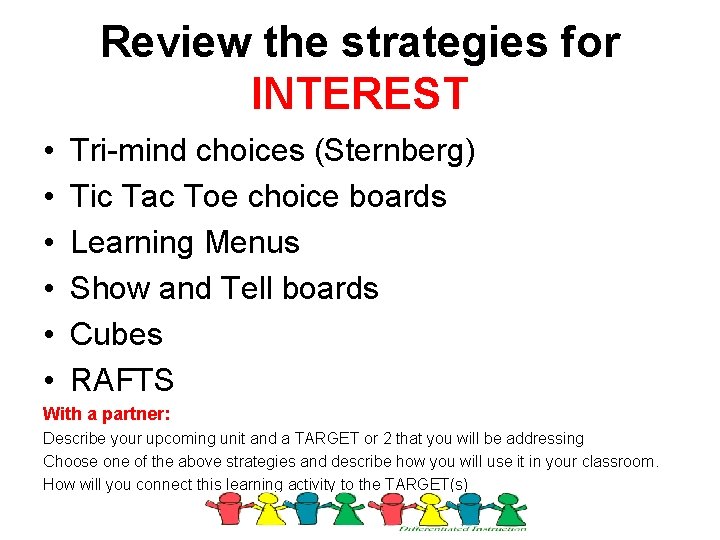
Review the strategies for INTEREST • • • Tri-mind choices (Sternberg) Tic Tac Toe choice boards Learning Menus Show and Tell boards Cubes RAFTS With a partner: Describe your upcoming unit and a TARGET or 2 that you will be addressing Choose one of the above strategies and describe how you will use it in your classroom. How will you connect this learning activity to the TARGET(s)
Tier by: • Readiness • Degree of structure • Need for support
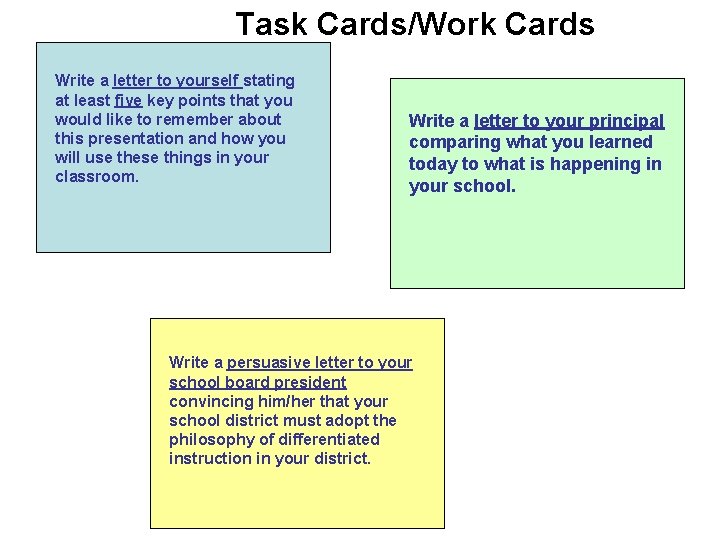
Task Cards/Work Cards Write a letter to yourself stating at least five key points that you would like to remember about this presentation and how you will use these things in your classroom. Write a letter to your principal comparing what you learned today to what is happening in your school. Write a persuasive letter to your school board president convincing him/her that your school district must adopt the philosophy of differentiated instruction in your district.
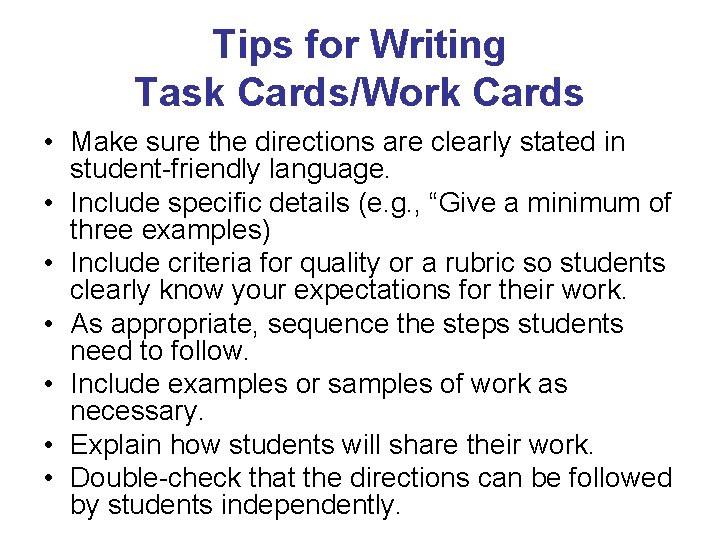
Tips for Writing Task Cards/Work Cards • Make sure the directions are clearly stated in student-friendly language. • Include specific details (e. g. , “Give a minimum of three examples) • Include criteria for quality or a rubric so students clearly know your expectations for their work. • As appropriate, sequence the steps students need to follow. • Include examples or samples of work as necessary. • Explain how students will share their work. • Double-check that the directions can be followed by students independently.
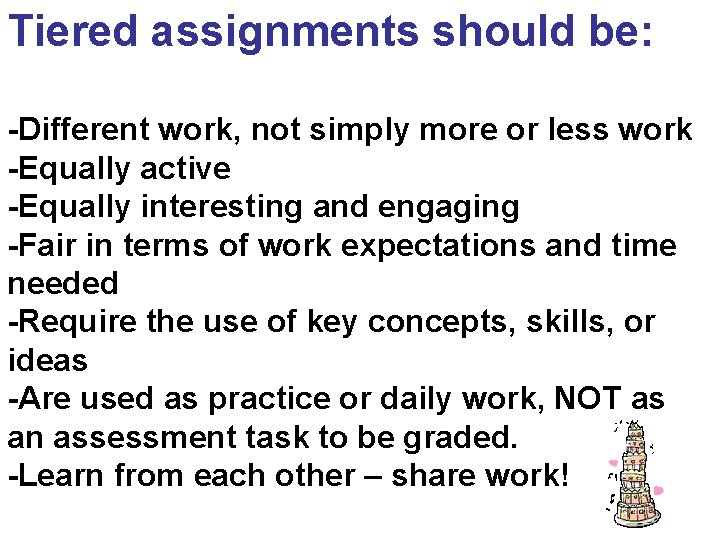
Tiered assignments should be: -Different work, not simply more or less work -Equally active -Equally interesting and engaging -Fair in terms of work expectations and time needed -Require the use of key concepts, skills, or ideas -Are used as practice or daily work, NOT as an assessment task to be graded. -Learn from each other – share work!
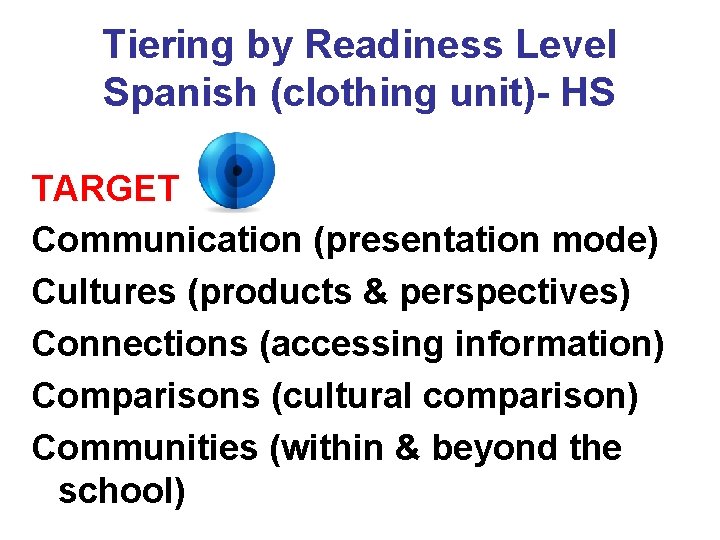
Tiering by Readiness Level Spanish (clothing unit)- HS TARGET Communication (presentation mode) Cultures (products & perspectives) Connections (accessing information) Comparisons (cultural comparison) Communities (within & beyond the school)
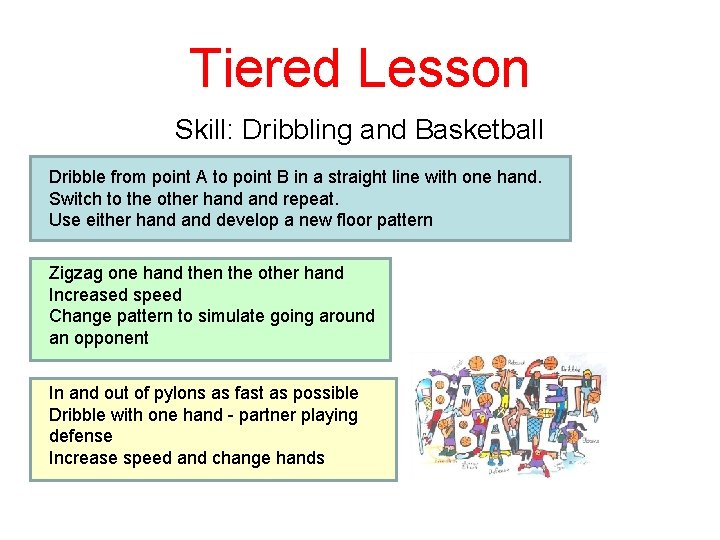
Tiered Lesson Skill: Dribbling and Basketball Dribble from point A to point B in a straight line with one hand. Switch to the other hand repeat. Use either hand develop a new floor pattern Zigzag one hand then the other hand Increased speed Change pattern to simulate going around an opponent In and out of pylons as fast as possible Dribble with one hand - partner playing defense Increase speed and change hands
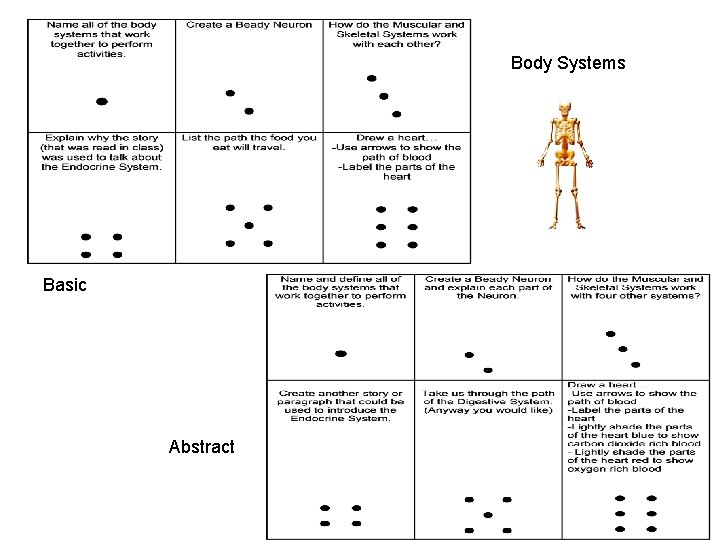
Body Systems Basic Abstract
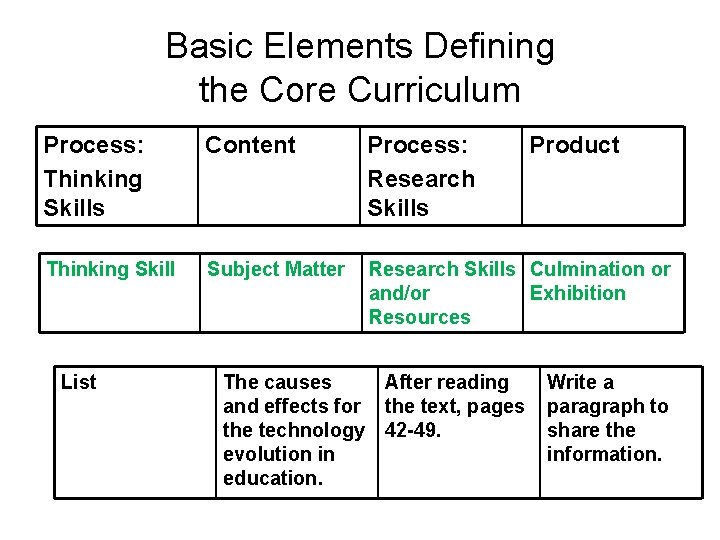
Basic Elements Defining the Core Curriculum Process: Thinking Skills Content Process: Research Skills Thinking Skill Subject Matter Research Skills Culmination or and/or Exhibition Resources List The causes After reading and effects for the text, pages the technology 42 -49. evolution in education. Product Write a paragraph to share the information.
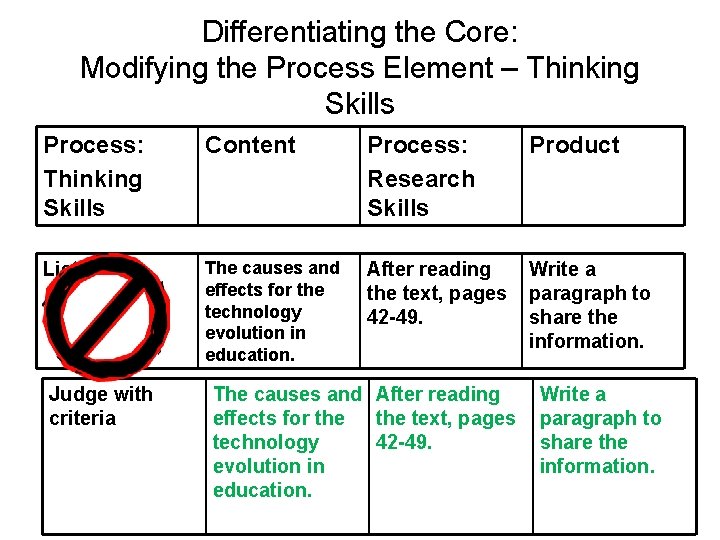
Differentiating the Core: Modifying the Process Element – Thinking Skills Process: Thinking Skills Content Process: Research Skills Product List The causes and effects for the technology evolution in education. After reading the text, pages 42 -49. Write a paragraph to share the information. Judge with criteria The causes and After reading effects for the text, pages technology 42 -49. evolution in education. Write a paragraph to share the information.
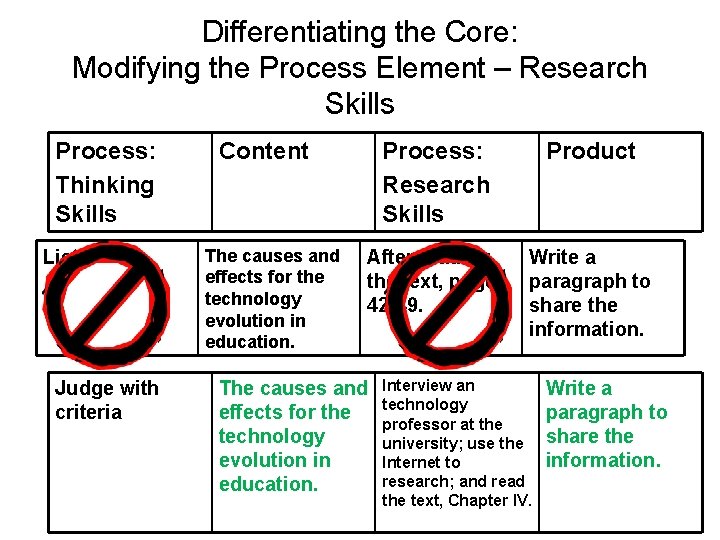
Differentiating the Core: Modifying the Process Element – Research Skills Process: Thinking Skills List Judge with criteria Content The causes and effects for the technology evolution in education. Process: Research Skills Product After reading the text, pages 42 -49. Write a paragraph to share the information. The causes and effects for the technology evolution in education. Interview an technology professor at the university; use the Internet to research; and read the text, Chapter IV. Write a paragraph to share the information.
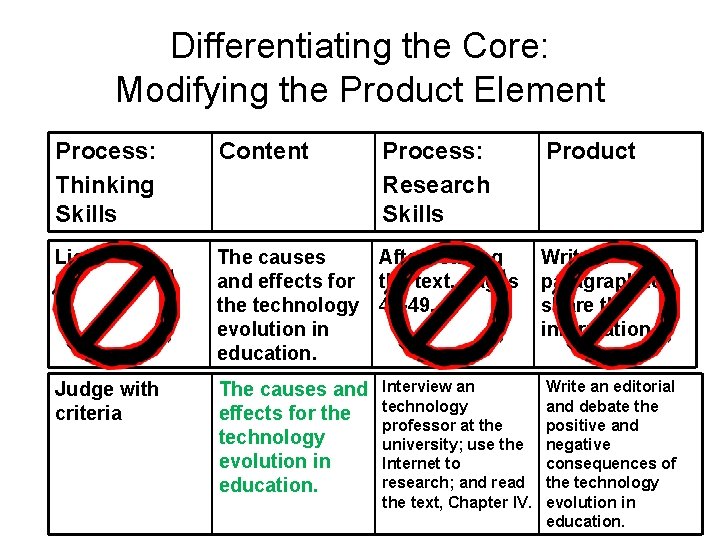
Differentiating the Core: Modifying the Product Element Process: Thinking Skills Content Process: Research Skills List The causes After reading and effects for the text, pages the technology 42 -49. evolution in education. Judge with criteria The causes and effects for the technology evolution in education. Interview an technology professor at the university; use the Internet to research; and read the text, Chapter IV. Product Write a paragraph to share the information. Write an editorial and debate the positive and negative consequences of the technology evolution in education.
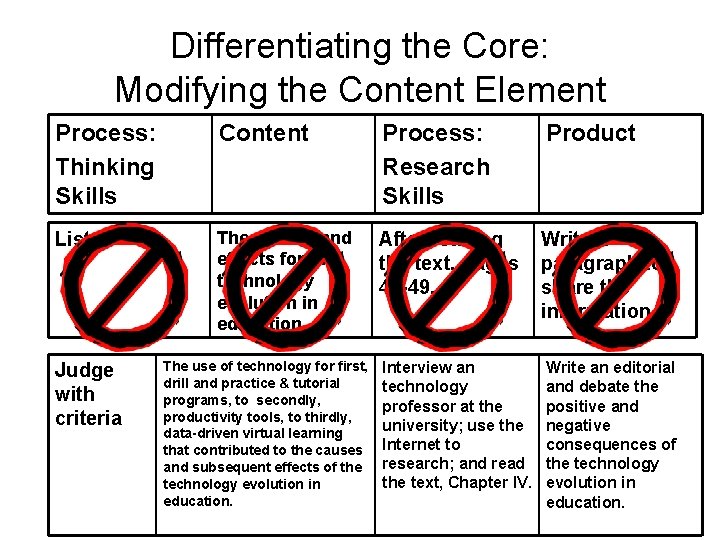
Differentiating the Core: Modifying the Content Element Process: Thinking Skills Content Process: Research Skills Product List The causes and effects for the technology evolution in education. After reading the text, pages 42 -49. Write a paragraph to share the information. Interview an technology professor at the university; use the Internet to research; and read the text, Chapter IV. Write an editorial and debate the positive and negative consequences of the technology evolution in education. Judge with criteria The use of technology for first, drill and practice & tutorial programs, to secondly, productivity tools, to thirdly, data-driven virtual learning that contributed to the causes and subsequent effects of the technology evolution in education.
Review the strategies for READINESS • Task cards • Think dots With a partner: Describe your upcoming unit and a TARGET or 2 that you will be addressing Choose one of the above strategies and describe how you will use it in your classroom. How will you connect this learning activity to the TARGET(s)
Choices involving Learning Profile The “Profiler”
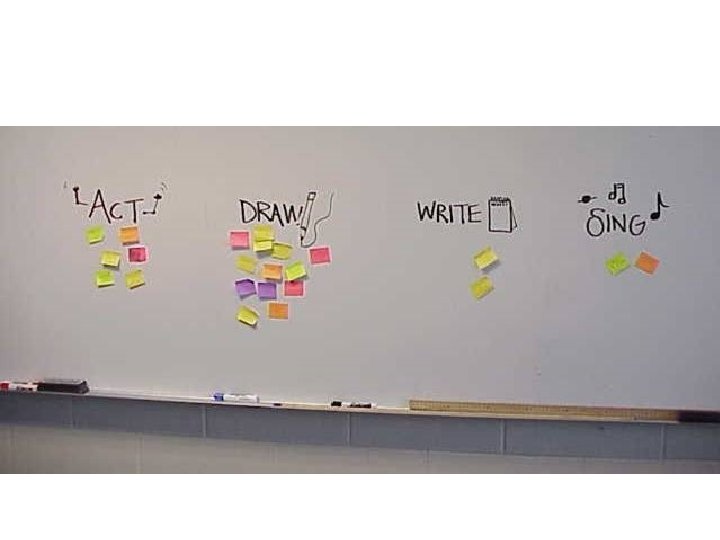
What is your preferred Learning Profile? • • • Write Draw Act Sing Build http: //www. niehs. nih. gov/kids/music. htm#index

• You have just attended a stimulating workshop on differentiated instruction and Differentiation “Profiler” you feel motivated to let the world know more about differentiated instruction. Your “world” might be a group of students, parents, fellow teachers, and/or the general public. You will join a group of workshop participants who are as motivated as you are and share your excitement about differentiate instruction to spread the news about this teaching and learning philosophy! TARGET: I can explain key elements of differentiated instruction.
Differentiation “Musician” Your mission is to write and perform a song (any style of music) about the experience of observing in a classroom which is focused on developing units and using strategies that help to differentiated instruction. You can make up a new tune or write new lyrics that fit with an existing melody. • You should have at least one verse about each of the FOUR elements that should be the focus of a differentiated classroom. • Include a chorus about the goal of differentiated instruction. • Make it personal and fun.
Differentiation “Writers” Your task is to write an article for USA Today telling the public how differentiated instruction helps teacher to meet the needs of diverse learners in their classrooms. You should minimally include the following information: • How students differ as learners. • How student learning differences affect how students learn. • Evidence you have that explains that students work harder when what they are asked to do connect to something they are interested in doing and/or connects to their learning profile. • Identify classroom techniques/strategies that support the achievement of students who have different readiness levels, different interests and/or different learning profiles.
Differentiation “Builders” • Your group has been commissioned to build a model of a differentiated classroom for a local museum featuring best practices in education. Your model must accurately reflect the FOUR elements of differentiated instruction in a classroom where these elements are being practiced. You must be able to explain your model to museum officials.
Differentiation “Actors” Your job is to create and perform an episode of a children's or teenager’s television program. This episode should be all about differentiated instruction. • Be sure to include the following information: • What is differentiated instruction. • What it is like being in a classroom where differentiated instruction is practiced. • How you (the student) will benefit from being in a classroom where differentiated instruction is practiced.
Differentiation “Artists” • Create a poster – or series of posters – that clearly illustrates the key points of what it means to differentiate instruction. Your poster(s) will be designed for those who are unable to read, so it/they must communicate clearly through pictures and graphics, and should not rely heavily on captions. Your posters should depict the three sets of FOUR elements of differentiated instruction. Poster paper, markers and other materials are available; let your instructor know what else you need.
Review the strategies for LEARNING PROFILE • The “Profiler” With a partner: Describe your upcoming unit and a TARGET or 2 that you will be addressing Describe how you will use this strategy in your classroom. How will you connect this learning activity to the TARGET(s)
- Slides: 58