
Art and Assets Audio Visual Design and Production
- Slides: 43
Art and Assets Audio Visual Design and Production Francisco Arcediano Robbin Bibb Vince Cross Wanda Eugene February 27 th & 29 th Introduction to Game Design
Presentation Overview • • Visual Design Surface Effects Animation Audio Design and Production February 27 th & 29 th Introduction to Game Design
Art and Assets Part II Thursday March 1 st February 27 th & 29 th Introduction to Game Design
Animation Francisco Arcediano February 27 th & 29 th Introduction to Game Design
• Focus on the process of creating animated 3 D art for real-time games. • Animation in video games is the art of capturing a series of individual movements in digital form and then playing them back in real time. – Just about everything in a game can be animated: from the user interface, to atmospheric effects, to characters, to even the camera. – Animations establishes the character and personality of the game. February 27 th & 29 th Introduction to Game Design
Responsibilities and Expectations of the Animator • Focus on character animator • To understand the meaning behind an expression and how to get the body posed and moving to accurately or stylistically convey the action for playback in real time. • To be knowledgeable in anatomy, since creating believable motion requires an understanding of the underlying mechanism, like rotating joints and bulging muscles. February 27 th & 29 th Introduction to Game Design
• Difference between a trained animator and an experienced technical artist. • To combine both the artistic and technical disciplines is a challenge, but 3 D applications help to make the process of learning animation tools visually more interactive and more intuitive. • The tools for animating characters are common to all popular packages, and although their workflow, names, and visual appearance may be slightly different, the concepts are generally the same. February 27 th & 29 th Introduction to Game Design
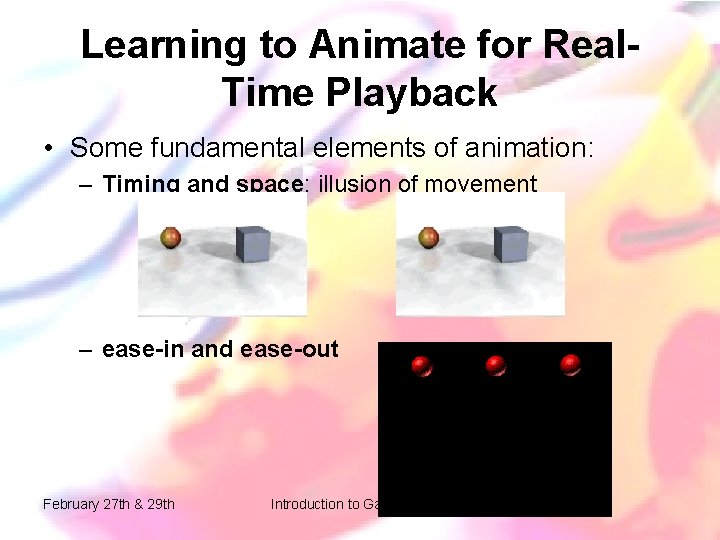
Learning to Animate for Real. Time Playback • Some fundamental elements of animation: – Timing and space: illusion of movement – ease-in and ease-out February 27 th & 29 th Introduction to Game Design
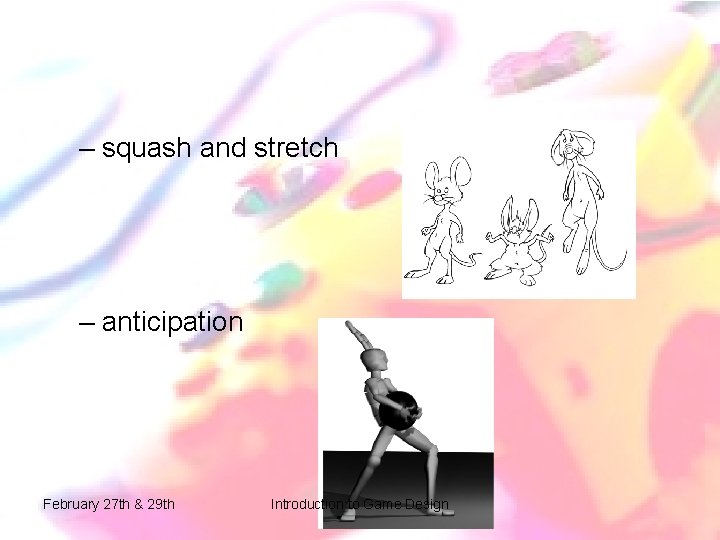
– squash and stretch – anticipation February 27 th & 29 th Introduction to Game Design
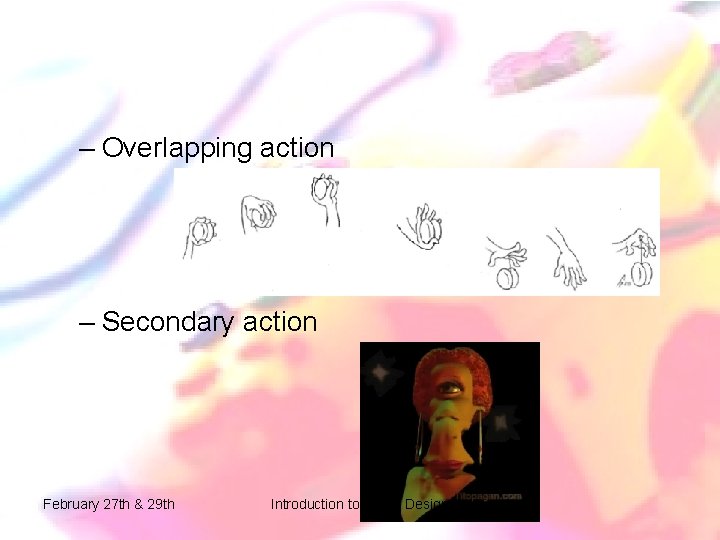
– Overlapping action – Secondary action February 27 th & 29 th Introduction to Game Design
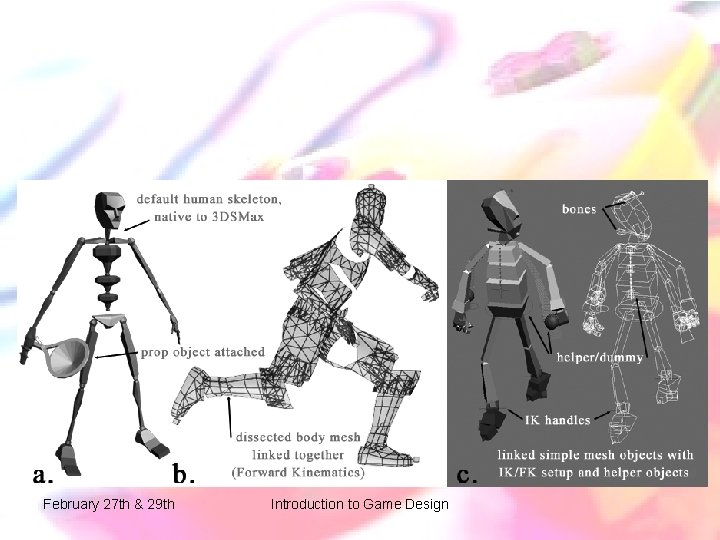
Production Workflow of Character Animation Most games requires the same basic steps. • Planning Your Work – Think about the look, feel, and timing of the animation. • Modeling and Texture Mapping – Creating the Skeleton Use of a skeletal structure that can simulate the way living things are able to move in the real world. A skeleton or rig comprised of bones gives the animator a means to deform geometry in a more intuitive and predictable way. February 27 th & 29 th Introduction to Game Design
– Vertex Weighting-Binding the Mesh to the Skeleton The character mesh needs to be attached to the skeleton using a method for binding it to all of the assigned bones. That enables the animator to deform the mesh into various poses. Rigging is the process of attaching or binding a mesh object to other control objects (such as a skeleton) On a vertex level, one or more animated bones will control that amount of movement of each vertex point relative to each other. This process of assigning and adjusting the amount of influence each bone has for every vertex is called vertex weighting. February 27 th & 29 th Introduction to Game Design
February 27 th & 29 th Introduction to Game Design
Examples of Character Animation • Animation: skeleton + mesh, texture • Connecting and Animating Bones • Animating a Run Cycle February 27 th & 29 th Introduction to Game Design
Facial Animation • The use of facial animation for expressing emotions and speech with audio dialogue is quickly becoming a vital component to passive (? ) story telling cut-scenes of newly released game titles. February 27 th & 29 th Introduction to Game Design
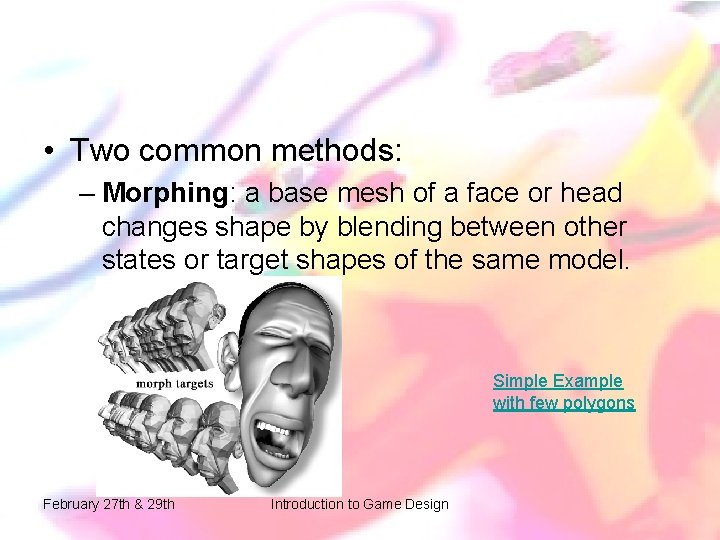
• Two common methods: – Morphing: a base mesh of a face or head changes shape by blending between other states or target shapes of the same model. Simple Example with few polygons February 27 th & 29 th Introduction to Game Design
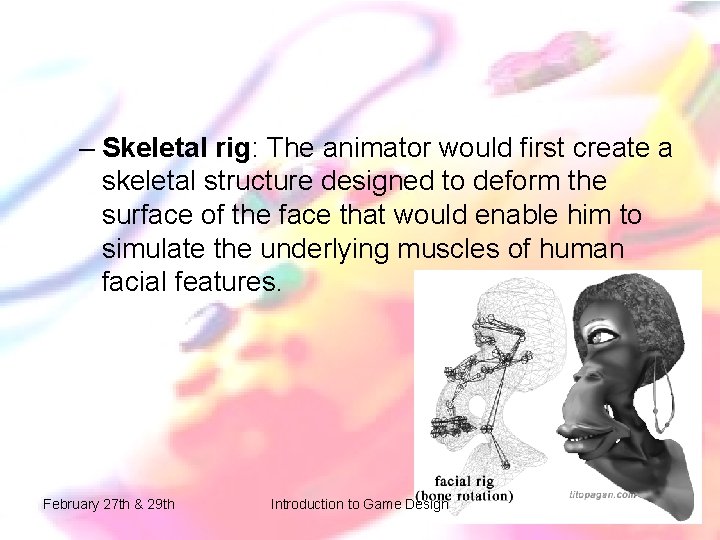
– Skeletal rig: The animator would first create a skeletal structure designed to deform the surface of the face that would enable him to simulate the underlying muscles of human facial features. February 27 th & 29 th Introduction to Game Design
Motion Capture • To provide character motion for a game. • mocap: movement that is performed by a live actor and captured by a computerized system that records the performer's every action in real time. • There are many things to consider when preparing for a motion capture shoot. – However, any advice is easily outdated as technology progresses and becomes more professional. February 27 th & 29 th Introduction to Game Design
• Appropriate Use and Availability – E. g. , sports-oriented games, dance performance, etc. – However, certain game genres may not prefer such realistic motion and require a hand animation approach to enhance their product's style. • For example, a cartoonlike game filled with fun, goofy, or playful characters. February 27 th & 29 th Introduction to Game Design
• Example: Measurand • Example: Hand animation • Example: Tony Hawks Project February 27 th & 29 th Introduction to Game Design
Simulation Animation • Another way to create realistic animation by a 3 D animator is to set up simulations that perform real-world effects, and then record the resulting animation of affected objects. • These systems can create the effect of wind that blows particles around for creating smoke, fire; or waterfalls. February 27 th & 29 th Introduction to Game Design
Audio Design and Production Wanda Eugene February 27 th & 29 th Introduction to Game Design
Name that Game Name That Game February 27 th & 29 th Introduction to Game Design
Overview • Game audio has evolved – Started out as simple bleeps & bloops – Improvements in technology have placed game audio on par with film soundtracks February 27 th & 29 th Introduction to Game Design
Audio Team • In the old days, all audio was done by one person • Today’s teams consist of dedicated professionals for sound design, music & dialog elements • Because of the game –dependent technology, the audio team must be involved with the project from the very beginning February 27 th & 29 th Introduction to Game Design
Audio Design Fundamentals • Audio makes 1/3 rd of the entire game experience – Often the shadow of visual and design • Two key points – Creativity • Bravely bring your audience to unexplored shores in terms of sound, music, and dialogue • Avoid video game sounding music • Beware. . everyone is a critic! – Integration • Make sure sound is properly triggered at the right time, volume, pitch, and pan February 27 th & 29 th Introduction to Game Design
Audio Design Fundamentals • Secrets to Success – The creative element – Technical Aspects – Business/Networking February 27 th & 29 th Introduction to Game Design
Audio Implementation • Creating great sound & music is only half of the work • Current generation of audio Design tools puts the power of implementation into the hands of the audio designer (where it belongs!) February 27 th & 29 th Introduction to Game Design
Transformation of Game Audio • Shift to data driven games – Assets not part of the code – Power and support back to the audio engineers • Audio/Sound Driver • Maintaining quality with limited memory storage and bandwidth February 27 th & 29 th Introduction to Game Design
Sound Design • Sound design – Most interactive element of the audio design – In-game sound effects are put into the driver as mono files – Challenges • Make the game sound dynamic without being repetitive • Sound libraries – Essential tools for building soundscapes February 27 th & 29 th Introduction to Game Design
Ambience • Create a mood more realistic and enjoyable atmosphere • Stereo ambience bed • Mirroring the image in the back speakers February 27 th & 29 th Introduction to Game Design
Music • Music provides emotional context for the game experience • Thousands of different ways to create music for games • Music can be linear or non-linear (i. e. interactive) – Both styles have advantages & disadvantages February 27 th & 29 th Introduction to Game Design
Interactive & Streaming Music • Interactive • Streaming – Changes based on what the player is doing – Music adjusted on the “fly” to match players actions – Created using MIDI branching or transitioning music to another piece of music February 27 th & 29 th – Music stored on a discbased media or hard drive – Read in a bit at a time – Most widely used method of providing music Introduction to Game Design
Creating Music • Provide a few different 30 -second demos versions of the music to see which one the designers/producers like best • Listen & reference to movie soundtracks – Remember that video game music is foreground instead of background music February 27 th & 29 th Introduction to Game Design
Lets Make beautiful Music together! Rhythm Wheel February 27 th & 29 th Introduction to Game Design
Adaptive Audio System • Handles the problem of repetition • Creates musical content that never plays back the same way twice • Informs players about their health, impending danger, or the distance between the character and their goal • Third party audio tools- i. e. Creative ISACT February 27 th & 29 th Introduction to Game Design
Voice Over Production • Becoming more common in game production • Budget for professional talent or the finished product may suffer February 27 th & 29 th Introduction to Game Design
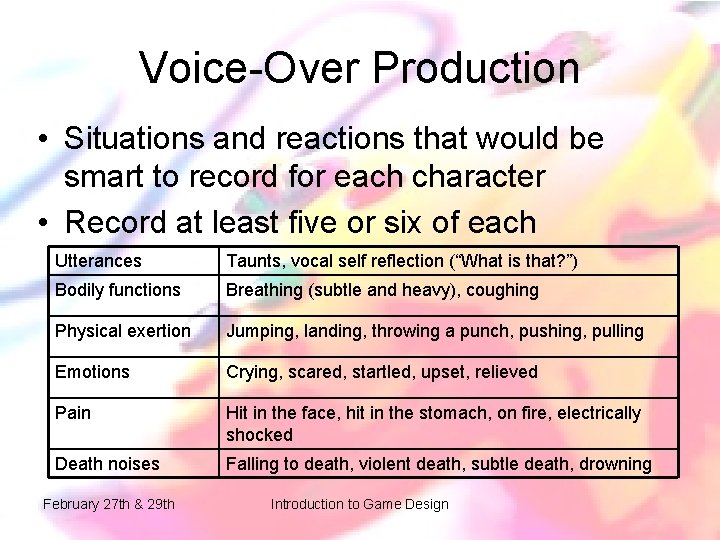
Voice-Over Production • Situations and reactions that would be smart to record for each character • Record at least five or six of each Utterances Taunts, vocal self reflection (“What is that? ”) Bodily functions Breathing (subtle and heavy), coughing Physical exertion Jumping, landing, throwing a punch, pushing, pulling Emotions Crying, scared, startled, upset, relieved Pain Hit in the face, hit in the stomach, on fire, electrically shocked Death noises Falling to death, violent death, subtle death, drowning February 27 th & 29 th Introduction to Game Design
Spatialized Audio • Includes 3 D audio & surround sound technologies • Adds a sense of space & realism to the soundscape February 27 th & 29 th Introduction to Game Design
Studio Savvy • An understanding of audio theory & recording techniques is necessary to create great game audio • Having the best gear available allows for the best output February 27 th & 29 th Introduction to Game Design
The Business • Creating audio for games is a business • Networking & location are keys to success February 27 th & 29 th Introduction to Game Design
Questions? February 27 th & 29 th Introduction to Game Design
References • http: //wwwtc. pbs. org/kcts/videogamerevolution/arcad e/name_that_game. swf? mii=1 • http: //www. creative. com/ • http: //www. ccd. rpi. edu/Eglash/csdt/latino/r hythm/SOFTWARE. htm February 27 th & 29 th Introduction to Game Design