
ART Adaptive Resonance Theory Arash Ashari Ali Mohammadi
- Slides: 51
ART (Adaptive Resonance Theory) Arash Ashari Ali Mohammadi Masood Feyzbakhsh Adaptive Resonance Theory NN
Contents • • Unsupervised ANNs Kohonen Self-Organising Map (SOM) Adaptive Resonance Theory (ART) ART 1 – Architeture – Learning algorithm – Example • ART 2 – Architeture – Learning algorithm – Example • ART Applications Adaptive Resonance Theory NN 2
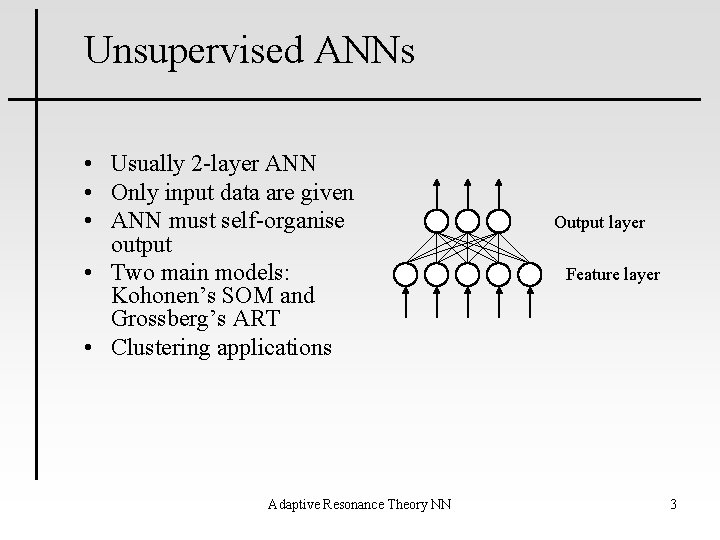
Unsupervised ANNs • Usually 2 -layer ANN • Only input data are given • ANN must self-organise output • Two main models: Kohonen’s SOM and Grossberg’s ART • Clustering applications Adaptive Resonance Theory NN Output layer Feature layer 3
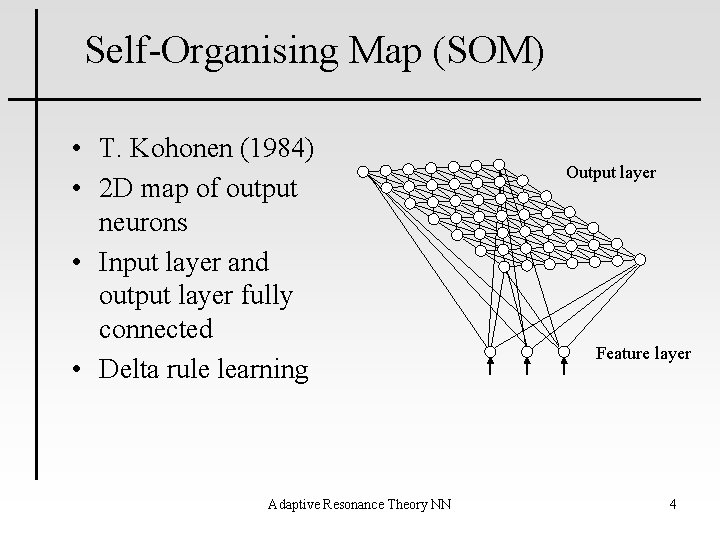
Self-Organising Map (SOM) • T. Kohonen (1984) • 2 D map of output neurons • Input layer and output layer fully connected • Delta rule learning Adaptive Resonance Theory NN Output layer Feature layer 4
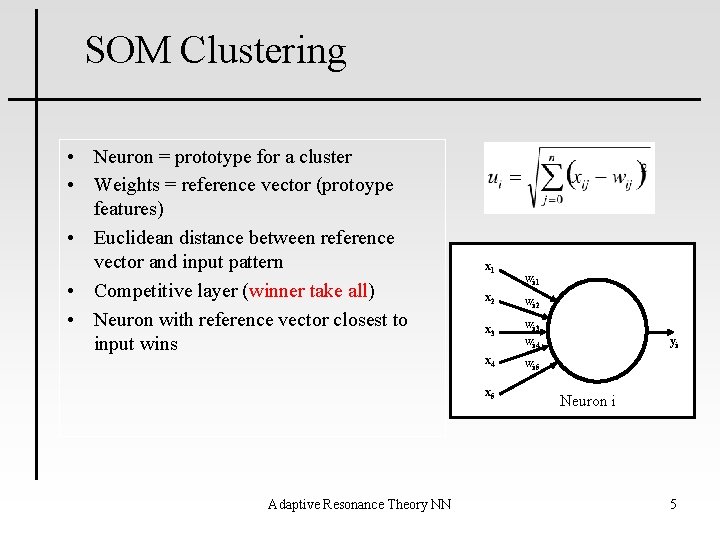
SOM Clustering • Neuron = prototype for a cluster • Weights = reference vector (protoype features) • Euclidean distance between reference vector and input pattern • Competitive layer (winner take all) • Neuron with reference vector closest to input wins x 1 x 2 wi 2 x 3 wi 4 x 4 wi 5 x 5 Adaptive Resonance Theory NN wi 1 yi Neuron i 5
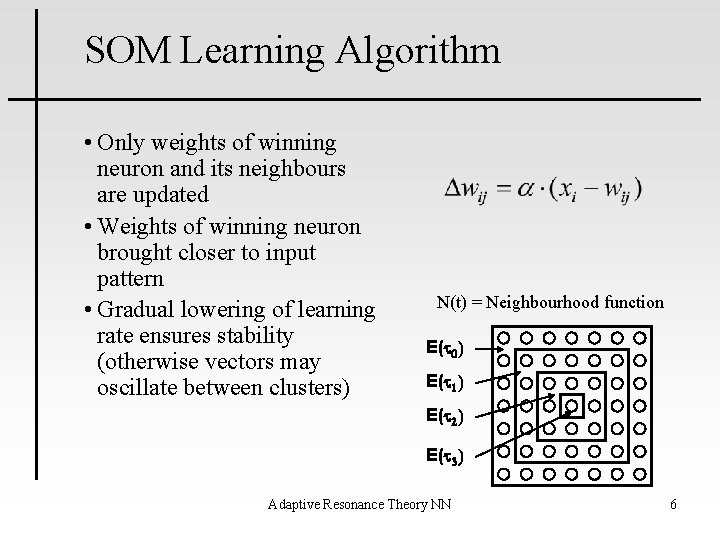
SOM Learning Algorithm • Only weights of winning neuron and its neighbours are updated • Weights of winning neuron brought closer to input pattern • Gradual lowering of learning rate ensures stability (otherwise vectors may oscillate between clusters) N(t) = Neighbourhood function E(t 0) E(t 1) E(t 2) E(t 3) Adaptive Resonance Theory NN 6
Some Issues about SOM • • • SOM can be used on-line (adaptation) Neurons need to be labelled Sometimes may not converge Results sensitive to choice of input features Results sensitive to order of presentation of data – Epoch learning Adaptive Resonance Theory NN 7
SOM Applications • Natural language processing – Document clustering – Document retrieval – Automatic query • Image segmentation • Data mining • Fuzzy partitioning • Condition-action association Adaptive Resonance Theory NN 8
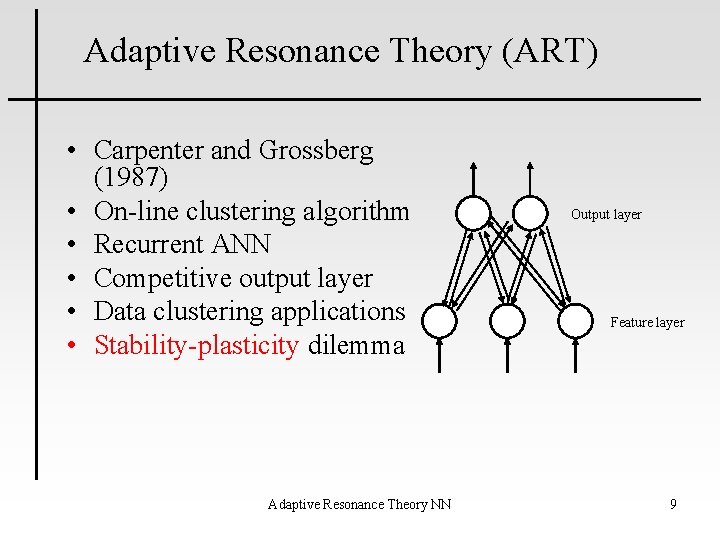
Adaptive Resonance Theory (ART) • Carpenter and Grossberg (1987) • On-line clustering algorithm • Recurrent ANN • Competitive output layer • Data clustering applications • Stability-plasticity dilemma Adaptive Resonance Theory NN Output layer Feature layer 9
Stability-Plasticity Dilemma • Stability: system behaviour doesn’t change after irrelevant events • Plasticity: System adapts its behaviour according to significant events • Dilemma: how to achieve stability without rigidity and plasticity without chaos? – Ongoing learning capability – Preservation of learned knowledge Adaptive Resonance Theory NN 10
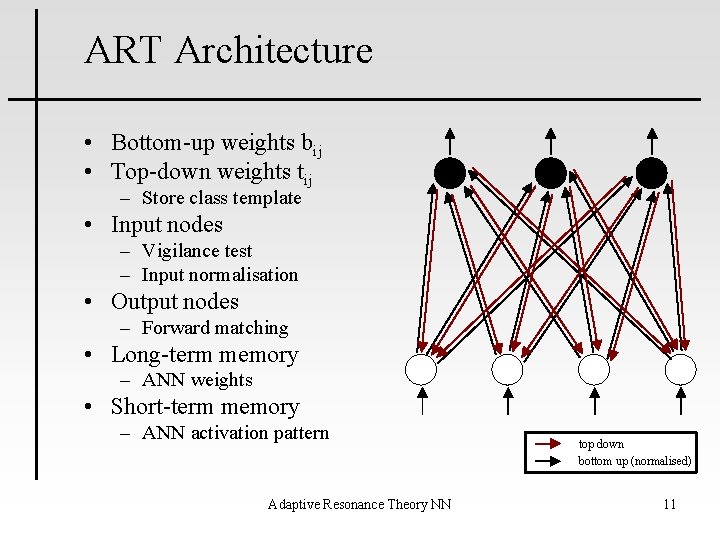
ART Architecture • Bottom-up weights bij • Top-down weights tij – Store class template • Input nodes – Vigilance test – Input normalisation • Output nodes – Forward matching • Long-term memory – ANN weights • Short-term memory – ANN activation pattern Adaptive Resonance Theory NN top down bottom up (normalised) 11
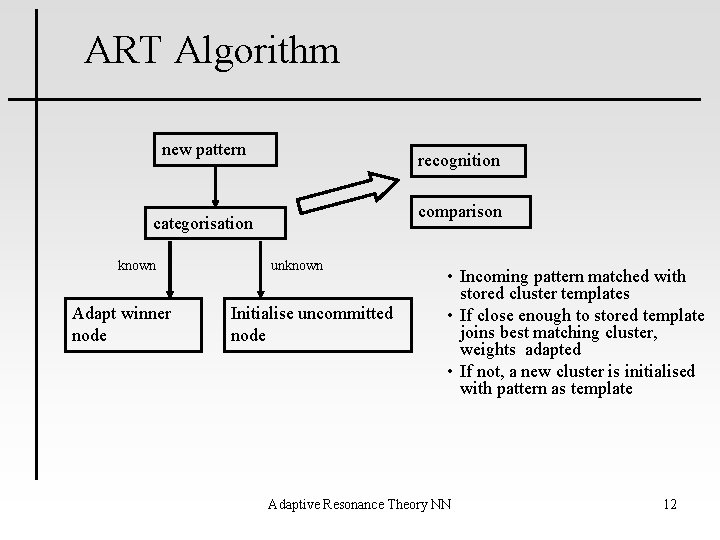
ART Algorithm new pattern recognition comparison categorisation known Adapt winner node unknown Initialise uncommitted node • Incoming pattern matched with stored cluster templates • If close enough to stored template joins best matching cluster, weights adapted • If not, a new cluster is initialised with pattern as template Adaptive Resonance Theory NN 12
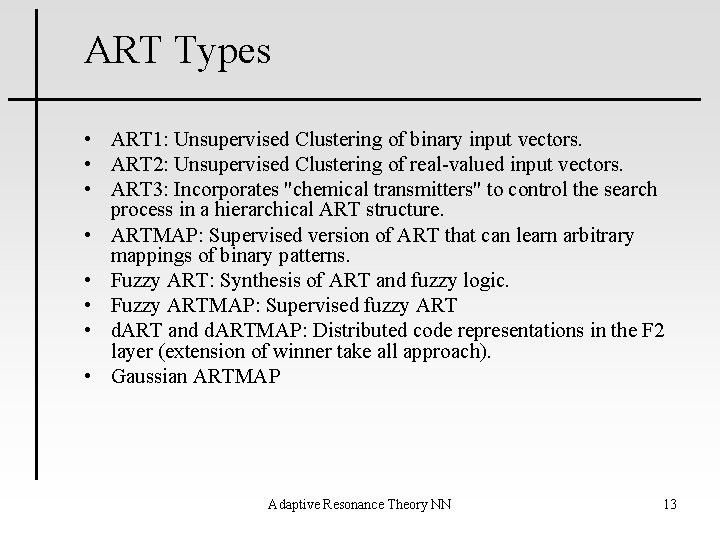
ART Types • ART 1: Unsupervised Clustering of binary input vectors. • ART 2: Unsupervised Clustering of real-valued input vectors. • ART 3: Incorporates "chemical transmitters" to control the search process in a hierarchical ART structure. • ARTMAP: Supervised version of ART that can learn arbitrary mappings of binary patterns. • Fuzzy ART: Synthesis of ART and fuzzy logic. • Fuzzy ARTMAP: Supervised fuzzy ART • d. ART and d. ARTMAP: Distributed code representations in the F 2 layer (extension of winner take all approach). • Gaussian ARTMAP Adaptive Resonance Theory NN 13
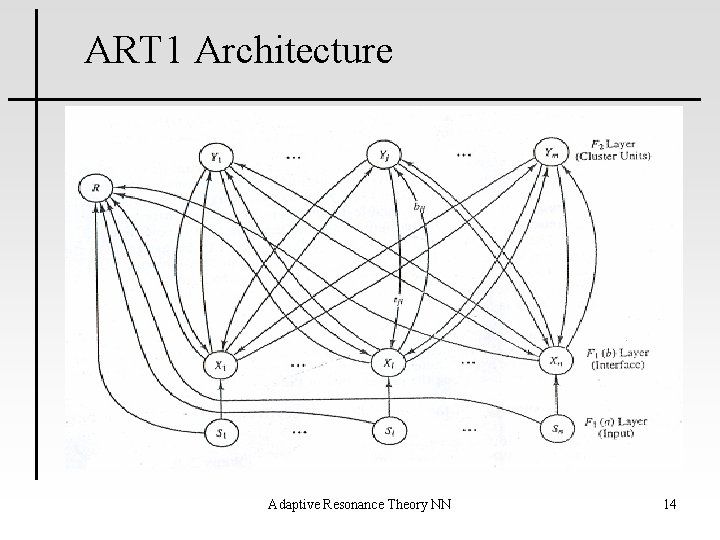
ART 1 Architecture Adaptive Resonance Theory NN 14
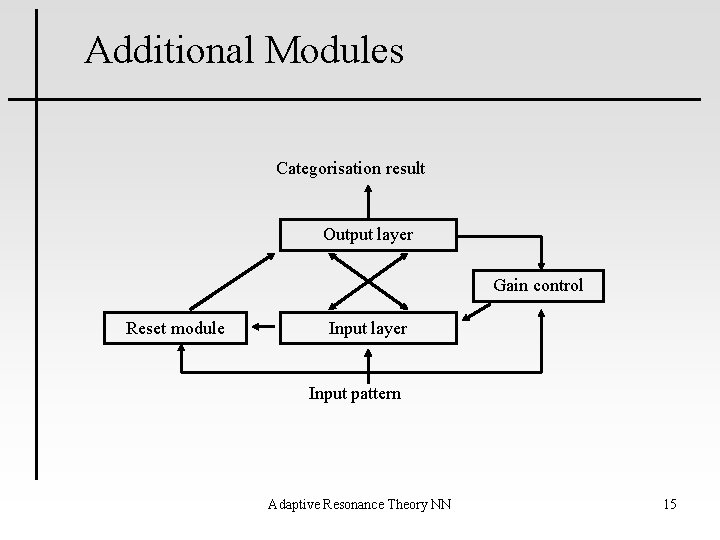
Additional Modules Categorisation result Output layer Gain control Reset module Input layer Input pattern Adaptive Resonance Theory NN 15
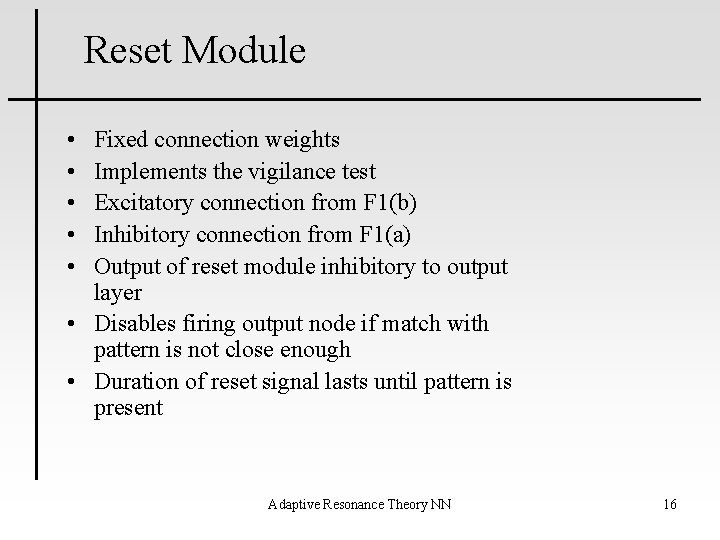
Reset Module • • • Fixed connection weights Implements the vigilance test Excitatory connection from F 1(b) Inhibitory connection from F 1(a) Output of reset module inhibitory to output layer • Disables firing output node if match with pattern is not close enough • Duration of reset signal lasts until pattern is present Adaptive Resonance Theory NN 16
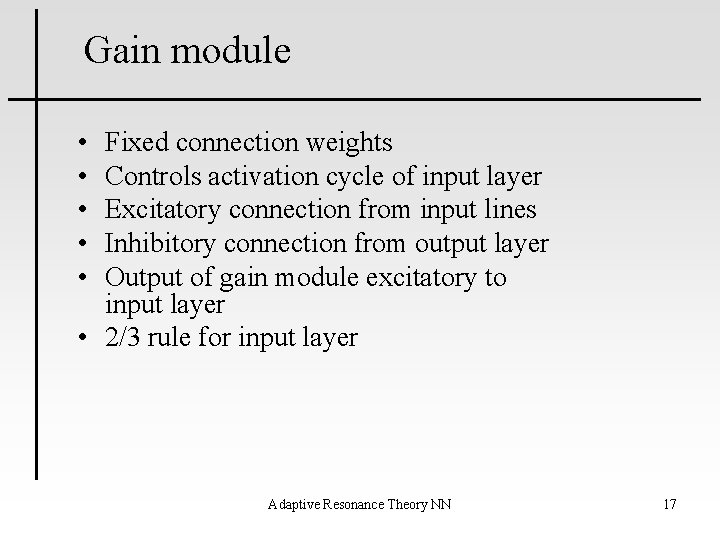
Gain module • • • Fixed connection weights Controls activation cycle of input layer Excitatory connection from input lines Inhibitory connection from output layer Output of gain module excitatory to input layer • 2/3 rule for input layer Adaptive Resonance Theory NN 17
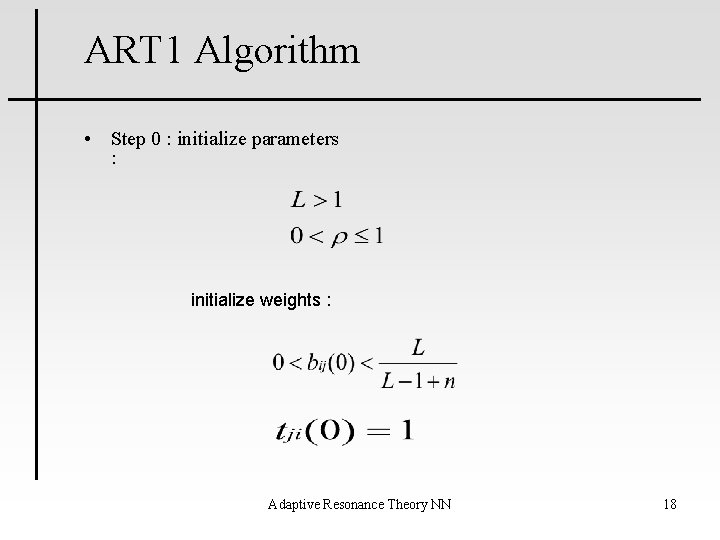
ART 1 Algorithm • Step 0 : initialize parameters : initialize weights : Adaptive Resonance Theory NN 18
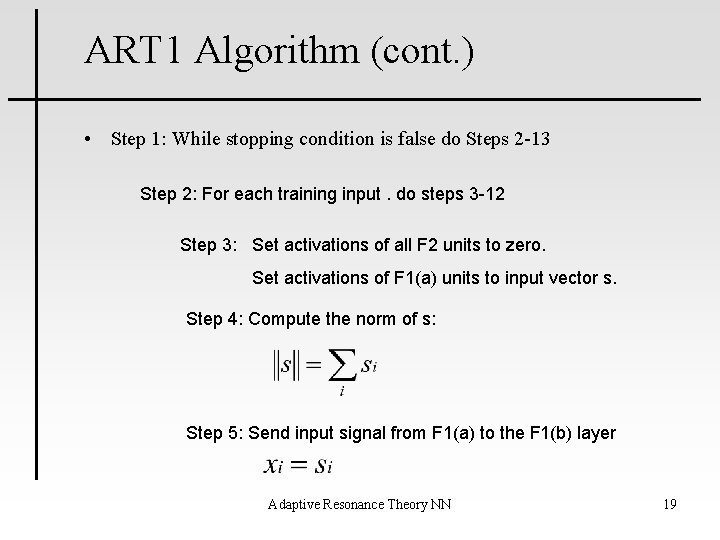
ART 1 Algorithm (cont. ) • Step 1: While stopping condition is false do Steps 2 -13 Step 2: For each training input. do steps 3 -12 Step 3: Set activations of all F 2 units to zero. Set activations of F 1(a) units to input vector s. Step 4: Compute the norm of s: Step 5: Send input signal from F 1(a) to the F 1(b) layer Adaptive Resonance Theory NN 19
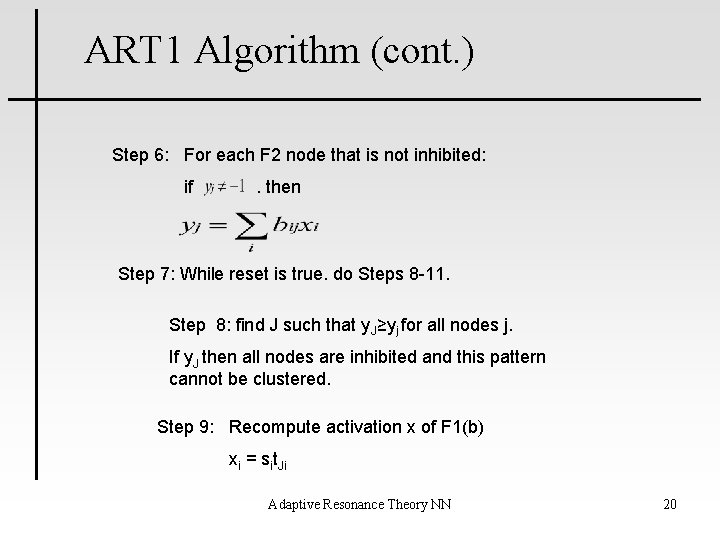
ART 1 Algorithm (cont. ) Step 6: For each F 2 node that is not inhibited: if . then Step 7: While reset is true. do Steps 8 -11. Step 8: find J such that y. J≥yj for all nodes j. If y. J then all nodes are inhibited and this pattern cannot be clustered. Step 9: Recompute activation x of F 1(b) xi = sit. Ji Adaptive Resonance Theory NN 20
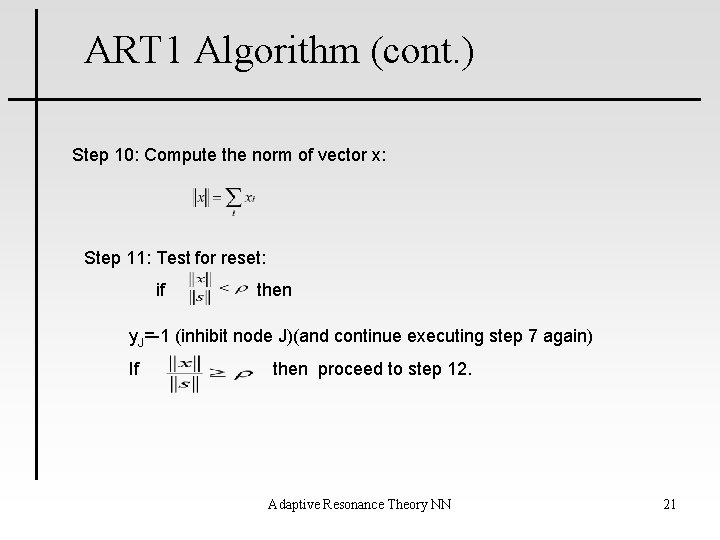
ART 1 Algorithm (cont. ) Step 10: Compute the norm of vector x: Step 11: Test for reset: if then y. J=-1 (inhibit node J)(and continue executing step 7 again) If then proceed to step 12. Adaptive Resonance Theory NN 21
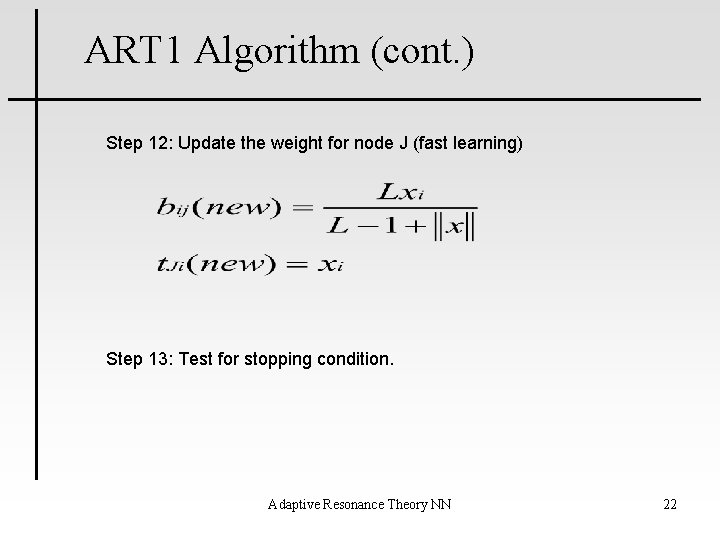
ART 1 Algorithm (cont. ) Step 12: Update the weight for node J (fast learning) Step 13: Test for stopping condition. Adaptive Resonance Theory NN 22
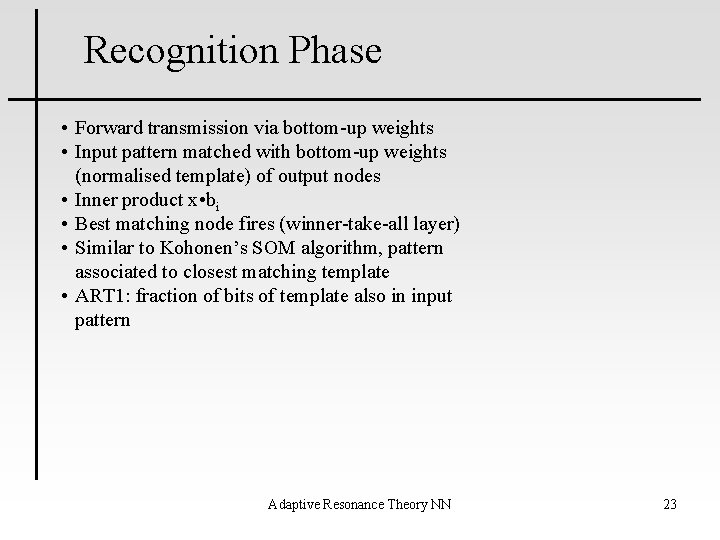
Recognition Phase • Forward transmission via bottom-up weights • Input pattern matched with bottom-up weights (normalised template) of output nodes • Inner product x • bi • Best matching node fires (winner-take-all layer) • Similar to Kohonen’s SOM algorithm, pattern associated to closest matching template • ART 1: fraction of bits of template also in input pattern Adaptive Resonance Theory NN 23
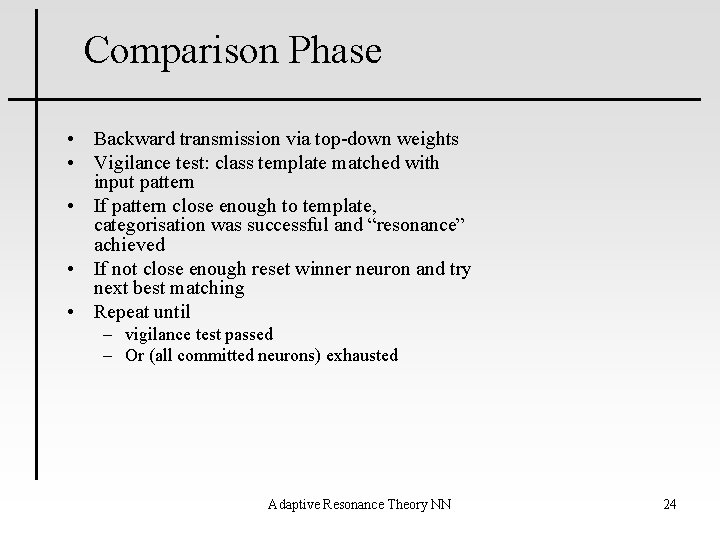
Comparison Phase • Backward transmission via top-down weights • Vigilance test: class template matched with input pattern • If pattern close enough to template, categorisation was successful and “resonance” achieved • If not close enough reset winner neuron and try next best matching • Repeat until – vigilance test passed – Or (all committed neurons) exhausted Adaptive Resonance Theory NN 24
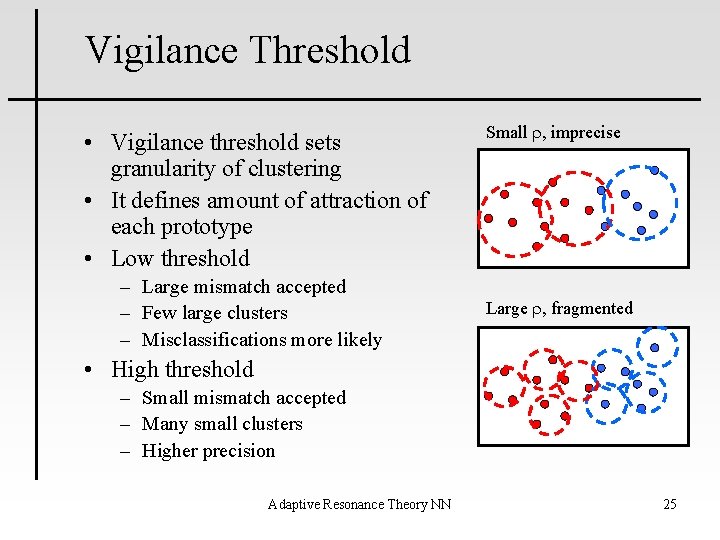
Vigilance Threshold • Vigilance threshold sets granularity of clustering • It defines amount of attraction of each prototype • Low threshold – Large mismatch accepted – Few large clusters – Misclassifications more likely Small r, imprecise Large r, fragmented • High threshold – Small mismatch accepted – Many small clusters – Higher precision Adaptive Resonance Theory NN 25
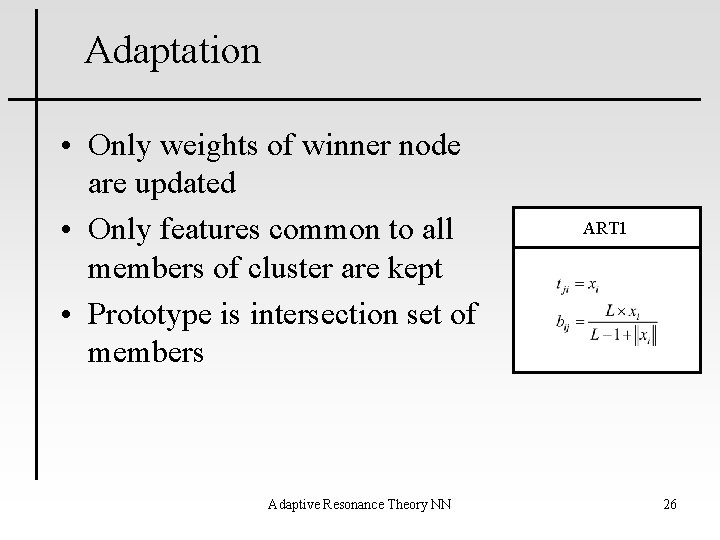
Adaptation • Only weights of winner node are updated • Only features common to all members of cluster are kept • Prototype is intersection set of members Adaptive Resonance Theory NN ART 1 26
Issues about ART 1 • • • Learned knowledge can be retrieved Fast learning algorithm Difficult to tune vigilance threshold New noisy patterns tend to “erode” templates ART 1 is sensitive to order of presentation of data • Accuracy sometimes not optimal • Only winner neuron is updated, more “point-topoint” mapping than SOM Adaptive Resonance Theory NN 27
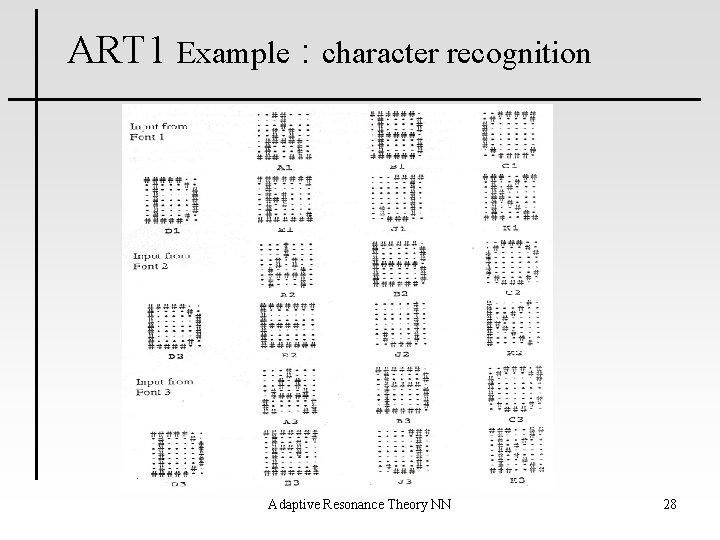
ART 1 Example : character recognition Adaptive Resonance Theory NN 28
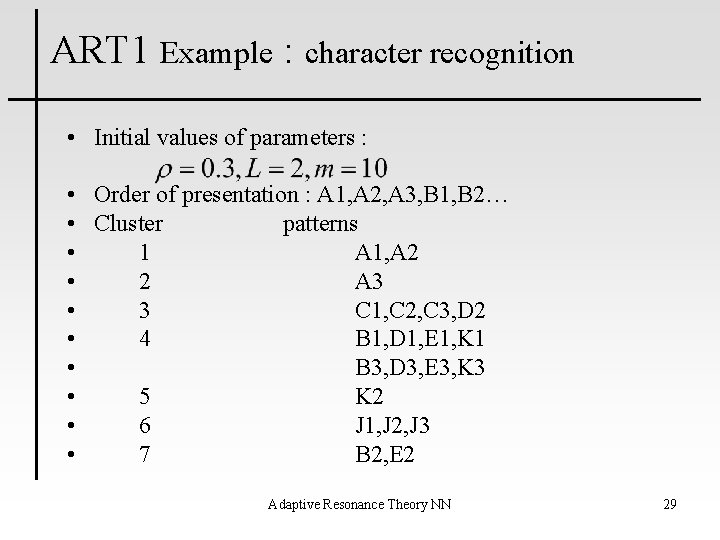
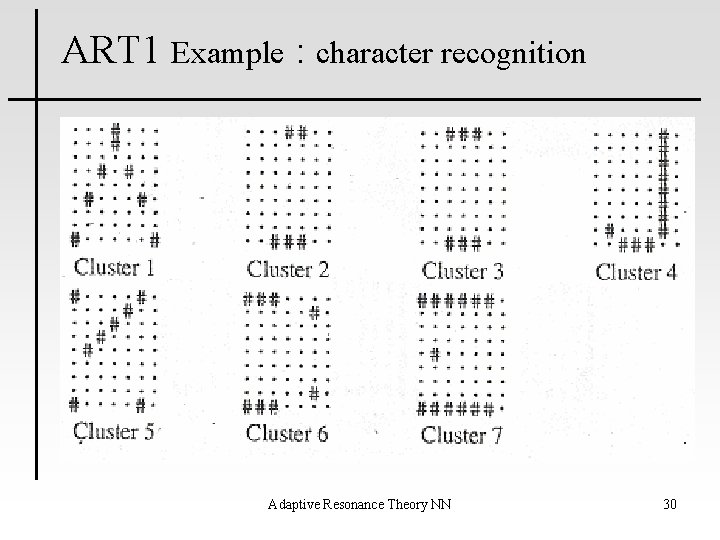
ART 1 Example : character recognition • Initial values of parameters : • Order of presentation : A 1, A 2, A 3, B 1, B 2… • Cluster patterns • 1 A 1, A 2 • 2 A 3 • 3 C 1, C 2, C 3, D 2 • 4 B 1, D 1, E 1, K 1 • B 3, D 3, E 3, K 3 • 5 K 2 • 6 J 1, J 2, J 3 • 7 B 2, E 2 Adaptive Resonance Theory NN 29
ART 1 Example : character recognition Adaptive Resonance Theory NN 30
ART 2 Unsupervised Clustering for : – Real-valued input vectors – Binary input vectors that are noisy – Includes a combination of normalization and noise suppression Adaptive Resonance Theory NN 31
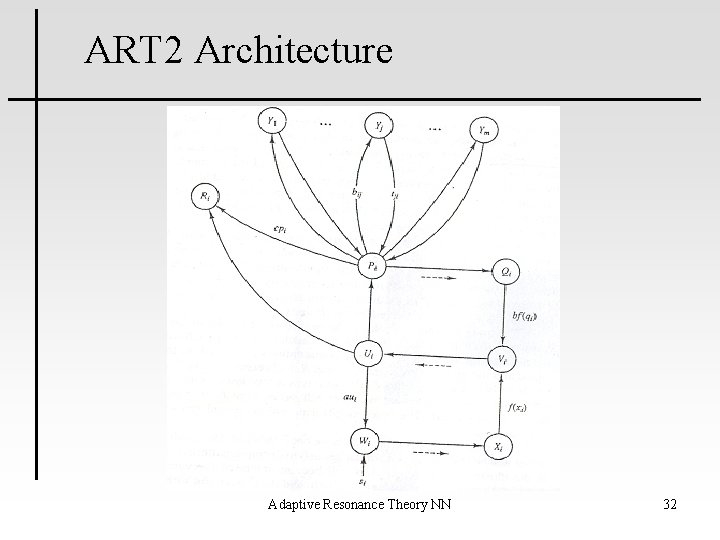
ART 2 Architecture Adaptive Resonance Theory NN 32
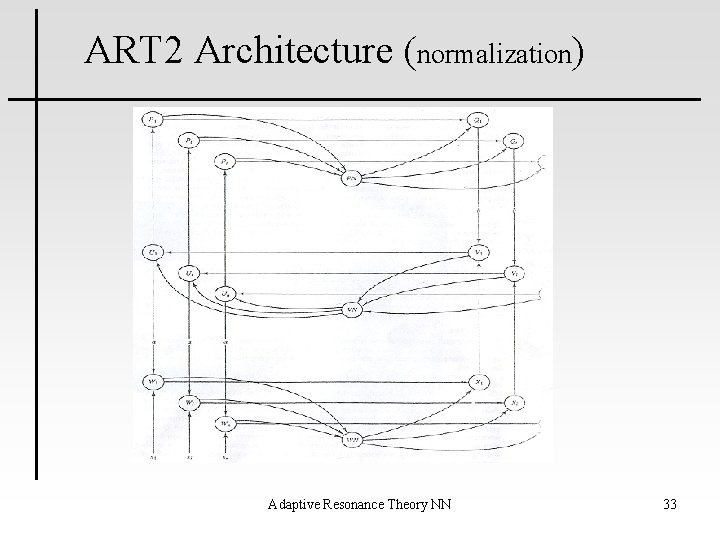
ART 2 Architecture (normalization) Adaptive Resonance Theory NN 33
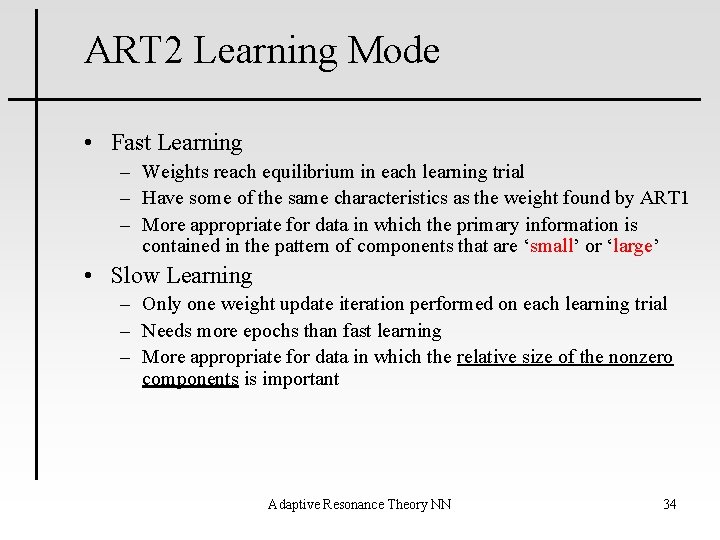
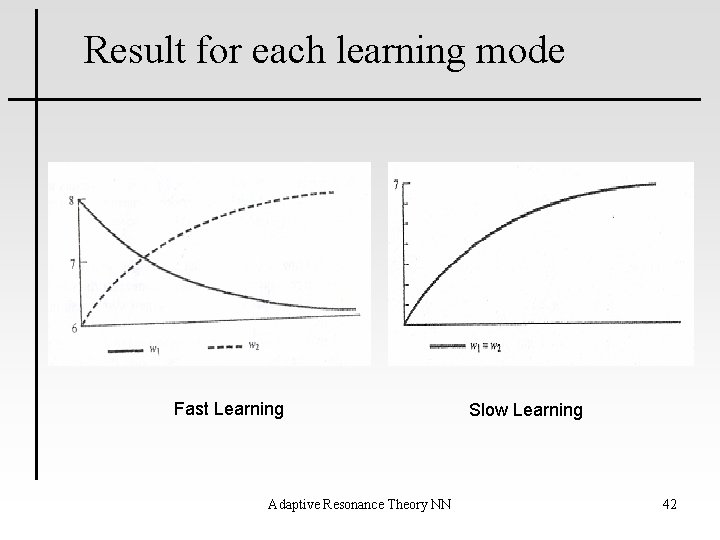
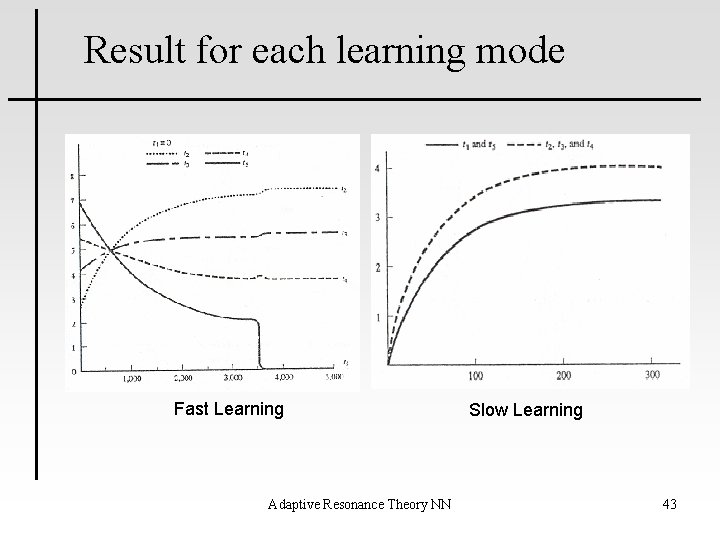
ART 2 Learning Mode • Fast Learning – Weights reach equilibrium in each learning trial – Have some of the same characteristics as the weight found by ART 1 – More appropriate for data in which the primary information is contained in the pattern of components that are ‘small’ or ‘large’ • Slow Learning – Only one weight update iteration performed on each learning trial – Needs more epochs than fast learning – More appropriate for data in which the relative size of the nonzero components is important Adaptive Resonance Theory NN 34
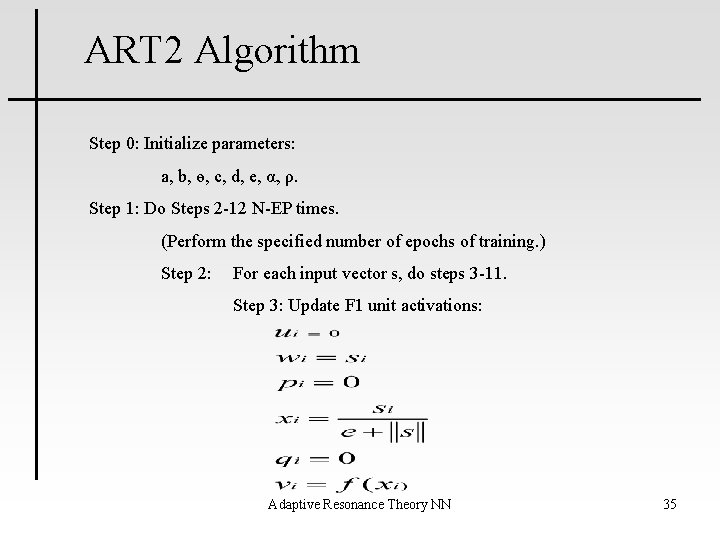
ART 2 Algorithm Step 0: Initialize parameters: a, b, ө, c, d, e, α, ρ. Step 1: Do Steps 2 -12 N-EP times. (Perform the specified number of epochs of training. ) Step 2: For each input vector s, do steps 3 -11. Step 3: Update F 1 unit activations: Adaptive Resonance Theory NN 35
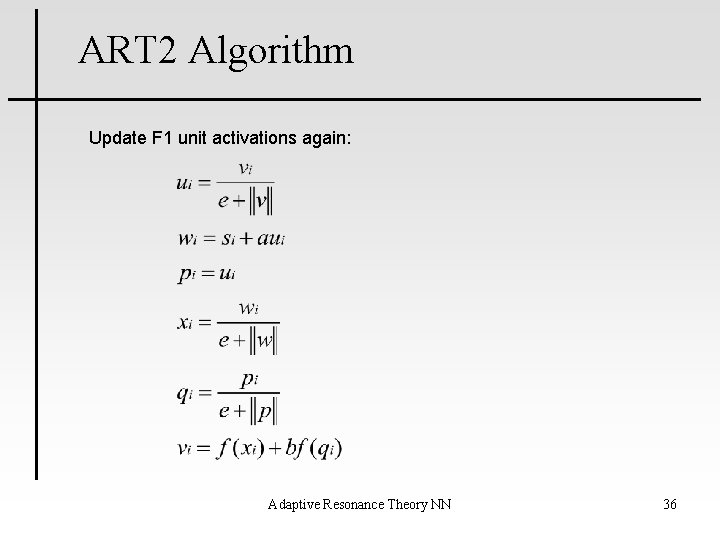
ART 2 Algorithm Update F 1 unit activations again: Adaptive Resonance Theory NN 36
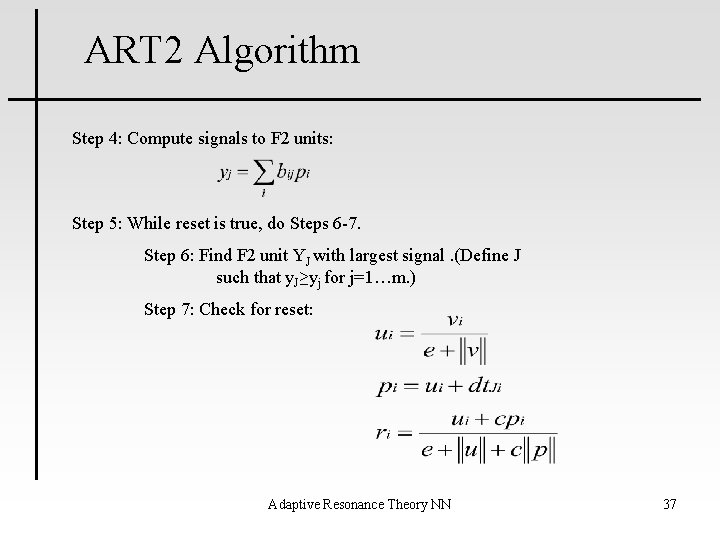
ART 2 Algorithm Step 4: Compute signals to F 2 units: Step 5: While reset is true, do Steps 6 -7. Step 6: Find F 2 unit YJ with largest signal. (Define J such that y. J≥yj for j=1…m. ) Step 7: Check for reset: Adaptive Resonance Theory NN 37
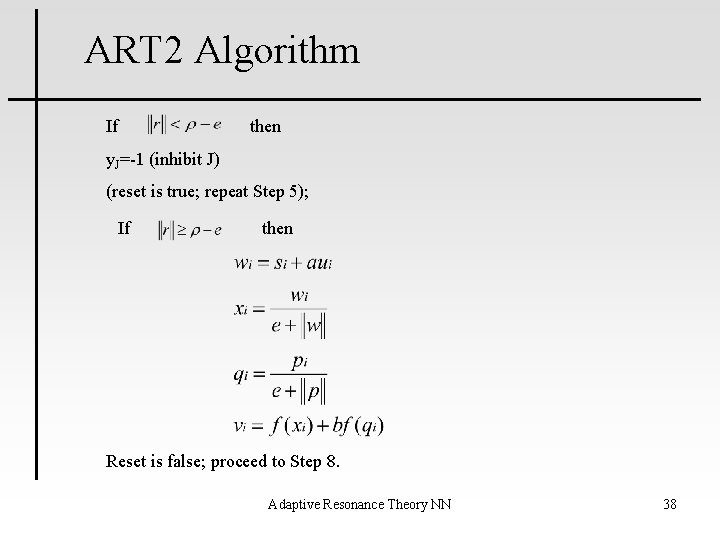
ART 2 Algorithm If then y. J=-1 (inhibit J) (reset is true; repeat Step 5); If then Reset is false; proceed to Step 8. Adaptive Resonance Theory NN 38
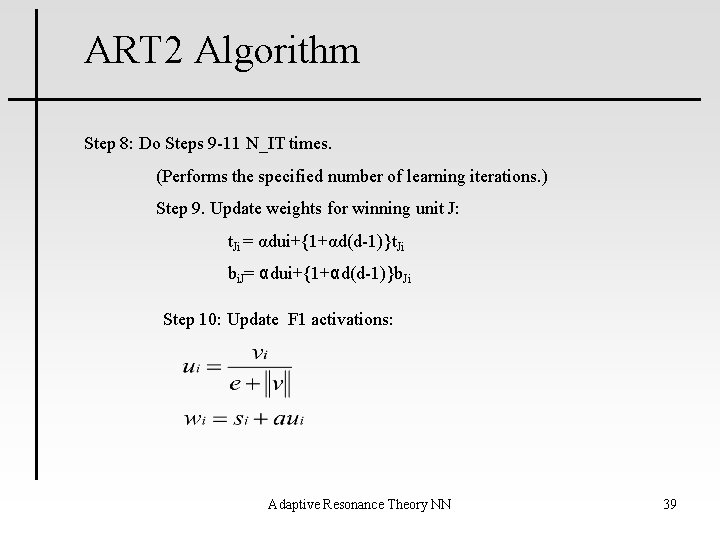
ART 2 Algorithm Step 8: Do Steps 9 -11 N_IT times. (Performs the specified number of learning iterations. ) Step 9. Update weights for winning unit J: t. Ji = αdui+{1+αd(d-1)}t. Ji bi. J= αdui+{1+αd(d-1)}b. Ji Step 10: Update F 1 activations: Adaptive Resonance Theory NN 39
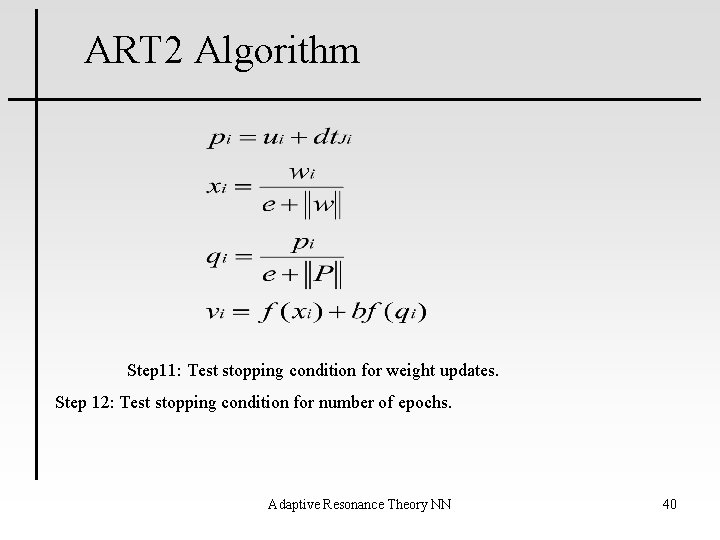
ART 2 Algorithm Step 11: Test stopping condition for weight updates. Step 12: Test stopping condition for number of epochs. Adaptive Resonance Theory NN 40
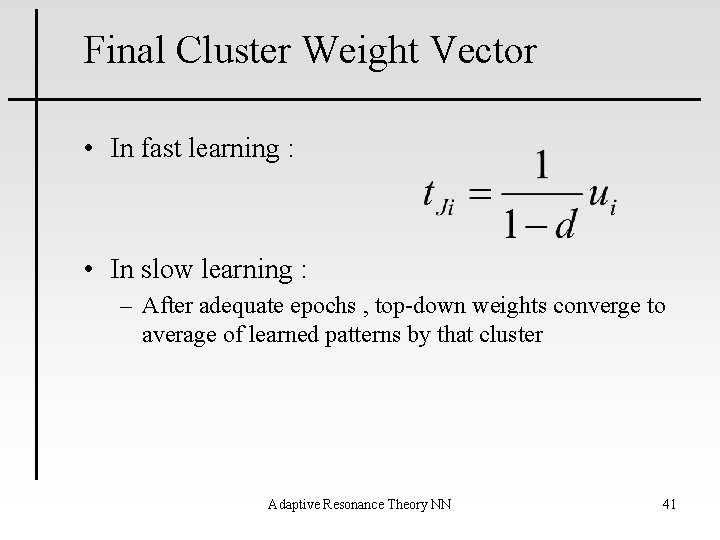
Final Cluster Weight Vector • In fast learning : • In slow learning : – After adequate epochs , top-down weights converge to average of learned patterns by that cluster Adaptive Resonance Theory NN 41
Result for each learning mode Fast Learning Adaptive Resonance Theory NN Slow Learning 42
Result for each learning mode Fast Learning Adaptive Resonance Theory NN Slow Learning 43
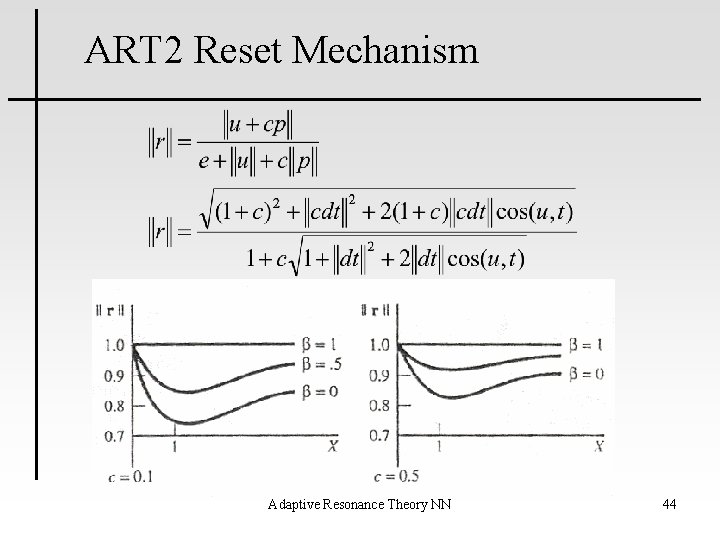
ART 2 Reset Mechanism Adaptive Resonance Theory NN 44
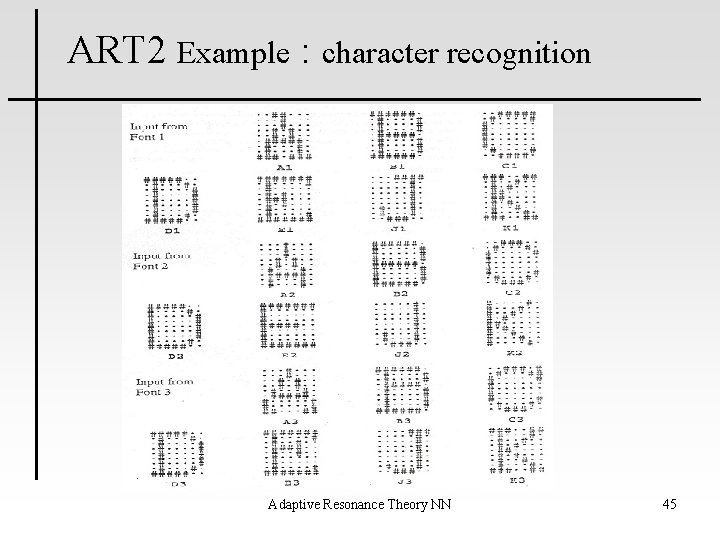
ART 2 Example : character recognition Adaptive Resonance Theory NN 45
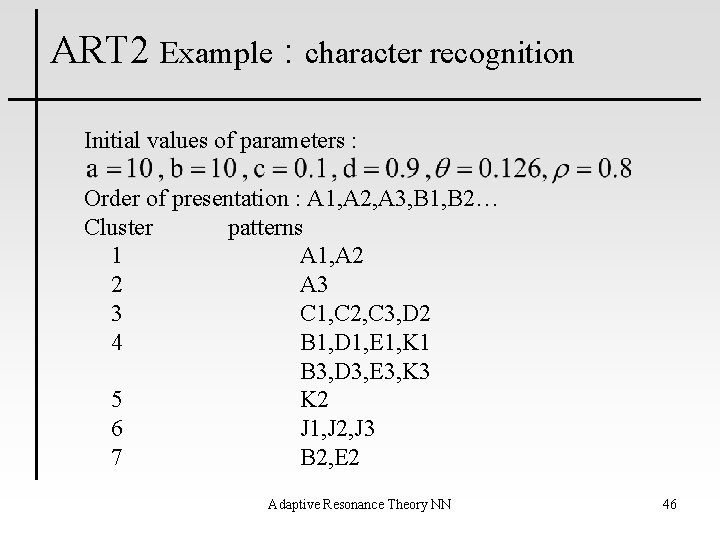
ART 2 Example : character recognition Initial values of parameters : Order of presentation : A 1, A 2, A 3, B 1, B 2… Cluster patterns 1 A 1, A 2 2 A 3 3 C 1, C 2, C 3, D 2 4 B 1, D 1, E 1, K 1 B 3, D 3, E 3, K 3 5 K 2 6 J 1, J 2, J 3 7 B 2, E 2 Adaptive Resonance Theory NN 46
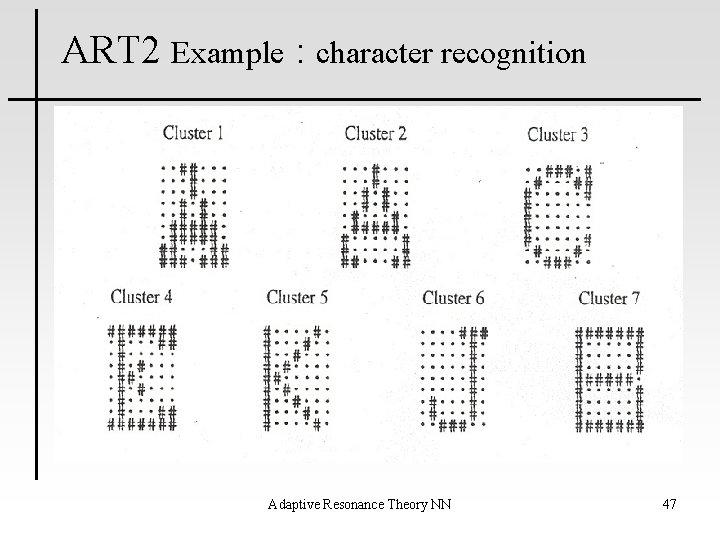
ART 2 Example : character recognition Adaptive Resonance Theory NN 47
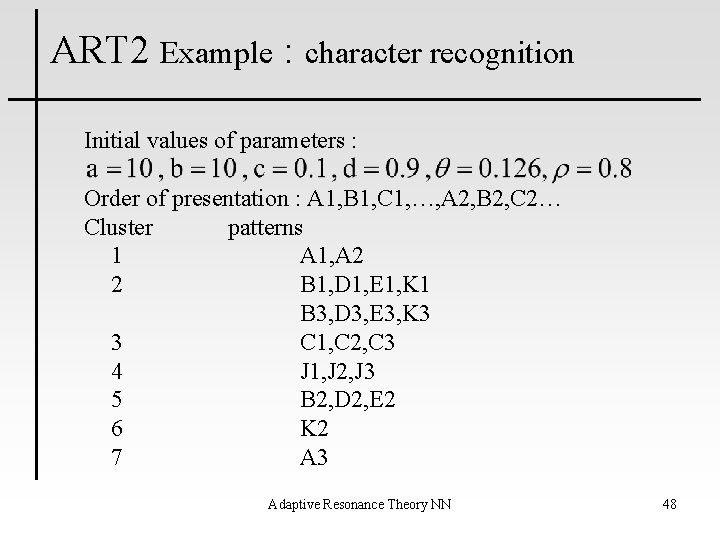
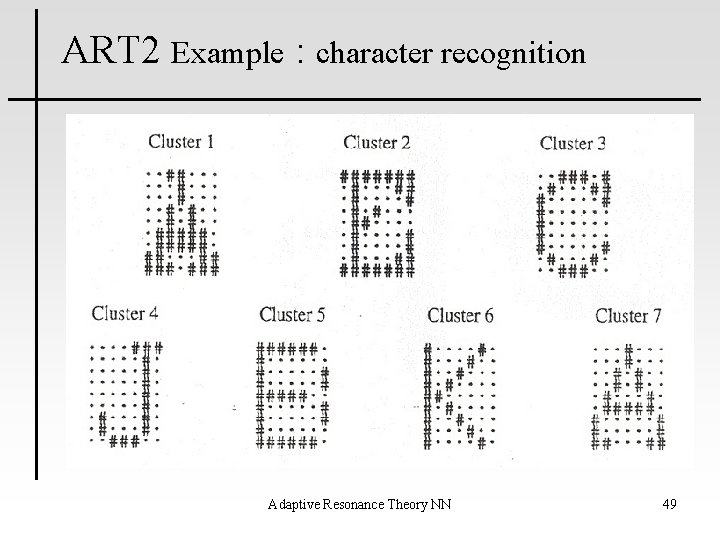
ART 2 Example : character recognition Initial values of parameters : Order of presentation : A 1, B 1, C 1, …, A 2, B 2, C 2… Cluster patterns 1 A 1, A 2 2 B 1, D 1, E 1, K 1 B 3, D 3, E 3, K 3 3 C 1, C 2, C 3 4 J 1, J 2, J 3 5 B 2, D 2, E 2 6 K 2 7 A 3 Adaptive Resonance Theory NN 48
ART 2 Example : character recognition Adaptive Resonance Theory NN 49
ART Applications • Natural language processing – Document clustering – Document retrieval – Automatic query • Image segmentation • Character recognition • Data mining – Data set partitioning – Detection of emerging clusters • Fuzzy partitioning • Condition-action association Adaptive Resonance Theory NN 50
Questions Adaptive Resonance Theory NN 51