
ARSITEKTUR INFORMASI LANJUTAN A Ridwan Siregar TAKSONOMI DAN










![SOCIAL TAGGING • Web 2. 0 [O’Reilly, 2005] and the rise of usergenerated content](https://slidetodoc.com/presentation_image/3a02834874cfeffd92c1207b64363951/image-27.jpg "SOCIAL TAGGING • Web 2. 0 [O’Reilly, 2005] and the rise of usergenerated content")


![USERS LIKE TO SEARCH • In Nielsen’s studies [Nielsen, 1997 c], most users are](https://slidetodoc.com/presentation_image/3a02834874cfeffd92c1207b64363951/image-30.jpg "USERS LIKE TO SEARCH • In Nielsen’s studies [Nielsen, 1997 c], most users are")
![BUT ON-SITE SEARCHING REDUCES SUCCESS • In Spool’s studies [UIE, 1998 b], users who](https://slidetodoc.com/presentation_image/3a02834874cfeffd92c1207b64363951/image-31.jpg "BUT ON-SITE SEARCHING REDUCES SUCCESS • In Spool’s studies [UIE, 1998 b], users who")



- Slides: 36
ARSITEKTUR INFORMASI LANJUTAN A. Ridwan Siregar
TAKSONOMI DAN HIRARKI • Taksonomi adalah susunan hirarkis berbagai kategori • Label/kategori (widget), sebaiknya: – Diungkapkan dalam bahasa pengguna – Tidak mendua – Saling eksklusif (tidak tumpang tindih) agar pengguna tahu di mana mencarinya – Menguraikan kategori utama/induk agar pengguna tidak menduga ada kategori yang hilang ARS AI Modul-7: Arsitektur Informasi Lanjutan 2
HIRARKI BANYAK • Jika kategori tidak saling eksklusif (misalnya item bisa muncul pada berapa tempat), taksonomi tersebut disebut hirarki banyak (polyhierarchical) • Untuk itu perlu membuat penunjuk silang (cross reference) pada berbagai lokasi: – Apakah tomat termasuk kategori buah, sayuran, atau strawberry? Mungkin semuanya benar, tomat secara teknis adalah jenis berry, juga buah, dan sering digunakan sebagai sayuran – Apakah toner cartridges terbaik dimasukkan di bawah laser printers atau printer supplies? Mungkin keduanya ARS AI Modul-7: Arsitektur Informasi Lanjutan 3
LUAS VS. DALAM • Jika hirarki terlalu sempit dan dalam, maka pengguna harus meng-klik terlalu banyak pilihan tingkatan • Jika hirarki terlalu luas, maka pengguna harus memilih di antara sejumlah sub-kategori pada setiap tingkatan ARS AI Modul-7: Arsitektur Informasi Lanjutan 4
DESAIN TOP-DOWN DAN BOTTOM-UP • Top-down: Mulai dari kategori terluas dan selanjutnya ke kategori sempit. Kategori toplevel berasal dari pengguna dan analisis gugus tugas. • Bottom-Up: Mulai dengan mengelompokkan item konten ke dalam kategori tingkat-rendah dan selanjutnya ke kategori luas ARS AI Modul-7: Arsitektur Informasi Lanjutan 5
KARTU KONSEP • Untuk membuat daftar konsep yang akan disajikan pada situs web, dilakukan melalui gugah pikir (brainstorming) atau mewawancarai pengguna atau pelanggan • Buat satu kartu untuk setiap konsep • Buat nomor untuk setiap kartu agar lebih mudah ditangani ARS AI Modul-7: Arsitektur Informasi Lanjutan 6
SORTIR KARTU TERBUKA • Pengguna menyusun kartu konsep ke dalam kategori dan sub-kategori sesuai dengan pilihan mereka sendiri dan kemudian mereka membuat labelnya ARS AI Modul-7: Arsitektur Informasi Lanjutan 7
SORTIR KARTU TERTUTUP • Pengguna menyusun kartu konsep ke dalam hirarki kategori yang telah ditetapkan. Anda bisa menanyakan apa pendapat mereka untuk setiap kategori yang anda buat. ARS AI Modul-7: Arsitektur Informasi Lanjutan 8
SORTIR PERCOBAAN ARS AI Modul-7: Arsitektur Informasi Lanjutan 9
PENGELOMPOKAN KARTU ARS AI Modul-7: Arsitektur Informasi Lanjutan 10
ANALISIS STATISTIK HASIL SORTIR KARTU • Web Category Analysis Tool (Web. CAT) http: //zing. ncsl. nist. gov/Web. Tools/Web. CAT/o verview. html • IBM EZSort http: //www 3. ibm. com/ibm/easy/eou_ext. nsf/ publish/410 • uz. Card. Sort http: //uzilla. mozdev. org/cardsort. html ARS AI Modul-7: Arsitektur Informasi Lanjutan 11
FACETED CLASSIFICATION Ranganathan memperkenalkan faceted classification dengan nama colon classification pada tahun 1933: • Pada awalnya terdiri dari lima kategori dasar: personality, matter, energy, space, and time (PMEST) • Setiap subyek (facet) dibagi lebih lanjut secara hirarkis • Suatu subyek senyawa atau topik ditempatkan pada satu atau lebih subyek (dimensi) • Subyek dipisahkan dengan notasi titik dua (: ) ARS AI Modul-7: Arsitektur Informasi Lanjutan 12
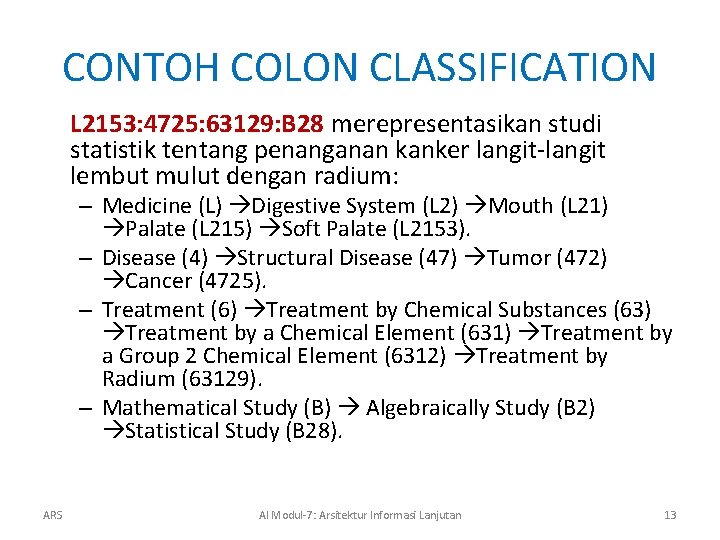
CONTOH COLON CLASSIFICATION L 2153: 4725: 63129: B 28 merepresentasikan studi statistik tentang penanganan kanker langit-langit lembut mulut dengan radium: – Medicine (L) Digestive System (L 2) Mouth (L 21) Palate (L 215) Soft Palate (L 2153). – Disease (4) Structural Disease (47) Tumor (472) Cancer (4725). – Treatment (6) Treatment by Chemical Substances (63) Treatment by a Chemical Element (631) Treatment by a Group 2 Chemical Element (6312) Treatment by Radium (63129). – Mathematical Study (B) Algebraically Study (B 2) Statistical Study (B 28). ARS AI Modul-7: Arsitektur Informasi Lanjutan 13
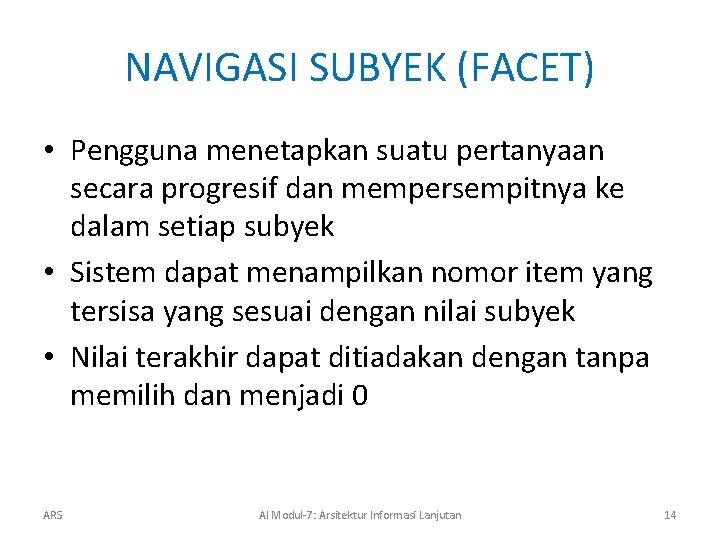
NAVIGASI SUBYEK (FACET) • Pengguna menetapkan suatu pertanyaan secara progresif dan mempersempitnya ke dalam setiap subyek • Sistem dapat menampilkan nomor item yang tersisa yang sesuai dengan nilai subyek • Nilai terakhir dapat ditiadakan dengan tanpa memilih dan menjadi 0 ARS AI Modul-7: Arsitektur Informasi Lanjutan 14
PENELUSURAN SUBYEK • Penelusuran teks penuh menghasilkan suatu set inisial yang cocok dengan item • Kemudian dipersempit ke bawah menggunakan facet ARS AI Modul-7: Arsitektur Informasi Lanjutan 15
CONTOH FACETED SEARCH • Endeca did much of the early work to popularise faceted search http: //www. endeca. com/ • Endeca demo web site, Wine Superstore http: //www. rpfconsulting. com: 8888/wine_de mo/ • K&L Wines http: //klwines. com/ • Ebags http: //ebags. com/ • geizhals. at http: //geizhals. at/? cat=dcamsp ARS AI Modul-7: Arsitektur Informasi Lanjutan 16
CONTROLLED VOCABULARIES • Kosakata terkendali (controlled vocabulary) adalah serangkaian istilah-istilah standar yang akan digunakan dalam suatu situs, dari yang sederhana hingga kompleks: – Synonym ring: daftar istilah-istilah ekuivalen sederhana – Authority file: daftar istilah-istilah – Classification scheme: hubungan hirarkis, lebih luas (BT) dan lebih sempit (NT) di antara istilah-istilah – Thesaurus: hubungan keterkaitan, see (SA) dan related (RT) di antara istilah-istilah ARS AI Modul-7: Arsitektur Informasi Lanjutan 17
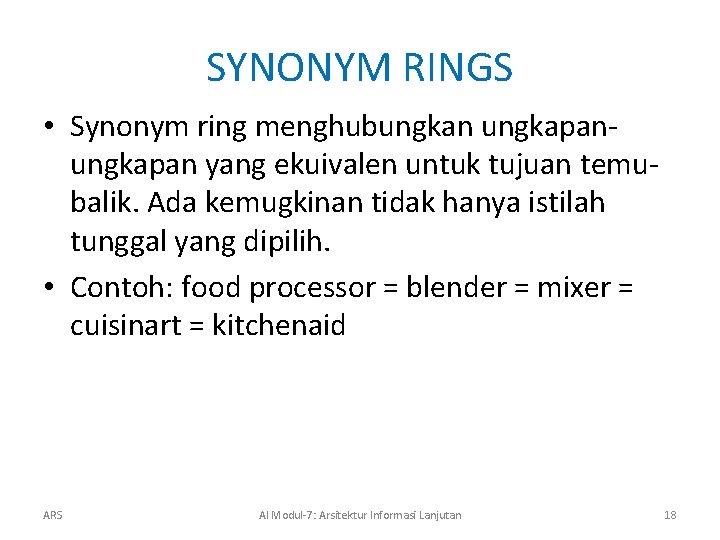
SYNONYM RINGS • Synonym ring menghubungkan ungkapan yang ekuivalen untuk tujuan temubalik. Ada kemugkinan tidak hanya istilah tunggal yang dipilih. • Contoh: food processor = blender = mixer = cuisinart = kitchenaid ARS AI Modul-7: Arsitektur Informasi Lanjutan 18
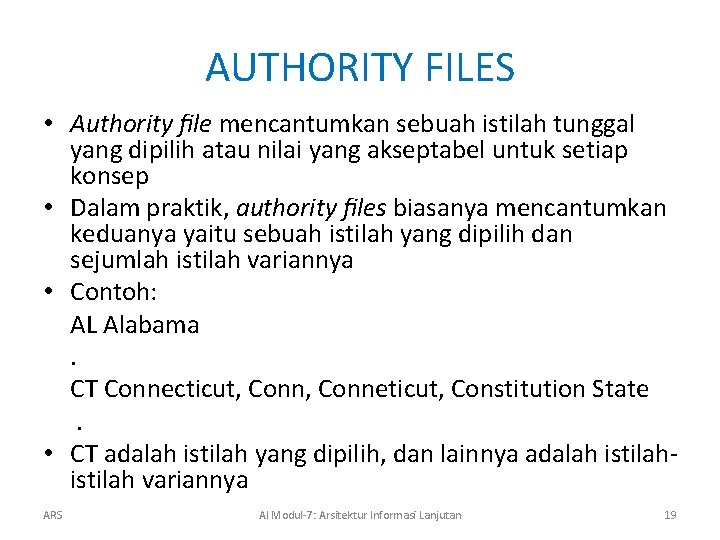
AUTHORITY FILES • Authority file mencantumkan sebuah istilah tunggal yang dipilih atau nilai yang akseptabel untuk setiap konsep • Dalam praktik, authority files biasanya mencantumkan keduanya yaitu sebuah istilah yang dipilih dan sejumlah istilah variannya • Contoh: AL Alabama. CT Connecticut, Conneticut, Constitution State. • CT adalah istilah yang dipilih, dan lainnya adalah istilah variannya ARS AI Modul-7: Arsitektur Informasi Lanjutan 19
CLASSIFCATION SCHEMES (TAXONOMIES) • Hirarki: – BT (broader terms) – NT (narrower terms ) – UF (used for) istilah-istilah varian • Contoh: Jeans BT Pants NT Levis NT Wranglers UF Dungarees UF Waist Overalls ARS AI Modul-7: Arsitektur Informasi Lanjutan 20
THESAURUS Jeans BT Pants NT Levis NT Wranglers UF Dungarees UF Waist Overalls RT Denim RT Overalls Denim BT Fabrics NT Ring Spun NT Dark Indigo NT Stonewash RT Jeans ARS AI Modul-7: Arsitektur Informasi Lanjutan 21
PENGGUNAAN KOSAKATA TERKENDALI PADA PENELUSURAN • KT dapat diintegrasikan dengan mesin pencari situs web untuk menangani situasi seperti berikut: – Synonyms: two words with the same meaning, like “jeans” and “dungarees” – Homonyms: words that sound the same, but have different meanings, like “bank” the financial institution and “bank” the side of a stream or river – Broaden or narrow a search – Common misspellings – Changes in content: for example, countries that change their name or have multiple spellings. – “Best Bets”: identifying the most popular pages associated with a certain term – Connecting a woman’s married name to her maiden name – Connecting abbreviations to the full word: for example, NY and New York, the chemical symbol Si with the element Silicon ARS AI Modul-7: Arsitektur Informasi Lanjutan 22
PENGGUNAAN INTERNAL KT • Selain membantu pengguna dengan penelusuran, KT dapat: Membantu menjaga perbedaan kategori anda Membuat navigasi situs Sebagai basis personalisasi Membantu mempersiapkan CMS atau proyek manajemen pengetahuan – Menjadikan organisasi dan pengguna menggunakan bahasa yang sama – Membantu organisasi dan pengguna memahami konsep yang dicakup oleh situs – – • KT merupakan peta konsep apa yang terdapat pada situs ARS AI Modul-7: Arsitektur Informasi Lanjutan 23
TEKNOLOGI PEMELIHARAAN KT • • ARS Excel spreadsheet Multites http: //www. multites. com/ Term Tree http: //www. termtree. com. au/ Lexico http: //www. lexico. com/ AI Modul-7: Arsitektur Informasi Lanjutan 24
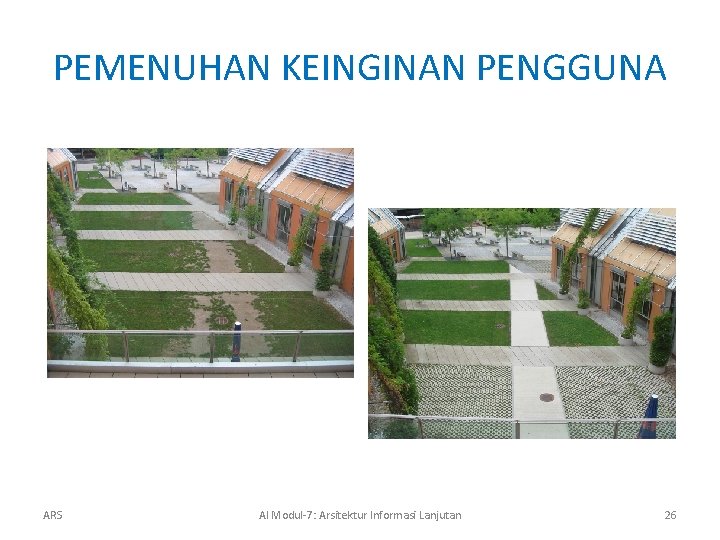
STRUKTUR YANG DI-GENERATE OLEH PENGGUNA • Adakalanya strategi yang dilakukan memungkinkan pengguna membuat struktur mereka sendiri • Emergent Paths: The Univ. of California at Irvine supposedly used a deliberate organic design approach, where pathways between buildings were only paved after seeing where users were actually walking. This idea of watching user behavior and then supporting it is also known as “paving the cow paths”. ARS AI Modul-7: Arsitektur Informasi Lanjutan 25
PEMENUHAN KEINGINAN PENGGUNA ARS AI Modul-7: Arsitektur Informasi Lanjutan 26
SOCIAL TAGGING • Web 2. 0 [O’Reilly, 2005] and the rise of usergenerated content has sparked a new form of emergent structure: collaborative tagging. Also called free tagging, collaborative categorisation, mob indexing. Users tag objects with one or more keywords. Nothing inherently new in that, simply the difference in scale (the number of people assigning tags). The network effect of “harnessing collective intelligence” [O’Reilly, 2006]. ARS AI Modul-7: Arsitektur Informasi Lanjutan 27
FOLKSONOMIES • Thomas Vander suggested in 2004 that a usercreated, bottom-up categorical structure be called a “folksonomy” [Morville and Rosenfeld, 2006]. In contrast to a specialist maintained, top-down taxonomy. Controlled vocabularies (including taxonomies) are too expensive to build and maintain in the majority of cases where tagging is useful. “The advantage of folksonomies is not that they are better than controlled vocabularies, it is that they are better than nothing. ” Clay Shirky, 2005. ARS AI Modul-7: Arsitektur Informasi Lanjutan 28
NAVIGATION SYSTEMS • • ARS Browsable categories Site-wide search Site map Site index AI Modul-7: Arsitektur Informasi Lanjutan 29
USERS LIKE TO SEARCH • In Nielsen’s studies [Nielsen, 1997 c], most users are task-focused and rely primarily on searching rather than link-following to find information: – Search dominant 50% – Link dominant 20% – Mixed 30% • To facilitate searching: – Put a search box or button on every page – Global search by default (searching whole site, rather than scoped search) – Relegate boolean queries to a secondary “Advanced Search” page ARS AI Modul-7: Arsitektur Informasi Lanjutan 30
BUT ON-SITE SEARCHING REDUCES SUCCESS • In Spool’s studies [UIE, 1998 b], users who used the on-site search facility, were actually less likely to find the information they were looking for: • % of successful tasks – Without search 53% – With search 30% • A search engine’s results are only as good as the input it receives: – – ARS Users do not know how to formulate queries Search syntax is different from site to site Users rarely change the default search options Users mistype search terms (an analysis of one week’s log files from Netscape’s Dev. Edge Online showed 3% of searches contained misspelled words). AI Modul-7: Arsitektur Informasi Lanjutan 31
PROVIDE SPECTRUM OF NAVIGATIONAL AIDS • Multiple Taxonomies: categories to browse – Search: Attribute and full text search – Site map: either graphical or a topical table of contents – Site index: alphabetical index of common words and phrases • See, for example, People. Soft http: //www. peoplesoft. com/. ARS AI Modul-7: Arsitektur Informasi Lanjutan 32
IA DELIVERABLES • Architecture Diagrams – Produce architecture diagrams describing the site structure: • Many people use Visio (Windows) or Omni. Graffle (Mac) to draw the drawings ARS AI Modul-7: Arsitektur Informasi Lanjutan 33
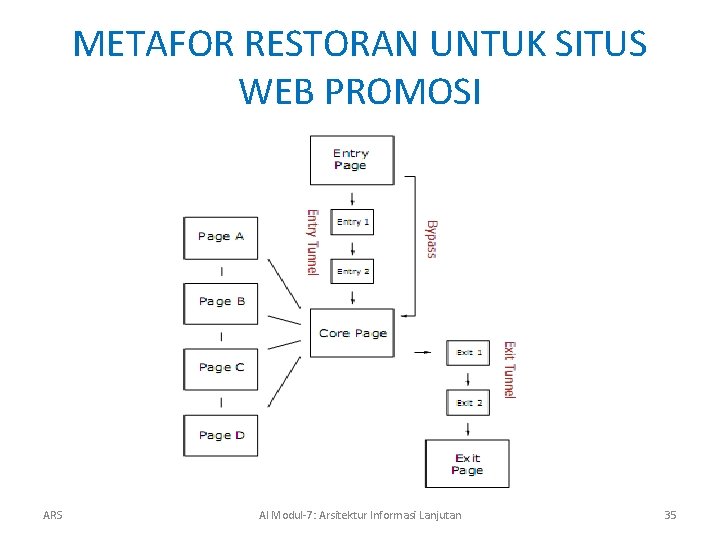
PROMOTIONAL SITE STRUCTURE (RESTAURANT METAPHOR) • Promotional sites should entice and pull visitors through, like a restaurant metaphor – Entry page. Front door to tell people where they are – Entry tunnel. Offer the option of a little ride into the site to build anticipation, but provide a bypass – Core page. Direct and guide visitors through your content – Exit tunnel. Show visitors the door – Exit page. The place to ask something from your visitors ARS AI Modul-7: Arsitektur Informasi Lanjutan 34
METAFOR RESTORAN UNTUK SITUS WEB PROMOSI ARS AI Modul-7: Arsitektur Informasi Lanjutan 35
• TERIMA KASIH ARS AI Modul-7: Arsitektur Informasi Lanjutan 36