
ARRT Advanced Risk Reduction Tool California Institute of
![Hoh In et al – Visualized Conflict Resolution (VCR) [Hoh & Roy, 2001] ARRT](https://slidetodoc.com/presentation_image_h2/539e233e864def7b2c8cb08126348541/image-27.jpg "Hoh In et al – Visualized Conflict Resolution (VCR) [Hoh & Roy, 2001] ARRT")
![References California Institute of Technology [Basili & Boehm, 2000] V. Basili & B. Boehm](https://slidetodoc.com/presentation_image_h2/539e233e864def7b2c8cb08126348541/image-30.jpg "References California Institute of Technology [Basili & Boehm, 2000] V. Basili & B. Boehm")
![References California Institute of Technology [Graves et al, 1998] T. Graves, M. Harrold, J.](https://slidetodoc.com/presentation_image_h2/539e233e864def7b2c8cb08126348541/image-31.jpg "References California Institute of Technology [Graves et al, 1998] T. Graves, M. Harrold, J.")
- Slides: 31
ARRT Advanced Risk Reduction Tool California Institute of Technology Presentation to the 1 st Annual NASA Office of Safety and Mission Assurance (OSMA) Software Assurance Symposium (SAS) Dr. Martin S. Feather ARRT Center Initiative Lead* Jet Propulsion Laboratory California Institute of Technology Martin. S. Feather@Jpl. Nasa. Gov http: //eis. jpl. nasa. gov/~mfeather *Initiative began in 1999 with Dr. John Kelly as Lead NASA OSMA SAS 2001 Advanced Risk Reduction Tool - M. S. Feather 1
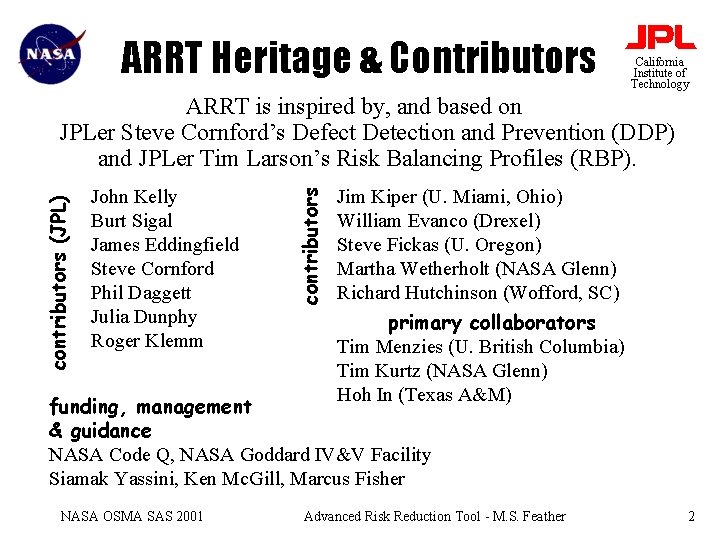
ARRT Heritage & Contributors California Institute of Technology John Kelly Burt Sigal James Eddingfield Steve Cornford Phil Daggett Julia Dunphy Roger Klemm contributors (JPL) ARRT is inspired by, and based on JPLer Steve Cornford’s Defect Detection and Prevention (DDP) and JPLer Tim Larson’s Risk Balancing Profiles (RBP). Jim Kiper (U. Miami, Ohio) William Evanco (Drexel) Steve Fickas (U. Oregon) Martha Wetherholt (NASA Glenn) Richard Hutchinson (Wofford, SC) primary collaborators Tim Menzies (U. British Columbia) Tim Kurtz (NASA Glenn) Hoh In (Texas A&M) funding, management & guidance NASA Code Q, NASA Goddard IV&V Facility Siamak Yassini, Ken Mc. Gill, Marcus Fisher NASA OSMA SAS 2001 Advanced Risk Reduction Tool - M. S. Feather 2
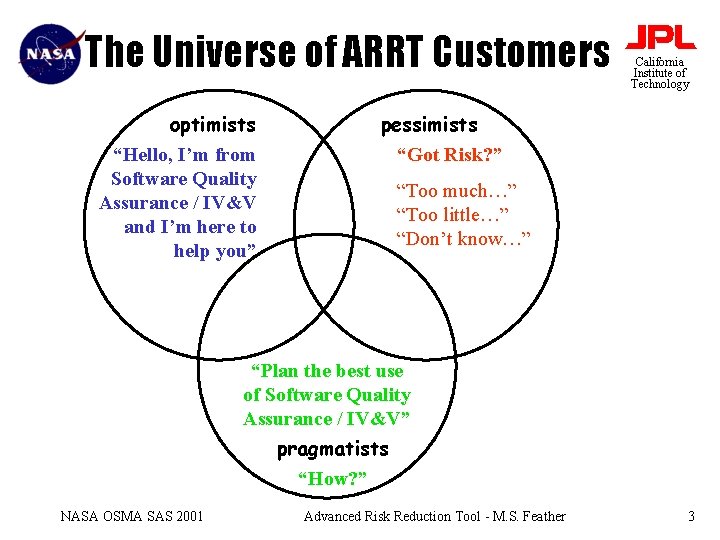
The Universe of ARRT Customers optimists California Institute of Technology pessimists “Hello, I’m from Software Quality Assurance / IV&V and I’m here to help you” “Got Risk? ” “Too much…” “Too little…” “Don’t know…” “Plan the best use of Software Quality Assurance / IV&V” pragmatists “How? ” NASA OSMA SAS 2001 Advanced Risk Reduction Tool - M. S. Feather 3
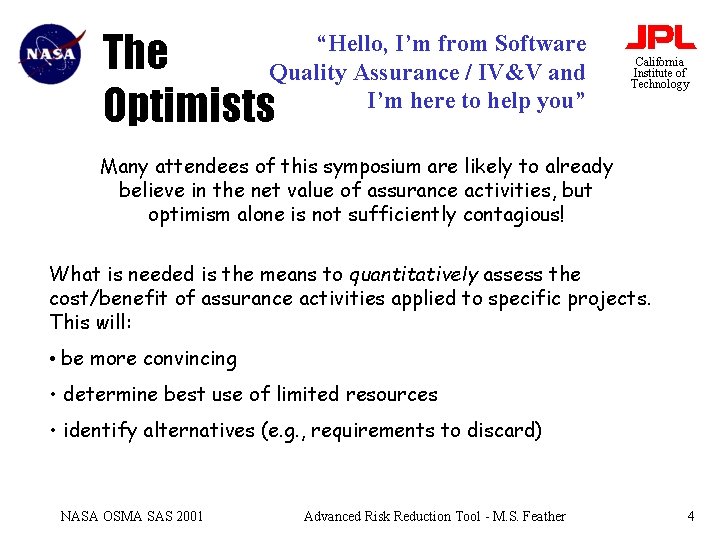
The Optimists “Hello, I’m from Software Quality Assurance / IV&V and I’m here to help you” California Institute of Technology Many attendees of this symposium are likely to already believe in the net value of assurance activities, but optimism alone is not sufficiently contagious! What is needed is the means to quantitatively assess the cost/benefit of assurance activities applied to specific projects. This will: • be more convincing • determine best use of limited resources • identify alternatives (e. g. , requirements to discard) NASA OSMA SAS 2001 Advanced Risk Reduction Tool - M. S. Feather 4
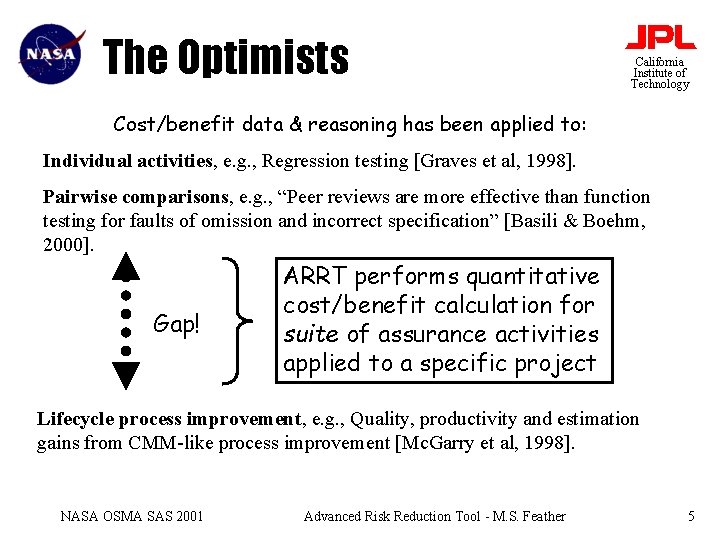
The Optimists California Institute of Technology Cost/benefit data & reasoning has been applied to: Individual activities, e. g. , Regression testing [Graves et al, 1998]. Pairwise comparisons, e. g. , “Peer reviews are more effective than function testing for faults of omission and incorrect specification” [Basili & Boehm, 2000]. Gap! ARRT performs quantitative cost/benefit calculation for suite of assurance activities applied to a specific project Lifecycle process improvement, e. g. , Quality, productivity and estimation gains from CMM-like process improvement [Mc. Garry et al, 1998]. NASA OSMA SAS 2001 Advanced Risk Reduction Tool - M. S. Feather 5
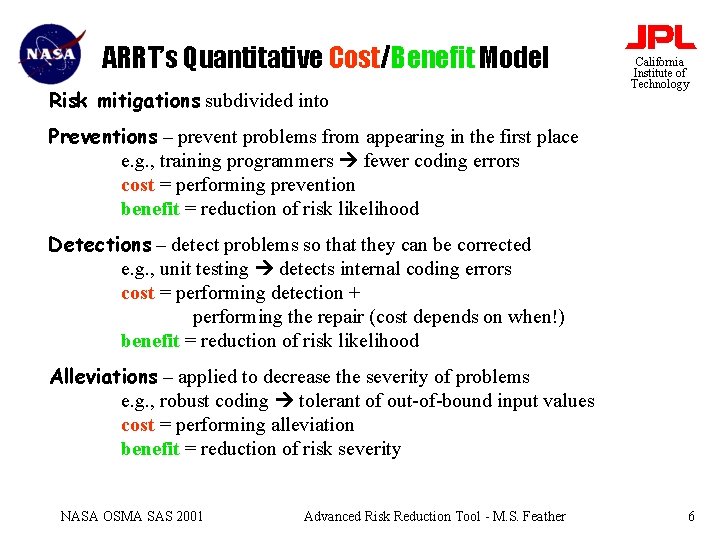
ARRT’s Quantitative Cost/Benefit Model Risk mitigations subdivided into California Institute of Technology Preventions – prevent problems from appearing in the first place e. g. , training programmers fewer coding errors cost = performing prevention benefit = reduction of risk likelihood Detections – detect problems so that they can be corrected e. g. , unit testing detects internal coding errors cost = performing detection + performing the repair (cost depends on when!) benefit = reduction of risk likelihood Alleviations – applied to decrease the severity of problems e. g. , robust coding tolerant of out-of-bound input values cost = performing alleviation benefit = reduction of risk severity NASA OSMA SAS 2001 Advanced Risk Reduction Tool - M. S. Feather 6
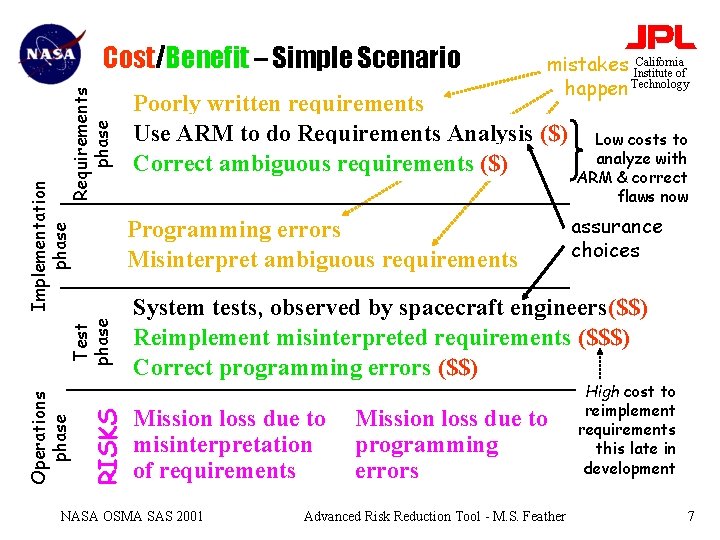
RISKS Operations phase Implementation phase Requirements Test phase Cost/Benefit – Simple Scenario California mistakes Institute of Technology happen Poorly written requirements Use ARM to do Requirements Analysis ($) Correct ambiguous requirements ($) Programming errors Misinterpret ambiguous requirements Low costs to analyze with ARM & correct flaws now assurance choices System tests, observed by spacecraft engineers($$) Reimplement misinterpreted requirements ($$$) Correct programming errors ($$) Mission loss due to misinterpretation of requirements NASA OSMA SAS 2001 Mission loss due to programming errors Advanced Risk Reduction Tool - M. S. Feather High cost to reimplement requirements this late in development 7
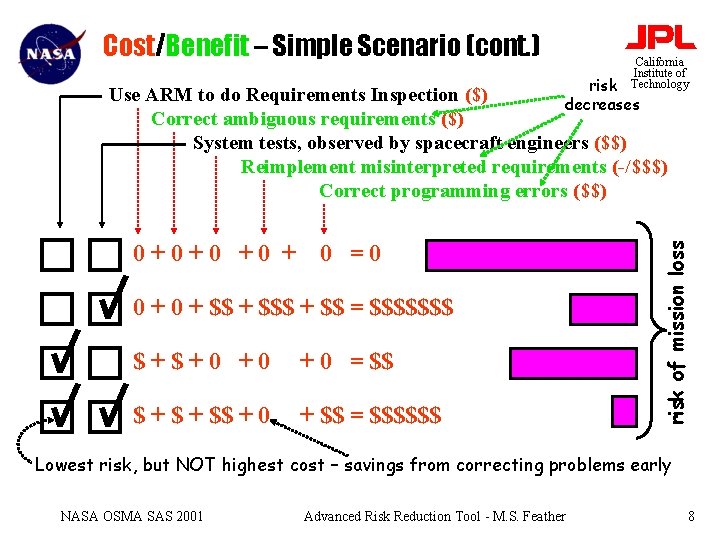
Cost/Benefit – Simple Scenario (cont. ) risk California Institute of Technology 0+0+0 +0 + 0 =0 0 + $$ = $$$$$$$ $+$+0 +0 + 0 = $$ $ + $$ + 0 + $$ = $$$$$$ risk of mission loss Use ARM to do Requirements Inspection ($) decreases Correct ambiguous requirements ($) System tests, observed by spacecraft engineers ($$) Reimplement misinterpreted requirements (-/$$$) Correct programming errors ($$) Lowest risk, but NOT highest cost – savings from correcting problems early NASA OSMA SAS 2001 Advanced Risk Reduction Tool - M. S. Feather 8
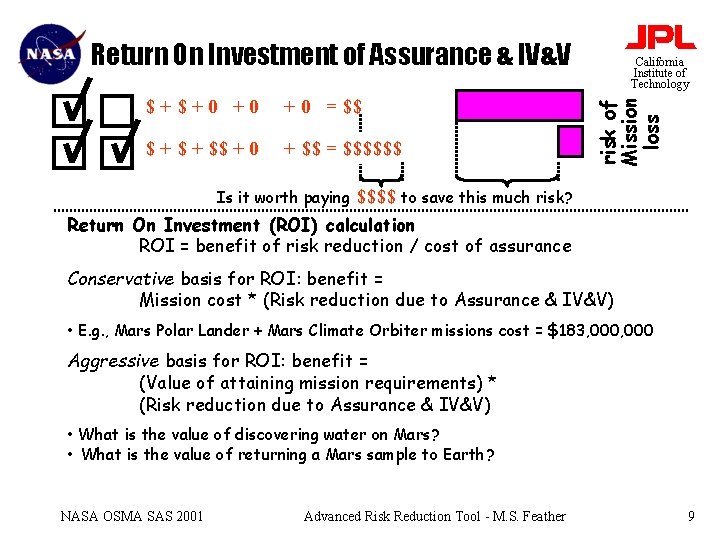
Return On Investment of Assurance & IV&V + 0 = $$ $ + $$ + 0 + $$ = $$$$$$ Is it worth paying risk of Mission loss $+$+0 +0 California Institute of Technology $$$$ to save this much risk? Return On Investment (ROI) calculation ROI = benefit of risk reduction / cost of assurance Conservative basis for ROI: benefit = Mission cost * (Risk reduction due to Assurance & IV&V) • E. g. , Mars Polar Lander + Mars Climate Orbiter missions cost = $183, 000 Aggressive basis for ROI: benefit = (Value of attaining mission requirements) * (Risk reduction due to Assurance & IV&V) • What is the value of discovering water on Mars? • What is the value of returning a Mars sample to Earth? NASA OSMA SAS 2001 Advanced Risk Reduction Tool - M. S. Feather 9
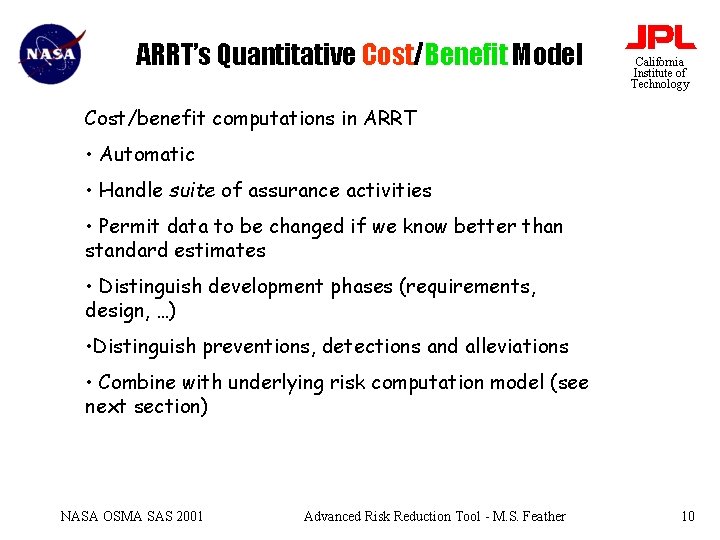
ARRT’s Quantitative Cost/Benefit Model California Institute of Technology Cost/benefit computations in ARRT • Automatic • Handle suite of assurance activities • Permit data to be changed if we know better than standard estimates • Distinguish development phases (requirements, design, …) • Distinguish preventions, detections and alleviations • Combine with underlying risk computation model (see next section) NASA OSMA SAS 2001 Advanced Risk Reduction Tool - M. S. Feather 10
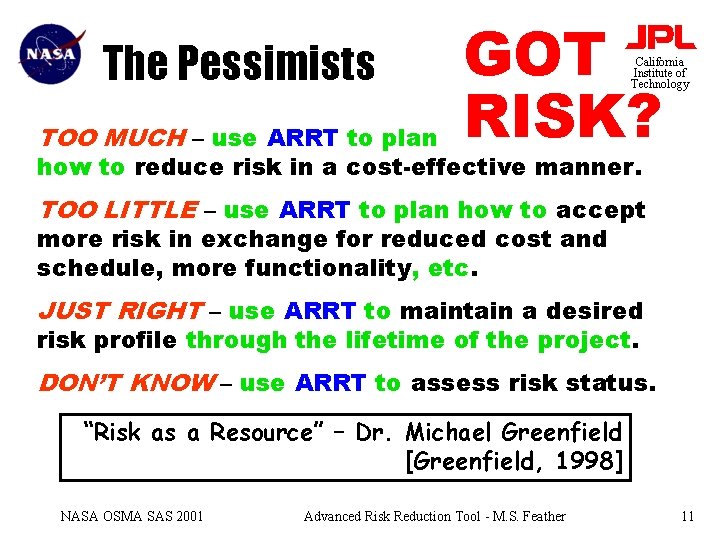
The Pessimists TOO MUCH – use ARRT to plan GOT RISK? California Institute of Technology how to reduce risk in a cost-effective manner. TOO LITTLE – use ARRT to plan how to accept more risk in exchange for reduced cost and schedule, more functionality, etc. JUST RIGHT – use ARRT to maintain a desired risk profile through the lifetime of the project. DON’T KNOW – use ARRT to assess risk status. “Risk as a Resource” – Dr. Michael Greenfield [Greenfield, 1998] NASA OSMA SAS 2001 Advanced Risk Reduction Tool - M. S. Feather 11
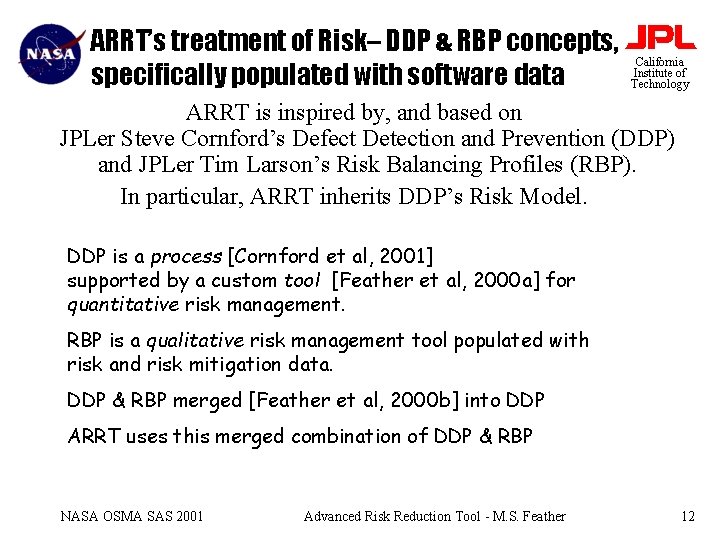
ARRT’s treatment of Risk– DDP & RBP concepts, specifically populated with software data California Institute of Technology ARRT is inspired by, and based on JPLer Steve Cornford’s Defect Detection and Prevention (DDP) and JPLer Tim Larson’s Risk Balancing Profiles (RBP). In particular, ARRT inherits DDP’s Risk Model. DDP is a process [Cornford et al, 2001] supported by a custom tool [Feather et al, 2000 a] for quantitative risk management. RBP is a qualitative risk management tool populated with risk and risk mitigation data. DDP & RBP merged [Feather et al, 2000 b] into DDP ARRT uses this merged combination of DDP & RBP NASA OSMA SAS 2001 Advanced Risk Reduction Tool - M. S. Feather 12
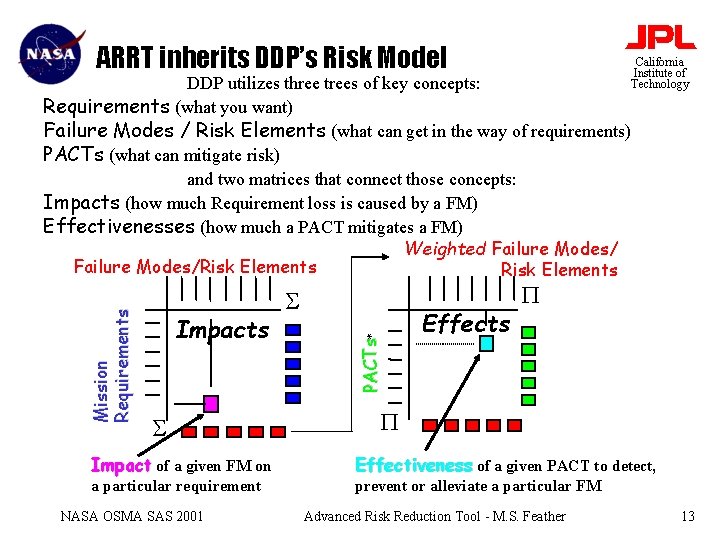
ARRT inherits DDP’s Risk Model California Institute of Technology Impacts Impact of a given FM on a particular requirement NASA OSMA SAS 2001 PACTs* Mission Requirements DDP utilizes three trees of key concepts: Requirements (what you want) Failure Modes / Risk Elements (what can get in the way of requirements) PACTs (what can mitigate risk) and two matrices that connect those concepts: Impacts (how much Requirement loss is caused by a FM) Effectivenesses (how much a PACT mitigates a FM) Weighted Failure Modes/Risk Elements Effects P P Effectiveness of a given PACT to detect, prevent or alleviate a particular FM Advanced Risk Reduction Tool - M. S. Feather 13
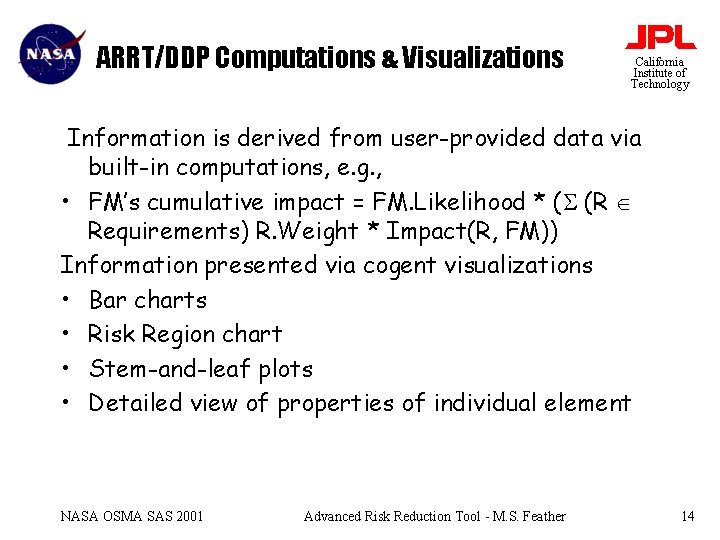
ARRT/DDP Computations & Visualizations California Institute of Technology Information is derived from user-provided data via built-in computations, e. g. , • FM’s cumulative impact = FM. Likelihood * ( (R Requirements) R. Weight * Impact(R, FM)) Information presented via cogent visualizations • Bar charts • Risk Region chart • Stem-and-leaf plots • Detailed view of properties of individual element NASA OSMA SAS 2001 Advanced Risk Reduction Tool - M. S. Feather 14
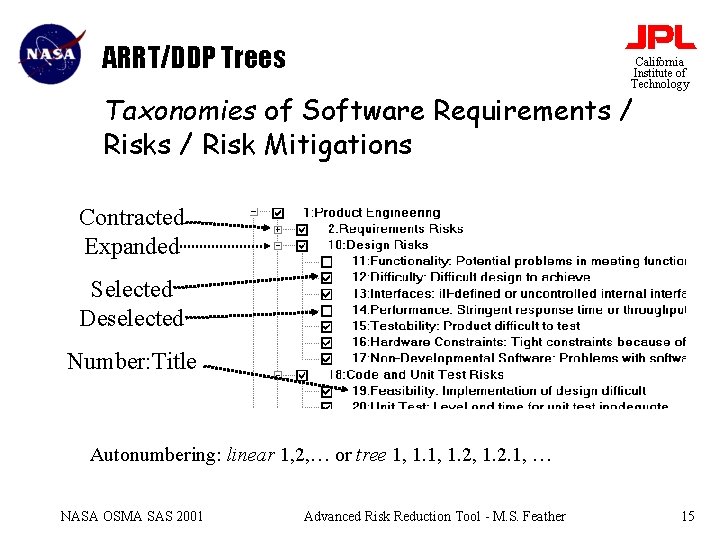
ARRT/DDP Trees California Institute of Technology Taxonomies of Software Requirements / Risk Mitigations Contracted Expanded Selected Deselected Number: Title Autonumbering: linear 1, 2, … or tree 1, 1. 2, 1. 2. 1, … NASA OSMA SAS 2001 Advanced Risk Reduction Tool - M. S. Feather 15
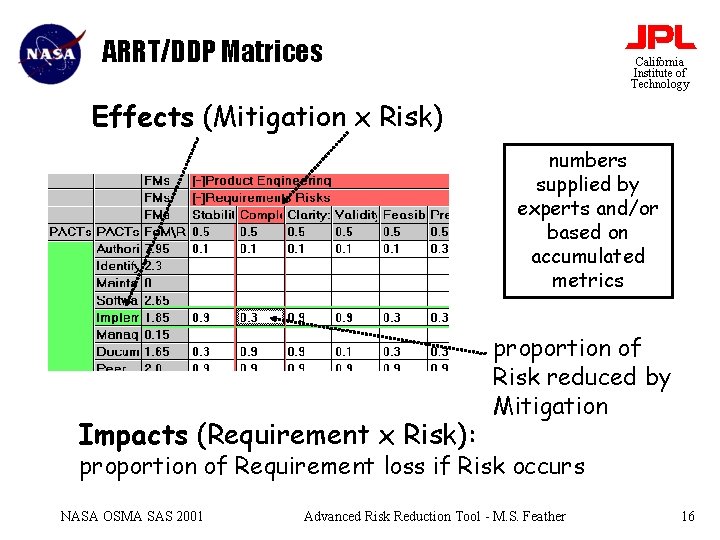
ARRT/DDP Matrices California Institute of Technology Effects (Mitigation x Risk) numbers supplied by experts and/or based on accumulated metrics Impacts (Requirement x Risk): proportion of Risk reduced by Mitigation proportion of Requirement loss if Risk occurs NASA OSMA SAS 2001 Advanced Risk Reduction Tool - M. S. Feather 16
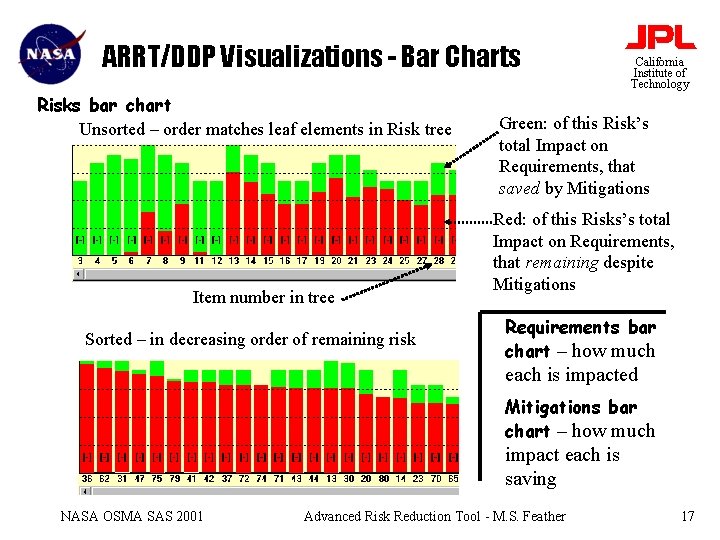
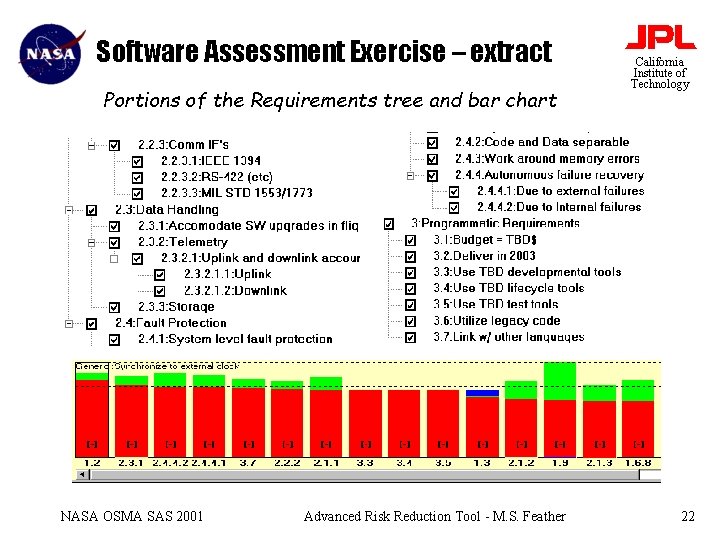
ARRT/DDP Visualizations - Bar Charts Risks bar chart Unsorted – order matches leaf elements in Risk tree Item number in tree Sorted – in decreasing order of remaining risk California Institute of Technology Green: of this Risk’s total Impact on Requirements, that saved by Mitigations Red: of this Risks’s total Impact on Requirements, that remaining despite Mitigations Requirements bar chart – how much each is impacted Mitigations bar chart – how much impact each is saving NASA OSMA SAS 2001 Advanced Risk Reduction Tool - M. S. Feather 17
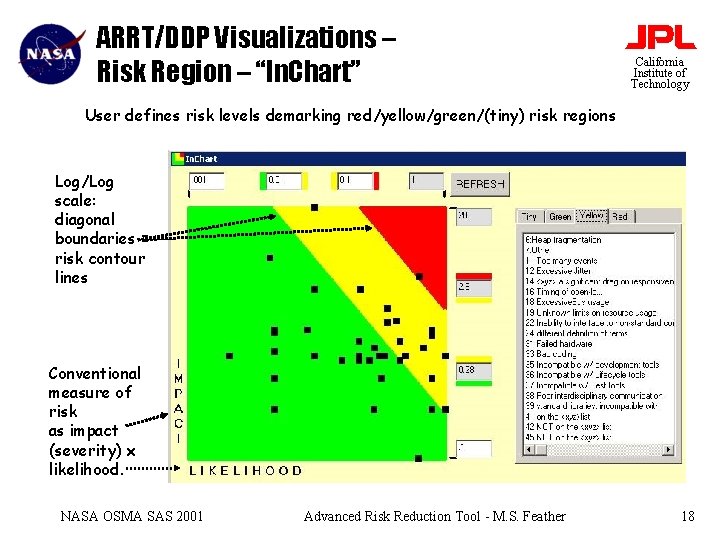
ARRT/DDP Visualizations – Risk Region – “In. Chart” California Institute of Technology User defines risk levels demarking red/yellow/green/(tiny) risk regions Log/Log scale: diagonal boundaries = risk contour lines Conventional measure of risk as impact (severity) x likelihood. NASA OSMA SAS 2001 Advanced Risk Reduction Tool - M. S. Feather 18
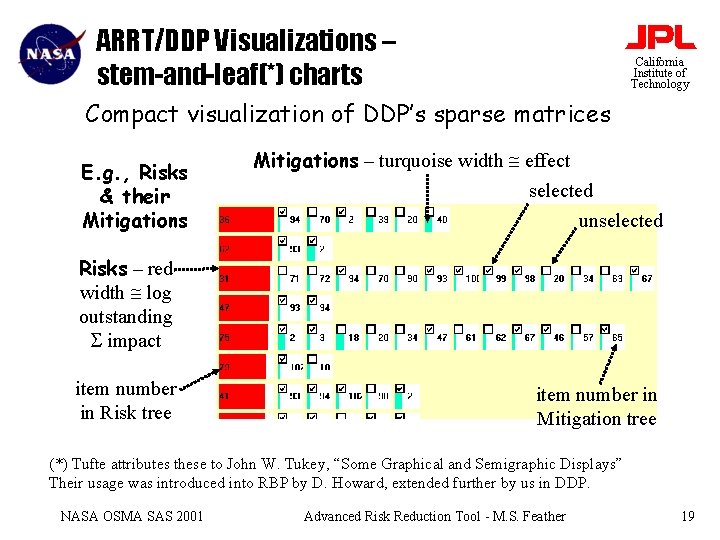
ARRT/DDP Visualizations – stem-and-leaf(*) charts California Institute of Technology Compact visualization of DDP’s sparse matrices E. g. , Risks & their Mitigations – turquoise width effect selected unselected Risks – red width log outstanding impact item number in Risk tree item number in Mitigation tree (*) Tufte attributes these to John W. Tukey, “Some Graphical and Semigraphic Displays” Their usage was introduced into RBP by D. Howard, extended further by us in DDP. NASA OSMA SAS 2001 Advanced Risk Reduction Tool - M. S. Feather 19
The Pragmatists California Institute of Technology Objective: Plan the best use of Software Quality Assurance & IV&V “Has it been used? ” “Where does the data come from? ” “How does it combine with software estimation & planning? ” “What about…? ” NASA OSMA SAS 2001 Advanced Risk Reduction Tool - M. S. Feather 20
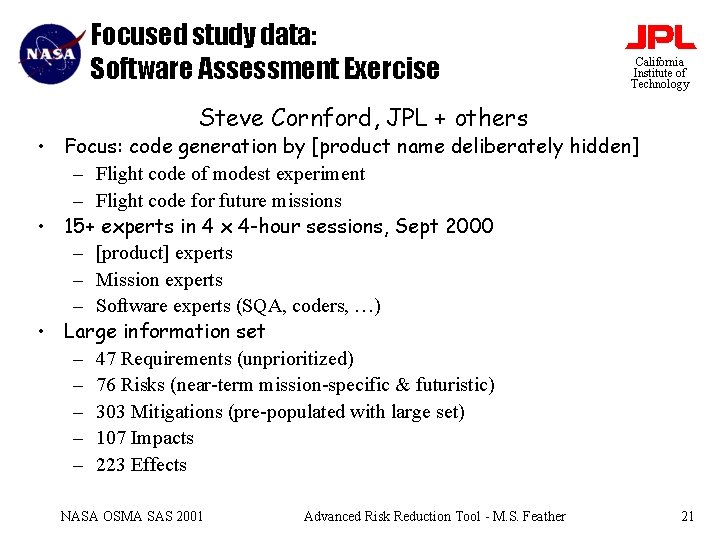
Focused study data: Software Assessment Exercise California Institute of Technology Steve Cornford, JPL + others • Focus: code generation by [product name deliberately hidden] – Flight code of modest experiment – Flight code for future missions • 15+ experts in 4 x 4 -hour sessions, Sept 2000 – [product] experts – Mission experts – Software experts (SQA, coders, …) • Large information set – 47 Requirements (unprioritized) – 76 Risks (near-term mission-specific & futuristic) – 303 Mitigations (pre-populated with large set) – 107 Impacts – 223 Effects NASA OSMA SAS 2001 Advanced Risk Reduction Tool - M. S. Feather 21
Software Assessment Exercise – extract Portions of the Requirements tree and bar chart NASA OSMA SAS 2001 Advanced Risk Reduction Tool - M. S. Feather California Institute of Technology 22
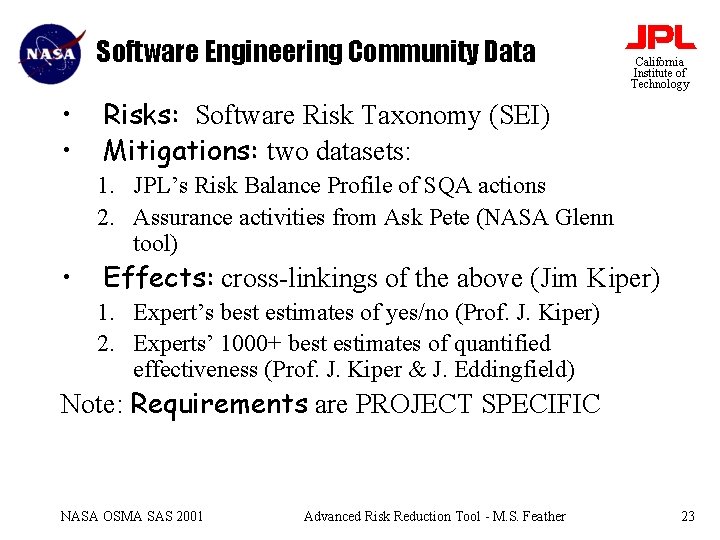
Software Engineering Community Data • • • California Institute of Technology Risks: Software Risk Taxonomy (SEI) Mitigations: two datasets: 1. JPL’s Risk Balance Profile of SQA actions 2. Assurance activities from Ask Pete (NASA Glenn tool) Effects: cross-linkings of the above (Jim Kiper) 1. Expert’s best estimates of yes/no (Prof. J. Kiper) 2. Experts’ 1000+ best estimates of quantified effectiveness (Prof. J. Kiper & J. Eddingfield) Note: Requirements are PROJECT SPECIFIC NASA OSMA SAS 2001 Advanced Risk Reduction Tool - M. S. Feather 23
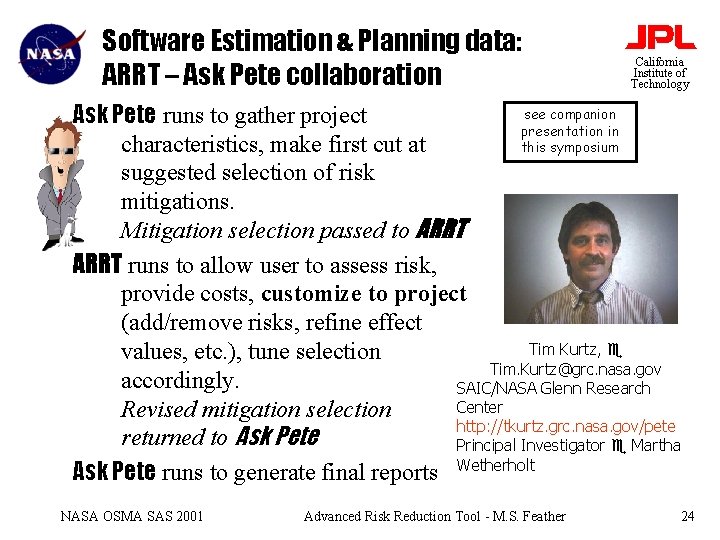
Software Estimation & Planning data: ARRT – Ask Pete collaboration California Institute of Technology see companion Ask Pete runs to gather project presentation in characteristics, make first cut at this symposium suggested selection of risk mitigations. Mitigation selection passed to ARRT runs to allow user to assess risk, provide costs, customize to project (add/remove risks, refine effect Tim Kurtz, e values, etc. ), tune selection Tim. Kurtz@grc. nasa. gov accordingly. SAIC/NASA Glenn Research Center Revised mitigation selection http: //tkurtz. grc. nasa. gov/pete returned to Ask Pete Principal Investigator e Martha Ask Pete runs to generate final reports Wetherholt NASA OSMA SAS 2001 Advanced Risk Reduction Tool - M. S. Feather 24
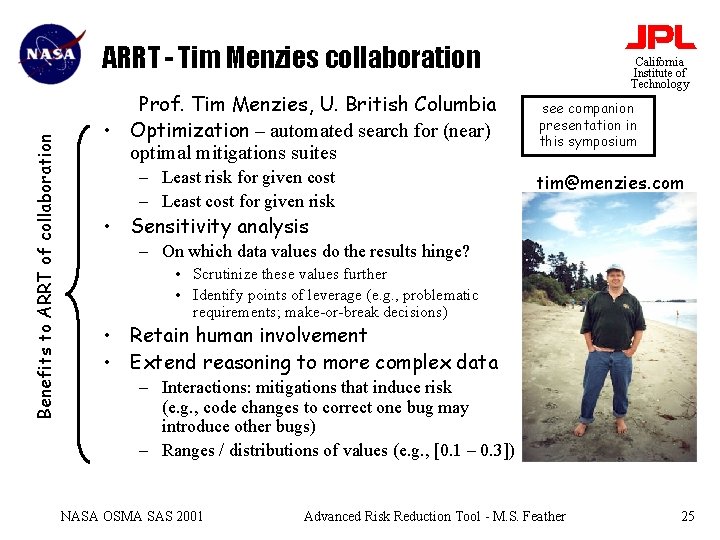
Benefits to ARRT of collaboration ARRT - Tim Menzies collaboration Prof. Tim Menzies, U. British Columbia • Optimization – automated search for (near) optimal mitigations suites – Least risk for given cost – Least cost for given risk California Institute of Technology see companion presentation in this symposium tim@menzies. com • Sensitivity analysis – On which data values do the results hinge? • Scrutinize these values further • Identify points of leverage (e. g. , problematic requirements; make-or-break decisions) • Retain human involvement • Extend reasoning to more complex data – Interactions: mitigations that induce risk (e. g. , code changes to correct one bug may introduce other bugs) – Ranges / distributions of values (e. g. , [0. 1 – 0. 3]) NASA OSMA SAS 2001 Advanced Risk Reduction Tool - M. S. Feather 25
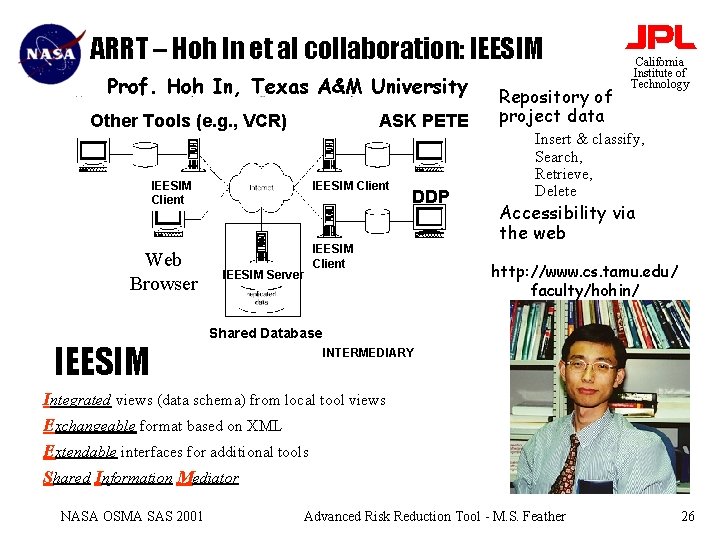
ARRT – Hoh In et al collaboration: IEESIM Prof. Hoh In, Texas A&M University Other Tools (e. g. , VCR) ASK PETE IEESIM Client Web Browser IEESIM Client IEESIM Server DDP IEESIM Client Repository of project data California Institute of Technology Insert & classify, Search, Retrieve, Delete Accessibility via the web http: //www. cs. tamu. edu/ faculty/hohin/ Shared Database INTERMEDIARY Integrated views (data schema) from local tool views Exchangeable format based on XML Extendable interfaces for additional tools Shared Information Mediator NASA OSMA SAS 2001 Advanced Risk Reduction Tool - M. S. Feather 26
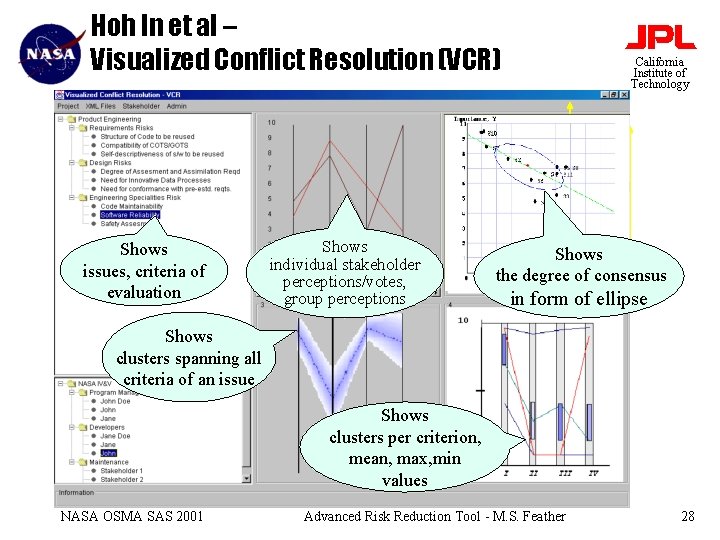
Hoh In et al – Visualized Conflict Resolution (VCR) [Hoh & Roy, 2001] ARRT data passed to VCR. Purposes: • Sophisticated Visualization California Institute of Technology see Friday’s demo at this symposium – Intuitive graphical presentations of consensus, conflict trends. – Scalable and multi-dimension visualization. • Powerful Analysis Support – Identify non-trivial interrelationships (Clustering). – Discover stakeholder decision rationales (Profiles). – Benefit-cost tradeoff analysis XML adopted as standard medium of data exchange Hoh’s visualization work Status: examples of both kinds motivated inclusion of the of data transferred & visualized NASA OSMA SAS 2001 green/yellow/red Risk chart capability into ARRT – slide 18 Advanced Risk Reduction Tool - M. S. Feather 27
Hoh In et al – Visualized Conflict Resolution (VCR) Shows issues, criteria of evaluation Shows individual stakeholder perceptions/votes, group perceptions California Institute of Technology Shows the degree of consensus in form of ellipse Shows clusters spanning all criteria of an issue Shows clusters per criterion, mean, max, min values NASA OSMA SAS 2001 Advanced Risk Reduction Tool - M. S. Feather 28
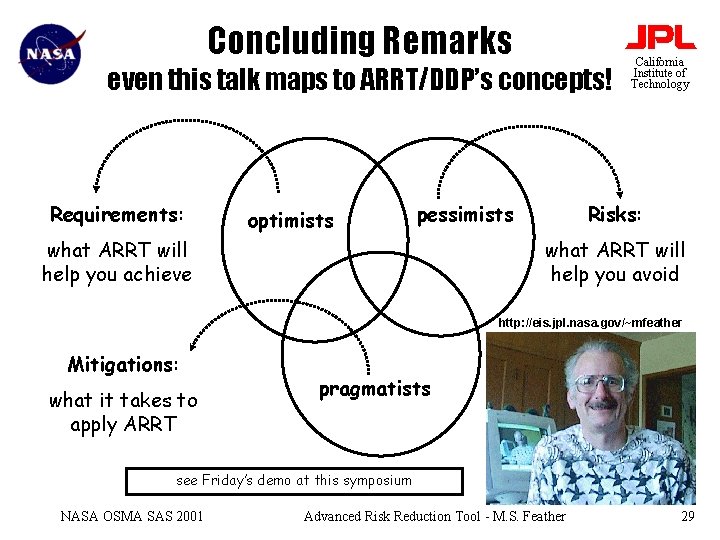
Concluding Remarks even this talk maps to ARRT/DDP’s concepts! Requirements: optimists pessimists what ARRT will help you achieve California Institute of Technology Risks: what ARRT will help you avoid http: //eis. jpl. nasa. gov/~mfeather Mitigations: what it takes to apply ARRT pragmatists see Friday’s demo at this symposium NASA OSMA SAS 2001 Advanced Risk Reduction Tool - M. S. Feather 29
References California Institute of Technology [Basili & Boehm, 2000] V. Basili & B. Boehm "Ce. Ba. SE: The Center for Empirically based Software Engineering" NASA Goddard 25 th Annual Software Engineering Workshop, 2000. [Cornford et al, 2001] S. L. Cornford, M. S. Feather & K. A. Hicks. “DDP – A tool for life-cycle risk management”, IEEE Aerospace Conference, Big Sky, Montana, Mar 2001, pp. 441 -451. [Feather et al, 2000 a] M. S. Feather, S. L. Cornford & M. Gibbel. “Scalable Mechanisms for Requirements Interaction Management”, 4 th IEEE International Conference on Requirements Engineering, Schaumburg, Illinois: 119 -129, June 2000. [Feather et al, 2000 b] M. S. Feather, S. L. Cornford & T. W. Larson. “Combining the Best Attributes of Qualitative and Quantitative Risk Management Tool Support”, 15 th IEEE International Conference on Automated Software Engineering, Grenoble, France: 309 -312, September 2000. NASA OSMA SAS 2001 Advanced Risk Reduction Tool - M. S. Feather 30
References California Institute of Technology [Graves et al, 1998] T. Graves, M. Harrold, J. Kim, A. Porter and G. Rothermel. “An Empirical Study of Regression Test Selection Techniques”. 20 th Int. Conference on Software Engineering, 1998, pp. 267 -273. [Greenfield, 1998] M. A. Greenfield “Risk Management ‘Risk As A Resource’ ” http: //www. hq. nasa. gov/office/codeq/risk/ [Hoh & Roy, 2001] H. In & S. Roy “Visualization Issues for Software Requirements Negotiation” 25 th Annual International Computer Software and Applications Conference, Chicago, IL, Oct. 2001. [Mc. Garry et al, 1998] F. Mc. Garry, S. Burke & B. Decker. Measuring the impacts individual process maturity attributes have on software products. , 5 th International Software Metrics Symposium, 1998, pp. 52 -60 NASA OSMA SAS 2001 Advanced Risk Reduction Tool - M. S. Feather 31