
ARRL FIELD DAY SIMPLIFIED Original presentation by TIM
ARRL FIELD DAY SIMPLIFIED Original presentation by TIM BUBIER, WT 1 A
Time to start thinking about Field Day 2018! • June 23 – 24, 2018 • Who, what, where, how? • Why?
Field Day 2018 This slideshow will attempt to explain: • Why? • How?
Field Day Simplified • • • Purpose of Field Day Basic Rules The Contact Exchange Scoring Station Setup Strategies
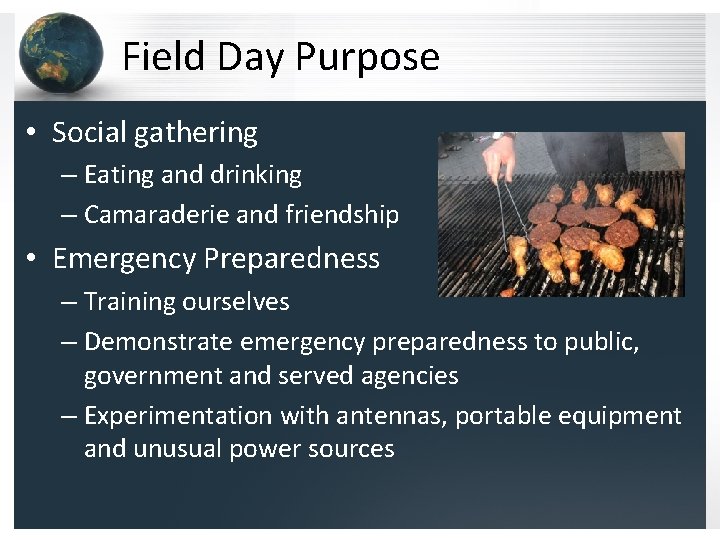
Field Day Purpose • Social gathering – Eating and drinking – Camaraderie and friendship • Emergency Preparedness – Training ourselves – Demonstrate emergency preparedness to public, government and served agencies – Experimentation with antennas, portable equipment and unusual power sources
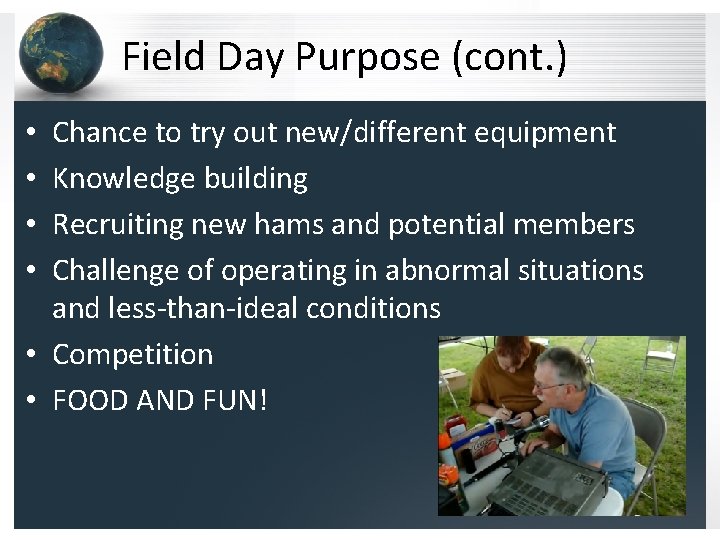
Field Day Purpose (cont. ) Chance to try out new/different equipment Knowledge building Recruiting new hams and potential members Challenge of operating in abnormal situations and less-than-ideal conditions • Competition • FOOD AND FUN! • •
Objective of Field Day • To work as many stations as possible on any and all amateur bands (excluding the 60, 30, 17, and 12 -meter bands – no repeaters) and to learn to operate in abnormal situations, in less than optimal conditions. • Field Day is open to all amateurs in the areas covered by the ARRL/RAC Field Organizations, and countries within IARU Region 2 • DX stations residing in other regions may be contacted for credit, but are not eligible to submit entries.
Motivation • Many hams profess no interest in operating radio on Field Day, but in reality they’re reluctant to participate because of: – “Mike Fright” (or “Key Fright”) – Unfamiliar with radio procedures in general – No experience on HF (but ham radio is more than 2 meter repeaters) – “Don’t like contests”
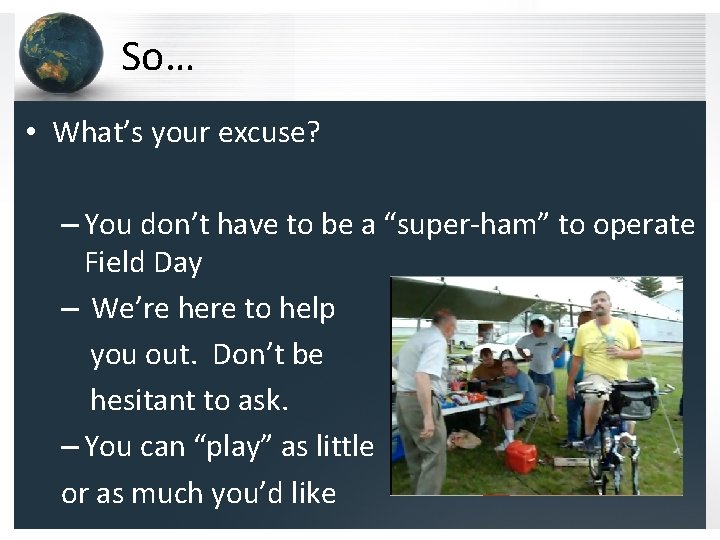
So… • What’s your excuse? – You don’t have to be a “super-ham” to operate Field Day – We’re here to help you out. Don’t be hesitant to ask. – You can “play” as little or as much you’d like
WHO CAN OPERATE FIELD DAY? • ANYONE • LICENCED HAMS CAN OPERATE ON THEIR OWN UNDER THE NORMAL RESTRICTIONS OF THEIR LICENSE, OR ON UNDER THE PERMISSIONS OF A CONTROL OPERATOR • NEWLY-LICENSED OR NONLICENSED PEOPLE ARE ENCOURAGE TO OPERATE THE GOTA STATION
What are we trying to accomplish? • Contact as many other stations as possible • On any and all amateur bands (excluding the 60, 30, 17, and 12 meter bands) • And in doing so, to learn to operate in abnormal situations in less than optimal conditions. • A premium is placed on: – developing skills to meet the challenges of emergency preparedness – acquainting the general public with the capabilities of Amateur Radio
Field Day Entry Categories • Are based on: – Number of transmitters • Total number of transmitters operating on Voice (SSB, AM, FM), CW (Morse Code) and Digital Modes • The Get On The Air (GOTA) station, along with a VHF/UHF station, do not count toward this number – Where the Station is located • In the “field”, at home, at an EOC, mobile, etc. – How Transmitters are powered • Emergency Power (Generators), Batteries, Solar, etc.
OUR OPERATION • We generally set up on Saturday morning, go through the night and then break down sometime on Sunday around noon. • We will operate 3 HF stations (CW, Phone and Digital). CW as long as we have ops then maybe digital. • We also have a dedicated VHF (6 meter) station as well as trying to make satellite contacts for bonus points
OUR OPERATION • We operate primarily on generators. We use solar charged batteries for Natural power bonus
OUR OPERATION ? Where and how do we want to operate this year?
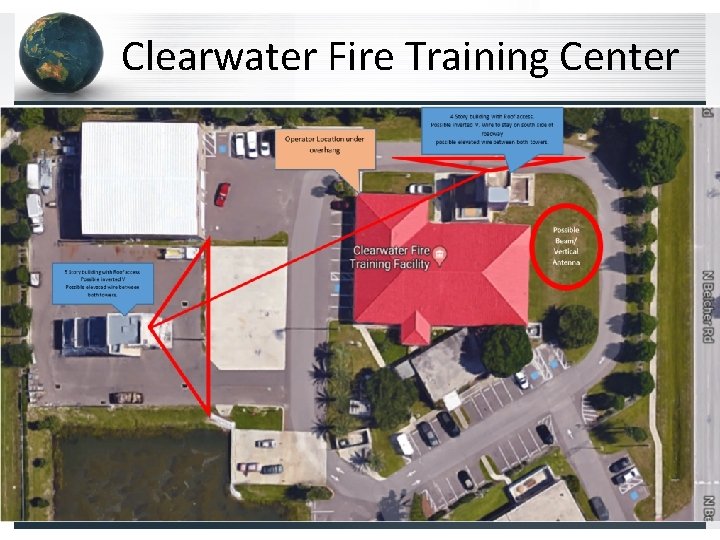
Clearwater Fire Training Center Our suggestion:
LOCATION, LOCATION • Site used for Winter Field Day • 50 foot tall fire tower for beam and slopers • Second tower for VHF station and talk-in
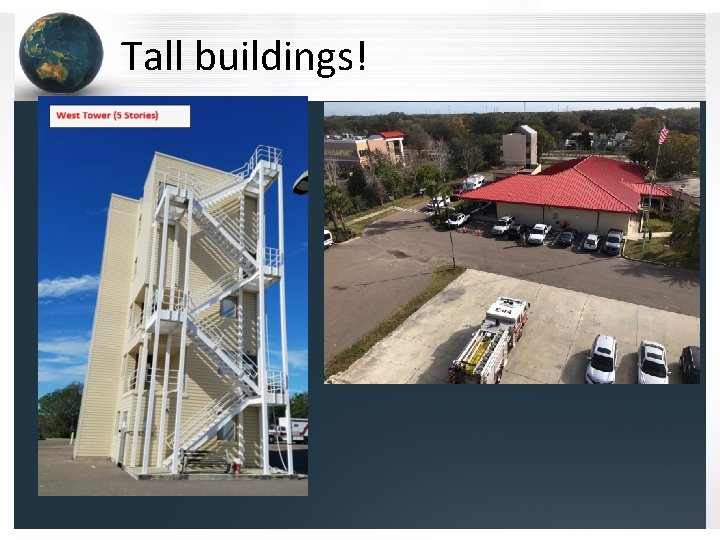
Tall buildings!
THE BASIC RULES • No new rules for 2018 • All transmitters must be within a 1000 foot circle • All transmitters must use the same call, W 4 TA
MORE RULES • Phone, CW, and Digital are considered separate “bands” • All voice contacts (SSB, FM, AM, satellite) are equivalent (1 point each) • All CW and digital contacts (PSK 31, RTTY, Packet, Pactor, etc. ) are equivalent (2 points each) • No cross--band contacts (exc. Satellite) • Only one xmtr per “band” at any time
CONTACTS • Can only work each station once per band-mode: – For example, you can work the same station once on 20 M phone, once on 20 M CW, and once on 20 M digital mode (total 5 points) – You can work the same station on other frequency bands and modes for additional points.
The Contact “Exchange” • In order to make a valid contact, the information to be exchanged consists of: – Number of transmitters at your site (3 for example) – Class of operation (A most commonly, F from EOC) – ARRL Section, State, Province or Part of State (WCF for us) • So, for us: – On CW – “ 3 A WCF” – On Phone – “Three Alpha Whiskey Charlie Foxtrot”
Exchange must be accurate • You must copy the information correctly from the other station AND… • The other station must copy your information correctly, OR ELSE… • It is not a valid contact and will be deducted from our final score
ARRL Section • 71 US and 12 Canadian Sections • Basically each US state (PR and US VI) and Canadian province • Some states/provinces are divided into multiple sections: – FL is 3 sections (NFL, WCF and SFL) – Massachusetts is 2, Eastern and Western (EMA & WMA) – New Jersey is 2 sections, Northern and Southern – Texas is 3 sections – Ontario is now 3 sections – New York is 4 sections – California is 6, etc.
ARRL Sections (continued) • Each section has a unique 2 or 3 letter identifier. • Examples: – ME = Maine – EMA = Eastern Massachusetts – LAX = Los Angeles – WTX = West Texas – NFL = Northern Florida • List can be found at each station and is prominent on most logging software – keeps track of worked sections and ones still needed.
BONUS POINTS DON’T JUST STAND AROUND – WORK ON THOSE BONUSES! HERE’S WHY AND HOW:
BONUS POINTS • 100% Emergency Power – 100 points per transmitter (except GOTA, VHF/UHF and Satellite) – Support equipment and peripherals (like computers, lights, etc. ) can be on regular commercial power • Media Publicity – 100 points • Public Location – 100 points • Originating a Message to Section Manager – 100 points. • Handling Messages – 10 points per, max 100 pts.
BONUS POINTS • Satellite QSO (just 1) – 100 points • Demo of Natural Power – 100 points (bicycle generator, solar panel, wind turbine) – Need to make 5 contacts minimum – Counts as one of the transmitters while in use – Includes batteries charged by alternate power (like a solar panel, for example) • Copying the special CW FD Bulletin from W 1 AW. (must be copied over the air) – 100 points
BONUS POINTS • Site Visit by an invited Elected Government Official (Fire Chief? )– 100 points • Site Visit by Served Agency Group Rep. (Red Cross, Salvation Army, local EMA, Law Enforcement, etc. ) – 100 points • Public Information Table – 100 points • Educational Activity (must be a “related to amateur radio” and a “formal activity”) – 100 points
BONUS POINTS • Web Submission of Field Day entry (when sent in to the proper web sit) – 50 points • Youth Participation – 20 points for each participant age 18 or younger who completes at least one QSO – Max. of 100 points
Basic Field Day Operating Strategies • Search and Pounce (S&P) • You roam around the bands looking for other stations calling CQ • Calling CQ • You sit on an open frequency and call CQ waiting to others to respond
Search and Pounce (S&P) • You can be selective about who you contact • Useful in contests where multipliers are ARRL sections, DX zones • You can intentionally avoid stations with big pile ups (many stations calling the same station) which wastes time and reduce your “Q Rate” (number of contacts (QSOs) per minute or hour) • You must check the log to make sure the calling station is not a “Dupe” (duplicate of earlier QSO)
Calling CQ • You never know who will answer • May not work as many multipliers (sections) • Usually can work a lot more stations (more points, higher “Q Rate”) • Can be even easier using a voice keyer (recorded voice message) • May have to handle a pile-up (good practice for upcoming W 1 AW/1 operations) • Can get tiring if you call by voice and no one answers
Example of Good Phone Exchange • You call: CQ Field Day, CQ Field Day from W 4 TA, Whisky Four Tengo Alpha • Someone answers: W 4 TA here is November Four Alpha Whiskey Baker • N 4 AWB, please copy Three Alpha, West Central Florida • QSL, please copy Four Alpha, South Florida, Four Alpha SFL, over • QSL, thanks for South Florida and good luck in Field Day. QRZ from Whiskey Four Tengo Alpha
Bad Example of Phone Exchange • You call: CQ Field Day, CQ Field Day from W 4 TA, Whiskey Four Tengo Alpha • Someone answers: W 4 TA from November Four Alpha Whiskey Baker. Four Alpha South Florida • N 4 AWB didn’t give you a chance to get his call before he sent his exchange and section. You are probably still trying to type in his call and he’s wasting time by giving it all at once so you need to ask him to repeat. • Take your time and make sure you get everything right before moving on. • Saves time and increases points.
Phonetics on Phone • Phone operators must use the ITU Phonetics: – A = Alpha – B = Bravo – C = Charlie – D = Delta – Etc. • A sheet with a complete list is also at each station
OPERATING HINTS Some good operating strategies for Phone, CW and Digital Modes
Hints for Working Phone • When Searching and Pouncing, enter calling station’s call in software FIRST, this way you don’t waste time calling a Dupe • Use phonetics for all of the exchange. • Repeat the other station’s exchange to make sure you got it right. “Thanks for South Florida” only takes an extra second and can help make sure you got it right the first time.
Hints for Working Phone • Don’t call at station with a pile up more than just a few of times. This wastes time and you can always come back to them later. Chances are, if they’re strong you’ll hear them again and, if they’re not, they won’t hear you anyway. • Don’t be long winded while calling CQ. Call a few times then listen. Call again if no one responds. • Keep your exchanges short and to the point. If you’ve been calling CQ, some stations will be impatient and leave before they call you if you’re going on about the weather and other stuff while they’re waiting.
Hints for Working Phone • Don’t be afraid to ask for repeats. If you can’t hear them the first time or forget to record it, just say, “Please repeat your… (call sign, section, etc. )” If you still can’t make it out, say, “Just you call, your call please” or “Just your section, ” etc. That sometimes makes it easier to make out without all the other stuff you don’t need and saves time. • Repeat only if asked. • Be patient – Many new operators on during Field Day
Hints for Digital Modes • PSK 31 and RTTY are the most popular Field Day Digital Modes • The macros for Field Day should be set up just like those for CW. In other words, CQ should be something like: “CQ FD de W 4 TA k” • No need for useless data like “thanks for…” or spelling out “West Central Florida” • Digital is a good use of the CW transmitter when there are no CW operators around. It’s easy and pretty foolproof if the right Macros are used.
- Slides: 41