
Arrhenius Equation Svante Arrhenius developed a mathematical relationship
- Slides: 5
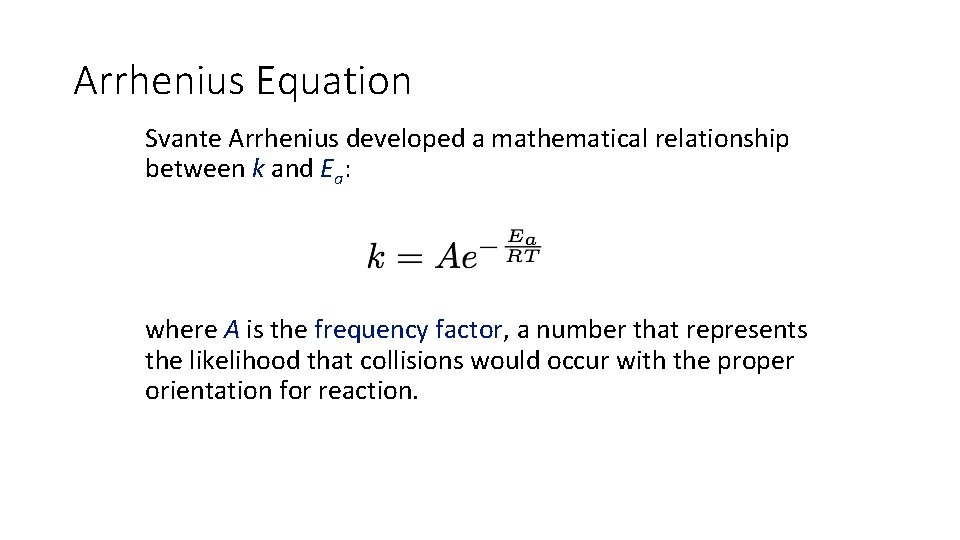
Arrhenius Equation Svante Arrhenius developed a mathematical relationship between k and Ea: where A is the frequency factor, a number that represents the likelihood that collisions would occur with the proper orientation for reaction.
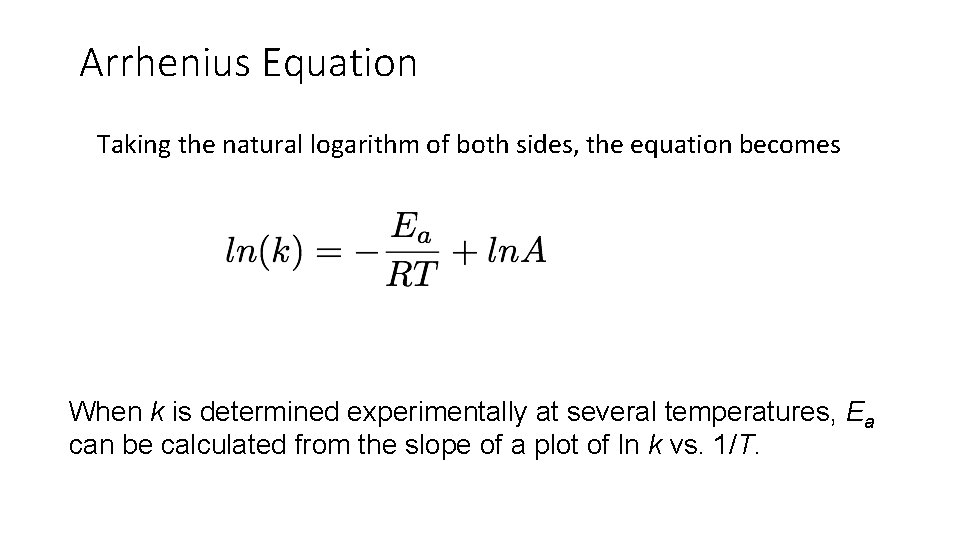
Arrhenius Equation Taking the natural logarithm of both sides, the equation becomes When k is determined experimentally at several temperatures, Ea can be calculated from the slope of a plot of ln k vs. 1/T.
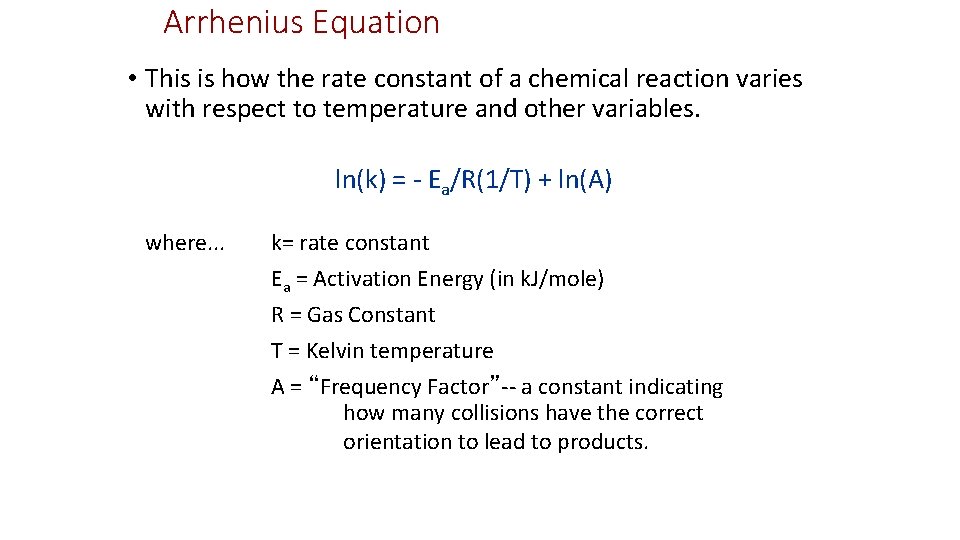
Arrhenius Equation • This is how the rate constant of a chemical reaction varies with respect to temperature and other variables. ln(k) = - Ea/R(1/T) + ln(A) where. . . k= rate constant Ea = Activation Energy (in k. J/mole) R = Gas Constant T = Kelvin temperature A = “Frequency Factor”-- a constant indicating how many collisions have the correct orientation to lead to products.
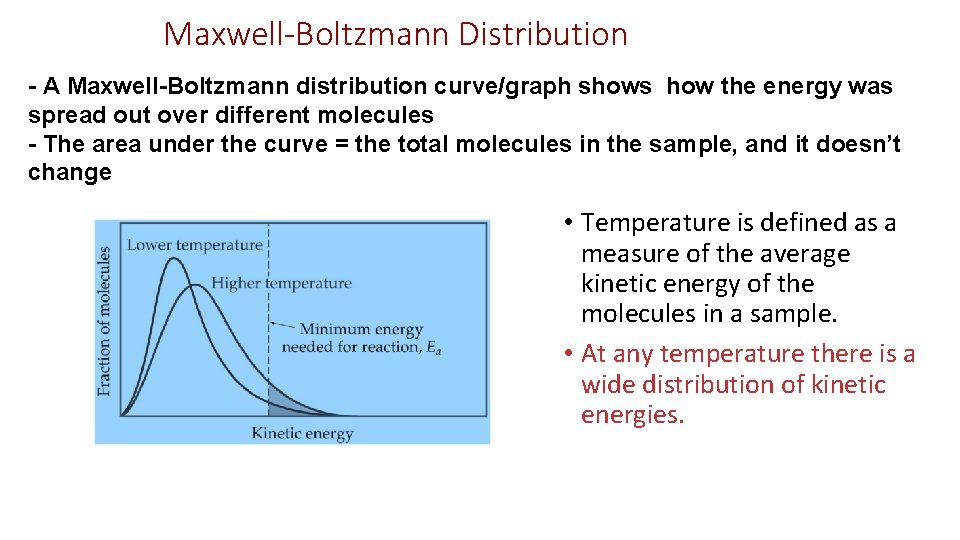
Maxwell-Boltzmann Distribution - A Maxwell-Boltzmann distribution curve/graph shows how the energy was spread out over different molecules - The area under the curve = the total molecules in the sample, and it doesn’t change • Temperature is defined as a measure of the average kinetic energy of the molecules in a sample. • At any temperature there is a wide distribution of kinetic energies.
Maxwell–Boltzmann Distributions • As the temperature increases, the curve flattens and broadens. • Thus at higher temperatures, a larger population of molecules has higher energy.