
Arrays and records Programming Language Design and Implementation

![Array accessing (continued) Rewriting access equation: L-value(A[I, J]) = - d 1*L 1 -](https://slidetodoc.com/presentation_image_h/d5a0032dbca358476a7397ad699321bd/image-7.jpg "Array accessing (continued) Rewriting access equation: L-value(A[I, J]) = - d 1*L 1 -")
![Array example Given following array: var A: array [7. . 12, 14. . 16]](https://slidetodoc.com/presentation_image_h/d5a0032dbca358476a7397ad699321bd/image-10.jpg "Array example Given following array: var A: array [7. . 12, 14. . 16]")
![Array slices Given array : A[L 1: U 1, L 2: U 2]: Give](https://slidetodoc.com/presentation_image_h/d5a0032dbca358476a7397ad699321bd/image-13.jpg "Array slices Given array : A[L 1: U 1, L 2: U 2]: Give")
![More on slices Diagonal slices: VO = L-value(A[L 1, L 2]) - d 1*L](https://slidetodoc.com/presentation_image_h/d5a0032dbca358476a7397ad699321bd/image-14.jpg "More on slices Diagonal slices: VO = L-value(A[L 1, L 2]) - d 1*L")
![Union types typedef union { int X; float Y; char Z[4]; } B; B](https://slidetodoc.com/presentation_image_h/d5a0032dbca358476a7397ad699321bd/image-18.jpg "Union types typedef union { int X; float Y; char Z[4]; } B; B")
- Slides: 21
Arrays and records Programming Language Design and Implementation (4 th Edition) by T. Pratt and M. Zelkowitz Prentice Hall, 2001 Section 6. 1 Arrays and records
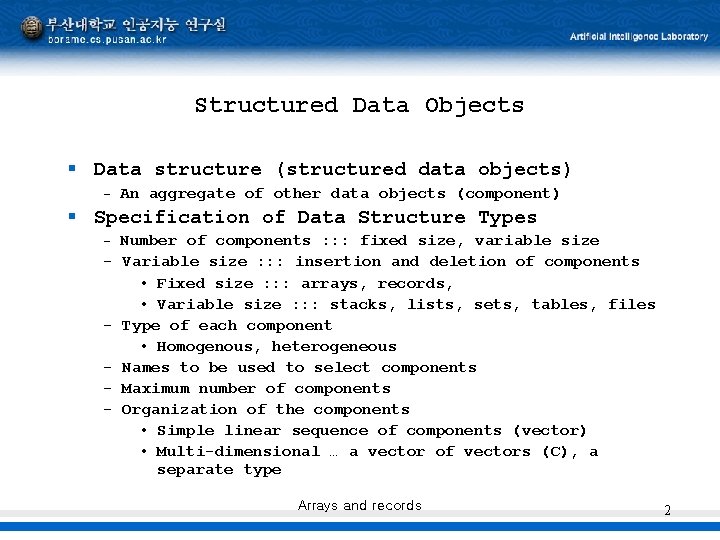
Structured Data Objects § Data structure (structured data objects) - An aggregate of other data objects (component) § Specification of Data Structure Types - Number of components : : : fixed size, variable size - Variable size : : : insertion and deletion of components • Fixed size : : : arrays, records, • Variable size : : : stacks, lists, sets, tables, files - Type of each component • Homogenous, heterogeneous - Names to be used to select components - Maximum number of components - Organization of the components • Simple linear sequence of components (vector) • Multi-dimensional … a vector of vectors (C), a separate type Arrays and records 2
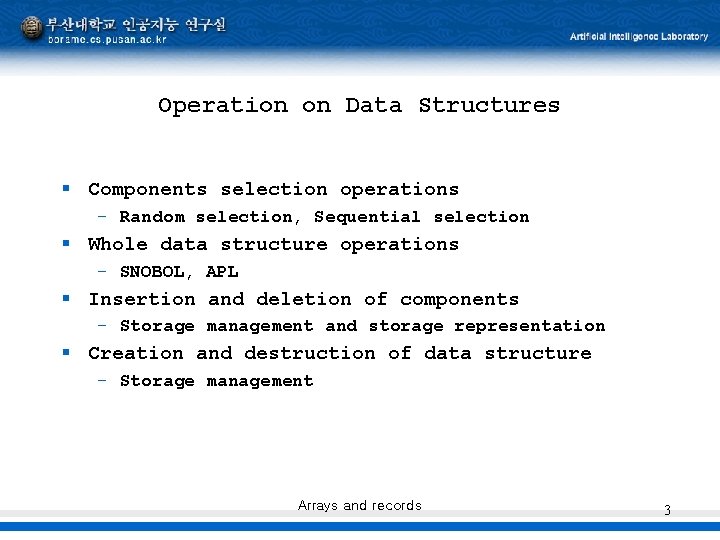
Operation on Data Structures § Components selection operations – Random selection, Sequential selection § Whole data structure operations – SNOBOL, APL § Insertion and deletion of components – Storage management and storage representation § Creation and destruction of data structure – Storage management Arrays and records 3
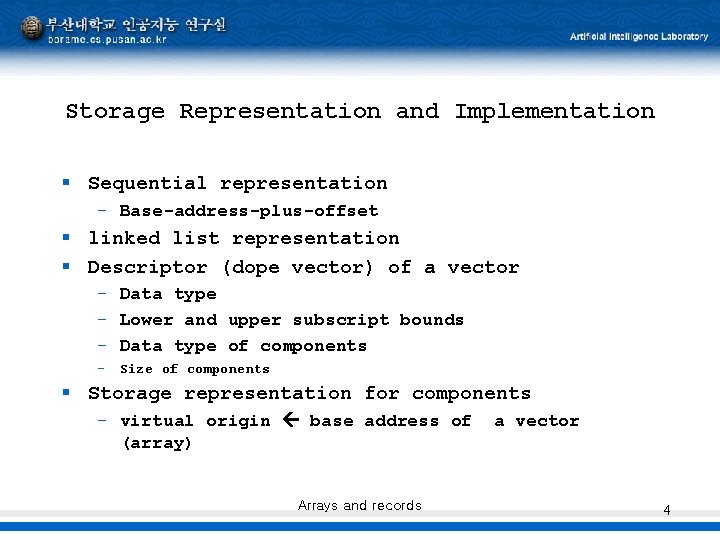
Storage Representation and Implementation § Sequential representation – Base-address-plus-offset § linked list representation § Descriptor (dope vector) of a vector – Data type – Lower and upper subscript bounds – Data type of components – Size of components § Storage representation for components – virtual origin base address of (array) Arrays and records a vector 4
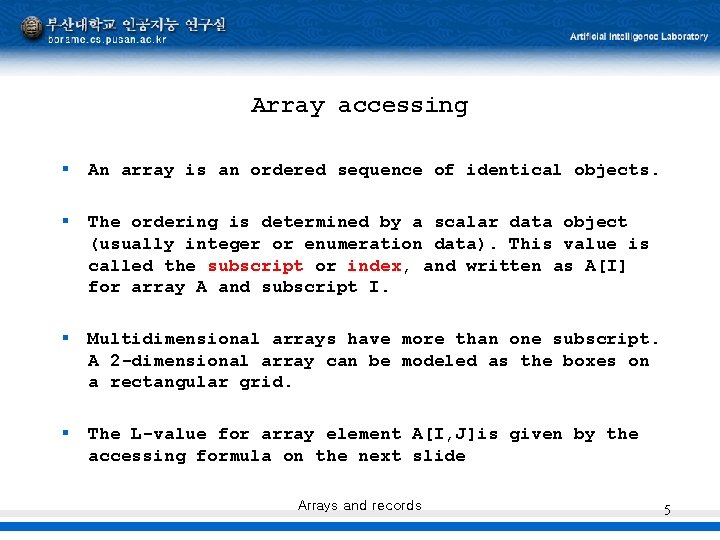
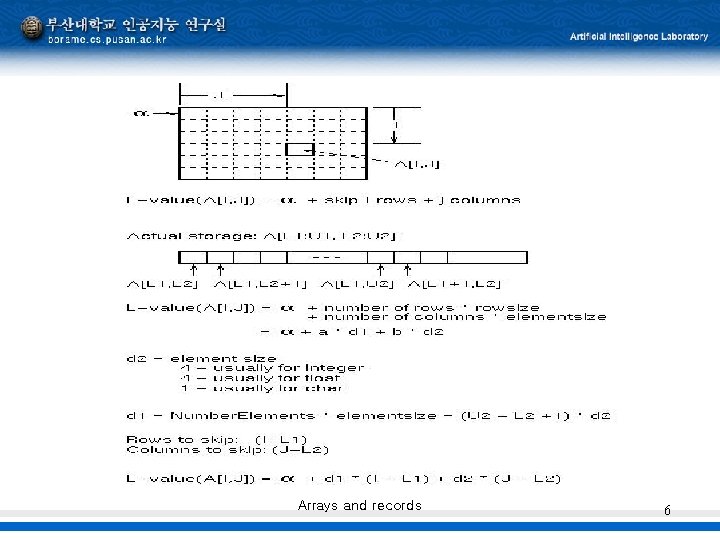
Array accessing § An array is an ordered sequence of identical objects. § The ordering is determined by a scalar data object (usually integer or enumeration data). This value is called the subscript or index, and written as A[I] for array A and subscript I. § Multidimensional arrays have more than one subscript. A 2 -dimensional array can be modeled as the boxes on a rectangular grid. § The L-value for array element A[I, J]is given by the accessing formula on the next slide Arrays and records 5
Arrays and records 6
Array accessing (continued) Rewriting access equation: L-value(A[I, J]) = - d 1*L 1 - d 2*L 2 +I*d 1 + J*d 2 Set I = 0; J= 0; L-value(A[0, 0]) = - d 1*L 1 - d 2*L 2 +0*d 1 + 0*d 2 L-value(A[0, 0]) = - d 1*L 1 - d 2*L 2, which is a constant. Call this constant the virtual origin (VO); It represents the address of the 0 th element of the array. L-value(A[I, J]) = VO +I*d 1 + J*d 2 To access an array element, typically use a dope vector: Arrays and records 7
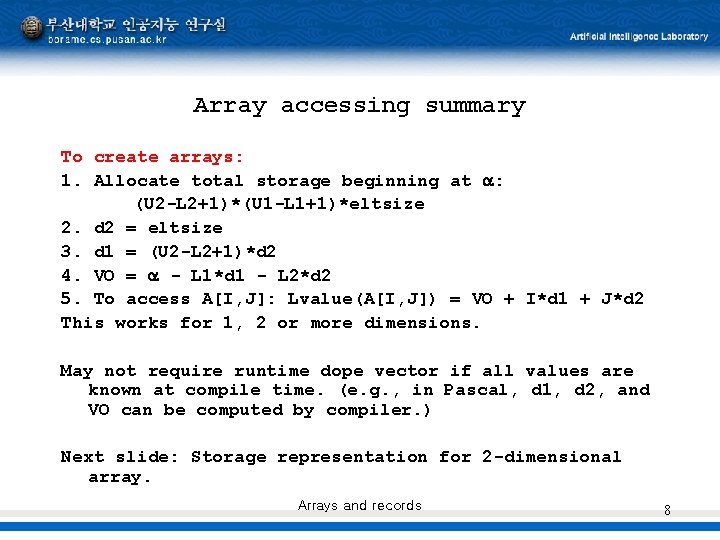
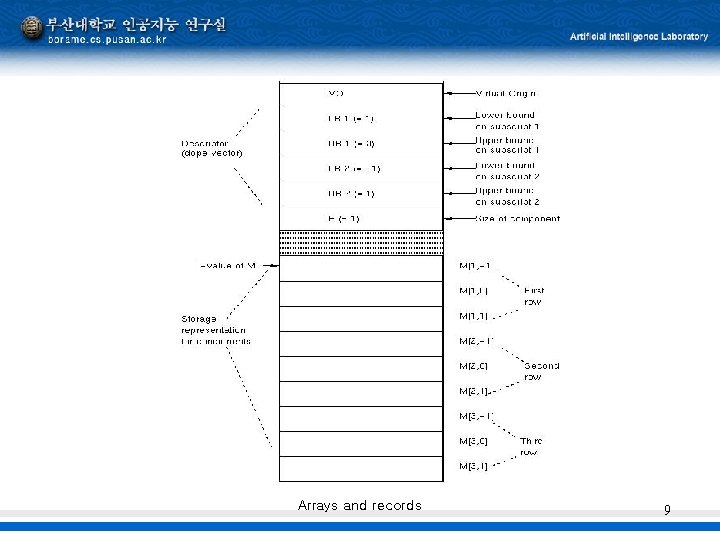
Array accessing summary To create arrays: 1. Allocate total storage beginning at : (U 2 -L 2+1)*(U 1 -L 1+1)*eltsize 2. d 2 = eltsize 3. d 1 = (U 2 -L 2+1)*d 2 4. VO = - L 1*d 1 - L 2*d 2 5. To access A[I, J]: Lvalue(A[I, J]) = VO + I*d 1 + J*d 2 This works for 1, 2 or more dimensions. May not require runtime dope vector if all values are known at compile time. (e. g. , in Pascal, d 1, d 2, and VO can be computed by compiler. ) Next slide: Storage representation for 2 -dimensional array. Arrays and records 8
Arrays and records 9
Array example Given following array: var A: array [7. . 12, 14. . 16] of real; Give dope vector if array stored beginning at location 500. d 2 = 4 (real data) d 1 = (16 -14+1) * 4 = 3 * 4 = 12 VO = 500 - 7 * 12 - 14 * 4 = 500 - 84 - 56 = 360 L-value(A[I, J]) = 360 + 12* I + 4* J 1. VO can be a positive or negative value, and can have an address that is before, within, or after the actual storage for the array: 2. In C, VO = since bounds start at 0. Example: char A[25] L-value(A[I]) = VO + (I-L 1) * d 1 = + I * 1 = + I Arrays and records 10
Indexing Methods § § Column Major – FORTRAN Low major – C, Pascal, … Arrays and records 11
Slices Arrays and records 12
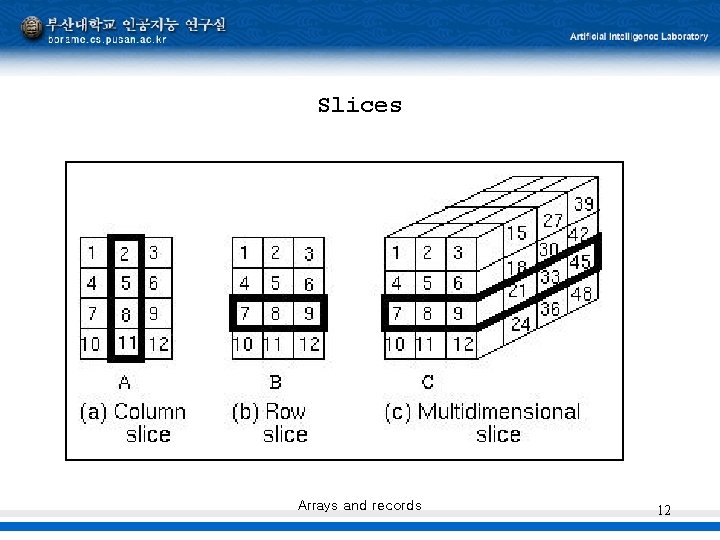
Array slices Given array : A[L 1: U 1, L 2: U 2]: Give d 1, d 2, and VO for vector: Dope vector A[I, *] = B[L 2: U 2] VO = L-value(A[I, L 2]) - d 2*L 2 M 1 = eltsize = d 2 Dope vector A[*, J] = B[L 1: U 1] VO = L-value(A[L 1, J]) - d 1*L 1 M 1 = rowsize = d 1 Create new dope vector that accesses original data Arrays and records 13
More on slices Diagonal slices: VO = L-value(A[L 1, L 2]) - d 1*L 1 - d 2*L 2 M 1 = d 1 + d 2 Other possibilities: Arrays and records 14
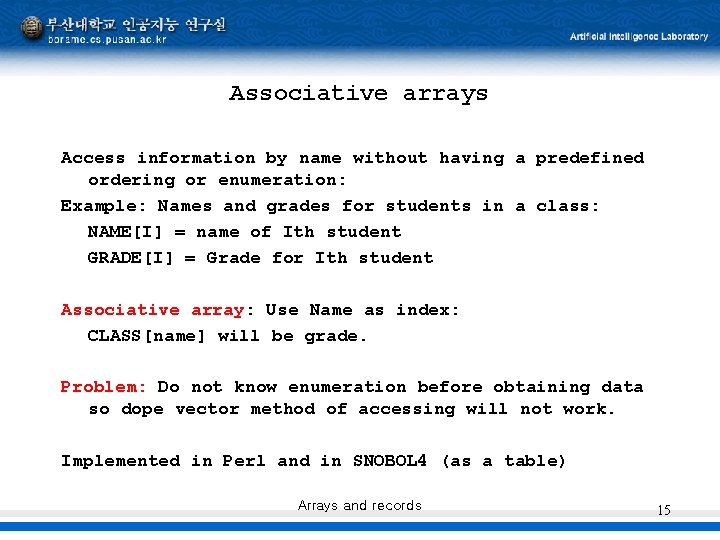
Associative arrays Access information by name without having a predefined ordering or enumeration: Example: Names and grades for students in a class: NAME[I] = name of Ith student GRADE[I] = Grade for Ith student Associative array: Use Name as index: CLASS[name] will be grade. Problem: Do not know enumeration before obtaining data so dope vector method of accessing will not work. Implemented in Perl and in SNOBOL 4 (as a table) Arrays and records 15
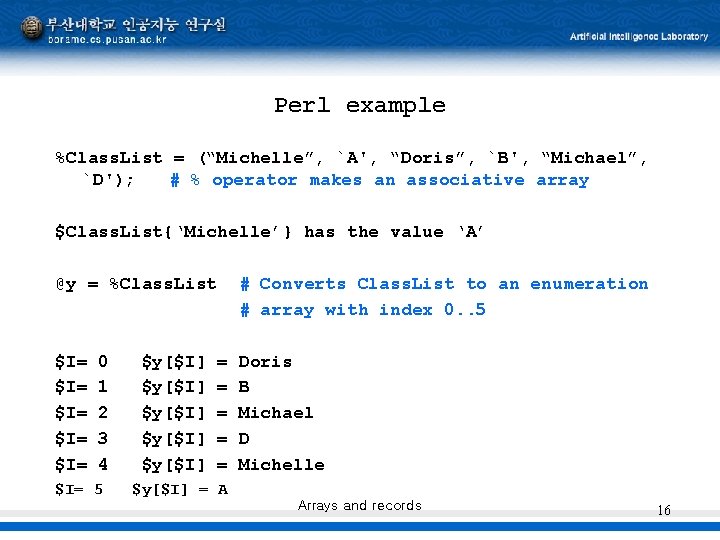
Perl example %Class. List = (“Michelle”, `A', “Doris”, `B', “Michael”, `D'); # % operator makes an associative array $Class. List{‘Michelle’} has the value ‘A’ @y = %Class. List # Converts Class. List to an enumeration # array with index 0. . 5 $I= $I= $I= Doris B Michael D Michelle 0 1 2 3 4 $I= 5 $y[$I] $y[$I] = = = $y[$I] = A Arrays and records 16
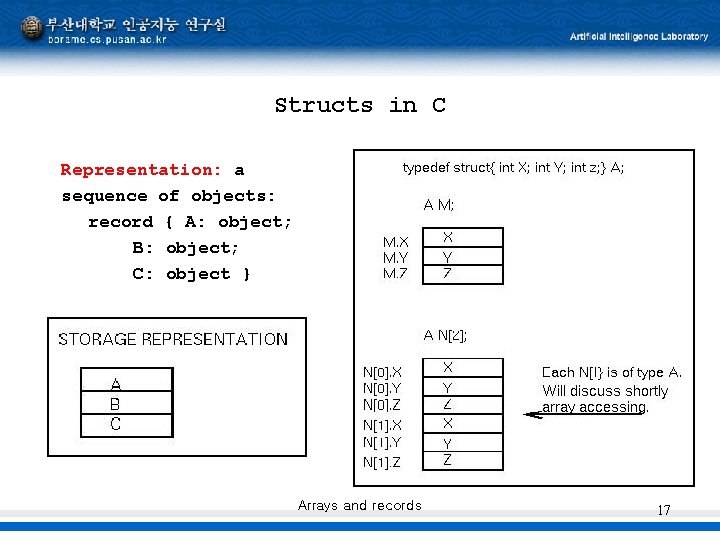
Structs in C Representation: a sequence of objects: record { A: object; B: object; C: object } Arrays and records 17
Union types typedef union { int X; float Y; char Z[4]; } B; B P; Similar to records, except all have overlapping (same) L-value. But problems can occur. What happens below? P. X = 142; printf(“%On”, P. Z[3]) All 3 data objects have same L-value and occupy same storage. No enforcement of type checking. Poor language design Arrays and records 18
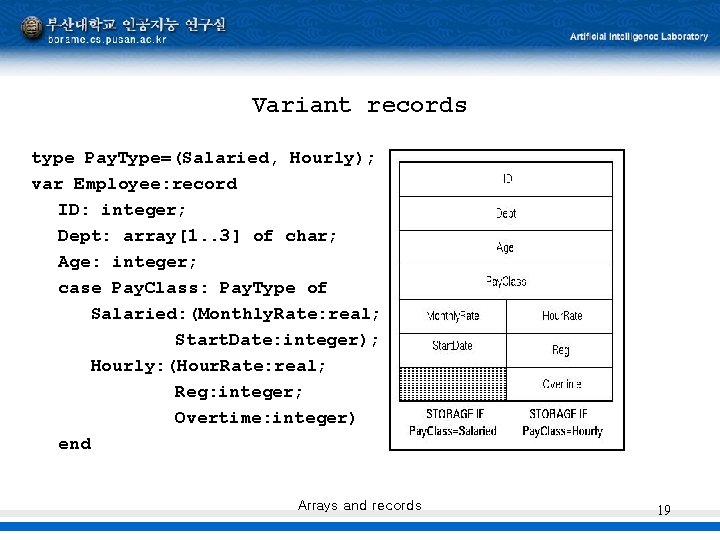
Variant records type Pay. Type=(Salaried, Hourly); var Employee: record ID: integer; Dept: array[1. . 3] of char; Age: integer; case Pay. Class: Pay. Type of Salaried: (Monthly. Rate: real; Start. Date: integer); Hourly: (Hour. Rate: real; Reg: integer; Overtime: integer) end Arrays and records 19
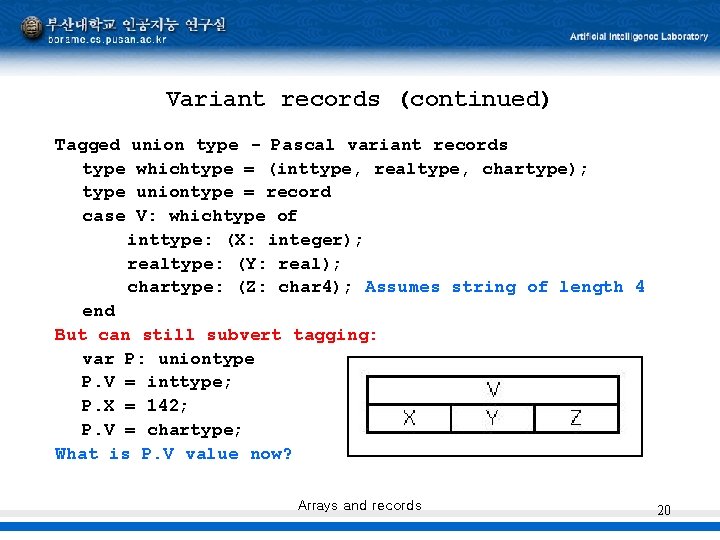
Variant records (continued) Tagged type case union type - Pascal variant records whichtype = (inttype, realtype, chartype); uniontype = record V: whichtype of inttype: (X: integer); realtype: (Y: real); chartype: (Z: char 4); Assumes string of length 4 end But can still subvert tagging: var P: uniontype P. V = inttype; P. X = 142; P. V = chartype; What is P. V value now? Arrays and records 20
Lists, Sets § § Not fixed, not homogenous Lisp의 자료구조 설명 car, cdr, cons § Stacks, queues, trees, directed graphs, property list § Property lists (table, description list) – Property name (attribute) – property value (value) § Sets – Elements: membership, insertion. deletion – Sets: union. intersection, difference – Implementation : : : Hashing elements에 대한 operations은 쉬우나, set 간의 연산은 어려움 Arrays and records 21