
Array CGH diagnosing developmental disorders Nigel P Carter
- Slides: 33
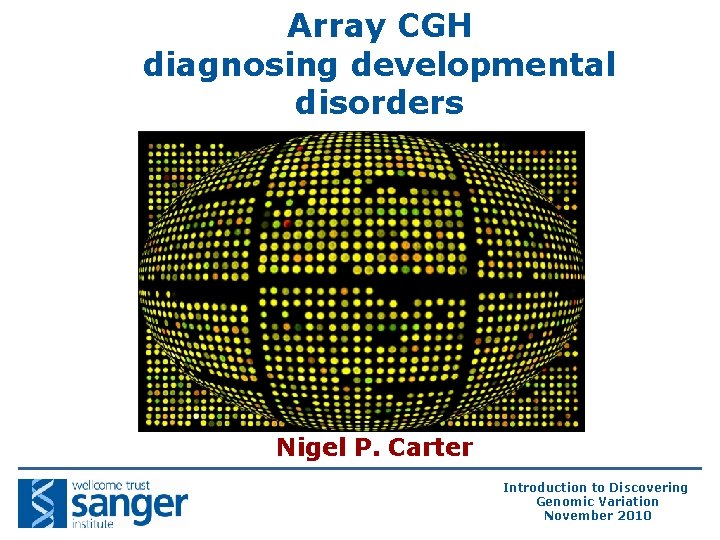
Array CGH diagnosing developmental disorders Nigel P. Carter Introduction to Discovering Genomic Variation November 2010
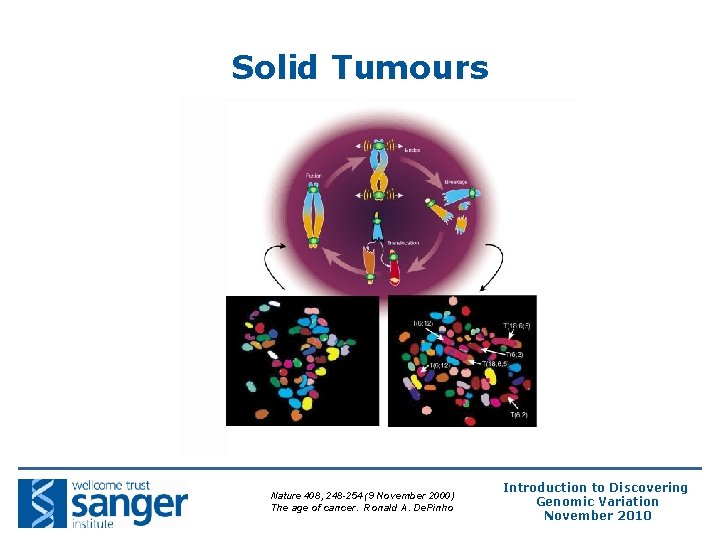
Solid Tumours Nature 408, 248 -254 (9 November 2000) The age of cancer. Ronald A. De. Pinho Introduction to Discovering Genomic Variation November 2010
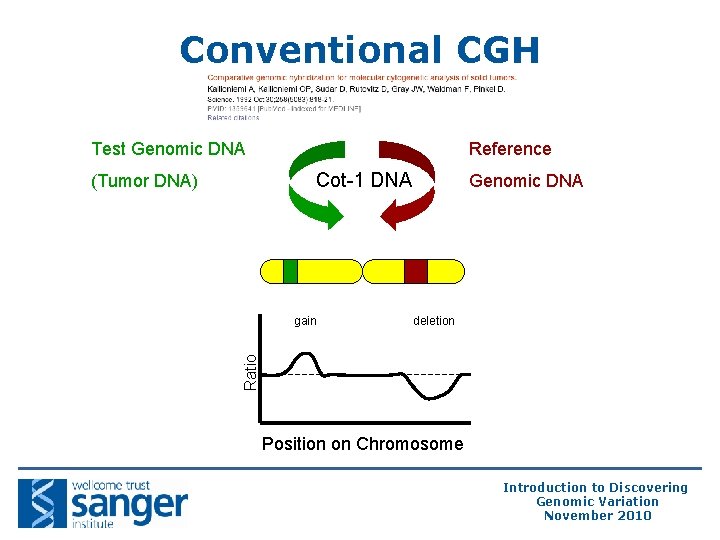
Conventional CGH Test Genomic DNA Reference Cot-1 DNA (Tumor DNA) deletion Ratio gain Genomic DNA Position on Chromosome Introduction to Discovering Genomic Variation November 2010
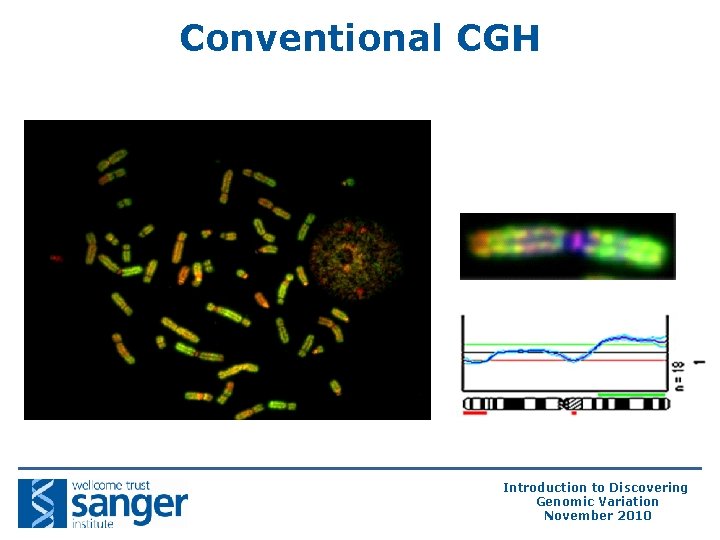
Conventional CGH Introduction to Discovering Genomic Variation November 2010
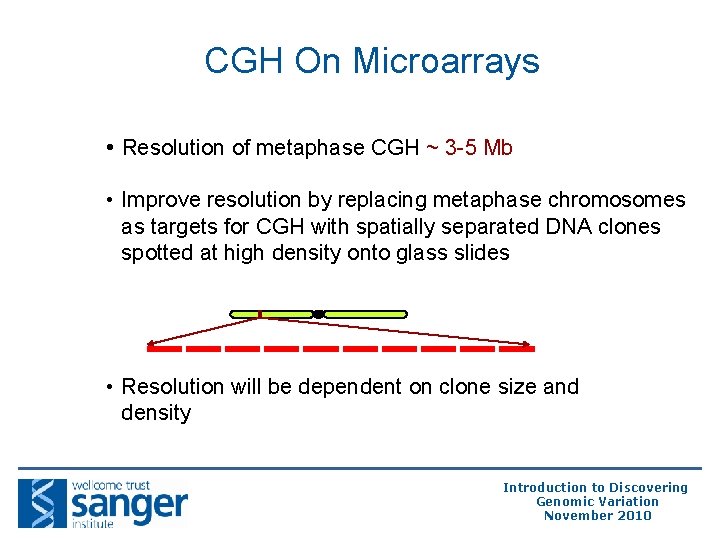
CGH On Microarrays • Resolution of metaphase CGH ~ 3 -5 Mb • Improve resolution by replacing metaphase chromosomes as targets for CGH with spatially separated DNA clones spotted at high density onto glass slides • Resolution will be dependent on clone size and density Introduction to Discovering Genomic Variation November 2010
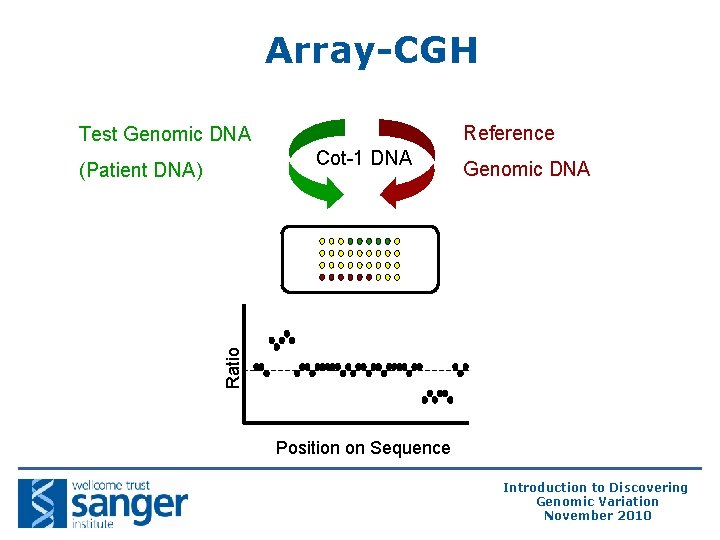
Array-CGH Reference Test Genomic DNA Cot-1 DNA Genomic DNA Ratio (Patient DNA) Position on Sequence Introduction to Discovering Genomic Variation November 2010
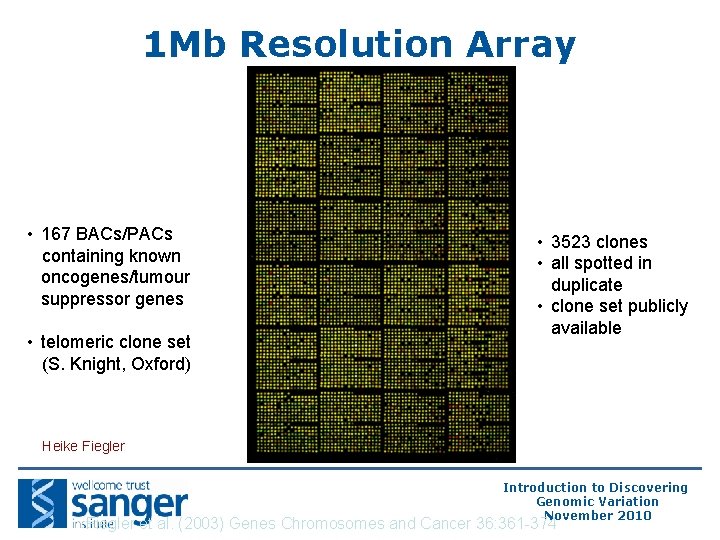
1 Mb Resolution Array • 167 BACs/PACs containing known oncogenes/tumour suppressor genes • telomeric clone set (S. Knight, Oxford) • 3523 clones • all spotted in duplicate • clone set publicly available Heike Fiegler Introduction to Discovering Genomic Variation November 2010 Fiegler et al. (2003) Genes Chromosomes and Cancer 36: 361 -374
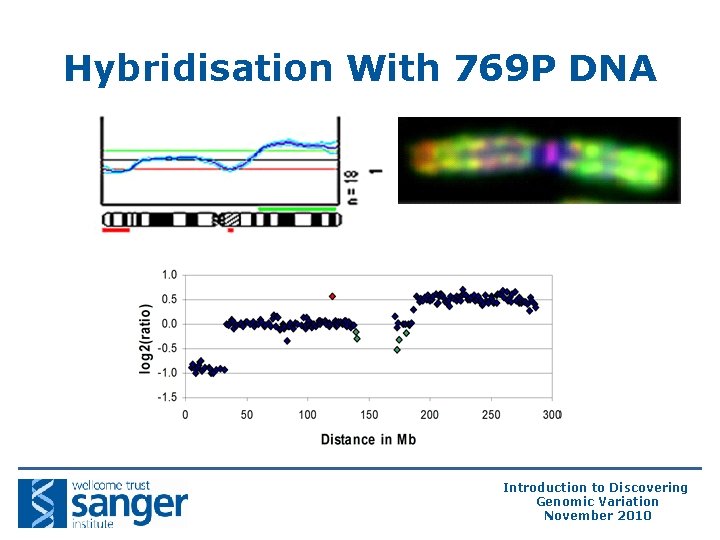
Hybridisation With 769 P DNA Introduction to Discovering Genomic Variation November 2010
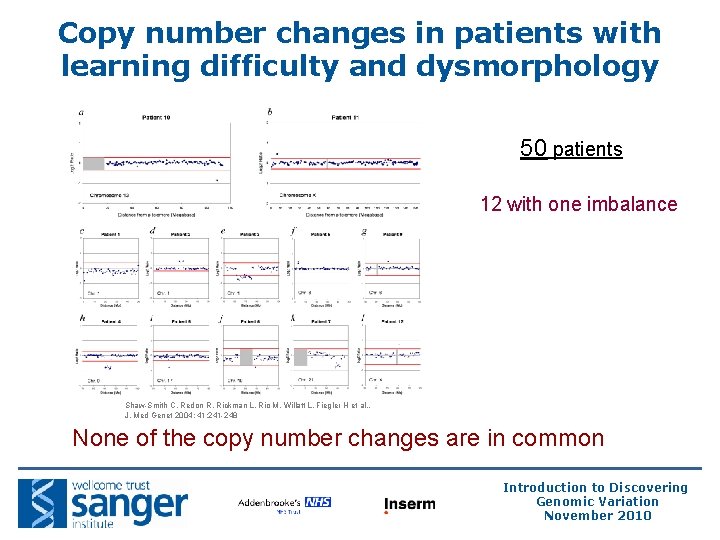
Copy number changes in patients with learning difficulty and dysmorphology 50 patients 12 with one imbalance Shaw-Smith C, Redon R, Rickman L, Rio M, Willatt L, Fiegler H et al. , J. Med Genet 2004; 41: 241 -248 None of the copy number changes are in common Introduction to Discovering Genomic Variation November 2010
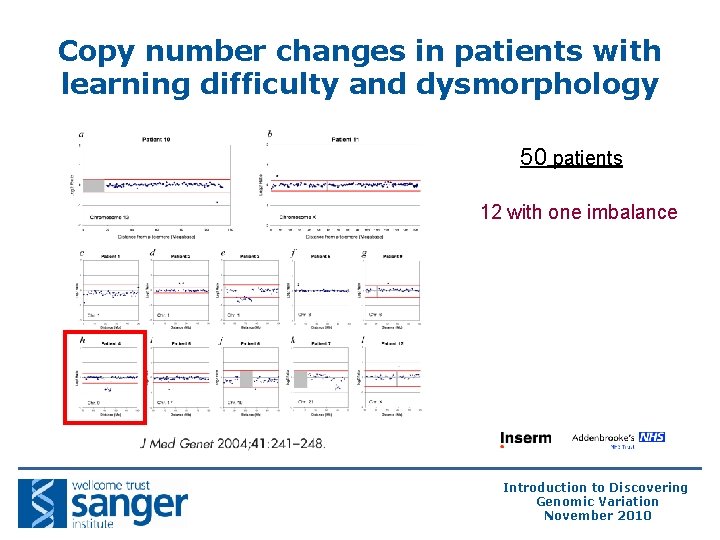
Copy number changes in patients with learning difficulty and dysmorphology 50 patients 12 with one imbalance Introduction to Discovering Genomic Variation November 2010
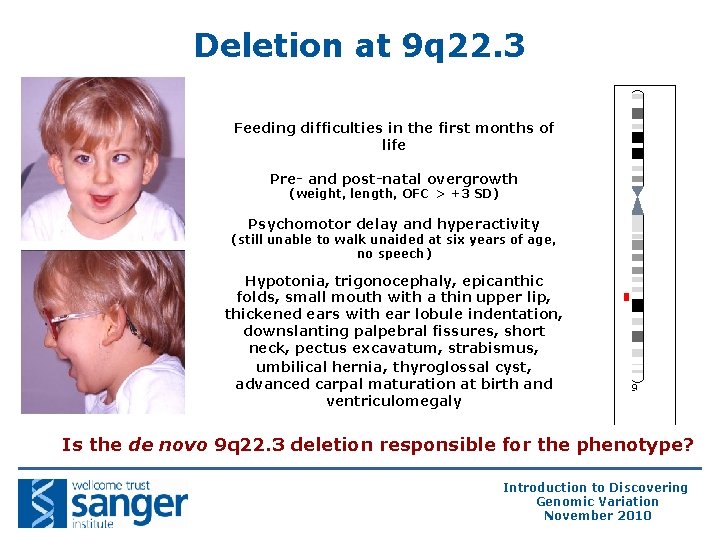
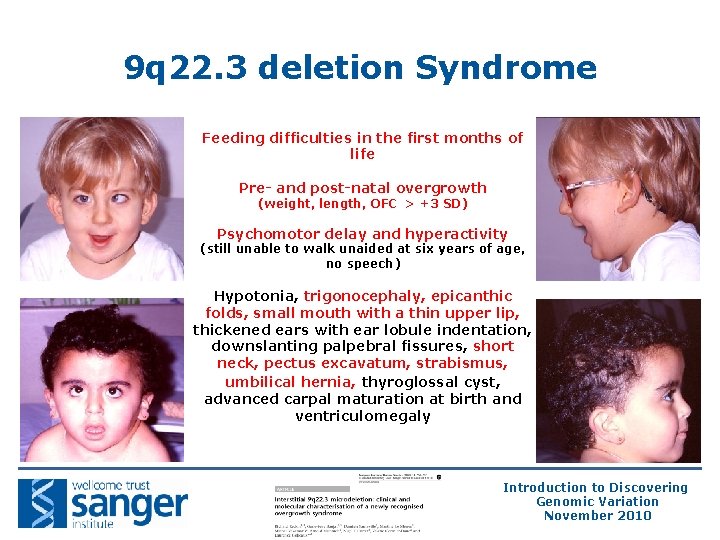
Deletion at 9 q 22. 3 Feeding difficulties in the first months of life Pre- and post-natal overgrowth (weight, length, OFC > +3 SD) Psychomotor delay and hyperactivity (still unable to walk unaided at six years of age, no speech) Hypotonia, trigonocephaly, epicanthic folds, small mouth with a thin upper lip, thickened ears with ear lobule indentation, downslanting palpebral fissures, short neck, pectus excavatum, strabismus, umbilical hernia, thyroglossal cyst, advanced carpal maturation at birth and ventriculomegaly Is the de novo 9 q 22. 3 deletion responsible for the phenotype? Introduction to Discovering Genomic Variation November 2010
Similar deletion at 9 q 22. 3 Chromosome 9 Richard Redon, Laurence Colleaux Introduction to Discovering Genomic Variation November 2010
9 q 22. 3 deletion Syndrome Feeding difficulties in the first months of life Pre- and post-natal overgrowth (weight, length, OFC > +3 SD) Psychomotor delay and hyperactivity (still unable to walk unaided at six years of age, no speech) Hypotonia, trigonocephaly, epicanthic folds, small mouth with a thin upper lip, thickened ears with ear lobule indentation, downslanting palpebral fissures, short neck, pectus excavatum, strabismus, umbilical hernia, thyroglossal cyst, advanced carpal maturation at birth and ventriculomegaly Introduction to Discovering Genomic Variation November 2010
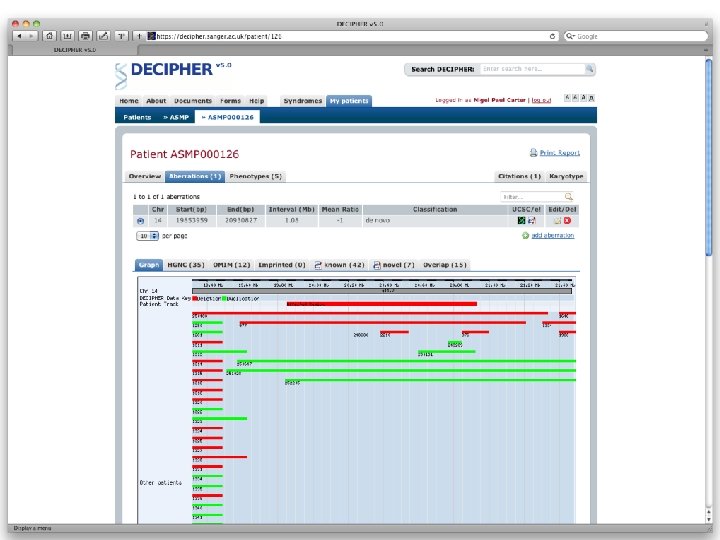
Introduction to Discovering Genomic Variation November 2010
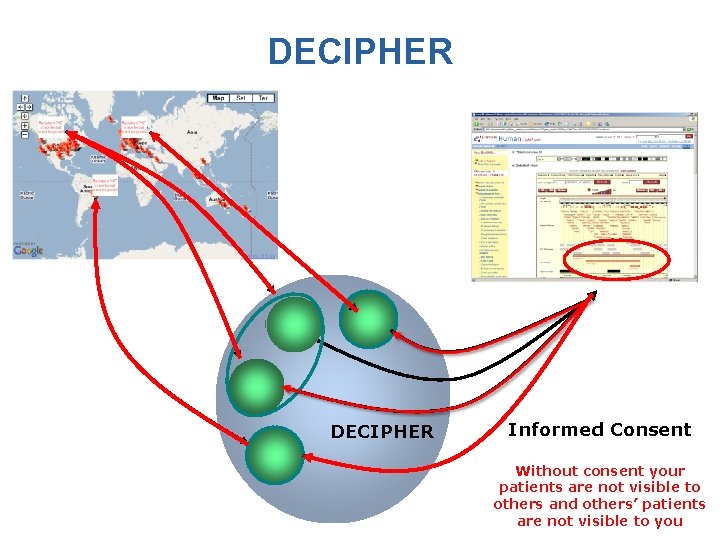
DECIPHER Informed Consent Without consent your Introduction Discovering patients aretonot visible to Genomic Variation others and others’ patients 2010 are November not visible to you
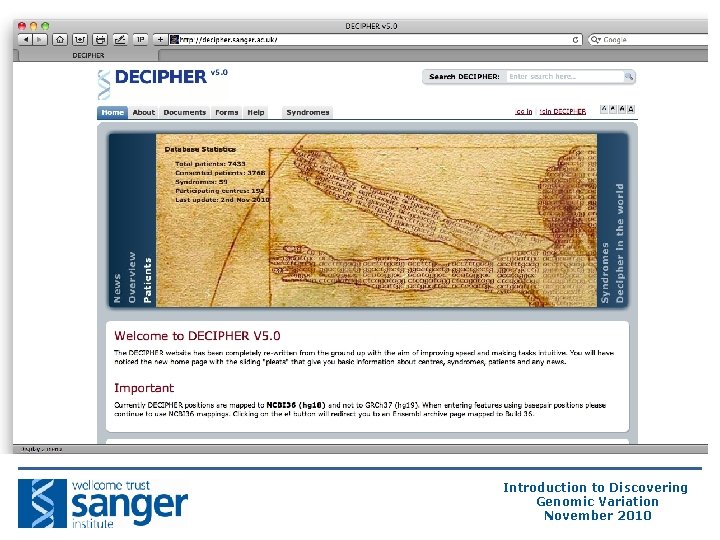
Introduction to Discovering Genomic Variation November 2010
Introduction to Discovering Genomic Variation November 2010
Introduction to Discovering Genomic Variation November 2010
Introduction to Discovering Genomic Variation November 2010
Introduction to Discovering Genomic Variation November 2010
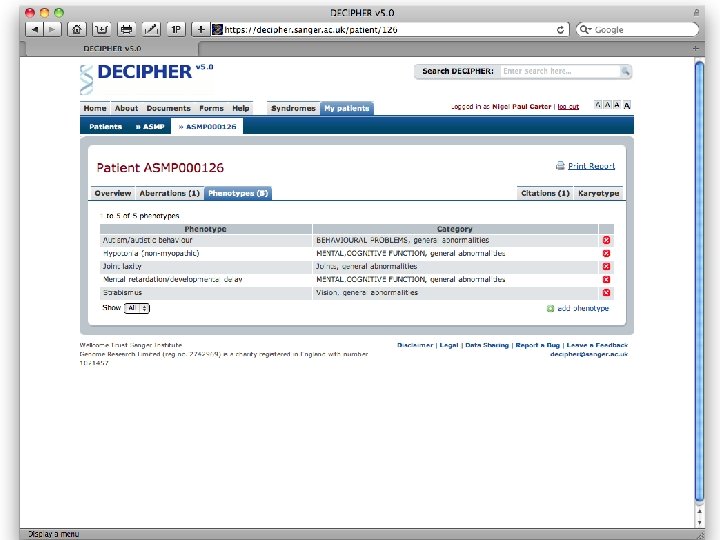
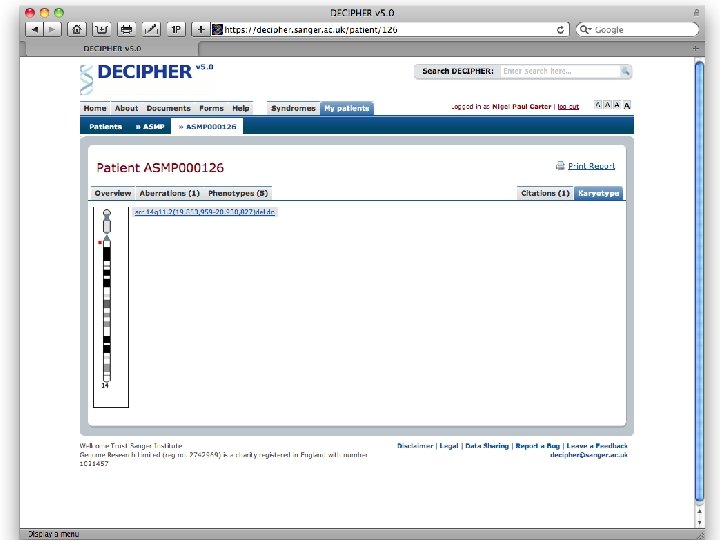
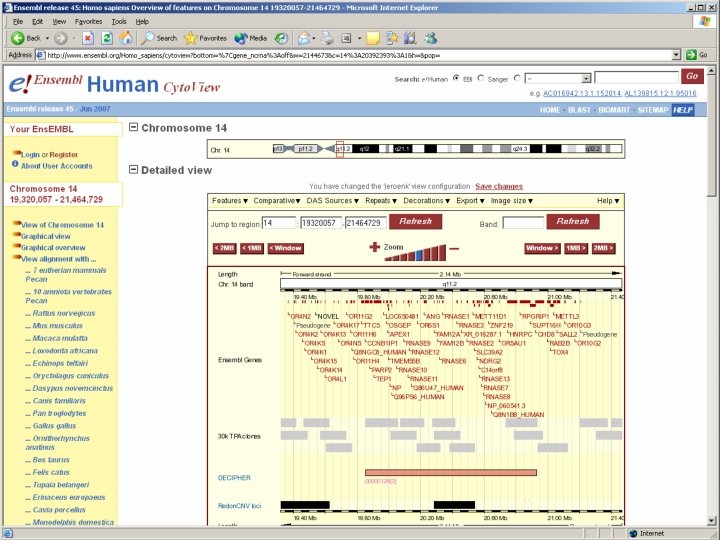
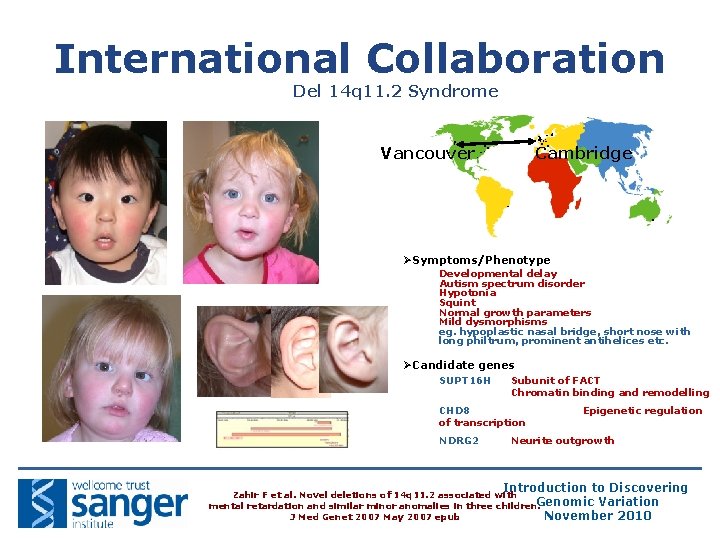
International Collaboration Del 14 q 11. 2 Syndrome Vancouver Cambridge ØSymptoms/Phenotype Developmental delay Autism spectrum disorder Hypotonia Squint Normal growth parameters Mild dysmorphisms eg. hypoplastic nasal bridge, short nose with long philtrum, prominent antihelices etc. ØCandidate genes SUPT 16 H Subunit of FACT Chromatin binding and remodelling CHD 8 of transcription NDRG 2 Epigenetic regulation Neurite outgrowth Introduction to Discovering Zahir F et al. Novel deletions of 14 q 11. 2 associated with Genomic Variation mental retardation and similar minor anomalies in three children. J Med Genet 2007 May 2007 epub November 2010
Introduction to Discovering Genomic Variation November 2010
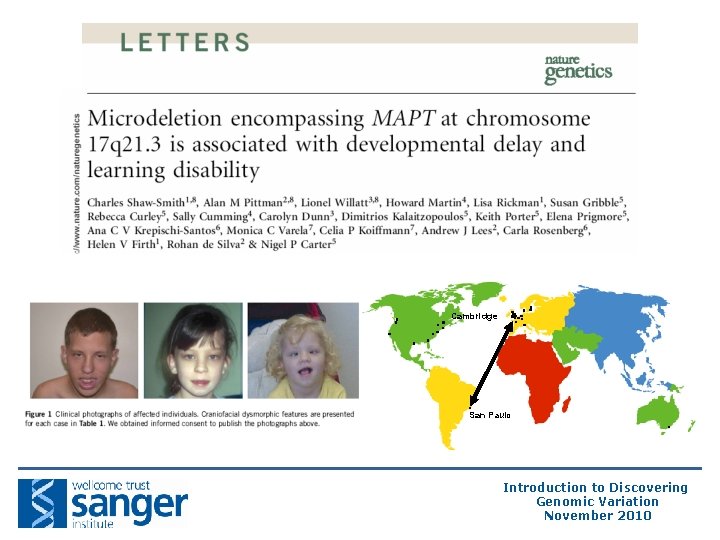
Cambridge San Paulo Introduction to Discovering Genomic Variation November 2010
Introduction to Discovering Genomic Variation November 2010
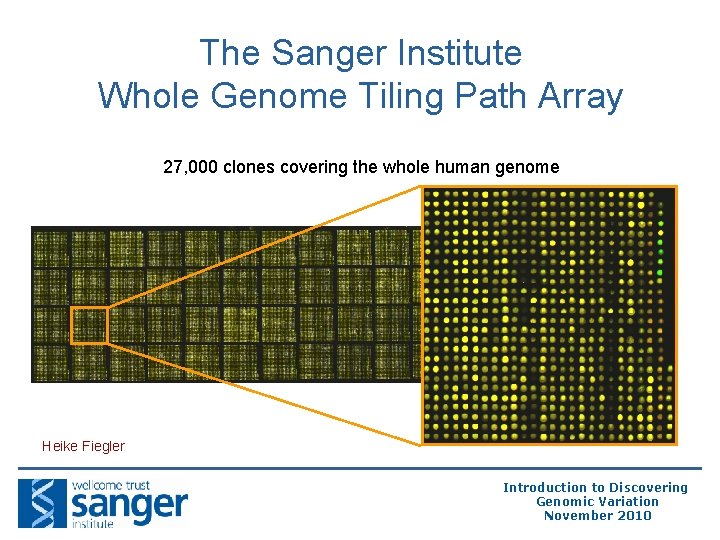
The Sanger Institute Whole Genome Tiling Path Array 27, 000 clones covering the whole human genome Heike Fiegler Introduction to Discovering Genomic Variation November 2010
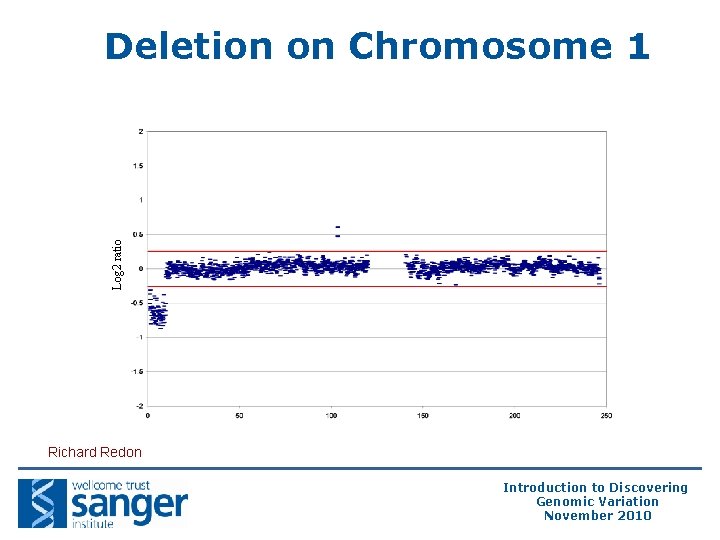
Log 2 ratio Deletion on Chromosome 1 Richard Redon Introduction to Discovering Genomic Variation November 2010
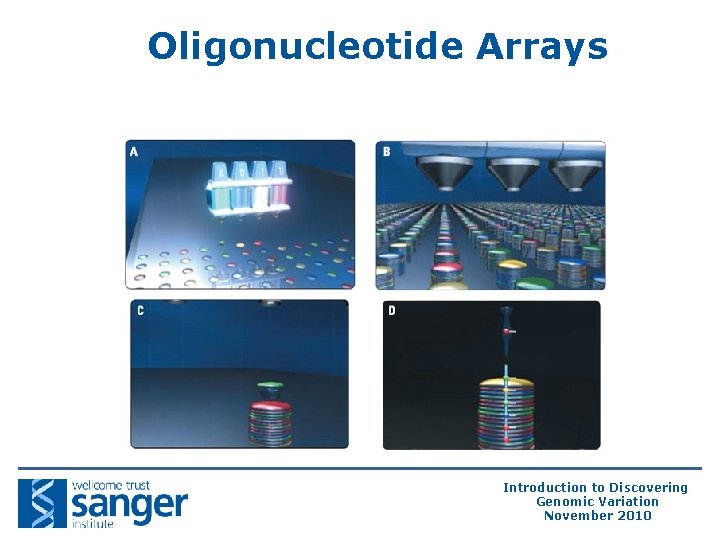
Oligonucleotide Arrays Introduction to Discovering Genomic Variation November 2010
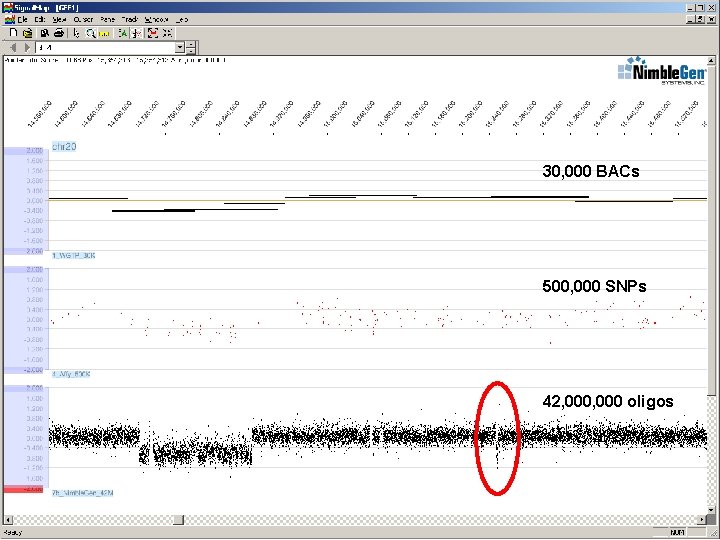
30, 000 BACs 500, 000 SNPs 42, 000 oligos Introduction to Discovering Genomic Variation November 2010
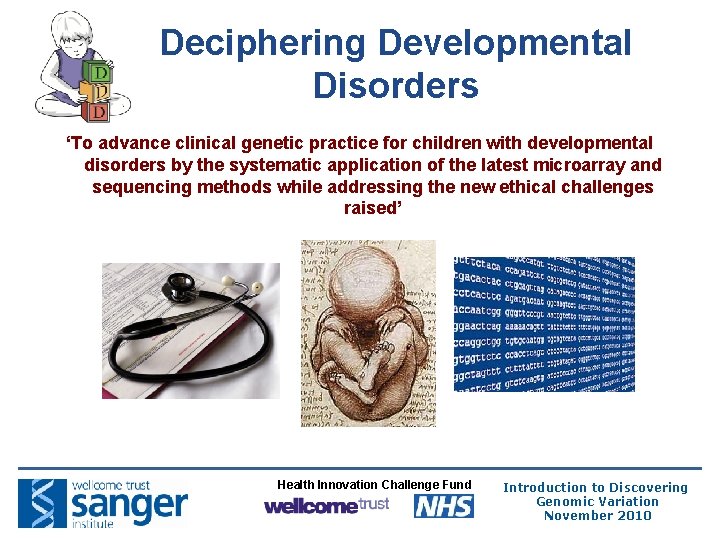
Deciphering Developmental Disorders ‘To advance clinical genetic practice for children with developmental disorders by the systematic application of the latest microarray and sequencing methods while addressing the new ethical challenges raised’ Health Innovation Challenge Fund Introduction to Discovering Genomic Variation November 2010
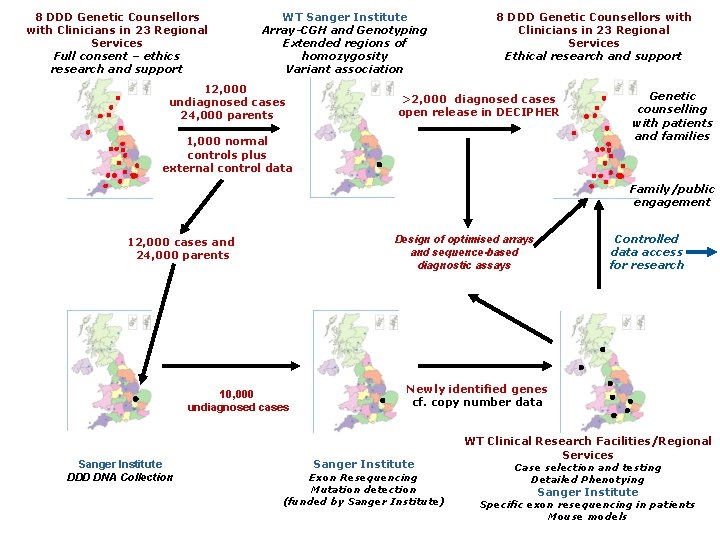
8 DDD Genetic Counsellors with Clinicians in 23 Regional Services Full consent – ethics research and support WT Sanger Institute Array-CGH and Genotyping Extended regions of homozygosity Variant association 12, 000 undiagnosed cases 24, 000 parents 8 DDD Genetic Counsellors with Clinicians in 23 Regional Services Ethical research and support >2, 000 diagnosed cases open release in DECIPHER 1, 000 normal controls plus external control data Genetic counselling with patients and families Family/public engagement Design of optimised arrays and sequence-based diagnostic assays 12, 000 cases and 24, 000 parents 10, 000 undiagnosed cases Sanger Institute DDD DNA Collection Controlled data access for research Newly identified genes cf. copy number data Sanger Institute Exon Resequencing Mutation detection (funded by Sanger Institute) WT Clinical Research Facilities/Regional Services Case selection and testing Detailed Phenotying Introduction to Discovering Sanger Institute Genomic Variation Specific exon resequencing in patients Mouse models November 2010
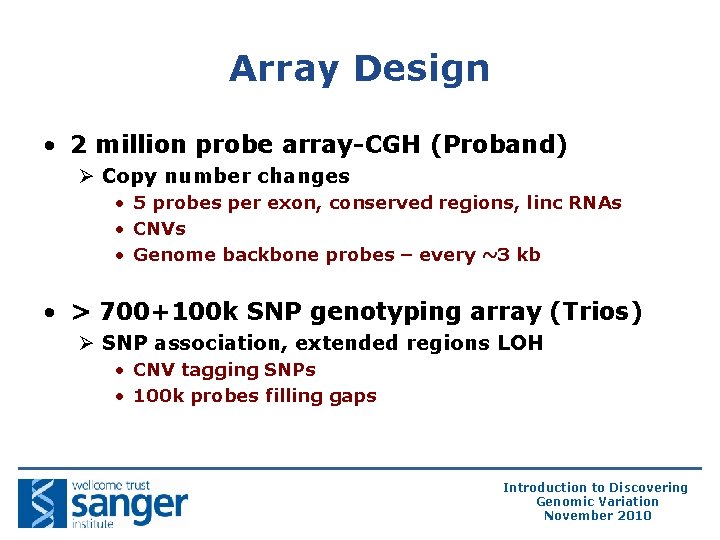
Array Design • 2 million probe array-CGH (Proband) Ø Copy number changes • 5 probes per exon, conserved regions, linc RNAs • CNVs • Genome backbone probes – every ~3 kb • > 700+100 k SNP genotyping array (Trios) Ø SNP association, extended regions LOH • CNV tagging SNPs • 100 k probes filling gaps Introduction to Discovering Genomic Variation November 2010
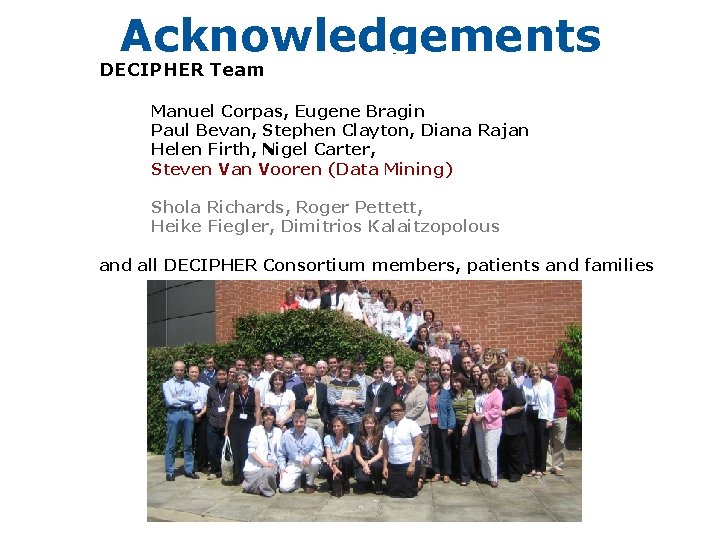
Acknowledgements DECIPHER Team Manuel Corpas, Eugene Bragin Paul Bevan, Stephen Clayton, Diana Rajan Helen Firth, Nigel Carter, Steven Van Vooren (Data Mining) Shola Richards, Roger Pettett, Heike Fiegler, Dimitrios Kalaitzopolous and all DECIPHER Consortium members, patients and families Introduction to Discovering Genomic Variation November 2010
Acknowledgements DDD § § § § § 23 UK Regional Genetics Services Nigel Carter, Matthew Hurles, Jeff Barrett Helen Firth, David Fitzpatrick Mike Parker Programmers – Adrian Tivey, Tom Fitzgerald, Stephen Clayton, Daniele Pietrobelli Wet lab - Susan Gribble, Elena Prigmore, Di Rajan, Kirsty Ambridge, Daniel Barrett, Netravathi Krishnappa, Tanya Bayzetinova + 1 Statistical Geneticist Project Manager – Caroline Wright Social Scientist/Ethicist – Anna Middleton § Sanger Pipelines § DECIPHER Team Introduction to Discovering Genomic Variation November 2010