
Arrangement of Rhetoric What do we mean by
Arrangement of Rhetoric
What do we mean by arrangement? � The organization of a piece of writing � Should be considered in your writing and that of others � “Is the text organized in the best possible way in order to achieve its purpose? ” � Not just beginning, middle, end but how the argument is structured within that framework � Depends on intended purpose and effect
Classical Model � Exordium—the introduction; introduces the reader to the subject (ethos) � Narratio—the narration; provides factual information and background material; begins the developmental paragraphs or establishes why there is a problem that needs addressing (pathos)
Classical Model � Confirmatio—the body (confirmation); the main part of the text; includes the proof to make the writer’s case (logos) � Refutatio—the refutation; addresses the counterargument; classically just before the conclusion, but if opposing views are well known or valued by the audience may be before the confirmatio (logos)

Classical Model � Peroratio—the conclusion; brings the essay to a satisfying close; answers the question “so what” (pathos and reminds of ethos) � Classic rhetoricians believed the last words and ideas are the ones remembered the most

Patterns of Development � Arrangement is based on purpose � Include a range of logical ways to organize an entire text or (more likely) individual paragraphs � The way we will study different types of writing
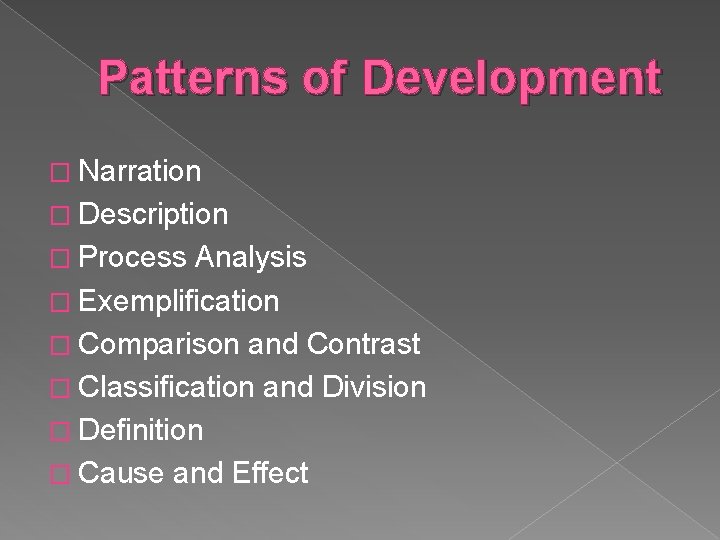
Patterns of Development � Narration � Description � Process Analysis � Exemplification � Comparison and Contrast � Classification and Division � Definition � Cause and Effect
- Slides: 7