
Arrakis The Operating System is the Control Plane
- Slides: 30
Arrakis: The Operating System is the Control Plane Simon Peter, Jialin Li, Irene Zhang, Dan R. K. Ports, et al. presented by Jimmy You EECS 582 – F 16 1
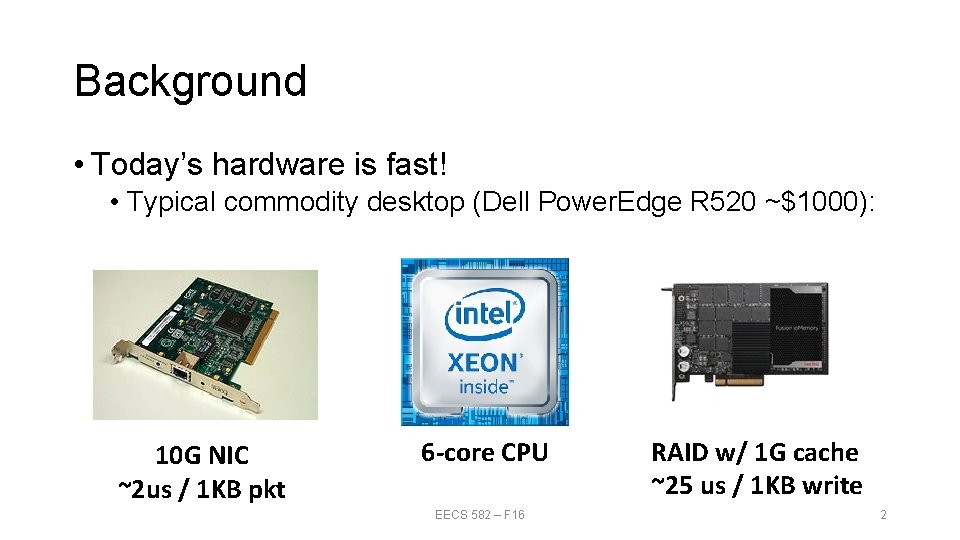
Background • Today’s hardware is fast! • Typical commodity desktop (Dell Power. Edge R 520 ~$1000): 10 G NIC ~2 us / 1 KB pkt 6 -core CPU EECS 582 – F 16 RAID w/ 1 G cache ~25 us / 1 KB write 2
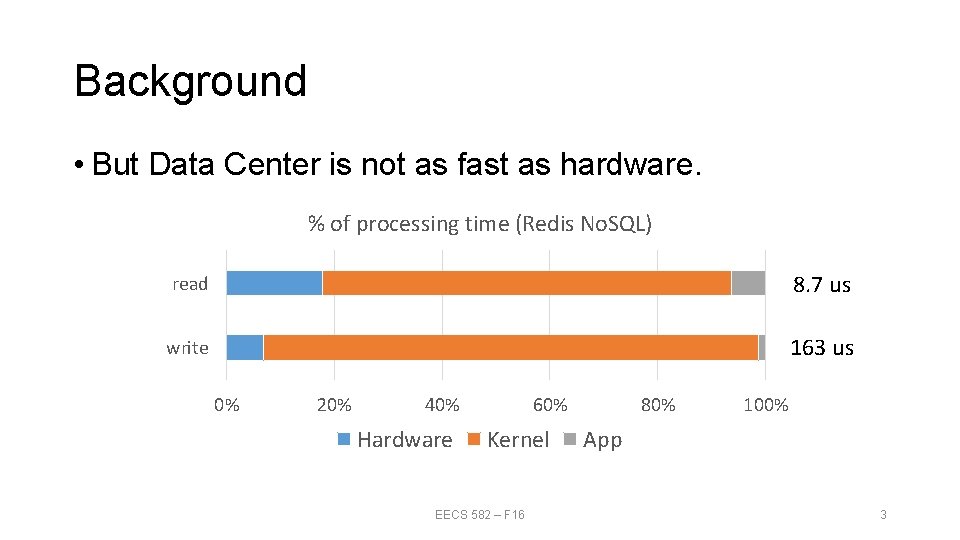
Background • But Data Center is not as fast as hardware. % of processing time (Redis No. SQL) read 8. 7 us write 163 us 0% 20% 40% Hardware 60% Kernel EECS 582 – F 16 80% 100% App 3
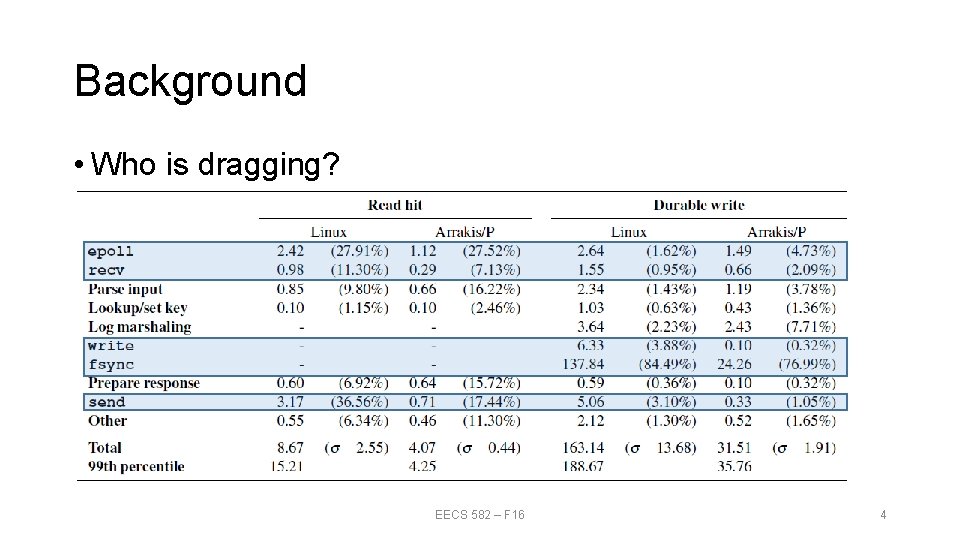
Background • Who is dragging? EECS 582 – F 16 4
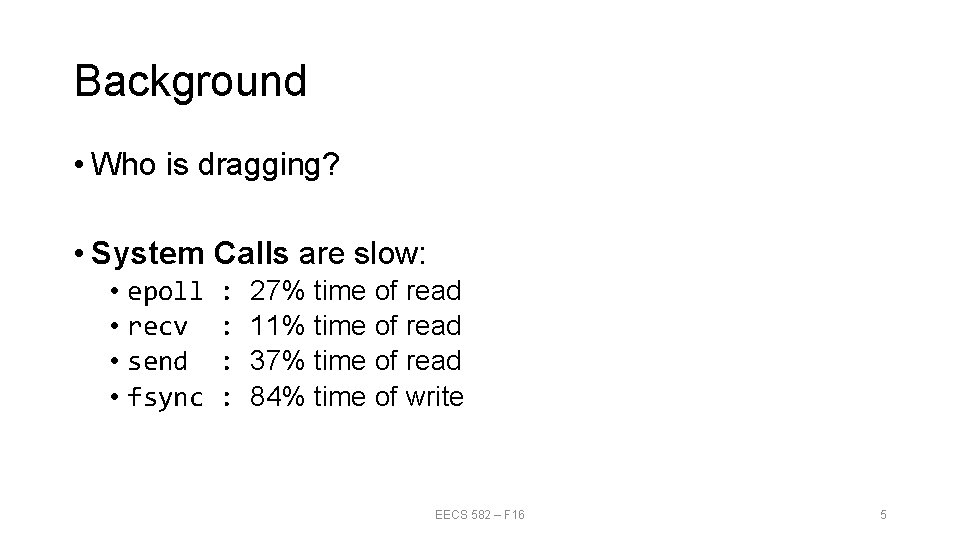
Background • Who is dragging? • System Calls are slow: • epoll • recv • send • fsync : : 27% time of read 11% time of read 37% time of read 84% time of write EECS 582 – F 16 5
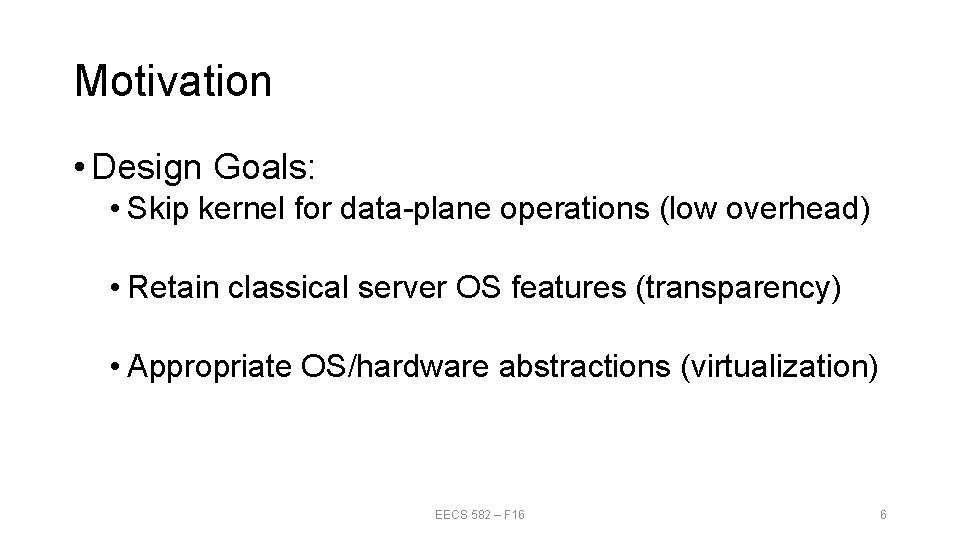
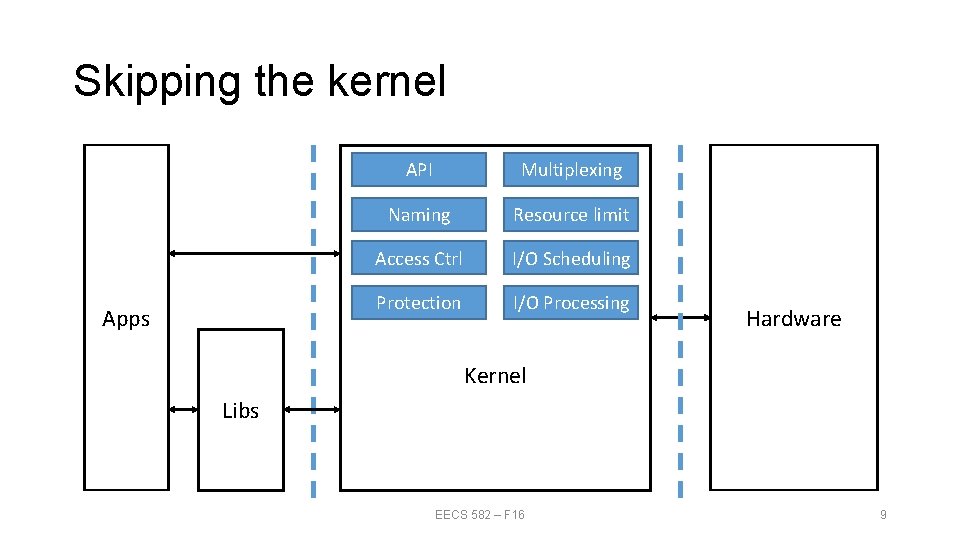
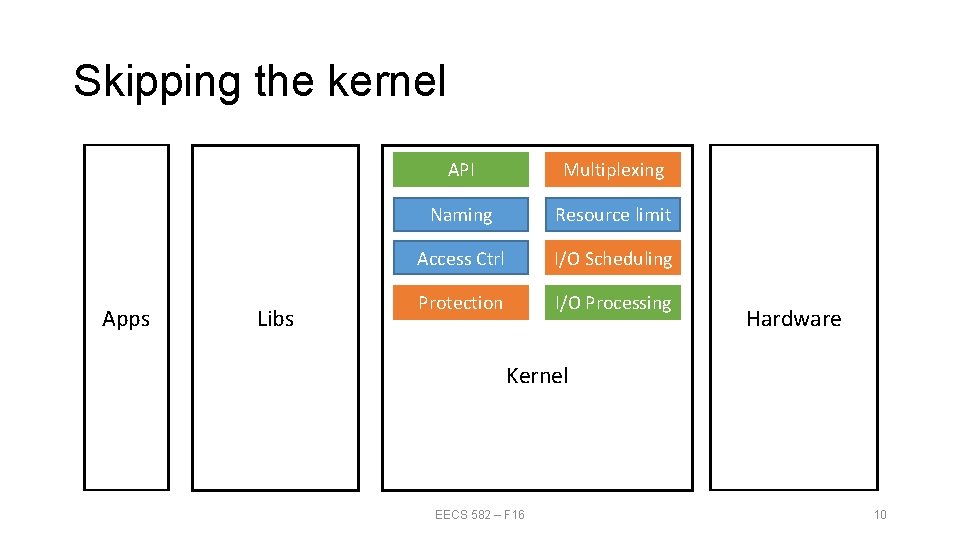
Motivation • Design Goals: • Skip kernel for data-plane operations (low overhead) • Retain classical server OS features (transparency) • Appropriate OS/hardware abstractions (virtualization) EECS 582 – F 16 6
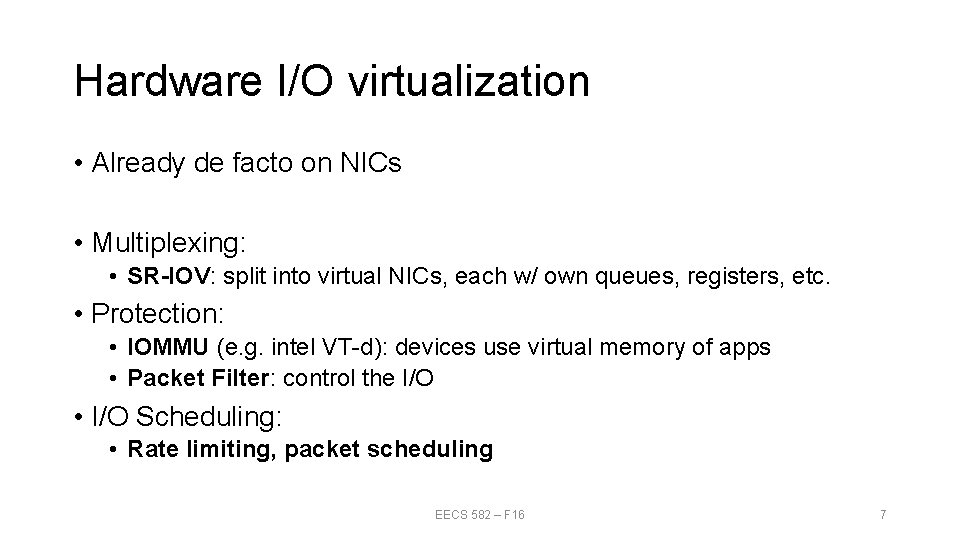
Hardware I/O virtualization • Already de facto on NICs • Multiplexing: • SR-IOV: split into virtual NICs, each w/ own queues, registers, etc. • Protection: • IOMMU (e. g. intel VT-d): devices use virtual memory of apps • Packet Filter: control the I/O • I/O Scheduling: • Rate limiting, packet scheduling EECS 582 – F 16 7
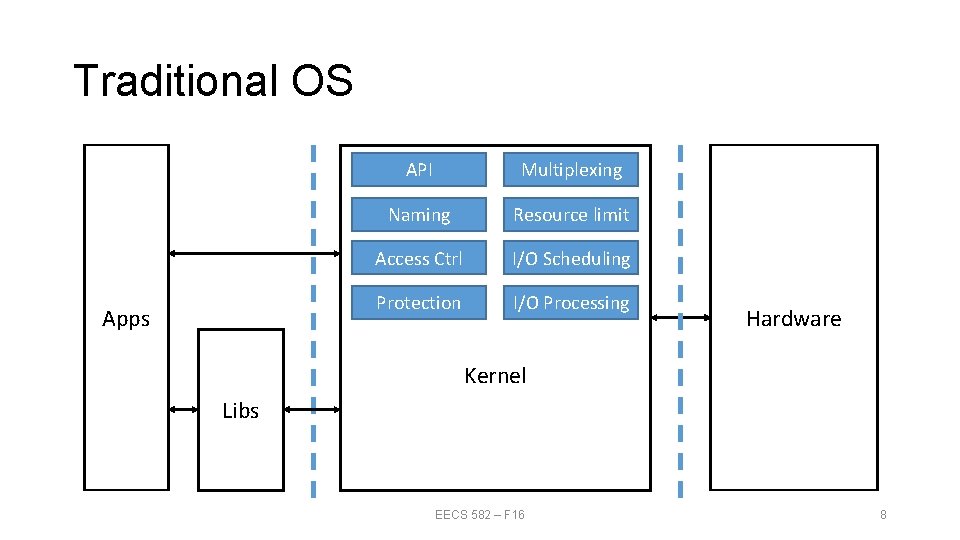
Traditional OS Apps API Multiplexing Naming Resource limit Access Ctrl I/O Scheduling Protection I/O Processing Hardware Kernel Libs EECS 582 – F 16 8
Skipping the kernel Apps API Multiplexing Naming Resource limit Access Ctrl I/O Scheduling Protection I/O Processing Hardware Kernel Libs EECS 582 – F 16 9
Skipping the kernel Apps Libs API Multiplexing Naming Resource limit Access Ctrl I/O Scheduling Protection I/O Processing Hardware Kernel EECS 582 – F 16 10
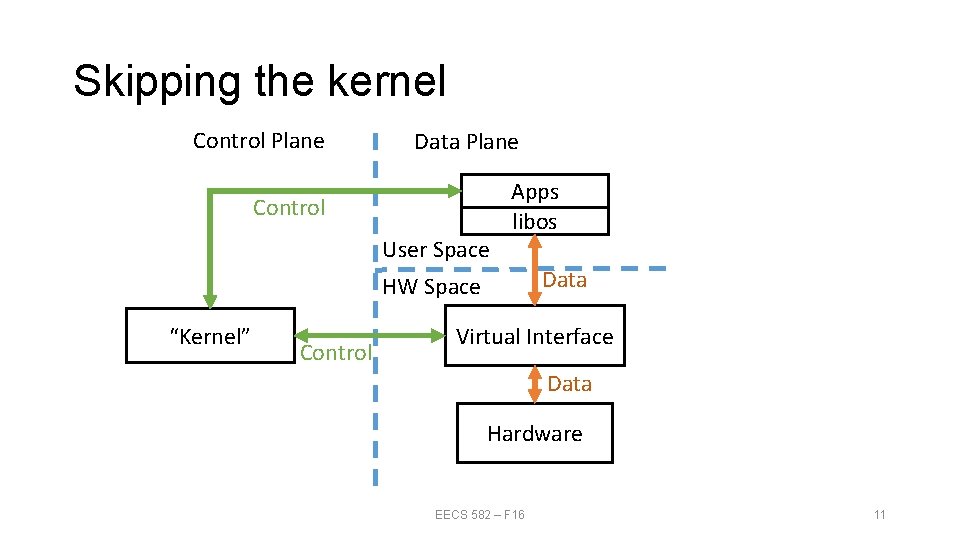
Skipping the kernel Control Plane Data Plane Control User Space Apps libos Data HW Space “Kernel” Control Virtual Interface Data Hardware EECS 582 – F 16 11
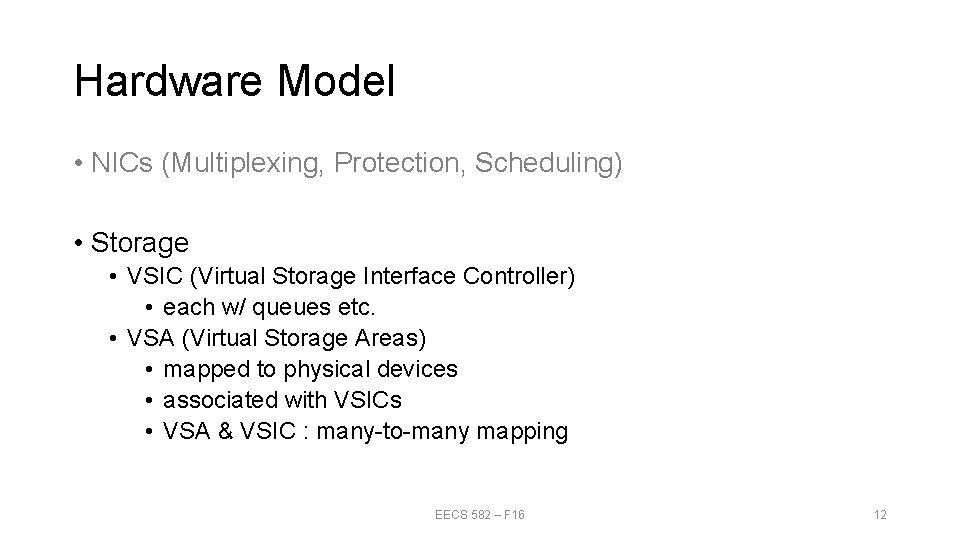
Hardware Model • NICs (Multiplexing, Protection, Scheduling) • Storage • VSIC (Virtual Storage Interface Controller) • each w/ queues etc. • VSA (Virtual Storage Areas) • mapped to physical devices • associated with VSICs • VSA & VSIC : many-to-many mapping EECS 582 – F 16 12
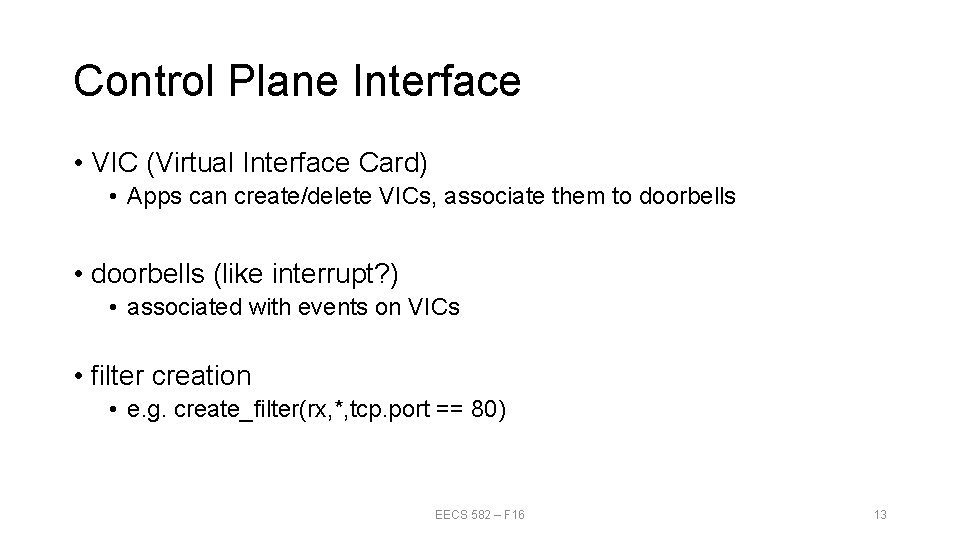
Control Plane Interface • VIC (Virtual Interface Card) • Apps can create/delete VICs, associate them to doorbells • doorbells (like interrupt? ) • associated with events on VICs • filter creation • e. g. create_filter(rx, *, tcp. port == 80) EECS 582 – F 16 13
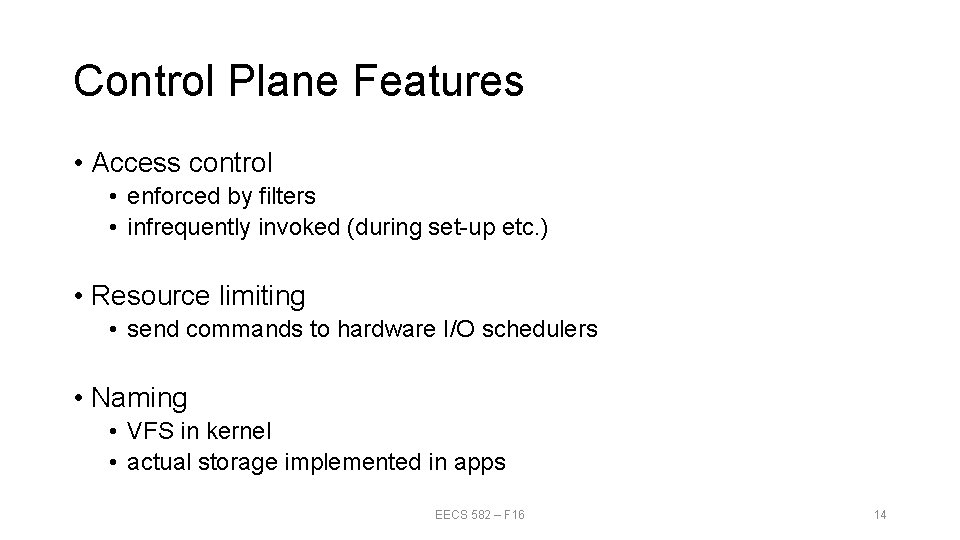
Control Plane Features • Access control • enforced by filters • infrequently invoked (during set-up etc. ) • Resource limiting • send commands to hardware I/O schedulers • Naming • VFS in kernel • actual storage implemented in apps EECS 582 – F 16 14
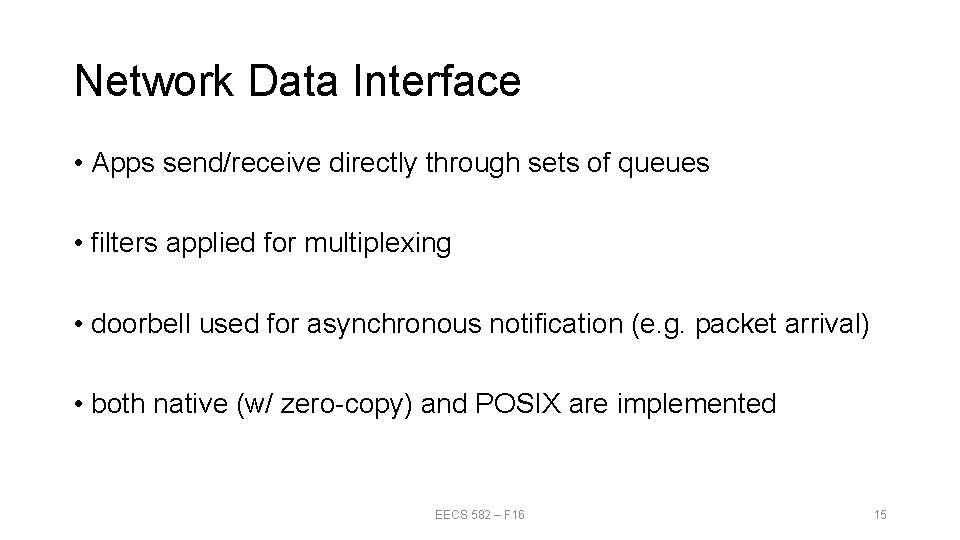
Network Data Interface • Apps send/receive directly through sets of queues • filters applied for multiplexing • doorbell used for asynchronous notification (e. g. packet arrival) • both native (w/ zero-copy) and POSIX are implemented EECS 582 – F 16 15
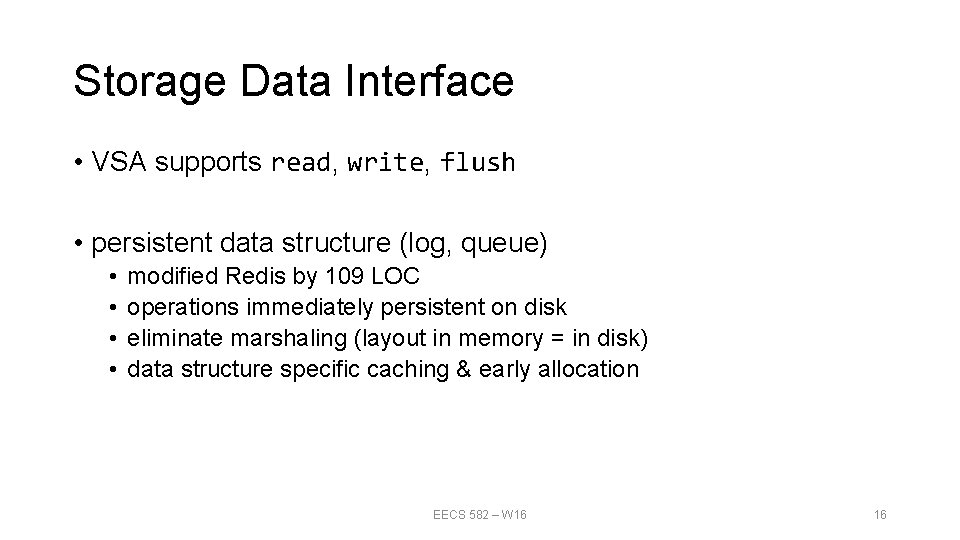
Storage Data Interface • VSA supports read, write, flush • persistent data structure (log, queue) • • modified Redis by 109 LOC operations immediately persistent on disk eliminate marshaling (layout in memory = in disk) data structure specific caching & early allocation EECS 582 – W 16 16
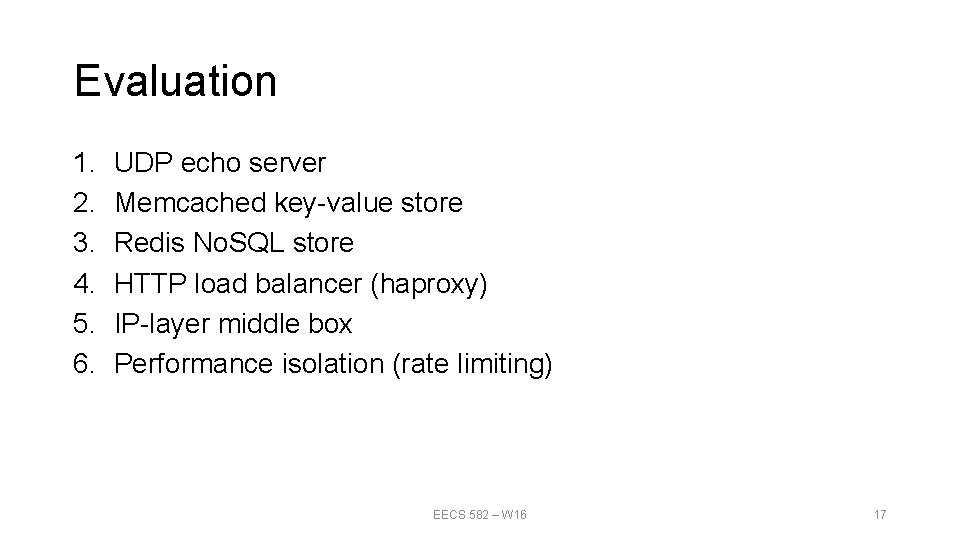
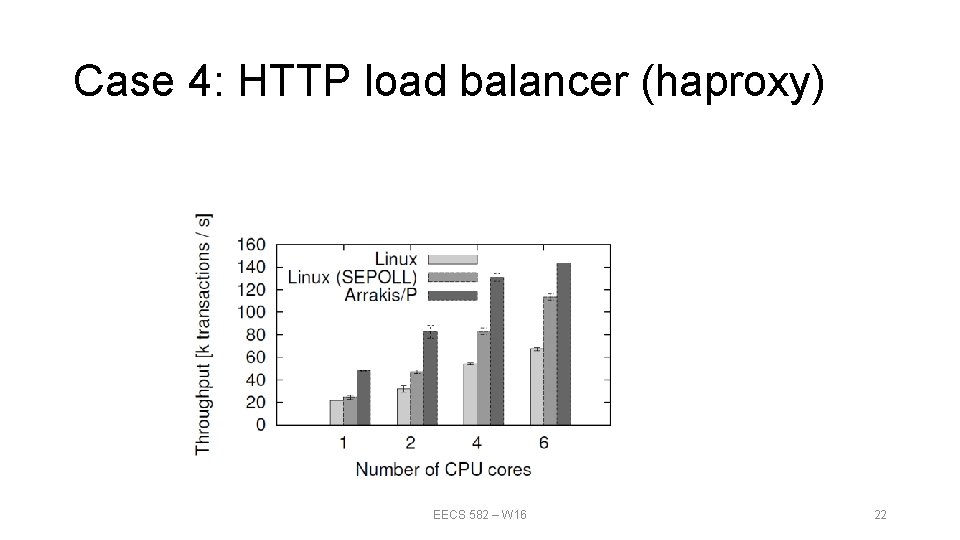
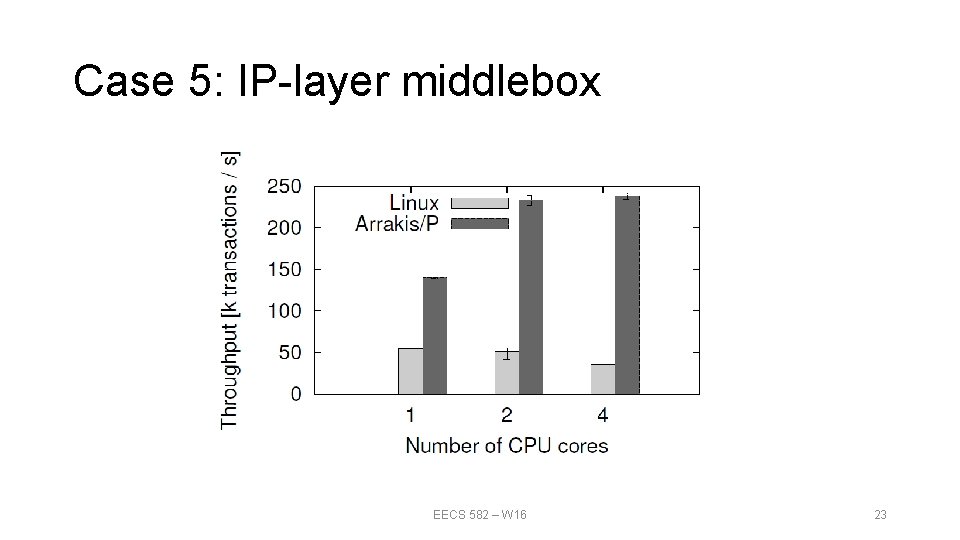
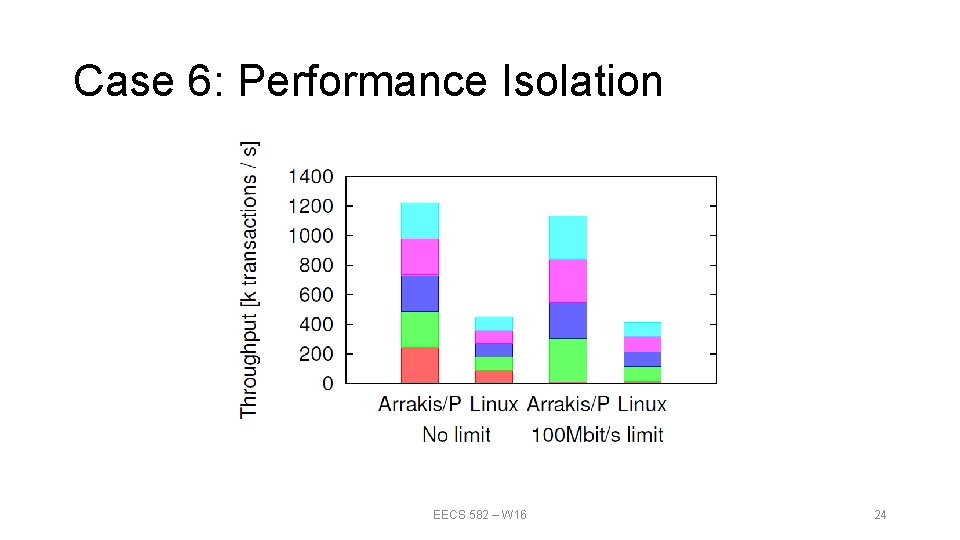
Evaluation 1. 2. 3. 4. 5. 6. UDP echo server Memcached key-value store Redis No. SQL store HTTP load balancer (haproxy) IP-layer middle box Performance isolation (rate limiting) EECS 582 – W 16 17
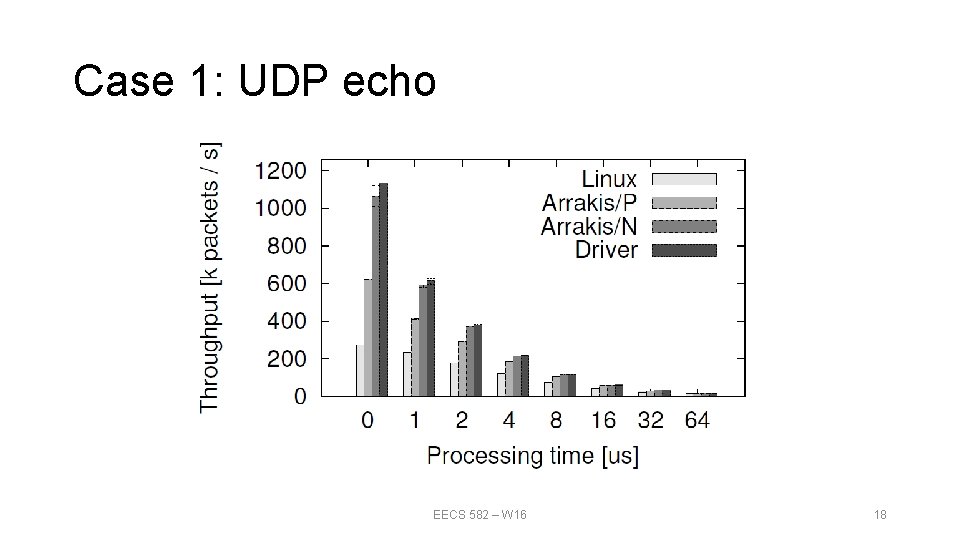
Case 1: UDP echo EECS 582 – W 16 18
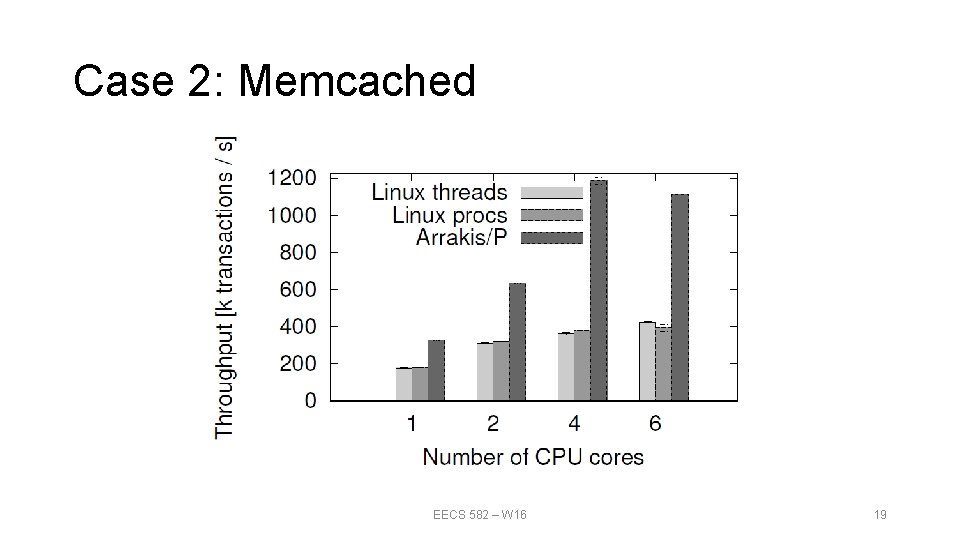
Case 2: Memcached EECS 582 – W 16 19
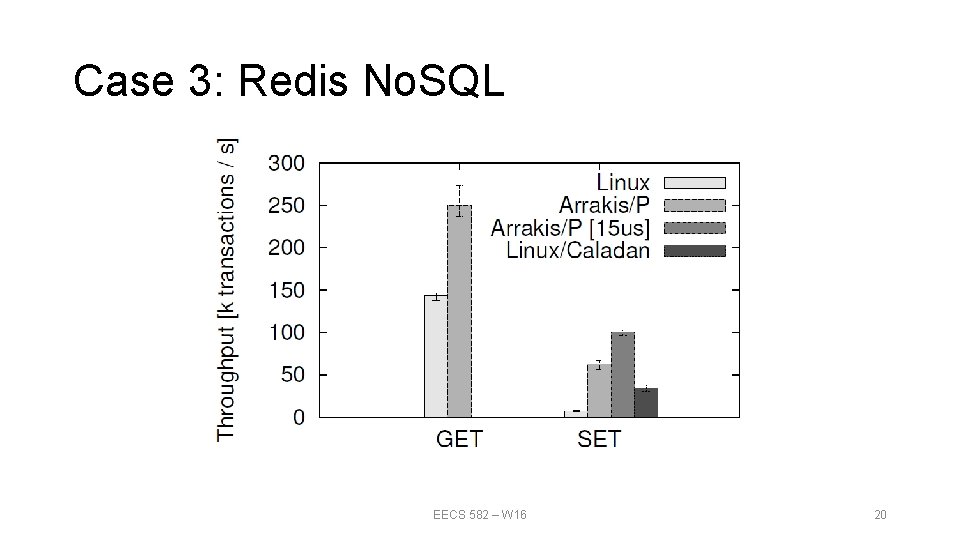
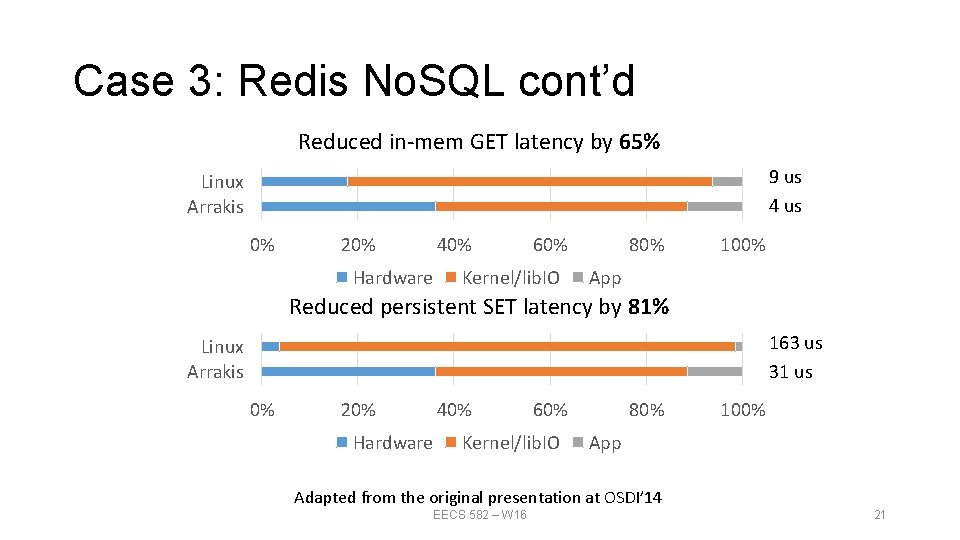
Case 3: Redis No. SQL EECS 582 – W 16 20
Case 3: Redis No. SQL cont’d Reduced in-mem GET latency by 65% 9 us 4 us Linux Arrakis 0% 20% 40% Hardware 60% Kernel/lib. IO 80% 100% App Reduced persistent SET latency by 81% 163 us 31 us Linux Arrakis 0% 20% 40% Hardware 60% Kernel/lib. IO 80% 100% App Adapted from the original presentation at OSDI’ 14 EECS 582 – W 16 21
Case 4: HTTP load balancer (haproxy) EECS 582 – W 16 22
Case 5: IP-layer middlebox EECS 582 – W 16 23
Case 6: Performance Isolation EECS 582 – W 16 24
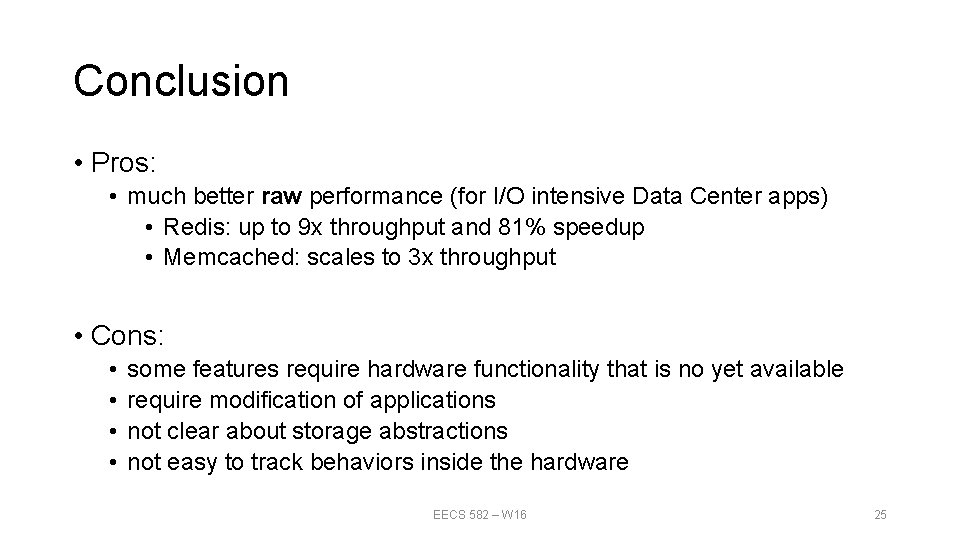
Conclusion • Pros: • much better raw performance (for I/O intensive Data Center apps) • Redis: up to 9 x throughput and 81% speedup • Memcached: scales to 3 x throughput • Cons: • • some features require hardware functionality that is no yet available require modification of applications not clear about storage abstractions not easy to track behaviors inside the hardware EECS 582 – W 16 25
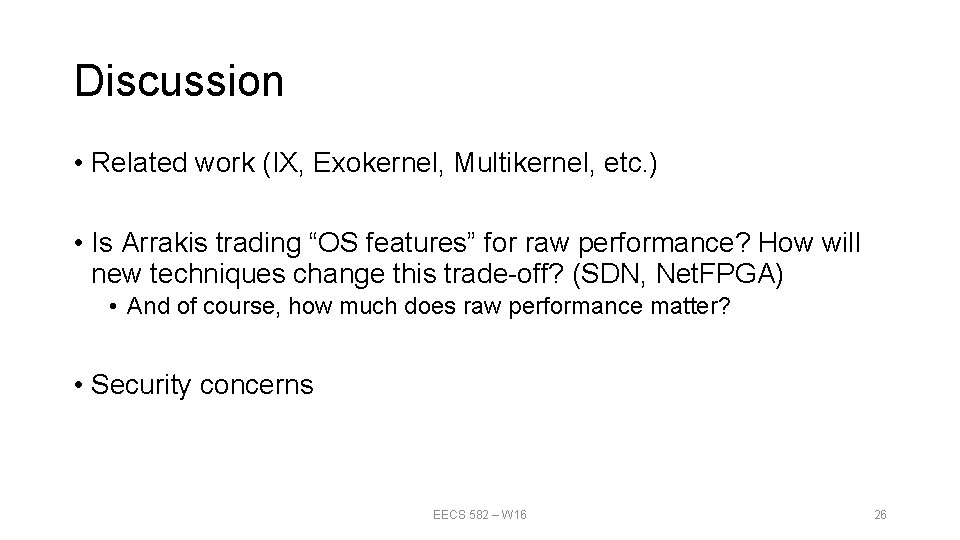
Discussion • Related work (IX, Exokernel, Multikernel, etc. ) • Is Arrakis trading “OS features” for raw performance? How will new techniques change this trade-off? (SDN, Net. FPGA) • And of course, how much does raw performance matter? • Security concerns EECS 582 – W 16 26
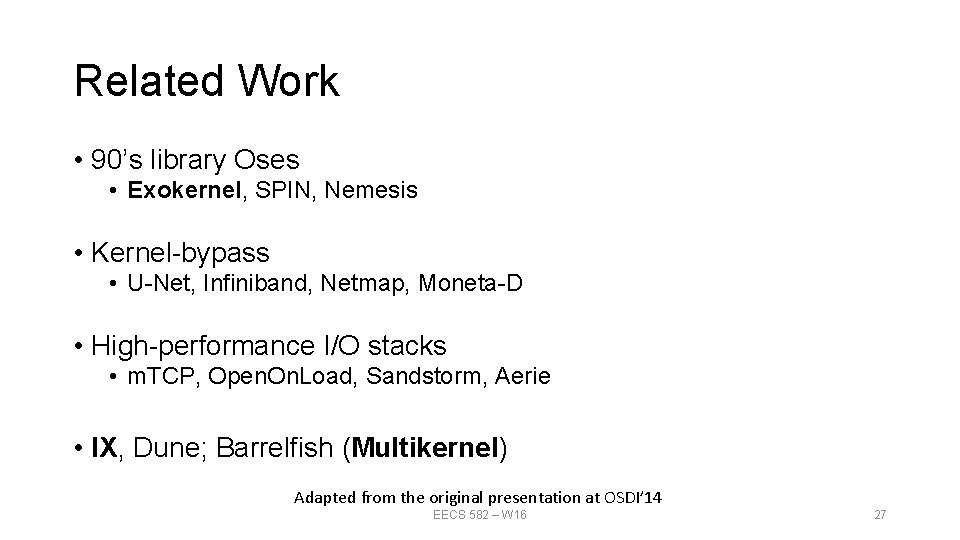
Related Work • 90’s library Oses • Exokernel, SPIN, Nemesis • Kernel-bypass • U-Net, Infiniband, Netmap, Moneta-D • High-performance I/O stacks • m. TCP, Open. On. Load, Sandstorm, Aerie • IX, Dune; Barrelfish (Multikernel) Adapted from the original presentation at OSDI’ 14 EECS 582 – W 16 27
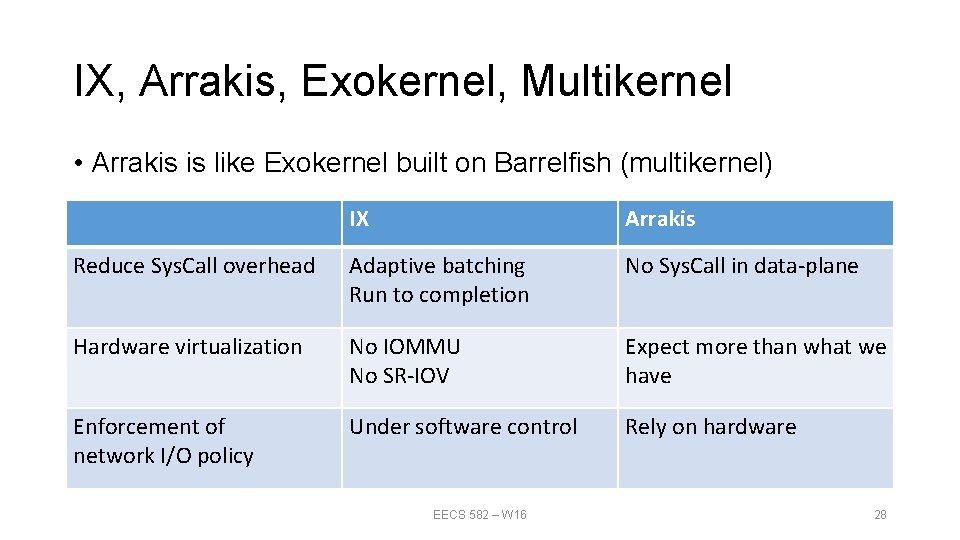
IX, Arrakis, Exokernel, Multikernel • Arrakis is like Exokernel built on Barrelfish (multikernel) IX Arrakis Reduce Sys. Call overhead Adaptive batching Run to completion No Sys. Call in data-plane Hardware virtualization No IOMMU No SR-IOV Expect more than what we have Enforcement of network I/O policy Under software control Rely on hardware EECS 582 – W 16 28
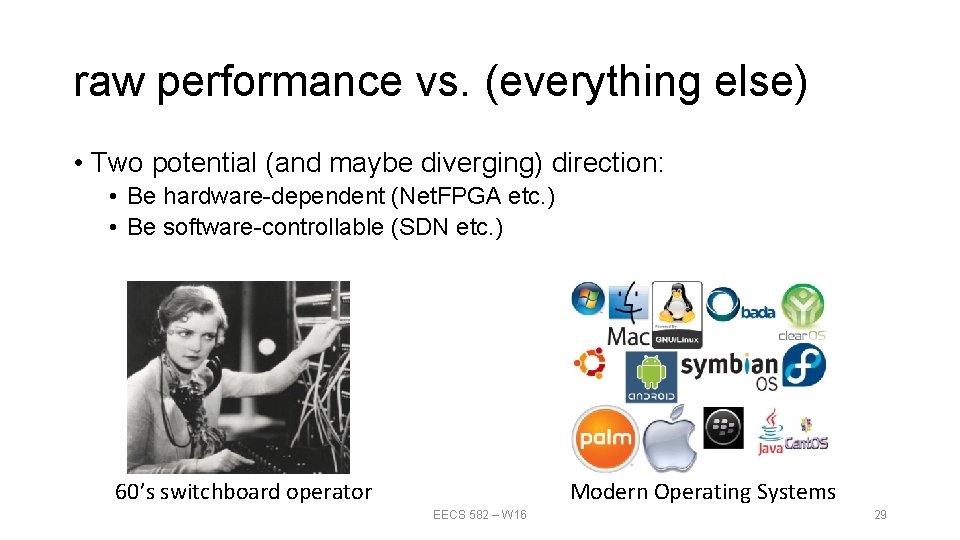
raw performance vs. (everything else) • Two potential (and maybe diverging) direction: • Be hardware-dependent (Net. FPGA etc. ) • Be software-controllable (SDN etc. ) 60’s switchboard operator Modern Operating Systems EECS 582 – W 16 29
Security concerns • Will bypassing the kernel be safe? • … EECS 582 – W 16 30