
Around the Regularity Lemma Lszl Lovsz Balzs szegedy
Around the Regularity Lemma László Lovász, Balázs szegedy Microsoft Research IAS Princeton
1. Szemerédi’s Regularity Lemma 2. The Regularity Lemma in Hilbert space 3. The Regularity Lemma as compactness 4. The Regularity Lemma as dimensionality
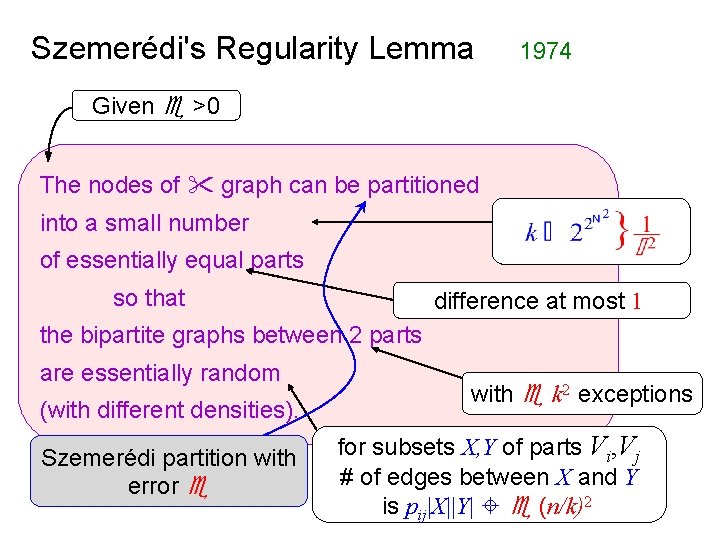
Szemerédi's Regularity Lemma 1974 Given >0 The nodes of graph can be partitioned into a small number of essentially equal parts so that difference at most 1 the bipartite graphs between 2 parts are essentially random (with different densities). Szemerédi partition with error with k 2 exceptions for subsets X, Y of parts Vi, Vj # of edges between X and Y is pij|X||Y| (n/k)2
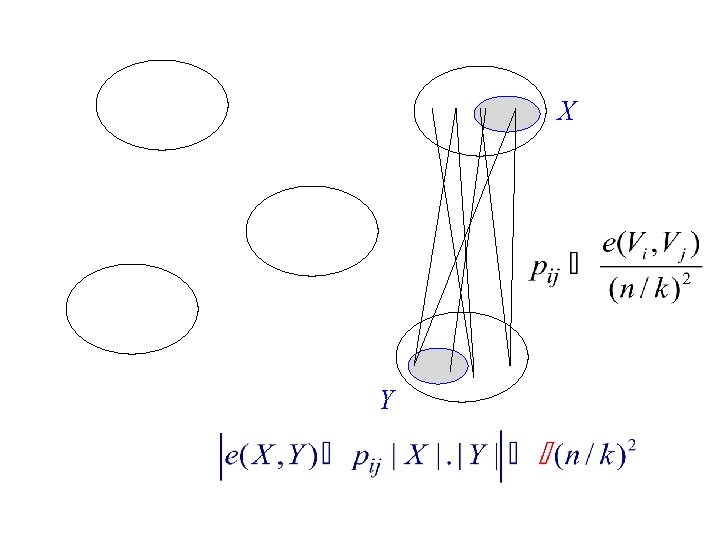
X Y
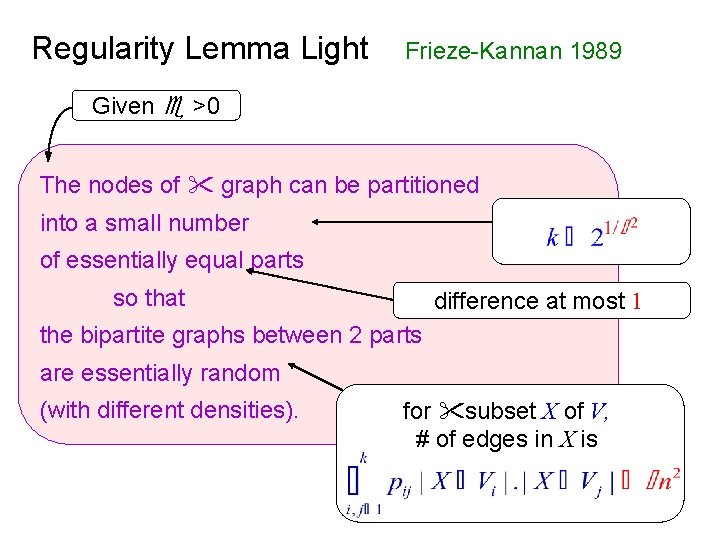
Regularity Lemma Light Frieze-Kannan 1989 Given >0 The nodes of graph can be partitioned into a small number of essentially equal parts so that difference at most 1 the bipartite graphs between 2 parts are essentially random (with different densities). for subset X of V, # of edges in X is
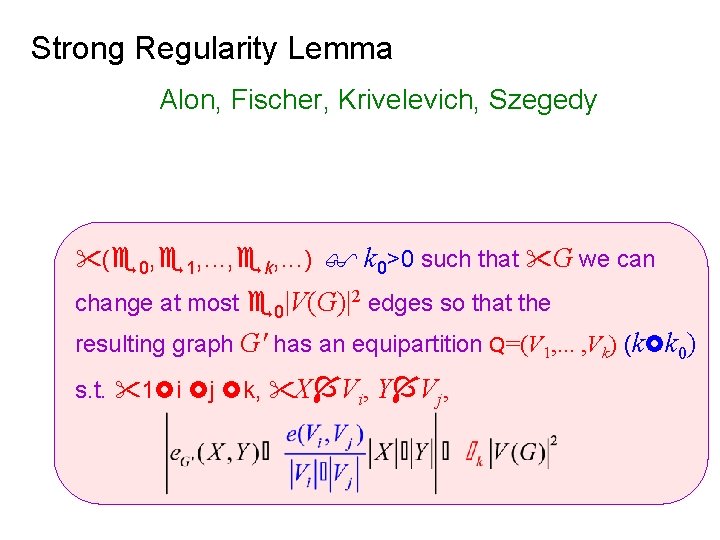
Strong Regularity Lemma Alon, Fischer, Krivelevich, Szegedy ( 0, 1, . . . , k, . . . ) k 0>0 such that G we can change at most 0|V(G)|2 edges so that the resulting graph G' has an equipartition Q=(V 1, . . . , Vk) (k k 0) s. t. 1 i j k, X Vi, Y Vj,
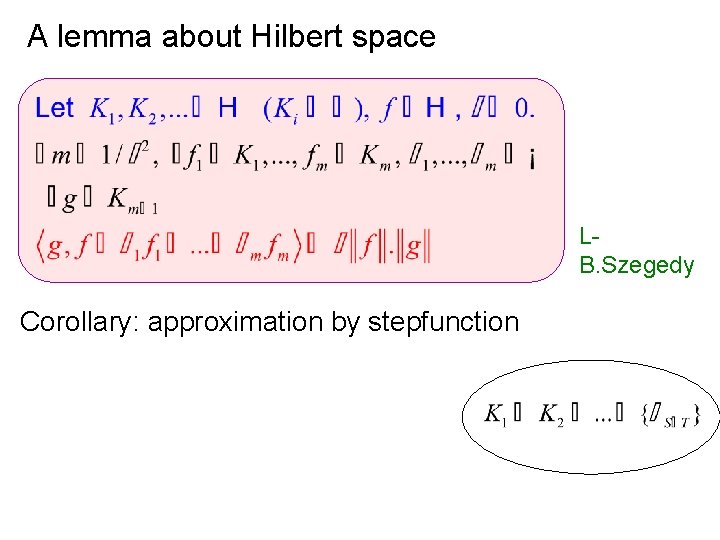
A lemma about Hilbert space LB. Szegedy Corollary: approximation by stepfunction
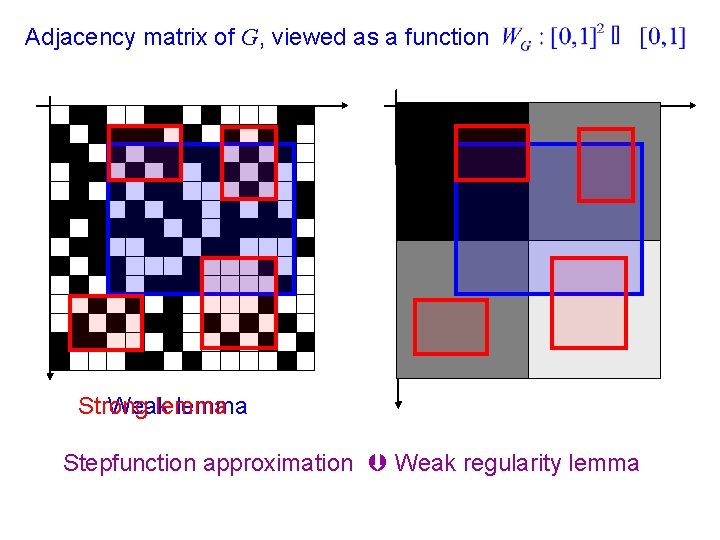
Adjacency matrix of G, viewed as a function Strong Weak lemma Stepfunction approximation Weak regularity lemma
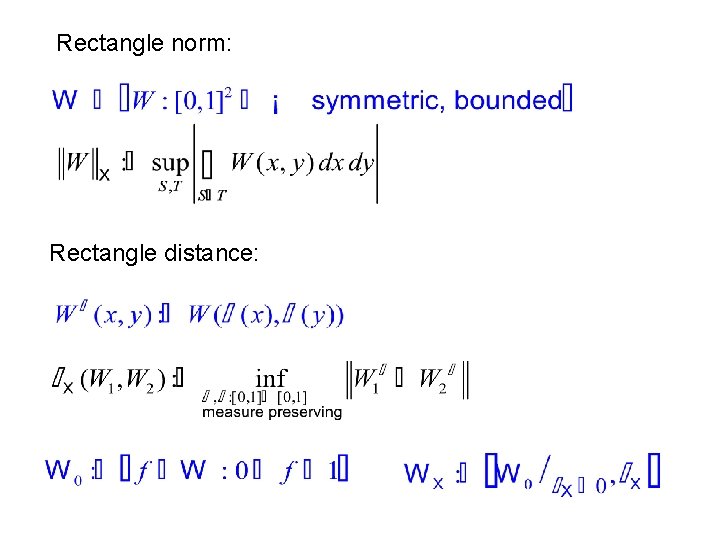
Rectangle norm: Rectangle distance:
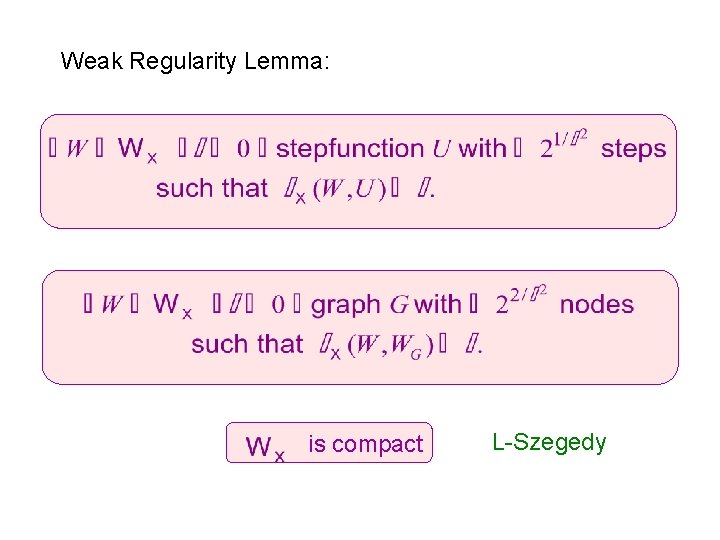
Weak Regularity Lemma: is compact L-Szegedy
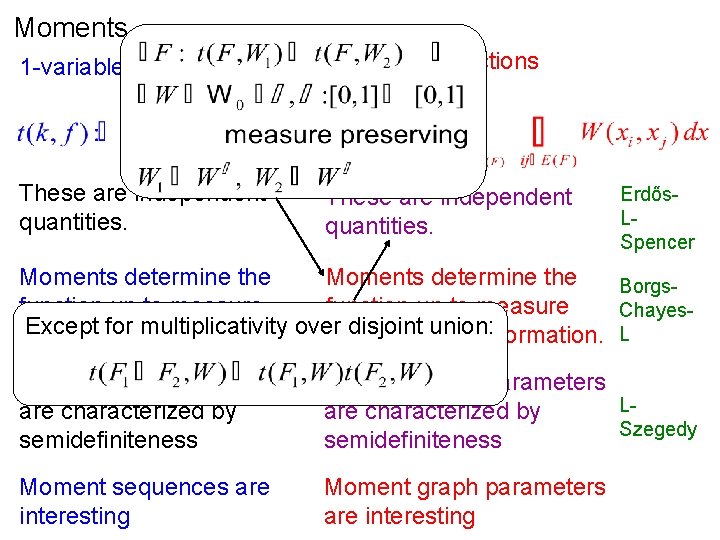
Moments 1 -variable functions 2 -variable functions These are independent quantities. Erdős. LSpencer Moments determine the Borgsfunction up to measure Chayes. Except for transformation. multiplicativity over disjoint union: preserving transformation. L Moment sequences are characterized by semidefiniteness Moment graph parameters Lare characterized by Szegedy semidefiniteness Moment sequences are interesting Moment graph parameters are interesting
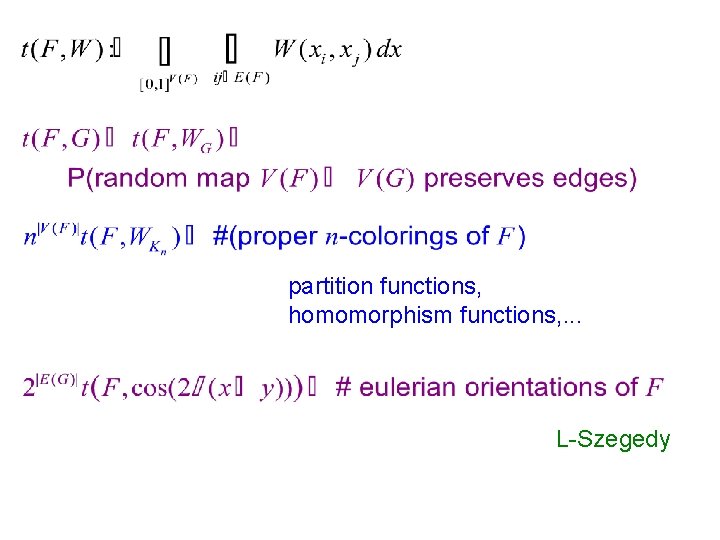
partition functions, homomorphism functions, . . . L-Szegedy
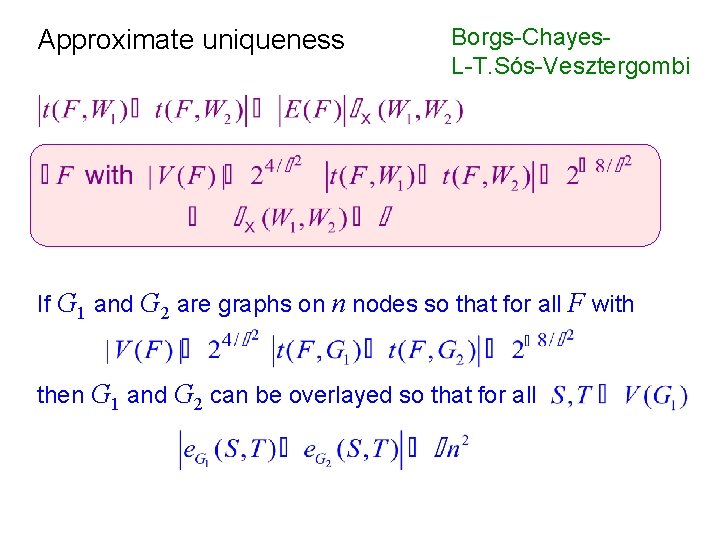
Approximate uniqueness Borgs-Chayes. L-T. Sós-Vesztergombi If G 1 and G 2 are graphs on n nodes so that for all F with then G 1 and G 2 can be overlayed so that for all
Applications: - Limits of graph sequences - Graph parameter testing - Extremal graph theory
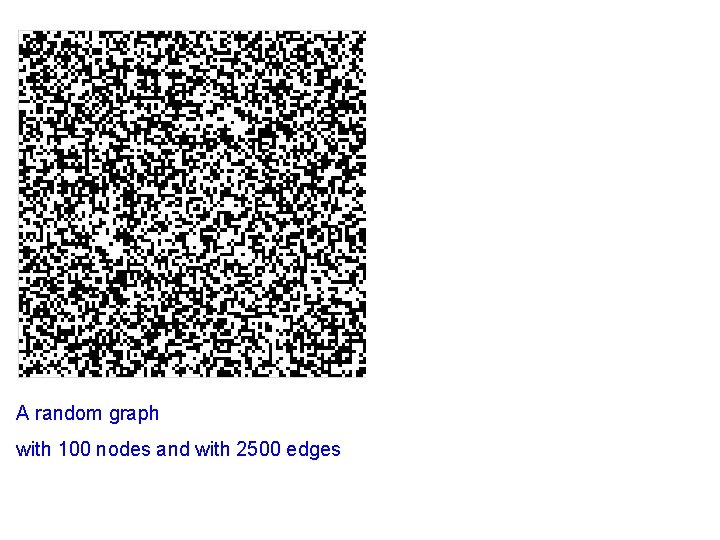
A random graph with 100 nodes and with 2500 edges
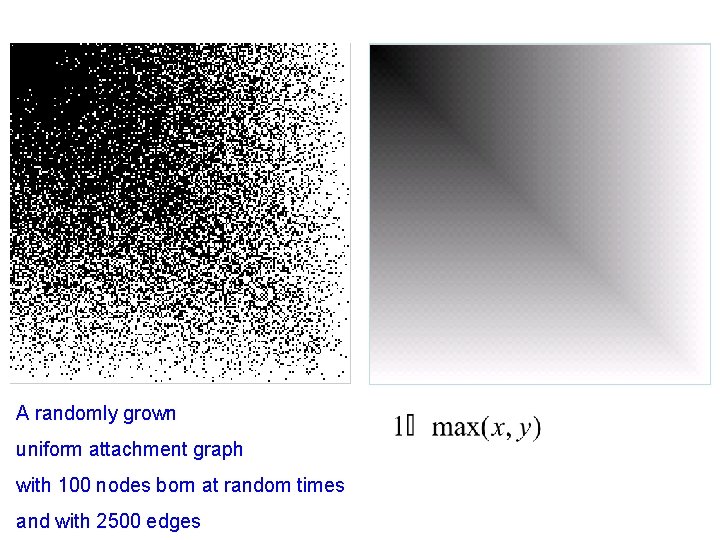
A randomly grown uniform attachment graph with 100 nodes born at random times and with 2500 edges
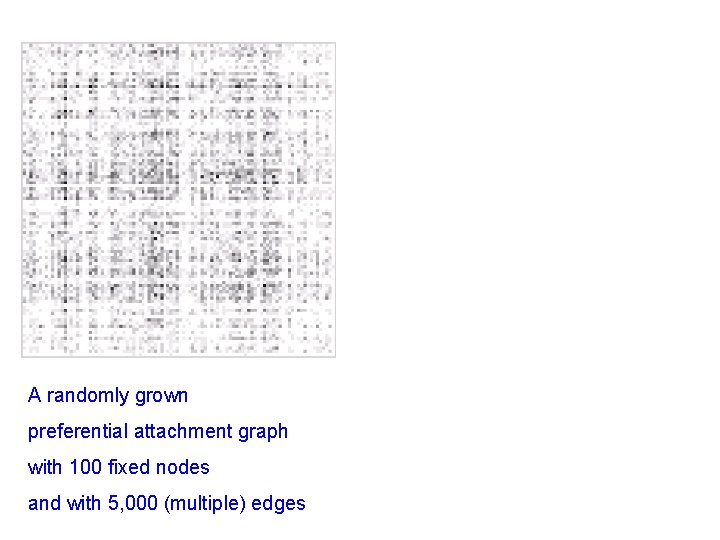
A randomly grown preferential attachment graph with 100 fixed nodes and with 5, 000 (multiple) edges
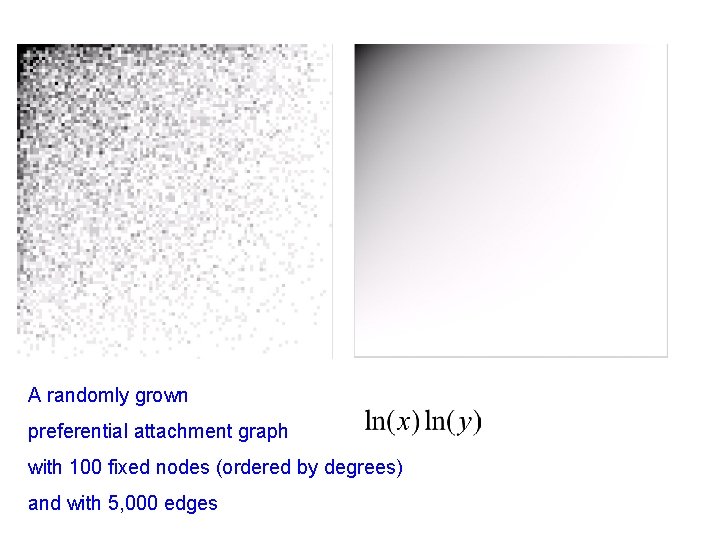
A randomly grown preferential attachment graph with 100 fixed nodes (ordered by degrees) and with 5, 000 edges
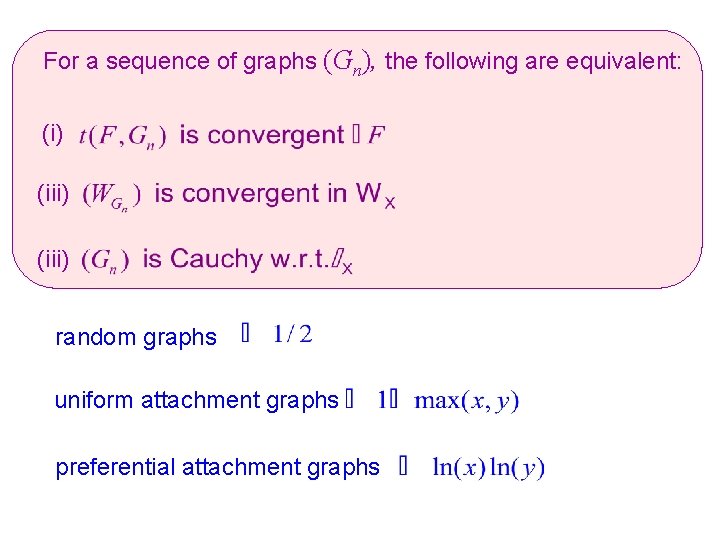
For a sequence of graphs (Gn), the following are equivalent: (i) (iii) random graphs uniform attachment graphs preferential attachment graphs
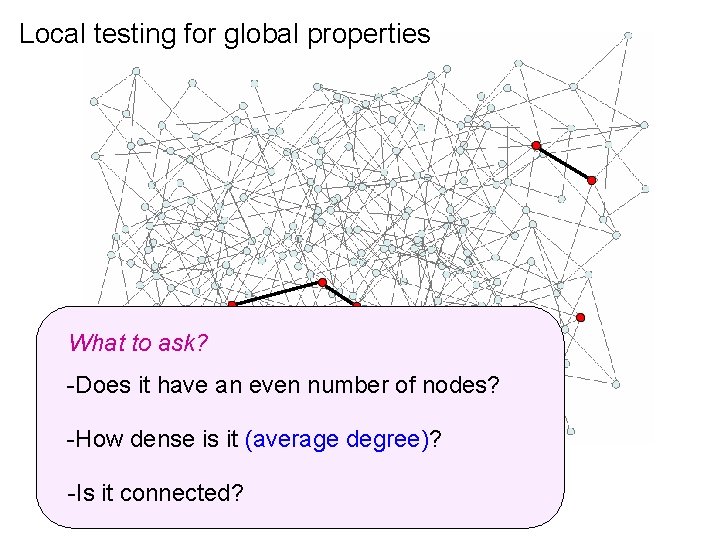
Local testing for global properties What to ask? -Does it have an even number of nodes? -How dense is it (average degree)? -Is it connected?
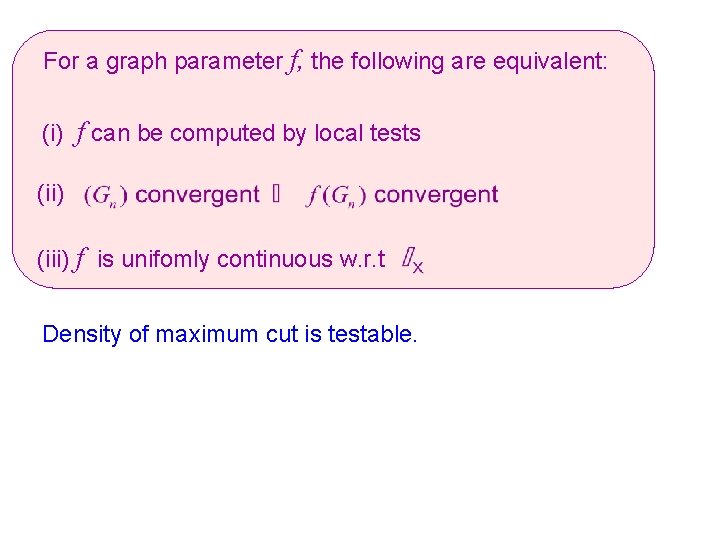
For a graph parameter f, the following are equivalent: (i) f can be computed by local tests (ii) (iii) f is unifomly continuous w. r. t Density of maximum cut is testable.
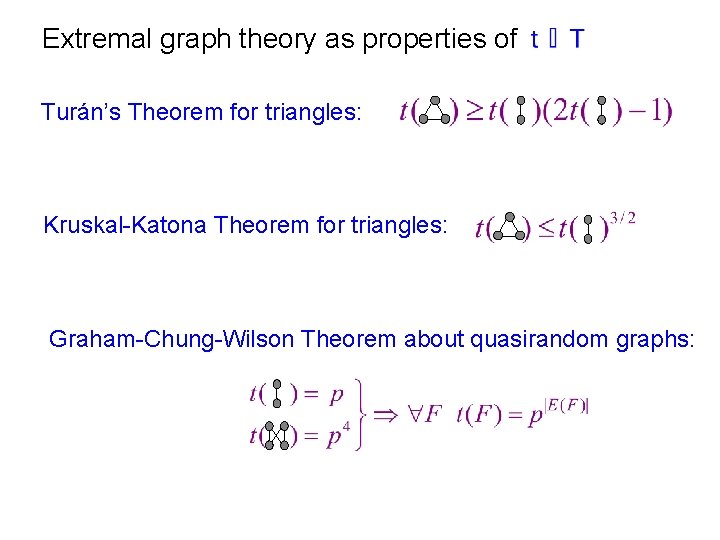
Extremal graph theory as properties of Turán’s Theorem for triangles: Kruskal-Katona Theorem for triangles: Graham-Chung-Wilson Theorem about quasirandom graphs:
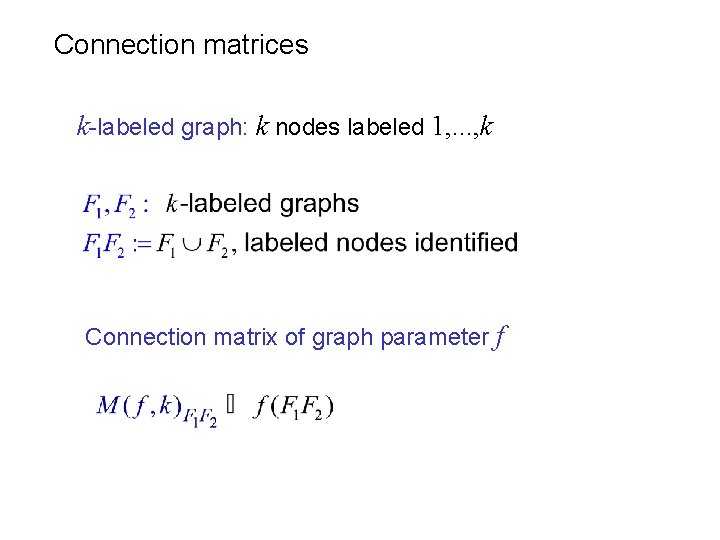
Connection matrices k-labeled graph: k nodes labeled 1, . . . , k Connection matrix of graph parameter f
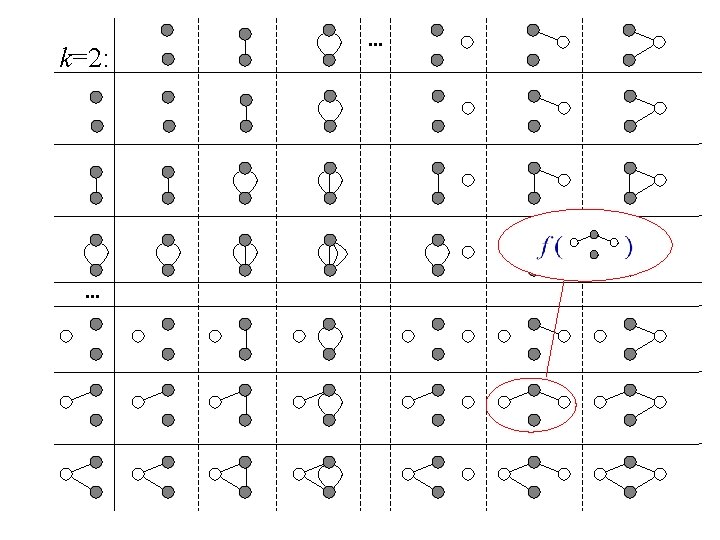
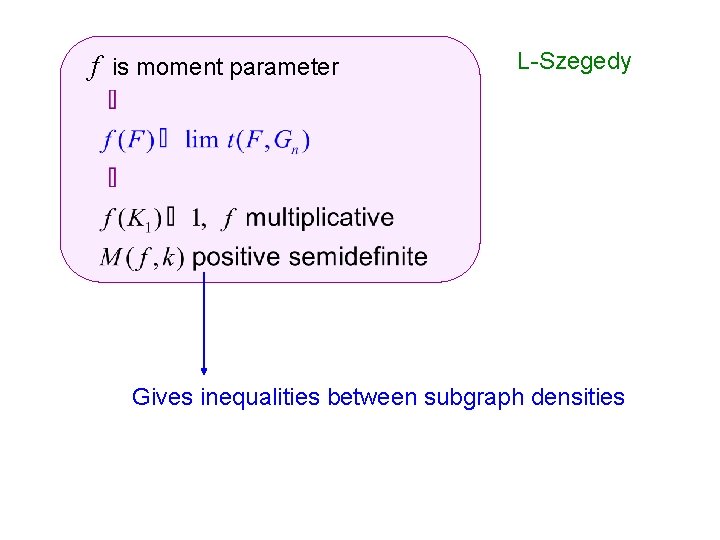
f is moment parameter L-Szegedy Gives inequalities between subgraph densities
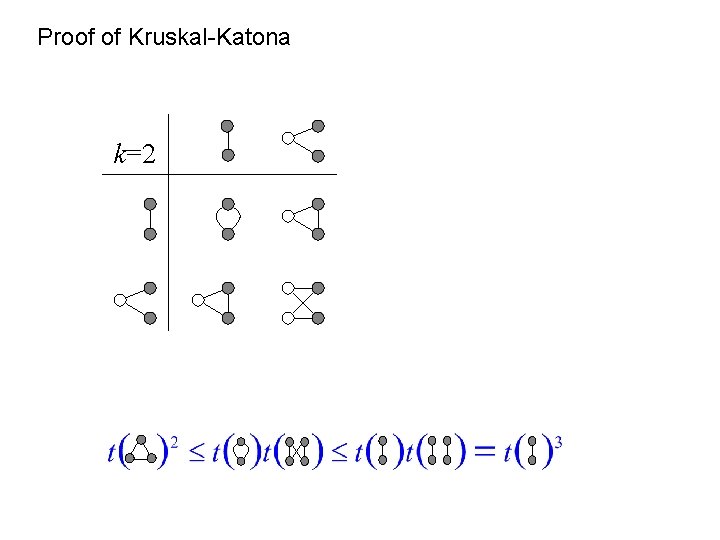
Proof of Kruskal-Katona k=2
- Slides: 26