
Aromaticity of benzene Benzene Structure The structural representation
Aromaticity of benzene

Benzene Structure

The structural representation of benzene is as shown in the figure below. The chemical formula for benzene is C 6 H 6, i. e it has 6 hydrogen- H atoms and six-carbon atoms and has an average mass of about 78. 112. The structure has a six-carbon ring which is represented by a hexagon and it includes 3 -double bonds. The carbon atoms are represented by a corner that is bonded to other atoms.

In benzene, the atoms are hydrogens. The double bonds within this structure are mainly separated by a single bond, hence this arrangement is recognized to have conjugated double bonds. A circle is used as an alternative symbol inside the hexagon that is used to represent six pi electrons. Due to the chemical formula, benzene is categorized as a hydrocarbon. It is a compound consisting of only hydrogen and carbon atoms. The formulas and structure reveal benzene as a pure aromatic hydrocarbon, wherein it is also defined as a compound composing hydrogen & carbon having alternate double bonds in the form of the ring.

STABILITY OF BENZENE Hydrogenation of benzene and other arenes is more difficult than hydrogenation of alkenes and alkynes. Two of the more active catalysts are rhodium and platinum, and it is possible to hydrogenate arenes in the presence of these catalysts at room temperature and modest pressure. Benzene consumes three molar equivalents of hydrogen to give cyclohexane. Nickel catalysts, although less expensive than rhodium and platinum, are also less active. Hydrogenation of arenes in the presence of nickel requires high temperatures (100– 200°C) and pressures (100 atm).
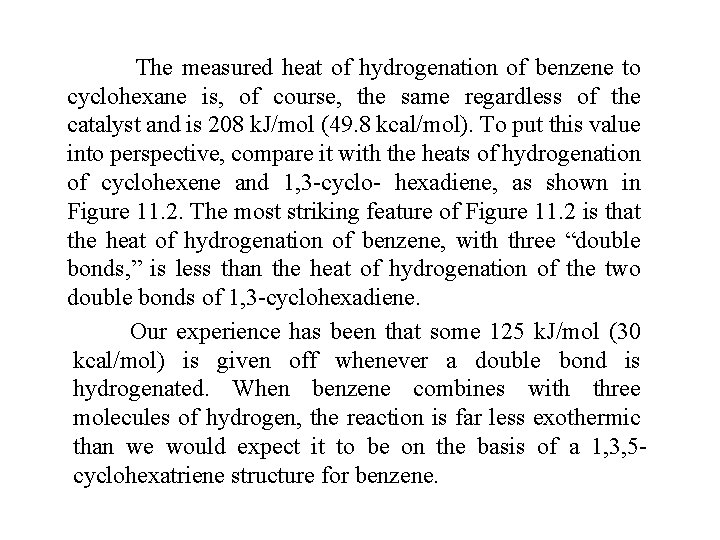
The measured heat of hydrogenation of benzene to cyclohexane is, of course, the same regardless of the catalyst and is 208 k. J/mol (49. 8 kcal/mol). To put this value into perspective, compare it with the heats of hydrogenation of cyclohexene and 1, 3 -cyclo- hexadiene, as shown in Figure 11. 2. The most striking feature of Figure 11. 2 is that the heat of hydrogenation of benzene, with three “double bonds, ” is less than the heat of hydrogenation of the two double bonds of 1, 3 -cyclohexadiene. Our experience has been that some 125 k. J/mol (30 kcal/mol) is given off whenever a double bond is hydrogenated. When benzene combines with three molecules of hydrogen, the reaction is far less exothermic than we would expect it to be on the basis of a 1, 3, 5 cyclohexatriene structure for benzene.
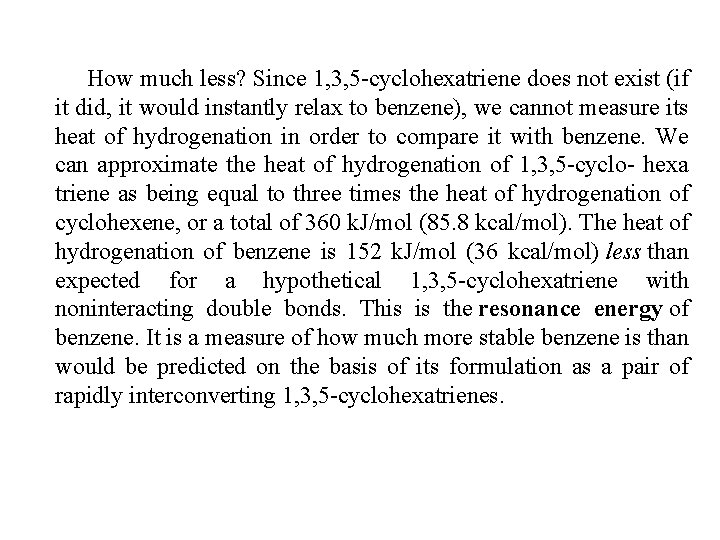
How much less? Since 1, 3, 5 -cyclohexatriene does not exist (if it did, it would instantly relax to benzene), we cannot measure its heat of hydrogenation in order to compare it with benzene. We can approximate the heat of hydrogenation of 1, 3, 5 -cyclo- hexa triene as being equal to three times the heat of hydrogenation of cyclohexene, or a total of 360 k. J/mol (85. 8 kcal/mol). The heat of hydrogenation of benzene is 152 k. J/mol (36 kcal/mol) less than expected for a hypothetical 1, 3, 5 -cyclohexatriene with noninteracting double bonds. This is the resonance energy of benzene. It is a measure of how much more stable benzene is than would be predicted on the basis of its formulation as a pair of rapidly interconverting 1, 3, 5 -cyclohexatrienes.
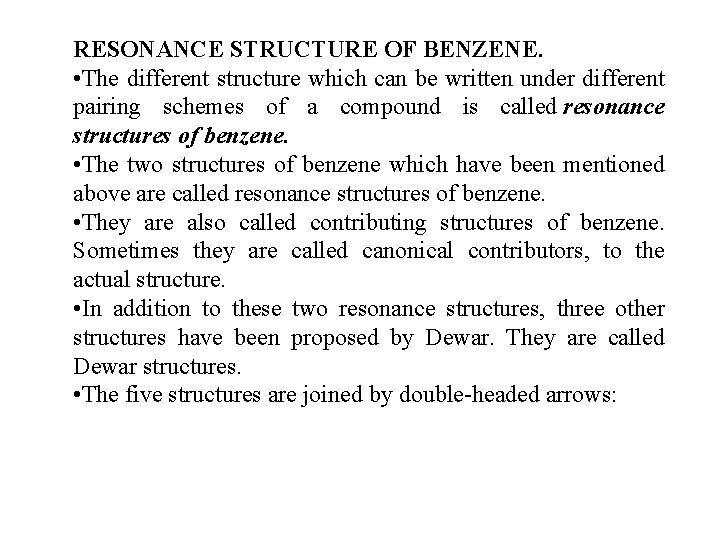
RESONANCE STRUCTURE OF BENZENE. • The different structure which can be written under different pairing schemes of a compound is called resonance structures of benzene. • The two structures of benzene which have been mentioned above are called resonance structures of benzene. • They are also called contributing structures of benzene. Sometimes they are called canonical contributors, to the actual structure. • In addition to these two resonance structures, three other structures have been proposed by Dewar. They are called Dewar structures. • The five structures are joined by double-headed arrows:

Aromaticity is defined as a property of the conjugated cycloalkenes which enhances the stabilization of a molecule due to its ability of electrons present in the ππ orbitals for the purpose of delocalization. Aromatic molecules are said to be very stable and they do not break so easily and also reacts with other types of substances. The organic compounds which are not said to be aromatic are known as aliphatic compounds. These might be in cyclic form, but only the aromatic rings have a special kind of stability.
Aromatic compounds are less stable compounds and they have many kinds of chemical as well as synthetic uses. In fact, the nucleic acids and the amino acids that make up our cell structure make use of these aromatic compounds. But, the main thing is what makes aromatic compounds? The aromatics compounds are said to exhibit some of the special characteristics or called as rules which are given below. The aromatic compounds are always cyclic structures. Each element of the ring within the structure must and should have a p-orbital ring which is in a perpendicular form to the ring, and this makes it a planar molecule All the compounds obey the Huckel’s Rule, i. e all the aromatic compounds should have the (4 n+2) Pi number of electrons. The last one is that the organic compound has to be flat.
What are the four conditions for aromaticity ? It should be in a ring form. It should be planar or flat. Every atom of the ring must be orthogonal to the plane of ring. It must satisfy the 4 n + 2 rule.
- Slides: 12