
AROMATIC HYDROCARBONS AROMATIC HYDROCARBONS Introduction structure of aromatic
AROMATIC HYDROCARBONS
AROMATIC HYDROCARBONS Introduction & structure of aromatic hydrocarbons
AROMATIC HYDROCARBONS Greek word ‘aroma’ means pleasant smelling. So, Aromatic hydrogen carbons are also called ‘arenes’.

AROMATIC HYDROCARBONS Ø Benzene and compounds that resemble benzene in their chemical behaviour are called as aromatic compounds. e. g. Benzene Naphthalene Anthracene Furan Thiophene : : Ø Ø Ø O S

AROMATIC HYDROCARBONS Ø Benzene and compounds that resemble benzene in their chemical behavior are called as aromatic compounds. e. g. Caffeine ( ) Methyl salicylate (PAIN RELIEVING OINTMENTS)
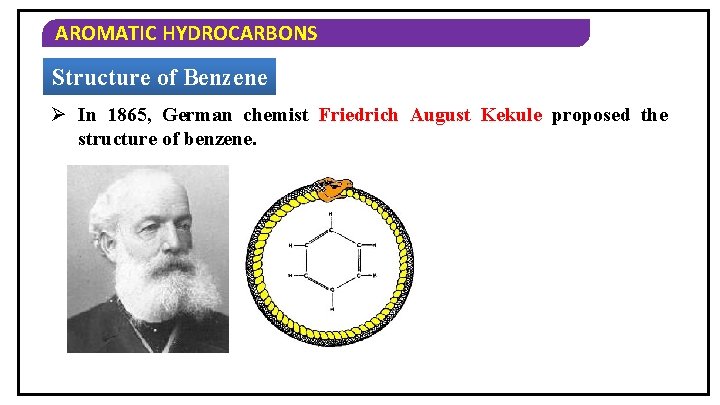
AROMATIC HYDROCARBONS Structure of Benzene Ø In 1865, German chemist Friedrich August Kekule proposed the structure of benzene.
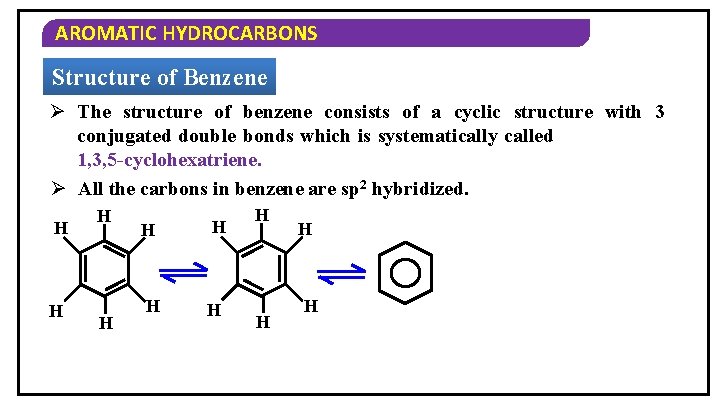
AROMATIC HYDROCARBONS Structure of Benzene Ø The structure of benzene consists of a cyclic structure with 3 conjugated double bonds which is systematically called 1, 3, 5 -cyclohexatriene. Ø All the carbons in benzene are sp 2 hybridized. H H H
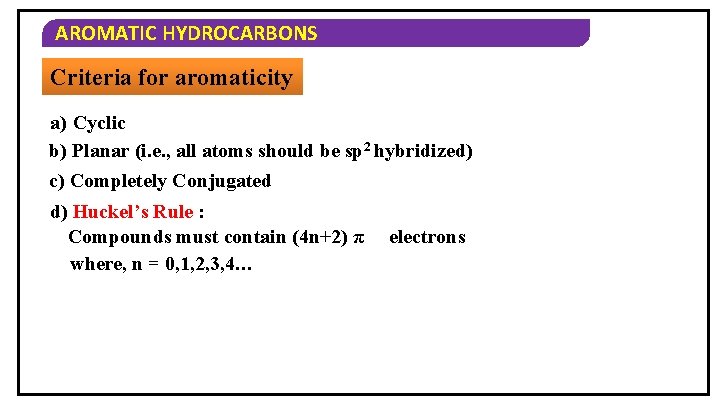
AROMATIC HYDROCARBONS Criteria for aromaticity a) Cyclic b) Planar (i. e. , all atoms should be sp 2 hybridized) c) Completely Conjugated d) Huckel’s Rule : Compounds must contain (4 n+2) π electrons where, n = 0, 1, 2, 3, 4…

AROMATIC HYDROCARBONS : N H Benzene Pyrrole Cyclobutadiene Cyclic Non Cyclic Planar Completelyconjugated Completely – (4 n )π πe–conjugated Conjugated but (4 n+ +2 2) e – (4 n n n=+=+1212))ππee–are (4 n arenot present in=πe 1 -3 4(1) + 22) 6 –πe (4(1) = – 6 πe– butadiene Non Aromatic Non Aromatic 1, 3 -Butadiene
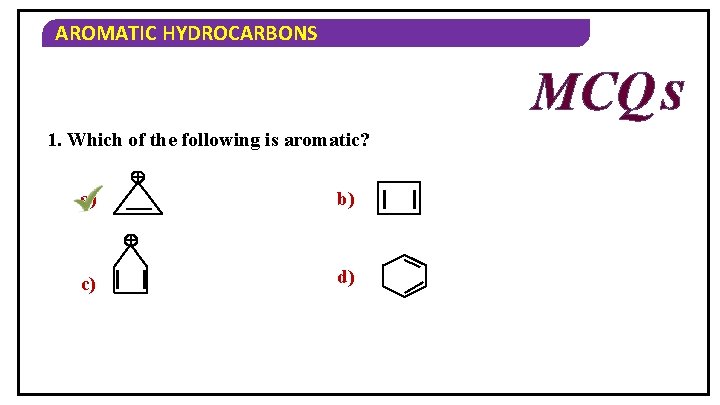
AROMATIC HYDROCARBONS MCQ S 1. Which of the following is aromatic? a) b) c) d)
AROMATIC HYDROCARBONS 2. Which of the following is referred to as Huckel’s rule? a) (4 n+1) electrons b) (4 n + 4) electrons c) (4 n + 2) electrons d) None of the above

AROMATIC HYDROCARBONS CLASSIFICATION OF AROMATIC COMPOUNDS

AROMATIC HYDROCARBONS CLASSIFICATION OF AROMATIC COMPOUNDS Benzenoids Ø The compounds contain one or more benzene rings in their structure. e. g. Benzene Benzaldehyde CHO

AROMATIC HYDROCARBONS CLASSIFICATION OF AROMATIC COMPOUND Non-Benzenoids Ø These compounds do not contain any benzene ring in their structure. e. g. : : O Thiophene Pyridine : Furan S N
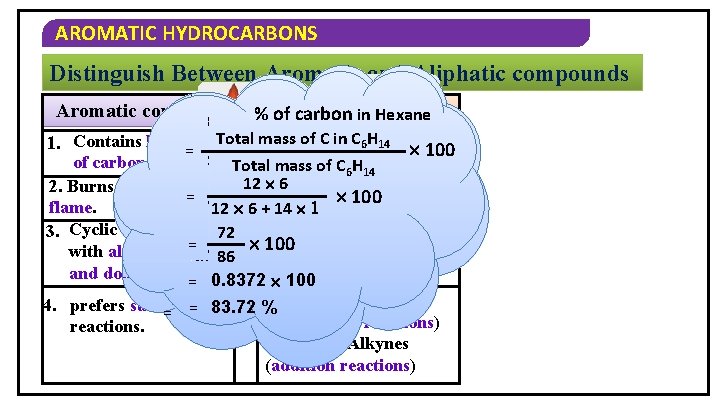
AROMATIC HYDROCARBONS Distinguish Between Aromatic and Aliphatic compounds Aromatic compound %Aliphatic ofincarbon in Hexane % of carbon Benzene mass in. HC 6 H% %Total 14 of 1. Contains higher Total mass of Cofin. CClower Contain 1. 6 6 ´ 100 = of carbon. Total mass of C H carbon. Total mass of C 6 H 6 6 14 6 2. Burns with sooty 12 2. ´ 126 ´ Burns with non-sooty = ´ 100 = flame. 12 12 ´ 6´+66+flame. ´ 14 1 ´ 1 3. Cyclic compound Open chain 72 72 3. ´ 100 = = ´ 100 with alternate single 86 compounds. 78 and double bonds. ´ 100 = 0. 8372 ´ 100 = 0. 9230 4. Alkanes 4. prefers substitution = 83. 72 % % = 92. 30 (Subsitution reactions) reactions. Alkens & Alkynes (addition reactions)
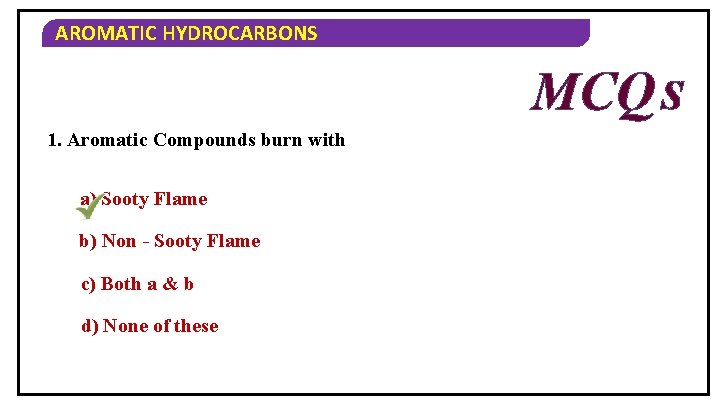
AROMATIC HYDROCARBONS MCQ S 1. Aromatic Compounds burn with a) Sooty Flame b) Non - Sooty Flame c) Both a & b d) None of these
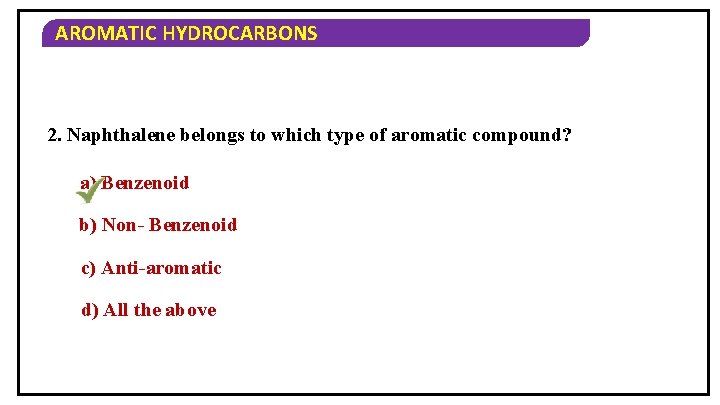
AROMATIC HYDROCARBONS 2. Naphthalene belongs to which type of aromatic compound? a) Benzenoid b) Non- Benzenoid c) Anti-aromatic d) All the above
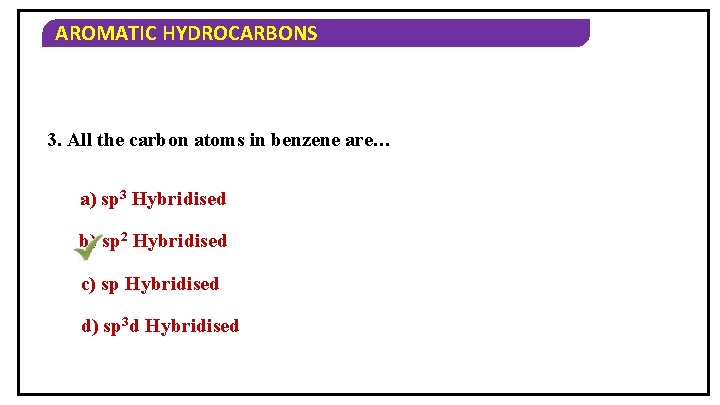
AROMATIC HYDROCARBONS 3. All the carbon atoms in benzene are… a) sp 3 Hybridised b) sp 2 Hybridised c) sp Hybridised d) sp 3 d Hybridised
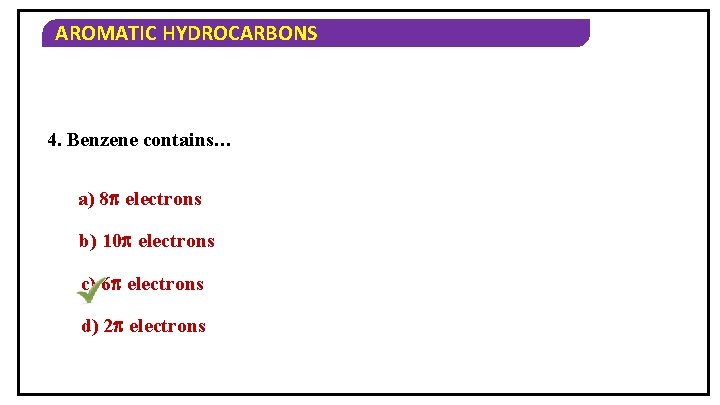
AROMATIC HYDROCARBONS 4. Benzene contains… a) 8 electrons b) 10 electrons c) 6 electrons d) 2 electrons
AROMATIC HYDROCARBONS NOMENCLATURE OF AROMATIC COMPOUNDS (PART-I)
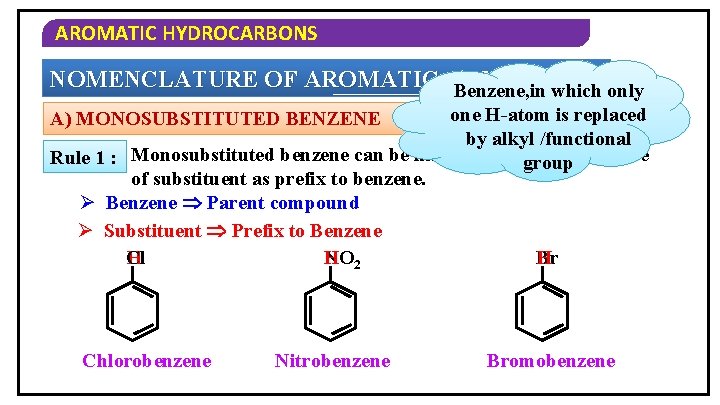
AROMATIC HYDROCARBONS NOMENCLATURE OF AROMATIC COMPOUNDS Benzene, in which only one H-atom is replaced by alkyl /functional Rule 1 : Monosubstituted benzene can be named by placing groupthe name of substituent as prefix to benzene. Ø Benzene Parent compound Ø Substituent Prefix to Benzene Cl H H NO 2 Br H A) MONOSUBSTITUTED BENZENE Chlorobenzene Nitrobenzene Bromobenzene
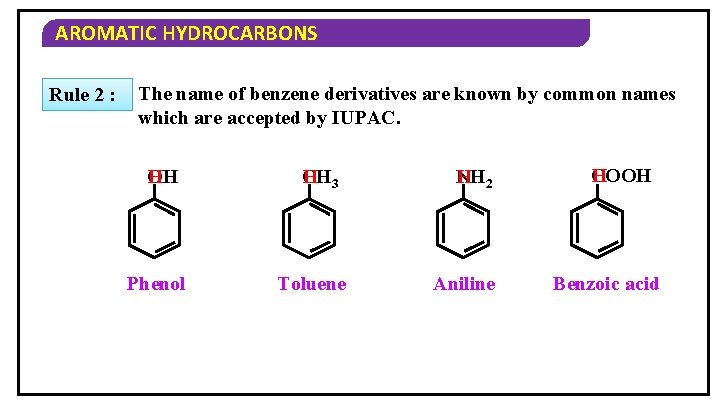
AROMATIC HYDROCARBONS Rule 2 : The name of benzene derivatives are known by common names which are accepted by IUPAC. OH H Phenol H 3 CH Toluene NH H 2 Aniline COOH H Benzoic acid
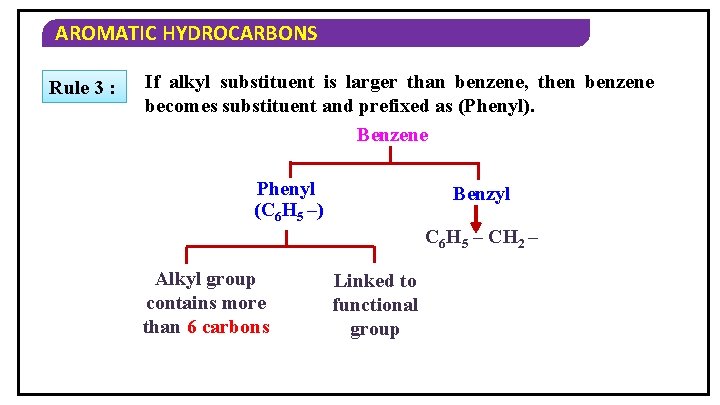
AROMATIC HYDROCARBONS Rule 3 : If alkyl substituent is larger than benzene, then benzene becomes substituent and prefixed as (Phenyl). Benzene Phenyl (C 6 H 5 –) Benzyl C 6 H 5 – CH 2 – Alkyl group contains more than 6 carbons Linked to functional group
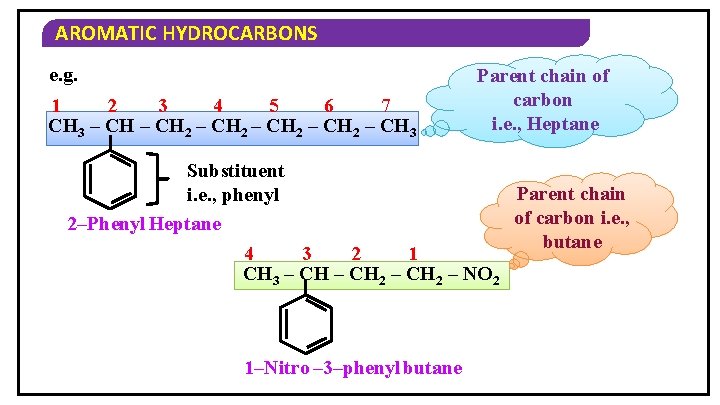
AROMATIC HYDROCARBONS e. g. 1 2 3 4 5 6 7 CH 3 – CH 2 – CH 3 Parent chain of carbon i. e. , Heptane Substituent i. e. , phenyl 2–Phenyl Heptane 4 3 2 1 CH 3 – CH 2 – NO 2 1–Nitro – 3–phenyl butane Parent chain of carbon i. e. , butane

AROMATIC HYDROCARBONS e. g. CH 2 – OH Benzyl alcohol 1 3 2 CH 2 – Cl 1–chloro – 3–phenyl Propane. Functional group (alcohol) Parent chain of carbon i. e. , Propane
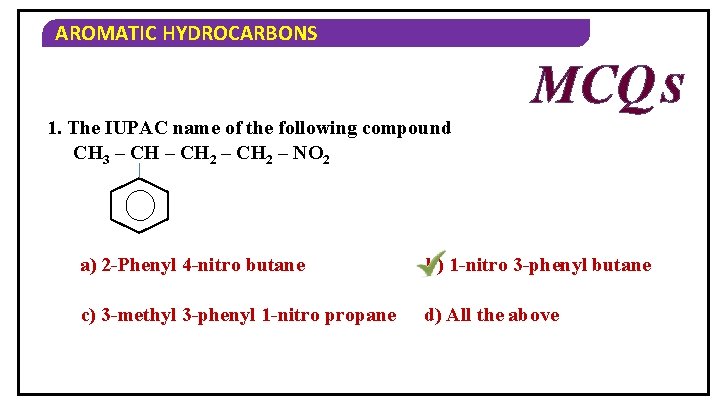
AROMATIC HYDROCARBONS MCQ S 1. The IUPAC name of the following compound CH 3 – CH 2 – NO 2 a) 2 -Phenyl 4 -nitro butane b) 1 -nitro 3 -phenyl butane c) 3 -methyl 3 -phenyl 1 -nitro propane d) All the above
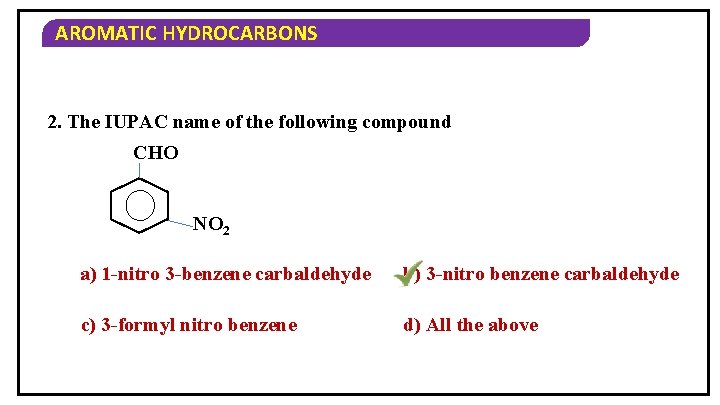
AROMATIC HYDROCARBONS 2. The IUPAC name of the following compound CHO NO 2 a) 1 -nitro 3 -benzene carbaldehyde b) 3 -nitro benzene carbaldehyde c) 3 -formyl nitro benzene d) All the above
AROMATIC HYDROCARBONS Nomenclature of aromatic compounds (part - II)
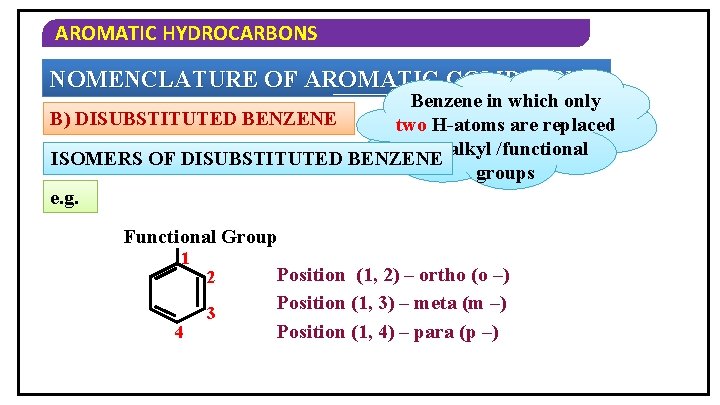
AROMATIC HYDROCARBONS NOMENCLATURE OF AROMATIC COMPOUNDS Benzene in which only B) DISUBSTITUTED BENZENE two H-atoms are replaced by alkyl /functional ISOMERS OF DISUBSTITUTED BENZENE groups e. g. Functional Group 1 4 2 3 Position (1, 2) – ortho (o –) Position (1, 3) – meta (m –) Position (1, 4) – para (p –)
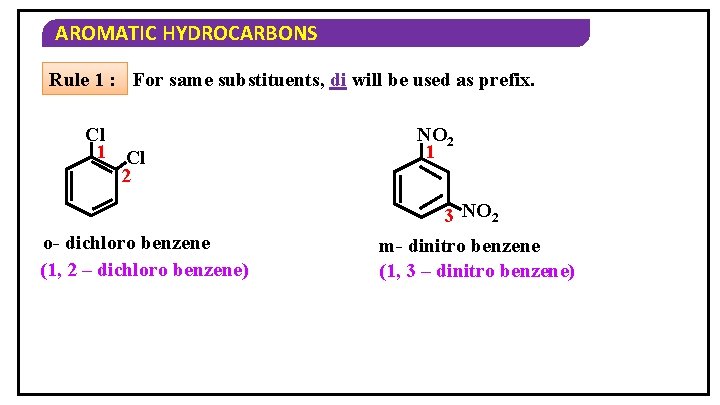
AROMATIC HYDROCARBONS Rule 1 : For same substituents, di will be used as prefix. Cl 1 Cl 2 NO 2 1 3 NO 2 o- dichloro benzene (1, 2 – dichloro benzene) m- dinitro benzene (1, 3 – dinitro benzene)
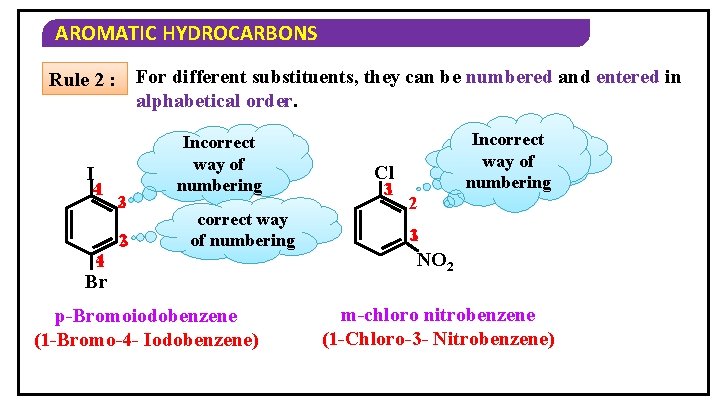
AROMATIC HYDROCARBONS For different substituents, they can be numbered and entered in alphabetical order. Rule 2 : I 41 41 32 23 Incorrect way of numbering Br p-Bromoiodobenzene (1 -Bromo-4 - Iodobenzene) Incorrect way of of numbering Cl 31 2 13 NO 2 m-chloro nitrobenzene (1 -Chloro-3 - Nitrobenzene)
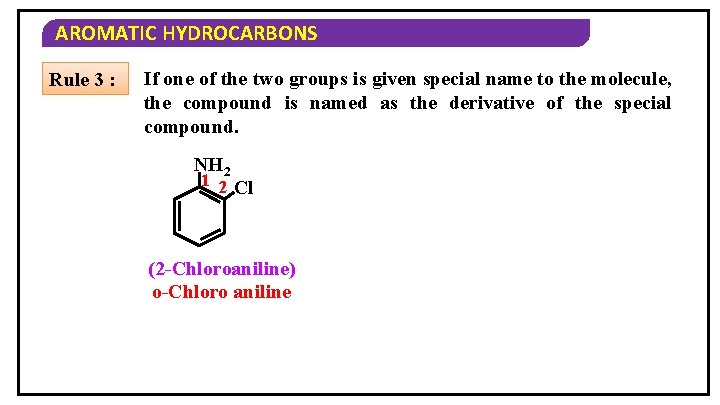
AROMATIC HYDROCARBONS Rule 3 : If one of the two groups is given special name to the molecule, the compound is named as the derivative of the special compound. NH 2 1 2 Cl (2 -Chloroaniline) o-Chloro aniline
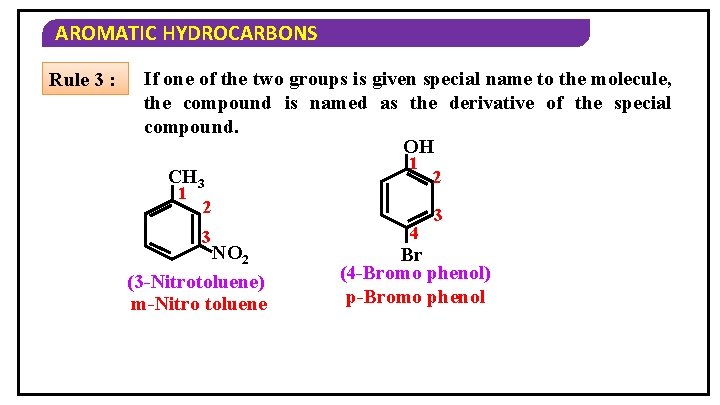
AROMATIC HYDROCARBONS Rule 3 : If one of the two groups is given special name to the molecule, the compound is named as the derivative of the special compound. OH 1 2 CH 3 1 2 3 NO 2 (3 -Nitrotoluene) m-Nitro toluene 4 3 Br (4 -Bromo phenol) p-Bromo phenol
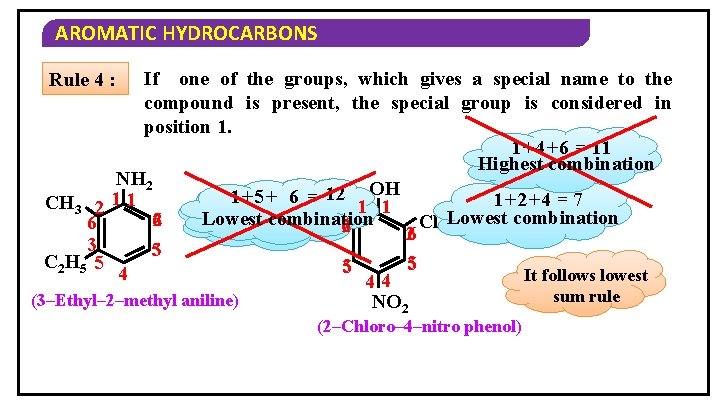
AROMATIC HYDROCARBONS If one of the groups, which gives a special name to the compound is present, the special group is considered in position 1. 1+4+6 = 11 Highest combination NH 2 OH 12 1+5 + 6 = 1 1 1+2+4 = 7 CH 3 2 1+2+ 3 = 6 1 1 Lowest combination 62 Cl Lowest combination 6 26 26 3 53 C 2 H 5 5 53 53 4 It follows lowest 44 sum rule (3–Ethyl– 2–methyl aniline) NO 2 Rule 4 : (2–Chloro– 4–nitro phenol)

AROMATIC HYDROCARBONS If more than two groups are attached to the direction of numbering, it should be such that it gives lowest combination 1+4+6 of numbers. 1 + 2+ 4 = 11 7 combination 35 6 = 11 Highest Br 1+4+6 2 CH 3 Lowest combination 4 Br 4 53 Highest 26 4 combination 4 1 1 5 35 1 CH 3 3 6 2 Br 26 1+2+4 =7 Br 4–Bromo– 1, 2–dimethyl benzene Lowest combination 1, 2, 4 -Tribromobenzene Rule 5:
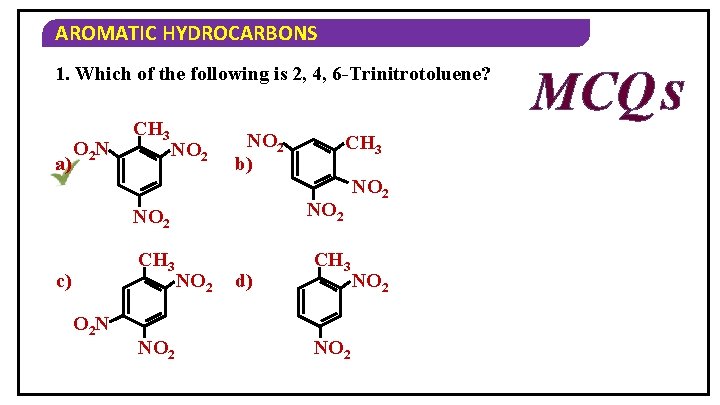
AROMATIC HYDROCARBONS 1. Which of the following is 2, 4, 6 -Trinitrotoluene? a) O 2 N CH 3 NO 2 b) NO 2 CH 3 c) O 2 N NO 2 CH 3 NO 2 d) CH 3 NO 2 MCQ S
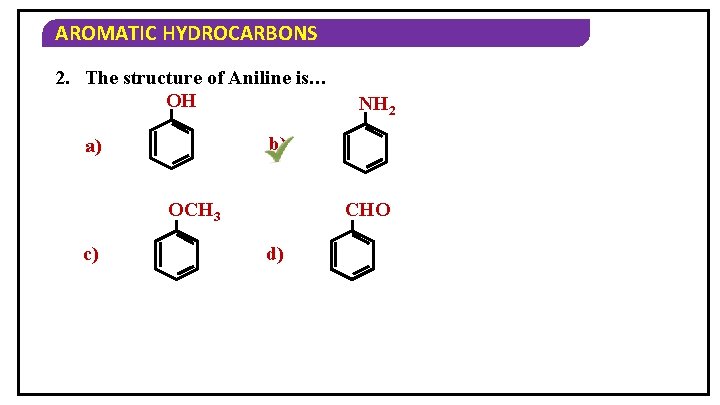
AROMATIC HYDROCARBONS 2. The structure of Aniline is… OH b) a) OCH 3 c) NH 2 CHO d)
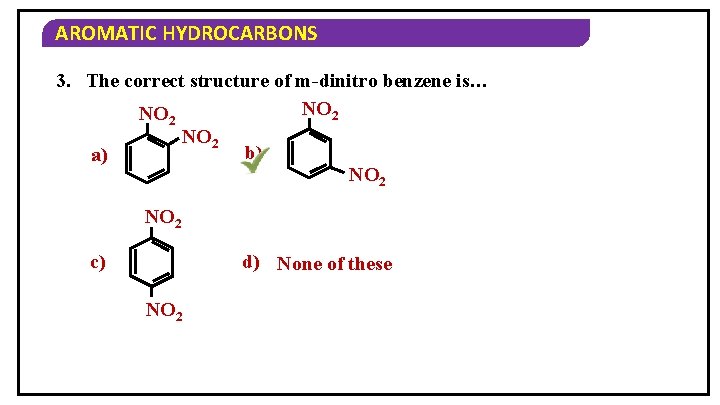
AROMATIC HYDROCARBONS 3. The correct structure of m-dinitro benzene is… NO 2 b) a) NO 2 c) d) None of these NO 2

AROMATIC HYDROCARBONS COOH 4. Name of the compound is… a) Acetophenone b) Benzaldehyde c) Benzoic acid d) b and c

AROMATIC HYDROCARBONS Thank you…
- Slides: 40