
Aromatic Compounds 1 1 Discovery of Benzene Isolated
Aromatic Compounds 1 1
Discovery of Benzene Isolated in 1825 by Michael Faraday who determined C: H ratio to be 1: 1. Synthesized in 1834 by Eilhard Mitscherlich who determined molecular formula to be C 6 H 6. Other related compounds with low C: H ratios had a pleasant smell, so they e classified as aromatic. => 2
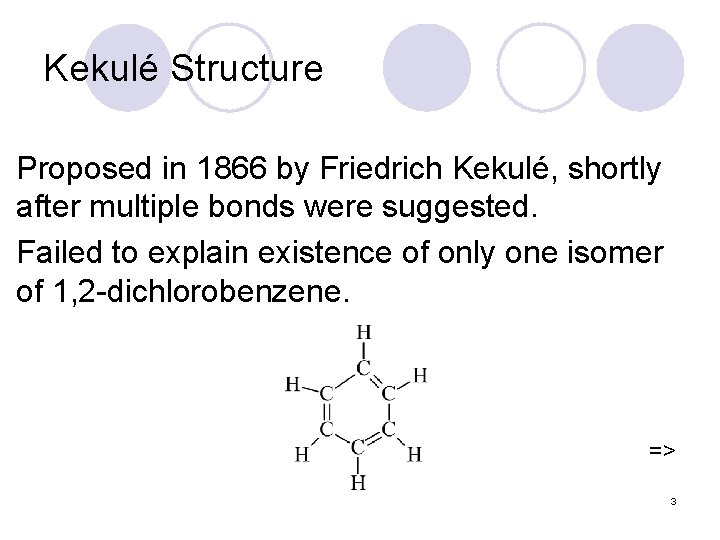
Kekulé Structure Proposed in 1866 by Friedrich Kekulé, shortly after multiple bonds were suggested. Failed to explain existence of only one isomer of 1, 2 -dichlorobenzene. => 3
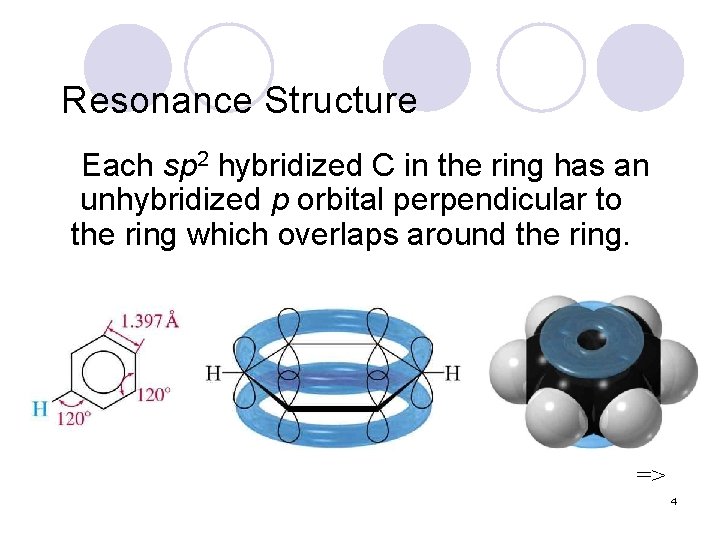
Resonance Structure Each sp 2 hybridized C in the ring has an unhybridized p orbital perpendicular to the ring which overlaps around the ring. => 4
Unusual Reactions Alkene + KMn. O 4 diol (addition) Benzene + KMn. O 4 no reaction. Alkene + Br 2/CCl 4 dibromide (addition) Benzene + Br 2/CCl 4 no reaction. With Fe. Cl 3 catalyst, Br 2 reacts with benzene to form bromobenzene + HBr (substitution!). Double bonds remain. => 5
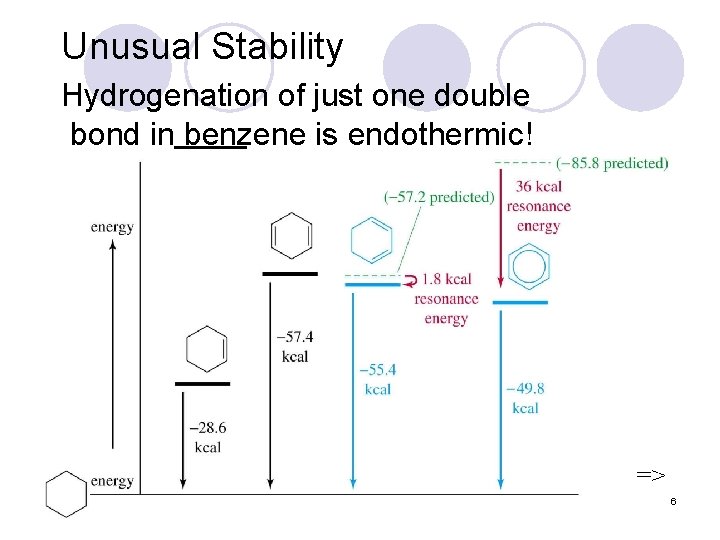
Unusual Stability Hydrogenation of just one double bond in benzene is endothermic! => 6
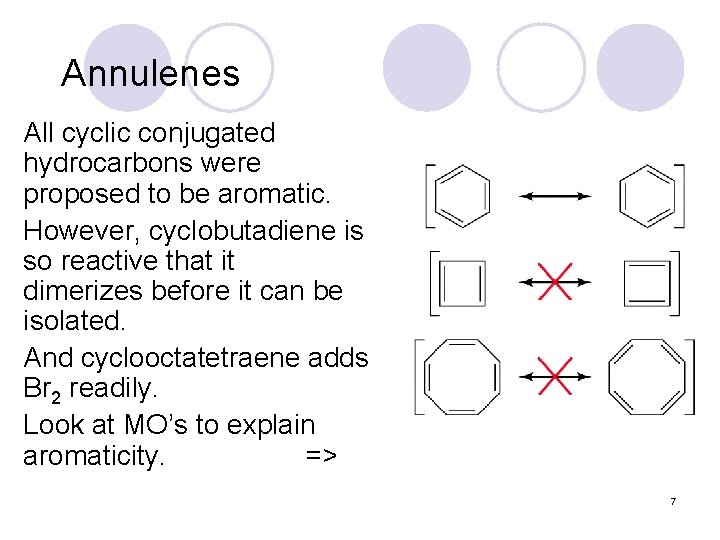
Annulenes All cyclic conjugated hydrocarbons were proposed to be aromatic. However, cyclobutadiene is so reactive that it dimerizes before it can be isolated. And cyclooctatetraene adds Br 2 readily. Look at MO’s to explain aromaticity. => 7
MO Rules for Benzene Six overlapping p orbitals must form six molecular orbitals. Three will be bonding, three antibonding. Lowest energy MO will have all bonding interactions, no nodes. As energy of MO increases, the number of nodes increases. => 8
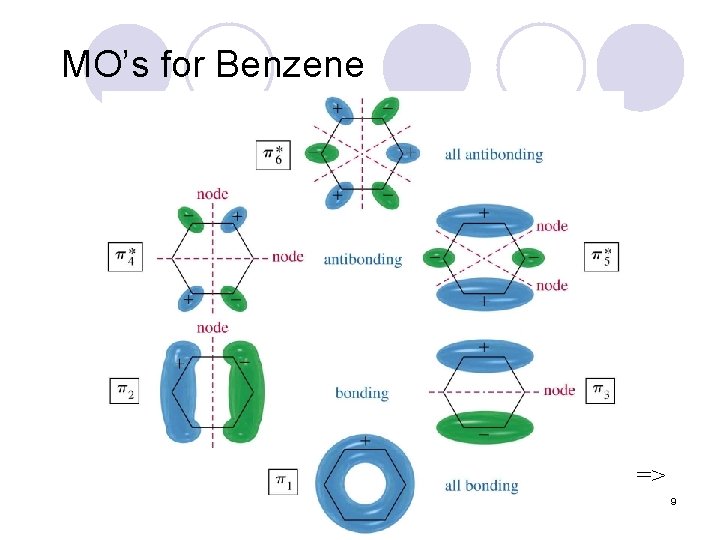
MO’s for Benzene => 9
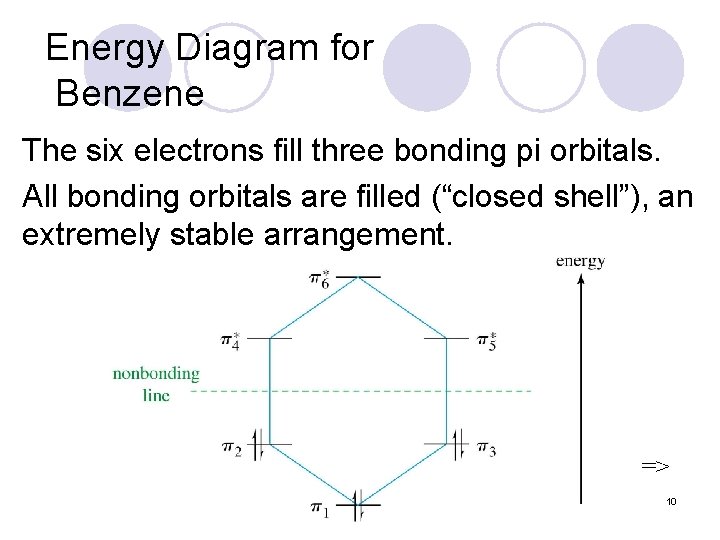
Energy Diagram for Benzene The six electrons fill three bonding pi orbitals. All bonding orbitals are filled (“closed shell”), an extremely stable arrangement. => 10
- Slides: 10