
Army Managerial Leadership NEW ARMY MANAGEMENT SYSTEM Version




- Slides: 14
Army Managerial Leadership NEW ARMY MANAGEMENT SYSTEM (Version 1. 0) Prepared & Presented by Dr. Stephen Clement ©
OUR VISION: To be acclaimed as a world-class, properly-designed and well-managed organization by our Soldiers and Stakeholders. In the same way that the Toyota Corporation is known for the “Toyota Way, ” we – the Generating Force of the United State Army – will be known for the “Army Way” of doing business. Our Efficiency Lightens Their Effectiveness Ensures Their Our Load Freedom OUR PURPOSE: Educating the Army’s senior civilian and military leaders with the knowledge they need to reach their personal managerial leadership goals and to be the leaders who bring to life the “Army Way" of doing business. Stephen Clement & Roger Harvey 2
BUSINESS TRANSFORMATION STRATEGY ©
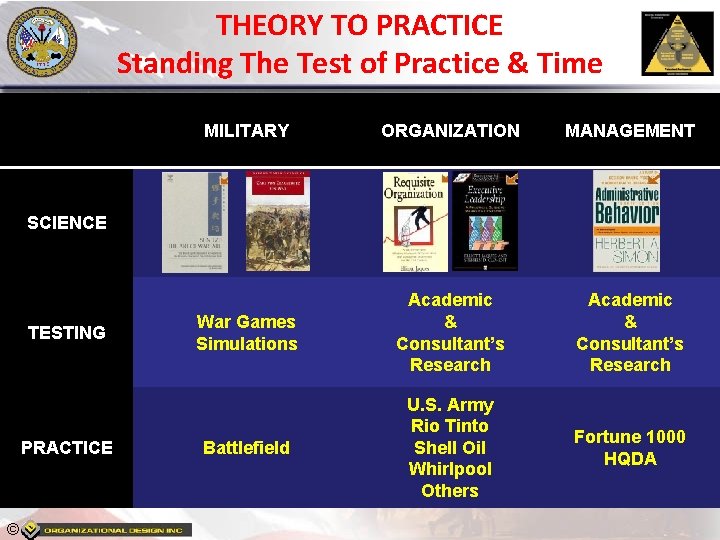
THEORY TO PRACTICE Standing The Test of Practice & Time MILITARY ORGANIZATION MANAGEMENT War Games Simulations Academic & Consultant’s Research Battlefield U. S. Army Rio Tinto Shell Oil Whirlpool Others Fortune 1000 HQDA SCIENCE TESTING PRACTICE ©
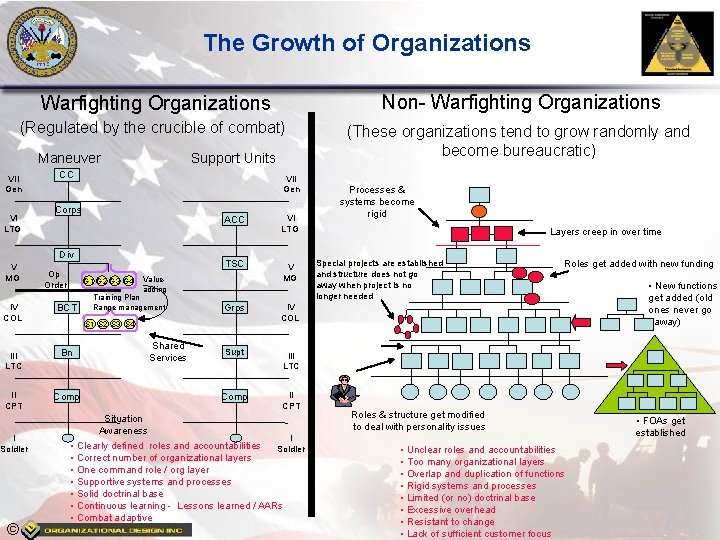
The Growth of Organizations Warfighting Organizations Non- Warfighting Organizations (Regulated by the crucible of combat) (These organizations tend to grow randomly and become bureaucratic) Maneuver VII Gen VI LTG Support Units CC VII Gen Corps ACC Div V MG Op Order G 1 G 2 G 3 G 4 IV COL BCT III LTC Bn II CPT Comp I Soldier © TSC Valueadding Training Plan Range management Situation Awareness V MG Grps IV COL Supt III LTC Comp II CPT S 1 S 2 S 3 S 4 Shared Services VI LTG Processes & systems become rigid Layers creep in over time Special projects are established and structure does not go away when project is no longer needed Roles get added with new funding Roles & structure get modified to deal with personality issues I • Clearly defined roles and accountabilities Soldier • Correct number of organizational layers • One command role / org layer • Supportive systems and processes • Solid doctrinal base • Continuous learning - Lessons learned / AARs • Combat adaptive • Unclear roles and accountabilities • Too many organizational layers • Overlap and duplication of functions • Rigid systems and processes • Limited (or no) doctrinal base • Excessive overhead • Resistant to change • Lack of sufficient customer focus • New functions get added (old ones never go away) • FOAs get established
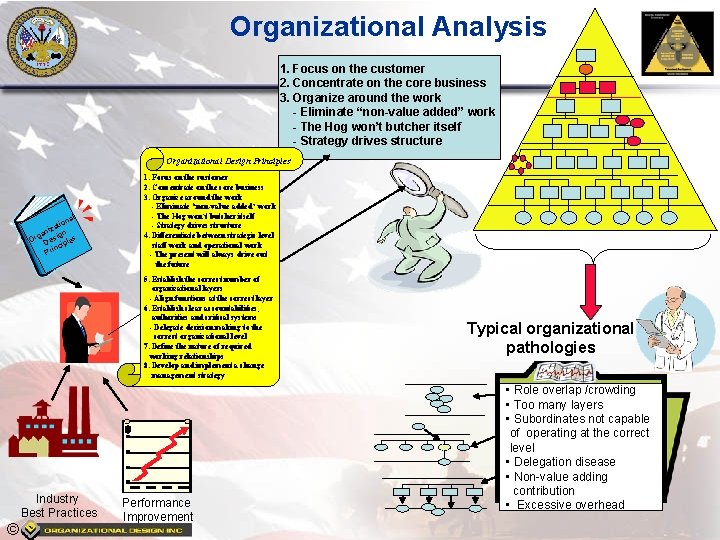
Organizational Analysis 1. Focus on the customer 2. Concentrate on the core business 3. Organize around the work - Eliminate “non-value added” work - The Hog won’t butcher itself - Strategy drives structure Organizational Design Principles al tion a z ni gn ga Or Desi ples nci Pri 1. Focus on the customer 2. Concentrate on the core business 3. Organize around the work - Eliminate “non-value added” work - The Hog won’t butcher itself - Strategy drives structure 4. Differentiate between strategic level staff work and operational work - The present will always drive out the future 5. Establish the correct number of organizational layers - Align functions at the correct layer 6. Establish clear accountabilities, authorities and critical systems - Delegate decision making to the correct organizational level 7. Define the nature of required working relationships 8. Develop and implement a change management strategy Industry Best Practices © Performance Improvement Typical organizational pathologies • Role overlap /crowding • Too many layers • Subordinates not capable of operating at the correct level • Delegation disease • Non-value adding contribution • Excessive overhead
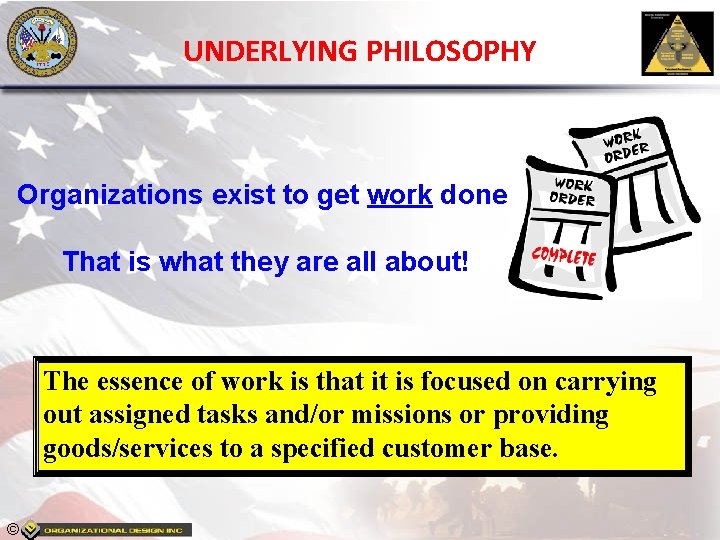
UNDERLYING PHILOSOPHY Organizations exist to get work done. That is what they are all about! The essence of work is that it is focused on carrying out assigned tasks and/or missions or providing goods/services to a specified customer base. ©
CREATING A REQUISITE ORGANIZATIONAL STRUCTURE Task Complexity VII Create a supportive corporate culture, vision and values. Worldwide networking and VI data accumulation. Identify and manage second V order consequences. Organizational Structure CEO EVP BU Pres IV Manage progress on multiple pathways simultaneously. GM GM Develop alternate pathways III (plans). Unit Mgr © II Accumulate essential information I Take immediate action, overcome obstacles. EVP Unit Mgr GM Unit Mgr Opr Opr Cognitive Capacity Synthesis; 2 nd Order Consequences Networking and Integration Systems Thinking Parallel Processing Generating Preplanned Options Cumulative processing Practical judgment
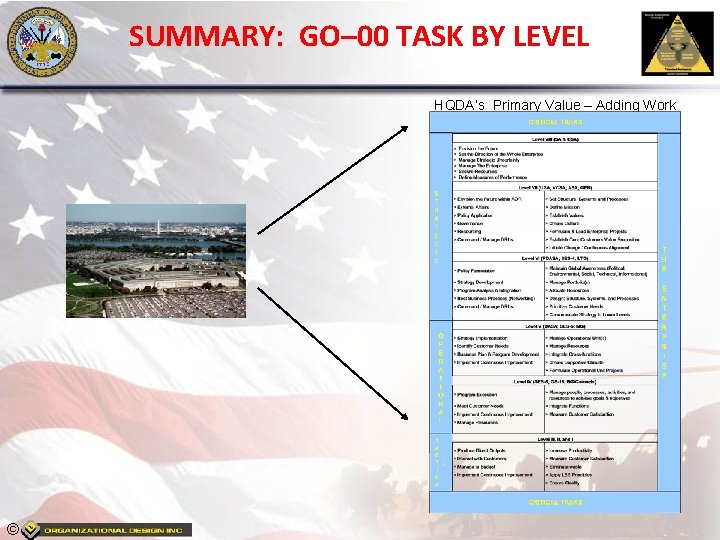
SUMMARY: GO– 00 TASK BY LEVEL HQDA’s Primary Value – Adding Work ©
HQDA’s PRIMARY VALUE - ADDING WORK IS STRATEGIC ©
DRU & OPERATING ACTIVITIES’ PRIMARY VALUE - ADDING WORK IS OPERATIONAL ©
ORGANIZATIONAL DESIGN PRINCIPLES 1. Focus on the Customer • Seek-out and Listen to the “Voice-of-Your-Customer” 2. Concentrate on the Core Business • Distinguish Core and Context Functions / Processes • Prioritize, Focus, and Align the Organization Around the Core 3. Organize Around the Work • Eliminate “Non-Valued” Work • The Hog Won’t Butcher Itself • Strategy Drives Structure 4. Differentiate Between Strategic Level Staff Work and Operational Work • Staff Work Produces Output that Flows up to the Boss • Operational Work Produces Direct Output for the Customer 5. Establish the Correct Number of Organization Levels • Align Functions at the Correct Organizational Level • Eliminate Duplicate Positions at the Same Level 6. Establish Clear Accountabilities and Authorities • Delegate Decision-Making Authority to the Proper Organization Level 7. Define the Nature of Required Working Relationships ©
POLICY– STRATEGY– EXECUTION Example: TBI & PTSD VIII VII POLICY APPLICATION Stakeholder Issues / Concerns / Emerging Problems 1 Policy Formulation VI Approval (Framing the Issue) 3 7 Strategy Evaluation Analysis 2 4 Analysis V Redo 6 Programs 5 IV Redo Execution III II © I Stakeholder Concern L. T. Acute Care • TBI • PTSD Policy Formulation Policy Application • Outsource • Treat In-House • Ignore Veterans Administration Strategy • TBI Centers of Excellence • Tele-Medicine • TBI Centers Programs Partner w/ U of Maryland TBI Center
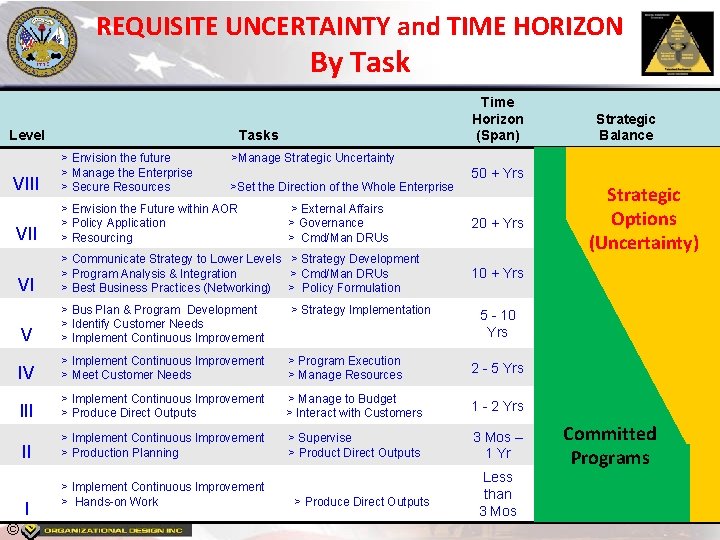
REQUISITE UNCERTAINTY and TIME HORIZON By Task Level Time Horizon (Span) Tasks VIII > Envision the future > Manage the Enterprise > Secure Resources VII > Envision the Future within AOR > Policy Application > Resourcing VI > Communicate Strategy to Lower Levels > Strategy Development > Program Analysis & Integration > Cmd/Man DRUs > Best Business Practices (Networking) > Policy Formulation > Strategy Implementation V > Bus Plan & Program Development > Identify Customer Needs > Implement Continuous Improvement IV > Implement Continuous Improvement > Meet Customer Needs > Program Execution > Manage Resources 2 - 5 Yrs III > Implement Continuous Improvement > Produce Direct Outputs > Manage to Budget > Interact with Customers 1 - 2 Yrs II > Implement Continuous Improvement > Production Planning > Supervise > Product Direct Outputs 3 Mos – 1 Yr I © >Manage Strategic Uncertainty >Set the Direction of the Whole Enterprise > Implement Continuous Improvement > Hands-on Work > External Affairs > Governance > Cmd/Man DRUs > Produce Direct Outputs Strategic Balance 50 + Yrs 20 + Yrs Strategic Options (Uncertainty) 10 + Yrs 5 - 10 Yrs Less than 3 Mos Committed Programs