
Army Knowledge Management A Principles Based Approach Marvin
Army Knowledge Management - A Principles Based Approach – Marvin Wages HQDA CIO G-6 marvin. wages@us. army. mil
Sun Tzu When a country has Generals that are thoroughly able and intelligent, then that country is safe and strong. This means that Generals have to be completely capable and completely knowledgeable in all operations. Chapter 3: Planning the Attack, Art of War
From Sun Tzu to You. Tube Let’s Watch: http: //www. youtube. com/watch? v=-4 CV 05 Hy. Ab. M
Introduction AKM VISION: A transformed Army, with agile capabilities and adaptive processes, powered by world class, secure, networkcentric access to knowledge, systems, and services, interoperable with the Joint environment Army Knowledge Management is the strategy to transform the Army into a net-centric, knowledge-based force
Army Enterprise Knowledge Management Strategy - End State The end-state of the strategy is to create a culture of collaboration and knowledge sharing in the Army where personalized and contextual information and knowledge is “pushed and pulled” from across the enterprise to meet mission objectives -an Army where good ideas are valued regardless of the source, the extant knowledge base is accessible without technological or structural barriers, and knowledge sharing is recognized and rewarded.
Definition of KM Knowledge management is a discipline that promotes an integrated approach to identifying, retrieving, evaluating, and sharing an enterprise’s tacit and explicit knowledge assets to meet mission objectives. The objective is to connect those who know with those who need to know (know-why, know-what, know-who, and know-how) by leveraging knowledge transfers from one-to-many across the enterprise. (Proposed AR 25 -1 revised definition)
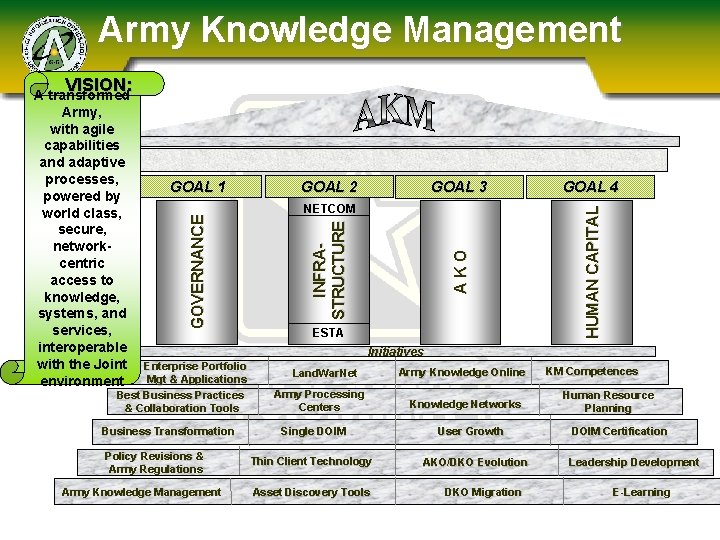
Army Knowledge Management VISION: Business Transformation Policy Revisions & Army Regulations Army Knowledge Management GOAL 3 H U MA N C A P I T A L NETCOM GOAL 4 AKO Enterprise Portfolio Mgt & Applications Best Business Practices & Collaboration Tools GOAL 2 Army Knowledge Online KM Competences I NF RAS T RUCT URE GOAL 1 G O V E RNANCE A transformed Army, with agile capabilities and adaptive processes, powered by world class, secure, networkcentric access to knowledge, systems, and services, interoperable with the Joint environment ESTA Initiatives Land. War. Net Army Processing Centers Single DOIM Thin Client Technology Asset Discovery Tools Knowledge Networks User Growth AKO/DKO Evolution DKO Migration Human Resource Planning DOIM Certification Leadership Development E-Learning

Tactical KM/Collaboration Tools Best of Breed Effort 18 Tools Nominated by Corps Commanders A VCS ved ro App y 06 Jul Standard Solution Set 1. Common Tactical Website • Identify Operational Requirements 2. Data Fusion (combining two tools) • Provide System/Tool information • Normalize Operational Requirements CTSF Assessment • Tool demonstration and operational requirements assessment • Technical assessment and integration 3. Real-time Collaboration DISA-Selected two for DOD Adobe 15 Dec 05 – 02 Feb 06 21 Feb 06 – 30 May 06 Lotus Sametime Connect
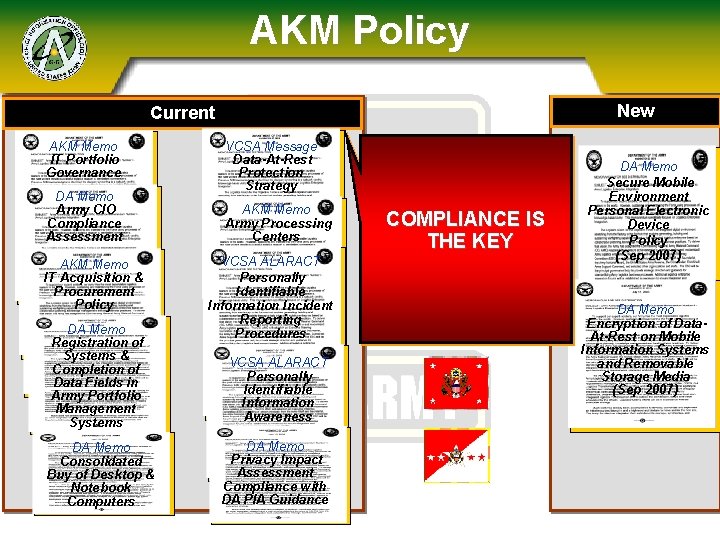
AKM Policy New Current AKM Memo IT Portfolio Governance DA Memo Army CIO Compliance Assessment AKM Memo IT Acquisition & Procurement Policy DA Memo Registration of Systems & Completion of Data Fields in Army Portfolio Management Systems DA Memo Consolidated Buy of Desktop & Notebook Computers VCSA Message Data-At-Rest Protection Strategy AKM Memo Army Processing Centers VCSA ALARACT Personally Identifiable Information Incident Reporting Procedures VCSA ALARACT Personally Identifiable Information Awareness DA Memo Privacy Impact Assessment Compliance with DA PIA Guidance COMPLIANCE IS THE KEY DA Memo Secure Mobile Environment Personal Electronic Device Policy (Sep 2007) DA Memo Encryption of Data. At-Rest on Mobile Information Systems and Removable Storage Media (Sep 2007)
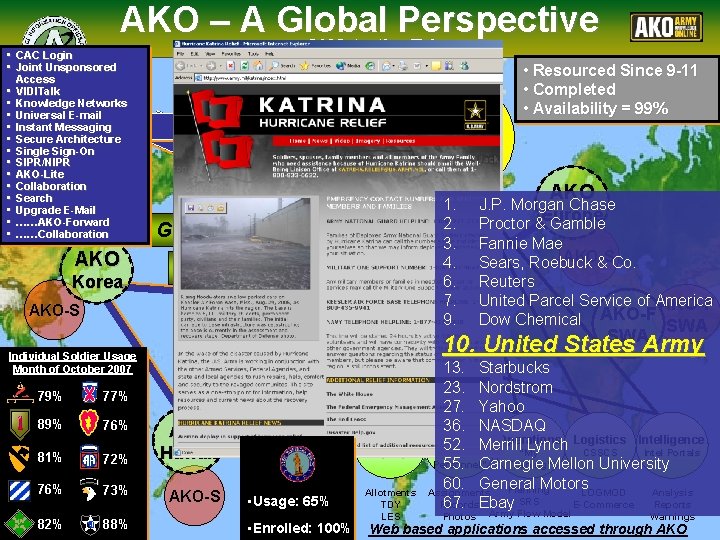
AKO – A Global Perspective • CAC Login • Joint Unsponsored Access • VIDITalk • Knowledge Networks • Universal E-mail • Instant Messaging • Secure Architecture • Single Sign-On • SIPR/NIPR • AKO-Lite • Collaboration • Search • Upgrade E-Mail • ……AKO-Forward • ……Collaboration AKO Korea ……. AKO to the Edge AKO Secondary Site (DR) AKO Prime Guard. Net ARNet AKO Main AKO-S Individual Soldier Usage Month of October 2007 79% 77% 89% 76% 81% 72% 76% 73% 82% 88% Ft. Belvoir AKO Hawaii AKO-S Finance “My Pay” • Usage: 65% • Enrolled: 100% Allotments TDY LES 1. 2. 3. 4. 6. 7. 9. • Resourced Since 9 -11 • Completed • Availability = 99% AKO J. P. Morgan Chase Europe Proctor & Gamble Fannie Mae AKO-S Sears, Roebuck & Co. Reuters United Parcel Service of America AKO-F Dow Chemical SWA 10. United States Army 13. Starbucks 23. Nordstrom 27. Yahoo 36. NASDAQ Personnel Operations Logistics Intelligence 52. Merrill“My Lynch CSSCS Intel Portals “My Personnel” Training”Mellon University 55. Carnegie 60. General Motors. LOGMOD Planning Assignments Analysis Records E-Commerce Reports 67. Ebay SRS Photos Army Flow Model Warnings Web based applications accessed through AKO 10
Knowledge Networks on AKO
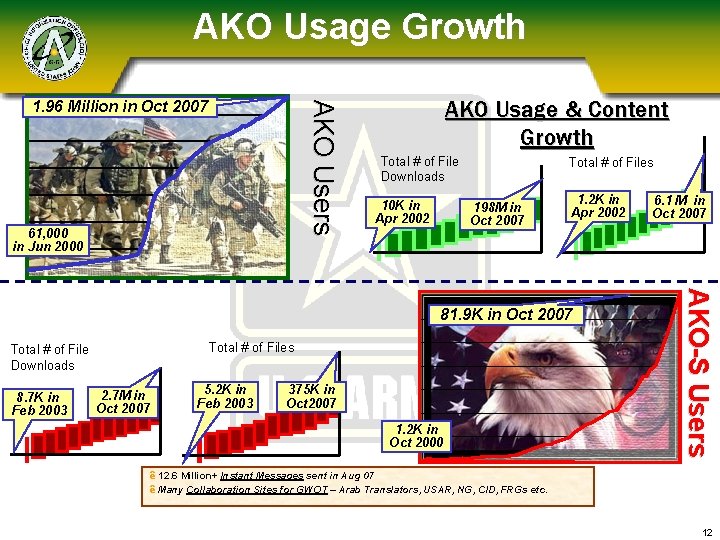
AKO Usage Growth AKO Users 1. 96 Million in Oct 2007 61, 000 in Jun 2000 AKO Usage & Content Growth Total # of File Downloads 10 K in Apr 2002 Total # of Files 198 M in Oct 2007 1. 2 K in Apr 2002 Total # of Files Total # of File Downloads 8. 7 K in Feb 2003 2. 7 M in Oct 2007 5. 2 K in Feb 2003 375 K in Oct 2007 1. 2 K in Oct 2000 AKO-S Users 81. 9 K in Oct 2007 6. 1 M in Oct 2007 ê 12. 6 Million+ Instant Messages sent in Aug 07 ê Many Collaboration Sites for GWOT – Arab Translators, USAR, NG, CID, FRGs etc. 12
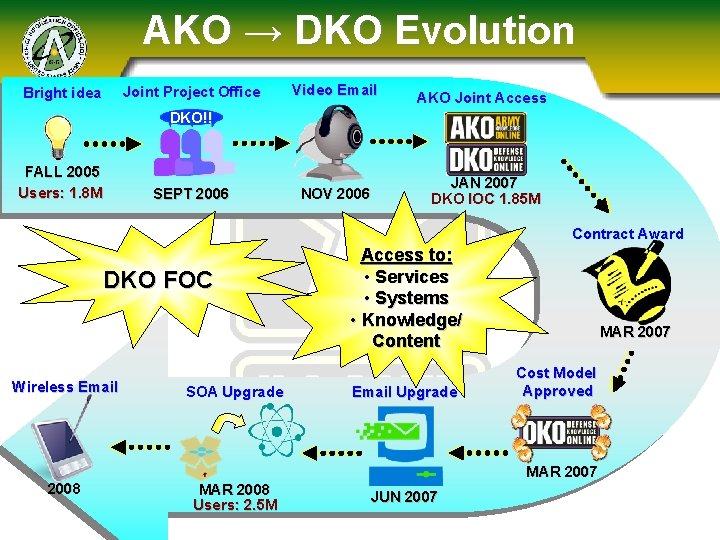
AKO → DKO Evolution Joint Project Office Bright idea Video Email AKO Joint Access NOV 2006 JAN 2007 DKO IOC 1. 85 M DKO!! FALL 2005 Users: 1. 8 M SEPT 2006 Contract Award DKO FOC Wireless Email 2008 SOA Upgrade Access to: • Services • Systems • Knowledge/ Content Email Upgrade MAR 2007 Cost Model Approved MAR 2007 MAR 2008 Users: 2. 5 M JUN 2007
New or Coming Soon to AKO/DKO • Upgrade of Portal to WSRP/SOA • New/Ongoing AKO Information Assurance/Security Initiatives: – Increased AKO Content Security measures – Insider Threat Detection Tool – Integration for Software Certificates/External Certificate Authorities • Blogs - done • Wiki’s – 1 Qtr 08 • Podcasts - done 14
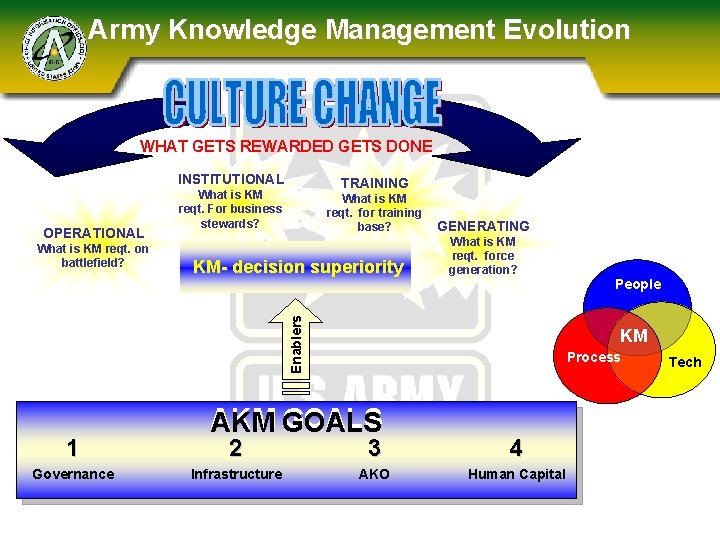
Army Knowledge Management Evolution WHAT GETS REWARDED GETS DONE INSTITUTIONAL OPERATIONAL What is KM reqt. for training base? KM- decision superiority GENERATING What is KM reqt. force generation? Enablers What is KM reqt. on battlefield? TRAINING What is KM reqt. For business stewards? 1 Governance People KM Process AKM GOALS 2 3 4 Infrastructure AKO Human Capital Tech
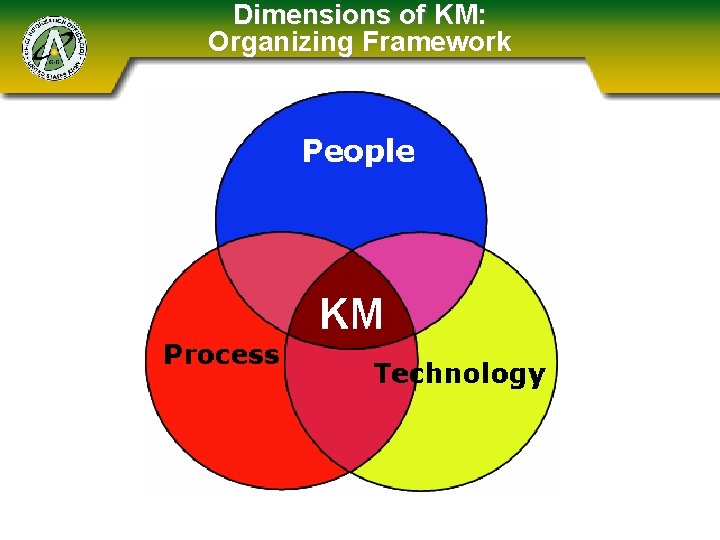
Dimensions of KM: Organizing Framework
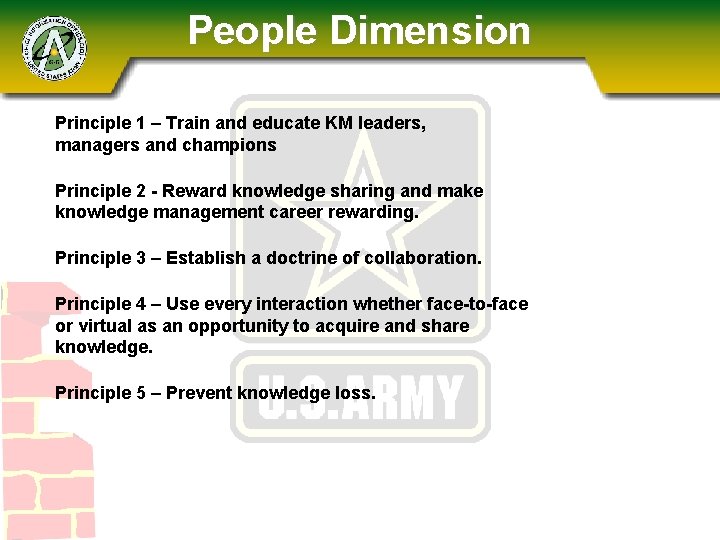
People Dimension Principle 1 – Train and educate KM leaders, managers and champions Principle 2 - Reward knowledge sharing and make knowledge management career rewarding. Principle 3 – Establish a doctrine of collaboration. Principle 4 – Use every interaction whether face-to-face or virtual as an opportunity to acquire and share knowledge. Principle 5 – Prevent knowledge loss.
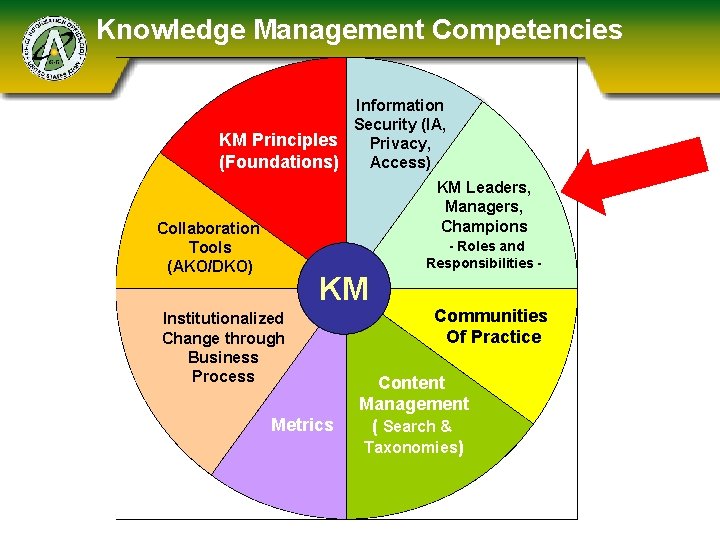
Knowledge Management Competencies Information Security (IA, KM Principles Privacy, (Foundations) Access) KM Leaders, Managers, Champions Collaboration Tools (AKO/DKO) - Roles and Responsibilities - KM Institutionalized Change through Business Process Metrics Communities Of Practice Content Management ( Search & Taxonomies)
Process Dimension Principle 6 – Protect and secure information and knowledge assets. Principle 7 – Embed knowledge assets (links, podcasts, videos, documents, simulations, wikis. . . ) in standard business processes and provide access to those who need to know. Principle 8 – Use standard business rules and processes across the enterprise
Technology Dimension Principle 9 – Use standardized collaborative tools sets. Principle 10 – Use Service-Oriented Architectures (SOA) to permit access and searching across boundaries. Principle 11 – Provide a robust search capability to access contextual knowledge across the enterprise. Principle 12 – Army Knowledge Online (AKO) or Defense Knowledge Online (DKO) is the preferred portal and access point to all Army-enterprise knowledge assets.
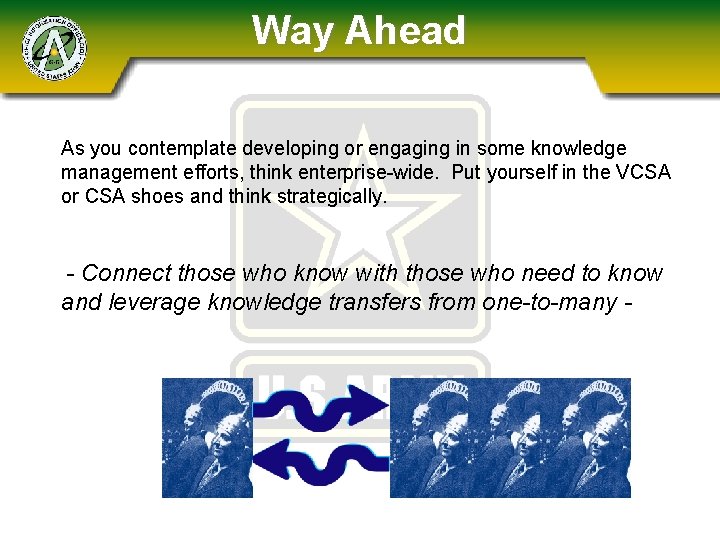
Way Ahead As you contemplate developing or engaging in some knowledge management efforts, think enterprise-wide. Put yourself in the VCSA or CSA shoes and think strategically. - Connect those who know with those who need to know and leverage knowledge transfers from one-to-many -
Backups
People Dimension Principle 1 – Train and educate KM leaders, managers and champions • Rationale: To create a culture of collaboration, the Army needs to educate the next generation KM change agents who understand KM principles and technologies and can effect change to accelerate meeting mission objectives. • Implications: Curriculum development and instructional delivery methods identified to train and educate the Force in KM competency at all levels of the Army (soldiers and civilians).
People Dimension Principle 2 - Reward knowledge sharing and make knowledge management career rewarding. • Rationale: What gets rewarded in organizations gets done. Reward structures guide organizational and individual behavior. • Implications: Establish KM careers fields, where appropriate, and insert performance elements into NSPS, OERs and NCOERs to evaluate knowledge sharing contributions.
People Dimension Principle 3 – Establish a doctrine of collaboration. • Rationale: A collaborative environment fosters new ideas, understanding and ways to execute the commander’s intent. • Implications: Leaders need to incorporate the Core Principles of Collaboration into their business procedures and human resources practices. – Core Principles of Collaboration • Responsibility for Provide - “need-to-share” should be replaced by “responsibility to provide”. • Empowered to Participate - Soldiers and civilians are empowered to participate and share insight in virtual collaborative communities without seeking prior permission. • User-driven - Collaborative communities are selfdefining, self creating and adaptable. Users own the collaborative community not IT providers.
People Dimension Principle 4 – Use every interaction whether face-to-face or virtual as an opportunity to acquire and share knowledge. • Rationale: Continuous learning is an expected day-to-day activity. Learning faster than adversaries or competitors yields short and long-term results. • Implications: Leaders need to frame dayto-day activities as learning opportunities to accelerate knowledge acquisition and transfer.
People Dimension Principle 5 – Prevent knowledge loss. • Rationale: Knowledge is perishable. It has a life cycle. The life cycle can’t begin until it is documented and assessed for its value. • Implications: Assess what is valuable from past activity, document it, and share with those who need to know.
People Dimension Principle 6 – Protect and secure information and knowledge assets. • Rationale: Denying adversaries’ access to key information and knowledge assets gives US Forces decisive advantage to securely communicate and collaborate across geographic and organizational boundaries. • Implications: Requires leaders of knowledge communities to comply with relevant information assurance regulations and policies.
Process Dimension Principle 7 – Embed knowledge assets (links, podcasts, videos, documents, simulations, wikis. . . ) in standard business processes and provide access to those who need to know. • Rationale: Leverage digital media to add context, understanding, and situational awareness to operations and business activities. • Implications: It is incumbent on leaders to creatively embed and use digital media (podcasts, videos, simulations, wikis…) in training routines and operations to add to or leverage the existing knowledge assets of the Army. Convert intellectual capital (ideas, best known practices) to structural capital (anything that is digitized and accessible and searchable by others).
Process Dimension Principle 8 – Use standard business rules and processes across the enterprise • Rationale: Established business rules and processes are repeatable thereby reducing learning curves and promoting consistent quality products and services. • Implications: Follow standard business rules and processes set by the Army and the Department of Defense. Modify and evolve business rules to meet the commander’s intent and quickly adapt business processes to meet or anticipate emerging threats or business opportunities (situational awareness). Lean Six Sigma and continuous process improvement principles apply.

Technology Dimension Principle 9 – Use standardized collaborative tools sets. • Rationale: Training on and using common collaborative software tool sets reduces training and maintenance costs while more importantly creating a common platform for data, information and knowledge exchange in theatres to accelerate meeting tactical and strategic objectives. It reduces impediments to searching for relevant knowledge across the enterprise. • Implications: Use approved Army and Do. D collaborative tools sets. Train and deploy with them. Provide access to structural capital to accelerate learning curves and adopt/modify best known practices.
Technology Dimension Principle 10 – Use Service-Oriented Architectures (SOA) to permit access and searching across boundaries. • Rationale: Create seamless and ubiquitous service-on-demand when one client application requests one or more services for another application which provides complimentary services. • Implications: KM applications need to be designed and operate with an enterprise focus, thereby permitting access searching across systems and organizations without technical or structural impediments.
Technology Dimension Principle 11 – Provide a robust search capability to access contextual knowledge across the enterprise. • Rationale: With the exception of classified information, knowledge bases should be accessible and searchable with search engines that deliver contextual knowledge and information. • Implications: In the design and operation of KM systems, leaders need to ensure that there are no organizational or technical barriers blocking access to digital media residing in knowledge bases.
Technology Dimension Principle 12 – Army Knowledge Online (AKO) or Defense Knowledge Online (DKO) is the preferred portal and access point to all Army-enterprise knowledge assets. • Rationale: Using one portal as a standard access and authentication point lessens confusion for users and provides a standard process for accessing enterprise knowledge assets while reducing total cost of ownership of other portals, websites or knowledge networks. • Implications: Use AKO/DKO as your portal of first choice. AKO is paid for by the HQDA CIO/G-6 and therefore is available to Army Commands and organizations at no additional cost.
- Slides: 34