
Army Cost Benefit Analysis A Case Study Battle
Army Cost Benefit Analysis A Case Study Battle Assembly Travel Reimbursement Developed based on information provided by Mr. Mario F. Wozniak Chief, Reserve Personnel Army (RPA), Budget Division US Army Reserve Command G 8 Author: Mr. William T. Huddleston, MSOR, MSME

Army Cost Benefit Analysis Battle Assembly Travel Reimbursement A Case Study
Terminal Learning Objective • Task: Perform Army Cost Benefit Analysis • Condition: You are training to become an ACE with access to ICAM course handouts, readings, and spreadsheet tools and awareness of Operational Environment (OE)/Contemporary Operational Environment (COE) variables and actors • Standard: with at least 80% accuracy: • Review the Army 8 Step Cost Benefit Analysis process • Apply Cost Benefit Analysis to the Battle Assembly case © Author: William T. Huddleston, MSOR, MSME Government Management Institute 3
Army Cost Benefit Analysis Battle Assembly Travel Reimbursement Army Reserve Command Overview
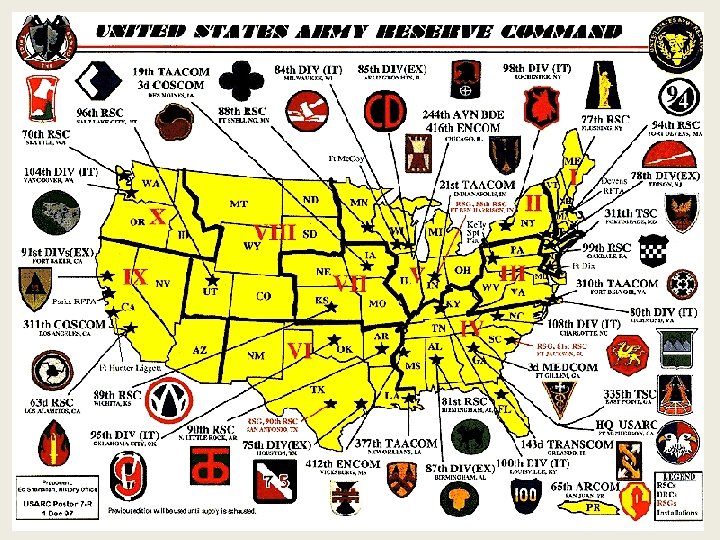
Army Reserve Command Leadership A 3 - star General leads the US Army Reserve Command holds the following two titles: 1. Chief, Army Reserve (CAR): Reports to Chief of Staff of Army; represents Army Reserve in policy and planning discussions with Army, Department of Defense and Congress 2. Commanding General (CG) of the US Army Reserve Command (USARC): Reports to Army Forces Command; responsible for staffing, training and readiness of most Army Reserve units in continental US and Puerto Rico
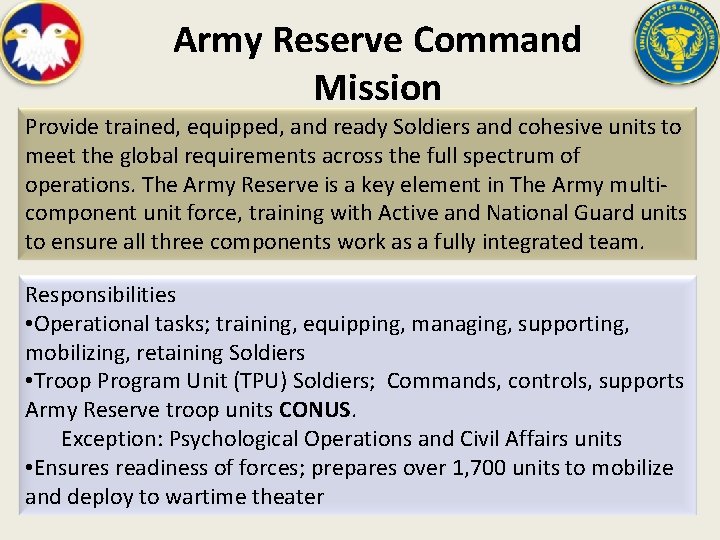
Army Reserve Command Mission Provide trained, equipped, and ready Soldiers and cohesive units to meet the global requirements across the full spectrum of operations. The Army Reserve is a key element in The Army multicomponent unit force, training with Active and National Guard units to ensure all three components work as a fully integrated team. Responsibilities • Operational tasks; training, equipping, managing, supporting, mobilizing, retaining Soldiers • Troop Program Unit (TPU) Soldiers; Commands, controls, supports Army Reserve troop units CONUS. Exception: Psychological Operations and Civil Affairs units • Ensures readiness of forces; prepares over 1, 700 units to mobilize and deploy to wartime theater
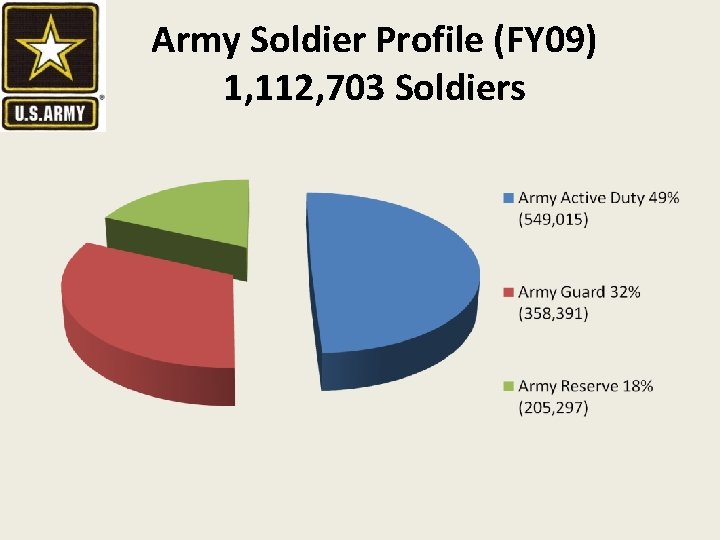
Army Soldier Profile (FY 09) 1, 112, 703 Soldiers
Army Cost Benefit Analysis Battle Assembly Travel Reimbursement Travel reimbursement is an existing issue within the ARC. “Soldier reimbursement of travel expenses to a Battle Assembly (BA)” BA consist of monthly drills; soldiers practice military skills to maintain individual and unit readiness in case of mobilization and deployment
Army Cost Benefit Analysis Battle Assembly Travel Reimbursement Case Study Overview Request initiated by US Army Reserve Command to: Extend National Defense Authorization Act (NDAA) to: • Authorize travel reimbursement for “specified group” of Soldiers traveling to Battle Assembly outside normal commuting distance (>150 miles) especially; - Soldiers with critical Military Occupation Specialties - Soldiers affected by Base Realignment and Closure (BRAC) - Units with designated leader shortages
Army Cost Benefit Analysis Battle Assembly Travel Reimbursement Case Study Overview Army Reserve Command (ARC) request to reimburse travel related expenses is based on: - Impact on morale, and personal finance issues for AR soldiers - Increased recruiting and training costs associated with AR Soldiers lost through attrition - Adverse impact to Operational Readiness by loss of Soldiers in critically needed categories through attrition - ARC’s Continuous Improvement effort modeling (ARFORGEN) and minimize “cross leveling”
Army Cost Benefit Analysis Battle Assembly Travel Reimbursement Case Study Overview Travel reimbursement to ARC Soldiers’ required to travel more than 150 miles to BA is being considered for several reasons: - Maintaining competitive edge by providing more benefits and promotion opportunities for skilled AR soldiers - AR promotions require some reservists move to new units beyond normal commuting distance - Maintaining camaraderie with fellow Soldiers is highly valued in ARC - BRAC is increasing soldier travel distance for BA and this is expected to impact more reservists with additional base closures
Army Cost Benefit Analysis Battle Assembly Travel Reimbursement Case Study Overview Assumptions: - Operational Readiness is a high command objective - ARC desires to support continuous improvement modeling (ARFORGEN’s enhancement is very important) - Economic conditions, promotions, Base Realignment and Closure (BRAC), and desire for Soldiers to stay in unit, result in increased number of soldiers traveling >150 miles to BA
Army Cost Benefit Analysis Battle Assembly Travel Reimbursement Case Study Overview Assumptions (continued): -Annual “out-of-pocket” Soldier expense is estimated between $500 -$4, 000 for travel to BA. Case will average travel expenses to Battle Assembly (BA) = $1, 500 -Recruiting and training cost is estimated at $75, 000 per Soldier -Operational Readiness is impacted when critically needed Soldiers leave service -Inflation rate 2% per year -Estimate travel reimbursement costs for 1 year and 10 years
Army Cost Benefit Analysis Battle Assembly Travel Reimbursement Case Study Overview Assumptions (continued): -Army reserve staff level = 205, 000 soldiers -5, 000 AR soldiers are affected by BRAC; 2, 500 or half of these soldiers are considered critical or skilled positions -50, 000 AR soldiers travel > 150 miles to BA; 24, 000 are considered critical or skilled positions -Predict current AR soldier attrition rate decrease 0. 5% if critically needed Soldiers are reimbursed for travel -Not all AR soldiers will be reimbursed for travel expenses
Army Cost Benefit Analysis Battle Assembly Travel Reimbursement Case Study Overview The commander identified some non-quantifiable factors that could be considered in a CBA: ü ü ü Image to general public Soldier value perception Soldier home financial stability Soldiers’ morale is important Increased Operational Readiness ARFORGEN enhancement
Army Cost Benefit Analysis Battle Assembly Travel Reimbursement Case Study Overview Cost Benefit Analysis (CBA) Review
Army Cost Benefit Analysis Battle Assembly Travel Reimbursement Case Study Overview What is Cost Benefit Analysis? A of comparing both and costs and benefits (positive/negative), against specified Courses of Action (COA) to determine the best .
Army Cost Benefit Analysis Battle Assembly Travel Reimbursement Case Study Overview What is Cost Benefit Analysis? A structured methodology of comparing both quantifiable and non-quantifiable costs and benefits (positive/negative), against specified Courses of Action (COA) to determine the best enterprise solution.
Army Cost Benefit Analysis Battle Assembly Travel Reimbursement Case Study Overview Why do we need a Cost Benefit Analysis? 1. 2. When making resourcing decisions: • Treat cost (both near and long term) as an upfront consideration, not as an afterthought • Obtain visibility of project value and positive and negative consequences to a decision path
Army Cost Benefit Analysis Battle Assembly Travel Reimbursement Case Study Overview Why do we need a Cost Benefit Analysis? 1. To make a better use of limited funds 2. When making resourcing decisions: • Treat cost (both near and long term) as an upfront consideration, not as an afterthought • Obtain visibility of project value and positive and negative consequences to a decision path
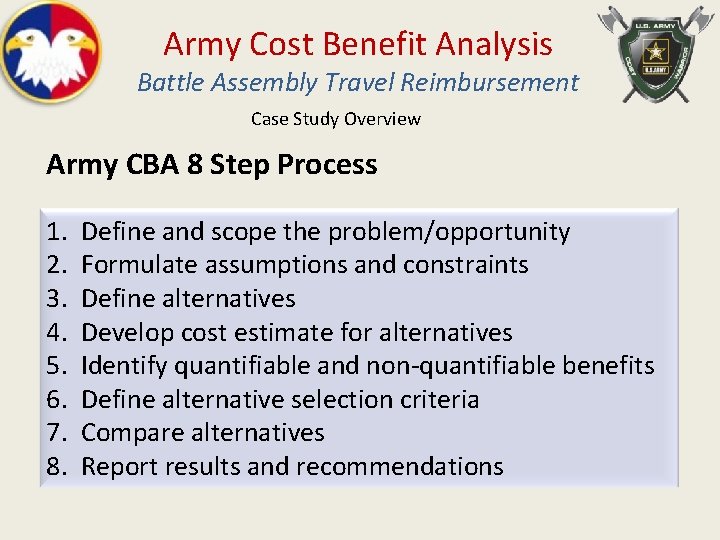
Army Cost Benefit Analysis Battle Assembly Travel Reimbursement Case Study Overview Army CBA 8 Step Process 1. Define and scope the problem/opportunity 2. Formulate assumptions and constraints 3. Define alternatives 4. Develop cost estimate for alternatives 5. Identify quantifiable and non-quantifiable benefits 6. Define alternative selection criteria 7. Compare alternatives 8. Report results and recommendations
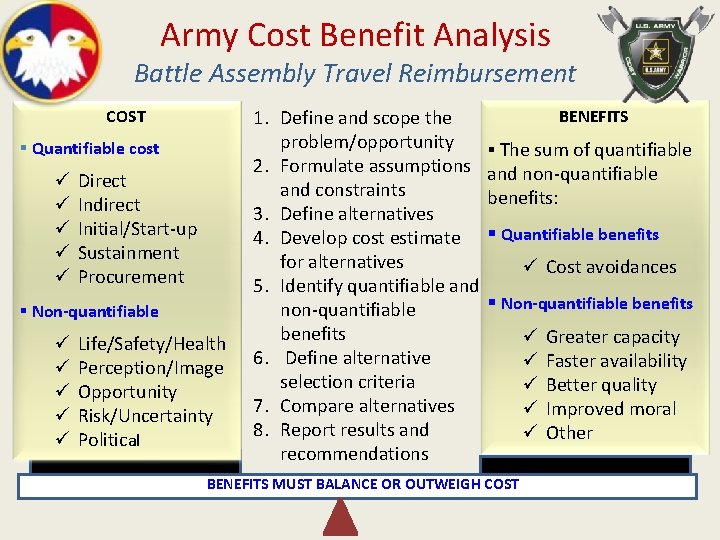
Army Cost Benefit Analysis Battle Assembly Travel Reimbursement COST § Quantifiable cost ü ü ü Direct Indirect Initial/Start-up Sustainment Procurement § Non-quantifiable ü ü ü Life/Safety/Health Perception/Image Opportunity Risk/Uncertainty Political BENEFITS 1. Define and scope the problem/opportunity § The sum of quantifiable 2. Formulate assumptions and non-quantifiable and constraints benefits: 3. Define alternatives 4. Develop cost estimate § Quantifiable benefits for alternatives ü Cost avoidances 5. Identify quantifiable and § Non-quantifiable benefits non-quantifiable benefits ü Greater capacity 6. Define alternative ü Faster availability selection criteria ü Better quality 7. Compare alternatives ü Improved moral 8. Report results and ü Other recommendations BENEFITS MUST BALANCE BB OR OUTWEIGH COST
Army Cost Benefit Analysis Battle Assembly Travel Reimbursement Case Study Team Exercise
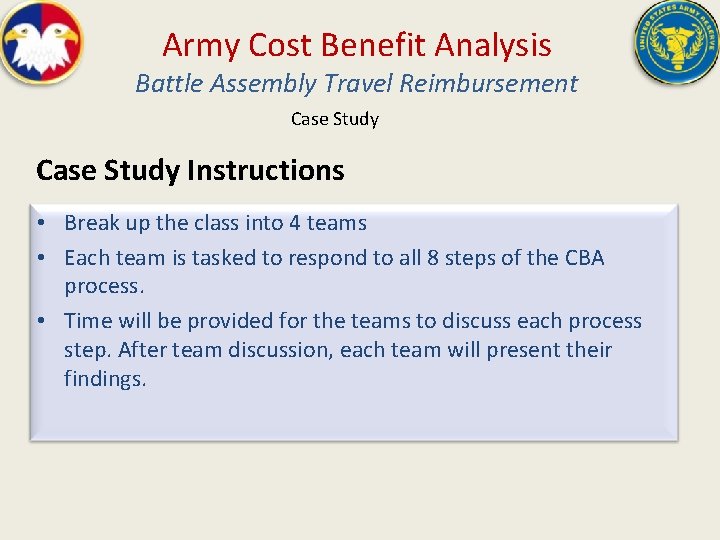
Army Cost Benefit Analysis Battle Assembly Travel Reimbursement Case Study Instructions • Break up the class into 4 teams • Each team is tasked to respond to all 8 steps of the CBA process. • Time will be provided for the teams to discuss each process step. After team discussion, each team will present their findings.
Army Cost Benefit Analysis Battle Assembly Travel Reimbursement Case Study Discussion 1. Define and Scope the Problem / Opportunity Questions for the Reviewer - Does the problem statement define a clear, unambiguous issue? As appropriate, does the objective reflect an enterprise perspective? - What major stakeholders are likely to be impacted?
Army Cost Benefit Analysis Battle Assembly Travel Reimbursement Case Study Discussion 2. Formulate Assumptions and Constraints Questions for the Reviewer: - Are the assumptions realistic? Were they provided by an appropriate subject matter expert? Are the assumptions or facts structured in a way that favors one alternative COA? - Do the assumptions, and facts clearly identify the natural and/or artificial limits or expansions placed on the solution set?
Army Cost Benefit Analysis Battle Assembly Travel Reimbursement Case Study 3. Define Alternative Courses of Action Questions for the Reviewer: - Have all feasible alternatives been considered, to include alternatives that represent creative thinking? - Have the alternatives been defined or described clearly, and to a sufficient level of detail to support the development of a cost estimate? - Is the status quo included, or is its absence explained? - Do the alternatives span a reasonably wide range of potential solutions?
Army Cost Benefit Analysis Battle Assembly Travel Reimbursement Case Study 4. Develop Cost Estimate for each Alternative Questions for the Reviewer: - Does the cost estimate span the appropriate life cycle? - As appropriate, does the documentation clearly differentiate between a cost-perspective estimate and a POM/budgetperspective estimate? - Are the cost estimates for each COA structured in a way that supports apples-to-apples comparison? - Is the cost estimate backed up by supporting documentation: - Data sources identified? - Rationale and methodology explained? - Analysts/POCs identified?
Army Cost Benefit Analysis Battle Assembly Travel Reimbursement Case Study 5. Identify Quantifiable and Non-Quantifiable Costs and benefits Questions for the Reviewer: - Do the perceived benefits reflect an enterprise perspective? - Are the benefits consistent with the problem statement?
Army Cost Benefit Analysis Battle Assembly Travel Reimbursement Case Study 6. Define Alternative Selection Criteria Questions for the Reviewer: - Are the selection criteria appropriately tailored to the problem statement or requirement? - Has appropriate consideration been given to both cost and non-cost criteria? - If weighting of selection criteria has been used, has the leader agreed with the weighting? - Do the selection criteria appear unrealistically skewed to favor one alternative?
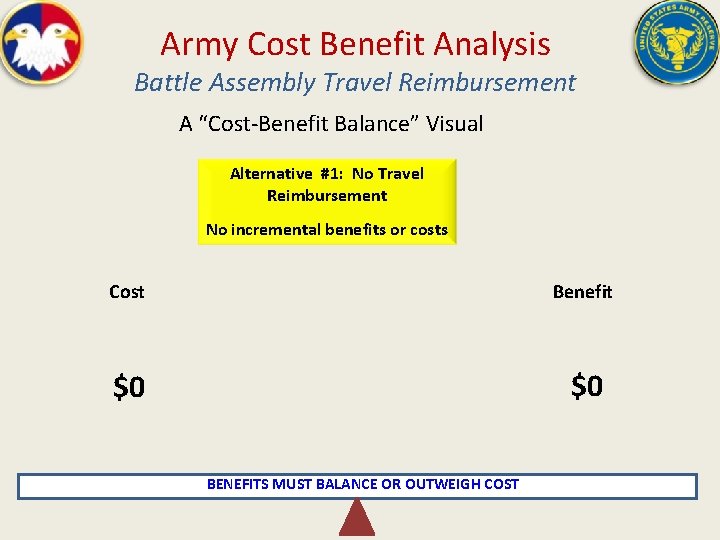
Army Cost Benefit Analysis Battle Assembly Travel Reimbursement A “Cost-Benefit Balance” Visual Alternative #1: No Travel Reimbursement No incremental benefits or costs Cost Benefit $0 $0 BENEFITS MUST BALANCE BB OR OUTWEIGH COST
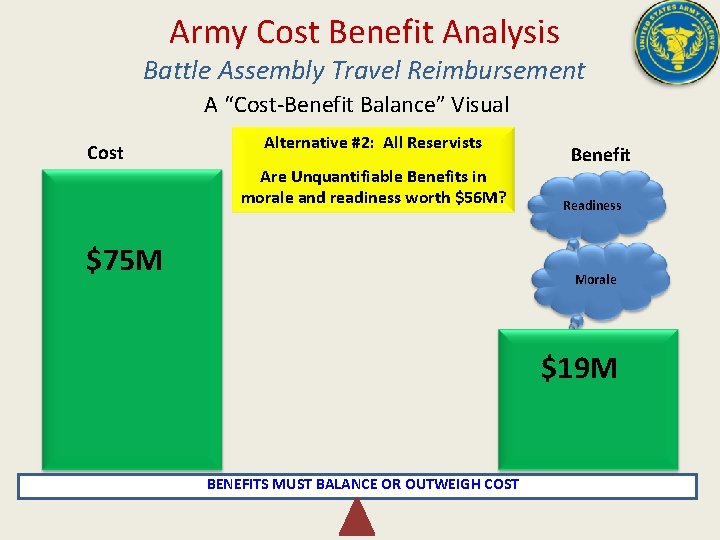
Army Cost Benefit Analysis Battle Assembly Travel Reimbursement A “Cost-Benefit Balance” Visual Cost Alternative #2: All Reservists Are Unquantifiable Benefits in morale and readiness worth $56 M? $75 M Benefit Readiness Morale $19 M BENEFITS MUST BALANCE BB OR OUTWEIGH COST
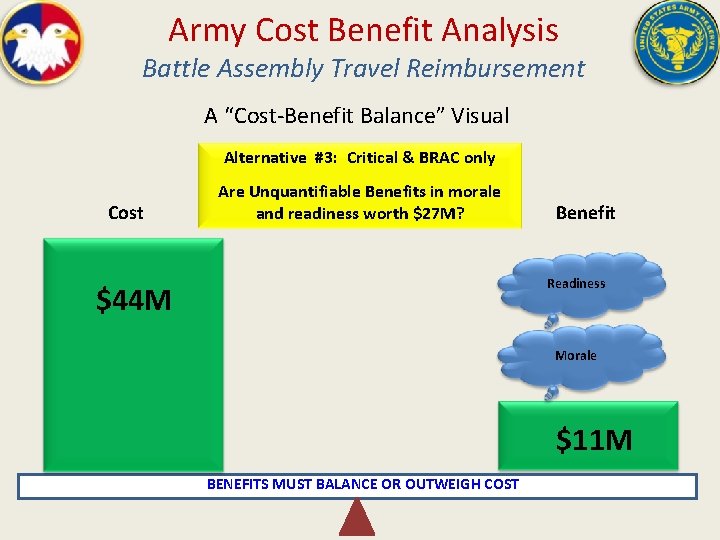
Army Cost Benefit Analysis Battle Assembly Travel Reimbursement A “Cost-Benefit Balance” Visual Alternative #3: Critical & BRAC only Cost Are Unquantifiable Benefits in morale and readiness worth $27 M? Benefit Readiness $36 M $44 M Morale $11 M BENEFITS MUST BALANCE BB OR OUTWEIGH COST
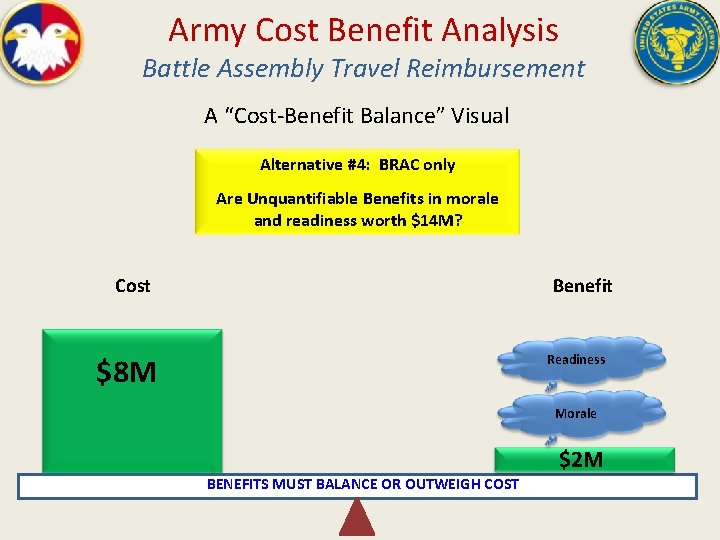
Army Cost Benefit Analysis Battle Assembly Travel Reimbursement A “Cost-Benefit Balance” Visual Alternative #4: BRAC only Are Unquantifiable Benefits in morale and readiness worth $14 M? Cost Benefit Readiness $8 M Morale $2 M BENEFITS MUST BALANCE BB OR OUTWEIGH COST
Army Cost Benefit Analysis Battle Assembly Travel Reimbursement Making a decision requires answering the questions on the previous slides How can you evaluate and compare the non-quantifiable costs and benefits? The Decision Matrix is one method of comparing alternatives
Army Cost Benefit Analysis Battle Assembly Travel Reimbursement Case Study 7. Compare Alternatives Questions for the Reviewer: - Does the analysis clearly demonstrate how the recommended COA best satisfies the selection criteria? - Is the recommended billpayer consistent with Army priorities? Do the benefits of the recommended COA justify the billpayer? - Are second- and third-order effects identified, and are the negative impacts acceptable?
Army Cost Benefit Analysis Battle Assembly Travel Reimbursement Case Study 8. Report Results and Recommendations Questions for the Reviewer: - Does the package contain all key elements, accompanied by supporting documentation? - Does the recommended COA address the problem, and is it consistent with the assumptions and constraints? - Does the analysis explain how the recommended COA is best at satisfying the selection criteria?
Army Cost Benefit Analysis Battle Assembly Travel Reimbursement Step 8: Report Results and Recommendations Executive Summary • Problem: • Brief description of methodology and number of COAs considered to determine the best menu choice. • Existing or new funding? • Recommendation: • Cost to Implement: – $ – Other: 39
Battle Assembly Training Case Study Instructor’s Support Material
Battle Assembly Training Instructor’s Support Material • Length Time: 4 h – Briefing 15 -20 min, break out in teams to prepare each of the points average 10 min per point area, presentation and discussion average 15 min per point, wrap up 15 -20 min. • Process – – Introduce the case Break the class into groups of 4 Each group needs to prepare material for presentation results Use the excel templates as applicable • Presentation – Discuss findings with participants and agree on main points to ensure that they are on the right truck – Introduce support for each point after students’ presentation
Battle Assembly Training Instructor’s Support Material Objectives: • Apply the CBA and by using it: • bring out the issues at hand • think though possible alternatives and support • Point to the: - Ranking process, and - Weight sensitivity since these are the key areas influencing the decision - Realize the need for support for a cost informed decision
Army Cost Benefit Analysis Battle Assembly Travel Reimbursement Case Study 1. Define and Scope the Problem / Opportunity ARC soldiers are adversely impacted by having to pay travel costs to attend Battle Assembly. Compare costs and benefits of extending travel reimbursement to ARC Soldiers traveling to BA.
Army Cost Benefit Analysis Battle Assembly Travel Reimbursement Case Study 2. Formulate Assumptions and Constraints - Current law does not allow for reimbursement of Soldier travel to Battle Assembly - Limit travel reimbursement to soldiers traveling greater than 150 miles to BA - Estimate 50, 000 Soldiers travelling to BAs are not reimbursed - 24, 000 of the 50, 000 Soldiers have critical skills positions - Soldiers spend average $1, 500 annually traveling to BAs - ARC Soldier attrition rate = 20% - Travel reimbursement can reduce ARC attrition by. 5% - AR staff level = 205, 000 Soldiers
Army Cost Benefit Analysis Battle Assembly Travel Reimbursement Case Study 2. Formulate Assumptions and Constraints - Economic conditions, Soldier promotions as well as BRAC increase travel distance to Battle Assembly - 5, 000 AR Soldiers effected by BRAC - 2, 500 Soldiers impacted by BRAC have critical skills - Annual training for new recruits averages $75, 000 - Operational Readiness is extremely important - Soldier morale very important - ARFORGEN enhancement is very important - Not all AR Soldiers can be reimbursed for travel to BA
Army Cost Benefit Analysis Battle Assembly Travel Reimbursement Case Study 2. Formulate Assumptions and Constraints - Calculate costs for 1 year and 10 years - Use 2% inflation rate
Army Cost Benefit Analysis Battle Assembly Travel Reimbursement Case Study 3. Define Alternative Courses of Action 1. No travel reimbursement to Battle Assembly (Status Quo) 2. Reimburse all Soldiers travelling to Battle Assembly greater than 150 miles 3. Reimburse only critically needed Soldiers and Soldiers impacted by BRAC travelling to Battle Assembly greater than 150 miles 4. Reimburse only Soldiers impacted by BRAC travelling to Battle Assembly greater than 150 miles
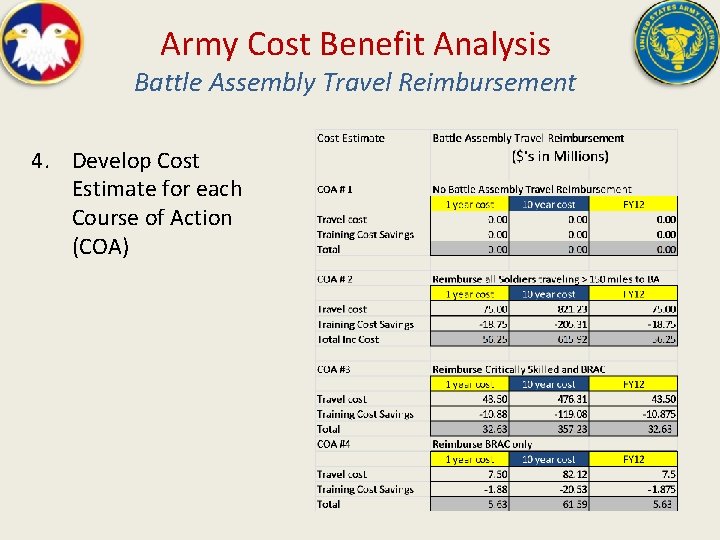
Army Cost Benefit Analysis Battle Assembly Travel Reimbursement 4. Develop Cost Estimate for each Course of Action (COA)
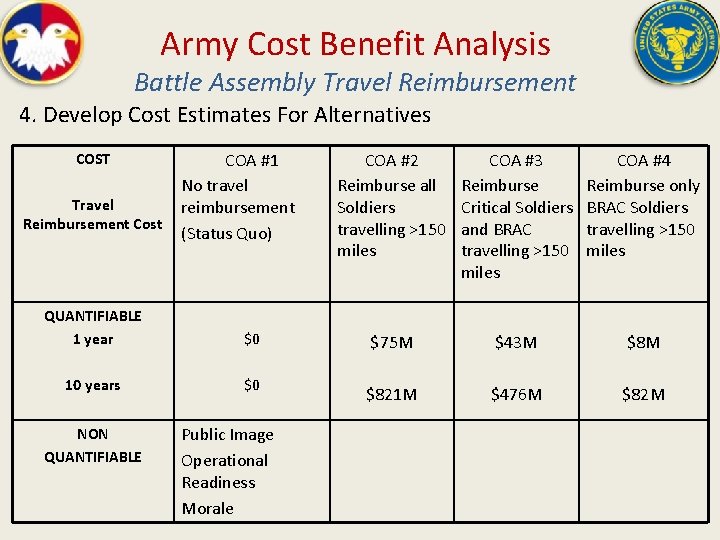
Army Cost Benefit Analysis Battle Assembly Travel Reimbursement 4. Develop Cost Estimates For Alternatives COST Travel Reimbursement Cost COA #1 No travel reimbursement (Status Quo) QUANTIFIABLE 1 year $0 10 years $0 NON QUANTIFIABLE Public Image Operational Readiness Morale COA #2 Reimburse all Soldiers travelling >150 miles COA #3 Reimburse Critical Soldiers and BRAC travelling >150 miles COA #4 Reimburse only BRAC Soldiers travelling >150 miles $75 M $43 M $821 M $476 M $82 M
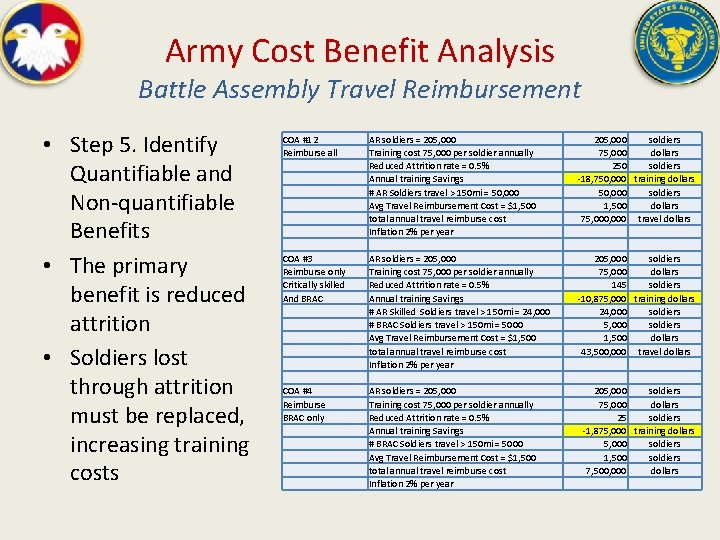
Army Cost Benefit Analysis Battle Assembly Travel Reimbursement • Step 5. Identify Quantifiable and Non-quantifiable Benefits • The primary benefit is reduced attrition • Soldiers lost through attrition must be replaced, increasing training costs COA #12 Reimburse all AR soldiers = 205, 000 Training cost 75, 000 per soldier annually Reduced Attrition rate = 0. 5% Annual training Savings # AR Soldiers travel > 150 mi = 50, 000 Avg Travel Reimbursement Cost = $1, 500 total annual travel reimburse cost Inflation 2% per year 205, 000 soldiers 75, 000 dollars 250 soldiers -18, 750, 000 training dollars 50, 000 soldiers 1, 500 dollars 75, 000 travel dollars COA #3 Reimburse only Critically skilled And BRAC AR soldiers = 205, 000 Training cost 75, 000 per soldier annually Reduced Attrition rate = 0. 5% Annual training Savings # AR Skilled Soldiers travel > 150 mi = 24, 000 # BRAC Soldiers travel > 150 mi = 5000 Avg Travel Reimbursement Cost = $1, 500 total annual travel reimburse cost Inflation 2% per year 205, 000 soldiers 75, 000 dollars 145 soldiers -10, 875, 000 training dollars 24, 000 soldiers 5, 000 soldiers 1, 500 dollars 43, 500, 000 travel dollars COA #4 Reimburse BRAC only AR soldiers = 205, 000 Training cost 75, 000 per soldier annually Reduced Attrition rate = 0. 5% Annual training Savings # BRAC Soldiers travel > 150 mi = 5000 Avg Travel Reimbursement Cost = $1, 500 total annual travel reimburse cost Inflation 2% per year 205, 000 soldiers 75, 000 dollars 25 soldiers -1, 875, 000 training dollars 5, 000 soldiers 1, 500 soldiers 7, 500, 000 dollars
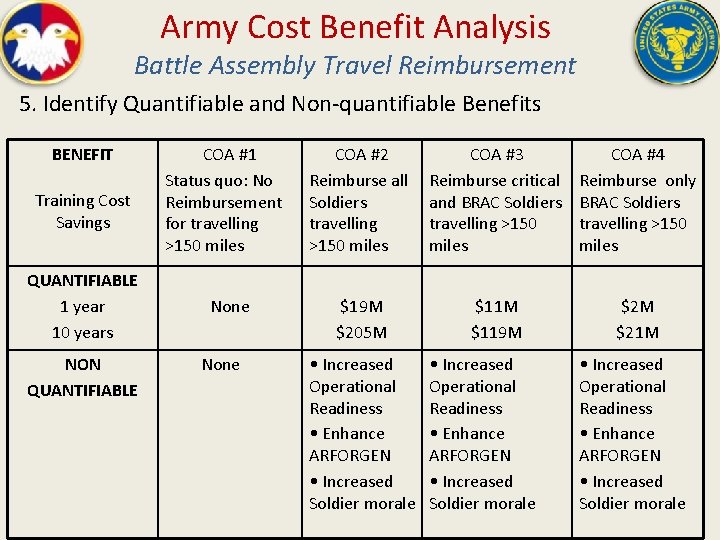
Army Cost Benefit Analysis Battle Assembly Travel Reimbursement 5. Identify Quantifiable and Non-quantifiable Benefits BENEFIT Training Cost Savings QUANTIFIABLE 1 year 10 years NON QUANTIFIABLE COA #1 Status quo: No Reimbursement for travelling >150 miles COA #2 Reimburse all Soldiers travelling >150 miles COA #3 Reimburse critical and BRAC Soldiers travelling >150 miles COA #4 Reimburse only BRAC Soldiers travelling >150 miles None $19 M $205 M $119 M $21 M None • Increased Operational Readiness • Enhance ARFORGEN • Increased Soldier morale
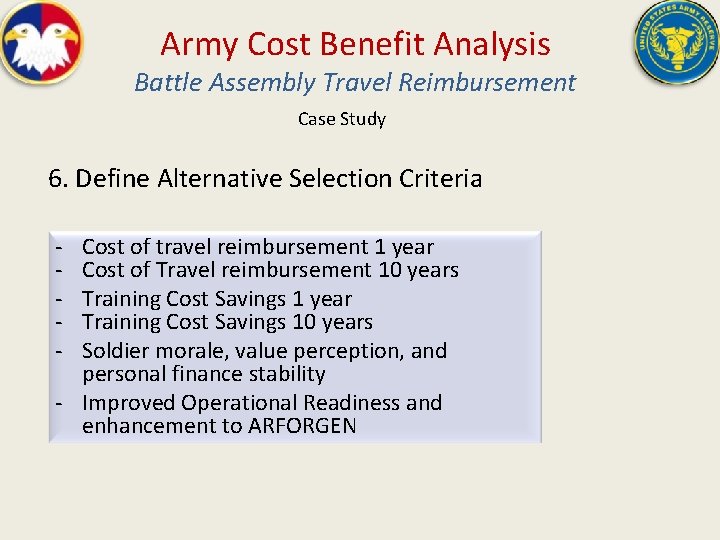
Army Cost Benefit Analysis Battle Assembly Travel Reimbursement Case Study 6. Define Alternative Selection Criteria - Cost of travel reimbursement 1 year Cost of Travel reimbursement 10 years Training Cost Savings 1 year Training Cost Savings 10 years Soldier morale, value perception, and personal finance stability - Improved Operational Readiness and enhancement to ARFORGEN
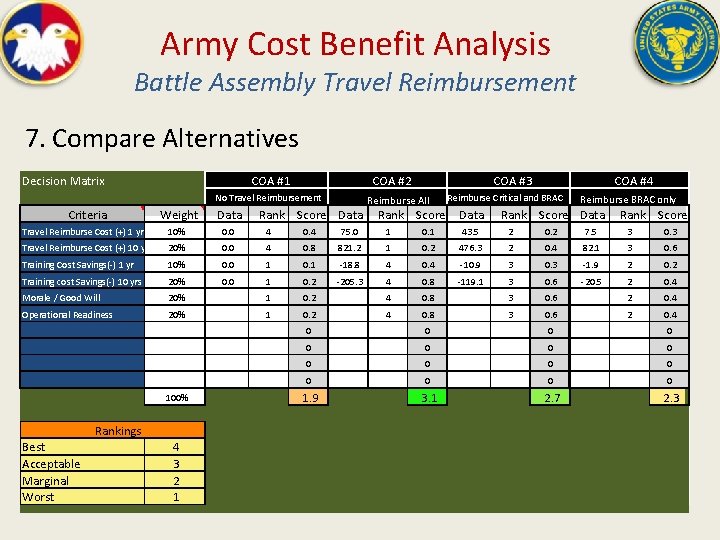
Army Cost Benefit Analysis Battle Assembly Travel Reimbursement 7. Compare Alternatives Decision Matrix COA #1 COA #2 No Travel Reimbursement Criteria Weight Data Rank Score Data COA #3 Reimburse All Rank Score COA #4 Reimburse Critical and BRAC Data Reimburse BRAC only Rank Score Data Rank Score Travel Reimburse Cost (+) 1 yr 10% 0. 0 4 0. 4 75. 0 1 0. 1 43. 5 2 0. 2 7. 5 3 0. 3 Travel Reimburse Cost (+) 10 yrs 20% 0. 0 4 0. 8 821. 2 1 0. 2 476. 3 2 0. 4 82. 1 3 0. 6 Training Cost Savings(-) 1 yr 10% 0. 0 1 0. 1 -18. 8 4 0. 4 -10. 9 3 0. 3 -1. 9 2 0. 2 Training cost Savings(-) 10 yrs 20% 0. 0 1 0. 2 -205. 3 4 0. 8 -119. 1 3 0. 6 -20. 5 2 0. 4 Morale / Good Will 20% 1 0. 2 4 0. 8 3 0. 6 2 0. 4 Operational Readiness 20% 1 0. 2 4 0. 8 3 0. 6 2 0. 4 100% Rankings Best Acceptable Marginal Worst 4 3 2 1 0 0 0 0 1. 9 3. 1 2. 7 2. 3
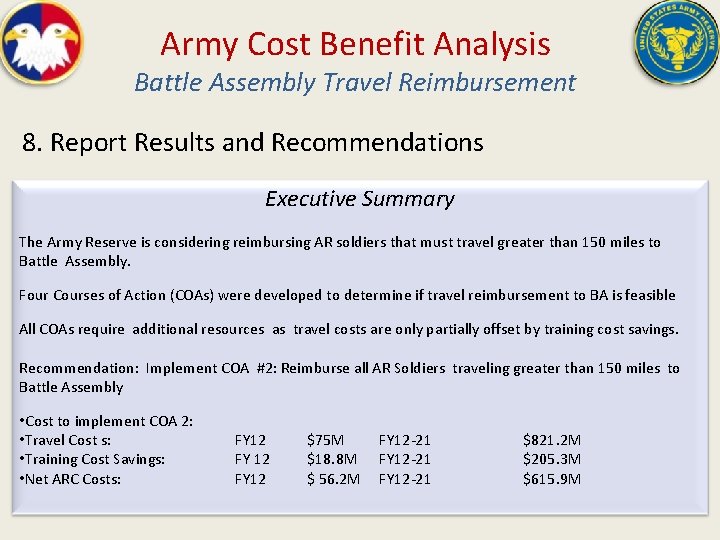
Army Cost Benefit Analysis Battle Assembly Travel Reimbursement 8. Report Results and Recommendations Executive Summary The Army Reserve is considering reimbursing AR soldiers that must travel greater than 150 miles to Battle Assembly. Four Courses of Action (COAs) were developed to determine if travel reimbursement to BA is feasible All COAs require additional resources as travel costs are only partially offset by training cost savings. Recommendation: Implement COA #2: Reimburse all AR Soldiers traveling greater than 150 miles to Battle Assembly • Cost to implement COA 2: • Travel Cost s: • Training Cost Savings: • Net ARC Costs: FY 12 $75 M $18. 8 M $ 56. 2 M FY 12 -21 $821. 2 M $205. 3 M $615. 9 M
- Slides: 54