
ARMSPCR Amplification Refractory Mutation System PCR Ali I

- Slides: 27
ARMS-PCR (Amplification. Refractory Mutation System PCR) Ali I. A. Gharip, BSc Biotech TA
dedication To spirit of my mother
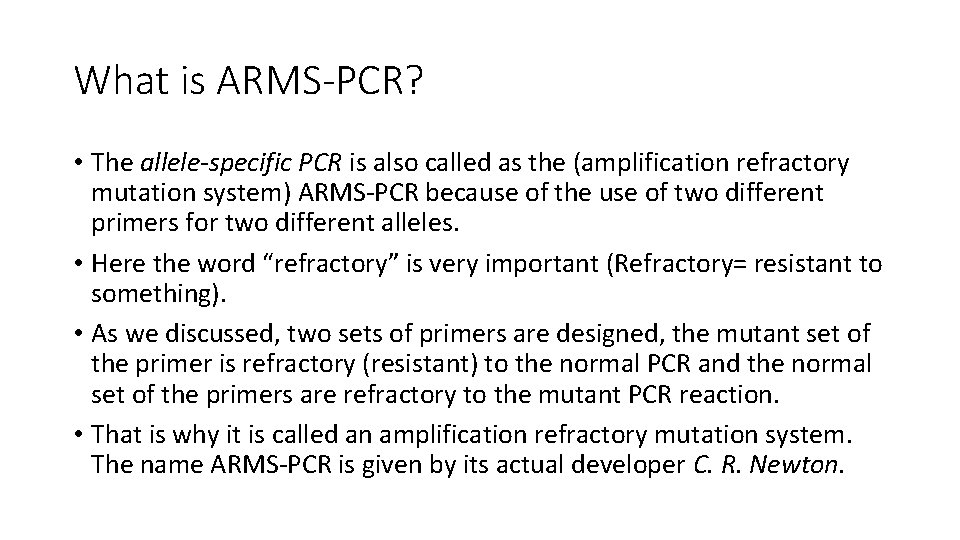
• The allele-specific PCR also called as an ARMS- PCR (amplification refractory mutation system) or PASA (PCR amplification of specific alleles) or AS-PCR used to detect the SNPs. • More specifically, it is adopted to detect the known SNPs (single nucleotide polymorphism), however, we cannot identify new mutations by ARMS-PCR. • Kary Mullis described the technique of in vitro amplification in the year 1983. After a few years of the discovery of the actual PCR technique, C. R. Newton and coworkers discovered the ARMS-PCR or allele-specific PCR technique.
What is allele-specific PCR? • The term suggests that the technique used in this type of PCR is specific to the particular type of allele. An allele is the alternative form of a gene. • If one allele has an SNP and the other alternative form is normal, we can analyse both the alleles by designing specific primers for each allele. • For that, we have to modify the single base at the 3’ end of the primer (one primer matches the normal allele and one primer matches the mutant allele).
• The PCR is performed simultaneously in a single reaction. If a mutant allele is present, then the PCR amplifies the mutant allele or if the normal allele is present, the normal allele will amplify.
What is ARMS-PCR? • The allele-specific PCR is also called as the (amplification refractory mutation system) ARMS-PCR because of the use of two different primers for two different alleles. • Here the word “refractory” is very important (Refractory= resistant to something). • As we discussed, two sets of primers are designed, the mutant set of the primer is refractory (resistant) to the normal PCR and the normal set of the primers are refractory to the mutant PCR reaction. • That is why it is called an amplification refractory mutation system. The name ARMS-PCR is given by its actual developer C. R. Newton.
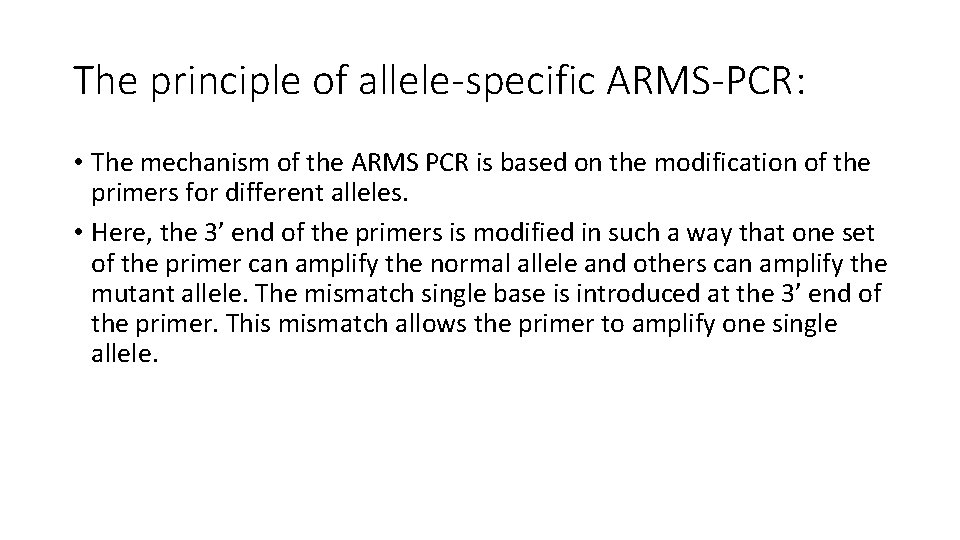
The principle of allele-specific ARMS-PCR: • The mechanism of the ARMS PCR is based on the modification of the primers for different alleles. • Here, the 3’ end of the primers is modified in such a way that one set of the primer can amplify the normal allele and others can amplify the mutant allele. The mismatch single base is introduced at the 3’ end of the primer. This mismatch allows the primer to amplify one single allele.
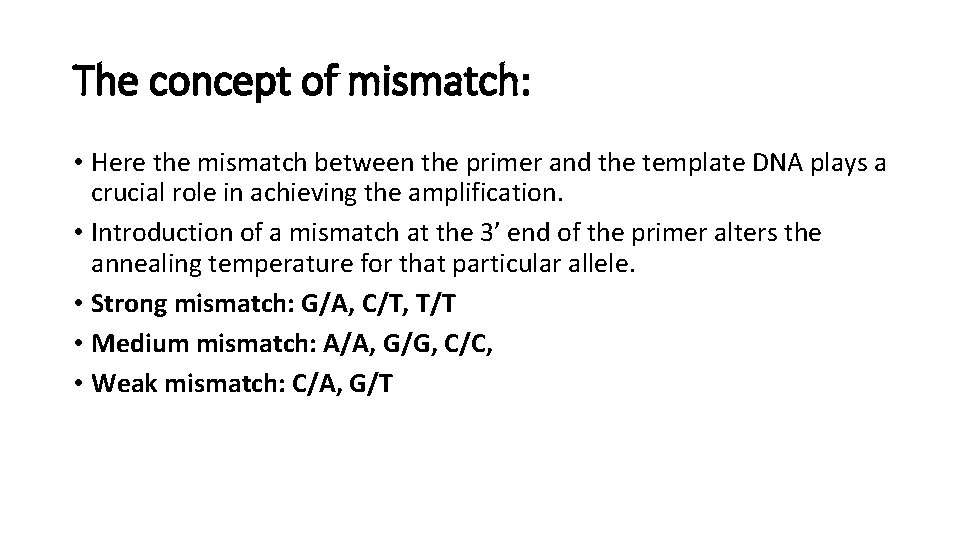
The concept of mismatch: • Here the mismatch between the primer and the template DNA plays a crucial role in achieving the amplification. • Introduction of a mismatch at the 3’ end of the primer alters the annealing temperature for that particular allele. • Strong mismatch: G/A, C/T, T/T • Medium mismatch: A/A, G/G, C/C, • Weak mismatch: C/A, G/T
How to do ARMS-PCR? • The process of the ARMS PCR is simple and very effective. No harmful radiolabelling is involved in the ARMS allele-specific PCR. • The procedure of ARMS PCR is divided into 4 steps: 1. 2. 3. 4. Primer designing Amplification Agarose gel electrophoresis Results interpretations
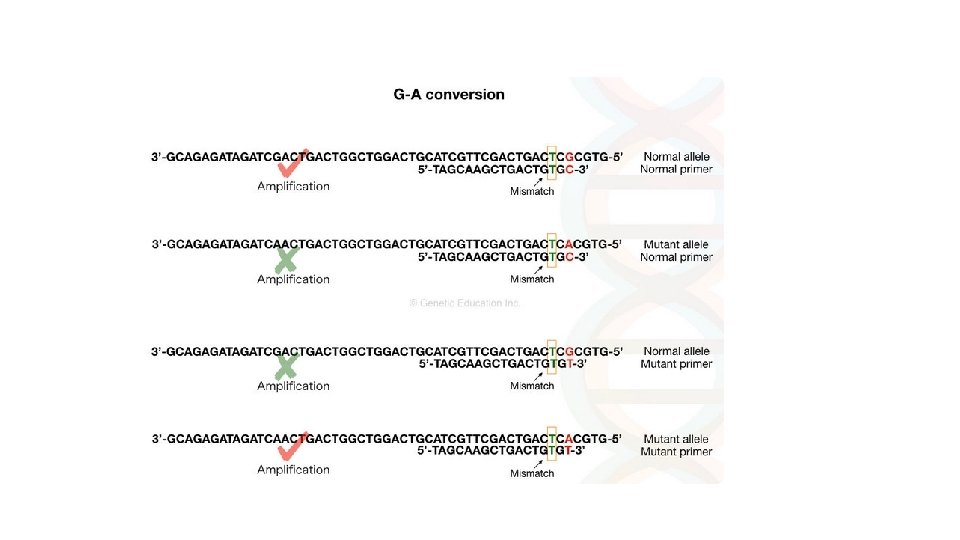
1. Primer designing for ARMS PCR: • The primer must be allele-specific. • Suppose our DNA sequence has G-A point mutation viz, G in normal allele and A in place of G in the mutant allele. We have to design a forward primer in such a manner that for normal allele the primer contains C (complementary to G) at 3’ end and the mutant primer contains T in place of C. • The magic of the present technique has happened when we add a mismatch base near to our SNP at the 3’ end.
Why we have to add mismatch? • The mismatch is the key factor in achieving the amplification. If the mismatch is weak the chance of amplification is higher. Add strong mismatch near the 3’ end of the primer (at -2 position ideally) hence, in the non-complementary allele it can not bind to the DNA sequences and therefore terminates amplification. • C: T, G: A and A: G are the strong mismatch base pairs which reduce the amplification process up to 100 fold. • The reverse primer or another primer (which is not modified) generally remains the same. Furthermore, the primer must fulfil all the criteria for the ideal primer. Read the primer design guideline:
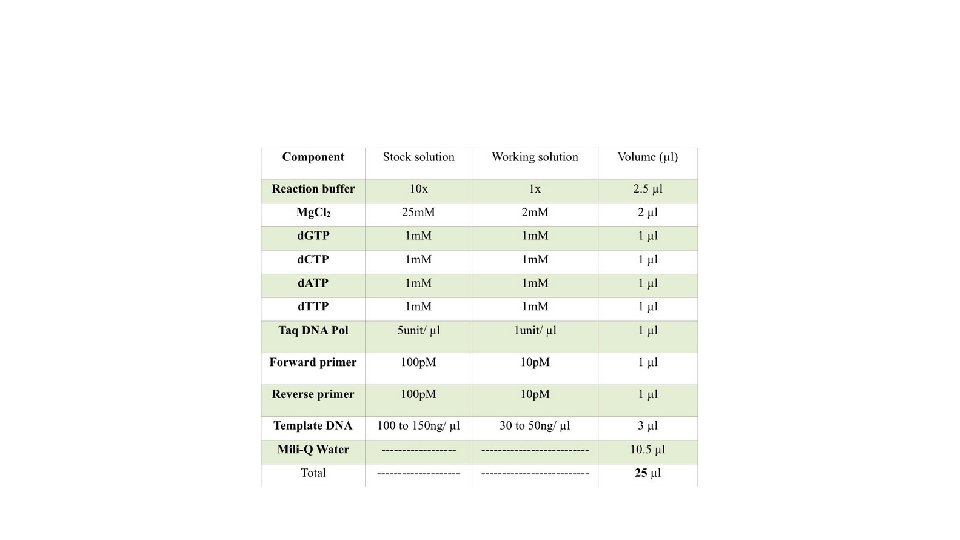
2. Amplification conditions: • The annealing temperature should higher (do not compromise the annealing temperature). • The concentration of the PCR components is given into the table below:
• Importantly, the PCR cycles for ARMS-PCR are lower than the normal PCR reaction. Set a PCR cycle between 22 to 25 but not 35. As the PCR cycles increase the chance of false-positive results increases. • “An additional mismatch to the 3’ end after the first mismatch increases the specificity of the ARMS-PCR reaction. ” • Here in the ARMS PCR, the internal control plays a crucial role, it facilitates additional accuracy in the allele-specific PCR by reducing the chance of the false-positive results.
3. Agarose gel electrophoresis: • The beauty of the ARMS PCR is that it does not require any hybridization steps. Which will make this technique more suitable and more reliable for the diagnosis. • The amplified fragments are directly loaded on the 2% agarose gel for getting the results. The samples are loaded sequentially on the agarose gel and run for 45 minutes.
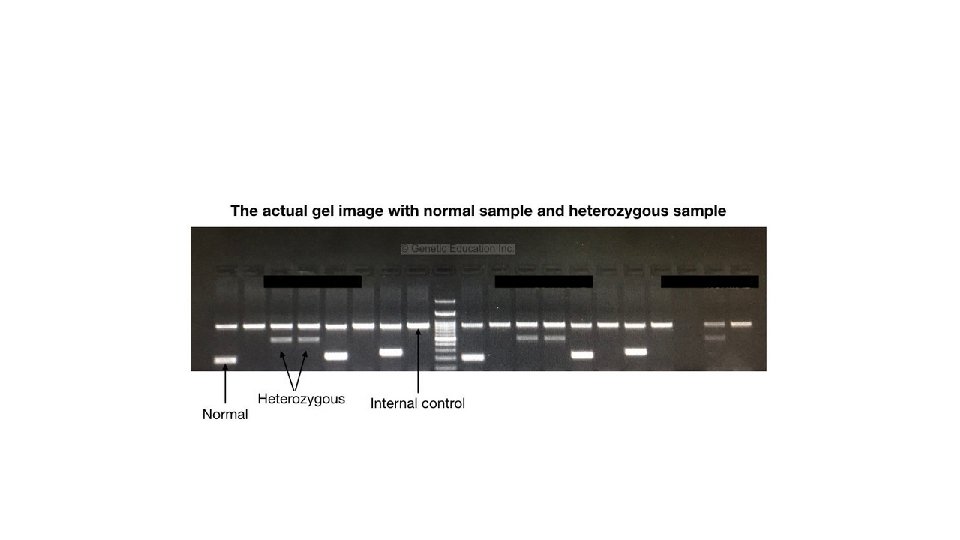
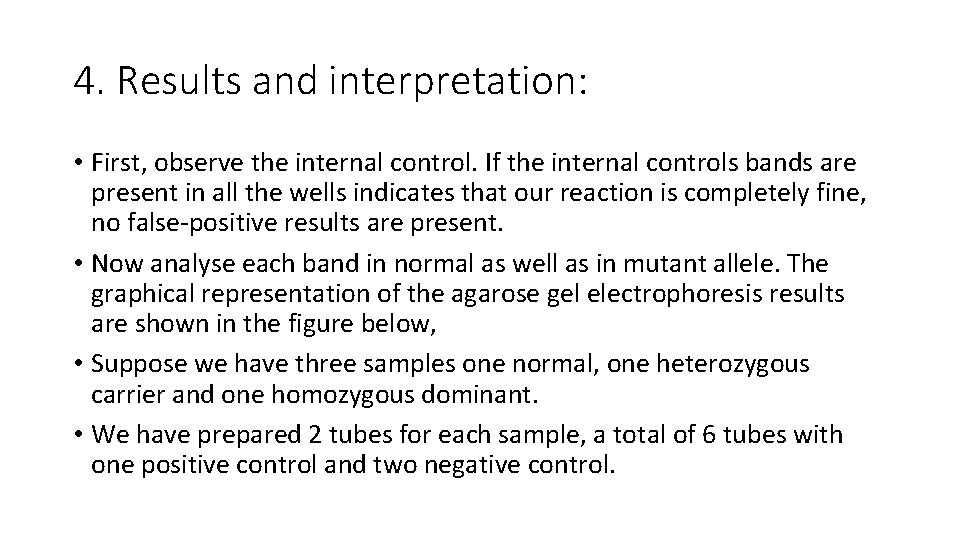
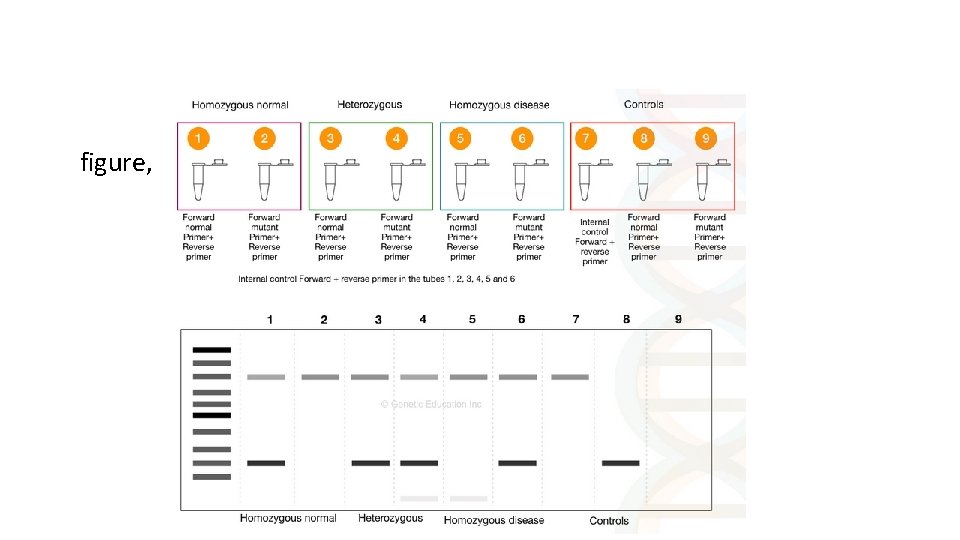
4. Results and interpretation: • First, observe the internal control. If the internal controls bands are present in all the wells indicates that our reaction is completely fine, no false-positive results are present. • Now analyse each band in normal as well as in mutant allele. The graphical representation of the agarose gel electrophoresis results are shown in the figure below, • Suppose we have three samples one normal, one heterozygous carrier and one homozygous dominant. • We have prepared 2 tubes for each sample, a total of 6 tubes with one positive control and two negative control.
figure,
• As shown into the figure above, an only single band is observed in the homozygous normal sample, two bands (one for normal and one for mutant) are observed in the heterozygous carrier sample and a single band of a mutant allele is observed in the homozygous disease condition. The wells 7, 8 and 9 are the controls.
Key tips: • Primer length should be 25 to 28 nucleotide • Incorporate one mismatch at -2 positions at the 3’ end • The second mismatch must be a weak mismatch • The concentration of ARMS primer should be 10 p. M and internal control primers concentration should around 1 to 3 p. M. • PCR program must be short. • The concertation of Mg. Cl 2 in PCR reaction is > 1. 5 m. M.
Importance of ARMS-PCR in the diagnosis of genetic disease: • The ARMS PCR is one of the important tools in the genetic disease diagnosis in recent days. The restriction digestion method is not 100% accurate and also, not all the sequences have the restriction site. • Therefore, restriction digestion is not applicable in all types of mutation or polymorphism. • The allele-specific PCR is an accurate method for single-gene disorders having the SNPs. It is also a gold standard method for Sickle cell anemia and thalassemia like inherited disorder.
• Also, it is applicable in mutation detection of JAK 2 and HIV. Commercial kits are now available for the different range of disorders such as Hb. S and JAK 2 gene SNPs detection kits. • S. Kwok and coworkers used ARMS-PCR in HIV type 1 module studies. Click here for the research paper. • The pioneers C. R. Newton and coworkers used this technique for the ATT gene deficiency SNP analysis. Click here for the research paper.
The advantage of ARMS PCR: • The technique is exclusively for the SNP genotyping. • Further, homozygous and heterozygous can be detected by this technique • It is widely applicable in the single gene point mutation detection such as sickle cell anaemia and thalassemia. • It is fast, reliable accurate and rapid.
Limitation of ARMS PCR: • Deletion/other major duplication and chromosomal abnormalities cannot be detected. • Only known SNPs are detected by ARMS-PCR. • Internal control is required because of the chance of the falsenegative results. • It is temperature-sensitive. A minute fluctuation in the temperature leads to false-positive results. • Thousands of SNPs cannot be detected in a single assay.
• Now answer to our question, Why high fidelity Taq DNA polymerase does not use in the ARMS PCR? • The high fidelity Taq DNA polymerase has the 3′ to 5′ exonuclease activity which removes the mismatch bases. that is why it is not used in the ARMS-PCR.
Conclusion: • The ARMS-PCR method is popular for the detection of known SNPs, however, it is a very tedious and time-consuming process to encounter more SNPs at once. Because it is allele-specific, the accuracy of ARMS-PCR is higher. • Some of the deletions can also be screened using ARMS-PCR method.