
Armory 101 Basics Presented by Yehuda ben Moshe
Armory 101 - Basics Presented by Yehuda ben Moshe Elmet Herald 1
Introduction • Armory is vast – Dozens of lines of division – Hundreds (thousands? ) of charges – Postures of quadrupeds, birds, etc. • We cover only a tiny fraction of this • Many resources for learning more 2
Resources • SCA Heraldic Primer: http: //heraldry. sca. org/armory/primer/ • A Grammar of Blazonry: http: //heraldry. sca. org/armory/bruce. html • Articles: http: //heraldry. sca. org/armory_articles. html • Parker’s Glossary: http: //www. heraldsnet. org/saitou/parker/Jpgl ossa. htm 3
Resources • Arthur Charles Fox-Davies - A Complete Guide To Heraldry – http: //archive. org/details/completeguidetoh 00 fox drich • John Woodward - A Treatise on Heraldry, British and Foreign • Rodney Dennys - The Heraldic Imagination 4
Resources • Period rolls of arms: – http: //www. s-gabriel. org/heraldry/ – http: //www. vikinganswerlady. com/Stars/Rolls_of _Arms. html – http: //www. yehudaheraldry. com/rolls 5
Terminology • Emblazon • The actual drawing of the device • Blazon A verbal description of the device • Written in a special language derived from Norman French • Follows specific grammar and construction rules • Not important to get right on a submission • We register the picture (emblazon), not the words (blazon) 6
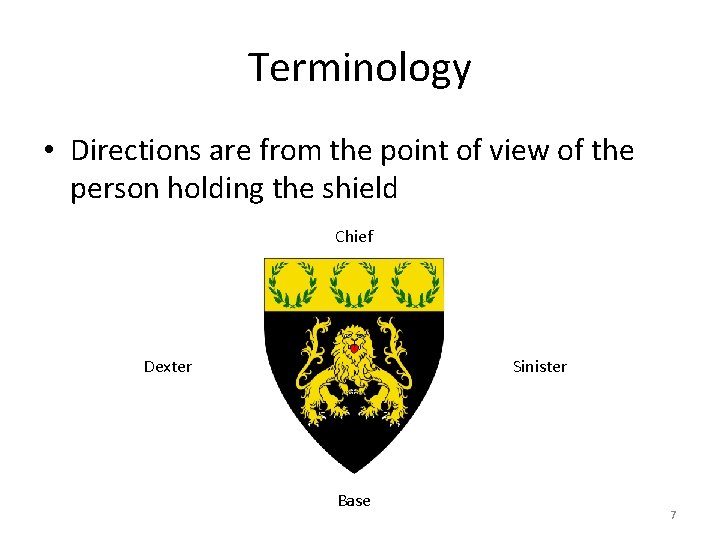
Terminology • Directions are from the point of view of the person holding the shield Chief Dexter Sinister Base 7
Terminology • Field – base “layer” of the device – Lines of division • Charges – anything placed on the field (or on top of other charges) • Tinctures – Colors – Metals 8
Rules • SENA – Standards for Evaluation of Names and Armory – Found at: http: //heraldry. sca. org/laurel/sena. html – Current rules for all submissions – Broken into 4 main sections: • • General Principles Personal Names Non-Personal Names Armory – Includes 13 appendices 9
Rules - Basics • Reproducibility (A 1 C) – Given a written blazon, two different artists should be able to draw very similar emblazons of the armory – Armory must be describable in standard heraldic terms 10
Rules - Basics • Recognizability (A 1 D) – Armor should lend itself to instant identification – Most of the period heraldic rules and styles arose out of this need – The viewer should be able to immediately identify the charges and arrangements 11
Rules - Basics • Submissions should be reasonably period (GP 1 B 1) – Period elements – Period combinations of the elements – “Core style” defines most common elements and combinations – Individually attested patterns allow submissions outside core style 12
Rules - Basics • Core Style (A 1 A 1) – Described in detail in A 2 and A 3 – Not identical to the style of any specific place and time – Based on the Anglo-Norman style – For the most part, doesn’t require documentation 13
Rules - Basics • Individually Attested Patterns (A 1 A 2) – Armory that doesn’t meet “Core Style” requirements – Registerable if adequately documented – Described in detail in A 4 14
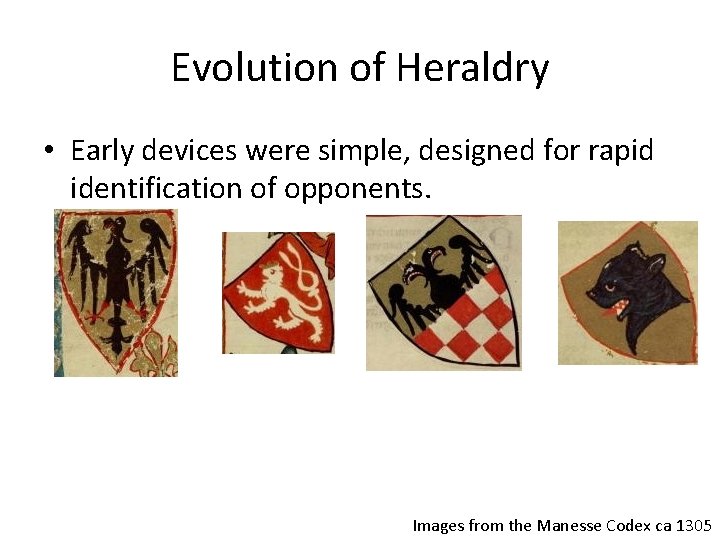
Evolution of Heraldry • Early devices were simple, designed for rapid identification of opponents. Images from the Manesse Codex ca 1305
Evolution of Heraldry • As warfare and technology evolved, individual identification became less important • “Heraldic space” was filling up • Heraldry became a perk of the nobility • Devices got more complex
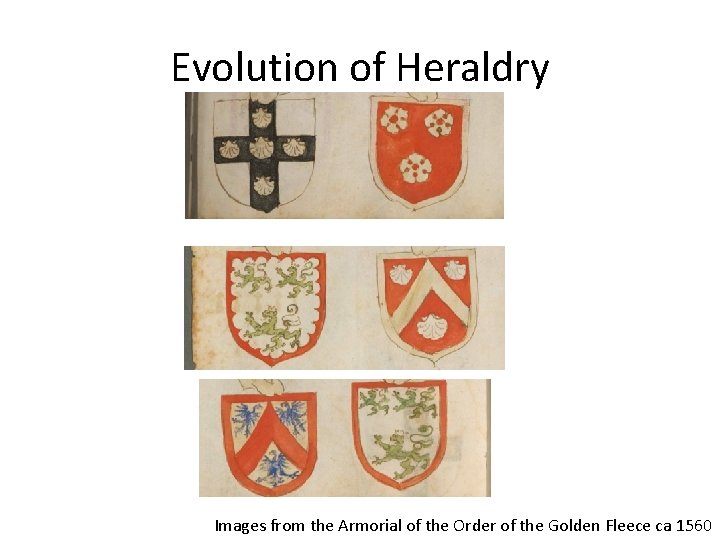
Evolution of Heraldry Images from the Armorial of the Order of the Golden Fleece ca 1560
Evolution of Heraldry - Marshalling • Noble families combined arms to show relationships • Armigerous wives combined their devices with those of their husbands • Children with two armigerous parents used devices combining those of • Three types of marshalling – dimidiation, impalement, quartering
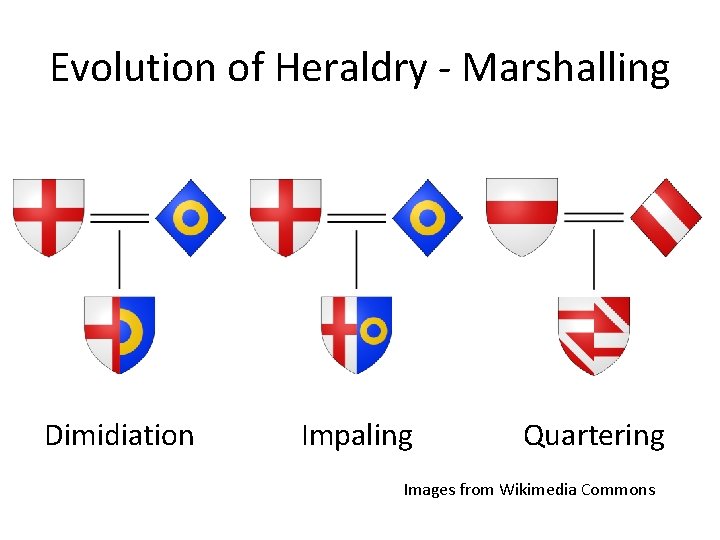
Evolution of Heraldry - Marshalling Dimidiation Impaling Quartering Images from Wikimedia Commons
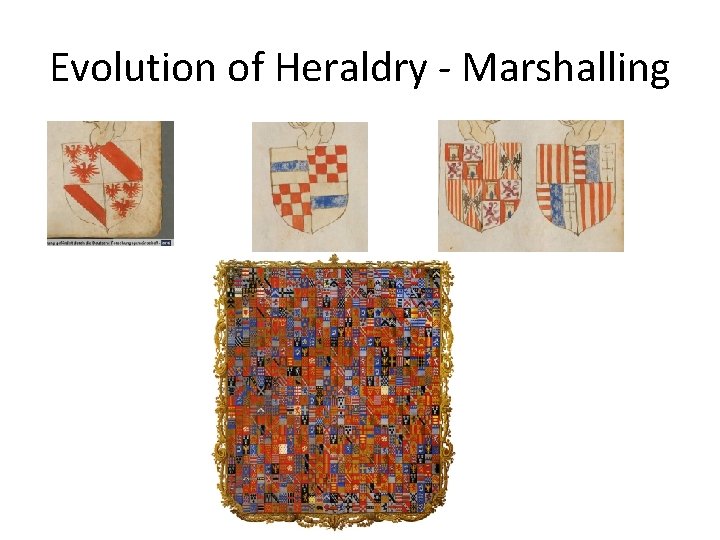
Evolution of Heraldry - Marshalling
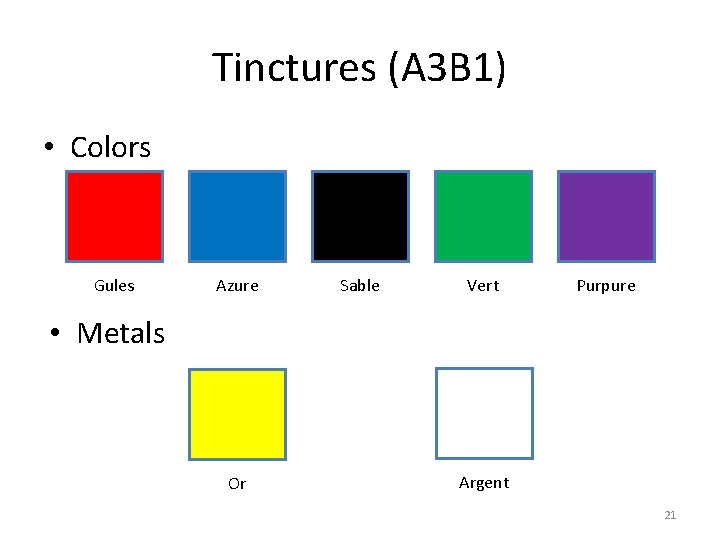
Tinctures (A 3 B 1) • Colors Gules Azure Sable Vert Purpure • Metals Or Argent 21
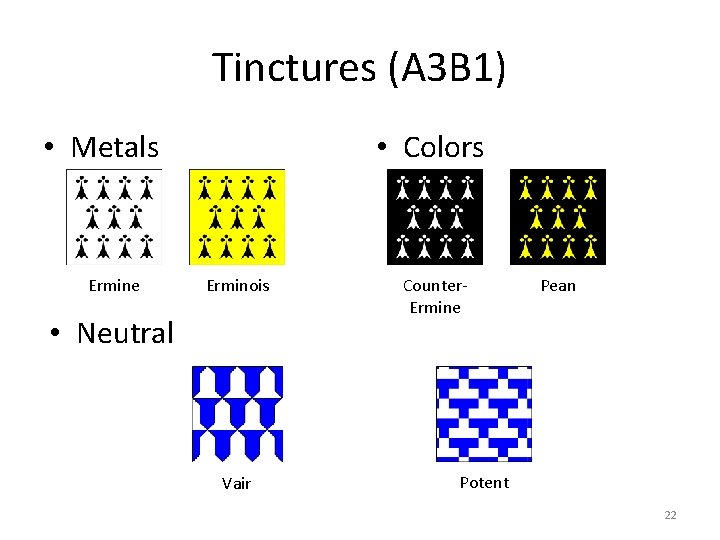
Tinctures (A 3 B 1) • Metals Ermine • Colors Erminois • Neutral Vair Counter. Ermine Pean Potent 22
Ordinaries • Ordinaries are charges • They are usually comprised of simple geometric figures running from side to side or top to bottom of the field • Ordinaries can be classified as central or peripheral 23
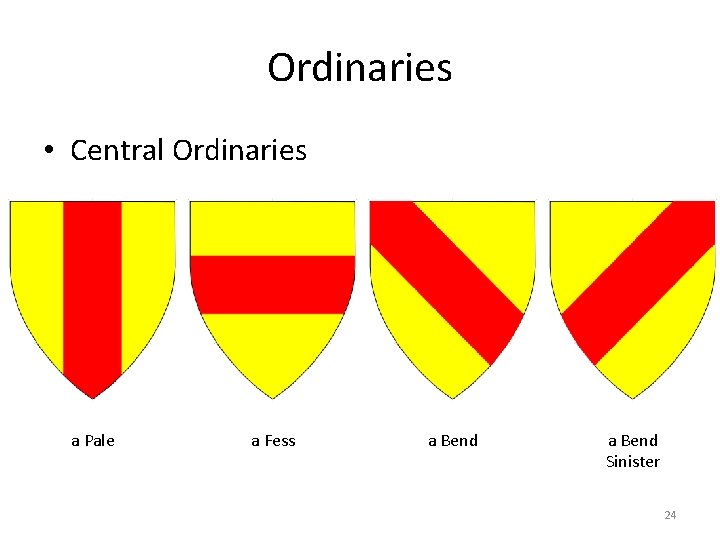
Ordinaries • Central Ordinaries a Pale a Fess a Bend Sinister 24
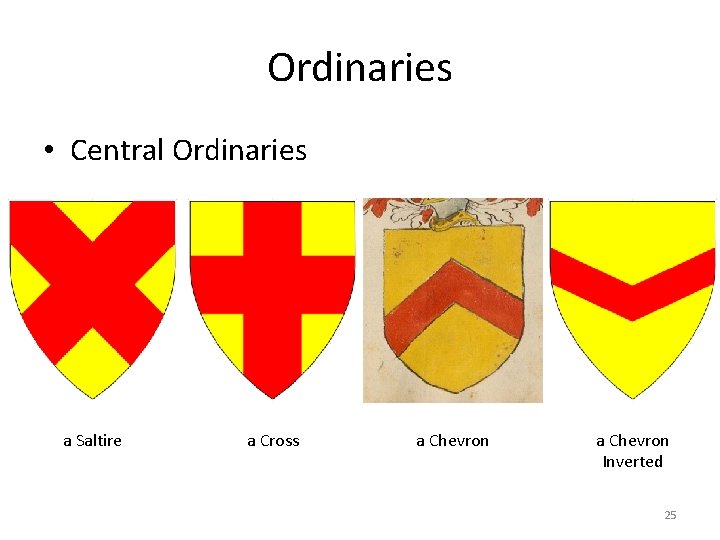
Ordinaries • Central Ordinaries a Saltire a Cross a Chevron Inverted 25

Ordinaries • Central Ordinaries a Pall Inverted 26
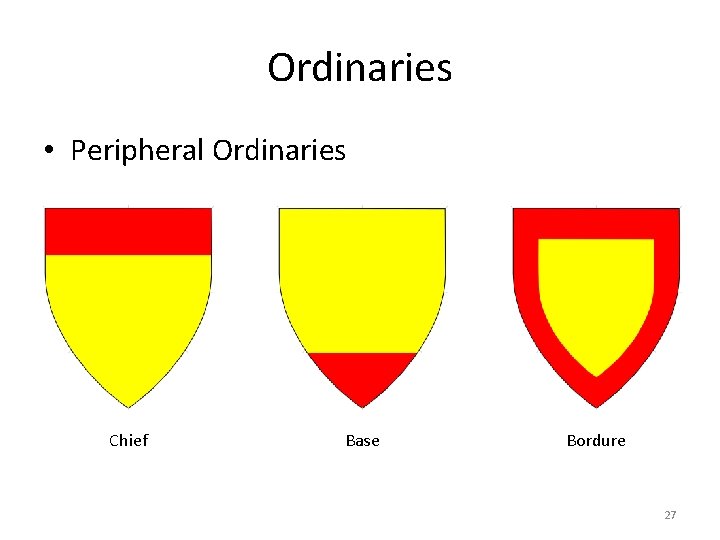
Ordinaries • Peripheral Ordinaries Chief Base Bordure 27
Lines of Division • Divides the field into 2 or more sections • Also known as: – “Lines of Partition” – “Field Divisions” – “Field Partitions” 28
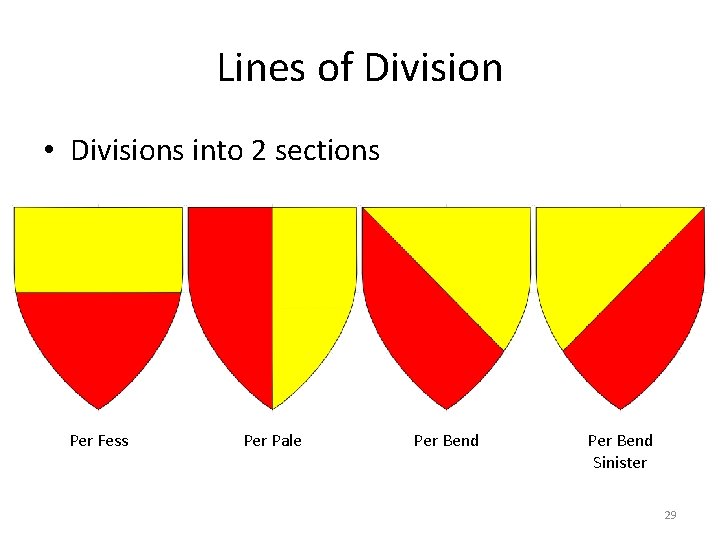
Lines of Division • Divisions into 2 sections Per Fess Per Pale Per Bend Sinister 29
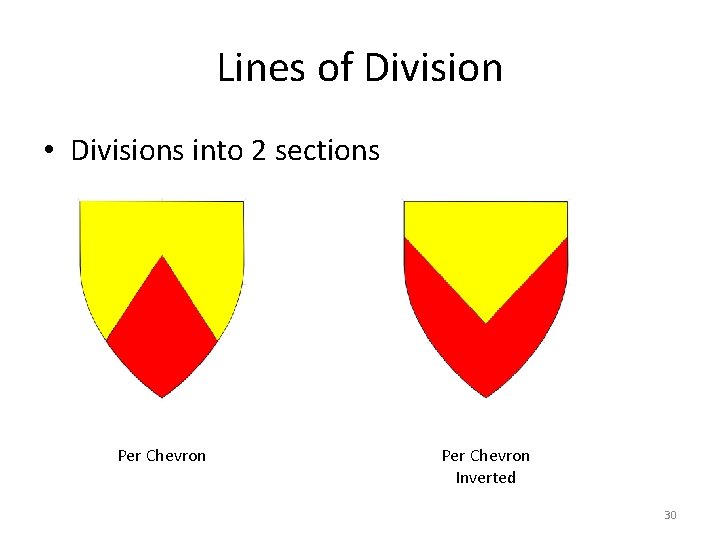
Lines of Division • Divisions into 2 sections Per Chevron Inverted 30
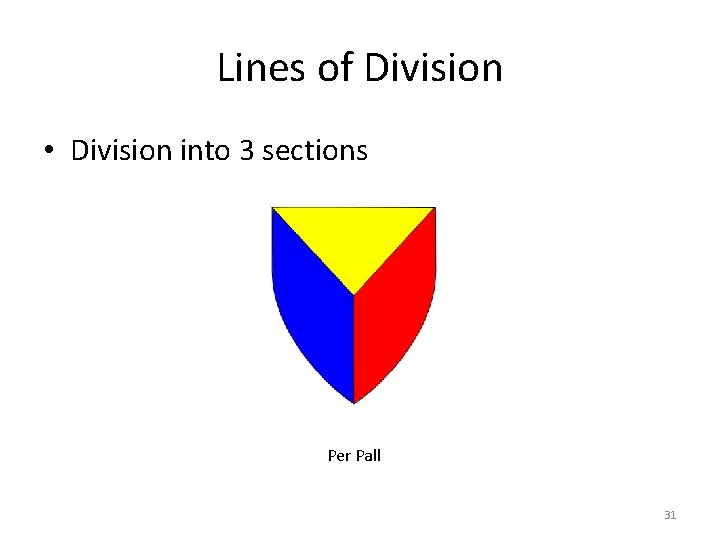
Lines of Division • Division into 3 sections Per Pall 31
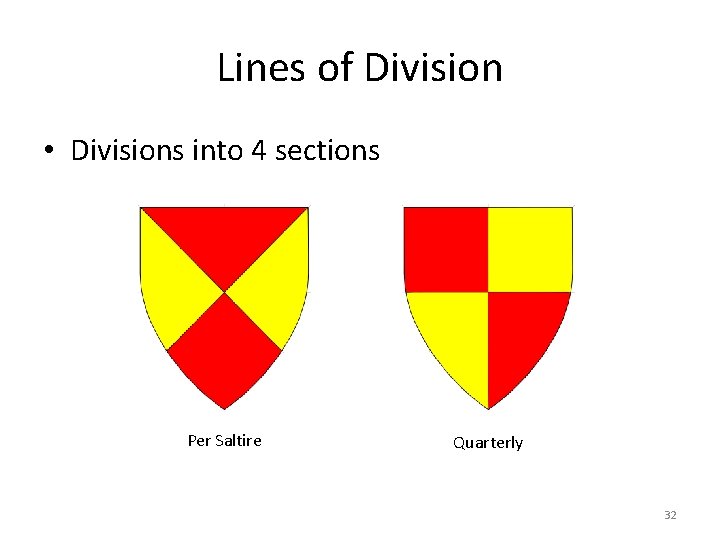
Lines of Division • Divisions into 4 sections Per Saltire Quarterly 32
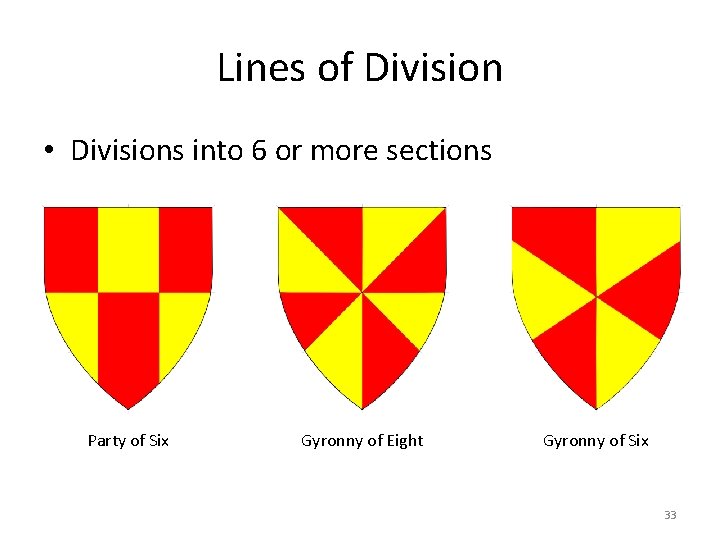
Lines of Division • Divisions into 6 or more sections Party of Six Gyronny of Eight Gyronny of Six 33
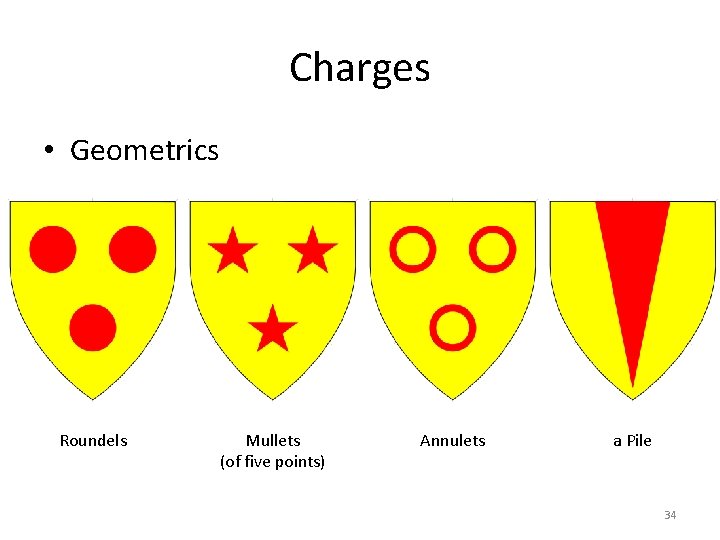
Charges • Geometrics Roundels Mullets (of five points) Annulets a Pile 34
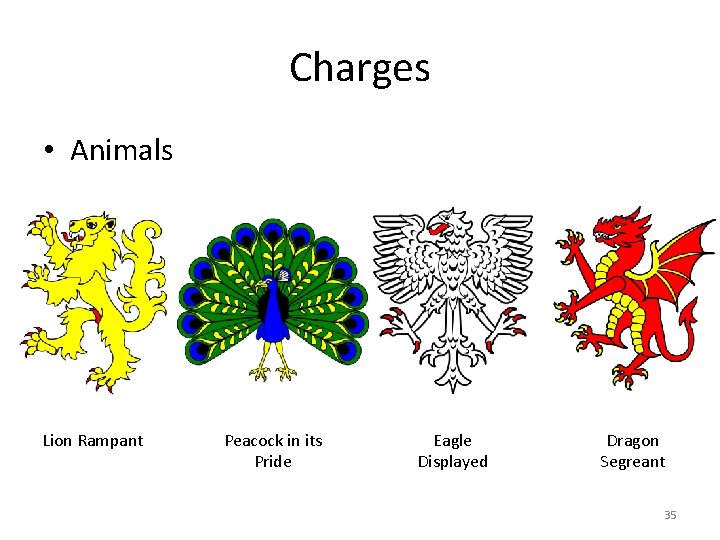
Charges • Animals Lion Rampant Peacock in its Pride Eagle Displayed Dragon Segreant 35
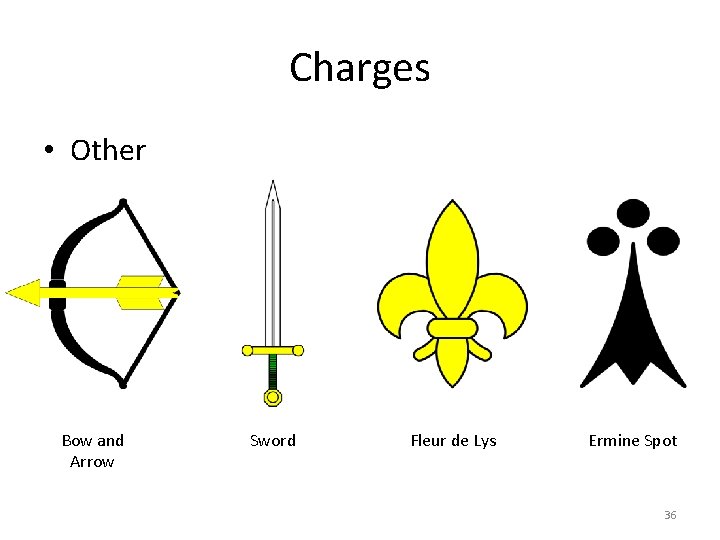
Charges • Other Bow and Arrow Sword Fleur de Lys Ermine Spot 36
Complex Lines • Lines of division and lines forming ordinaries shown so far were simple, straight lines • Such lines can also be complex, using various patterns.
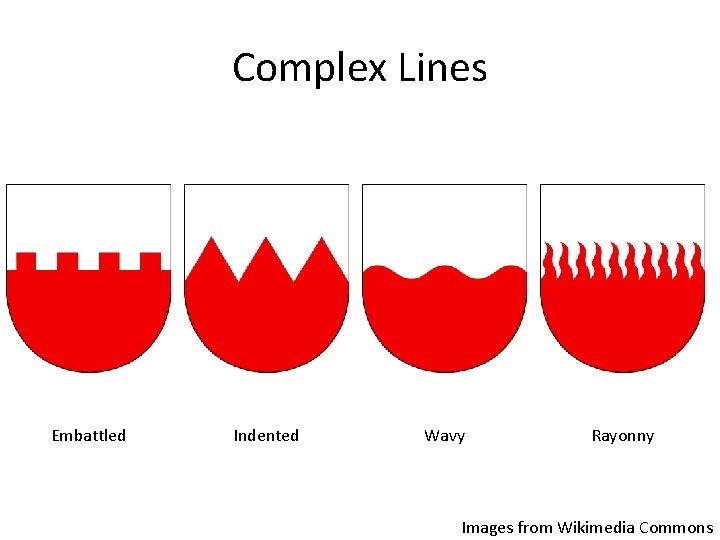
Complex Lines Embattled Indented Wavy Rayonny Images from Wikimedia Commons
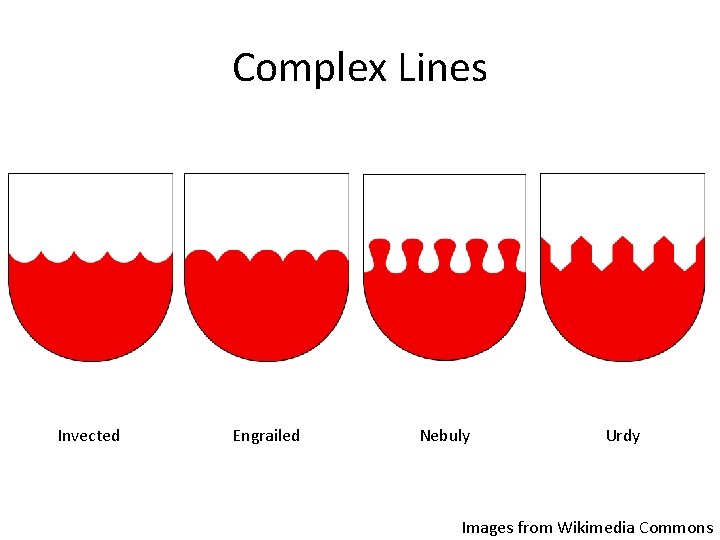
Complex Lines Invected Engrailed Nebuly Urdy Images from Wikimedia Commons
Rules of Heraldry – Blazon • Blazon utilizes a specific grammar structure • Items generally follow the pattern “number, type, posture, tincture”, with tincture always the last • “Arrangement” can come before the “number” of after “posture” • We usually blazon from lowest to highest level, from center out, from chief to base, from dexter to sinister – Field is always blazoned first
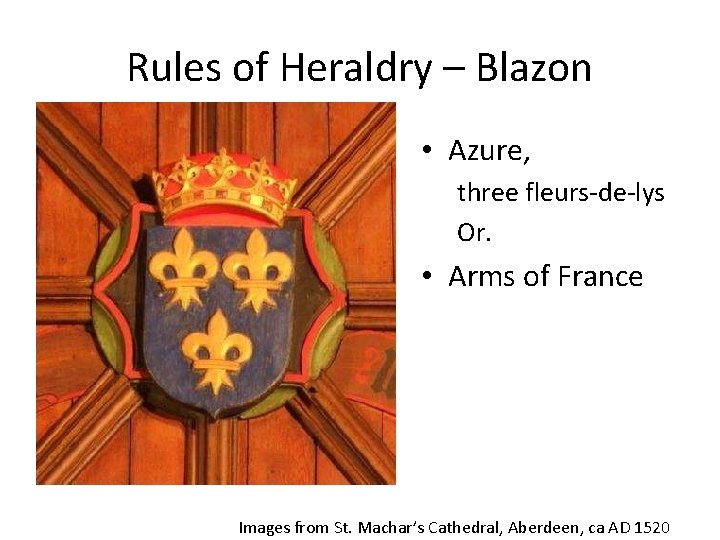
Rules of Heraldry – Blazon • Azure, three fleurs-de-lys Or. • Arms of France Images from St. Machar’s Cathedral, Aberdeen, ca AD 1520
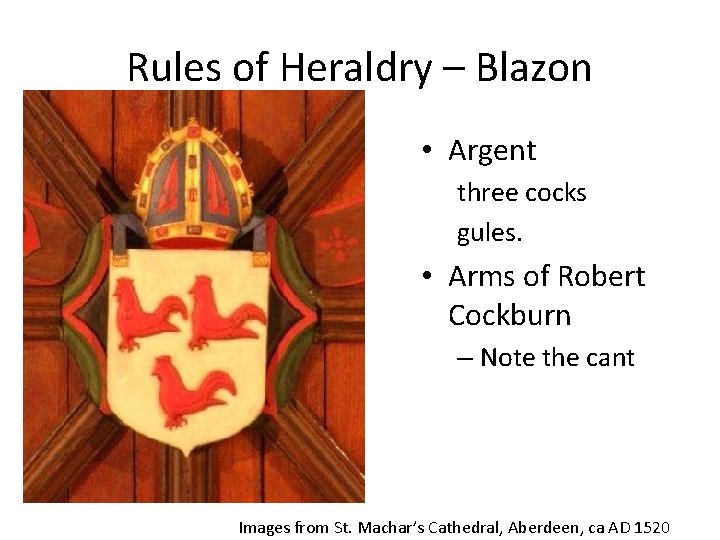
Rules of Heraldry – Blazon • Argent three cocks gules. • Arms of Robert Cockburn – Note the cant Images from St. Machar’s Cathedral, Aberdeen, ca AD 1520
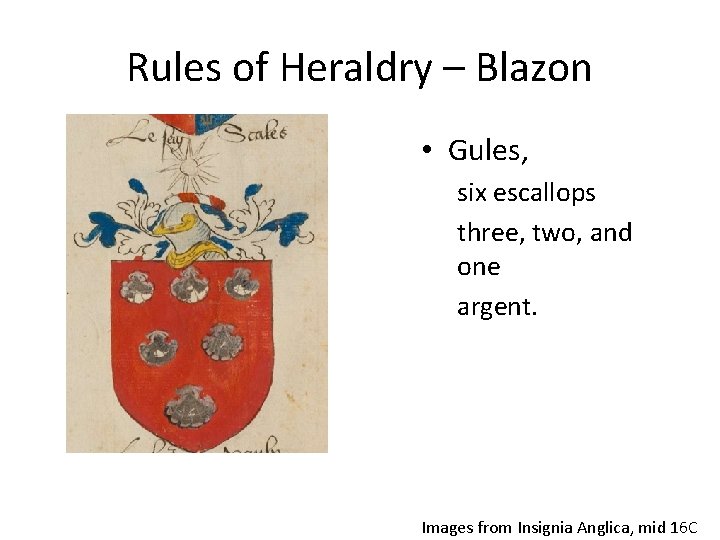
Rules of Heraldry – Blazon • Gules, six escallops three, two, and one argent. Images from Insignia Anglica, mid 16 C
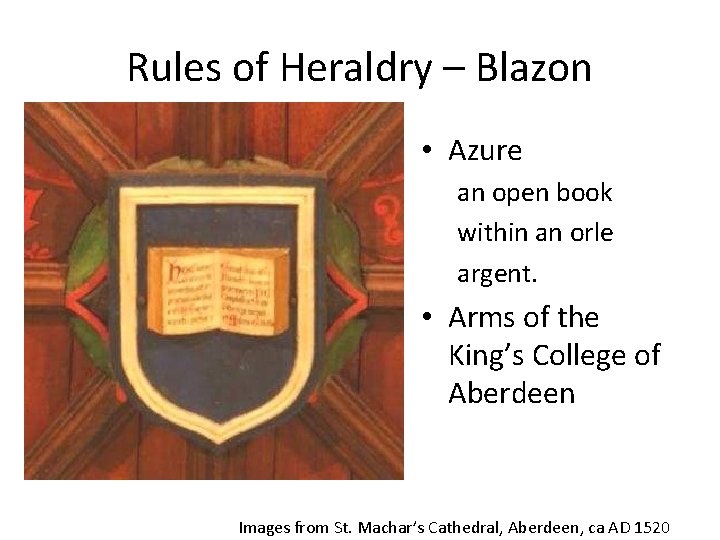
Rules of Heraldry – Blazon • Azure an open book within an orle argent. • Arms of the King’s College of Aberdeen Images from St. Machar’s Cathedral, Aberdeen, ca AD 1520
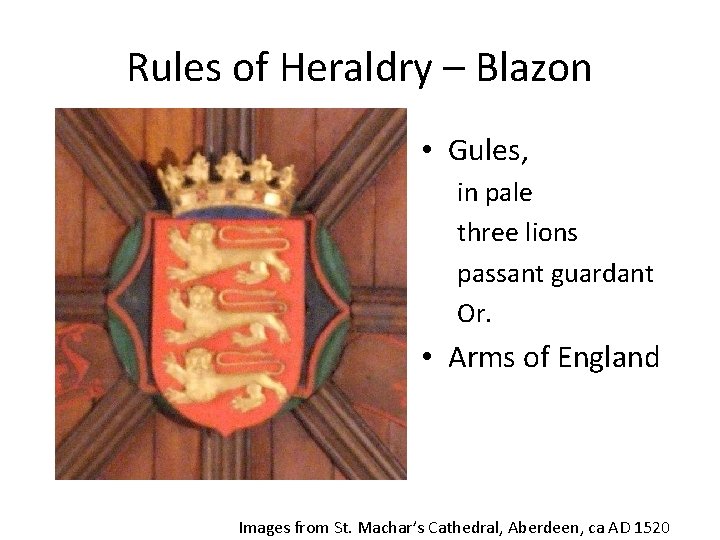
Rules of Heraldry – Blazon • Gules, in pale three lions passant guardant Or. • Arms of England Images from St. Machar’s Cathedral, Aberdeen, ca AD 1520
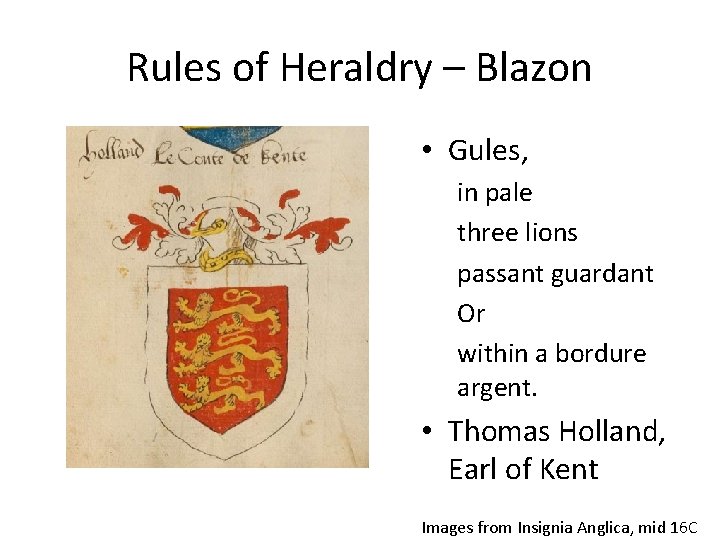
Rules of Heraldry – Blazon • Gules, in pale three lions passant guardant Or within a bordure argent. • Thomas Holland, Earl of Kent Images from Insignia Anglica, mid 16 C
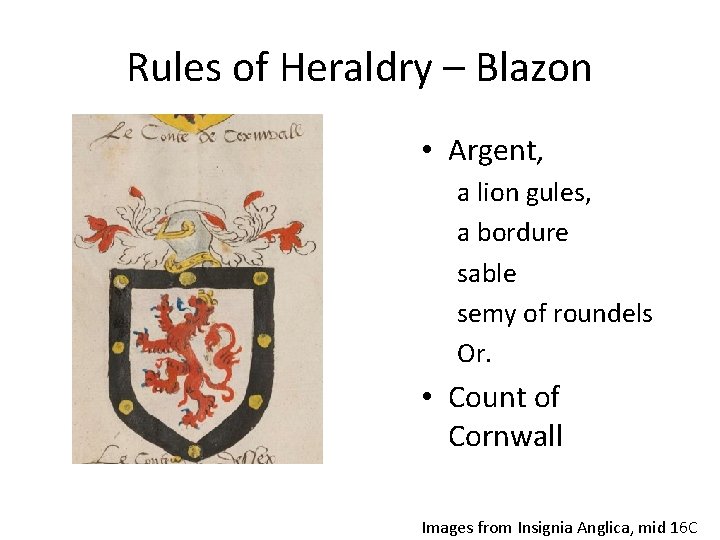
Rules of Heraldry – Blazon • Argent, a lion gules, a bordure sable semy of roundels Or. • Count of Cornwall Images from Insignia Anglica, mid 16 C
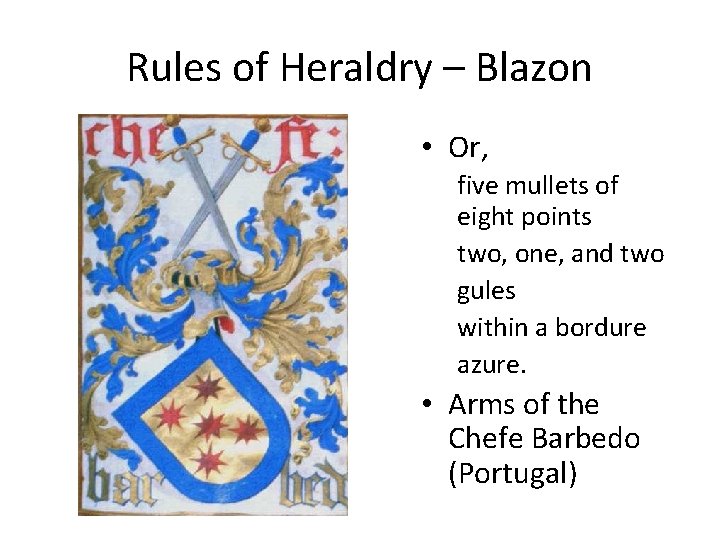
Rules of Heraldry – Blazon • Or, five mullets of eight points two, one, and two gules within a bordure azure. • Arms of the Chefe Barbedo (Portugal)
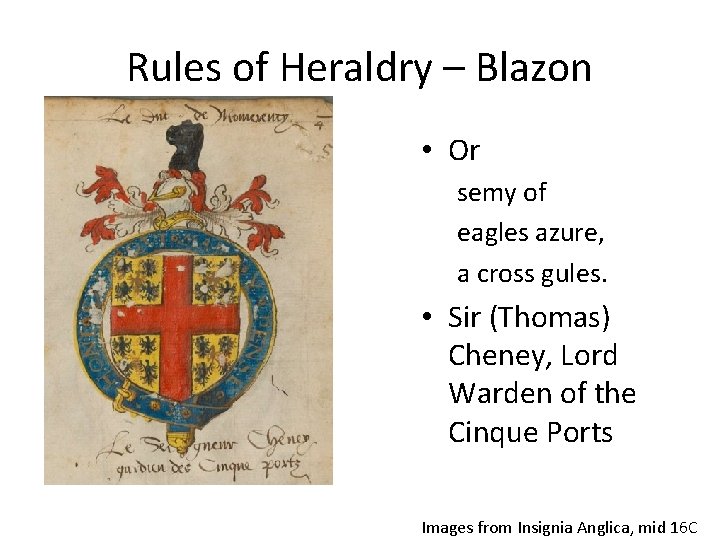
Rules of Heraldry – Blazon • Or semy of eagles azure, a cross gules. • Sir (Thomas) Cheney, Lord Warden of the Cinque Ports Images from Insignia Anglica, mid 16 C

Rules of Heraldry – Blazon • Checky Or and azure. • Count of Warren Images from Insignia Anglica, mid 16 C
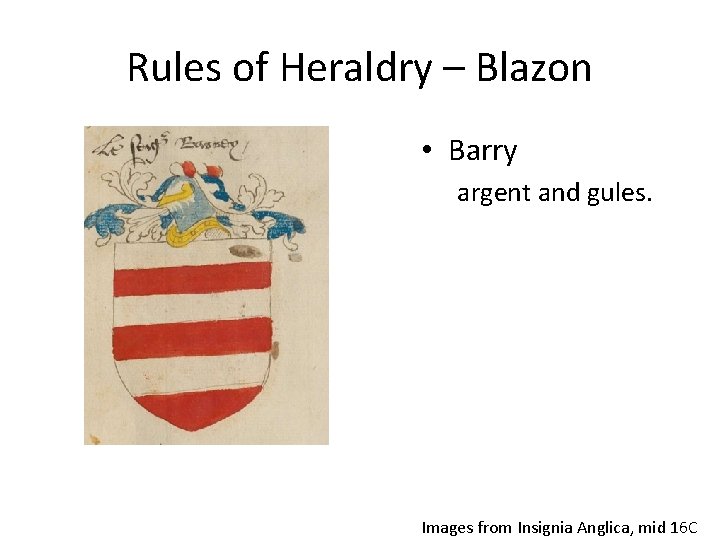
Rules of Heraldry – Blazon • Barry argent and gules. Images from Insignia Anglica, mid 16 C
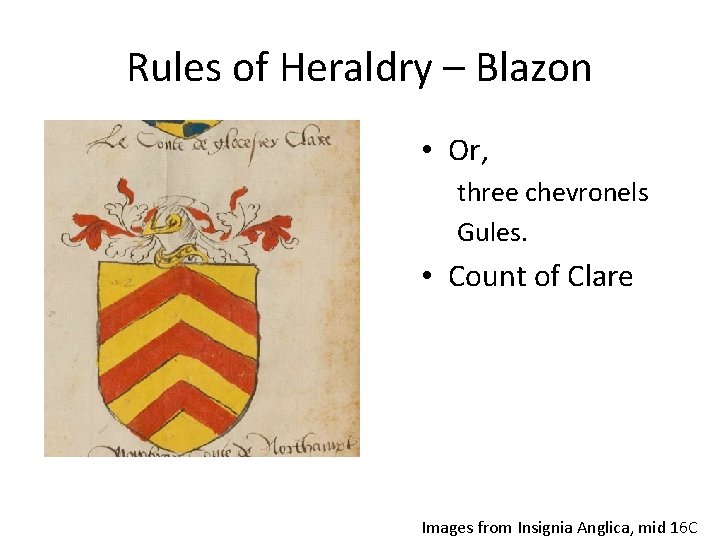
Rules of Heraldry – Blazon • Or, three chevronels Gules. • Count of Clare Images from Insignia Anglica, mid 16 C
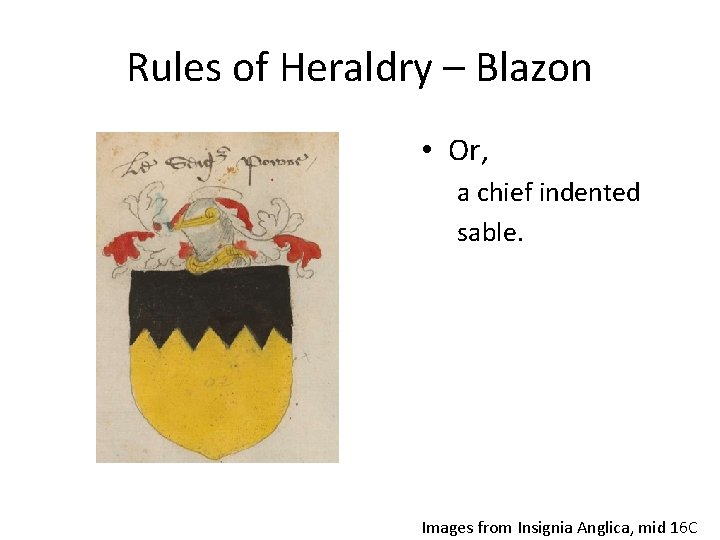
Rules of Heraldry – Blazon • Or, a chief indented sable. Images from Insignia Anglica, mid 16 C
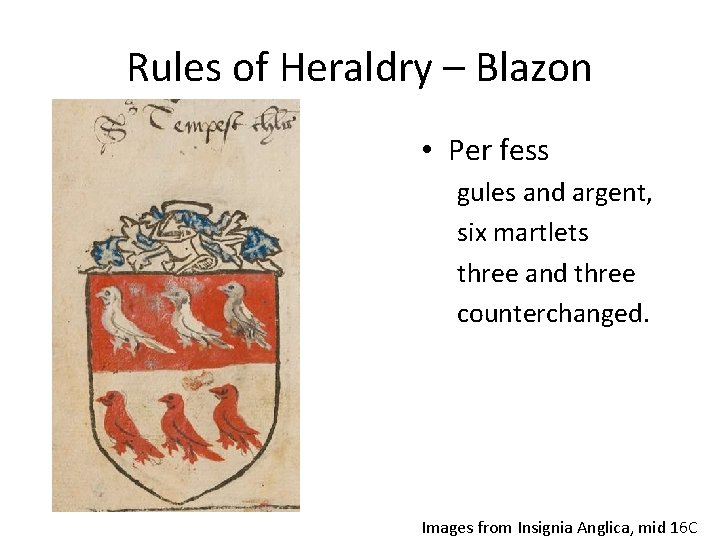
Rules of Heraldry – Blazon • Per fess gules and argent, six martlets three and three counterchanged. Images from Insignia Anglica, mid 16 C
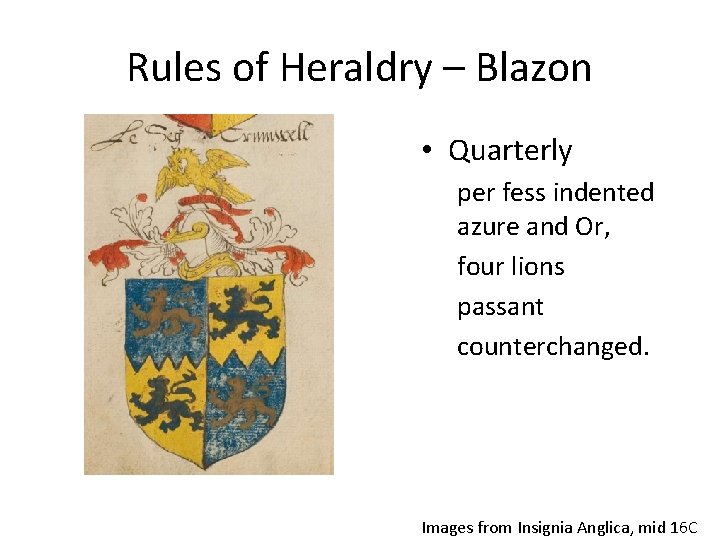
Rules of Heraldry – Blazon • Quarterly per fess indented azure and Or, four lions passant counterchanged. Images from Insignia Anglica, mid 16 C
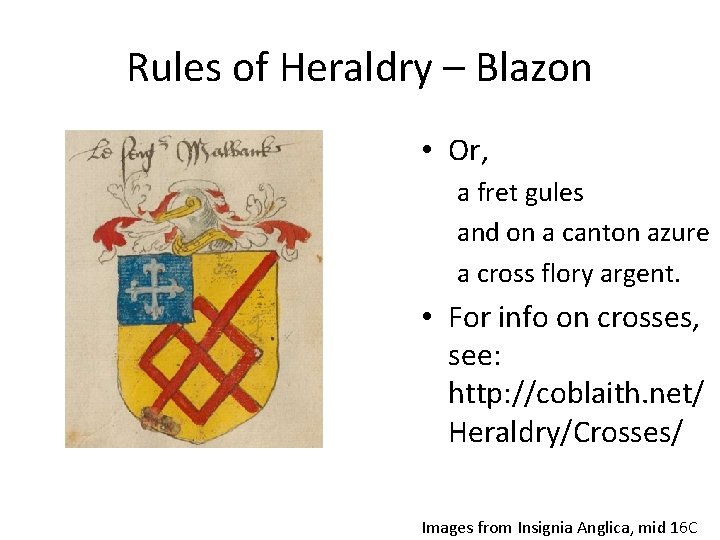
Rules of Heraldry – Blazon • Or, a fret gules and on a canton azure a cross flory argent. • For info on crosses, see: http: //coblaith. net/ Heraldry/Crosses/ Images from Insignia Anglica, mid 16 C
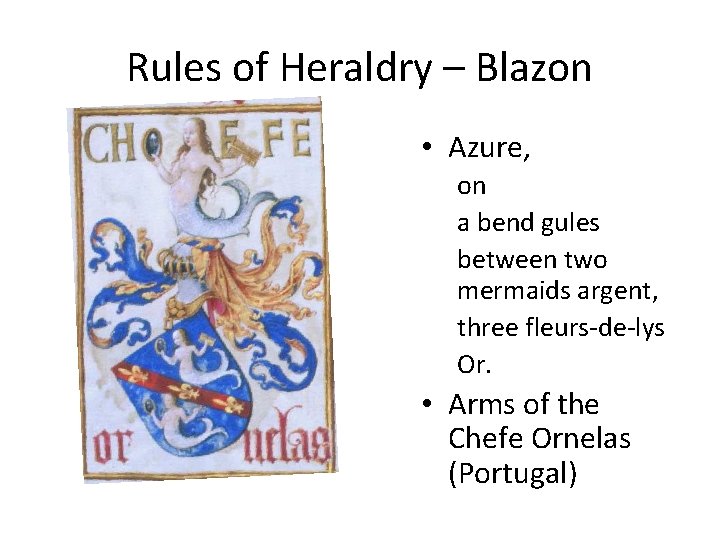
Rules of Heraldry – Blazon • Azure, on a bend gules between two mermaids argent, three fleurs-de-lys Or. • Arms of the Chefe Ornelas (Portugal)
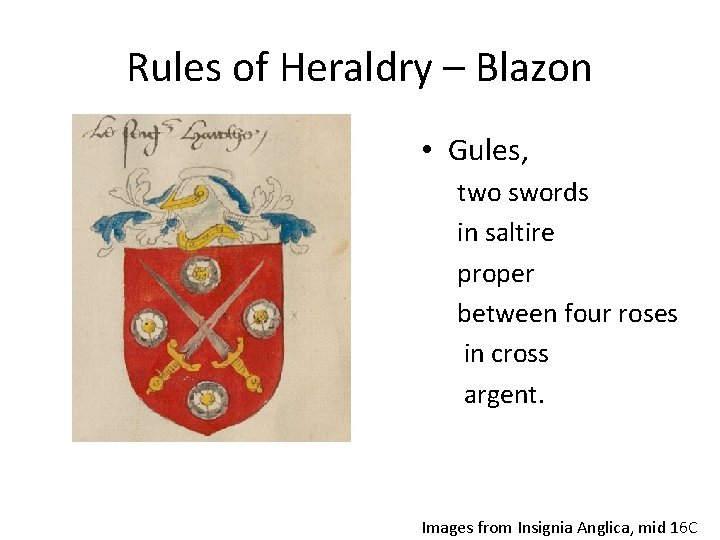
Rules of Heraldry – Blazon • Gules, two swords in saltire proper between four roses in cross argent. Images from Insignia Anglica, mid 16 C
Final Thoughts • Registerable vs. Authentic – A submission must be registerable; it need not be authentic – While we can encourage clients to design periodlooking armory, we cannot, and should not, force the decision – If a client is set on a registerable but not very authentic submission, you should process it!

Final Thoughts • Customer Service – It is our job to help our clients – We are here to make registrations happen, not prevent them from happening – When consulting, help clients create registerable submissions they like – When commenting, look for reasons to allow registration, not prohibit it – Heralds want a reputation for being helpful, not obstructionist!
About me • Elmet Herald – I am the East Kingdom heraldic education deputy • elmet@eastkingdom. org • jgalak@gmail. com • This handout can be found at: – http: //www. yehudaheraldry. com/ekhu
- Slides: 61