
ARM CortexM 0 Introduction Department of Electrical Engineering




- Slides: 30
ARM Cortex-M 0 Introduction Department of Electrical Engineering, National Taiwan Ocean University 3/1/2012 Richard Kuo Assistant Professor www. ee. ntou. edu. tw
Outline Department of Electrical Engineering, National Taiwan Ocean University ► ► ► ARM Processors roadmap ARM Cortex-M 0 roadmap Cortex-M 0 performance Cortex-M 0 functional blocks Cortex-M 0 architecture overview Memory Model Exception Model Cortex-M 0 address map System Control Space System Timer NVIC www. ee. ntou. edu. tw
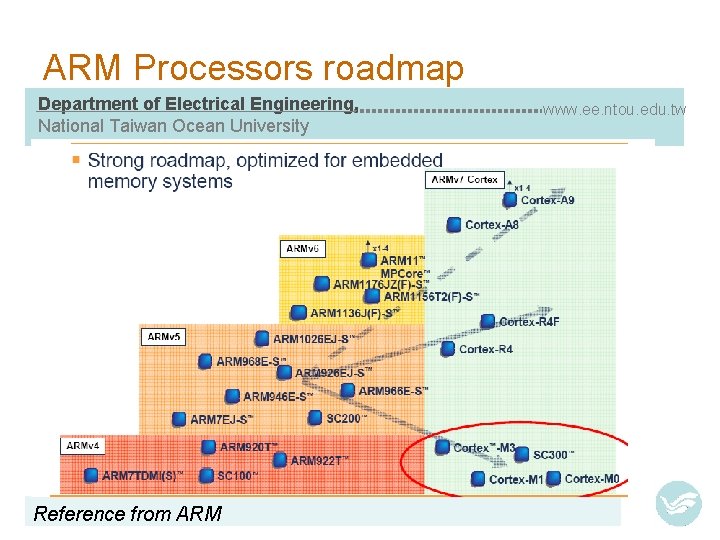
ARM Processors roadmap Department of Electrical Engineering, National Taiwan Ocean University Reference from ARM www. ee. ntou. edu. tw
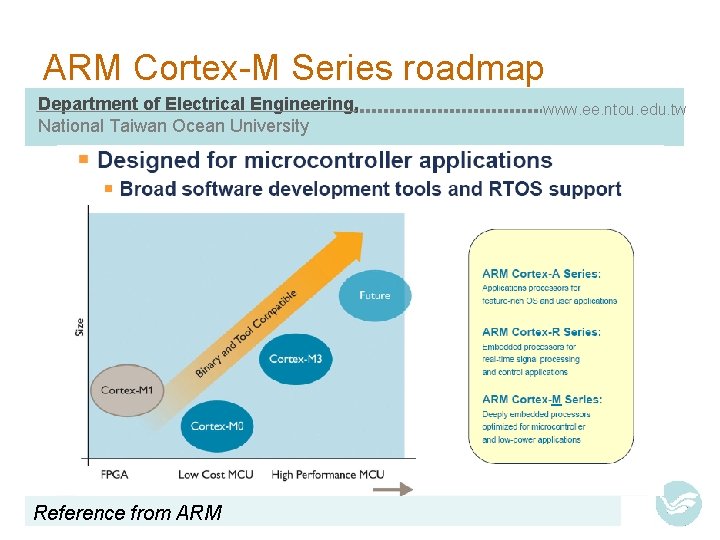
ARM Cortex-M Series roadmap Department of Electrical Engineering, National Taiwan Ocean University Reference from ARM www. ee. ntou. edu. tw
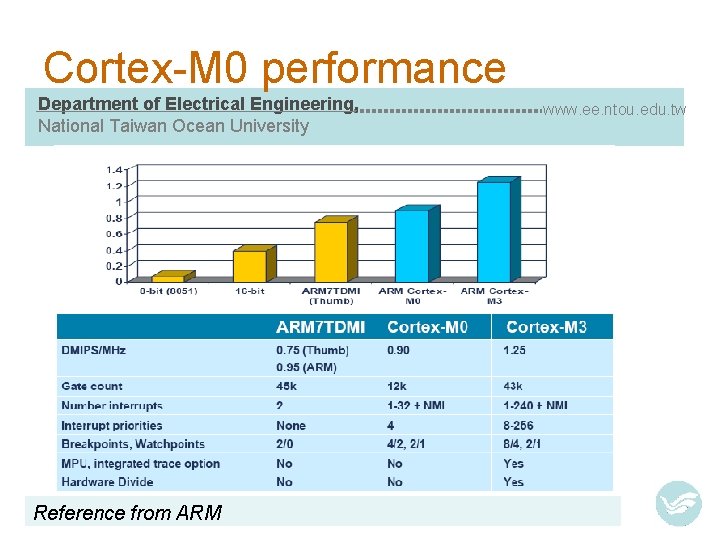
Cortex-M 0 performance Department of Electrical Engineering, National Taiwan Ocean University Reference from ARM www. ee. ntou. edu. tw
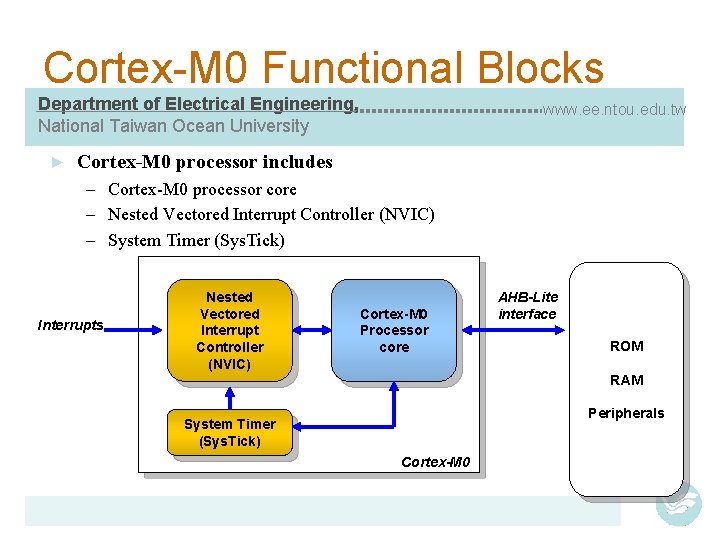
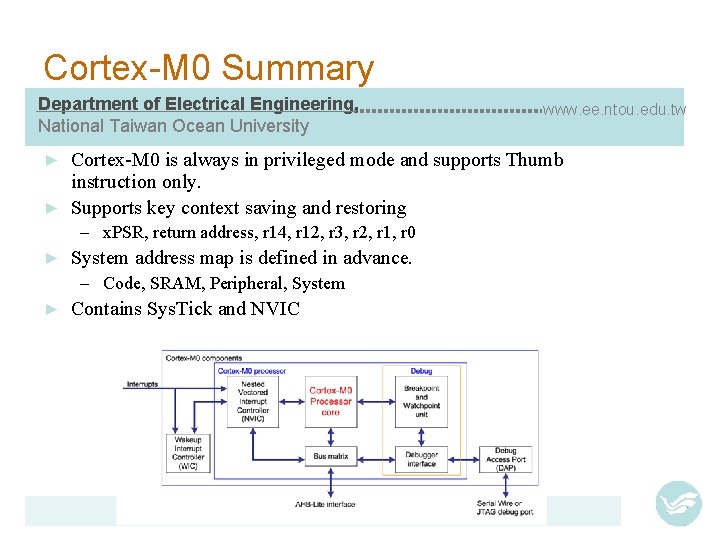
Cortex-M 0 Functional Blocks Department of Electrical Engineering, National Taiwan Ocean University ► www. ee. ntou. edu. tw Cortex-M 0 processor includes – Cortex-M 0 processor core – Nested Vectored Interrupt Controller (NVIC) – System Timer (Sys. Tick) Interrupts Nested Vectored Interrupt Controller (NVIC) Cortex-M 0 Processor core AHB-Lite interface ROM RAM Peripherals System Timer (Sys. Tick) Cortex-M 0
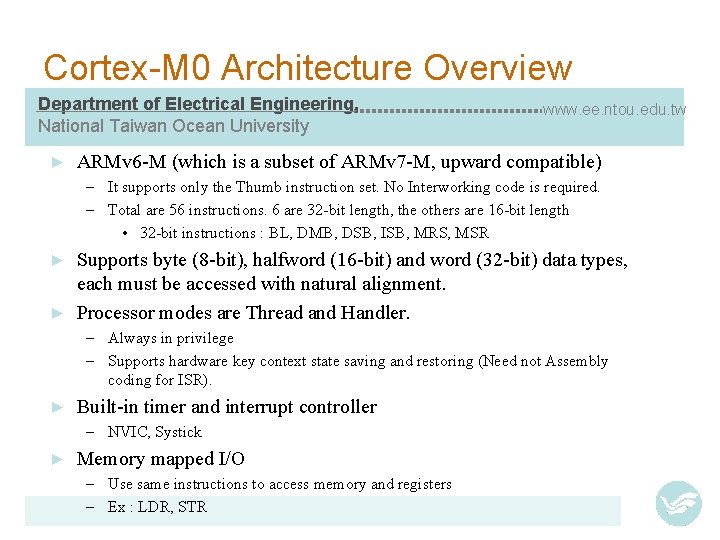
Cortex-M 0 Architecture Overview Department of Electrical Engineering, National Taiwan Ocean University ► www. ee. ntou. edu. tw ARMv 6 -M (which is a subset of ARMv 7 -M, upward compatible) – It supports only the Thumb instruction set. No Interworking code is required. – Total are 56 instructions. 6 are 32 -bit length, the others are 16 -bit length • 32 -bit instructions : BL, DMB, DSB, ISB, MRS, MSR Supports byte (8 -bit), halfword (16 -bit) and word (32 -bit) data types, each must be accessed with natural alignment. ► Processor modes are Thread and Handler. ► – Always in privilege – Supports hardware key context state saving and restoring (Need not Assembly coding for ISR). ► Built-in timer and interrupt controller – NVIC, Systick ► Memory mapped I/O – Use same instructions to access memory and registers – Ex : LDR, STR
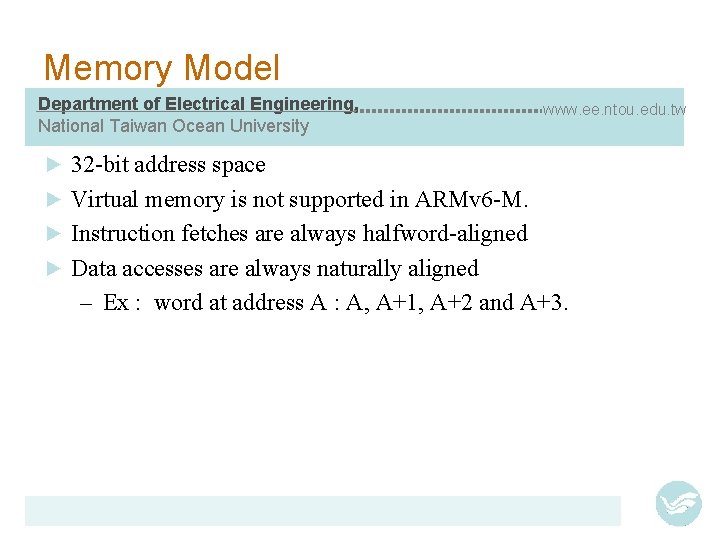
Memory Model Department of Electrical Engineering, National Taiwan Ocean University www. ee. ntou. edu. tw 32 -bit address space ► Virtual memory is not supported in ARMv 6 -M. ► Instruction fetches are always halfword-aligned ► Data accesses are always naturally aligned – Ex : word at address A : A, A+1, A+2 and A+3. ►
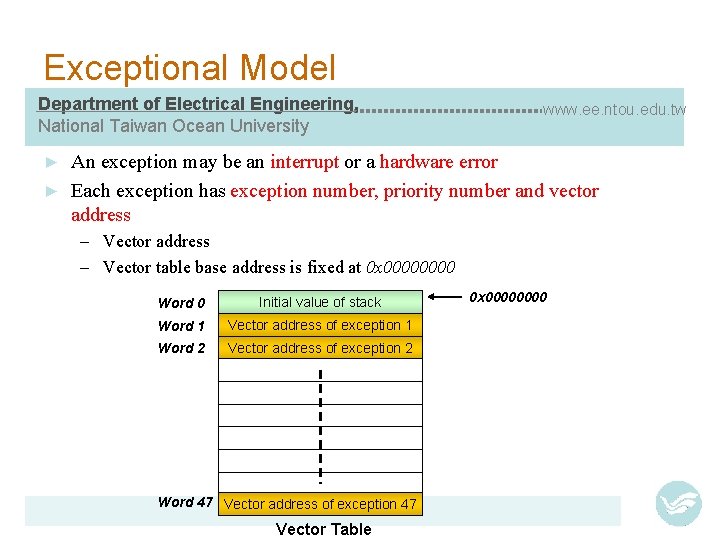
Exceptional Model Department of Electrical Engineering, National Taiwan Ocean University www. ee. ntou. edu. tw An exception may be an interrupt or a hardware error ► Each exception has exception number, priority number and vector address ► – Vector address – Vector table base address is fixed at 0 x 0000 Word 0 Initial value of stack Word 1 Vector address of exception 1 Word 2 Vector address of exception 2 Word 47 Vector address of exception 47 Vector Table 0 x 0000
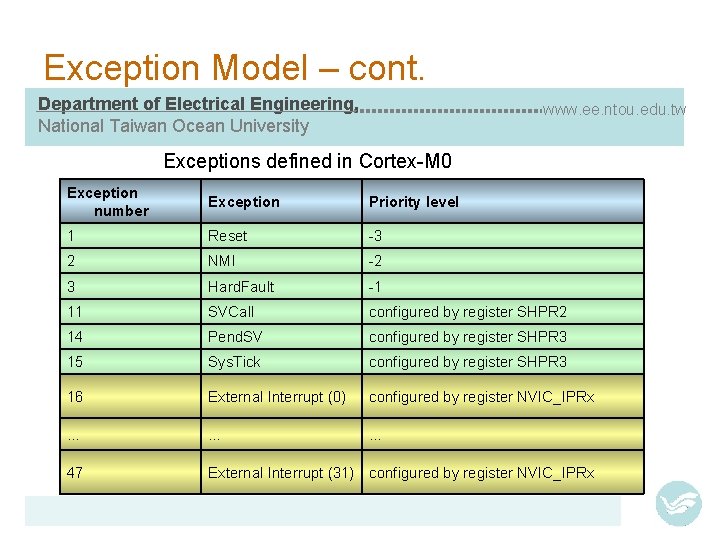
Exception Model – cont. Department of Electrical Engineering, National Taiwan Ocean University www. ee. ntou. edu. tw Exceptions defined in Cortex-M 0 Exception number Exception Priority level 1 Reset -3 2 NMI -2 3 Hard. Fault -1 11 SVCall configured by register SHPR 2 14 Pend. SV configured by register SHPR 3 15 Sys. Tick configured by register SHPR 3 16 External Interrupt (0) configured by register NVIC_IPRx … … … 47 External Interrupt (31) configured by register NVIC_IPRx
Exception Model – cont. Department of Electrical Engineering, National Taiwan Ocean University ► Exception www. ee. ntou. edu. tw priorities and pre-emption – Lower numbers take higher precedence – If multiple exceptions have the same priority number, the pending exception with the lowest exception number takes precedence. – Only exceptions with a higher priority (lower priority number) can pre-empt an active exception.
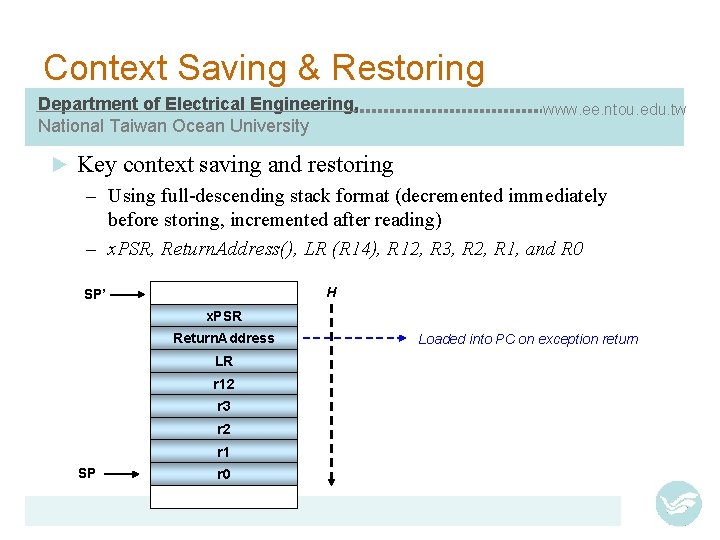
Context Saving & Restoring Department of Electrical Engineering, National Taiwan Ocean University ► www. ee. ntou. edu. tw Key context saving and restoring – Using full-descending stack format (decremented immediately before storing, incremented after reading) – x. PSR, Return. Address(), LR (R 14), R 12, R 3, R 2, R 1, and R 0 H SP’ x. PSR Return. Address LR r 12 r 3 r 2 r 1 SP r 0 Loaded into PC on exception return
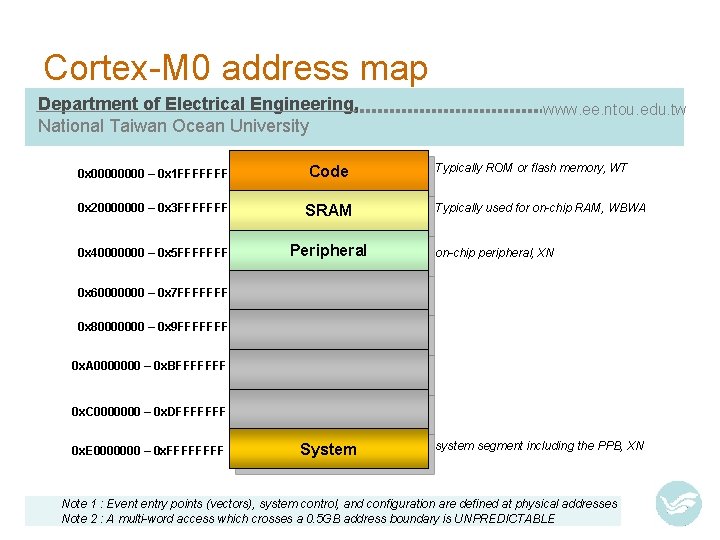
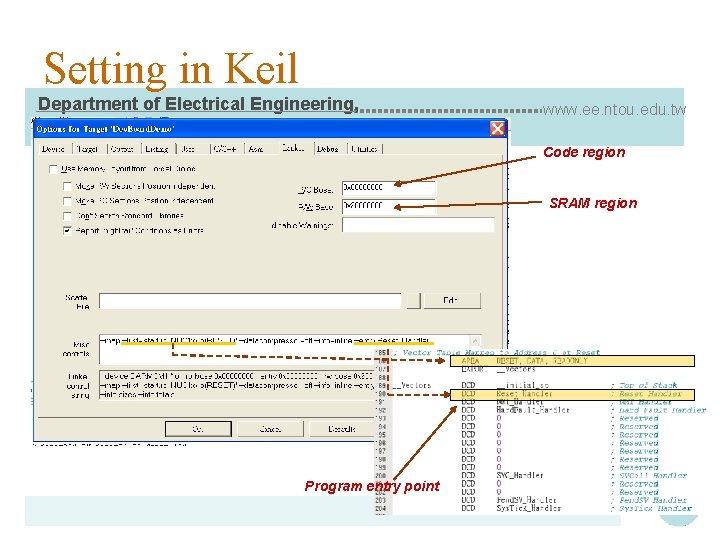
Cortex-M 0 address map Department of Electrical Engineering, National Taiwan Ocean University www. ee. ntou. edu. tw 0 x 0000 – 0 x 1 FFFFFFF Code Typically ROM or flash memory, WT 0 x 20000000 – 0 x 3 FFFFFFF SRAM Typically used for on-chip RAM, WBWA 0 x 40000000 – 0 x 5 FFFFFFF Peripheral on-chip peripheral, XN 0 x 60000000 – 0 x 7 FFFFFFF 0 x 80000000 – 0 x 9 FFFFFFF 0 x. A 0000000 – 0 x. BFFFFFFF 0 x. C 0000000 – 0 x. DFFFFFFF 0 x. E 0000000 – 0 x. FFFF System segment including the PPB, XN Note 1 : Event entry points (vectors), system control, and configuration are defined at physical addresses Note 2 : A multi-word access which crosses a 0. 5 GB address boundary is UNPREDICTABLE
Setting in Keil Department of Electrical Engineering, National Taiwan Ocean University www. ee. ntou. edu. tw Code region SRAM region Program entry point
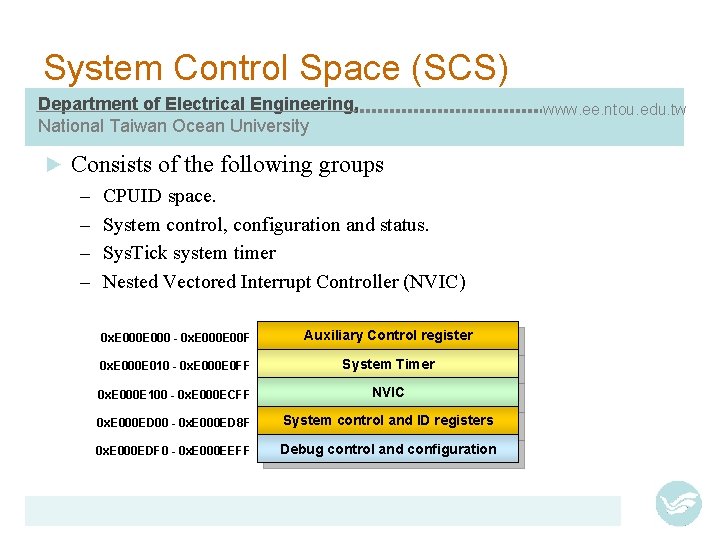
System Control Space (SCS) Department of Electrical Engineering, National Taiwan Ocean University ► www. ee. ntou. edu. tw Consists of the following groups – – CPUID space. System control, configuration and status. Sys. Tick system timer Nested Vectored Interrupt Controller (NVIC) 0 x. E 000 - 0 x. E 000 E 00 F Auxiliary Control register 0 x. E 000 E 010 - 0 x. E 000 E 0 FF System Timer 0 x. E 000 E 100 - 0 x. E 000 ECFF NVIC 0 x. E 000 ED 00 - 0 x. E 000 ED 8 F System control and ID registers 0 x. E 000 EDF 0 - 0 x. E 000 EEFF Debug control and configuration
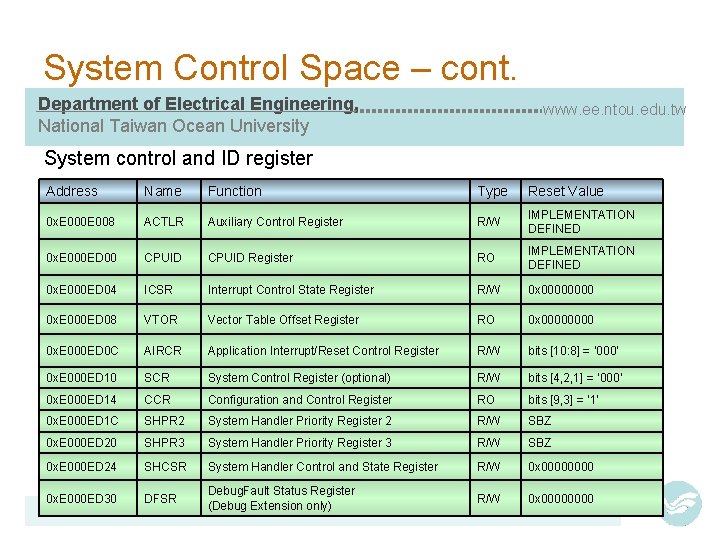
System Control Space – cont. Department of Electrical Engineering, National Taiwan Ocean University www. ee. ntou. edu. tw System control and ID register Address Name Function Type Reset Value 0 x. E 000 E 008 ACTLR Auxiliary Control Register R/W IMPLEMENTATION DEFINED 0 x. E 000 ED 00 CPUID Register RO IMPLEMENTATION DEFINED 0 x. E 000 ED 04 ICSR Interrupt Control State Register R/W 0 x 0000 0 x. E 000 ED 08 VTOR Vector Table Offset Register RO 0 x 0000 0 x. E 000 ED 0 C AIRCR Application Interrupt/Reset Control Register R/W bits [10: 8] = ’ 000’ 0 x. E 000 ED 10 SCR System Control Register (optional) R/W bits [4, 2, 1] = ’ 000’ 0 x. E 000 ED 14 CCR Configuration and Control Register RO bits [9, 3] = ’ 1’ 0 x. E 000 ED 1 C SHPR 2 System Handler Priority Register 2 R/W SBZ 0 x. E 000 ED 20 SHPR 3 System Handler Priority Register 3 R/W SBZ 0 x. E 000 ED 24 SHCSR System Handler Control and State Register R/W 0 x 0000 0 x. E 000 ED 30 DFSR Debug. Fault Status Register (Debug Extension only) R/W 0 x 0000
System Control Space – cont. Department of Electrical Engineering, National Taiwan Ocean University ► Some registers are implementation defined and read-only – Ex : CPUID, VTOR ► Interrupt Control State Register (ICSR) – Generate system interrupt request in software manner. – NMI, Pend. SV and Sys. Tick ► www. ee. ntou. edu. tw System Handler Priority Registers – Set up priority number of system interrupts • SHPR 2 : SVCall • SHPR 3 : Sys. Tick and Pend. SV
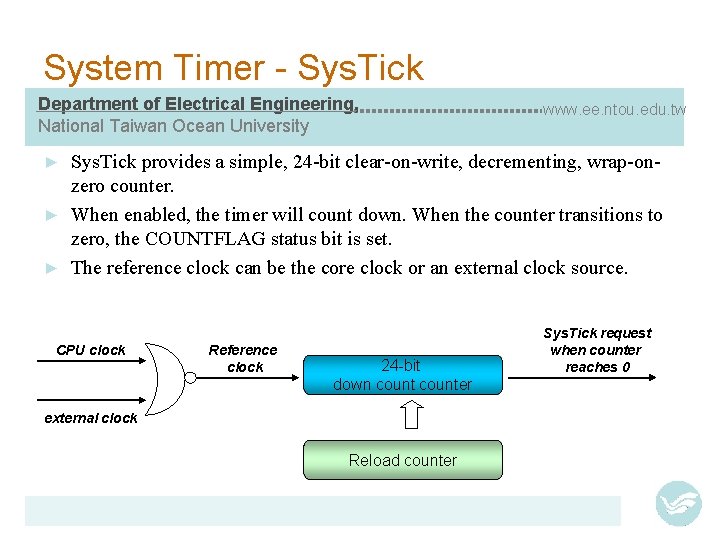
System Timer - Sys. Tick Department of Electrical Engineering, National Taiwan Ocean University www. ee. ntou. edu. tw Sys. Tick provides a simple, 24 -bit clear-on-write, decrementing, wrap-onzero counter. ► When enabled, the timer will count down. When the counter transitions to zero, the COUNTFLAG status bit is set. ► The reference clock can be the core clock or an external clock source. ► CPU clock Reference clock 24 -bit down counter external clock Reload counter Sys. Tick request when counter reaches 0
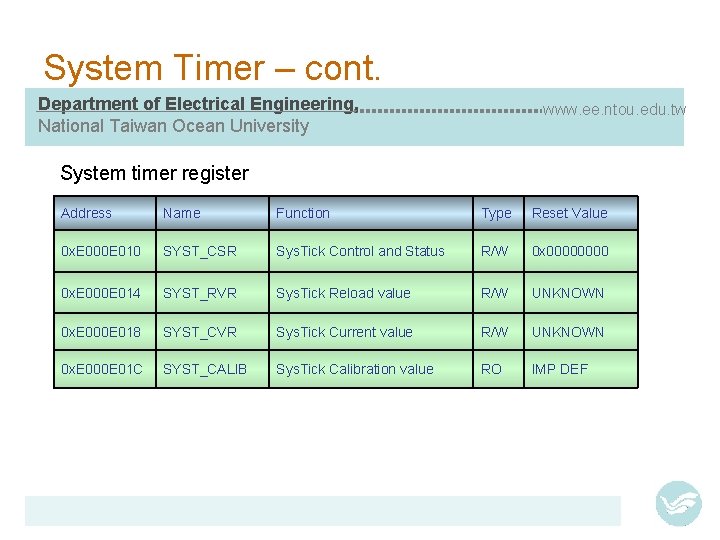
System Timer – cont. Department of Electrical Engineering, National Taiwan Ocean University www. ee. ntou. edu. tw System timer register Address Name Function Type Reset Value 0 x. E 000 E 010 SYST_CSR Sys. Tick Control and Status R/W 0 x 0000 0 x. E 000 E 014 SYST_RVR Sys. Tick Reload value R/W UNKNOWN 0 x. E 000 E 018 SYST_CVR Sys. Tick Current value R/W UNKNOWN 0 x. E 000 E 01 C SYST_CALIB Sys. Tick Calibration value RO IMP DEF
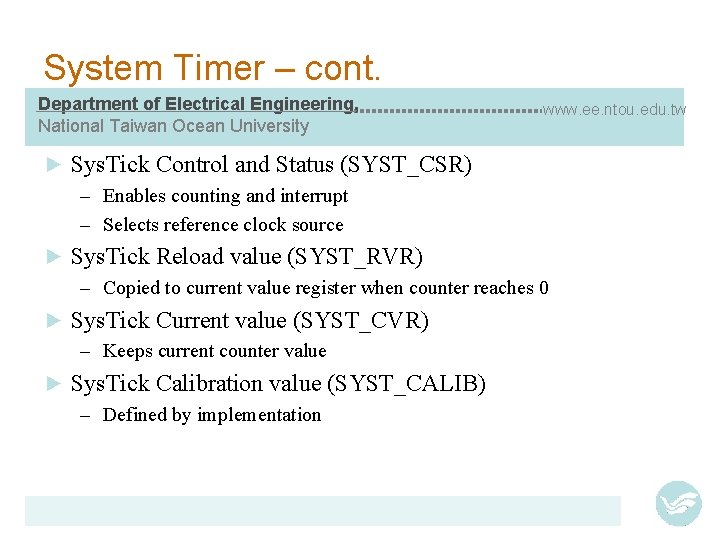
System Timer – cont. Department of Electrical Engineering, National Taiwan Ocean University ► www. ee. ntou. edu. tw Sys. Tick Control and Status (SYST_CSR) – Enables counting and interrupt – Selects reference clock source ► Sys. Tick Reload value (SYST_RVR) – Copied to current value register when counter reaches 0 ► Sys. Tick Current value (SYST_CVR) – Keeps current counter value ► Sys. Tick Calibration value (SYST_CALIB) – Defined by implementation
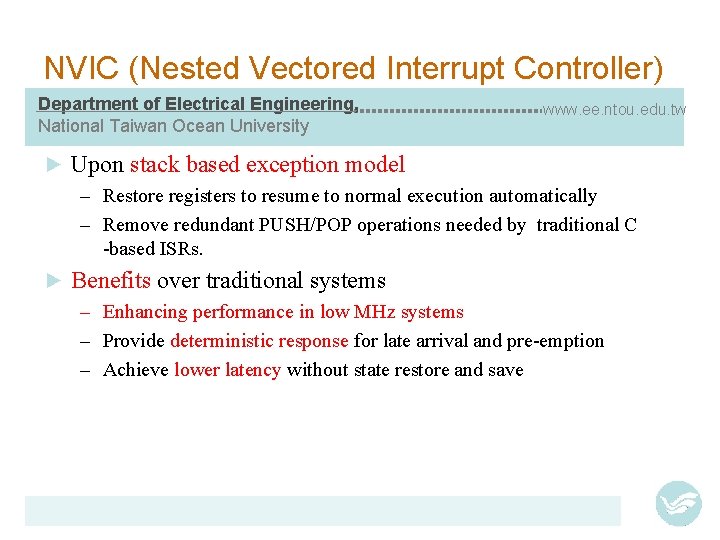
NVIC (Nested Vectored Interrupt Controller) Department of Electrical Engineering, National Taiwan Ocean University ► www. ee. ntou. edu. tw Upon stack based exception model – Restore registers to resume to normal execution automatically – Remove redundant PUSH/POP operations needed by traditional C -based ISRs. ► Benefits over traditional systems – Enhancing performance in low MHz systems – Provide deterministic response for late arrival and pre-emption – Achieve lower latency without state restore and save
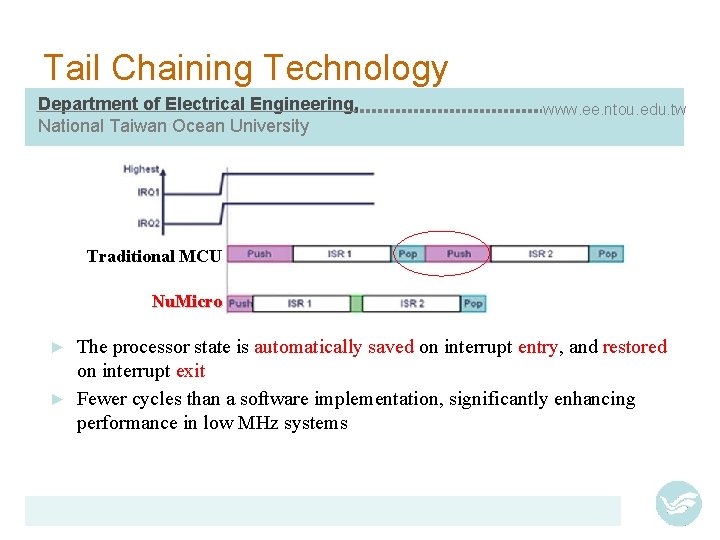
Tail Chaining Technology Department of Electrical Engineering, National Taiwan Ocean University www. ee. ntou. edu. tw Traditional MCU Nu. Micro The processor state is automatically saved on interrupt entry, and restored on interrupt exit ► Fewer cycles than a software implementation, significantly enhancing performance in low MHz systems ►
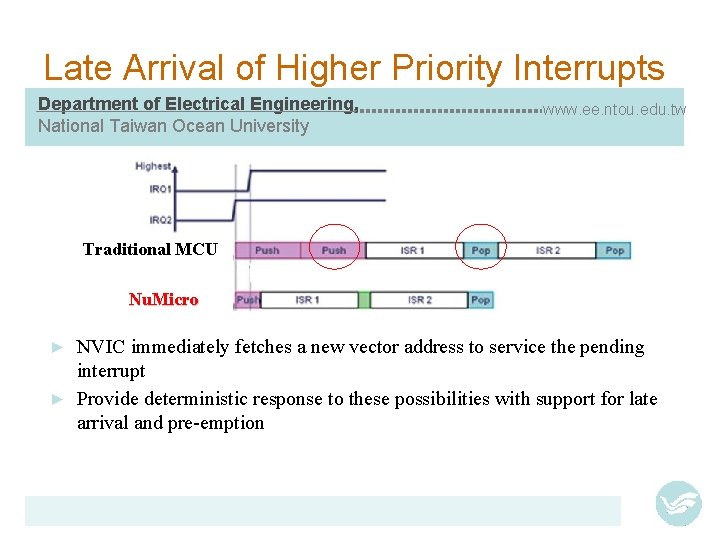
Late Arrival of Higher Priority Interrupts Department of Electrical Engineering, National Taiwan Ocean University www. ee. ntou. edu. tw Traditional MCU Nu. Micro NVIC immediately fetches a new vector address to service the pending interrupt ► Provide deterministic response to these possibilities with support for late arrival and pre-emption ►
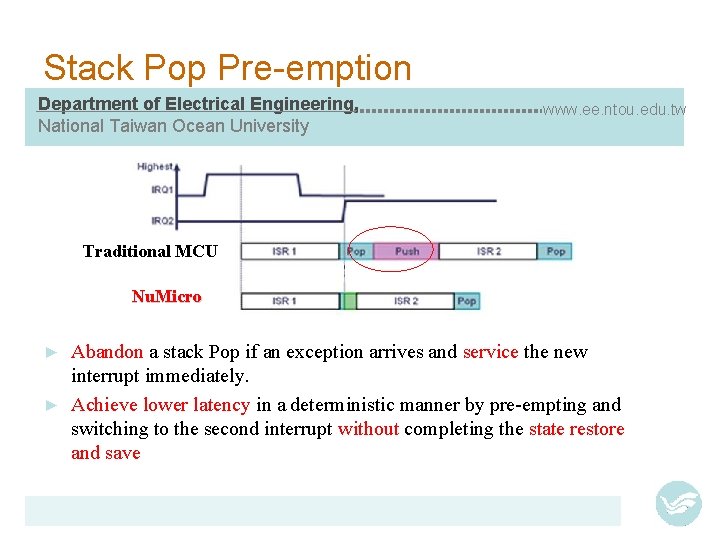
Stack Pop Pre-emption Department of Electrical Engineering, National Taiwan Ocean University www. ee. ntou. edu. tw Traditional MCU Nu. Micro Abandon a stack Pop if an exception arrives and service the new interrupt immediately. ► Achieve lower latency in a deterministic manner by pre-empting and switching to the second interrupt without completing the state restore and save ►
Nested Vectored Interrupt Controller (NVIC) Department of Electrical Engineering, National Taiwan Ocean University www. ee. ntou. edu. tw Supports up to 32 (IRQ[31: 0]) discrete interrupts which can be either level-sensitive or pulse-sensitive. ► NVIC interrupts can be enabled/disabled, pended/un-pended and prioritized by setting NVIC control registers ► interrupt 0 : Interrupt 31 NVIC Interrupt number Cortex-M 0 Exception number Exception 1 Exception 2 Exception 47 System interrupts Vector Table
NVIC registers Department of Electrical Engineering, National Taiwan Ocean University www. ee. ntou. edu. tw Address Name Function Type Reset Value 0 x. E 000 E 100 NVIC_ISER Irq 0 to 31 Set-Enable Register R/W 0 x 0000 0 x. E 000 E 180 NVIC_ICER Irq 0 to 31 Clear-Enable Register R/W 0 x 0000 0 x. E 000 E 200 NVIC_ISPR Irq 0 to 31 Set-Pending Register R/W 0 x 0000 0 x. E 000 E 280 NVIC_ICPR Irq 0 to 31 Clear-Pending Register R/W 0 x 0000 0 x. E 000 E 400 NVIC_IPR 0 Irq 0 to 3 Priority Register R/W 0 x 0000 0 x. E 000 E 404 NVIC_IPR 1 Irq 4 to 7 Priority Register R/W 0 x 0000 0 x. E 000 E 408 NVIC_IPR 2 Irq 8 to 11 Priority Register R/W 0 x 0000 0 x. E 000 E 40 C NVIC_IPR 3 Irq 12 to 15 Priority Register R/W 0 x 0000 0 x. E 000 E 410 NVIC_IPR 4 Irq 16 to 19 Priority Register R/W 0 x 0000 0 x. E 000 E 414 NVIC_IPR 5 Irq 20 to 23 Priority Register R/W 0 x 0000 0 x. E 000 E 418 NVIC_IPR 6 Irq 24 to 27 Priority Register R/W 0 x 0000 0 x. E 000 E 41 C NVIC_IPR 7 Irq 28 to 31 Priority Register R/W 0 x 0000
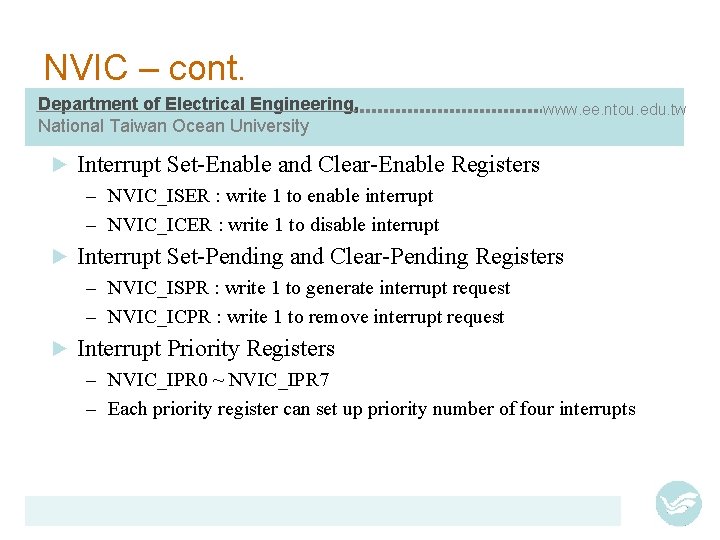
NVIC – cont. Department of Electrical Engineering, National Taiwan Ocean University ► www. ee. ntou. edu. tw Interrupt Set-Enable and Clear-Enable Registers – NVIC_ISER : write 1 to enable interrupt – NVIC_ICER : write 1 to disable interrupt ► Interrupt Set-Pending and Clear-Pending Registers – NVIC_ISPR : write 1 to generate interrupt request – NVIC_ICPR : write 1 to remove interrupt request ► Interrupt Priority Registers – NVIC_IPR 0 ~ NVIC_IPR 7 – Each priority register can set up priority number of four interrupts
Cortex-M 0 Summary Department of Electrical Engineering, National Taiwan Ocean University www. ee. ntou. edu. tw Cortex-M 0 is always in privileged mode and supports Thumb instruction only. ► Supports key context saving and restoring ► – x. PSR, return address, r 14, r 12, r 3, r 2, r 1, r 0 ► System address map is defined in advance. – Code, SRAM, Peripheral, System ► Contains Sys. Tick and NVIC
General Disclaimer Department of Electrical Engineering, National Taiwan Ocean University www. ee. ntou. edu. tw The Lecture is strictly used for educational purpose. MAKES NO GUARANTEE OF VALIDITY ► The lecture cannot guarantee the validity of the information found here. The lecture may recently have been changed, vandalized or altered by someone whose opinion does not correspond with the state of knowledge in the relevant fields. Note that most other encyclopedias and reference works also have similar disclaimers. No formal peer review ► The lecture is not uniformly peer reviewed; while readers may correct errors or engage in casual peer review, they have no legal duty to do so and thus all information read here is without any implied warranty of fitness for any purpose or use whatsoever. Even articles that have been vetted by informal peer review or featured article processes may later have been edited inappropriately, just before you view them. No contract; limited license ► ► Please make sure that you understand that the information provided here is being provided freely, and that no kind of agreement or contract is created between you and the owners or users of this site, the owners of the servers upon which it is housed, the individual Wikipedia contributors, any project administrators, sysops or anyone else who is in any way connected with this project or sister projects subject to your claims against them directly. You are being granted a limited license to copy anything from this site; it does not create or imply any contractual or extracontractual liability on the part of Wikipedia or any of its agents, members, organizers or other users. There is no agreement or understanding between you and the content provider regarding your use or modification of this information beyond the Creative Commons Attribution-Sharealike 3. 0 Unported License (CCBY-SA) and the GNU Free Documentation License (GFDL);
General Disclaimer Department of Electrical Engineering, National Taiwan Ocean University www. ee. ntou. edu. tw Trademarks ► Any of the trademarks, service marks, collective marks, design rights or similar rights that are mentioned, used or cited in the lectures are the property of their respective owners. Their use here does not imply that you may use them for any purpose other than for the same or a similar informational use as contemplated by the original authors under the CC-BY-SA and GFDL licensing schemes. Unless otherwise stated , we are neither endorsed by nor affiliated with any of the holders of any such rights and as such we cannot grant any rights to use any otherwise protected materials. Your use of any such or similar incorporeal property is at your own risk. Personality rights ► The lecture may portray an identifiable person who is alive or deceased recently. The use of images of living or recently deceased individuals is, in some jurisdictions, restricted by laws pertaining to personality rights, independent from their copyright status. Before using these types of content, please ensure that you have the right to use it under the laws which apply in the circumstances of your intended use. You are solely responsible for ensuring that you do not infringe someone else's personality rights.