
ARM Assembly Programming Computer Organization and Assembly Languages
ARM Assembly Programming Computer Organization and Assembly Languages Yung-Yu Chuang 2007/11/19 with slides by Peng-Sheng Chen
Introduction • The ARM processor is very easy to program at the assembly level. (It is a RISC) • We will learn ARM assembly programming at the user level and run it on a GBA emulator.
ARM programmer model • The state of an ARM system is determined by the content of visible registers and memory. • A user-mode program can see 15 32 -bit generalpurpose registers (R 0 -R 14), program counter (PC) and CPSR. • Instruction set defines the operations that can change the state.
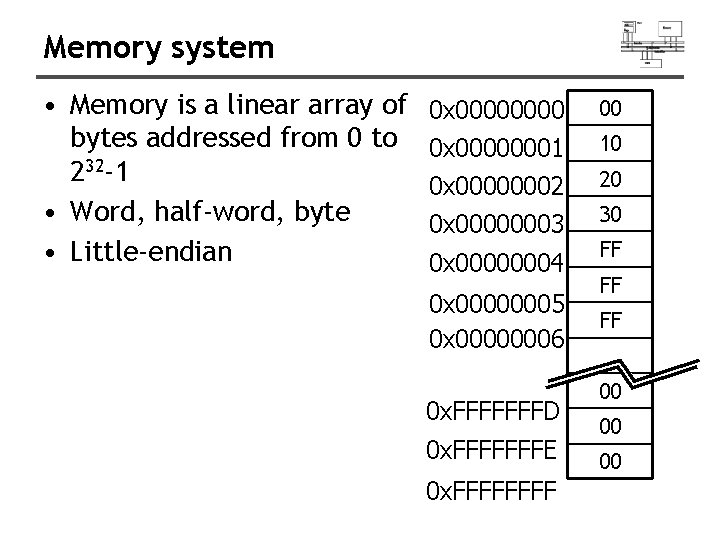
Memory system • Memory is a linear array of bytes addressed from 0 to 232 -1 • Word, half-word, byte • Little-endian 0 x 0000 00 0 x 00000001 10 0 x 00000002 20 0 x 00000003 30 0 x 00000004 0 x 00000005 0 x 00000006 0 x. FFFFFFFD 0 x. FFFFFFFE 0 x. FFFF FF 00 00 00
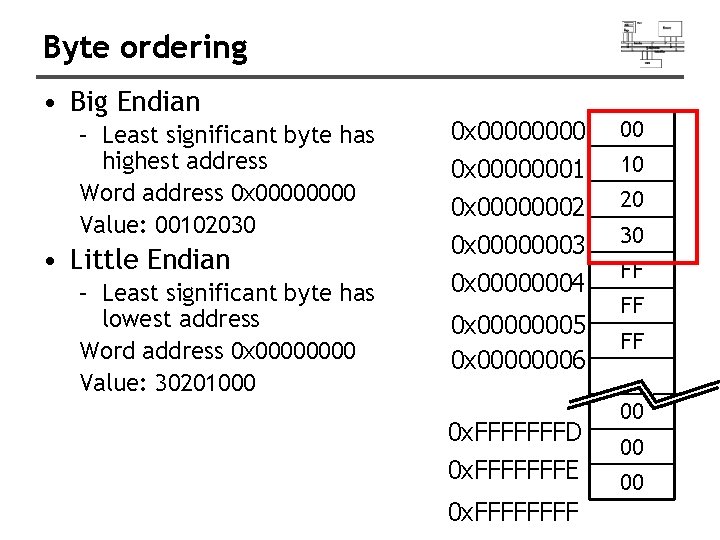
Byte ordering • Big Endian – Least significant byte has highest address Word address 0 x 0000 Value: 00102030 • Little Endian – Least significant byte has lowest address Word address 0 x 0000 Value: 30201000 0 x 00000001 10 0 x 00000002 20 0 x 00000003 30 0 x 00000004 0 x 00000005 0 x 00000006 0 x. FFFFFFFD 0 x. FFFFFFFE 0 x. FFFF FF 00 00 00
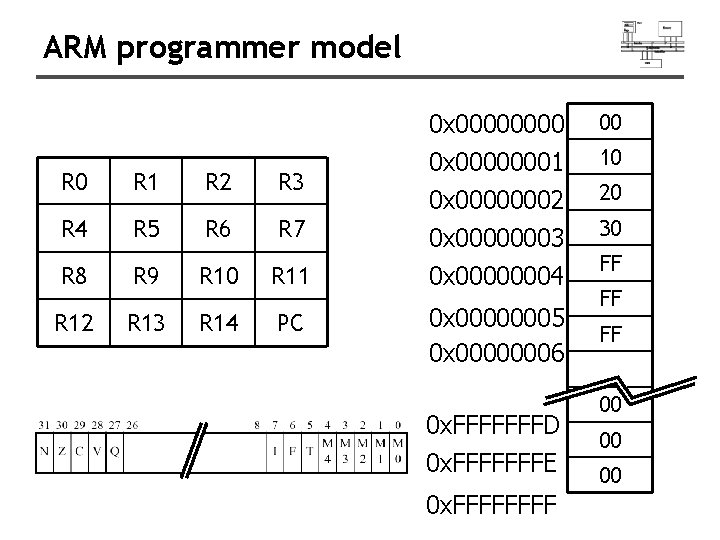
ARM programmer model R 0 R 1 R 2 R 3 R 4 R 5 R 6 R 7 0 x 0000 00 0 x 00000001 10 0 x 00000002 20 0 x 00000003 30 R 8 R 9 R 10 R 11 0 x 00000004 R 12 R 13 R 14 PC 0 x 00000005 0 x 00000006 0 x. FFFFFFFD 0 x. FFFFFFFE 0 x. FFFF FF 00 00 00
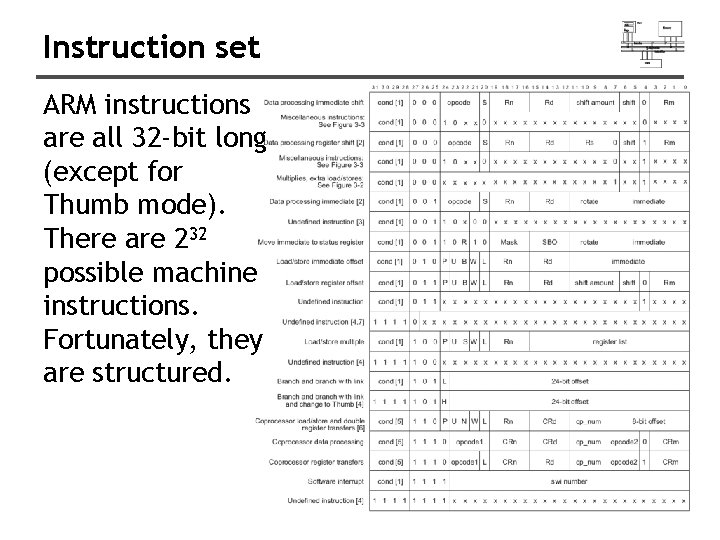
Instruction set ARM instructions are all 32 -bit long (except for Thumb mode). There are 232 possible machine instructions. Fortunately, they are structured.
Features of ARM instruction set • • • Load-store architecture 3 -address instructions Conditional execution of every instruction Possible to load/store multiple register at once Possible to combine shift and ALU operations in a single instruction
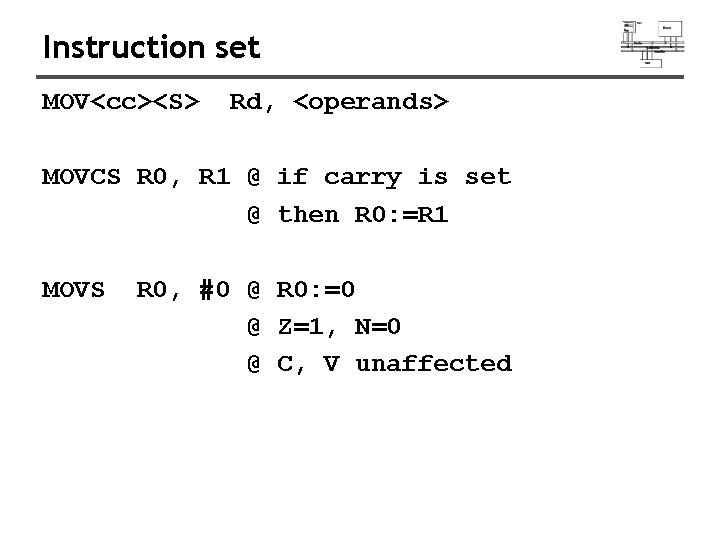
Instruction set MOV<cc><S> Rd, <operands> MOVCS R 0, R 1 @ if carry is set @ then R 0: =R 1 MOVS R 0, #0 @ R 0: =0 @ Z=1, N=0 @ C, V unaffected
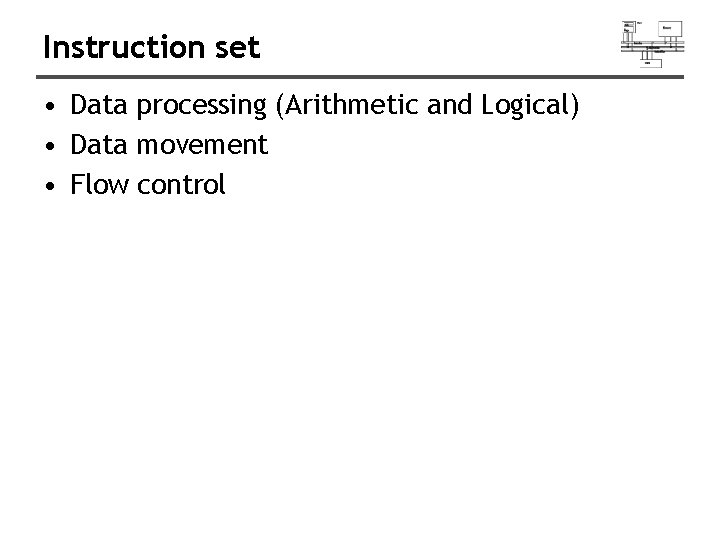
Instruction set • Data processing (Arithmetic and Logical) • Data movement • Flow control
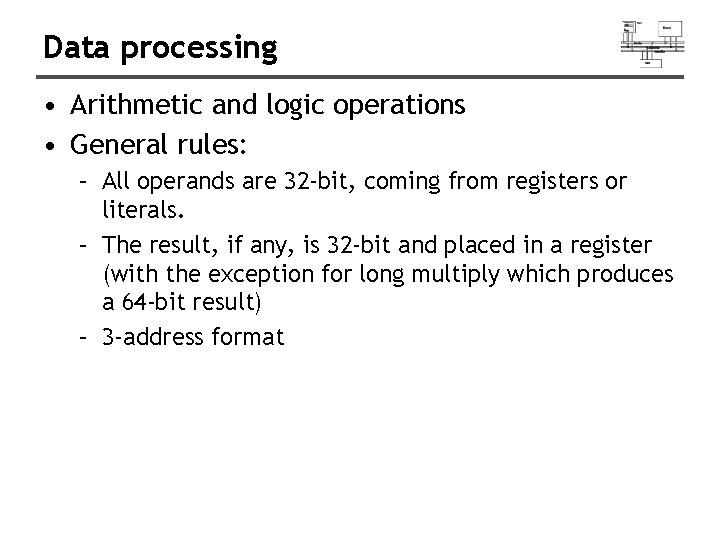
Data processing • Arithmetic and logic operations • General rules: – All operands are 32 -bit, coming from registers or literals. – The result, if any, is 32 -bit and placed in a register (with the exception for long multiply which produces a 64 -bit result) – 3 -address format
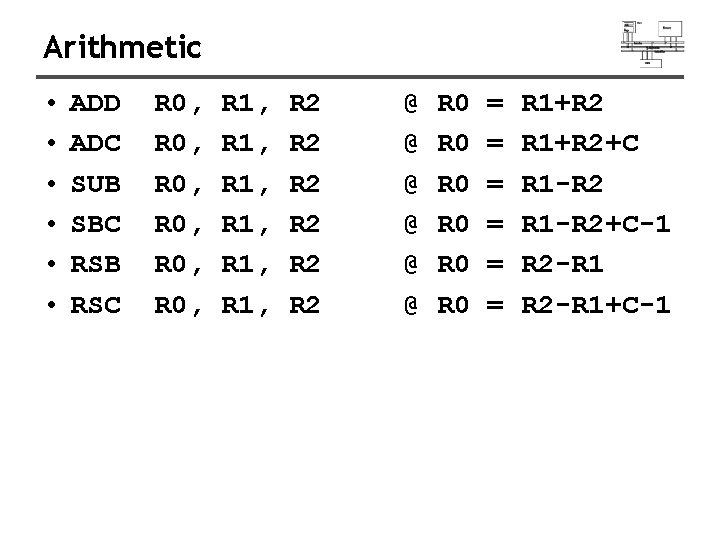
Arithmetic • • • ADD ADC SUB SBC RSB RSC R 0, R 0, R 1, R 1, R 2 R 2 R 2 @ @ @ R 0 R 0 R 0 = = = R 1+R 2+C R 1 -R 2+C-1 R 2 -R 1+C-1
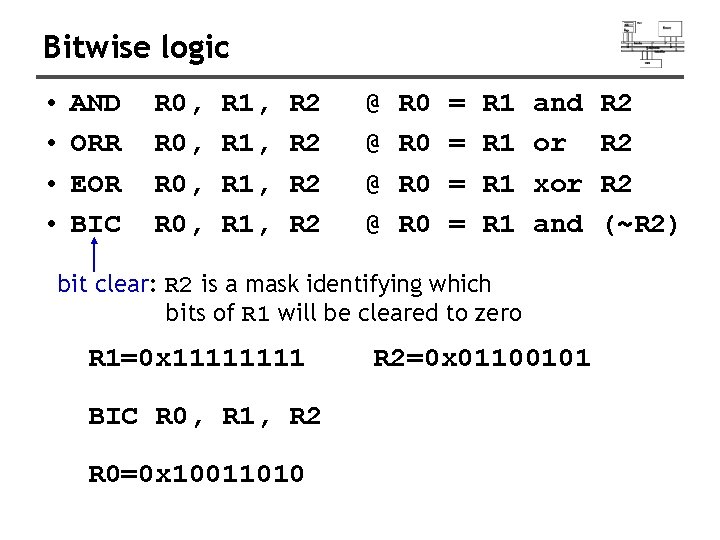
Bitwise logic • • AND ORR EOR BIC R 0, R 1, R 2 R 2 @ @ R 0 R 0 = = R 1 R 1 and or xor and bit clear: R 2 is a mask identifying which bits of R 1 will be cleared to zero R 1=0 x 1111 BIC R 0, R 1, R 2 R 0=0 x 10011010 R 2=0 x 01100101 R 2 R 2 (~R 2)
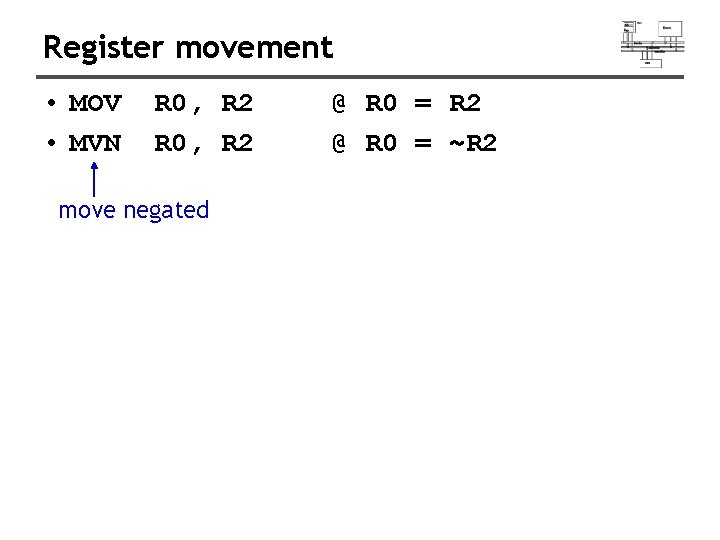
Register movement • MOV • MVN R 0, R 2 move negated @ R 0 = R 2 @ R 0 = ~R 2
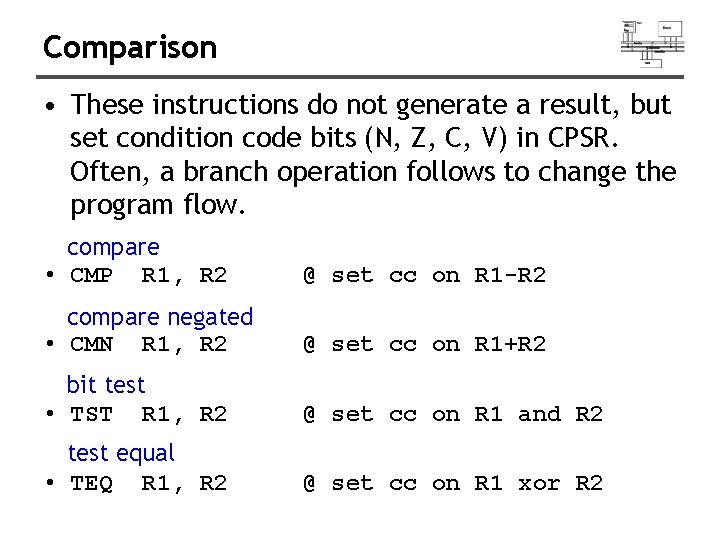
Comparison • These instructions do not generate a result, but set condition code bits (N, Z, C, V) in CPSR. Often, a branch operation follows to change the program flow. compare • CMP R 1, R 2 @ set cc on R 1 -R 2 compare negated • CMN R 1, R 2 @ set cc on R 1+R 2 bit test • TST R 1, R 2 @ set cc on R 1 and R 2 test equal • TEQ R 1, R 2 @ set cc on R 1 xor R 2
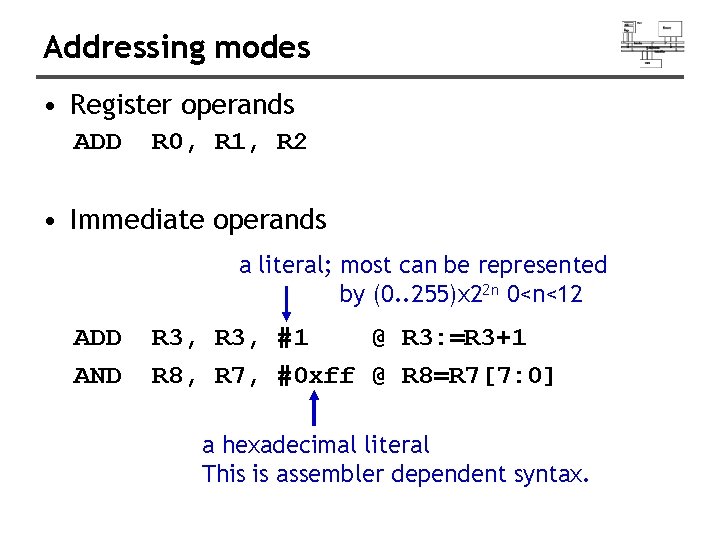
Addressing modes • Register operands ADD R 0, R 1, R 2 • Immediate operands a literal; most can be represented by (0. . 255)x 22 n 0<n<12 ADD AND R 3, #1 @ R 3: =R 3+1 R 8, R 7, #0 xff @ R 8=R 7[7: 0] a hexadecimal literal This is assembler dependent syntax.
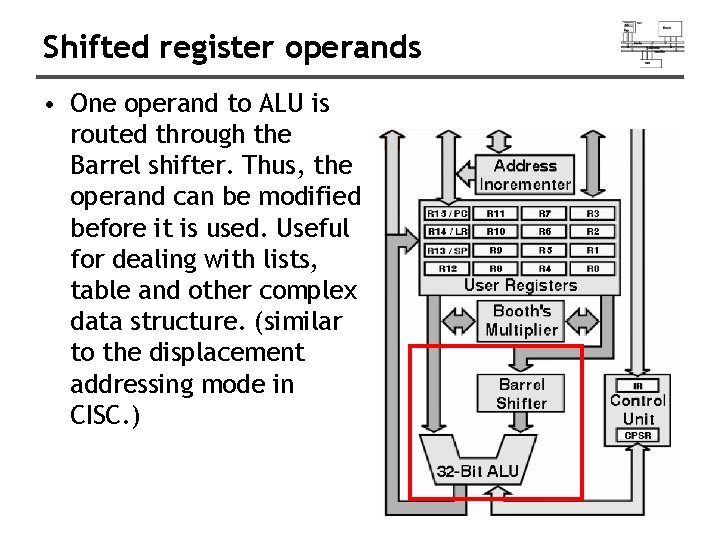
Shifted register operands • One operand to ALU is routed through the Barrel shifter. Thus, the operand can be modified before it is used. Useful for dealing with lists, table and other complex data structure. (similar to the displacement addressing mode in CISC. )
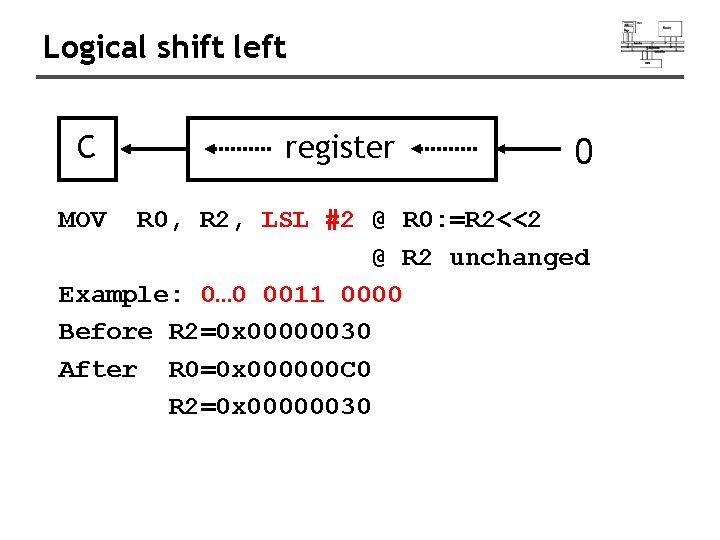
Logical shift left C MOV register 0 R 0, R 2, LSL #2 @ R 0: =R 2<<2 @ R 2 unchanged Example: 0… 0 0011 0000 Before R 2=0 x 00000030 After R 0=0 x 000000 C 0 R 2=0 x 00000030
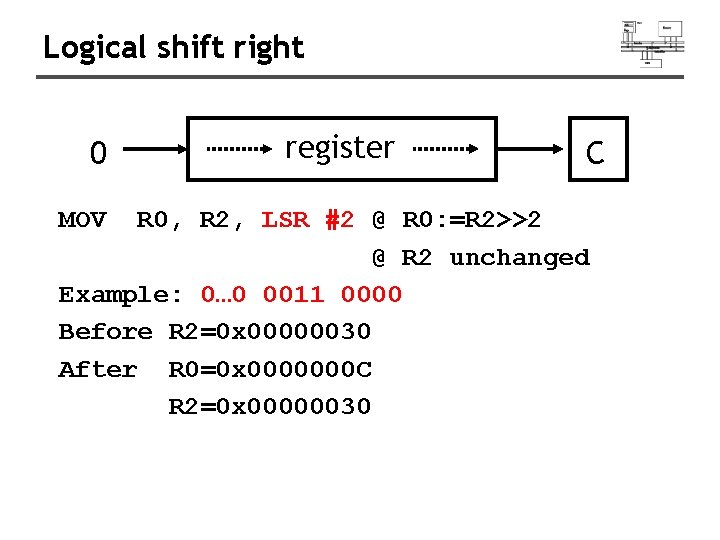
Logical shift right 0 MOV register C R 0, R 2, LSR #2 @ R 0: =R 2>>2 @ R 2 unchanged Example: 0… 0 0011 0000 Before R 2=0 x 00000030 After R 0=0 x 0000000 C R 2=0 x 00000030
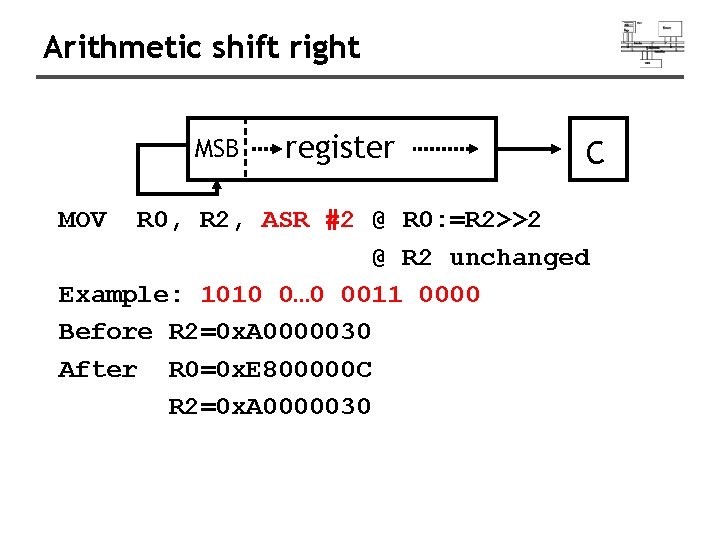
Arithmetic shift right MSB MOV register C R 0, R 2, ASR #2 @ R 0: =R 2>>2 @ R 2 unchanged Example: 1010 0… 0 0011 0000 Before R 2=0 x. A 0000030 After R 0=0 x. E 800000 C R 2=0 x. A 0000030
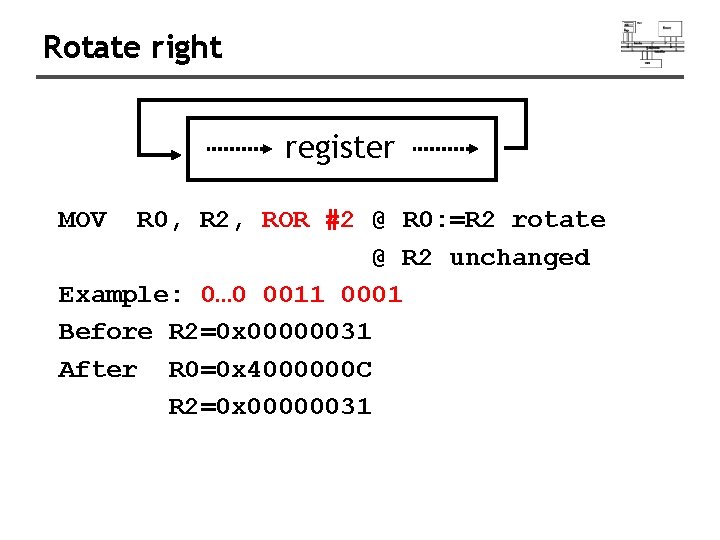
Rotate right register MOV R 0, R 2, ROR #2 @ R 0: =R 2 rotate @ R 2 unchanged Example: 0… 0 0011 0001 Before R 2=0 x 00000031 After R 0=0 x 4000000 C R 2=0 x 00000031
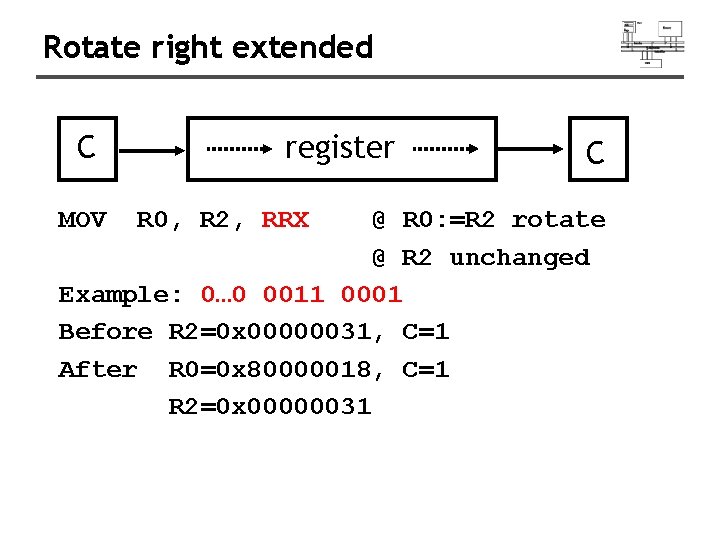
Rotate right extended C MOV register R 0, R 2, RRX C @ R 0: =R 2 rotate @ R 2 unchanged Example: 0… 0 0011 0001 Before R 2=0 x 00000031, C=1 After R 0=0 x 80000018, C=1 R 2=0 x 00000031
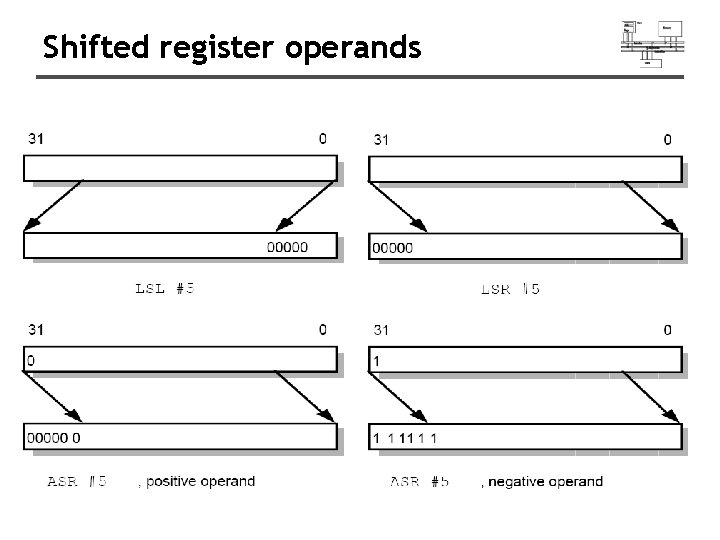
Shifted register operands
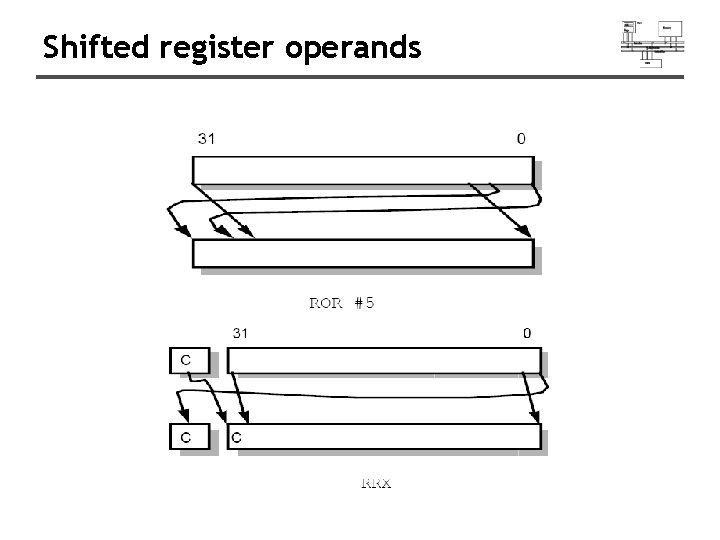
Shifted register operands
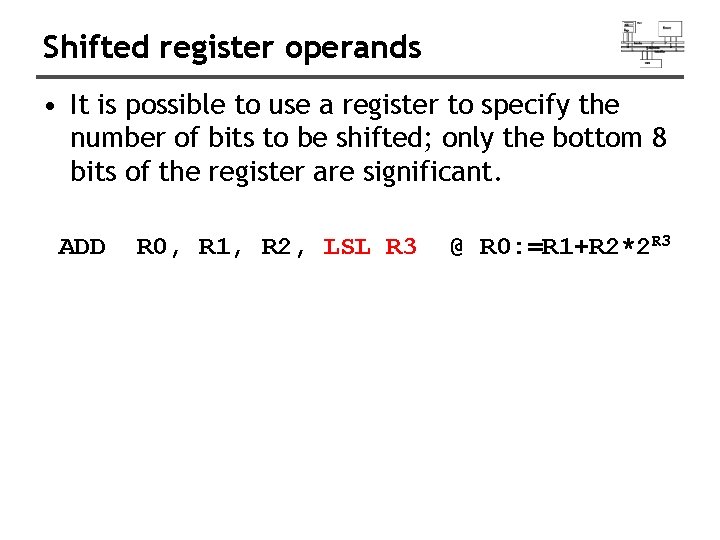
Shifted register operands • It is possible to use a register to specify the number of bits to be shifted; only the bottom 8 bits of the register are significant. ADD R 0, R 1, R 2, LSL R 3 @ R 0: =R 1+R 2*2 R 3
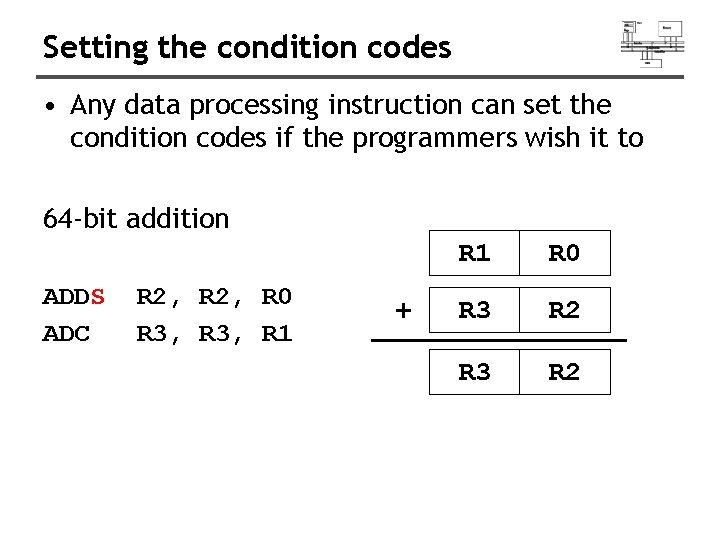
Setting the condition codes • Any data processing instruction can set the condition codes if the programmers wish it to 64 -bit addition ADDS ADC R 2, R 0 R 3, R 1 + R 1 R 0 R 3 R 2
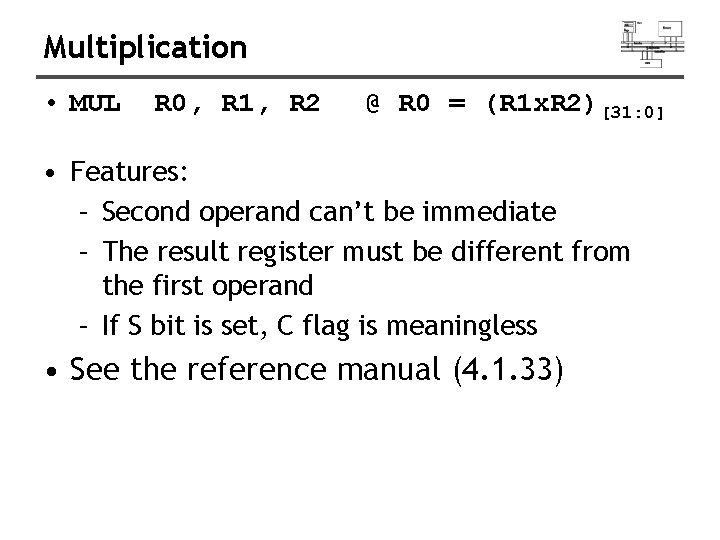
Multiplication • MUL R 0, R 1, R 2 @ R 0 = (R 1 x. R 2)[31: 0] • Features: – Second operand can’t be immediate – The result register must be different from the first operand – If S bit is set, C flag is meaningless • See the reference manual (4. 1. 33)
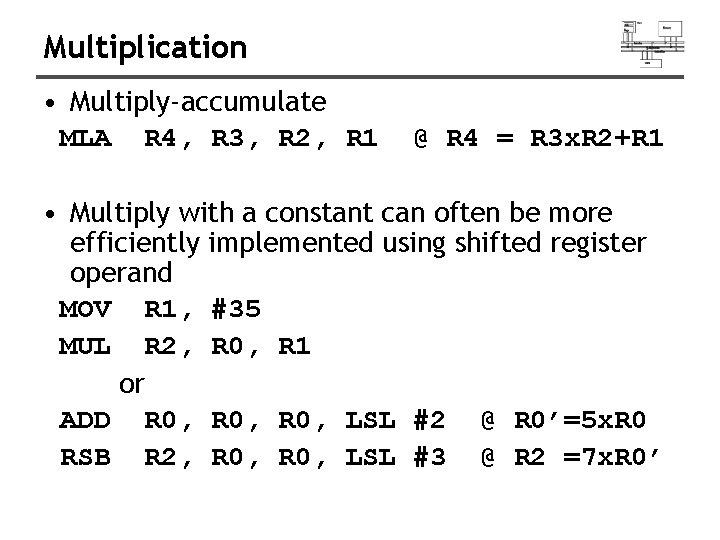
Multiplication • Multiply-accumulate MLA R 4, R 3, R 2, R 1 @ R 4 = R 3 x. R 2+R 1 • Multiply with a constant can often be more efficiently implemented using shifted register operand MOV R 1, #35 MUL R 2, R 0, R 1 or ADD R 0, LSL #2 @ R 0’=5 x. R 0 RSB R 2, R 0, LSL #3 @ R 2 =7 x. R 0’
Data transfer instructions • Move data between registers and memory • Three basic forms – Single register load/store – Multiple register load/store – Single register swap: SWP(B), atomic instruction for semaphore
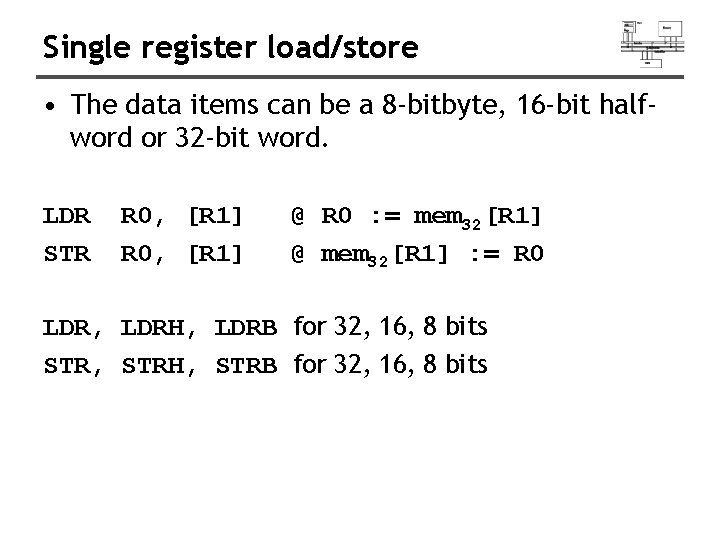
Single register load/store • The data items can be a 8 -bitbyte, 16 -bit halfword or 32 -bit word. LDR STR R 0, [R 1] @ R 0 : = mem 32[R 1] @ mem 32[R 1] : = R 0 LDR, LDRH, LDRB for 32, 16, 8 bits STR, STRH, STRB for 32, 16, 8 bits
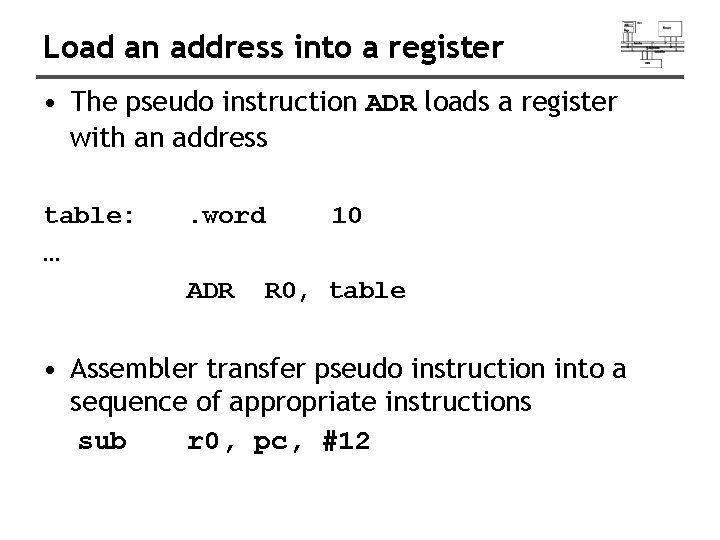
Load an address into a register • The pseudo instruction ADR loads a register with an address table: … . word ADR 10 R 0, table • Assembler transfer pseudo instruction into a sequence of appropriate instructions sub r 0, pc, #12
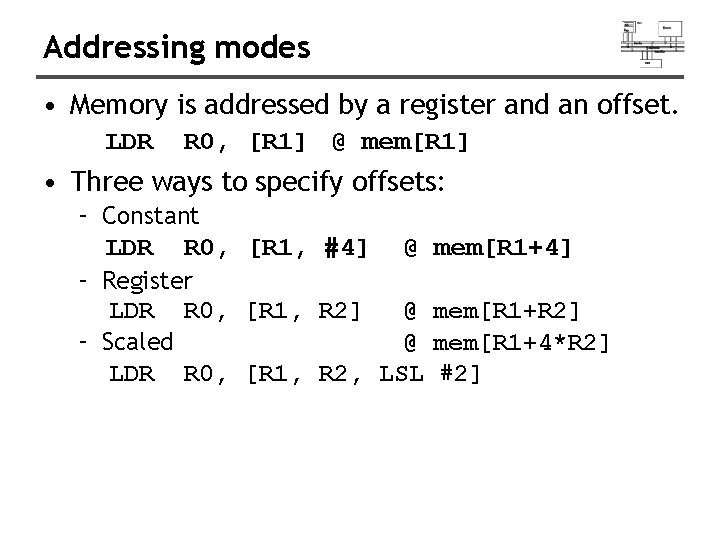
Addressing modes • Memory is addressed by a register and an offset. LDR R 0, [R 1] @ mem[R 1] • Three ways to specify offsets: – Constant LDR R 0, [R 1, #4] @ – Register LDR R 0, [R 1, R 2] @ – Scaled @ LDR R 0, [R 1, R 2, LSL mem[R 1+4] mem[R 1+R 2] mem[R 1+4*R 2] #2]
![Addressing modes • Pre-indexed addressing (LDR R 0, [R 1, #4]) without a writeback](http://slidetodoc.com/presentation_image/5f0b3e28e59348ef073f2ea386b699be/image-33.jpg "Addressing modes • Pre-indexed addressing (LDR R 0, [R 1, #4]) without a writeback")
Addressing modes • Pre-indexed addressing (LDR R 0, [R 1, #4]) without a writeback • Auto-indexing addressing (LDR R 0, [R 1, #4]!) calculation before accessing with a writeback • Post-indexed addressing (LDR R 0, [R 1], #4) calculation after accessing with a writeback
![Pre-indexed addressing LDR R 0, [R 1, #4] LDR R 0, [R 1, R](http://slidetodoc.com/presentation_image/5f0b3e28e59348ef073f2ea386b699be/image-34.jpg "Pre-indexed addressing LDR R 0, [R 1, #4] LDR R 0, [R 1, R")
Pre-indexed addressing LDR R 0, [R 1, #4] LDR R 0, [R 1, R 1 @ R 0=mem[R 1+4] @ R 1 unchanged ] + R 0
![Auto-indexing addressing LDR R 0, [R 1, #4]! @ R 0=mem[R 1+4] @ R](http://slidetodoc.com/presentation_image/5f0b3e28e59348ef073f2ea386b699be/image-35.jpg "Auto-indexing addressing LDR R 0, [R 1, #4]! @ R 0=mem[R 1+4] @ R")
Auto-indexing addressing LDR R 0, [R 1, #4]! @ R 0=mem[R 1+4] @ R 1=R 1+4 No extra time; Fast; LDR R 0, [R 1, R 1 ]! + R 0
![Post-indexed addressing LDR R 0, R 1, #4 @ R 0=mem[R 1] @ R](http://slidetodoc.com/presentation_image/5f0b3e28e59348ef073f2ea386b699be/image-36.jpg "Post-indexed addressing LDR R 0, R 1, #4 @ R 0=mem[R 1] @ R")
Post-indexed addressing LDR R 0, R 1, #4 @ R 0=mem[R 1] @ R 1=R 1+4 LDR R 0, [R 1], R 0 R 1 +
![Comparisons • Pre-indexed addressing LDR R 0, [R 1, R 2] @ R 0=mem[R](http://slidetodoc.com/presentation_image/5f0b3e28e59348ef073f2ea386b699be/image-37.jpg "Comparisons • Pre-indexed addressing LDR R 0, [R 1, R 2] @ R 0=mem[R")
Comparisons • Pre-indexed addressing LDR R 0, [R 1, R 2] @ R 0=mem[R 1+R 2] @ R 1 unchanged • Auto-indexing addressing LDR R 0, [R 1, R 2]! @ R 0=mem[R 1+R 2] @ R 1=R 1+R 2 • Post-indexed addressing LDR R 0, [R 1], R 2 @ R 0=mem[R 1] @ R 1=R 1+R 2
![Application loop: ADR R 1, table LDR R 0, [R 1] R 1 ADD](http://slidetodoc.com/presentation_image/5f0b3e28e59348ef073f2ea386b699be/image-38.jpg "Application loop: ADR R 1, table LDR R 0, [R 1] R 1 ADD")
Application loop: ADR R 1, table LDR R 0, [R 1] R 1 ADD R 1, #4 @ operations on R 0 … ADR R 1, table LDR R 0, [R 1], #4 @ operations on R 0 …
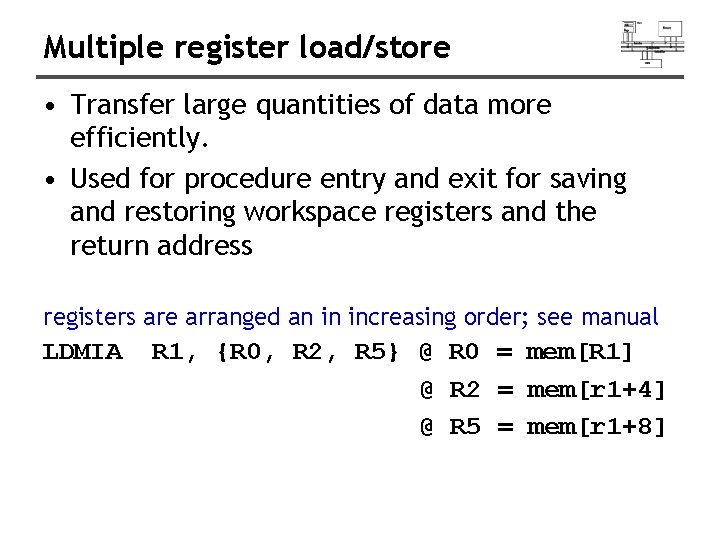
Multiple register load/store • Transfer large quantities of data more efficiently. • Used for procedure entry and exit for saving and restoring workspace registers and the return address registers are arranged an in increasing order; see manual LDMIA R 1, {R 0, R 2, R 5} @ R 0 = mem[R 1] @ R 2 = mem[r 1+4] @ R 5 = mem[r 1+8]
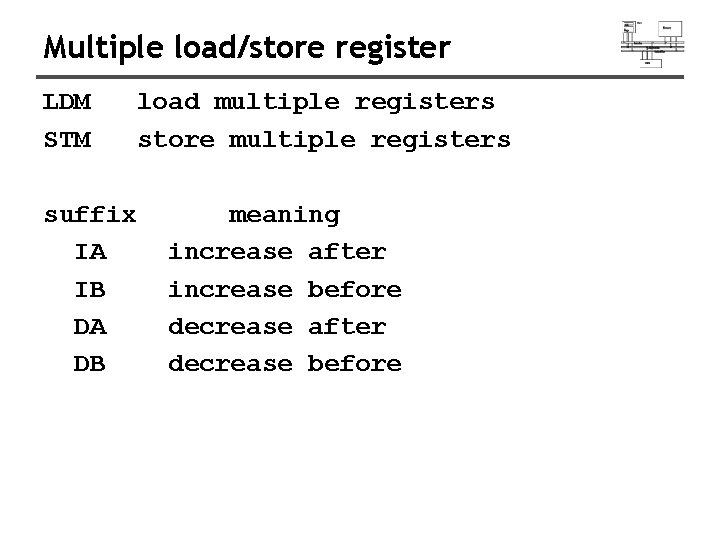
Multiple load/store register LDM STM suffix IA IB DA DB load multiple registers store multiple registers meaning increase after increase before decrease after decrease before
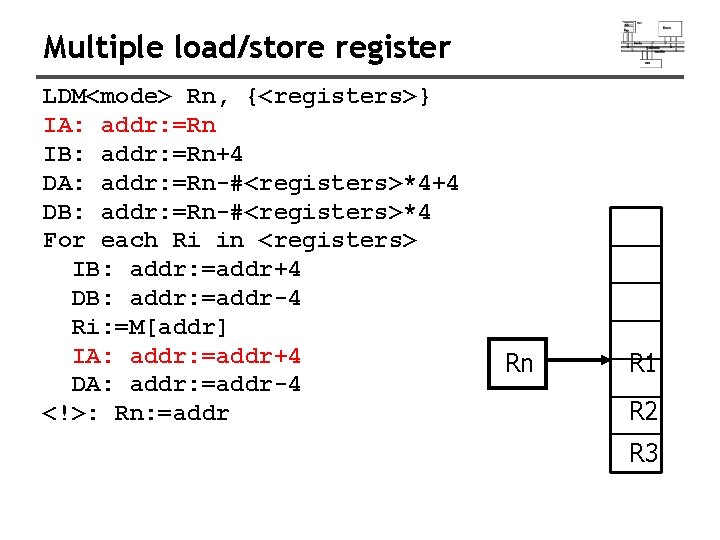
Multiple load/store register LDM<mode> Rn, {<registers>} IA: addr: =Rn IB: addr: =Rn+4 DA: addr: =Rn-#<registers>*4+4 DB: addr: =Rn-#<registers>*4 For each Ri in <registers> IB: addr: =addr+4 DB: addr: =addr-4 Ri: =M[addr] IA: addr: =addr+4 DA: addr: =addr-4 <!>: Rn: =addr Rn R 1 R 2 R 3
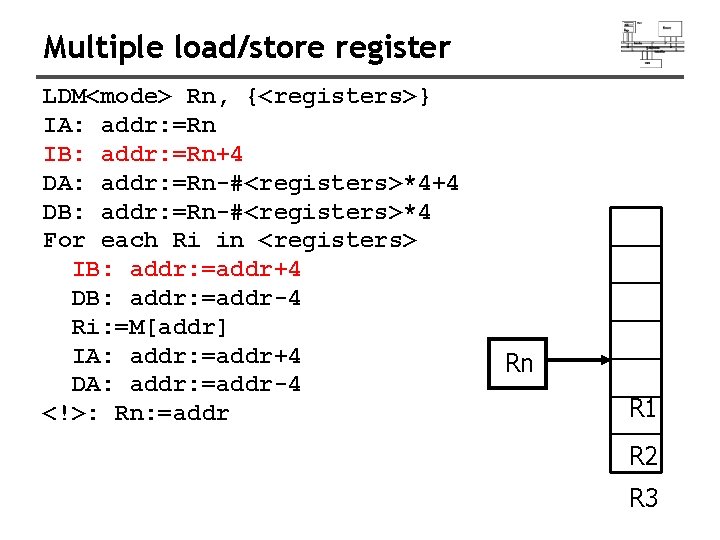
Multiple load/store register LDM<mode> Rn, {<registers>} IA: addr: =Rn IB: addr: =Rn+4 DA: addr: =Rn-#<registers>*4+4 DB: addr: =Rn-#<registers>*4 For each Ri in <registers> IB: addr: =addr+4 DB: addr: =addr-4 Ri: =M[addr] IA: addr: =addr+4 DA: addr: =addr-4 <!>: Rn: =addr Rn R 1 R 2 R 3
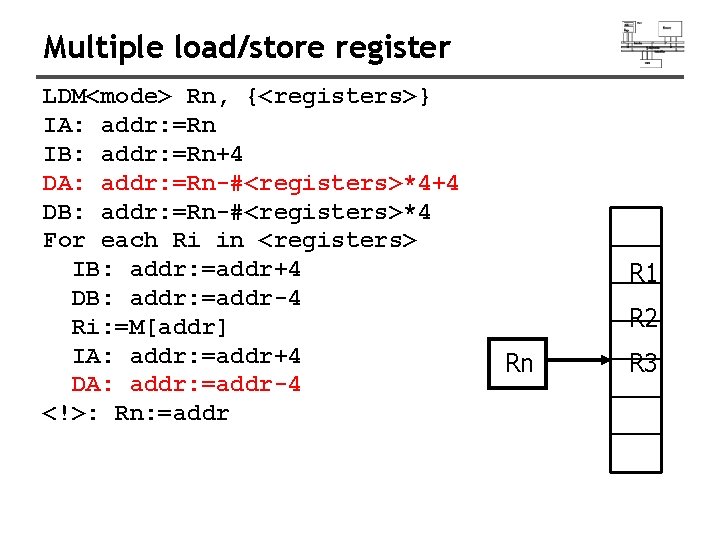
Multiple load/store register LDM<mode> Rn, {<registers>} IA: addr: =Rn IB: addr: =Rn+4 DA: addr: =Rn-#<registers>*4+4 DB: addr: =Rn-#<registers>*4 For each Ri in <registers> IB: addr: =addr+4 DB: addr: =addr-4 Ri: =M[addr] IA: addr: =addr+4 DA: addr: =addr-4 <!>: Rn: =addr R 1 R 2 Rn R 3
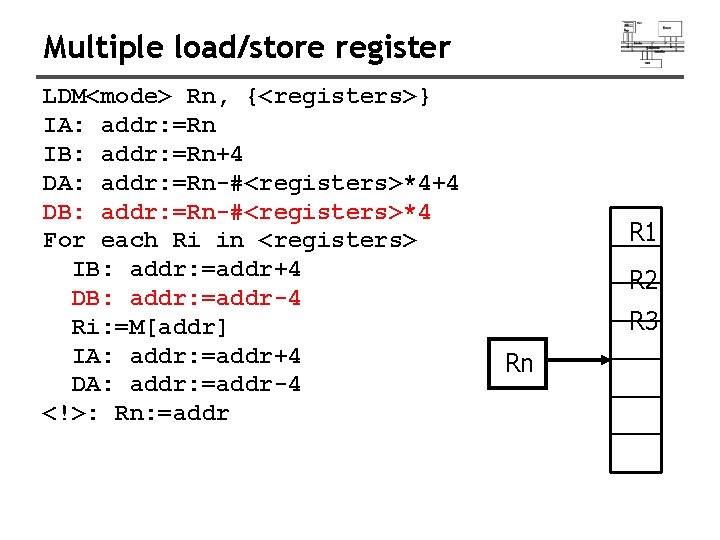
Multiple load/store register LDM<mode> Rn, {<registers>} IA: addr: =Rn IB: addr: =Rn+4 DA: addr: =Rn-#<registers>*4+4 DB: addr: =Rn-#<registers>*4 For each Ri in <registers> IB: addr: =addr+4 DB: addr: =addr-4 Ri: =M[addr] IA: addr: =addr+4 DA: addr: =addr-4 <!>: Rn: =addr R 1 R 2 R 3 Rn
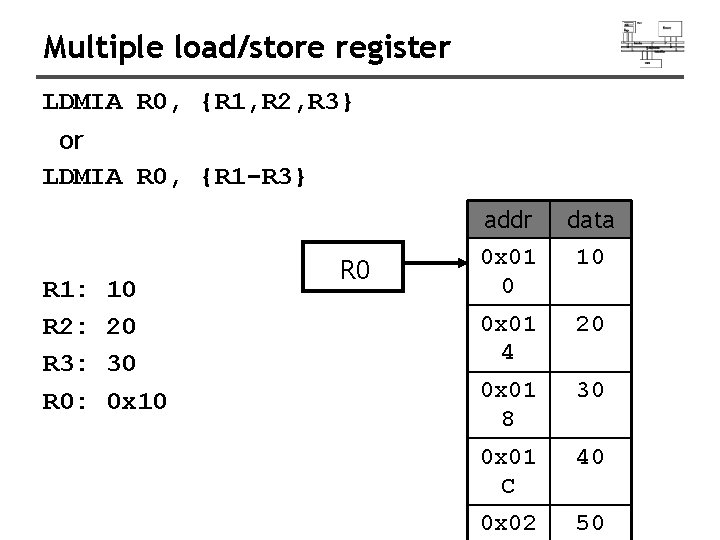
Multiple load/store register LDMIA R 0, {R 1, R 2, R 3} or LDMIA R 0, {R 1 -R 3} R 1: R 2: R 3: R 0: 10 20 30 0 x 10 R 0 addr 0 x 01 0 data 10 0 x 01 4 20 0 x 01 8 30 0 x 01 C 40 0 x 02 50
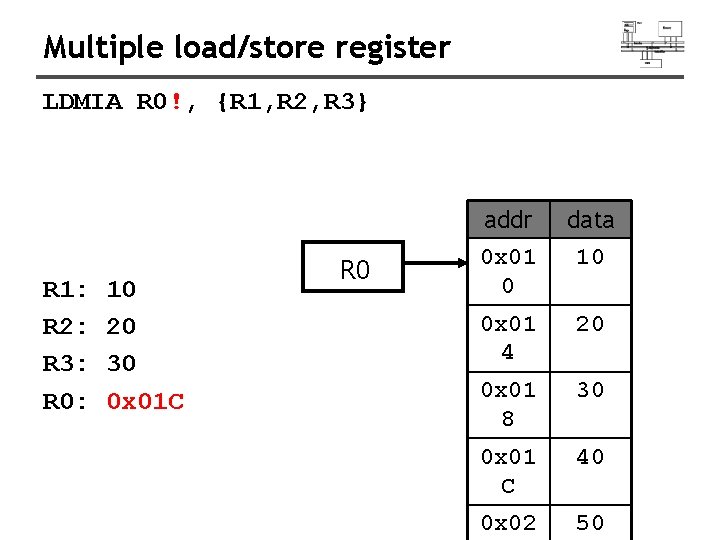
Multiple load/store register LDMIA R 0!, {R 1, R 2, R 3} R 1: R 2: R 3: R 0: 10 20 30 0 x 01 C R 0 addr 0 x 01 0 data 10 0 x 01 4 20 0 x 01 8 30 0 x 01 C 40 0 x 02 50
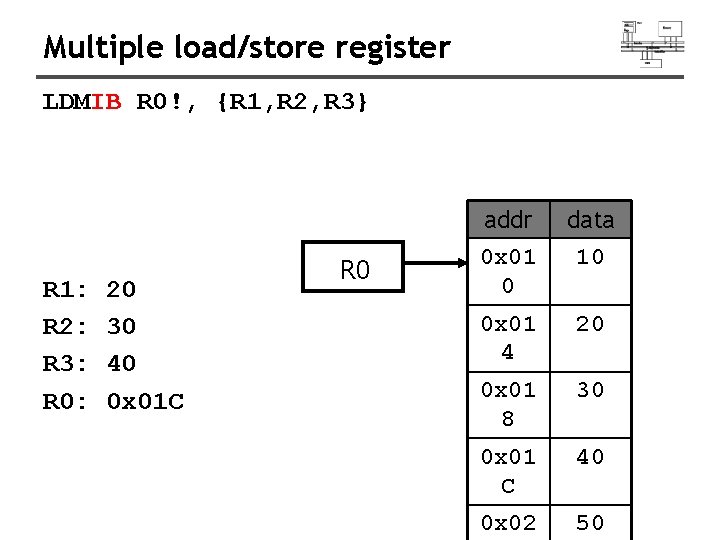
Multiple load/store register LDMIB R 0!, {R 1, R 2, R 3} R 1: R 2: R 3: R 0: 20 30 40 0 x 01 C R 0 addr 0 x 01 0 data 10 0 x 01 4 20 0 x 01 8 30 0 x 01 C 40 0 x 02 50
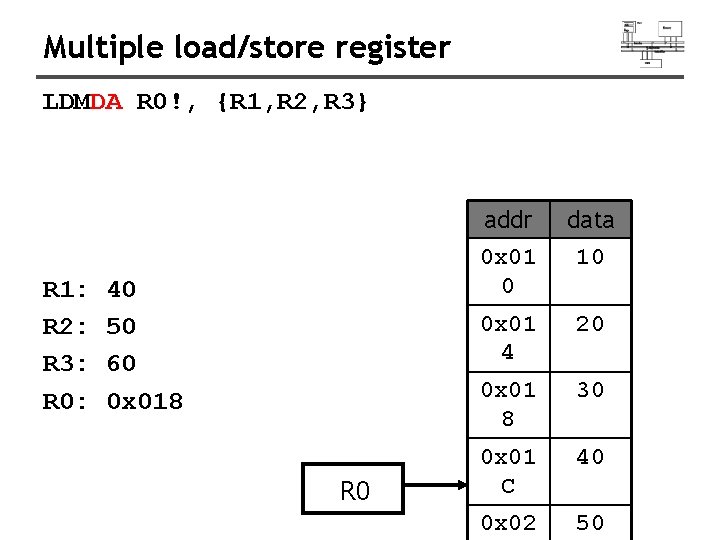
Multiple load/store register LDMDA R 0!, {R 1, R 2, R 3} R 1: R 2: R 3: R 0: 40 50 60 0 x 018 R 0 addr 0 x 01 0 data 10 0 x 01 4 20 0 x 01 8 30 0 x 01 C 40 0 x 02 50
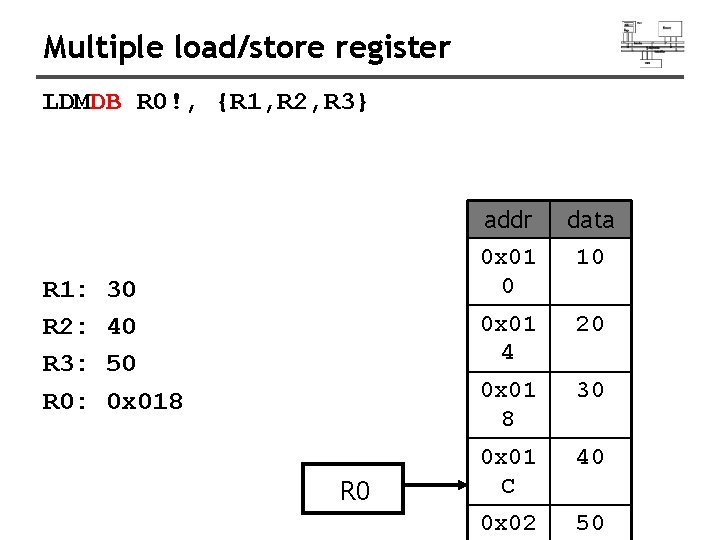
Multiple load/store register LDMDB R 0!, {R 1, R 2, R 3} R 1: R 2: R 3: R 0: 30 40 50 0 x 018 R 0 addr 0 x 01 0 data 10 0 x 01 4 20 0 x 01 8 30 0 x 01 C 40 0 x 02 50
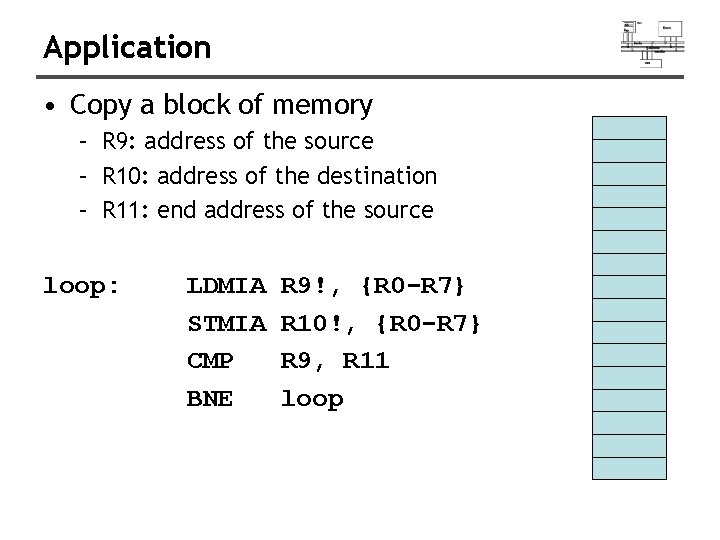
Application • Copy a block of memory – R 9: address of the source – R 10: address of the destination – R 11: end address of the source loop: LDMIA STMIA CMP BNE R 9!, {R 0 -R 7} R 10!, {R 0 -R 7} R 9, R 11 loop
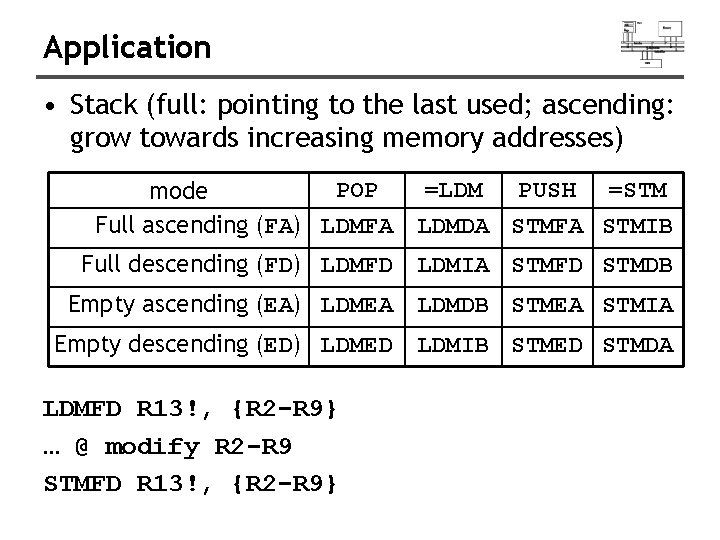
Application • Stack (full: pointing to the last used; ascending: grow towards increasing memory addresses) POP mode Full ascending (FA) LDMFA =LDM PUSH =STM LDMDA STMFA STMIB Full descending (FD) LDMFD LDMIA STMFD STMDB Empty ascending (EA) LDMEA LDMDB STMEA STMIA Empty descending (ED) LDMED LDMIB STMED STMDA LDMFD R 13!, {R 2 -R 9} … @ modify R 2 -R 9 STMFD R 13!, {R 2 -R 9}
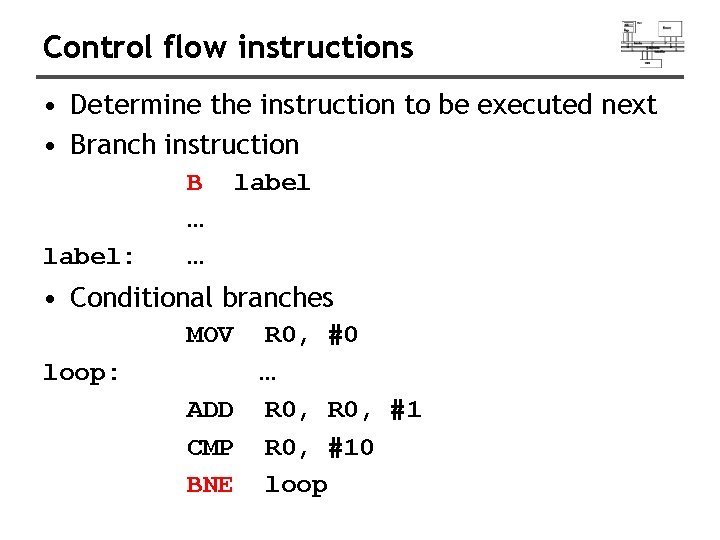
Control flow instructions • Determine the instruction to be executed next • Branch instruction label: B … … label • Conditional branches MOV loop: R 0, #0 … ADD R 0, #1 CMP R 0, #10 BNE loop
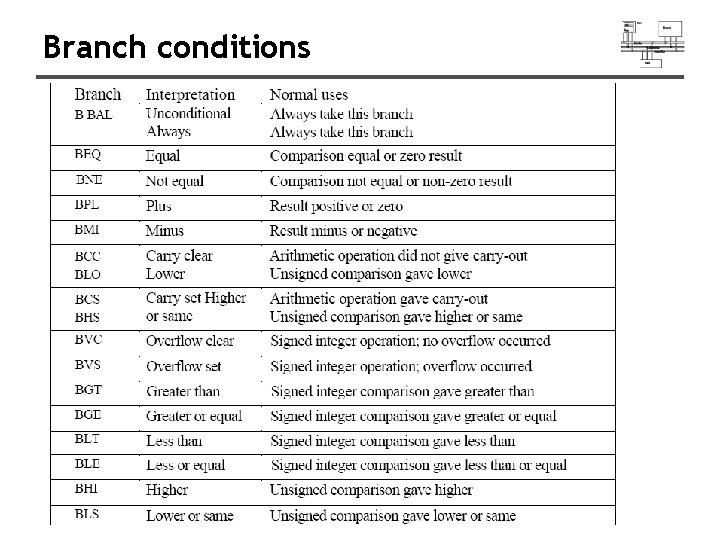
Branch conditions
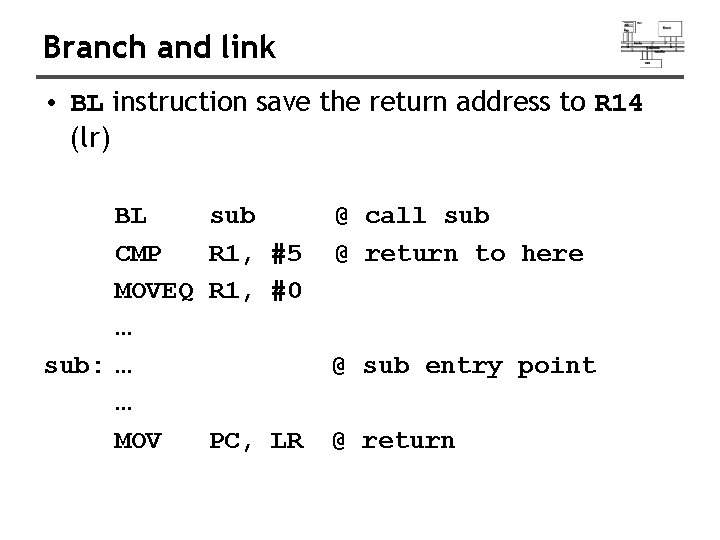
Branch and link • BL instruction save the return address to R 14 (lr) BL CMP MOVEQ … sub: … … MOV sub R 1, #5 R 1, #0 @ call sub @ return to here @ sub entry point PC, LR @ return
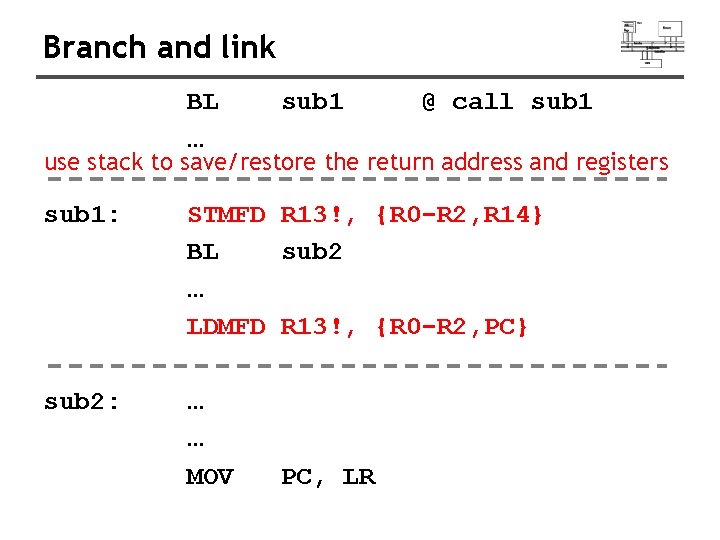
Branch and link BL … sub 1 @ call sub 1 use stack to save/restore the return address and registers sub 1: STMFD R 13!, {R 0 -R 2, R 14} BL sub 2 … LDMFD R 13!, {R 0 -R 2, PC} sub 2: … … MOV PC, LR
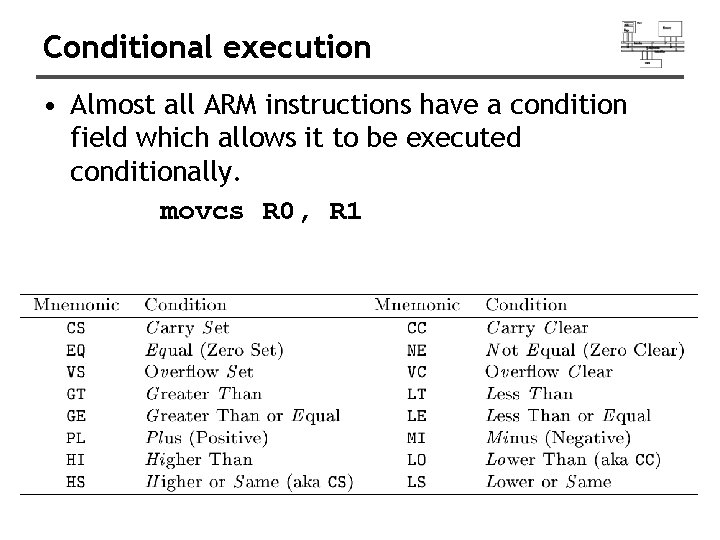
Conditional execution • Almost all ARM instructions have a condition field which allows it to be executed conditionally. movcs R 0, R 1
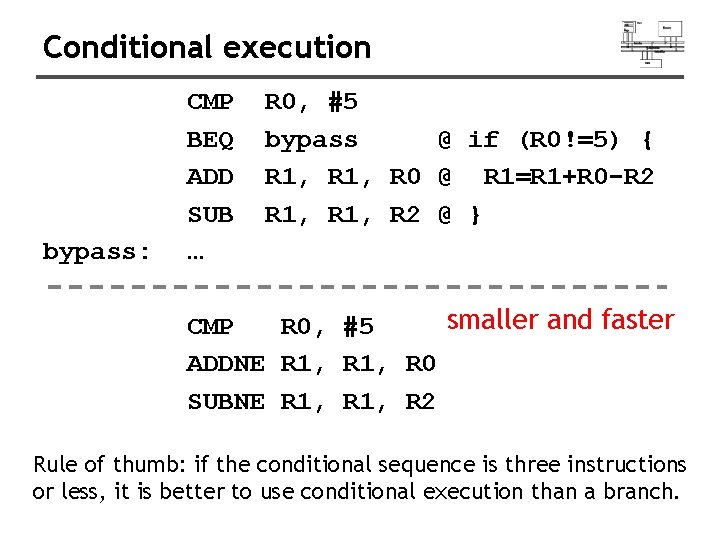
Conditional execution bypass: CMP BEQ ADD SUB … R 0, #5 bypass @ if (R 0!=5) { R 1, R 0 @ R 1=R 1+R 0 -R 2 R 1, R 2 @ } smaller and faster CMP R 0, #5 ADDNE R 1, R 0 SUBNE R 1, R 2 Rule of thumb: if the conditional sequence is three instructions or less, it is better to use conditional execution than a branch.
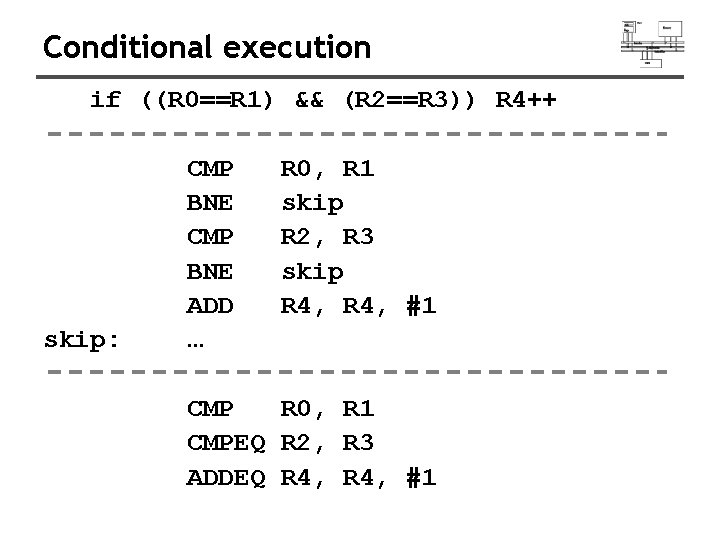
Conditional execution if ((R 0==R 1) && (R 2==R 3)) R 4++ skip: CMP BNE ADD … R 0, R 1 skip R 2, R 3 skip R 4, #1 CMP R 0, R 1 CMPEQ R 2, R 3 ADDEQ R 4, #1
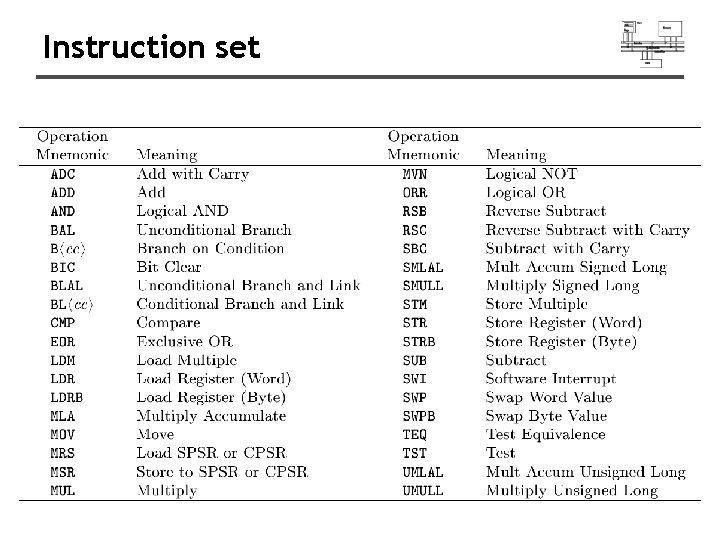
Instruction set
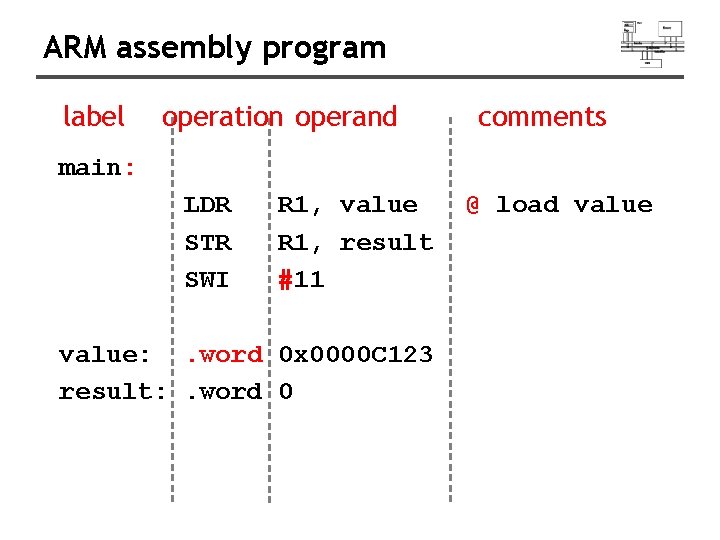
ARM assembly program label operation operand comments main: LDR STR SWI R 1, value R 1, result #11 value: . word 0 x 0000 C 123 result: . word 0 @ load value
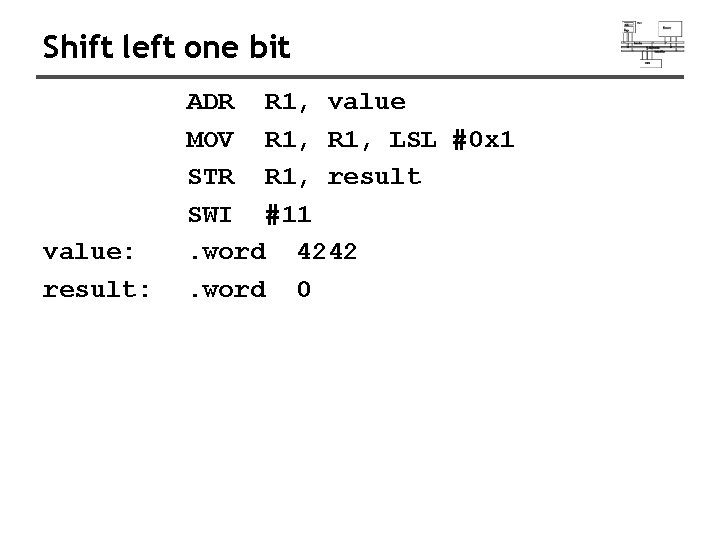
Shift left one bit value: result: ADR R 1, value MOV R 1, LSL #0 x 1 STR R 1, result SWI #11. word 4242. word 0
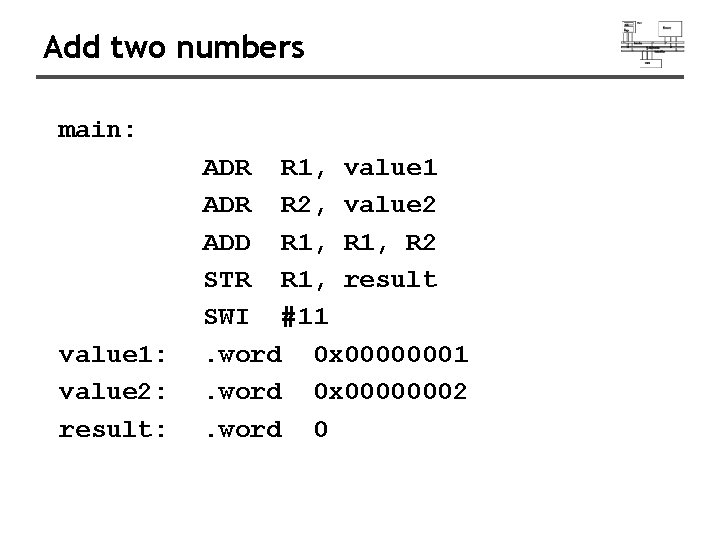
Add two numbers main: value 1: value 2: result: ADR R 1, value 1 ADR R 2, value 2 ADD R 1, R 2 STR R 1, result SWI #11. word 0 x 00000002. word 0
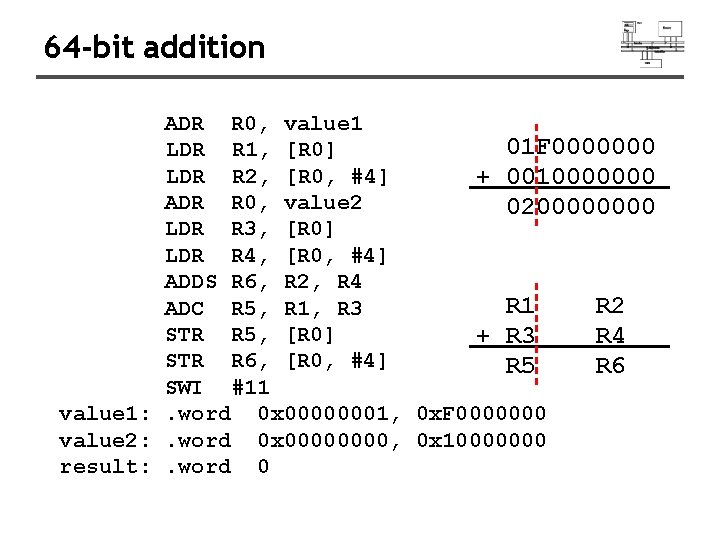
64 -bit addition ADR R 0, value 1 01 F 0000000 LDR R 1, [R 0] LDR R 2, [R 0, #4] + 0010000000 ADR R 0, value 2 020000 LDR R 3, [R 0] LDR R 4, [R 0, #4] C ADDS R 6, R 2, R 4 R 1 R 2 ADC R 5, R 1, R 3 STR R 5, [R 0] + R 3 R 4 STR R 6, [R 0, #4] R 5 R 6 SWI #11 value 1: . word 0 x 00000001, 0 x. F 0000000 value 2: . word 0 x 0000, 0 x 10000000 result: . word 0
![Loops • For loops for (i-0; i<10; i++) {a[i]=0; } MOV ADR MOV LOOP:](http://slidetodoc.com/presentation_image/5f0b3e28e59348ef073f2ea386b699be/image-64.jpg "Loops • For loops for (i-0; i<10; i++) {a[i]=0; } MOV ADR MOV LOOP:")
Loops • For loops for (i-0; i<10; i++) {a[i]=0; } MOV ADR MOV LOOP: CMP BGE STR ADD B EXIT: . . R 1, #0 R 2, A R 0, #0 R 0, #10 EXIT R 1, [R 2, R 0, LSL #2] R 0, #1 LOOP
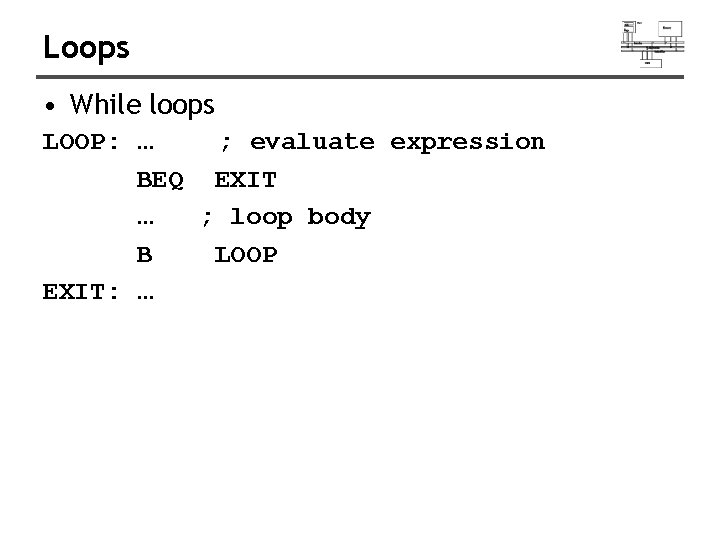
Loops • While loops LOOP: … ; evaluate expression BEQ EXIT … ; loop body B LOOP EXIT: …
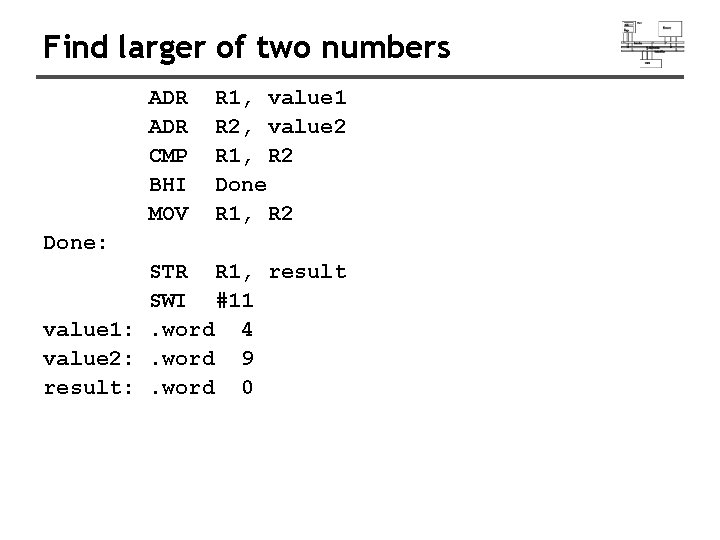
Find larger of two numbers ADR CMP BHI MOV R 1, value 1 R 2, value 2 R 1, R 2 Done: STR R 1, result SWI #11 value 1: . word 4 value 2: . word 9 result: . word 0
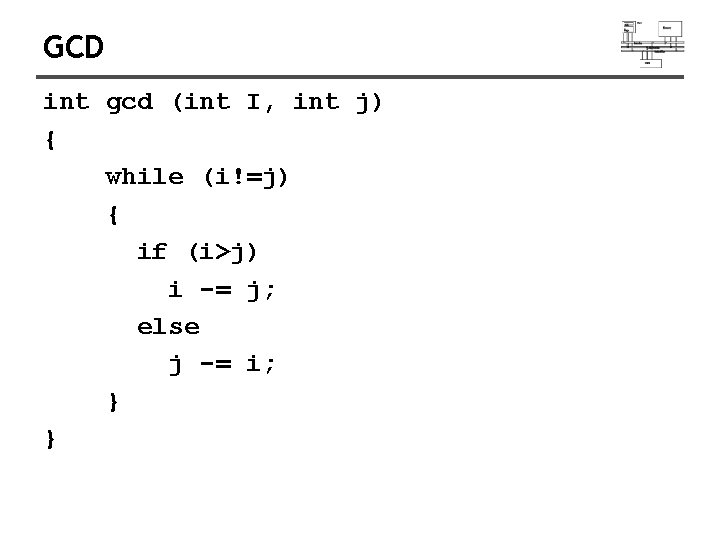
GCD int gcd (int I, int j) { while (i!=j) { if (i>j) i -= j; else j -= i; } }
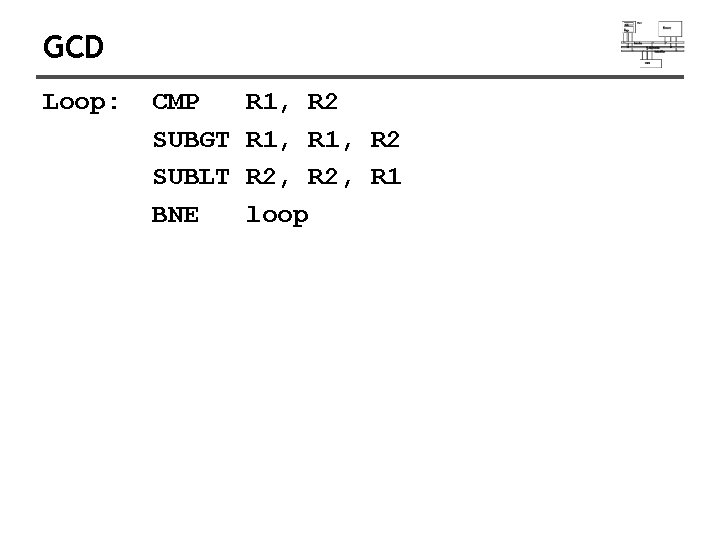
GCD Loop: CMP SUBGT SUBLT BNE R 1, R 2, R 2, R 1 loop
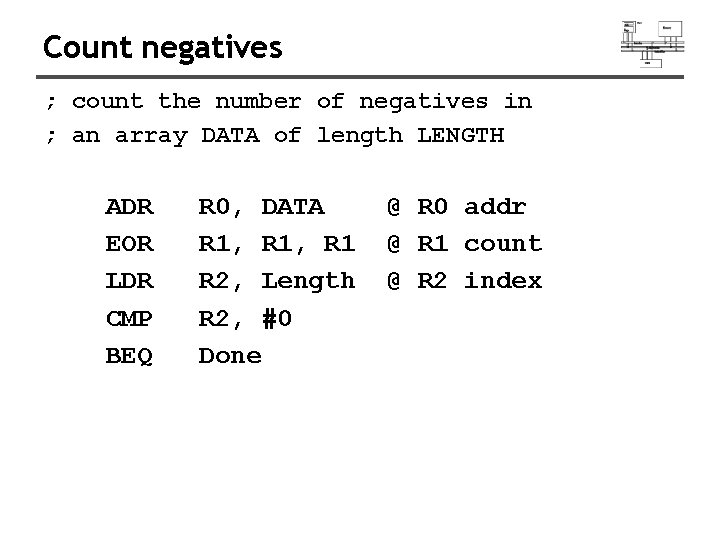
Count negatives ; count the number of negatives in ; an array DATA of length LENGTH ADR EOR LDR CMP BEQ R 0, DATA R 1, R 1 R 2, Length R 2, #0 Done @ R 0 addr @ R 1 count @ R 2 index
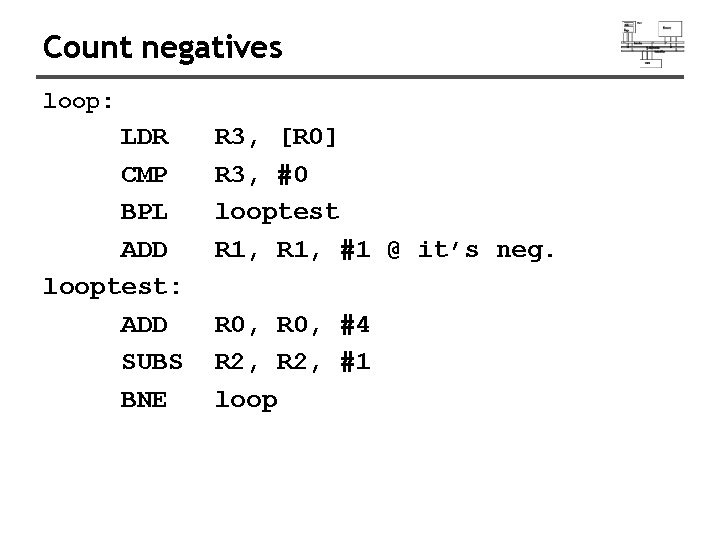
Count negatives loop: LDR CMP BPL ADD looptest: ADD SUBS BNE R 3, [R 0] R 3, #0 looptest R 1, #1 @ it’s neg. R 0, #4 R 2, #1 loop
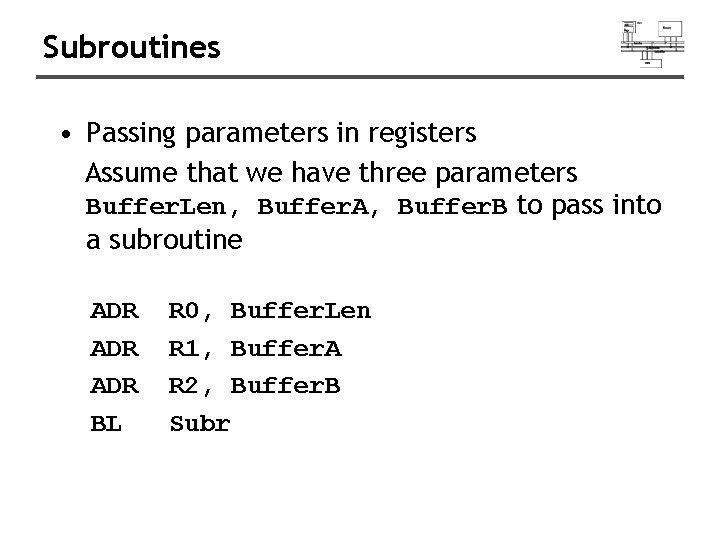
Subroutines • Passing parameters in registers Assume that we have three parameters Buffer. Len, Buffer. A, Buffer. B to pass into a subroutine ADR ADR BL R 0, Buffer. Len R 1, Buffer. A R 2, Buffer. B Subr
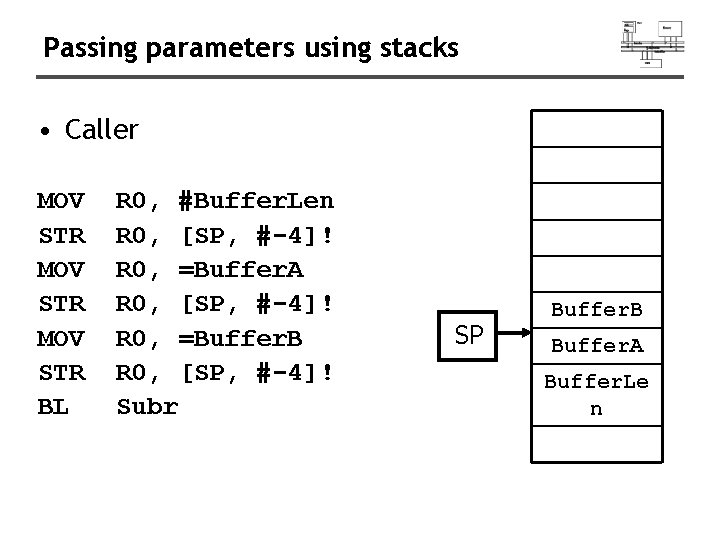
Passing parameters using stacks • Caller MOV STR BL R 0, #Buffer. Len R 0, [SP, #-4]! R 0, =Buffer. A R 0, [SP, #-4]! R 0, =Buffer. B R 0, [SP, #-4]! Subr SP Buffer. B Buffer. A Buffer. Le n
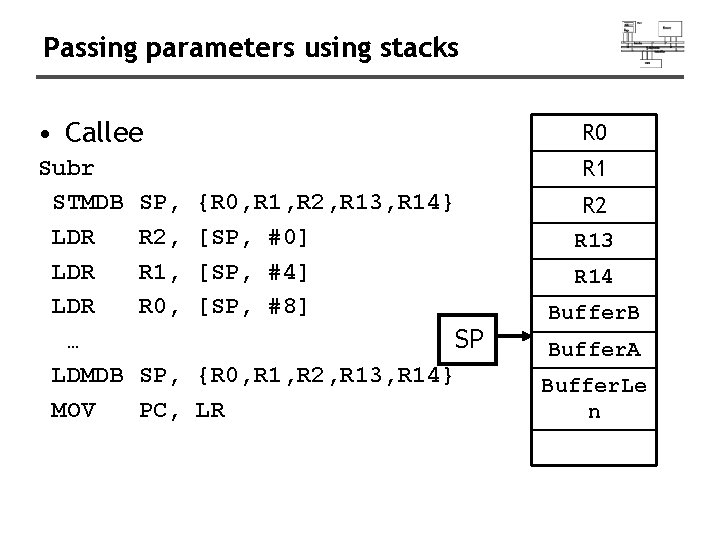
Passing parameters using stacks • Callee R 0 Subr STMDB LDR LDR … LDMDB MOV R 1 SP, R 2, R 1, R 0, {R 0, R 1, R 2, R 13, R 14} [SP, #0] [SP, #4] [SP, #8] SP SP, {R 0, R 1, R 2, R 13, R 14} PC, LR R 2 R 13 R 14 Buffer. B Buffer. A Buffer. Le n
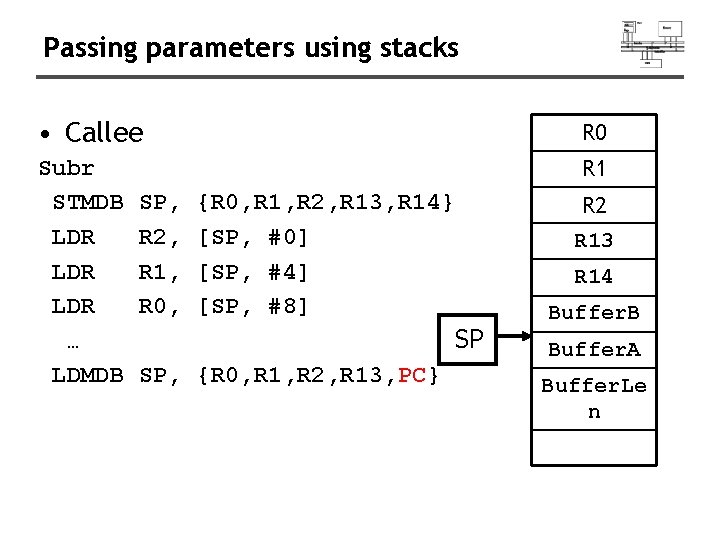
Passing parameters using stacks • Callee R 0 Subr STMDB LDR LDR … LDMDB R 1 SP, R 2, R 1, R 0, {R 0, R 1, R 2, R 13, R 14} [SP, #0] [SP, #4] [SP, #8] SP SP, {R 0, R 1, R 2, R 13, PC} R 2 R 13 R 14 Buffer. B Buffer. A Buffer. Le n
Review • • ARM ARM architecture programmer model instruction set assembly programming
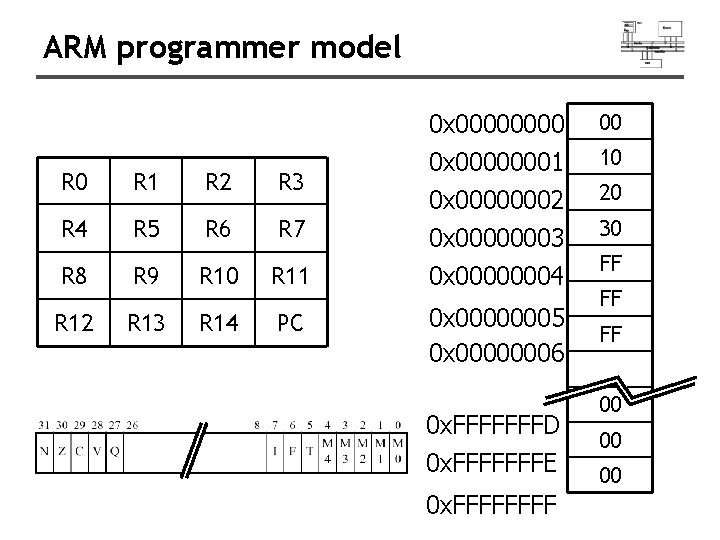
ARM programmer model R 0 R 1 R 2 R 3 R 4 R 5 R 6 R 7 0 x 0000 00 0 x 00000001 10 0 x 00000002 20 0 x 00000003 30 R 8 R 9 R 10 R 11 0 x 00000004 R 12 R 13 R 14 PC 0 x 00000005 0 x 00000006 0 x. FFFFFFFD 0 x. FFFFFFFE 0 x. FFFF FF 00 00 00
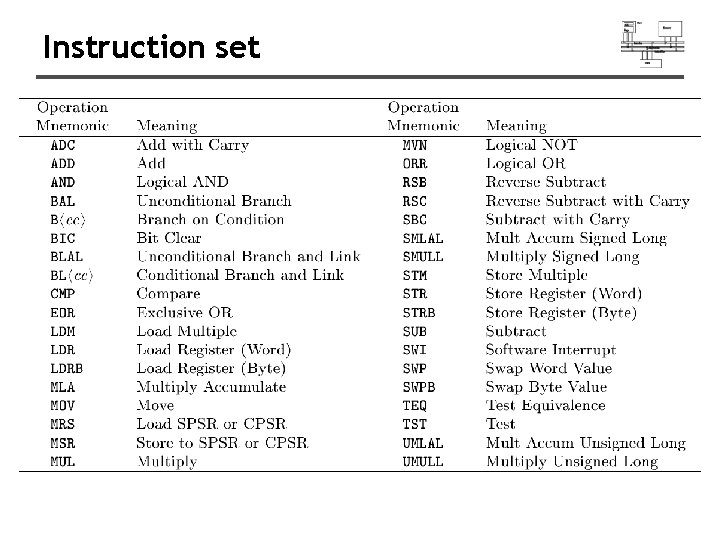
Instruction set
References • ARM Limited. ARM Architecture Reference Manual. • Peter Knaggs and Stephen Welsh, ARM: Assembly Language Programming. • Peter Cockerell, ARM Assembly Language Programming. • Peng-Sheng Chen, Embedded System Software Design and Implementation.
- Slides: 78