
Arlette Noels Josefina Montalban Institut d Astrophysique et
Arlette Noels, Josefina Montalban Institut d’ Astrophysique et Géophysique Université de Liège, Belgium and Carla Maceroni INAF - Rome Astronomical Observatory, Italy THE A STAR PUZZLE - IAU Symposium 224 Poprad , Slovakia July 8, 2004
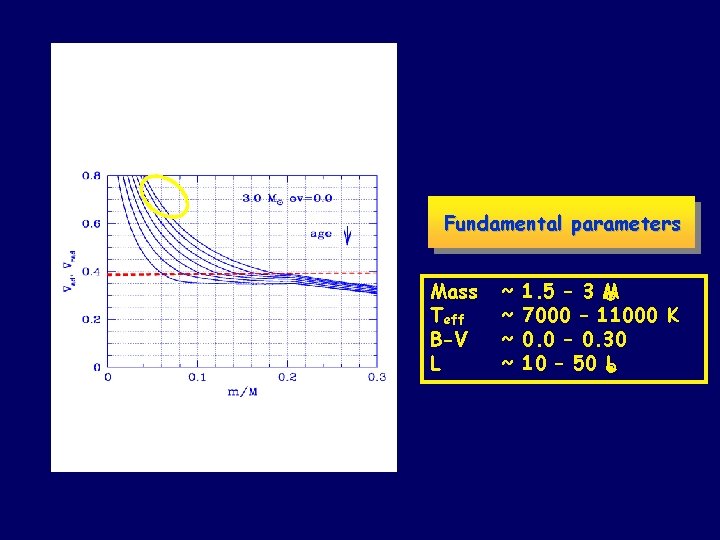
Fundamental parameters Mass Teff B-V L ~ ~ 1. 5 – 3 M 7000 – 11000 K 0. 0 – 0. 30 10 – 50 L
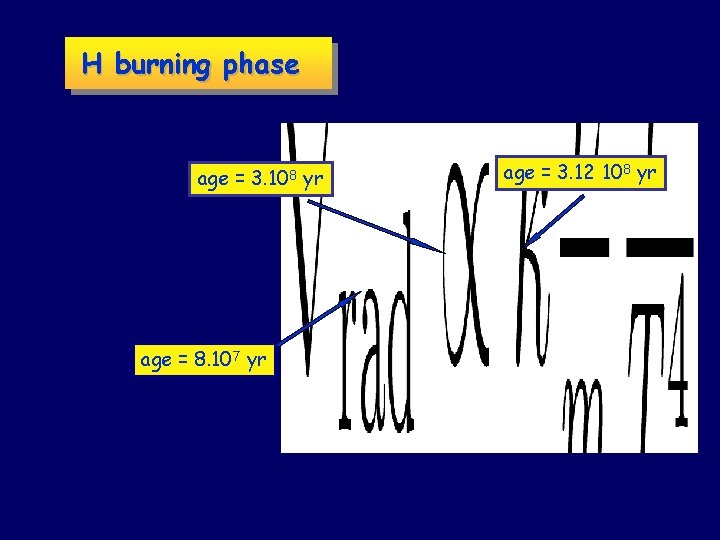
H burning phase age = 3. 108 yr age = 8. 107 yr age = 3. 12 108 yr
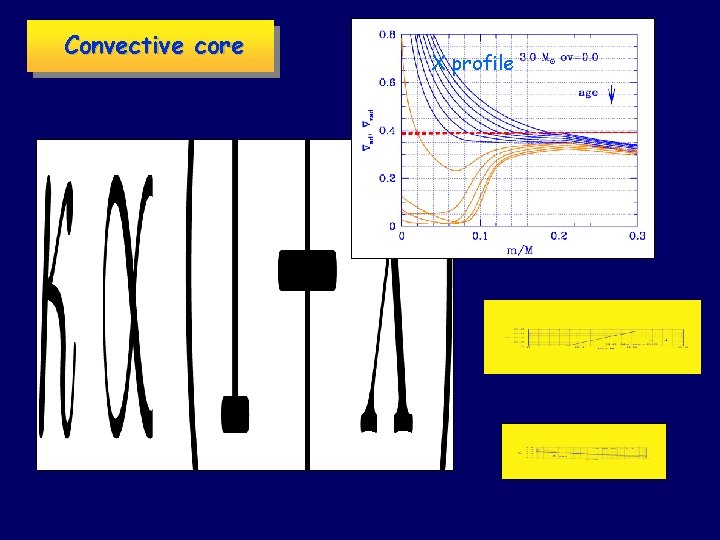
Convective core X profile
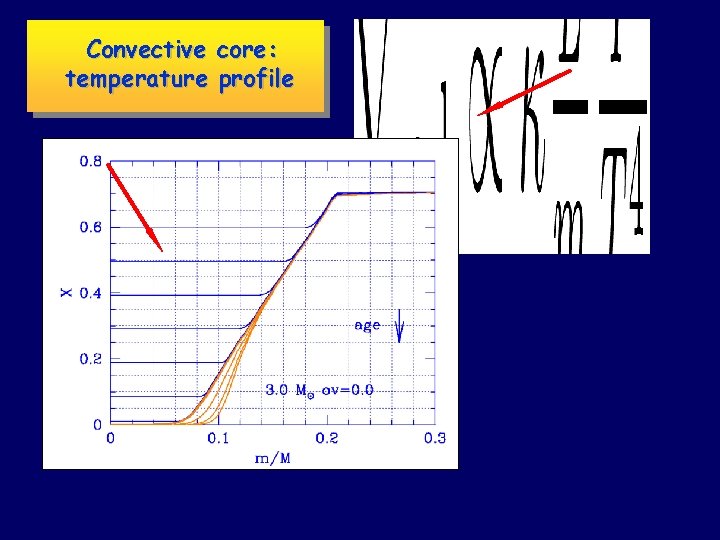
Convective core: temperature profile
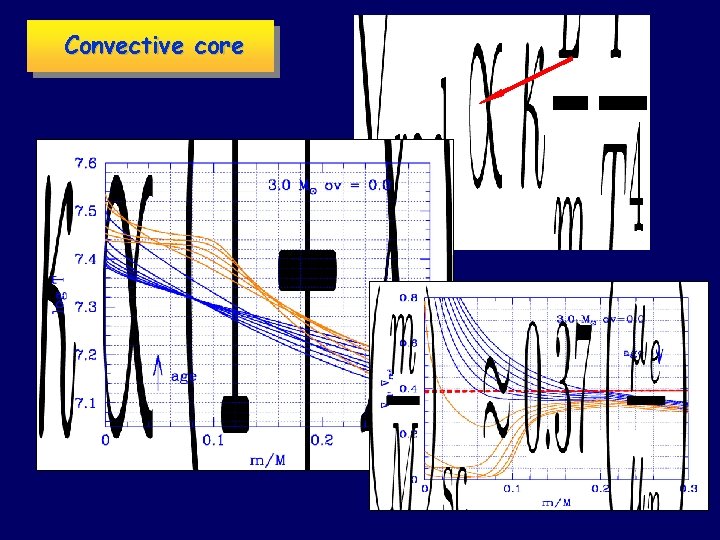
Convective core
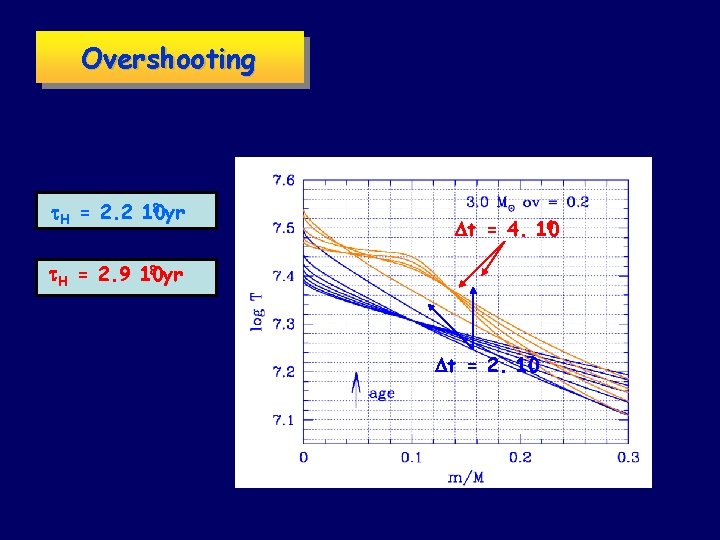
Overshooting 8 8 yr 2. 210 10 yr t. H==3. 0 6 Dt = 4. 10 8 yr t. H = 2. 9 10 7 Dt = 2. 10
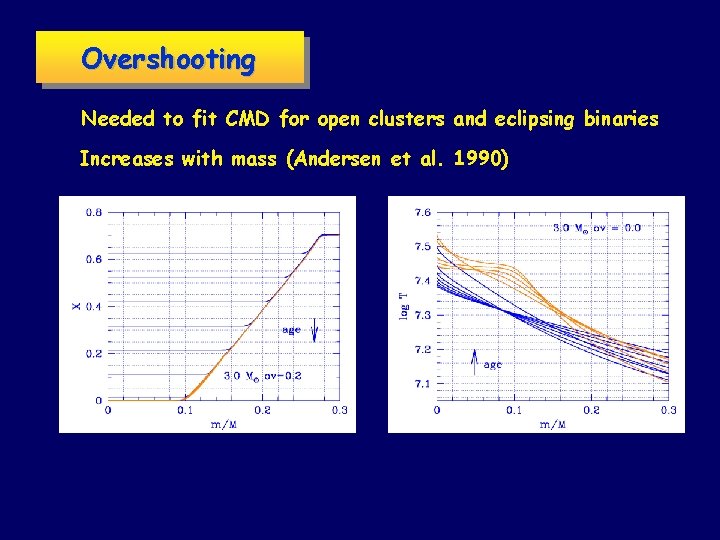
Overshooting Needed to fit CMD for open clusters and eclipsing binaries Increases with mass (Andersen et al. 1990)
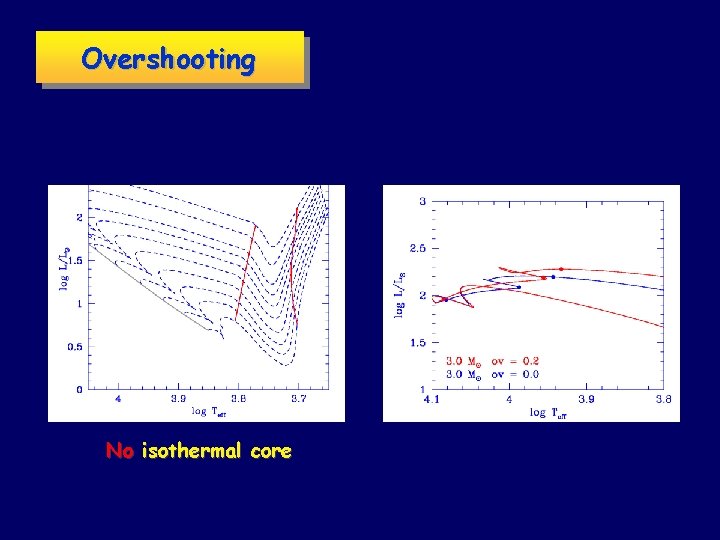
Overshooting No isothermal core
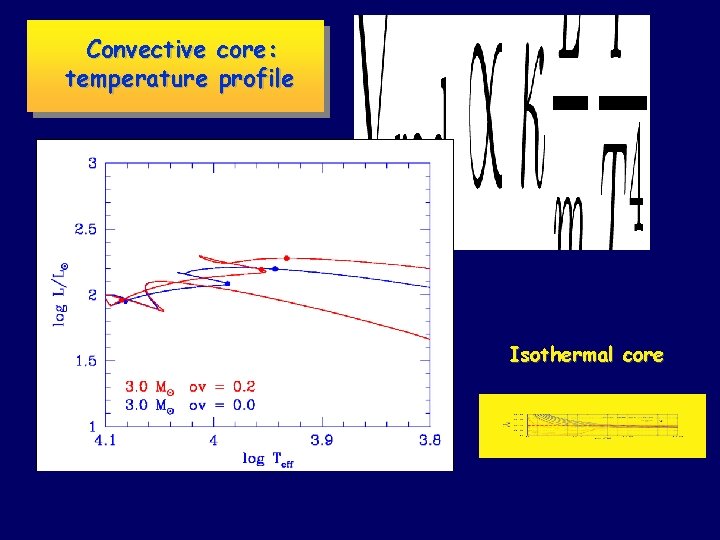
Convective core: temperature profile Isothermal core
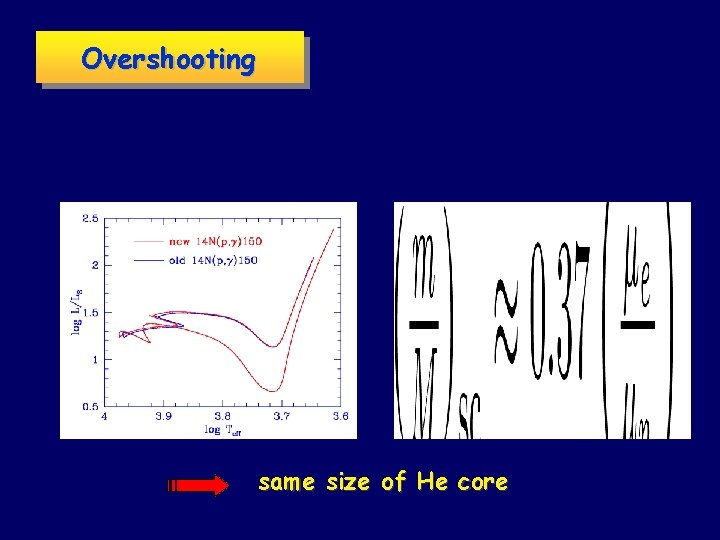
Overshooting same size of He core
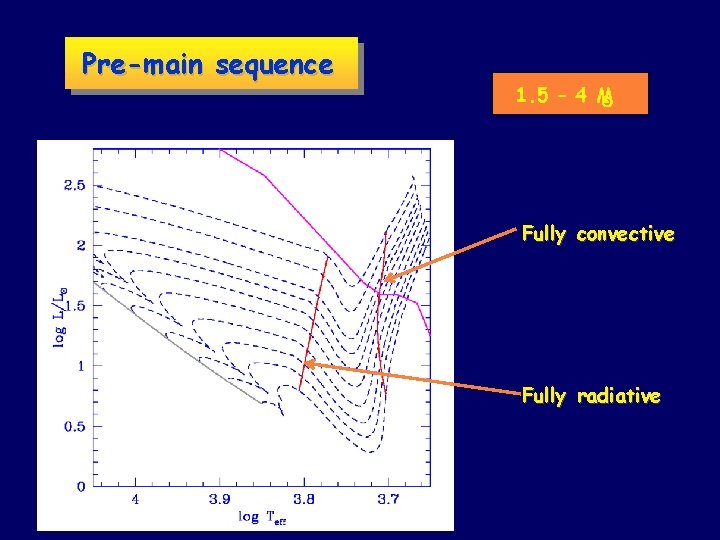
Pre-main sequence 1. 5 – 4 M Fully convective Fully radiative
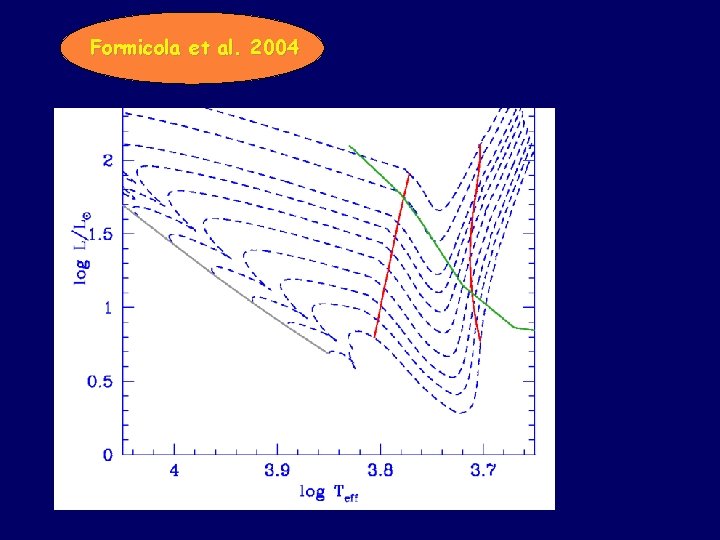
Formicola et al. 2004
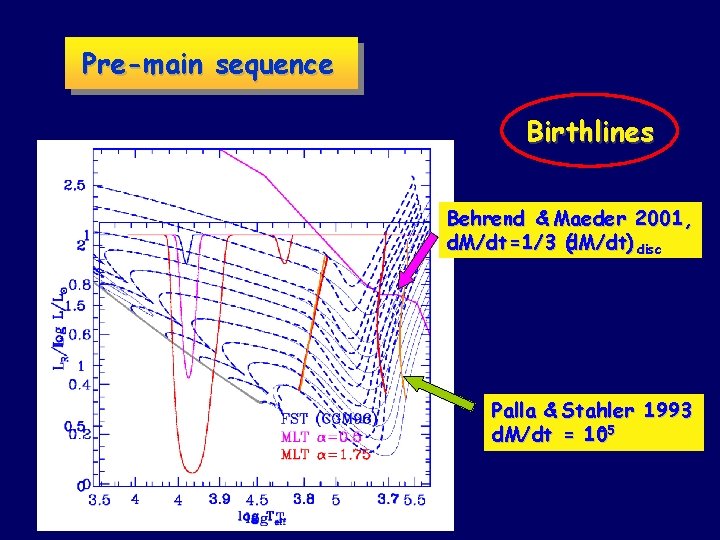
Pre-main sequence Birthlines Behrend & Maeder 2001, d. M/dt =1/3 (d. M/dt) disc Palla & Stahler 1993 d. M/dt = 10 -5
Pre-main sequence FST (Canuto et al. 1996). Effect of treatment of convection on PMS evolutionary tracks location MLT, a=1. 6
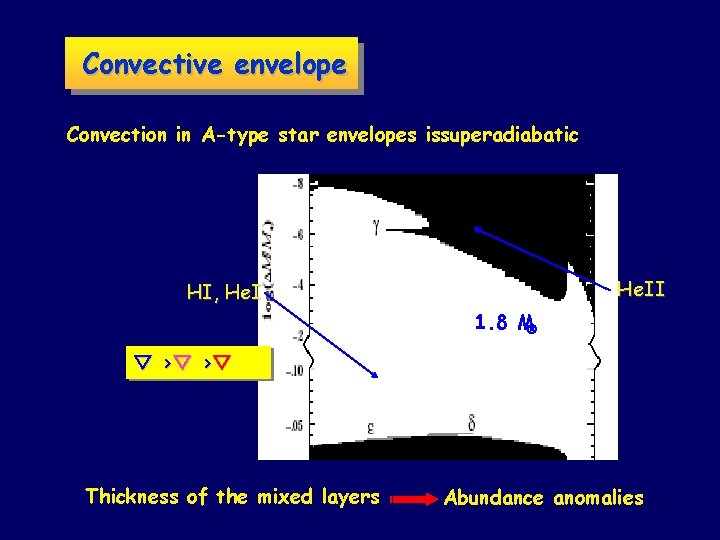
Convective envelope Convection in A-type star envelopes issuperadiabatic He. II HI, He. I 1. 8 M > > Thickness of the mixed layers Abundance anomalies
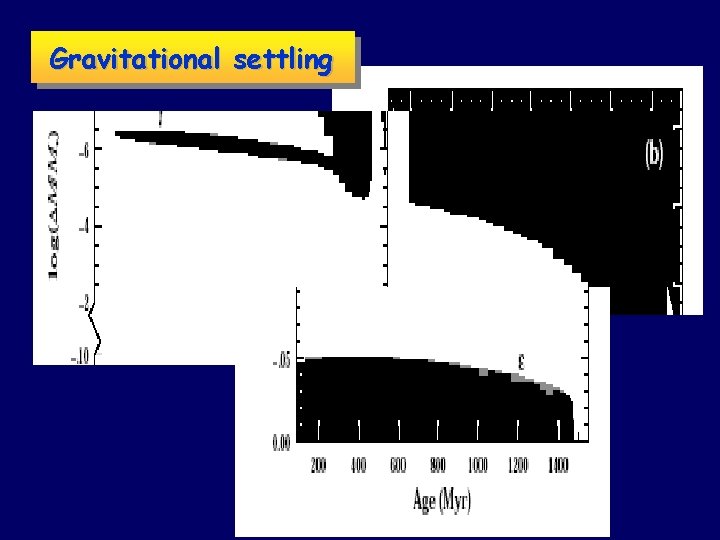
Gravitational settling
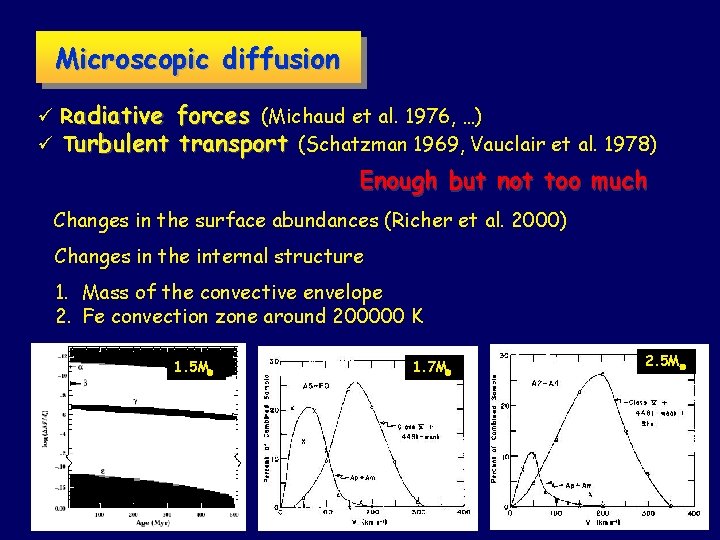
Microscopic diffusion ü Radiative forces (Michaud et al. 1976, …) ü Turbulent transport (Schatzman 1969, Vauclair et al. 1978) Enough but not too much Changes in the surface abundances (Richer et al. 2000) Changes in the internal structure 1. Mass of the convective envelope 2. Fe convection zone around 200000 K 1. 5 M 1. 7 M 2. 5 M
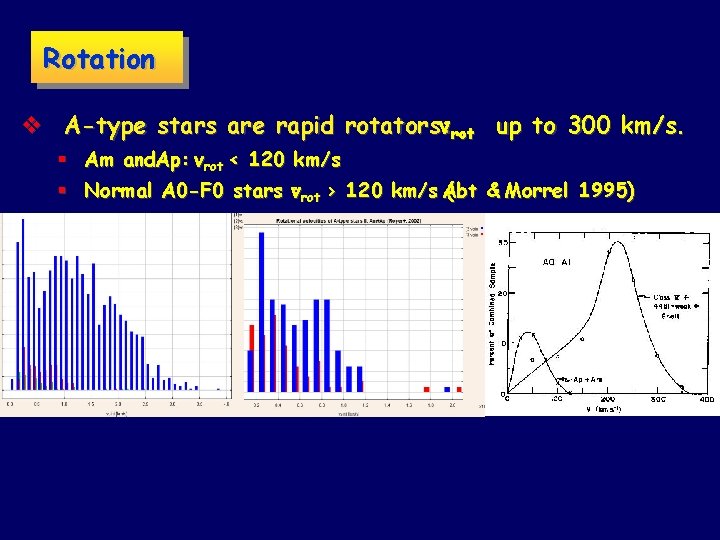
Rotation v A-type stars are rapid rotators: vrot up to 300 km/s. § Am and. Ap : vrot < 120 km/s § Normal A 0 -F 0 stars v: rot > 120 km/s Abt ( & Morrel 1995)
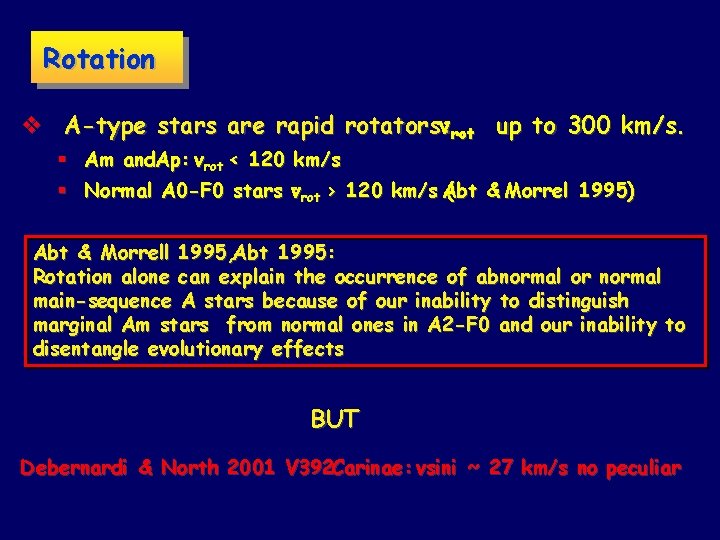
Rotation v A-type stars are rapid rotators: vrot up to 300 km/s. § Am and. Ap : vrot < 120 km/s § Normal A 0 -F 0 stars v: rot > 120 km/s Abt ( & Morrel 1995) Abt & Morrell 1995, Abt 1995: Rotation alone can explain the occurrence of abnormal or normal main-sequence A stars because of our inability to distinguish marginal Am stars from normal ones in A 2 -F 0 and our inability to disentangle evolutionary effects BUT Debernardi & North 2001 V 392 Carinae: vsini ~ 27 km/s no peculiar
Rotation New Catalogue by Royer et al. 2002 :
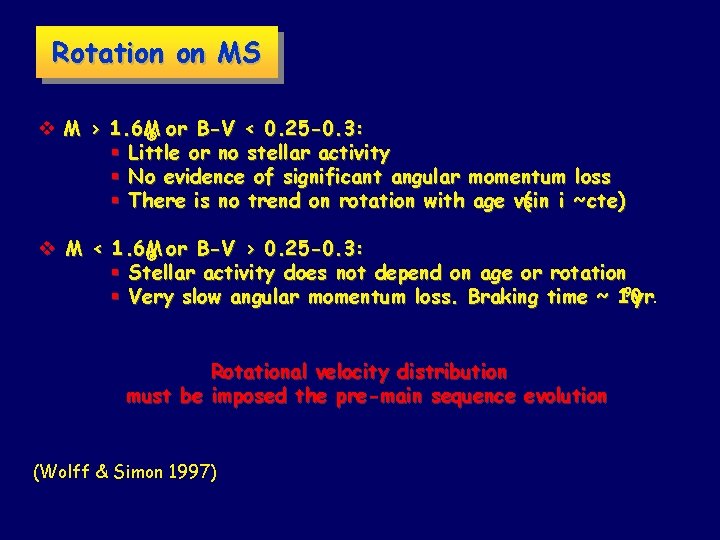
Rotation on MS v M > 1. 6 M or B-V < 0. 25 -0. 3: § Little or no stellar activity § No evidence of significant angular momentum loss § There is no trend on rotation with age vsin ( i ~ cte ) v M < 1. 6 M or B-V > 0. 25 -0. 3: § Stellar activity does not depend on age or rotation 9 yr. § Very slow angular momentum loss. Braking time ~ 10 yr Rotational velocity distribution must be imposed the pre-main sequence evolution (Wolff & Simon 1997)
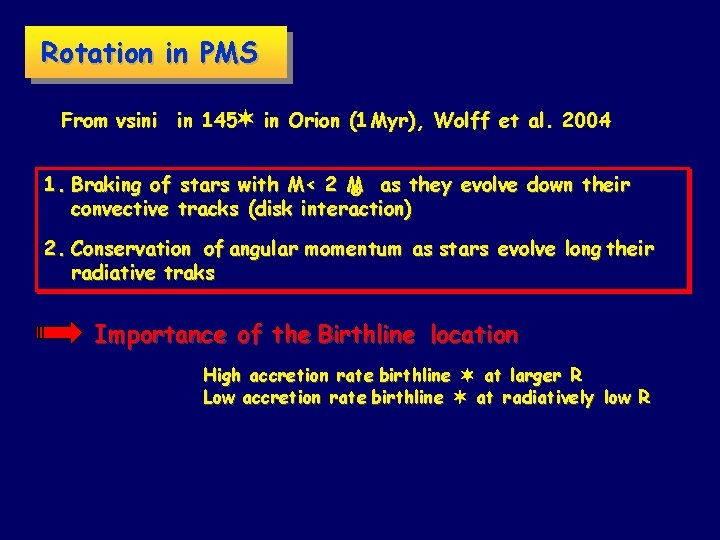
Rotation in PMS From vsini in 145 in Orion (1 Myr), Wolff et al. 2004 : 1. Braking of stars with M< 2 M as they evolve down their convective tracks (disk interaction) 2. Conservation of angular momentum as stars evolve long their radiative traks Importance of the Birthline location High accretion rate birthline at larger R Low accretion rate birthline at radiatively low R
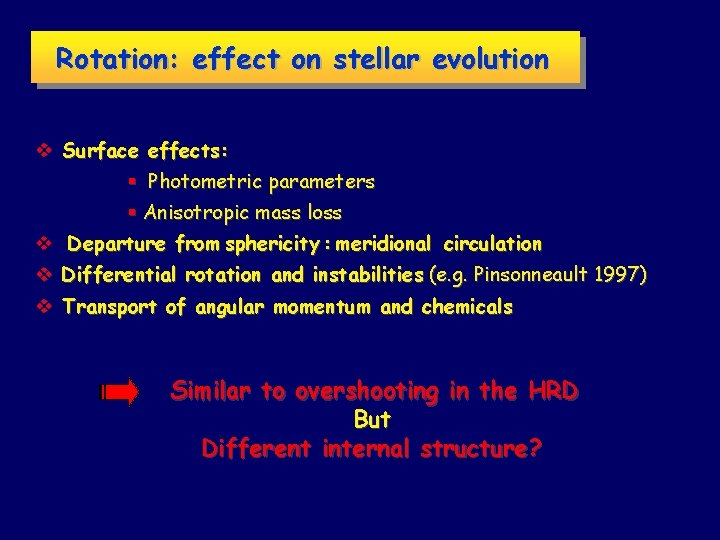
Rotation: effect on stellar evolution v Surface effects: § Photometric parameters § Anisotropic mass loss v Departure from sphericity : meridional circulation v Differential rotation and instabilities (e. g. Pinsonneault 1997) v Transport of angular momentum and chemicals Similar to overshooting in the HRD But Different internal structure?
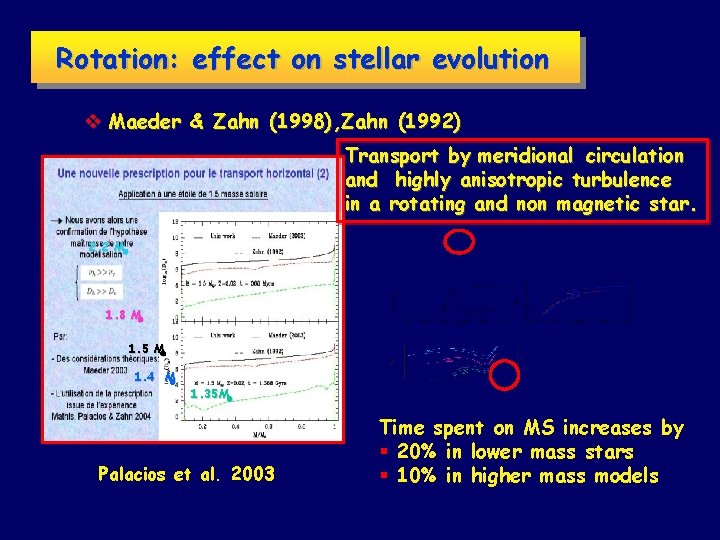
Rotation: effect on stellar evolution v Maeder & Zahn (1998), Zahn (1992) Transport by meridional circulation and highly anisotropic turbulence in a rotating and non magnetic star. 2. 2 M 1. 8 M 1. 5 M 1. 4 M 1. 35 M Palacios et al. 2003 Time spent on MS increases by § 20% in lower mass stars § 10% in higher mass models
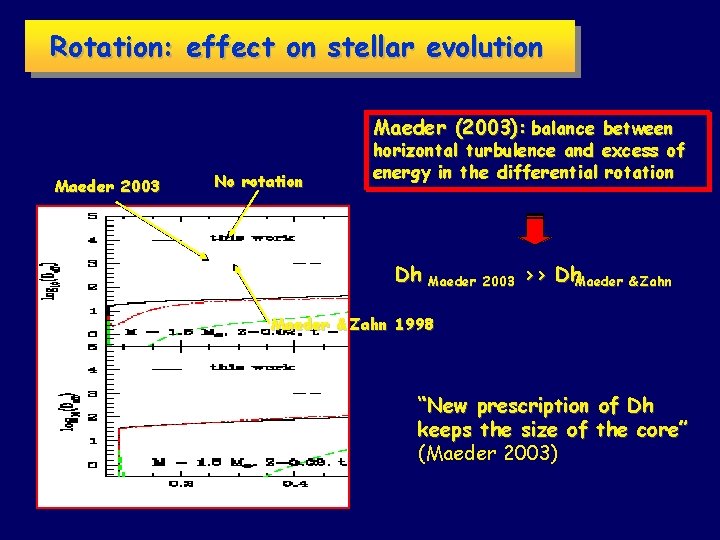
Rotation: effect on stellar evolution Maeder (2003): balance between Maeder 2003 No rotation horizontal turbulence and excess of energy in the differential rotation Dh Maeder 2003 >> Dh. Maeder & Zahn 1998 “New prescription of Dh keeps the size of the core” (Maeder 2003)
Rotation: effect on stellar evolution β-viscosity prescription to determine Dh Horizontal turbulent diffusivity: Dh Mathis & Zahn 2004 Mathis et al. 2004 Vertical effective diffusivity: Deff
Rotation: effect on stellar evolution v Differential rotation in radiative layers (Tayler instability) Magnetic field (Spruit 1999, 2002). v Magneto-rotational instability (Balbus & Hawley 1991)could transport J to the surface(Arlt et al. 2003). Timescale ~ life time for A type stars Effect on J of Ap stars
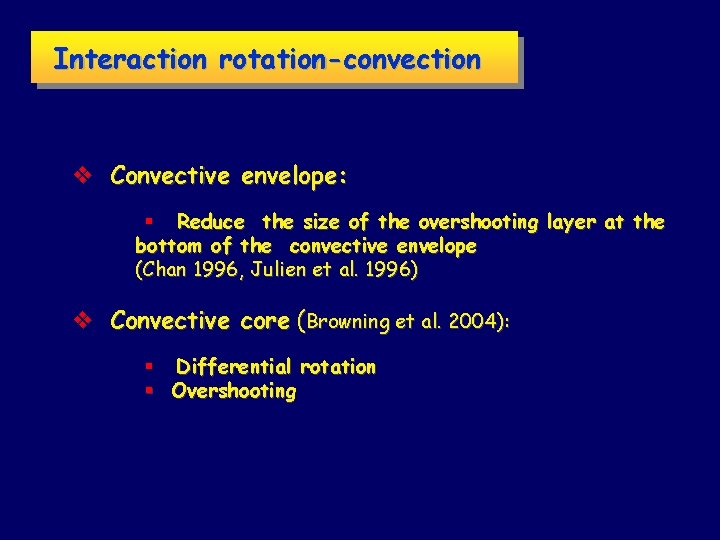
Interaction rotation-convection v Convective envelope: § Reduce the size of the overshooting layer at the bottom of the convective envelope (Chan 1996, Julien et al. 1996) v Convective core (Browning et al. 2004): § Differential rotation § Overshooting
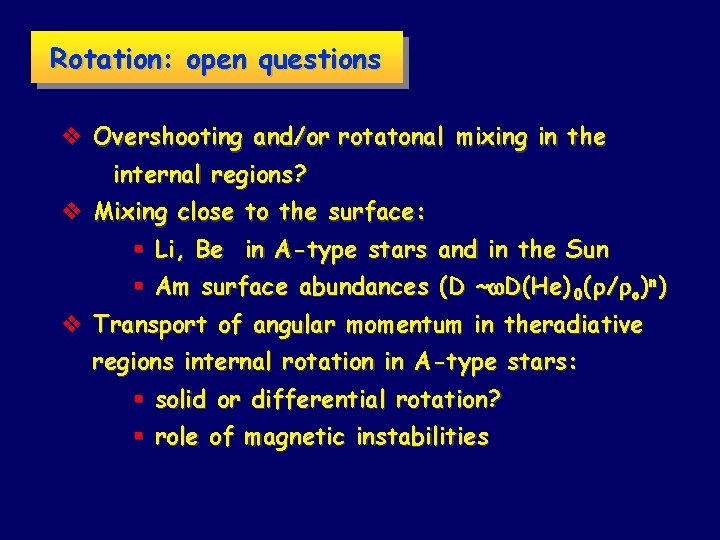
Rotation: open questions v Overshooting and/or rotatonal mixing in the internal regions? v Mixing close to the surface: § Li, Be in A-type stars and in the Sun § Am surface abundances (D ~w. D(He) 0(r/ro)n) v Transport of angular momentum in theradiative regions internal rotation in A-type stars: § solid or differential rotation? § role of magnetic instabilities
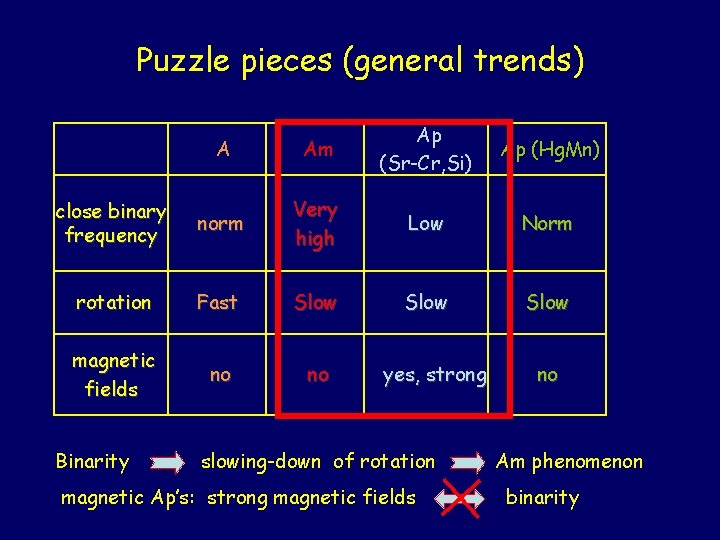
Puzzle pieces (general trends) A Am Ap (Sr-Cr, Si) close binary frequency norm Very high Low Norm rotation Fast Slow magnetic fields no no Binarity yes, strong slowing-down of rotation magnetic Ap’s: strong magnetic fields Ap (Hg. Mn) no Am phenomenon binarity
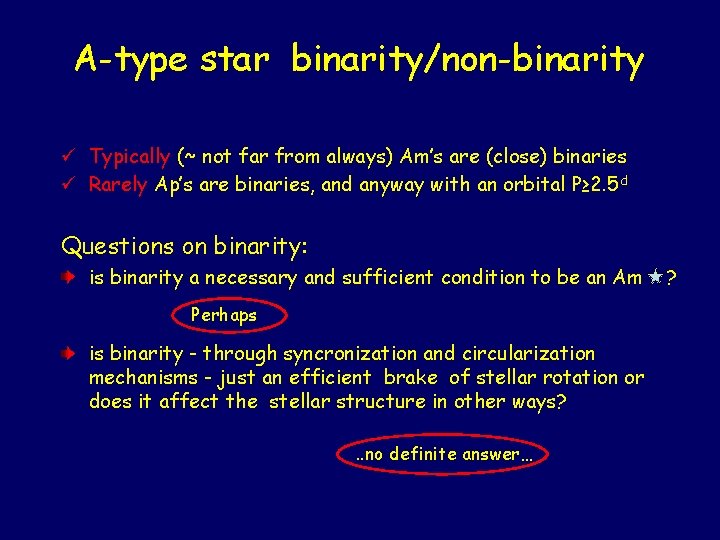
A-type star binarity/non-binarity ü Typically (~ not far from always) Am’s are (close) binaries ü Rarely Ap’s are binaries, and anyway with an orbital P≥ 2. 5 d Questions on binarity: is binarity a necessary and sufficient condition to be an Am Perhaps is binarity - through syncronization and circularization mechanisms - just an efficient brake of stellar rotation or does it affect the stellar structure in other ways? . . no definite answer… ?
. . . l king for the answers The synchronization (and circularization) theories are usually compared withthe Observed (orbital) Period Distributions (OPD), the rotational data and the eccentricity - P plots. Three sorts of problems: Limits of the available theories or in their application Small and non homogeneous available samples with sufficiently accurate elements Selection effects on the OPD
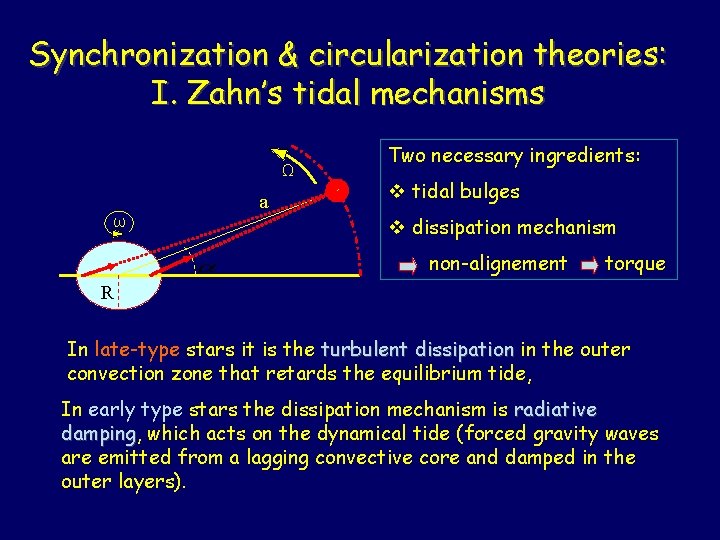
Synchronization & circularization theories: I. Zahn’s tidal mechanisms Ω a ω Two necessary ingredients: v tidal bulges v dissipation mechanism non-alignement torque R In late-type stars it is the turbulent dissipation in the outer convection zone that retards the equilibrium tide, In early type stars the dissipation mechanism is radiative damping, damping which acts on the dynamical tide (forced gravity waves are emitted from a lagging convective core and damped in the outer layers).
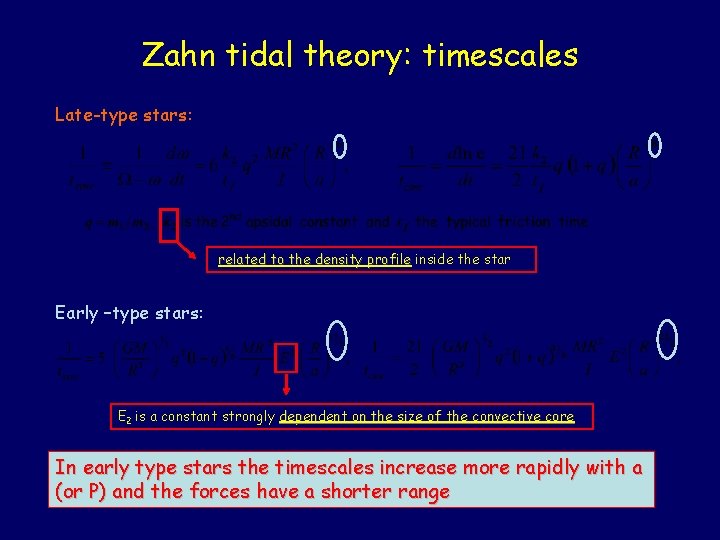
Zahn tidal theory: timescales Late-type stars: related to the density profile inside the star Early –type stars: E 2 is a constant strongly dependent on the size of the convective core In early type stars the timescales increase more rapidly with a (or P) and the forces have a shorter range
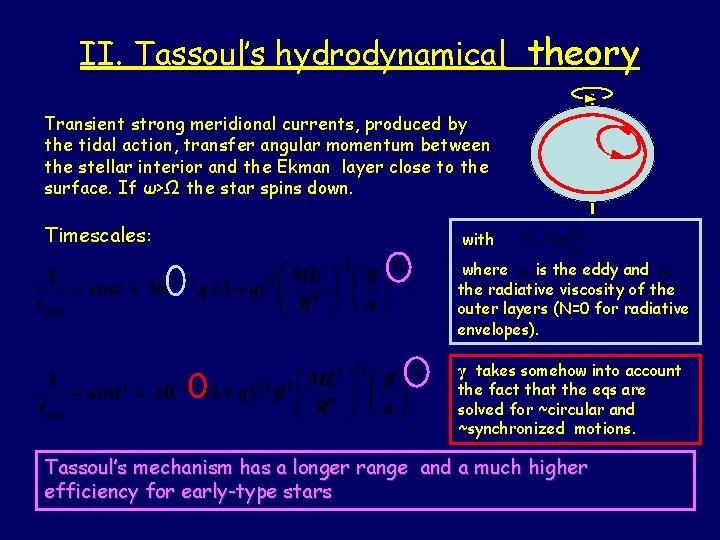
II. Tassoul’s hydrodynamical theory Transient strong meridional currents, produced by the tidal action, transfer angular momentum between the stellar interior and the Ekman layer close to the surface. If ω>Ω the star spins down. Timescales: with where is the eddy and the radiative viscosity of the outer layers (N=0 for radiative envelopes). γ takes somehow into account the fact that the eqs are solved for ~circular and ~synchronized motions. Tassoul’s mechanism has a longer range and a much higher efficiency for early-type stars
Warnings! !the use of timescales cannot replace the integration of the evolutionary equations, which require as well the introduction of stellar evolutionary models (see Claret et al. 1995, Claret et Cunha 1997) !Both theories are for quasi-circular & quasisynchronized orbits. Tassoul introduces an arbitrary factor (~10 -40) in the timescales. !The strong dependence of the processes on R/a requires systems with very accurate element determination.
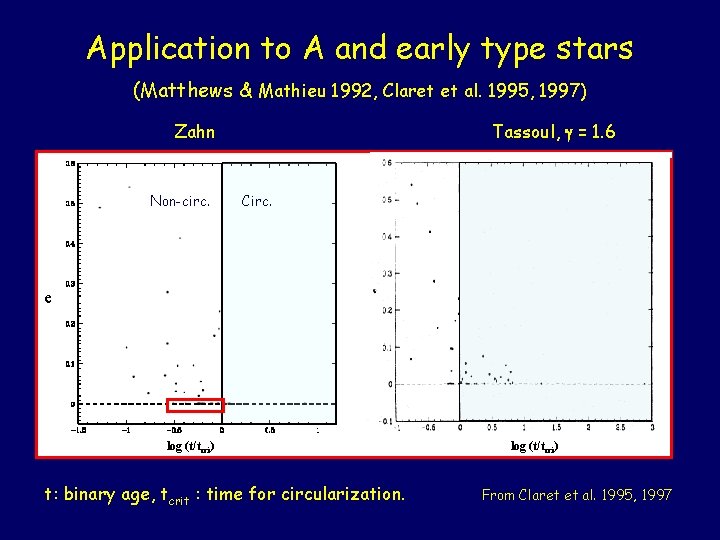
Application to A and early type stars (Matthews & Mathieu 1992, Claret et al. 1995, 1997) Zahn Non-circ. e Tassoul, = 1. 6 Circ. e log (t/tcri) t: binary age, tcrit : time for circularization. log (t/tcri) From Claret et al. 1995, 1997
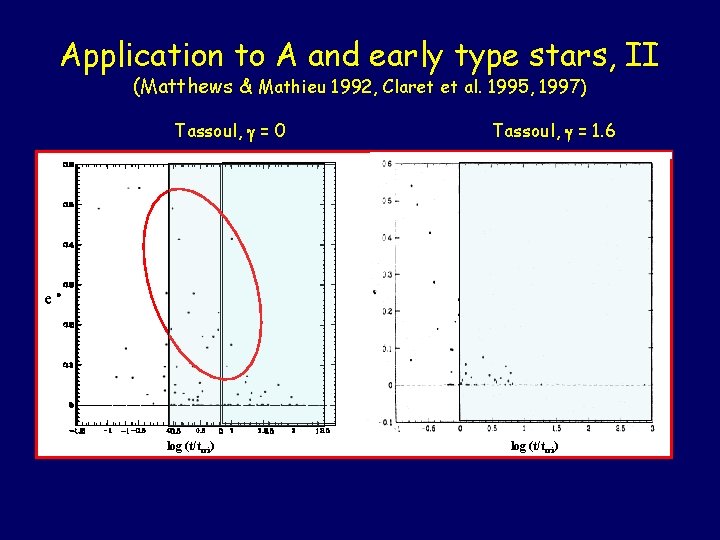
Application to A and early type stars, II (Matthews & Mathieu 1992, Claret et al. 1995, 1997) Tassoul, = 0 e Tassoul, = 1. 6 e log (t/tcri)
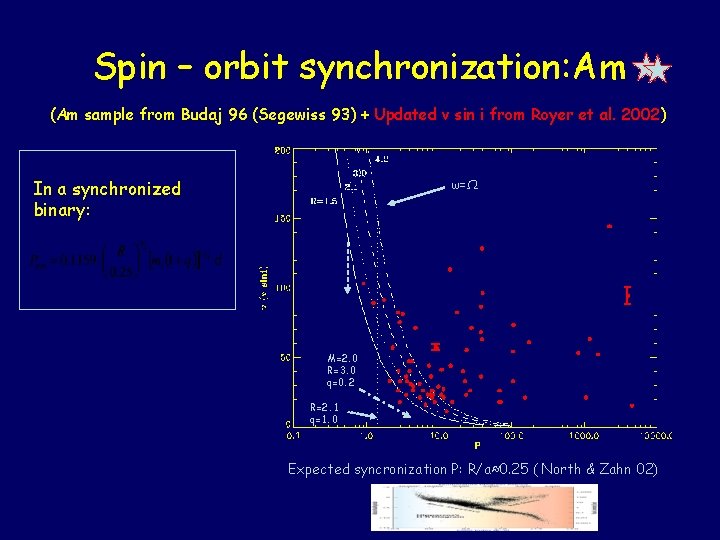
Spin – orbit synchronization: Am (Am sample from Budaj 96 (Segewiss 93) + Updated v sin i from Royer et al. 2002) In a synchronized binary: ω=Ω M=2. 0 R=3. 0 q=0. 2 R=2. 1 q=1. 0 Expected syncronization P: R/a≈0. 25 ( North & Zahn 02)
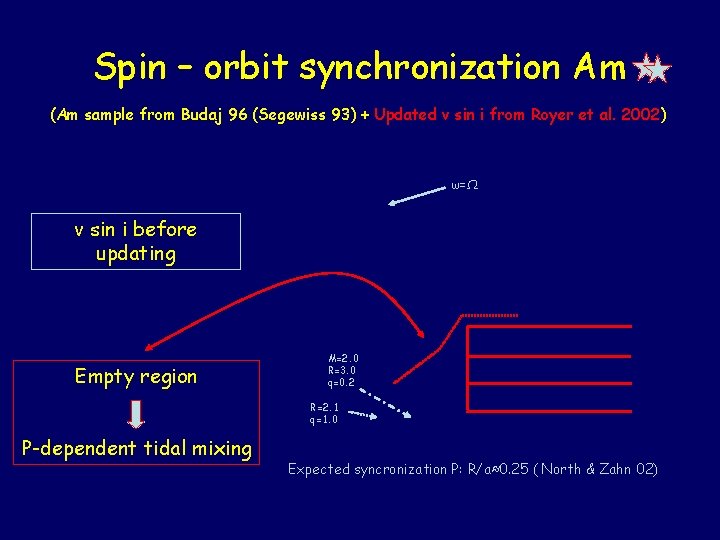
Spin – orbit synchronization Am (Am sample from Budaj 96 (Segewiss 93) + Updated v sin i from Royer et al. 2002) ω=Ω v sin i before updating Empty region M=2. 0 R=3. 0 q=0. 2 R=2. 1 q=1. 0 P-dependent tidal mixing Expected syncronization P: R/a≈0. 25 ( North & Zahn 02)
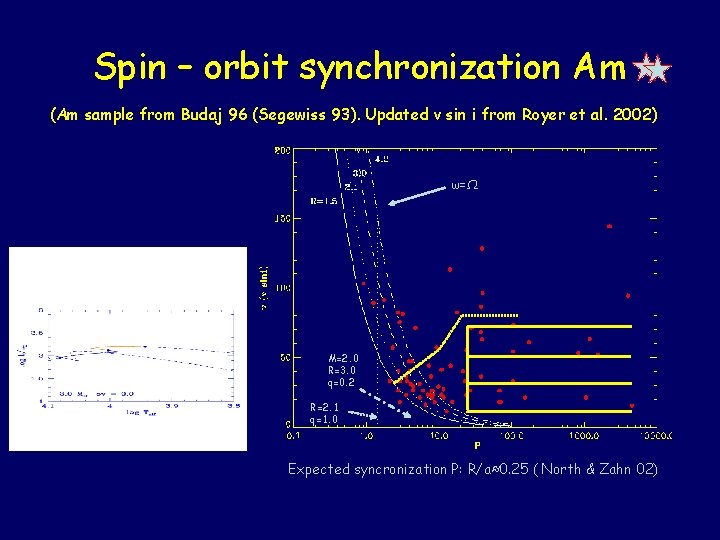
Spin – orbit synchronization Am (Am sample from Budaj 96 (Segewiss 93). Updated v sin i from Royer et al. 2002) ω=Ω M=2. 0 R=3. 0 q=0. 2 R=2. 1 q=1. 0 Expected syncronization P: R/a≈0. 25 ( North & Zahn 02)
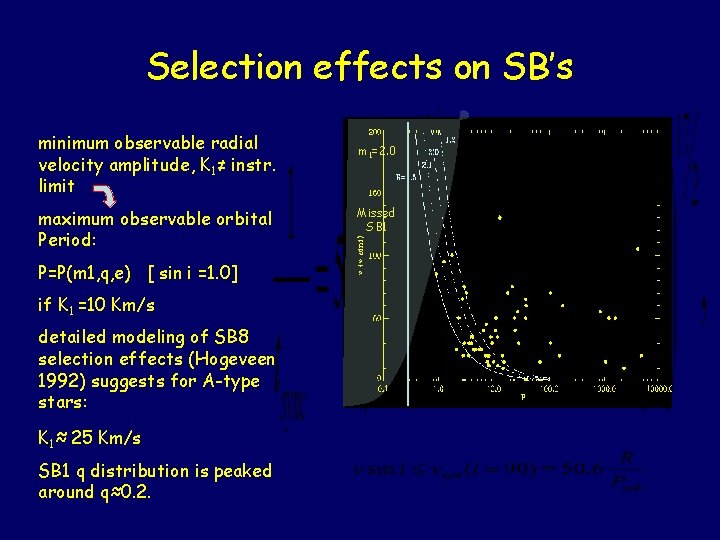
Selection effects on SB’s minimum observable radial velocity amplitude, K 1≠ instr. limit maximum observable orbital Period: P=P(m 1, q, e) [ sin i =1. 0] if K 1 =10 Km/s detailed modeling of SB 8 selection effects (Hogeveen 1992) suggests for A-type stars: K 1≈ 25 Km/s SB 1 q distribution is peaked around q≈0. 2. m 1=2. 0 Missed SB 1

- Slides: 44