
Arkansas Private Option to Arkansas Works Increasing coverage
- Slides: 25
Arkansas Private Option to Arkansas Works Increasing coverage & demand for services Clinta Ché Reed, Ph. D, RN, CNL-BC Keitha Griffith, DNP, RN, NEA-BC Sue Tedford, MNSc, APRN Arkansas Center for Nursing, Inc.
Purpose Providing coverage to large number of previously uninsured Arkansans has the potential to improve the health of a notoriously unhealthy state. However, it is not known if the current number of providers and access to services is adequate to meet the needs of this group. The Arkansas Center for Nursing (ACN) is working to investigate this issue and mobilize the workforce to promote a culture of health in Arkansas.
Objectives • Discuss the Medicaid Section 1115 waiver in Arkansas and the potential impact on demand for healthcare services, especially primary care services. • Discuss the work of the Arkansas Center for Nursing in educating stakeholders and legislators about the ability of nurses to meet the healthcare needs of the citizens of Arkansas.
Arkansas Center for Nursing, Inc. Progress since last Forum meeting • • Organizational Chart & Bylaws Incorporated as AR nonprofit First Board meeting – June 1, 2016 First Fundraiser – Keeper of the Lamp art show/silent auction First Annual Meeting – November 2016 Work & Activities Granted funding through AR State Board of Nursing budget
Arkansas Private Option In 2013, Arkansas introduced an innovative plan using Medicaid expansion funds to purchase private insurance for qualified beneficiaries. Received one of the nation’s first Section 1115 waivers to implement the Arkansas Private Option. By September 2016, the AR uninsured rate dropped by 57%
Goals of AR Private Option Program • Develop delivery system efficiencies • Promote insurance carrier participation • Enhance insurance competition • Ensure care continuity • Leverage private insurance market to access providers
Increasing coverage in Arkansas • Medically fragile placed in traditional Medicaid • Majority of qualified beneficiaries use AR state marketplace to obtain private insurances • Income < 100 % federal poverty level ($11, 880 for individual) • No cost-sharing at point of care for covered services • Income > 100 % federal poverty level • Modest cost-sharing within federal limits • Out-of-pocket costs capped annually < 5% of family income.
AR Private Option – Results • Improved access to primary care • Improved access to prescription medications • Decreased reliance on the emergency departments • Increase in use of preventive care • Improved low-income adults perceptions of quality and health compared to states not expanding Medicaid program.
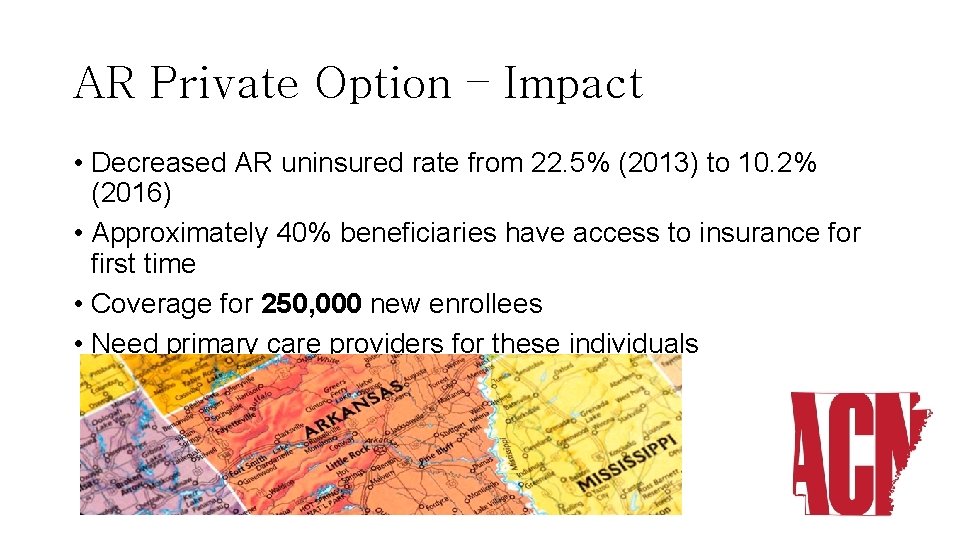
AR Private Option – Impact • Decreased AR uninsured rate from 22. 5% (2013) to 10. 2% (2016) • Approximately 40% beneficiaries have access to insurance for first time • Coverage for 250, 000 new enrollees • Need primary care providers for these individuals
Arkansas Works In April 2016, the Arkansas legislature voted to overhaul the program into Arkansas Works. • Arkansas Works allows the expansion of Medicaid to continue with some modifications including a work requirement and asset test not permitted under the Obama Administration. • This change appears to appeal to both Democrats and Republicans in the state.
Demand for services - Nationally • AAMC report & projections • • Moderate to high use of APRNs & PAs Population Health Achievement scenario Health Care Utilization Equity scenario Arkansas meets several criteria for increased demand for providers • Maldistribution of providers • AAMC Consumer Access Survey • Pre- vs. Post-ACA – More able to afford services, more report not being able to find a provider
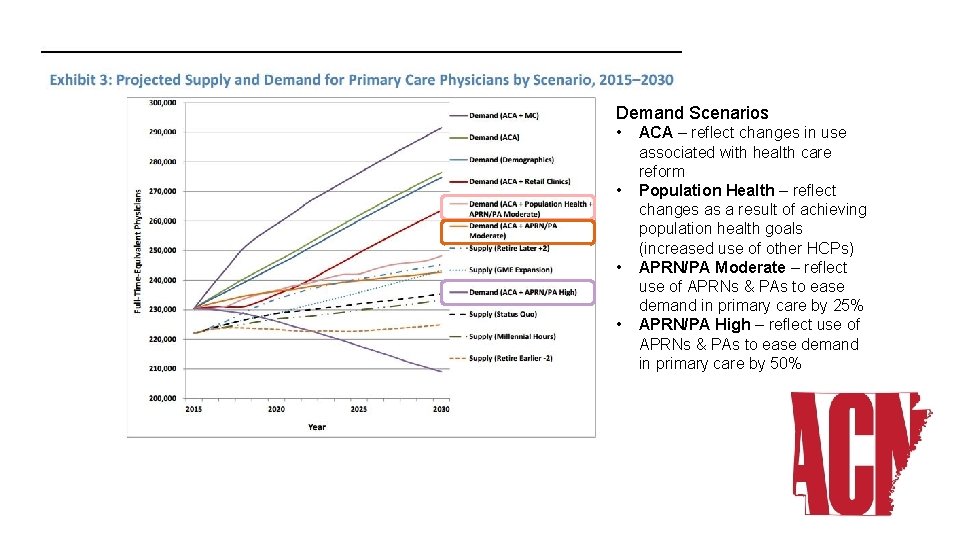
Demand Scenarios • • ACA – reflect changes in use associated with health care reform Population Health – reflect changes as a result of achieving population health goals (increased use of other HCPs) APRN/PA Moderate – reflect use of APRNs & PAs to ease demand in primary care by 25% APRN/PA High – reflect use of APRNs & PAs to ease demand in primary care by 50%
Demand for Services - Arkansas • Arkansas Health Workforce Strategic Plan (2012) • 500, 000 Arkansans live in HPSAs • Characteristics of AR population – aging population, disease burden, low health literacy • Limited pipeline of health providers • More insured citizens • ACHI physician supply data • Maldistribution of providers • Drive-time analysis • Policy Position Statement #31 -33 – Improve & expand workforce. Increase primary care capacity. Enhance roles for non-physician providers (October 2016)
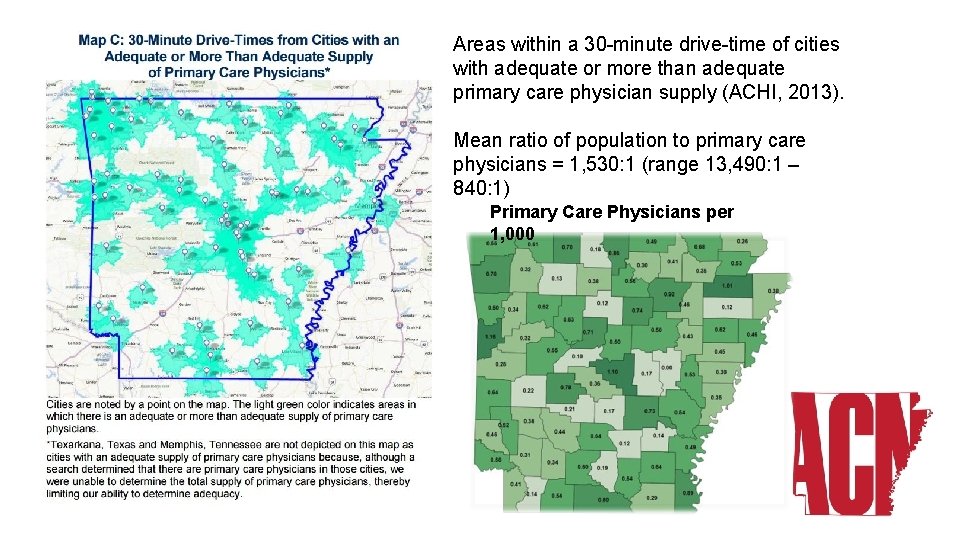
Areas within a 30 -minute drive-time of cities with adequate or more than adequate primary care physician supply (ACHI, 2013). Mean ratio of population to primary care physicians = 1, 530: 1 (range 13, 490: 1 – 840: 1) Primary Care Physicians per 1, 000
Arkansas Center for Research in Economics • Nurse Practitioners… • • • Provide excellent primary care Less expensive than physicians, easier to increase numbers More likely to move to rural areas than physicians Provide excellent care for diabetes and other chronic conditions Increased use is likely to spur innovation in health care delivery Allows primary care physicians to focus on more complex services
Proposed legislation in Arkansas • Removal of mandated Collaborative Practice Agreement (HB 1181, HB 1186) • PCP recognition for primary care APRNs (HB 1182) • Schedule II prescriptive authority (HB 1228) • Global signature authority (HB 1180) Major Pushback Bills • APRN regulation by Board of Medicine (HB 1254) • Joint oversight of APRNs by Boards of Nursing & Medicine (HB 1525)
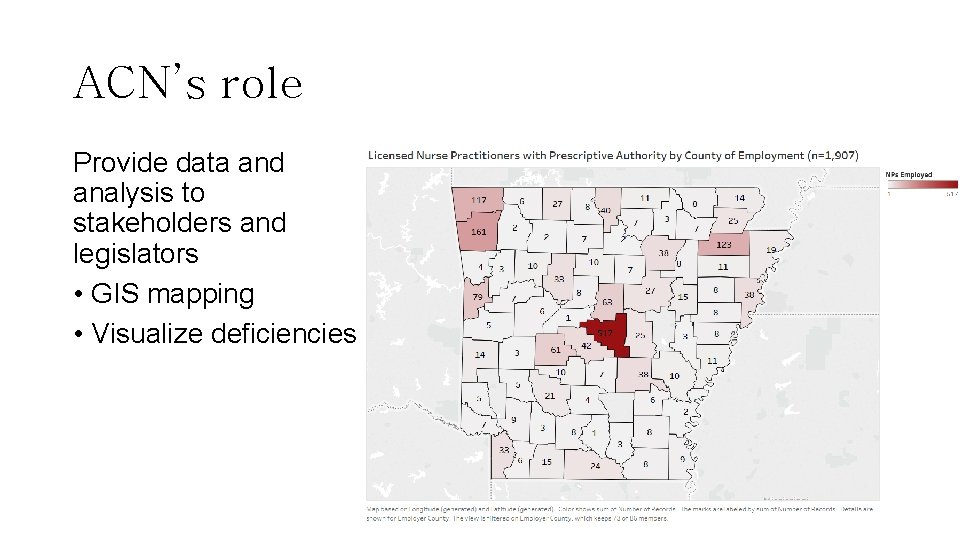
ACN’s role Provide data and analysis to stakeholders and legislators • GIS mapping • Visualize deficiencies
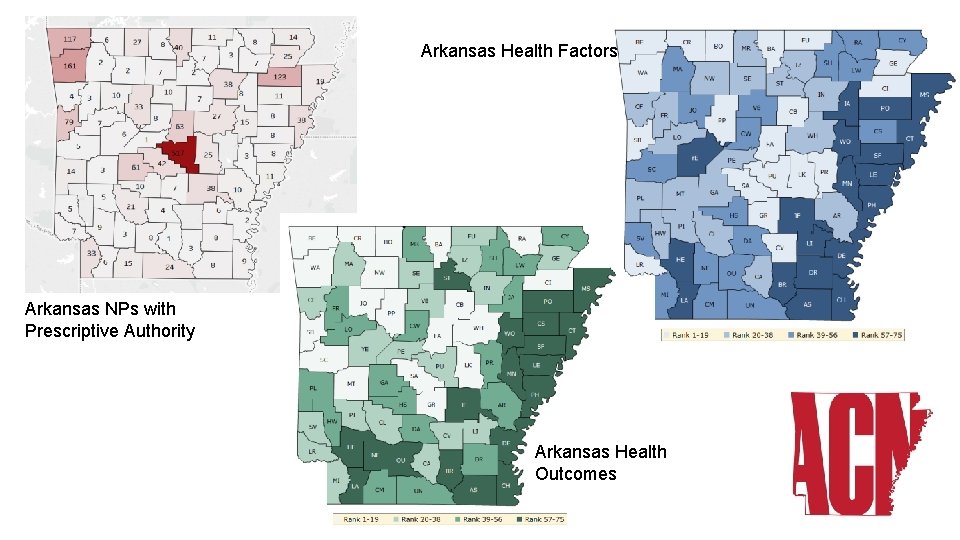
Arkansas Health Factors Arkansas NPs with Prescriptive Authority Arkansas Health Outcomes
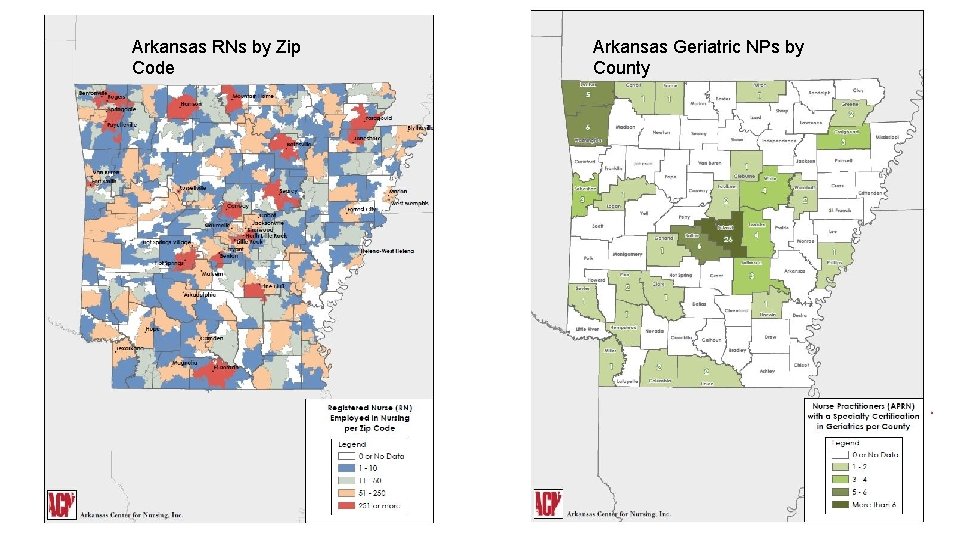
Arkansas RNs by Zip Code Arkansas Geriatric NPs by County
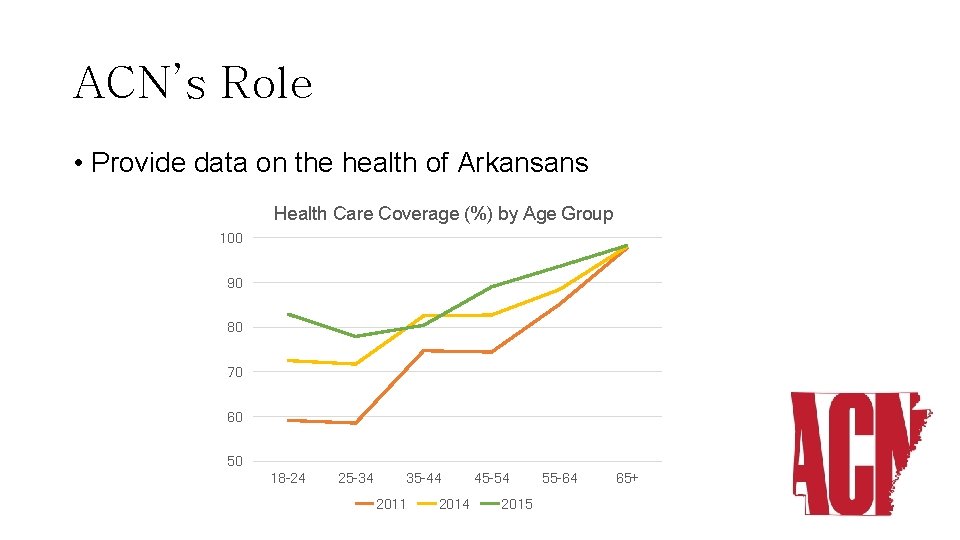
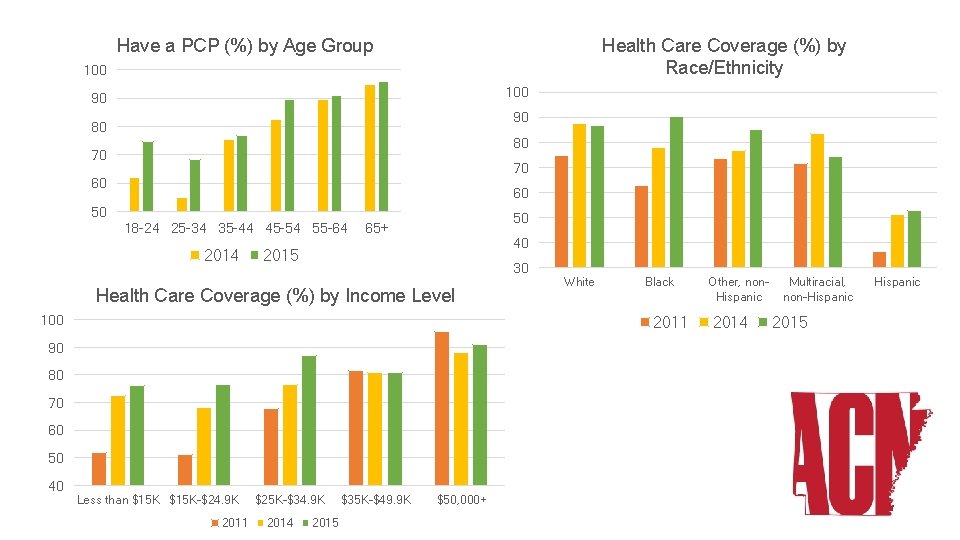
ACN’s Role • Provide data on the health of Arkansans Health Care Coverage (%) by Age Group 100 90 80 70 60 50 18 -24 25 -34 35 -44 2011 2014 45 -54 2015 55 -64 65+
Health Care Coverage (%) by Race/Ethnicity Have a PCP (%) by Age Group 100 90 90 80 80 70 70 60 60 50 18 -24 25 -34 35 -44 45 -54 55 -64 2014 50 65+ 40 2015 30 Health Care Coverage (%) by Income Level 100 Black 2011 90 80 70 60 50 40 White Less than $15 K-$24. 9 K 2011 $25 K-$34. 9 K 2014 2015 $35 K-$49. 9 K $50, 000+ Other, non. Hispanic 2014 Multiracial, non-Hispanic 2015 Hispanic
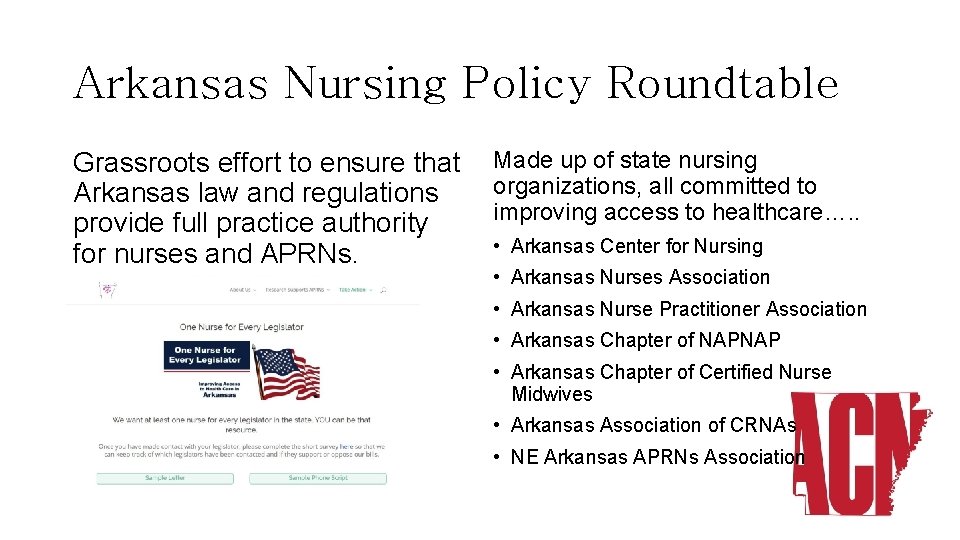
Arkansas Nursing Policy Roundtable Grassroots effort to ensure that Arkansas law and regulations provide full practice authority for nurses and APRNs. Made up of state nursing organizations, all committed to improving access to healthcare…. . • Arkansas Center for Nursing • Arkansas Nurses Association • Arkansas Nurse Practitioner Association • Arkansas Chapter of NAPNAP • Arkansas Chapter of Certified Nurse Midwives • Arkansas Association of CRNAs • NE Arkansas APRNs Association
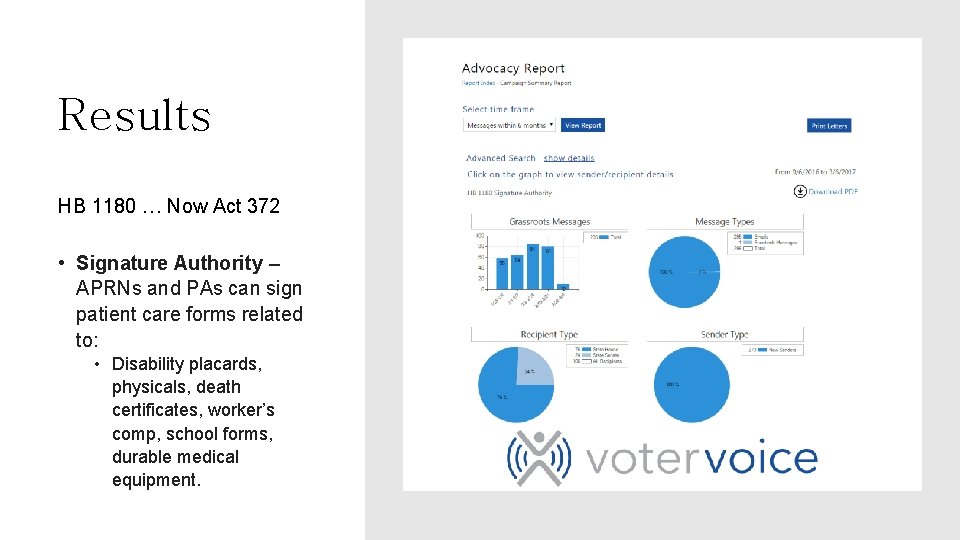
Results HB 1180 … Now Act 372 • Signature Authority – APRNs and PAs can sign patient care forms related to: • Disability placards, physicals, death certificates, worker’s comp, school forms, durable medical equipment.
Legislation Results • Removal of mandated Collaborative Practice Agreement (HB 1181, HB 1186) • PCP recognition for primary care APRNs (HB 1182) • Schedule II prescriptive authority (HB 1228) Major Pushback Bills • APRN regulation by Board of Medicine (HB 1254) • Joint oversight of APRNs by Boards of Nursing & Medicine (HB 1525)
Implications for Future Work • Maintain motivated nursing workforce • Improve communication with ACHI and physician groups • Address other nursing policy issues • Re-introduce bills in next legislative session