
Arkansas Budget and Appropriation Process Fiscal Services Division
Arkansas Budget and Appropriation Process Fiscal Services Division 1 Capitol Mall, 5 th Floor 1
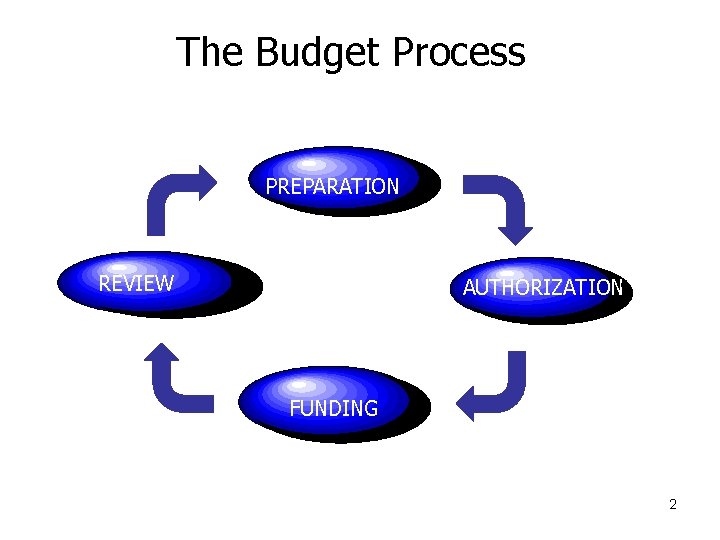
The Budget Process PREPARATION REVIEW AUTHORIZATION FUNDING 2
PREPARATION The Budget Process revolves around the State Fiscal Year which begins July 1 and ends June 30. The Preparation Phase Budget Calendars: 3
PREPARATION The Preparation Phase Roles In Budget Preparation 4
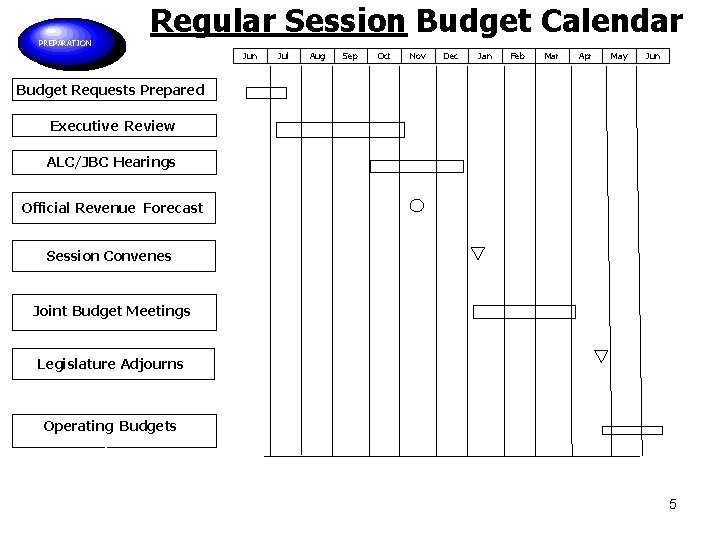
PREPARATION Regular Session Budget Calendar Jun Jul Aug Sep Oct Nov Dec Jan Feb Mar Apr May Jun Budget Requests Prepared Executive Review ALC/JBC Hearings Official Revenue Forecast Session Convenes Joint Budget Meetings Legislature Adjourns Operating Budgets Prepared 5
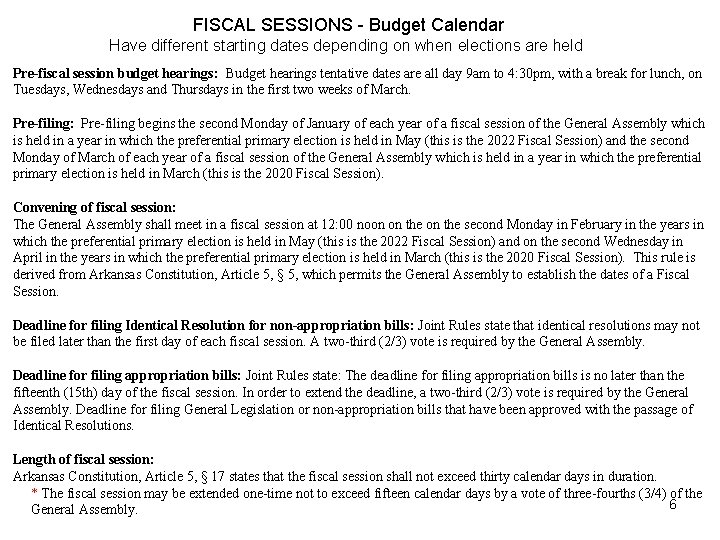
FISCAL SESSIONS - Budget Calendar Have different starting dates depending on when elections are held Pre-fiscal session budget hearings: Budget hearings tentative dates are all day 9 am to 4: 30 pm, with a break for lunch, on Tuesdays, Wednesdays and Thursdays in the first two weeks of March. Pre-filing: Pre-filing begins the second Monday of January of each year of a fiscal session of the General Assembly which is held in a year in which the preferential primary election is held in May (this is the 2022 Fiscal Session) and the second Monday of March of each year of a fiscal session of the General Assembly which is held in a year in which the preferential primary election is held in March (this is the 2020 Fiscal Session). Convening of fiscal session: The General Assembly shall meet in a fiscal session at 12: 00 noon on the second Monday in February in the years in which the preferential primary election is held in May (this is the 2022 Fiscal Session) and on the second Wednesday in April in the years in which the preferential primary election is held in March (this is the 2020 Fiscal Session). This rule is derived from Arkansas Constitution, Article 5, § 5, which permits the General Assembly to establish the dates of a Fiscal Session. Deadline for filing Identical Resolution for non-appropriation bills: Joint Rules state that identical resolutions may not be filed later than the first day of each fiscal session. A two-third (2/3) vote is required by the General Assembly. Deadline for filing appropriation bills: Joint Rules state: The deadline for filing appropriation bills is no later than the fifteenth (15 th) day of the fiscal session. In order to extend the deadline, a two-third (2/3) vote is required by the General Assembly. Deadline for filing General Legislation or non-appropriation bills that have been approved with the passage of Identical Resolutions. Length of fiscal session: Arkansas Constitution, Article 5, § 17 states that the fiscal session shall not exceed thirty calendar days in duration. * The fiscal session may be extended one-time not to exceed fifteen calendar days by a vote of three-fourths (3/4) of the 6 General Assembly.
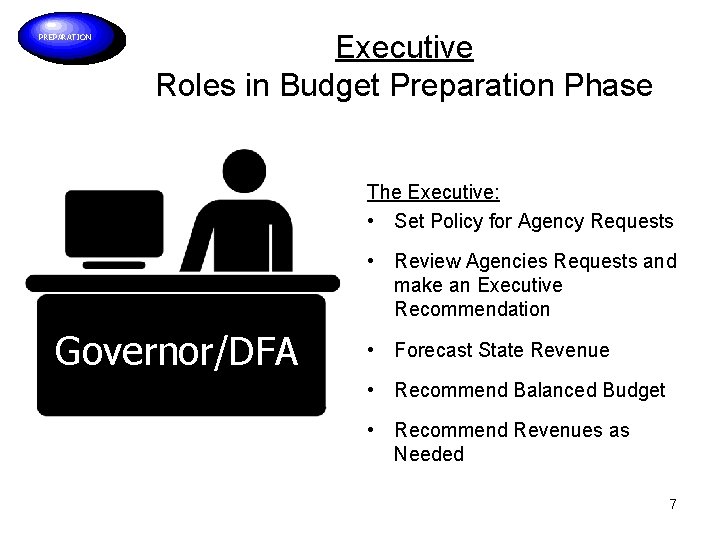
PREPARATION Executive Roles in Budget Preparation Phase The Executive: • Set Policy for Agency Requests • Review Agencies Requests and make an Executive Recommendation Governor/DFA • Forecast State Revenue • Recommend Balanced Budget • Recommend Revenues as Needed 7
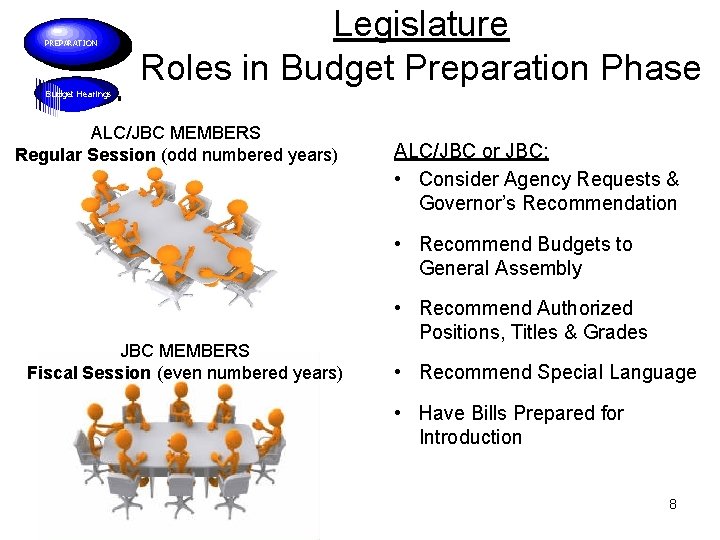
PREPARATION Legislature Roles in Budget Preparation Phase Budget Hearings ALC/JBC MEMBERS Regular Session (odd numbered years) ALC/JBC or JBC: • Consider Agency Requests & Governor’s Recommendation • Recommend Budgets to General Assembly JBC MEMBERS Fiscal Session (even numbered years) • Recommend Authorized Positions, Titles & Grades • Recommend Special Language • Have Bills Prepared for Introduction 8
gs Pag Budg Submit Execut (DFABudg AL Commit Budget
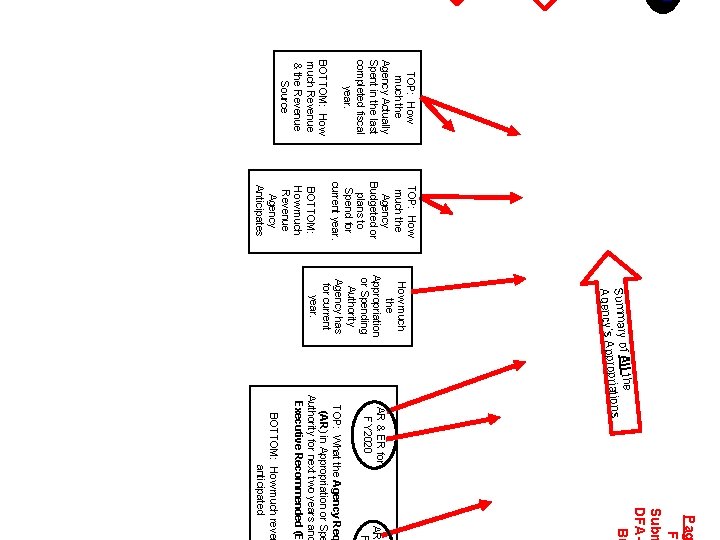
TOP: How much the Agency Actually Spent in the last completed fiscal year. BOTTOM: How much Revenue & the Revenue Source TOP: How much the Agency Budgeted or plans to Spend for current year. BOTTOM: How much Revenue Agency Anticipates AR & ER for FY 2020 All the Summary of propriations Agency's Ap How much the Appropriation or Spending Authority Agency has for current year. Pag Fo Subm DFABu AR F TOP: What the Agency Req (AR) in Appropriation or Spe Authority for next two years and Executive Recommended (E BOTTOM: How much reven anticipated
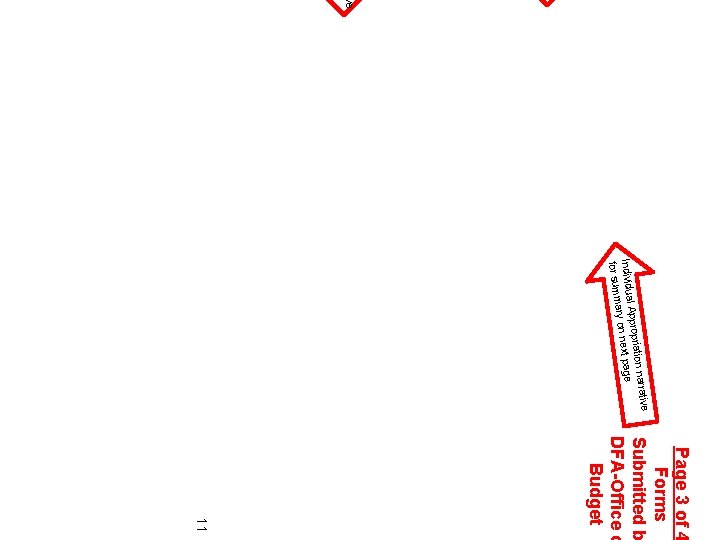
ve ative ation narr l Appropri page Individua xt ary on ne for summ Page 3 of 4 Forms Submitted b DFA-Office o Budget 11
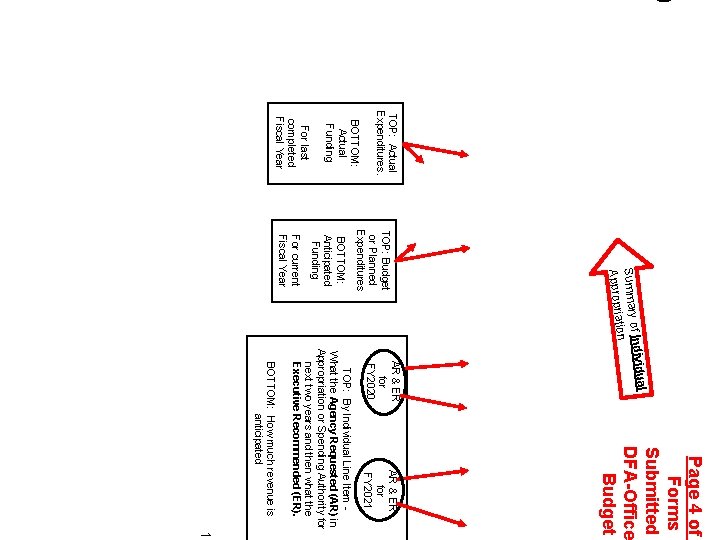
TOP: Actual Expenditures. BOTTOM: Actual Funding For last completed Fiscal Year l Page 4 of Forms Submitted b DFA-Office Budget AR & ER for FY 2021 TOP: By Individual Line Item What the Agency Requested (AR) in Appropriation or Spending Authority for next two years and then what the Executive Recommended (ER). AR & ER for FY 2020 ua of Individ Summary tion Appropria TOP: Budget or Planned Expenditures BOTTOM: Anticipated Funding For current Fiscal Year BOTTOM: How much revenue is anticipated 12
PREPARATION Budget Request Commitment Items • Regular Salaries • Operating Expenses • Capital Outlay • Professional Fees 13
PREPARATION Budget Hearings = Appropriation Bills • Appropriation bills for each State Agency and Institution of Higher Education are drafted as approved in Budget Hearings. • Arkansas Legislative Council & Joint Budget Committee (ALC/JBC) conducts budget hearings for Regular Session and Joint Budget Committee (JBC) conducts budget hearings for Fiscal Session. • The Appropriation bills will have: – Numbers of Positions as recommended (in a report) by the Personnel Subcommittee and adopted by the full committee. – Special Language as recommended (in a report) by the Special Language Subcommittee and adopted by the full committee – Appropriation levels or spending authority as adopted by the full committee. 14
AUTHORIZATION APPROPRIATION AN APPROPRIATION GIVES THE AGENCY THE AUTHORITY TO SPEND MONEY IF AND WHEN IT BECOMES AVAILABLE. 15
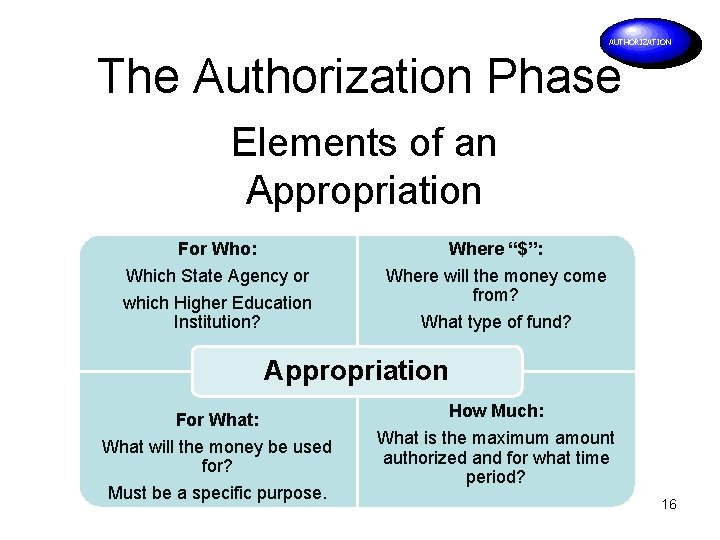
AUTHORIZATION The Authorization Phase Elements of an Appropriation For Who: Where “$”: Which State Agency or which Higher Education Institution? Where will the money come from? What type of fund? Appropriation For What: What will the money be used for? Must be a specific purpose. How Much: What is the maximum amount authorized and for what time period? 16
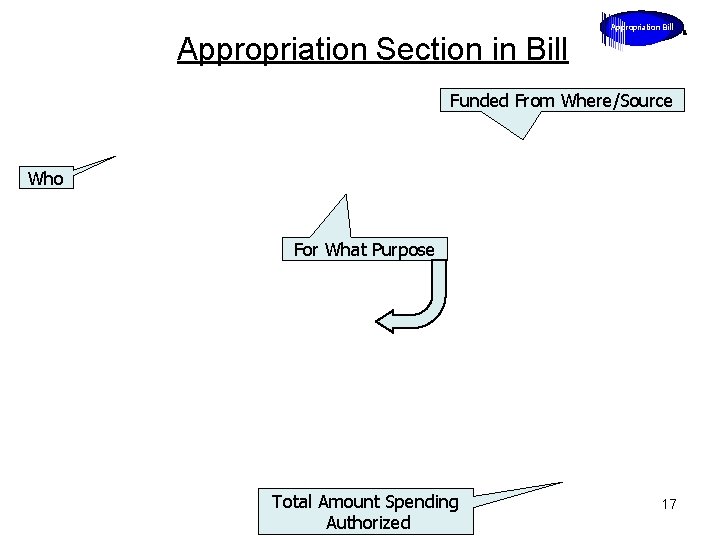
Appropriation Section in Bill Appropriation Bill Funded From Where/Source Who For What Purpose Total Amount Spending Authorized 17
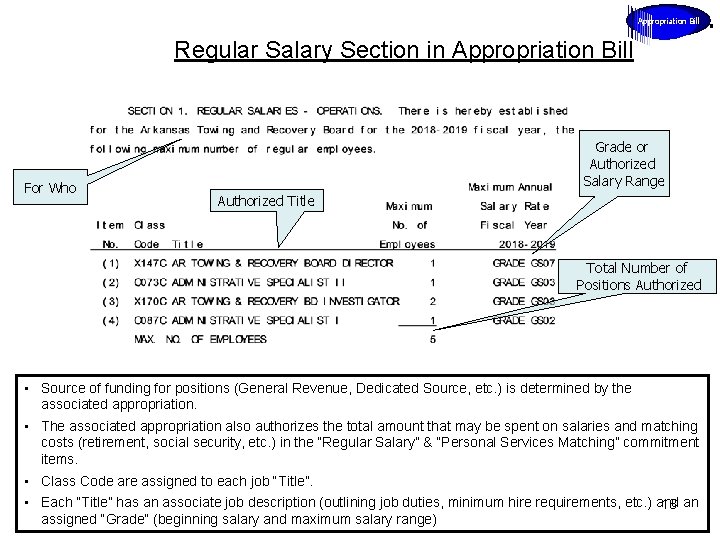
Appropriation Bill Regular Salary Section in Appropriation Bill For Who Grade or Authorized Salary Range Authorized Title Total Number of Positions Authorized • Source of funding for positions (General Revenue, Dedicated Source, etc. ) is determined by the associated appropriation. • The associated appropriation also authorizes the total amount that may be spent on salaries and matching costs (retirement, social security, etc. ) in the “Regular Salary” & “Personal Services Matching” commitment items. • Class Code are assigned to each job “Title”. • Each “Title” has an associate job description (outlining job duties, minimum hire requirements, etc. ) and an 18 assigned “Grade” (beginning salary and maximum salary range)
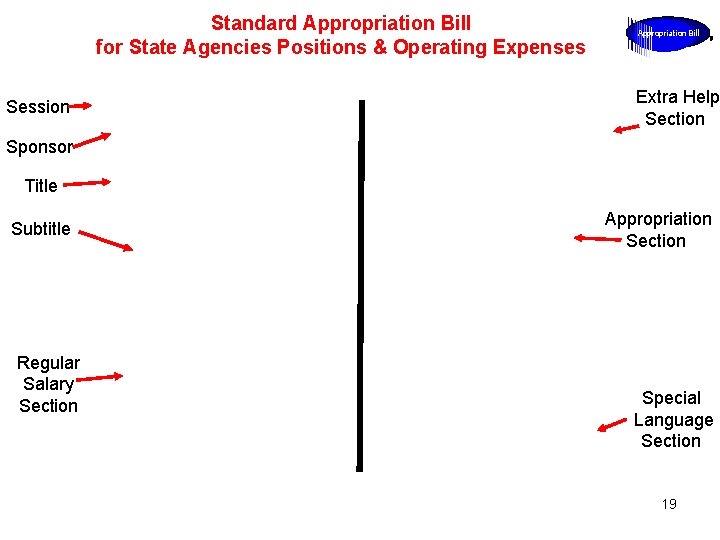
Standard Appropriation Bill for State Agencies Positions & Operating Expenses Session Appropriation Bill Extra Help Section Sponsor Title Subtitle Regular Salary Section Appropriation Section Special Language Section 19
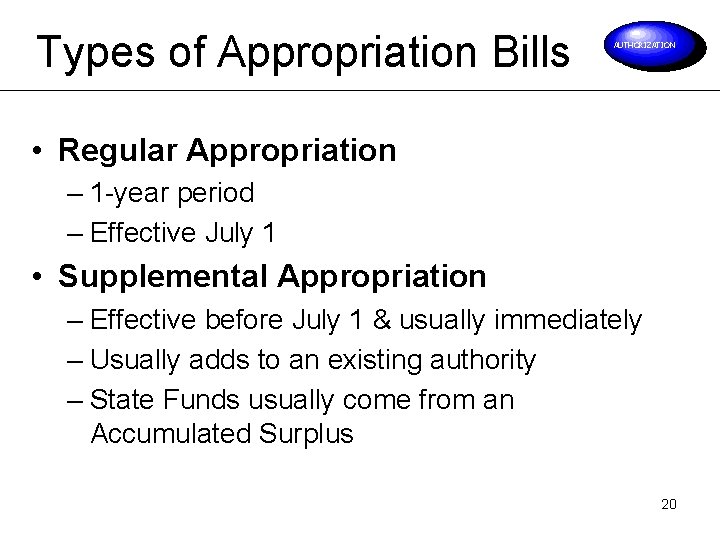
Types of Appropriation Bills AUTHORIZATION • Regular Appropriation – 1 -year period – Effective July 1 • Supplemental Appropriation – Effective before July 1 & usually immediately – Usually adds to an existing authority – State Funds usually come from an Accumulated Surplus 20
AUTHORIZATION • Construction – State Funds usually from General Improvement Fund (Surplus & Interest Earnings) • Reappropriations – Allows the Agency to spend the balance of an appropriation provided by another General Assembly. – Not new authority to spend – Usually for old construction projects 21
Authorization Phase – Constitutional Restrictions AUTHORIZATION Ø 1 Year Limit on Appropriations. Ø Single Subject. Ø General Appropriation Bill must "embrace nothing but appropriations for the ordinary expenses of the executive, legislative and judicial departments of the state” & be passed first. Ø Appropriations must be in dollars and cents. Ø Appropriations require 3/4 ths vote to pass. 22
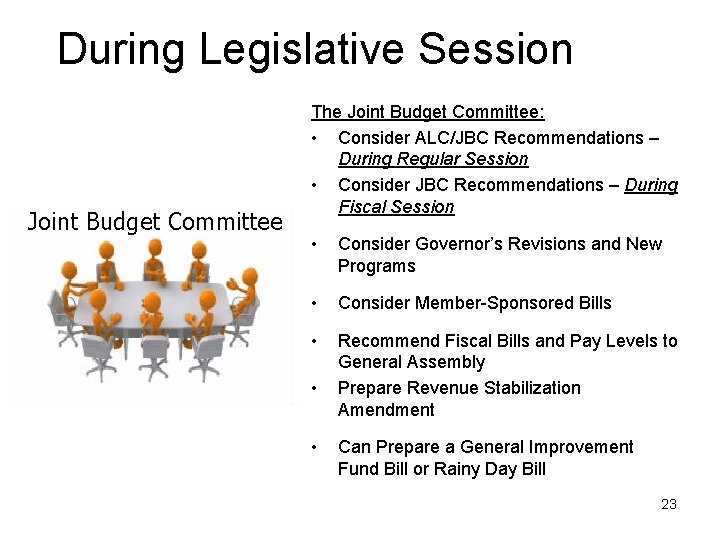
During Legislative Session Joint Budget Committee The Joint Budget Committee: • Consider ALC/JBC Recommendations – During Regular Session • Consider JBC Recommendations – During Fiscal Session • Consider Governor’s Revisions and New Programs • Consider Member-Sponsored Bills • Recommend Fiscal Bills and Pay Levels to General Assembly Prepare Revenue Stabilization Amendment • • Can Prepare a General Improvement Fund Bill or Rainy Day Bill 23
Funding for Appropriation Bills FUNDING Now that there is Appropriation or Spending Authority where does the money or funding come from? 24
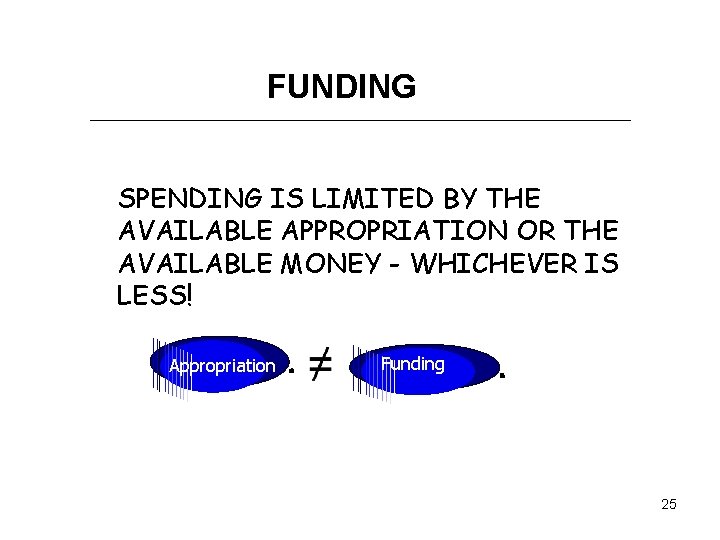
FUNDING SPENDING IS LIMITED BY THE AVAILABLE APPROPRIATION OR THE AVAILABLE MONEY - WHICHEVER IS LESS! Appropriation Funding 25
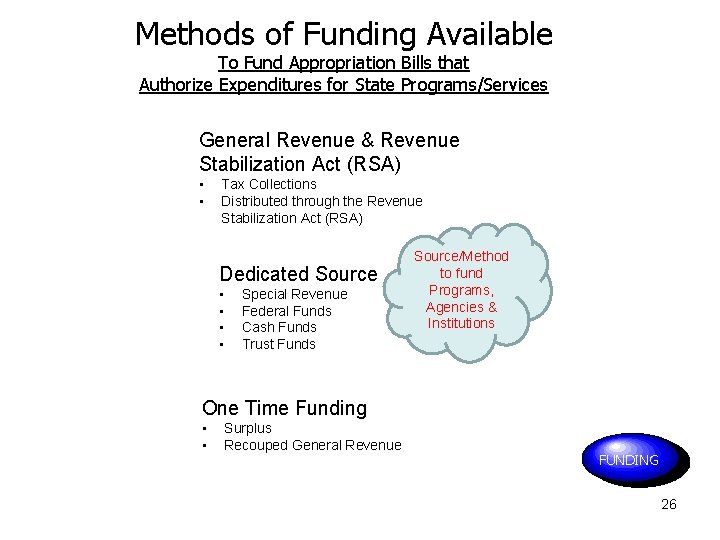
Methods of Funding Available To Fund Appropriation Bills that Authorize Expenditures for State Programs/Services General Revenue & Revenue Stabilization Act (RSA) • • Tax Collections Distributed through the Revenue Stabilization Act (RSA) Dedicated Source • • Special Revenue Federal Funds Cash Funds Trust Funds Source/Method to fund Programs, Agencies & Institutions One Time Funding • • Surplus Recouped General Revenue FUNDING 26
GENERAL REVENUES • Funds received by the State from fees and taxes levied on the general population of the state. • The proceeds are not designated to be used for a particular purpose but are allocated every year by acts of the General Assembly. • Interest earnings are retained in the State Treasury. • 3% to 4% deducted for administrative service charge • Legislature distributes funds each year through Revenue Stabilization Law for operating budgets • Recovered fund balances usually authorized for supplemental, rainy day and construction fund (exceptions are Education and Higher Education Institutions) Same Examples: Sales tax, Income tax, Insurance premium tax, Racing taxes, Alcoholic beverages FUNDING 27
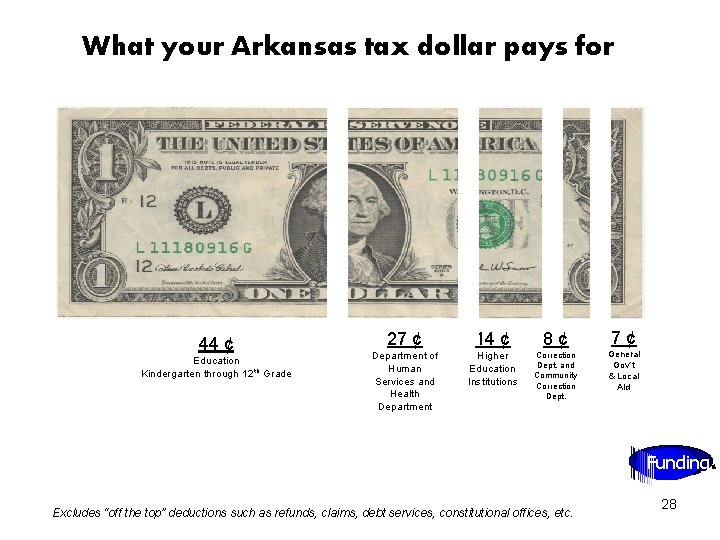
What your Arkansas tax dollar pays for 44 ¢ Education Kindergarten through 12 th Grade 27 ¢ 14 ¢ 8 ¢ 7 ¢ Department of Human Services and Health Department Higher Education Institutions Correction Dept. and Community Correction Dept. General Gov’t & Local Aid Funding Excludes “off the top” deductions such as refunds, claims, debt services, constitutional offices, etc. 28
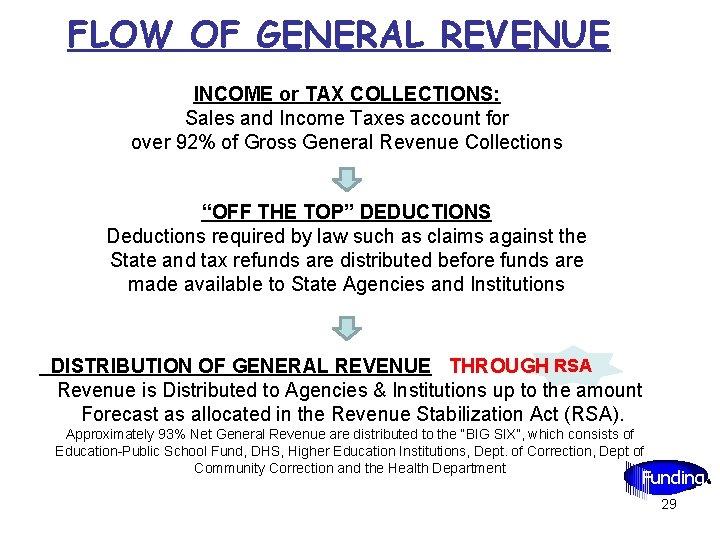
FLOW OF GENERAL REVENUE INCOME or TAX COLLECTIONS: Sales and Income Taxes account for over 92% of Gross General Revenue Collections “OFF THE TOP” DEDUCTIONS Deductions required by law such as claims against the State and tax refunds are distributed before funds are made available to State Agencies and Institutions DISTRIBUTION OF GENERAL REVENUE THROUGH RSA Revenue is Distributed to Agencies & Institutions up to the amount Forecast as allocated in the Revenue Stabilization Act (RSA). Approximately 93% Net General Revenue are distributed to the “BIG SIX”, which consists of Education-Public School Fund, DHS, Higher Education Institutions, Dept. of Correction, Dept of Community Correction and the Health Department Funding 29
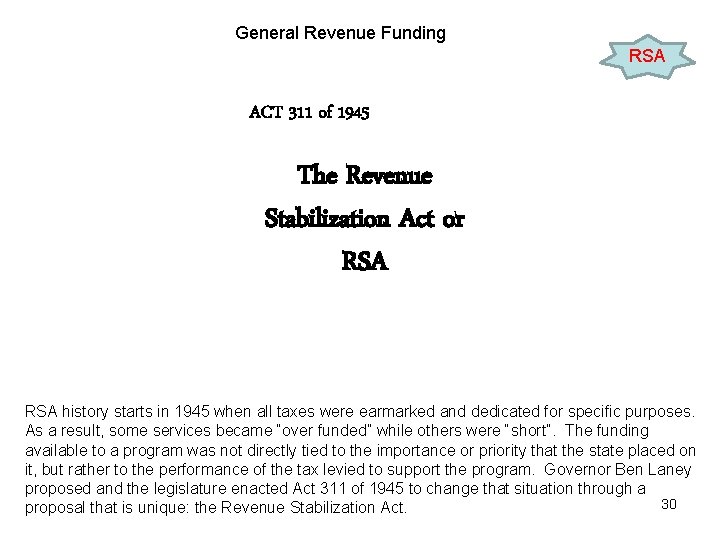
General Revenue Funding RSA ACT 311 of 1945 The Revenue Stabilization Act or RSA history starts in 1945 when all taxes were earmarked and dedicated for specific purposes. As a result, some services became “over funded” while others were “short”. The funding available to a program was not directly tied to the importance or priority that the state placed on it, but rather to the performance of the tax levied to support the program. Governor Ben Laney proposed and the legislature enacted Act 311 of 1945 to change that situation through a 30 proposal that is unique: the Revenue Stabilization Act.
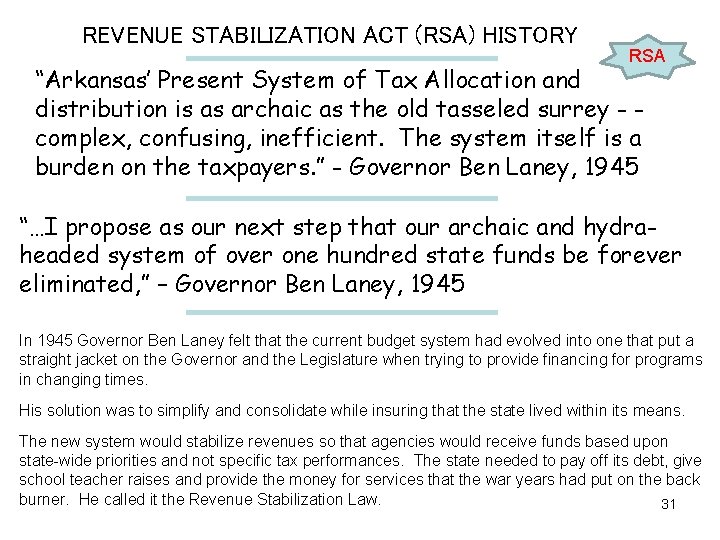
REVENUE STABILIZATION ACT (RSA) HISTORY RSA “Arkansas’ Present System of Tax Allocation and distribution is as archaic as the old tasseled surrey - complex, confusing, inefficient. The system itself is a burden on the taxpayers. ” - Governor Ben Laney, 1945 “…I propose as our next step that our archaic and hydraheaded system of over one hundred state funds be forever eliminated, ” – Governor Ben Laney, 1945 In 1945 Governor Ben Laney felt that the current budget system had evolved into one that put a straight jacket on the Governor and the Legislature when trying to provide financing for programs in changing times. His solution was to simplify and consolidate while insuring that the state lived within its means. The new system would stabilize revenues so that agencies would receive funds based upon state-wide priorities and not specific tax performances. The state needed to pay off its debt, give school teacher raises and provide the money for services that the war years had put on the back burner. He called it the Revenue Stabilization Law. 31
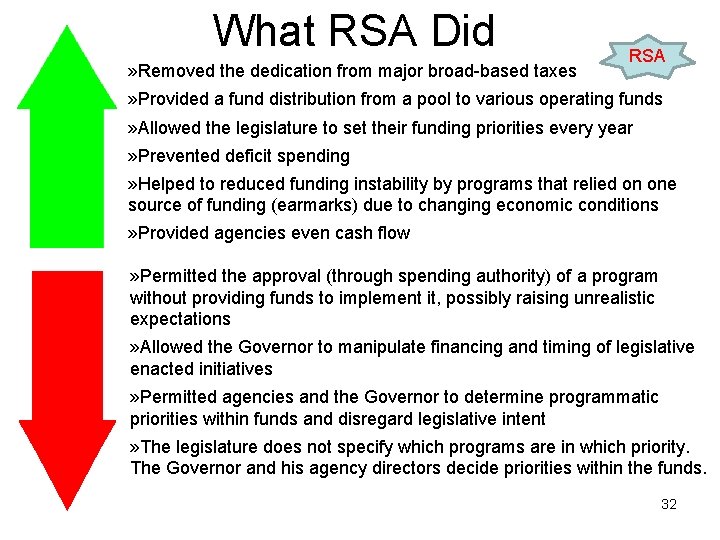
What RSA Did » Removed the dedication from major broad-based taxes RSA » Provided a fund distribution from a pool to various operating funds » Allowed the legislature to set their funding priorities every year » Prevented deficit spending » Helped to reduced funding instability by programs that relied on one source of funding (earmarks) due to changing economic conditions » Provided agencies even cash flow » Permitted the approval (through spending authority) of a program without providing funds to implement it, possibly raising unrealistic expectations » Allowed the Governor to manipulate financing and timing of legislative enacted initiatives » Permitted agencies and the Governor to determine programmatic priorities within funds and disregard legislative intent » The legislature does not specify which programs are in which priority. The Governor and his agency directors decide priorities within the funds. 32
RSA What is Category A, B and C in RSA? The Revenue Stabilization Law deals only with distributing GENERAL REVENUES and it distributes money as we get it. You can look at our funding system as “Contingency Budgeting” because the amount of general revenues an agency will receive depends upon the amount of tax dollars actually collected. The legislature enacts amendments to the Revenue Stabilization Law every year. The allocations contain the legislature’s priorities and are designated “A”, “B”, and “C”. “A” must be funded before “B, ” which must be funded before “C, ” etc. There may be several categories after “A” or there may only be one. A revenue estimate of A + 50% of B means that there will be enough to finance all the “A” category and 1/2 or 50% of the “B” category. 33
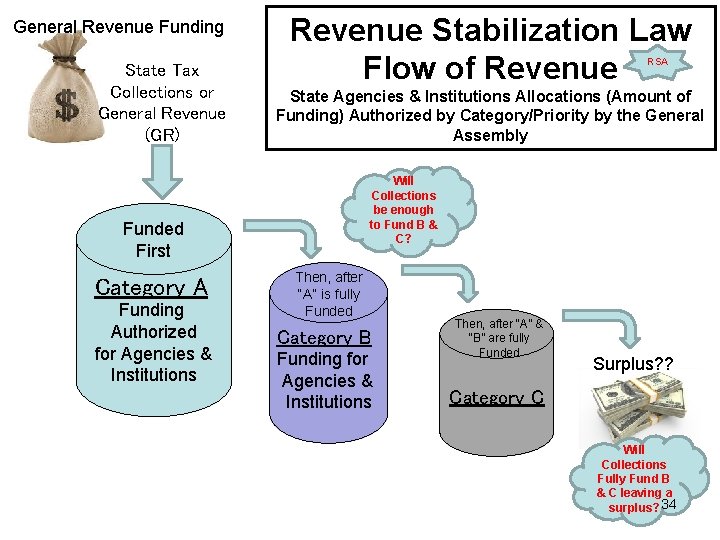
General Revenue Funding State Tax Collections or General Revenue (GR) Revenue Stabilization Law Flow of Revenue RSA State Agencies & Institutions Allocations (Amount of Funding) Authorized by Category/Priority by the General Assembly Will Collections be enough to Fund B & C? Funded First Category A Funding Authorized for Agencies & Institutions Then, after “A” is fully Funded Category B Funding for Agencies & Institutions Then, after “A” & “B” are fully Funded Surplus? ? Category C Will Collections Fully Fund B & C leaving a surplus? 34
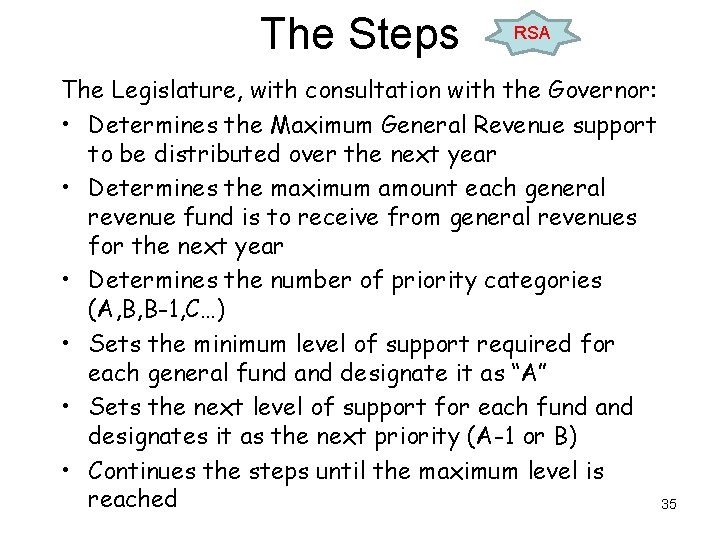
The Steps RSA The Legislature, with consultation with the Governor: • Determines the Maximum General Revenue support to be distributed over the next year • Determines the maximum amount each general revenue fund is to receive from general revenues for the next year • Determines the number of priority categories (A, B, B-1, C…) • Sets the minimum level of support required for each general fund and designate it as “A” • Sets the next level of support for each fund and designates it as the next priority (A-1 or B) • Continues the steps until the maximum level is reached 35
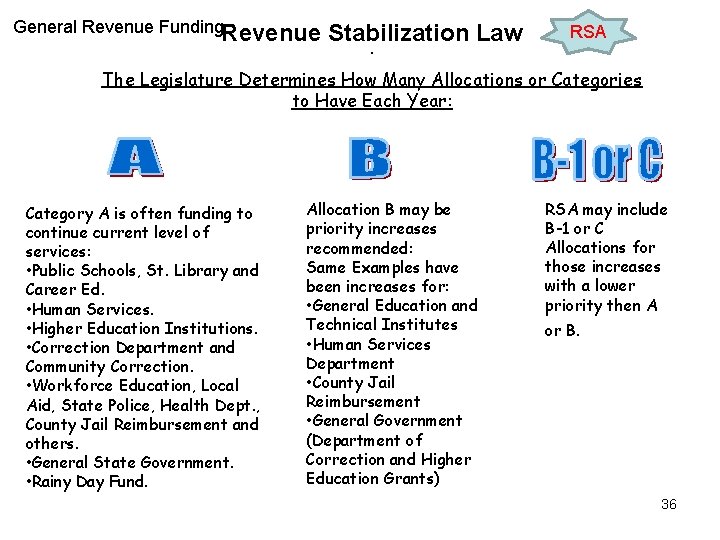
General Revenue Funding. Revenue Stabilization Law. RSA The Legislature Determines How Many Allocations or Categories to Have Each Year: Category A is often funding to continue current level of services: • Public Schools, St. Library and Career Ed. • Human Services. • Higher Education Institutions. • Correction Department and Community Correction. • Workforce Education, Local Aid, State Police, Health Dept. , County Jail Reimbursement and others. • General State Government. • Rainy Day Fund. Allocation B may be priority increases recommended: Same Examples have been increases for: • General Education and Technical Institutes • Human Services Department • County Jail Reimbursement • General Government (Department of Correction and Higher Education Grants) RSA may include B-1 or C Allocations for those increases with a lower priority then A or B. 36
RSA PRIORITIES RSA The legislature does not specify which programs are in which priority. The Governor and his agency directors decide priorities within the funds. 37
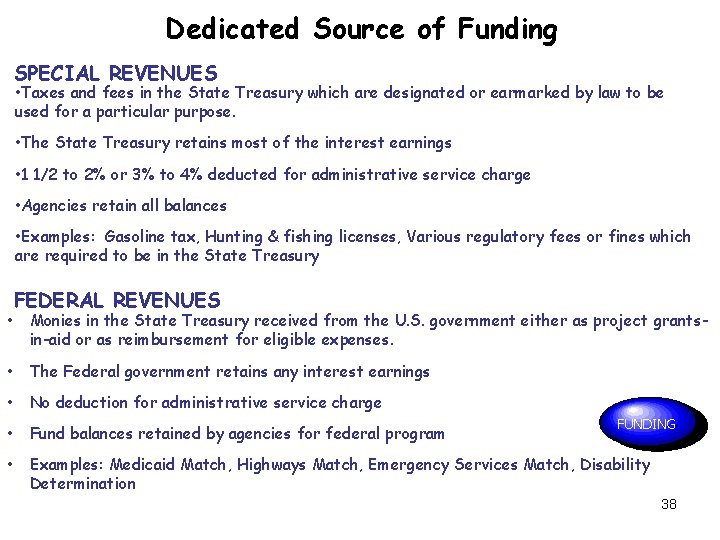
Dedicated Source of Funding SPECIAL REVENUES • Taxes and fees in the State Treasury which are designated or earmarked by law to be used for a particular purpose. • The State Treasury retains most of the interest earnings • 1 1/2 to 2% or 3% to 4% deducted for administrative service charge • Agencies retain all balances • Examples: Gasoline tax, Hunting & fishing licenses, Various regulatory fees or fines which are required to be in the State Treasury • FEDERAL REVENUES Monies in the State Treasury received from the U. S. government either as project grantsin-aid or as reimbursement for eligible expenses. • The Federal government retains any interest earnings • No deduction for administrative service charge • Fund balances retained by agencies for federal program • Examples: Medicaid Match, Highways Match, Emergency Services Match, Disability Determination FUNDING 38
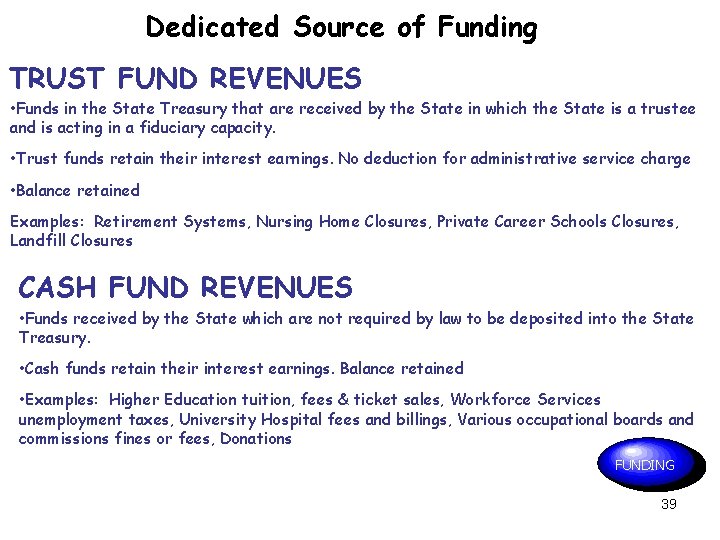
Dedicated Source of Funding TRUST FUND REVENUES • Funds in the State Treasury that are received by the State in which the State is a trustee and is acting in a fiduciary capacity. • Trust funds retain their interest earnings. No deduction for administrative service charge • Balance retained Examples: Retirement Systems, Nursing Home Closures, Private Career Schools Closures, Landfill Closures CASH FUND REVENUES • Funds received by the State which are not required by law to be deposited into the State Treasury. • Cash funds retain their interest earnings. Balance retained • Examples: Higher Education tuition, fees & ticket sales, Workforce Services unemployment taxes, University Hospital fees and billings, Various occupational boards and commissions fines or fees, Donations FUNDING 39
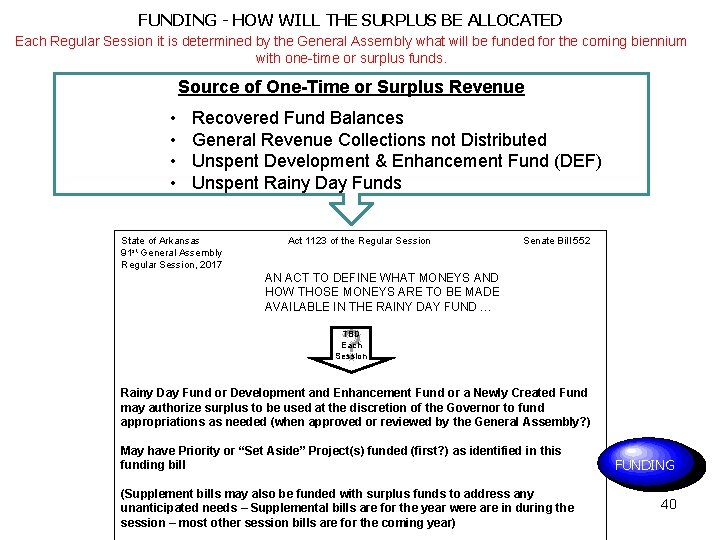
FUNDING - HOW WILL THE SURPLUS BE ALLOCATED Each Regular Session it is determined by the General Assembly what will be funded for the coming biennium with one-time or surplus funds. Source of One-Time or Surplus Revenue • • Recovered Fund Balances General Revenue Collections not Distributed Unspent Development & Enhancement Fund (DEF) Unspent Rainy Day Funds State of Arkansas 91 st General Assembly Regular Session, 2017 Act 1123 of the Regular Session Senate Bill 552 AN ACT TO DEFINE WHAT MONEYS AND HOW THOSE MONEYS ARE TO BE MADE AVAILABLE IN THE RAINY DAY FUND … TBD Each Session Rainy Day Fund or Development and Enhancement Fund or a Newly Created Fund may authorize surplus to be used at the discretion of the Governor to fund appropriations as needed (when approved or reviewed by the General Assembly? ) May have Priority or “Set Aside” Project(s) funded (first? ) as identified in this funding bill (Supplement bills may also be funded with surplus funds to address any unanticipated needs – Supplemental bills are for the year were are in during the session – most other session bills are for the coming year) FUNDING 40
Between Legislative Sessions REVIEW CHAFFIN v. ARK. GAME & FISH COMMISSION (1988) “. . . since the practice of review and advice violates the separation of powers doctrine, [it] is unconstitutional. ” 41
Legislative Council Subcommittees That Influence Budgets & Appropriations (Page 1 of 3) PEER: • Budget Adjustments • Misc. Federal Grants • Interagency Contracts REVIEW 42
Legislative Council Subcommittees That Influence Budgets & Appropriations (Continued Page 2 of 3) RULES & REGULATIONS • Various Agency Rules & Regulations PERSONNEL • Special Entry Rates • Personnel Policy Changes • Pay Plan REVIEW 43
Legislative Council Subcommittees That Influence Budgets & Appropriations (Continued Page 3 of 3) REVIEW • Contracts • Methods of Finance • Discretionary Grants CLAIMS REVIEW • Approved Claims Against the State • Appealed Claims REVIEW 44
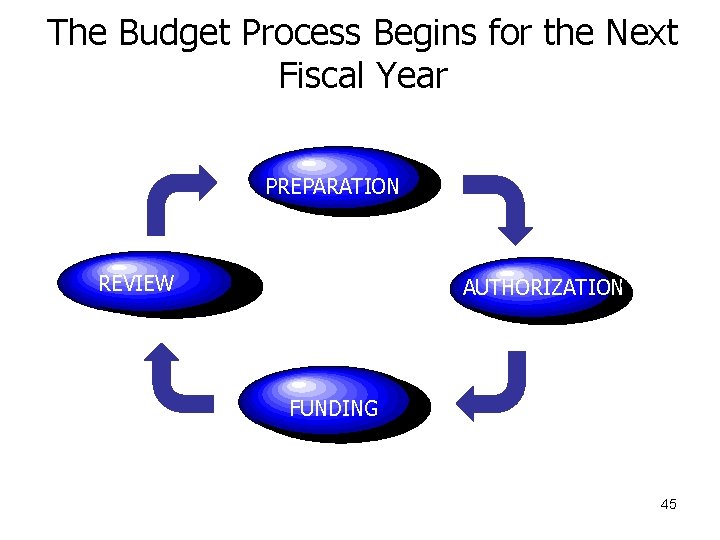
The Budget Process Begins for the Next Fiscal Year PREPARATION REVIEW AUTHORIZATION FUNDING 45
Legislative Process Summary Pages The next 5 pages provide a high level summary of the Budget Hearings and Legislative Session which overlap the different Phases in the overall Budget Process. 46
Legislative Process Summary Legislative Sessions • Regular Sessions are in January every odd number year 2017, 2019 etc. • Fiscal Session are held every even numbered years in February. Regular Session Budget Hearings for Regular Sessions start in the preceding October • Example: 2017 Regular Session budget hearings start October 2016. • Regular Session Budget Hearings are held by Arkansas Legislative Council and the Joint Budget Committee (ALC/JBC). • All State Agencies and Institutions submit their request for the next two years. • ALC/JBC often assigns subcommittees to review specific items or requests by Agencies and Institutions. • The Personnel Subcommittee examines position, titles, grades, number of position and other related personnel items. • The Special Language Subcommittee Examines substantive or temporary non codified language. Regular Session starts the second Monday in January 47
Legislative Process Summary Fiscal Session First Fiscal Session was held in 2010 and take place every even numbered year. Fiscal Sessions are limited to Budget items or appropriation bills unless substantive legislation is authorized by the General Assembly with Identical Resolution passed by both chambers on the First Day of the Fiscal Sessions are limited to 30 days unless extended by the General Assembly up to a maximum of 15 additional days (45 days is the maximum allowed). JBC conducts the Pre Fiscal Session Budget Hearings JBC meets and conducts business during the Fiscal Sessions the same as during a Regular Session. 48
Legislative Process Summary After the Budget hearings and during both the Regular and Fiscal session the members of the Joint Budget Committee meet to: • Evaluate and consider the ALC/JBC recommendations, made during budget hearing, before recommending the bills to the general assembly. • Consider any Governor’s proposed changes and new initiatives. • Consider individual member sponsored bills. • Recommend various fiscal law changes and state employee pay level legislation to the general assembly. • Recommend an amendment to the Revenue Stabilization Law to determine General Revenue spending. • Recommend what if anything to do with surplus or one-time moneys that have become available. Use for Improvements, state infrastructure needs, unanticipated needs, federal match, city and county government needs, rainy day fund, long term reserve fund, etc. 49
Legislative Process Summary Joint Budget Committee (JBC) meets during the session: • JBC meets each week during the session at the call of the Chairs • Usually Tuesday through Thursday from 9 am to 10 am in Big Mac A • All appropriation bills, which grant each Agency and Institution spending authority, are initially referred to JBC • JBC may modify, hold or recommend the agency or institution bill to the House and Senate Chamber for enactment. • • Once passed out of JBC they are placed on the House and Senate Budget Calendars. JBC often assigns subcommittees to more closely examine parts of the appropriation bills prior to taking action the bill. Examples: • The Personnel Subcommittee examines position, titles, grades, number of position and other related personnel items referred to it by JBC. • The Special Language Subcommittee Examines substantive or temporary non codified language in appropriation bills in bills referred to it by JBC. 50
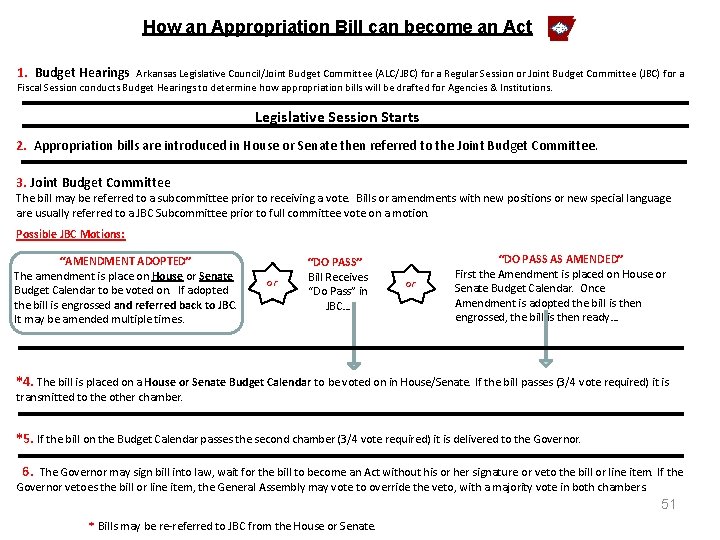
How an Appropriation Bill can become an Act 1. Budget Hearings Arkansas Legislative Council/Joint Budget Committee (ALC/JBC) for a Regular Session or Joint Budget Committee (JBC) for a Fiscal Session conducts Budget Hearings to determine how appropriation bills will be drafted for Agencies & Institutions. Legislative Session Starts 2. Appropriation bills are introduced in House or Senate then referred to the Joint Budget Committee. 3. Joint Budget Committee The bill may be referred to a subcommittee prior to receiving a vote. Bills or amendments with new positions or new special language are usually referred to a JBC Subcommittee prior to full committee vote on a motion. Possible JBC Motions: “AMENDMENT ADOPTED” The amendment is place on House or Senate Budget Calendar to be voted on. If adopted the bill is engrossed and referred back to JBC. It may be amended multiple times. or “DO PASS” Bill Receives “Do Pass” in JBC… or “DO PASS AS AMENDED” First the Amendment is placed on House or Senate Budget Calendar. Once Amendment is adopted the bill is then engrossed, the bill is then ready… *4. The bill is placed on a House or Senate Budget Calendar to be voted on in House/Senate. If the bill passes (3/4 vote required) it is transmitted to the other chamber. *5. If the bill on the Budget Calendar passes the second chamber (3/4 vote required) it is delivered to the Governor. 6. The Governor may sign bill into law, wait for the bill to become an Act without his or her signature or veto the bill or line item. If the Governor vetoes the bill or line item, the General Assembly may vote to override the veto, with a majority vote in both chambers. 51 * Bills may be re-referred to JBC from the House or Senate.
Thank you! If we can be of any assistance to you please contact the Bureau of Legislative Research - Fiscal Services Division 1 Capitol Mall, 5 th Floor. 52
- Slides: 52