
Arkansas Academic Partnership in Public Child Welfare Arkansas
Arkansas Academic Partnership in Public Child Welfare & Arkansas Division of Children & Family Services
Purpose q Assist the Division of Children and Family Services (DCFS) in Educating Prospective Child Welfare Professionals And Training Current DCFS Family Service Workers q Enhance And Support Family-Centered Systems Reform In Both Public Child Welfare And Academic University Settings. Arkansas Academic Partnership in Public Child Welfare
Points of Interest ü Comprised of two major DCFS contracts held with University of Arkansas (UAF) & University of Arkansas (UALR)/Mid. SOUTH. ü Each contract contains shared program deliverables. ü UALR/Mid. SOUTH contract contains additional program deliverables. ü Each of the eight Social Work Programs within the state ss represented in the Partnership. ü Arkansas Tech University has a Rehabilitation Sciences Program. ü All academic programs are accredited by the appropriate accreditation body. Arkansas Academic Partnership in Public Child Welfare
Historical Points of Interest � 1991 – Founded with UAF, UALR, UAPB, & DCFS � 1994 – ASU & Harding Join � 1995 – UA Monticello Joins � 1996 – ATU & Philander Smith Join � 1997 – SAU Joins � 2010 – Field Training For All New DCFS Supervisors Added Arkansas Academic Partnership in Public Child Welfare
Program Highlights Ø Maintains Five Training Academies Ø Develops & Provides New Staff Training Programs Ø Provides Field Training & Advanced Practice Education Ø Participates in DCFS Program Improvement Efforts Ø Provides Foster/Adoptive Parent Pre -Service Training Ø Completes Foster/Adoptive Home Assessments Ø Offers Continuing Education Arkansas Academic Partnership in Public Child Welfare
Program Highlights Ø Oversees Seven University Partner Sub-Contracts Ø Develops Training Materials Ø Develops & Maintains Operational Guidelines Ø Provides Field Training & Advanced Practice Education Ø Participates In DCFS Program Improvement Efforts Ø Provides Continuing Education Ø Creates Online Practice Tools & Skill Development Resources Arkansas Academic Partnership in Public Child Welfare
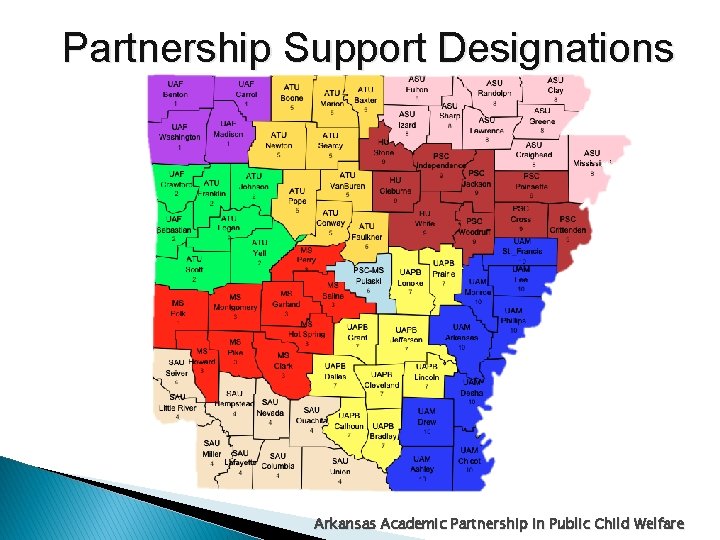
Partnership Support Designations Arkansas Academic Partnership in Public Child Welfare
UAF Academic Partnership Staff q Each Sub-Contracted University Has A IV-E Coordinator & At Least One Field Trainer. q Additional Partnership Staff Varies & May Include: Ø Training Design Coordinator. Ø Research Assistants. Ø Field Placement Coordinators. Ø Administrative/Clerical Support. Ø Fiscal Support Specialists. Arkansas Academic Partnership in Public Child Welfare
IV-E Coordinators v Manage a Specific University’s Contract Performance & Supervises Partnership Staff For That University v Serve As The Primary Points Of Contact for His/Her Corresponding DCFS Area v Coordinate Continued Education & Professional Development Opportunities v Serve on DCFS Workgroups As Needed Arkansas Academic Partnership in Public Child Welfare
Field Trainers Ø Deliver On-the-Job Training (OJT) To New Workers & Supervisors Ø Provide Continued Field Training Support To New Workers and Supervisors Throughout The First Year Of Employment In That Particular Role Ø Provide Advanced Practice Education (APE) Ø Conduct SAFE Home Studies for DCFS Foster/Adoptive Families As Needed Ø Serve On DCFS Workgroups As Needed Arkansas Academic Partnership in Public Child Welfare
University of Arkansas (UALR) Mid. SOUTH Training Academy
q Mid. SOUTH is the community service unit of the UALR School of Social Work. q Mid. SOUTH provides leadership, training, and product support in the areas of addiction, child welfare, technology, distance learning, and organizational development.
Training Academy Locations Ø Ø Ø Arkadelphia Fayetteville Jonesboro Little Rock Monticello
Academy Staff Ø Classroom Trainers Ø CHRIS Trainers Ø IVE Coordinator/Field Trainers Ø Foster/Adopt PRIDE Trainers Ø Curriculum Development Staff Ø Administrative Staff
Classroom Trainers q Provide New Staff Training, New Supervisor/Leadership Training, And New Program Assistant Trainings. q Develop And Offer A Variety Of IV-E Allowable Continuing Education Trainings Based On Current DCFS Training Needs. q Coordinate And Facilitate Regional Team Meetings q Serve on DCFS Workgroups As Needed. q Assist With SAFE Home Studies As Needed.
CHRIS Trainers q Provide CHRIS Navigation And Orientation Training. q Provide CHRIS Training Throughout New Staff Trainings. q Provide Additional CHRIS Related Trainings. q Provide “Super CHRIS” Training To DCFS Supervisors. q Conduct One-On-One CHRIS Training As Needed.
Foster/Adopt PRIDE Trainers § § § Coordinate Foster & Adoptive Parent Pre-Service & Continuing Education With DCFS Resource & Adoption Staff. Deliver 27 -Hour PRIDE Pre-Service Training To Prospective DCFS Foster & Adoptive Families. Deliver Continuing Education To Foster & Adoptive Families. May offer PRIDE Training In A Variety Of Formats To Meet Participant Needs (e. g. , Week Nights Or Weekends). Conduct SAFE Home Studies For PRIDE Participants (While Other Trainers May Assist With Home Studies, PRIDE Trainers Conduct The Majority).
Arkansas Division of Children & Family Services CARE * COMMIT * CONNECT
DCFS Mission To Keep Children Safe And Help Families. DCFS Will Respectfully Engage Families And Youth And Use Community-Based Services And Supports To Assist Parents In Successfully Caring For Their Children. We Will Focus On The Safety, Permanency, And Well-Being For All Children And Youth. CARE * COMMIT * CONNECT
DCFS Practice Model v Describes the Division’s efforts to renew its work with families and operationalize the Division’s mission statement. v Provides a framework for how everyone within the Division works together to serve children and families. CARE * COMMIT * CONNECT
DCFS Practice Model Goals Ø Safely keep children with their families. Ø Enhance well-being in all of our practice with families. Ø Ensure foster care and other placements support goals of permanency. CARE * COMMIT * CONNECT
DCFS Practice Model Goals § Use permanent placement with relatives or other adults, when reunification is not possible, who have a close relationship to the child (preferred permanency option). § Ensure adoptions, when that is the best permanency option, are timely, well-supported and lifelong. § Ensure youth have access to an array of resources to help achieve successful transition to adulthood. CARE * COMMIT * CONNECT
DCFS Practice Model Principles � Behavior change and the work of change is a part of our daily challenge. � Safety for children is achieved through positive protective relationships with caring family and community members. � Meaningful decisions require close family participation in decision-making. CARE * COMMIT * CONNECT
DCFS Practice Model Principles § Strengths of families and supporting these strengths contribute to life-long permanent relationships for children. § Families’ success depends on community involvement and shared problem solving. § Practice with families is interrelated at every step of the casework process. CARE * COMMIT * CONNECT
DCFS Practice Model Principles Ø Sustainable success with families is the work of a team. Ø The entire system must support frontline practice to achieve positive outcomes with families. Ø Every staff position, role, and activity of the Division show continuous effort to build and maintain professionalism. CARE * COMMIT * CONNECT
DCFS Practice Model Principles § Skill-based training and consultation forms the foundation for successful practice with families. § Quality improvement and accountability guide all of our work. § How we do the work is as important as the work we do. CARE * COMMIT * CONNECT
DCFS Case Types § Supportive Services § Differential Response § Child Maltreatment Investigation § Protective Services / In-Home Case § Temporary Out of Home Services Case (Foster Care) § Guardianship and Adoption Services CARE * COMMIT * CONNECT
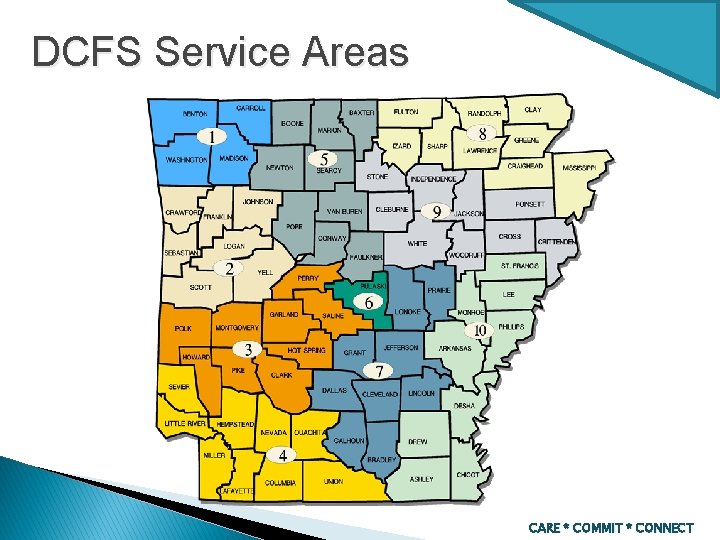
DCFS Service Areas CARE * COMMIT * CONNECT
DCFS Field Organizational Structure § Each service area is led by an Area Director. § Almost every county has a County Supervisor who reports to his/her Area Director. In some cases one supervisor may supervise two small counties. § Larger counties may also have Unit Supervisors who report directly to the county supervisor. CARE * COMMIT * CONNECT
DCFS Field Organizational Structure § Family Service Workers (FSWs) report to either unit or county supervisors depending on the county. § FSWs have primary responsibility for all case plan and case management activities. § In smaller counties FSWs are often “generalists. ” § Generalists handle all aspects of a report/case including the investigation and any subsequently opened protective services or foster care cases.
DCFS Field Organizational Structure § In larger counties FSWs are often specialized into specific functional roles § FSW functional roles may include: Ø Investigators Ø Differential Response Specialists Ø Caseworkers (supportive services, protective services, and foster care cases) Ø Resource Workers (open and maintain foster and adoptive homes) Ø Adoption Specialists Ø Community Engagement Specialists
DCFS Field Organizational Structure § Most counties also have at least one support staff member. § Support staff functional roles include but are not limited to: Ø Program Assistants Ø Transitional Youth Services Coordinators Ø Health Service Workers Ø Clerical Staff
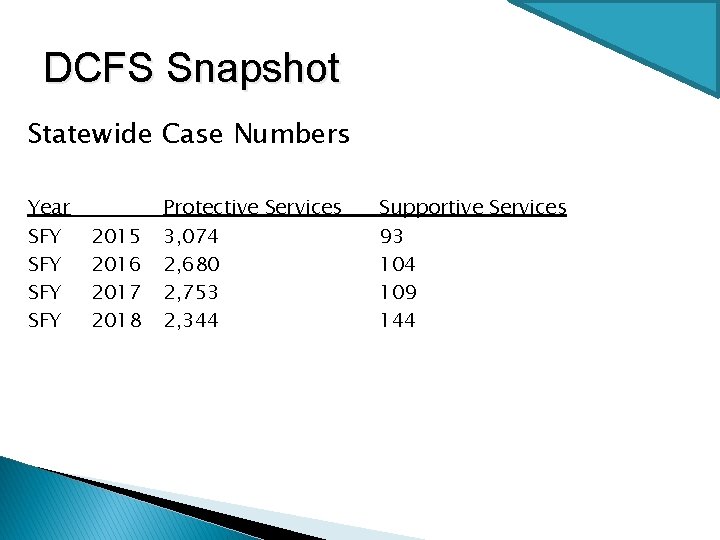
DCFS Snapshot Statewide Case Numbers Year SFY SFY 2015 2016 2017 2018 Protective Services 3, 074 2, 680 2, 753 2, 344 Supportive Services 93 104 109 144
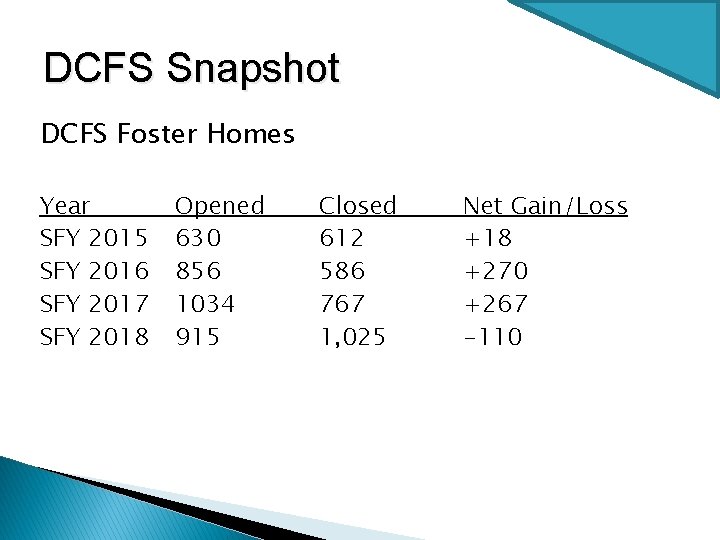
DCFS Snapshot DCFS Foster Homes Year SFY 2015 SFY 2016 SFY 2017 SFY 2018 Opened 630 856 1034 915 Closed 612 586 767 1, 025 Net Gain/Loss +18 +270 +267 -110
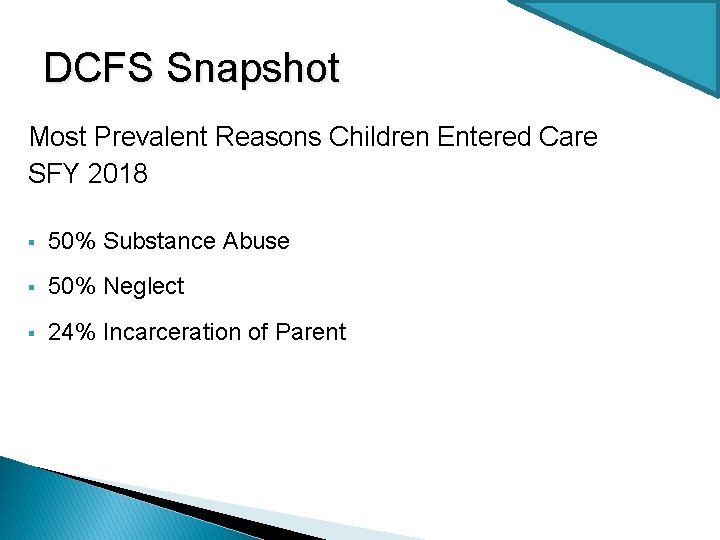
DCFS Snapshot Most Prevalent Reasons Children Entered Care SFY 2018 § 50% Substance Abuse § 50% Neglect § 24% Incarceration of Parent
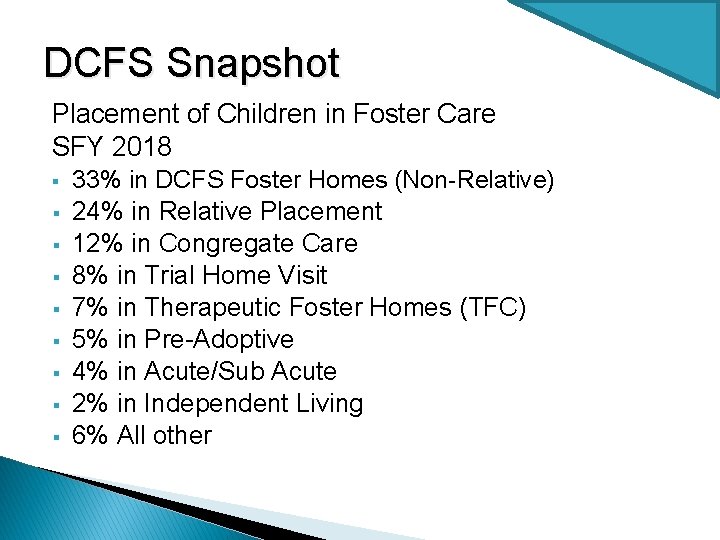
DCFS Snapshot Placement of Children in Foster Care SFY 2018 § § § § § 33% in DCFS Foster Homes (Non-Relative) 24% in Relative Placement 12% in Congregate Care 8% in Trial Home Visit 7% in Therapeutic Foster Homes (TFC) 5% in Pre-Adoptive 4% in Acute/Sub Acute 2% in Independent Living 6% All other
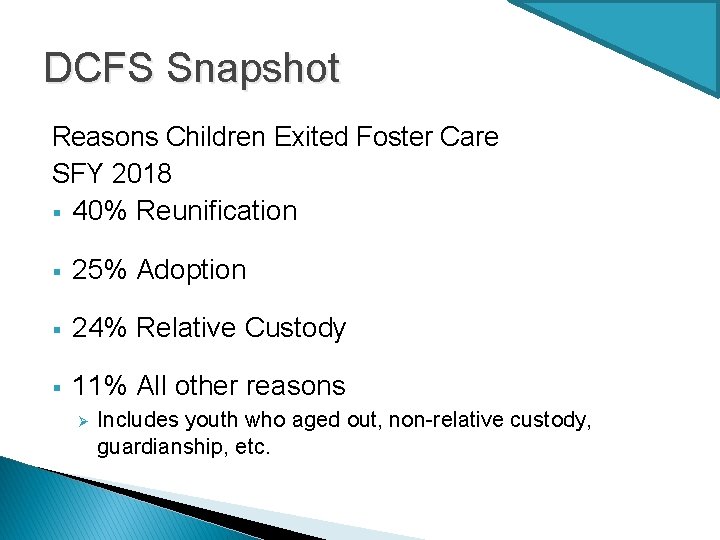
DCFS Snapshot Reasons Children Exited Foster Care SFY 2018 § 40% Reunification § 25% Adoption § 24% Relative Custody § 11% All other reasons Ø Includes youth who aged out, non-relative custody, guardianship, etc.
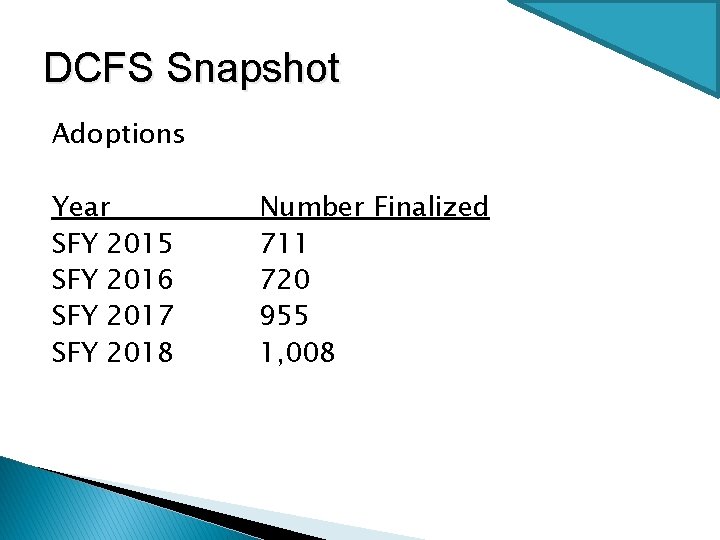
DCFS Snapshot Adoptions Year SFY 2015 SFY 2016 SFY 2017 SFY 2018 Number Finalized 711 720 955 1, 008
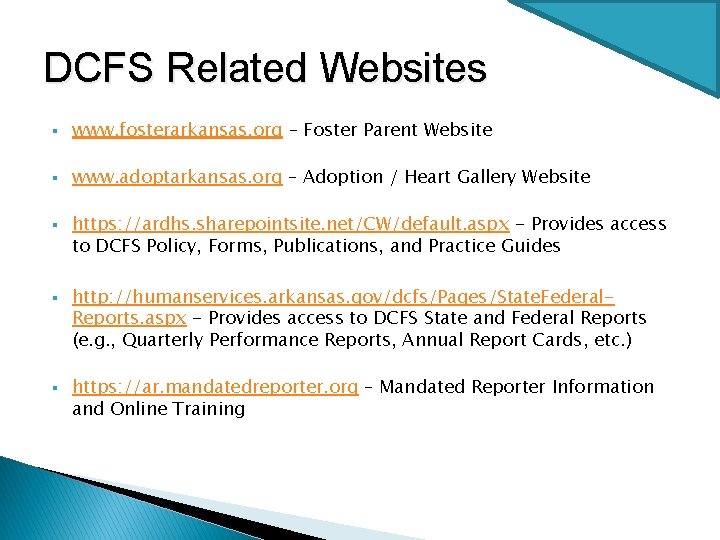
DCFS Related Websites § www. fosterarkansas. org – Foster Parent Website § www. adoptarkansas. org – Adoption / Heart Gallery Website § § § https: //ardhs. sharepointsite. net/CW/default. aspx - Provides access to DCFS Policy, Forms, Publications, and Practice Guides http: //humanservices. arkansas. gov/dcfs/Pages/State. Federal. Reports. aspx - Provides access to DCFS State and Federal Reports (e. g. , Quarterly Performance Reports, Annual Report Cards, etc. ) https: //ar. mandatedreporter. org – Mandated Reporter Information and Online Training
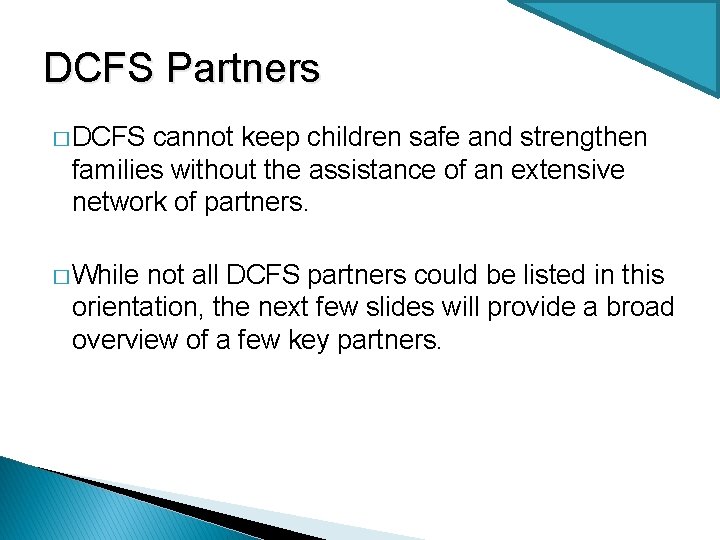
DCFS Partners � DCFS cannot keep children safe and strengthen families without the assistance of an extensive network of partners. � While not all DCFS partners could be listed in this orientation, the next few slides will provide a broad overview of a few key partners.
DCFS Partners § § DCFS is one division within the Arkansas Department of Human Services (DHS). DCFS sister agencies include: Division of Aging and Adult Services Ø Division of Behavioral Health Services Ø Division of Child Care & Early Childhood Education Ø Division of Community Service & Nonprofit Support Ø Division of County Operations Ø Division of Developmental Disabilities Services Ø Division of Medical Services (Medicaid) Ø Division of Services for the Blind Ø Division of Youth Services Ø
DCFS Partners § Arkansas State Police Crimes Against Children Division (CACD) Ø Components include a central administrative office, Child Abuse Hotline operations, and nine area investigative offices. Ø Child Abuse Hotline is staffed 24 -7 by a team of specially trained personnel who may launch a child maltreatment investigation based on reports meeting the criteria of state and federal laws. Ø Child Abuse Hotline Number: 1 -800 -482 -5964 or 1 -800 SAVE-A-CHILD.
DCFS Partners § Arkansas State Police Crimes Against Children Division (CACD) Ø Responsible for reports involving: v v Ø Most Priority 1 allegations Allegations involving a foster child whether foster child is the offender or the victim Alleged offenders ages 14 -18 and the allegation is severe maltreatment Out-of-home alleged offenders For more information visit: http: //asp. arkansas. gov/divisions/crimes-children/ against
DCFS Partners § Administrative Office of the Courts (AOC) --Juvenile Division Ø Provides Juvenile Division of Circuit Court with resources to better serve the children and families who appear before the court. Ø Ensures the well-being of children, youth and families is a high priority within the Arkansas judicial system. Ø Houses the Attorney Ad-Litem (AAL), Parent Counsel, and Court Appointed Special Advocates (CASA), and Court Improvement Project (CIP) Programs. Ø For more information visit: https: //courts. arkansas. gov/administration/juvenile
DCFS Partners § Child Advocacy Centers / Child Safety Centers Ø Non-profit, child-friendly facilities offering comprehensive approach to serving child abuse victims and their families. Ø CACs can conduct forensic interviews and case reviews. Ø Access to medical and mental health services available either on-site or through referrals. Ø 13 CACs statewide. Ø For more information visit: http: //www. accardv. uams. edu/child-abuse. asp
DCFS Partners § Children of Arkansas Loved for a Lifetime (The CALL) Ø A faith-based organization comprised of a network of Christian churches that works to recruit and train foster and adoptive homes for DCFS. Ø Currently active in 46 counties. Ø For more information visit: http: //thecallinarkansas. org/
The Arkansas Academic Partnership in Public Child Welfare & The Division of Children and Family Services: How We Work Together to Care, Commit, and Connect
Competency Based Training Model � Uses statements of knowledge and skills required for workers to do their jobs effectively � Provides guidance in the development of learning objectives � Helps assess training needs � Divided § § § into three primary categories: Core (100 series) Specialty (200 -300 series) Related (300 series)
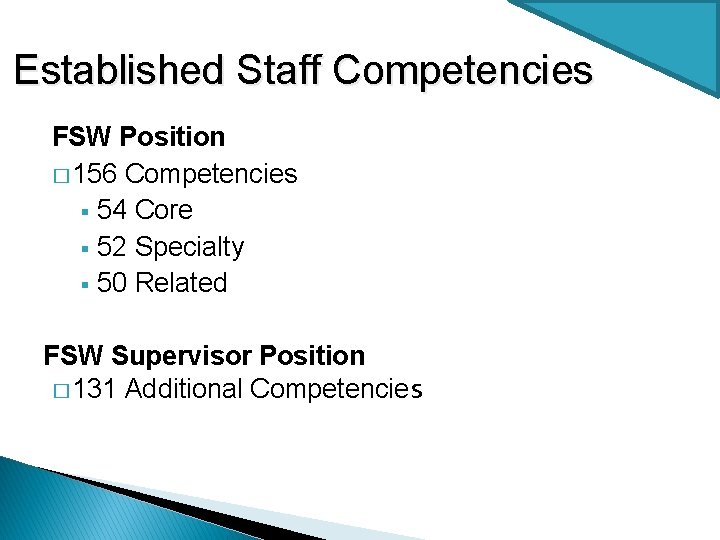
Established Staff Competencies FSW Position � 156 Competencies § 54 Core § 52 Specialty § 50 Related FSW Supervisor Position � 131 Additional Competencies
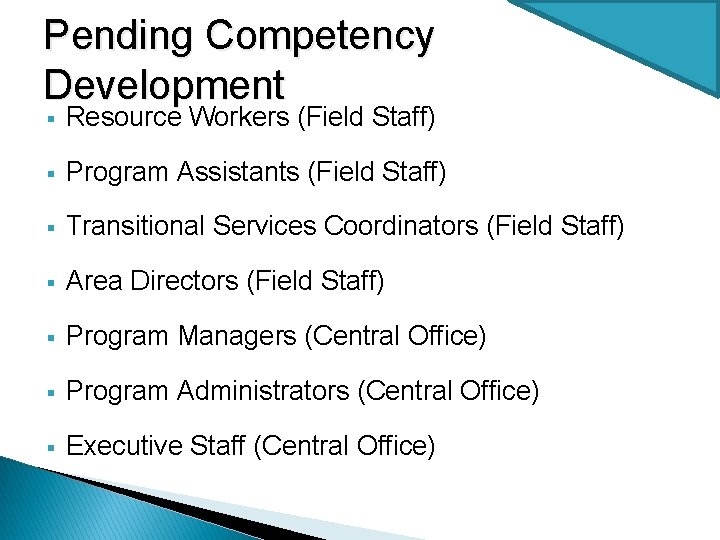
Pending Competency Development § Resource Workers (Field Staff) § Program Assistants (Field Staff) § Transitional Services Coordinators (Field Staff) § Area Directors (Field Staff) § Program Managers (Central Office) § Program Administrators (Central Office) § Executive Staff (Central Office)
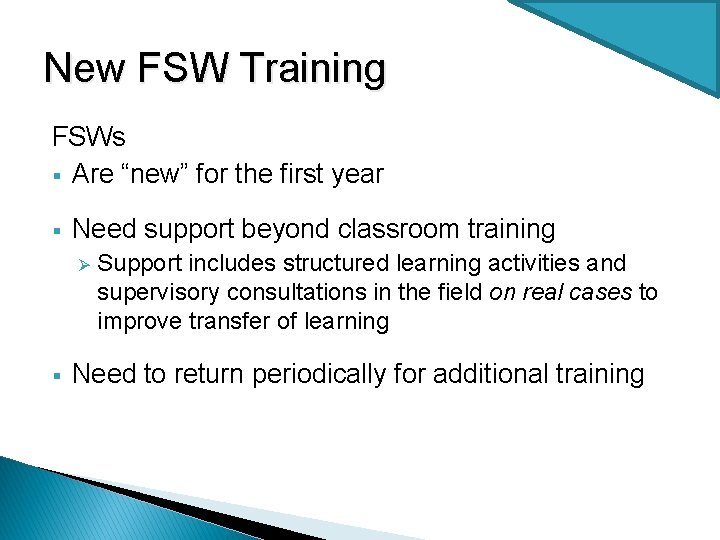
New FSW Training FSWs § Are “new” for the first year § Need support beyond classroom training Ø § Support includes structured learning activities and supervisory consultations in the field on real cases to improve transfer of learning Need to return periodically for additional training
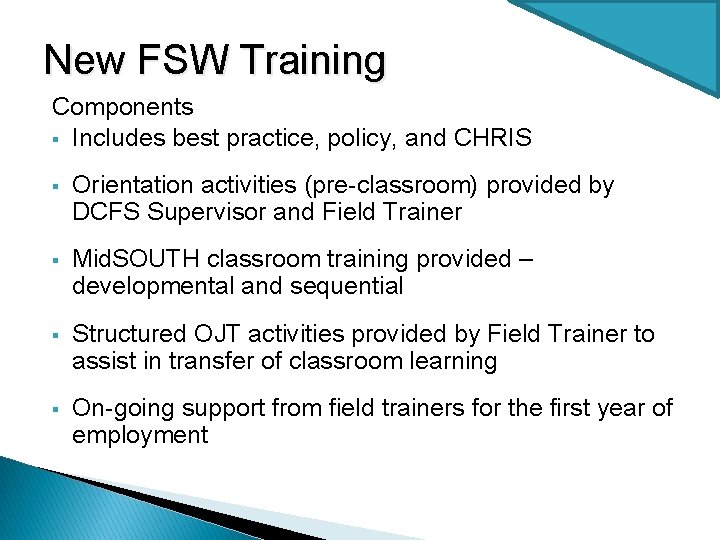
New FSW Training Components § Includes best practice, policy, and CHRIS § Orientation activities (pre-classroom) provided by DCFS Supervisor and Field Trainer § Mid. SOUTH classroom training provided – developmental and sequential § Structured OJT activities provided by Field Trainer to assist in transfer of classroom learning § On-going support from field trainers for the first year of employment
New FSW Training § In order for a new FSW to be prepared for work in the field, it is critical that the FSW’s supervisor, classroom trainer, and field trainer, work together to support the new FSW. § The following slides describe the expectations of the FSW’s supervisor, classroom trainer, and field trainer in this process.
New FSW Training Pre-Training: Supervisor Responsibilities § Sets up FSW with network and CHRIS access § Completes DHS/DCFS Orientation § Covers travel reimbursement policies § Provides overview of initial training process and general expectations while attending training
New FSW Training Pre-Training: Supervisor Responsibilities § Coordinates first meeting with field trainer § Determines caseload assignments for training period
New FSW Training Pre-Training: Mid. SOUTH Responsibilities § Sends “welcome to training” letter to FSW and Supervisor § CHRIS Trainer schedules and completes CHRIS Orientation and Navigation; DCFS Portal & Resources Training § FSW completes policy pre-test
New FSW Training Pre-Training: Field Trainer Responsibilities § Contacts supervisor to schedule the first meeting with the FSW in first week § Outlines roles and services provided § Reviews “New Worker Notebook”
New FSW Training Pre-Training: Field Trainer Responsibilities § Discusses pre-training activities: Ø Accesses policy and procedures Ø Completes FSW Readiness Survey Ø Discusses FSW suggested activities Ø Explains meetings with supervisor § Explains Mandatory Reporting – PUB-357
New FSW Training Supporting the FSW: DCFS Supervisor Responsibilities § Maintains regular contact with new FSW/trainee § Addresses issues negatively impacting training process § Partners with field and classroom trainers to ensure training goals and objectives are being met
New FSW Training Supporting the FSW: Field Trainer Responsibilities § Interacts weekly, principally face-to-face § Models best practice behaviors, educates, directs FSW to resources, etc. § Ensures educational activities are congruent with the learning style of the FSW § Supports communication process between the new FSW / trainee, and supervisor
New FSW Training Supporting the FSW: Field Trainer Responsibilities § Discusses any verbalized or observed concerns § Provides encouragement and support to FSW § Capitalizes on teachable moments related to problemsolving
New FSW Training Supporting the FSW: Field Trainer Responsibilities § Asks the right questions as opposed to telling the FSW what to do § Promotes a positive attitude and openness to change § Helps make links between various Division initiatives
New FSW Training Supporting the New FSW : Field Trainer “Don’ts” § Don’t act as an FSW’s supervisor § Don’t act as an FSW’s therapist
New FSW Training Field Trainer Overview of OJT Activities § Meets weekly to assist with training needs § Assists FSW in researching reasons a case was opened § Accompanies FSW on at least three home visits § Discusses best practices and the Practice Model
New FSW Training Field Trainer Overview of OJT Activities § Meets with supervisor regularly on training progress § Reviews CANS/FAST Assessment, case plan, CHRIS entries § Reviews / critiques documentation § Reinforces DCFS Policy and Procedures
Post New FSW Training Skill Assessment Tools/Methods § New Staff – 100 Competency Series § Pre and Post Assessment (Mid. SOUTH) § FSW Initial and Advanced Readiness Survey (Field Trainer) § Individual Training Needs Assessment Survey (Mid. SOUTH)
New FSW Training Worker Readiness Assessment Meeting (WRAM) § Completed within 20 working days of new FSW completing eight months of employment with the Division § Meeting coordinated by FSW’s field trainer § All classroom trainers for that FSW provide summary of the results of pre- and post-tests and classroom observations of the FSW which may be submitted electronically to the field trainer in a report prior to the WRAM § Field trainer documents and shares his/her observations of field training with FSW to review during the meeting along with notes received from classroom trainers to identify strengths and areas needing improvement and what supports, as applicable, may be needed for the FSW’s continued professional development § Field trainer electronically submits the WRAM Summary to the UA Little Rock Mid. SOUTH Training Director § DCFS Training Manager may randomly follow up on WRAM summaries with FSW and FSW Supervisor to assess progress of FSW, whether any training needs or other supports identified in the WRAM Summary have been provided, or if any other supports are needed at that point in time
Advanced Practice Education (APE) § Provides individualized training to FSWs and supervisors with more than one year of DCFS experience. § May be requested by the FSW (self-referral), FSW Supervisor, or Area Director. § Focuses on a specific skill or objective.
Training Design/Curriculum Development § For the Partnership, the Training Design Coordinator develops and implements new curriculum and trainings related to current, IV-E allowable training needs. § For Mid. SOUTH, the Head Curriculum Developer develops and implements new and revised curriculum and trainings related to current, IV-E allowable training needs. § Each university also maintains an Interdisciplinary Committee (IDC) (a. k. a. Multidisciplinary Committee) on child welfare. § IDCs assist in developing and promoting child welfare curriculum across academic programs.
Continuing Education and Professional Development § When requested, Partnership and Mid. SOUTH offer continuing education and professional development opportunities on IV-E allowable topics through a variety of forums including classroom trainings, workshops, and conferences. § Partnership may develop and deliver these opportunities or sponsor DCFS staff to attend continuing education and professional development forums provided by other approved organizations.
Continuing Education and Professional Development § Continuing education and professional development topics may be IV-E allowable at a 75: 25 (federal: state) reimbursement rate or a 50: 50 reimbursement rate.
Area Director Coordination § Each university IV-E coordinator and Mid. SOUTH Lead Academy Trainer meets (generally) on a monthly basis with the DCFS Area Director or designee to plan and coordinate training needs for the area. § DCFS Central Office Professional Development Unit (PDU) Training Manager attends these meetings for each area on a quarterly basis. § PDU Training Manager reviews minutes from meetings when unable to attend meeting in person.
Student Field Education Units § Partnership recruits and selects field education students (a. k. a. stipend interns and non-stipend interns) to serve in DCFS county offices statewide. § Non-stipend interns choose to gain professional child welfare experience in DCFS county offices while meeting the academic requirements of his/her degree program. § Stipend interns undergo a more formal selection process, receive a stipend of up to $2, 500 per semester for a maximum of two semesters, and enter into a contractual obligation to work for DCFS for a period of one year following successful completion of an appropriate degree program.
Ongoing Planning / Coordination The Partnership, including Mid. SOUTH, and DCFS utilize the following forums for ongoing planning and coordination efforts: § Quarterly Regional Team Meetings § Monthly Area Director / IV-E Coordinator Meetings § Quarterly Partnership Meetings § Training Skills and Development Team (TSDT) Meetings § Interdisciplinary Committee (IDC) Committee Meetings
Online Communication � https: //km. uark. edu – IV-E Partnership Website (includes access to online DCFS Supervisory Handbook)
Thank you! Footer Text 11/9/2020 76
- Slides: 76