
Arizona State Troopers Highway Patrol Division Sergeant John






- Slides: 36
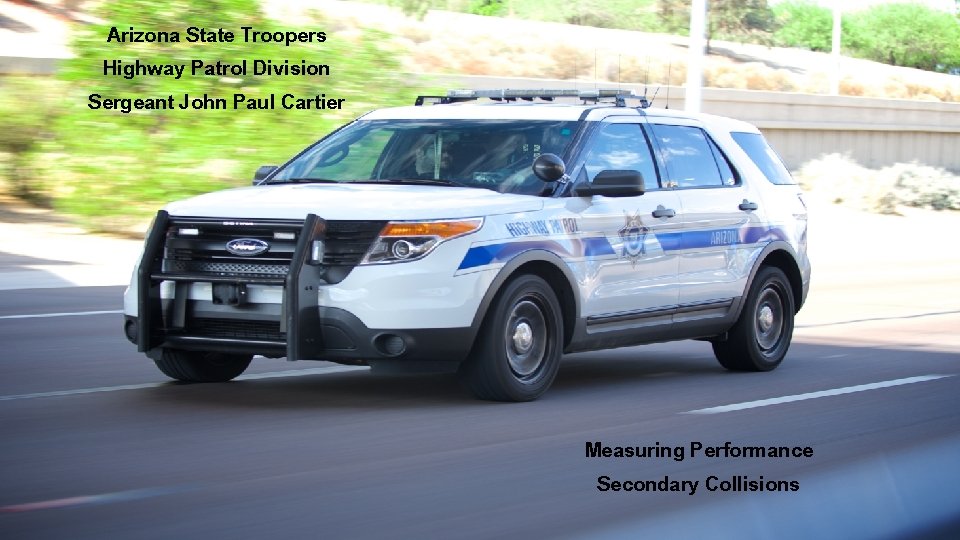
Arizona State Troopers Highway Patrol Division Sergeant John Paul Cartier Measuring Performance Secondary Collisions
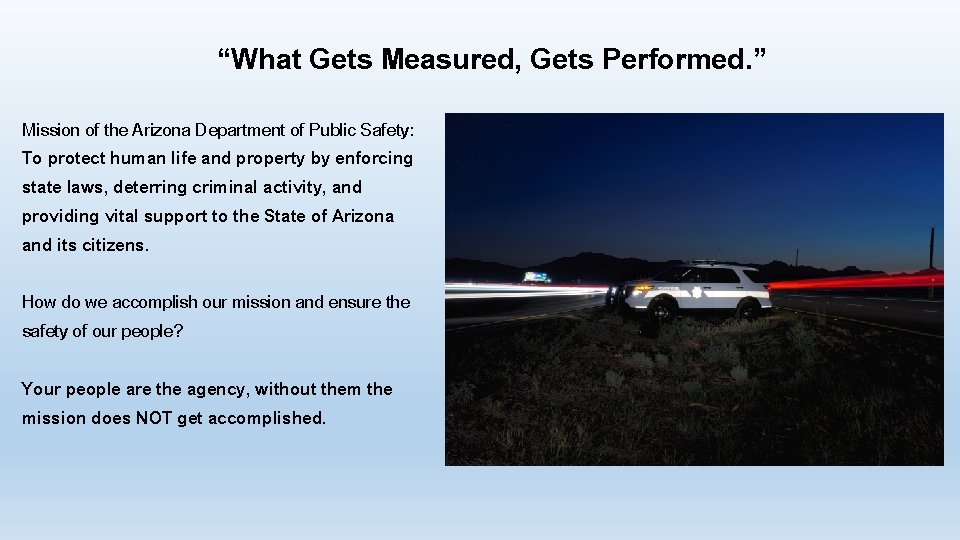
“What Gets Measured, Gets Performed. ” Mission of the Arizona Department of Public Safety: To protect human life and property by enforcing state laws, deterring criminal activity, and providing vital support to the State of Arizona and its citizens. How do we accomplish our mission and ensure the safety of our people? Your people are the agency, without them the mission does NOT get accomplished.
Why Make Traffic Incident Management (TIM) a Priority? • Current national issues • First responder and public safety issues • Fatality and property damage reduction • Infrastructure challenges • Technology challenges • Competition for resources • Existing enforcement programs • New mandates • Planned and unplanned special/natural events • Deficient budgets (staffing, equipment, training)
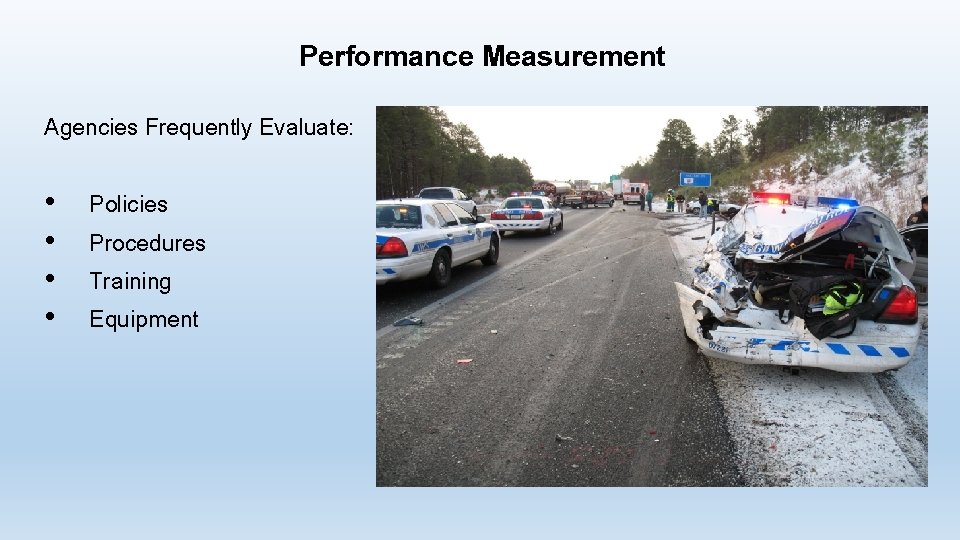
Performance Measurement Agencies Frequently Evaluate: • • Policies Procedures Training Equipment
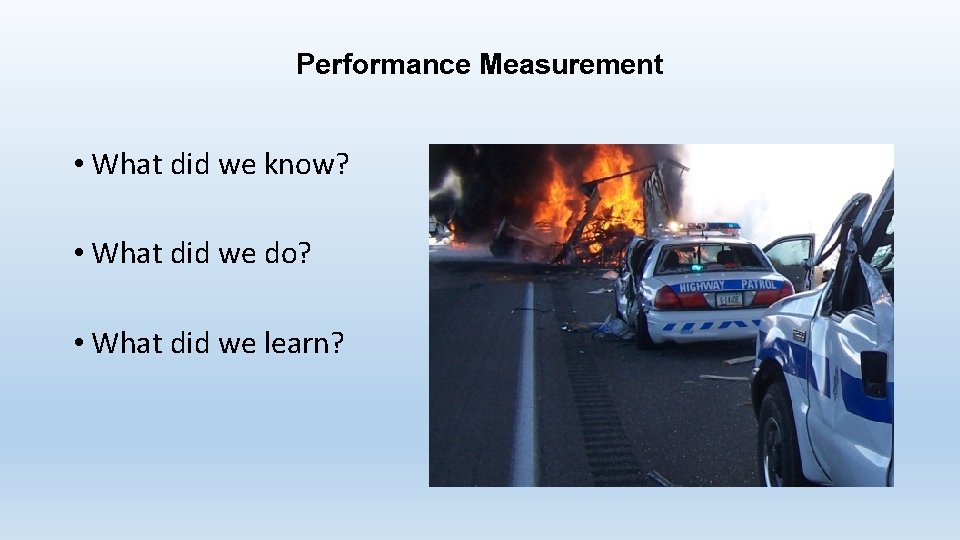
Performance Measurement • What did we know? • What did we do? • What did we learn?
Traffic Incident Management (TIM) Performance Measures DATA COLLECTION DATA APPLICATION
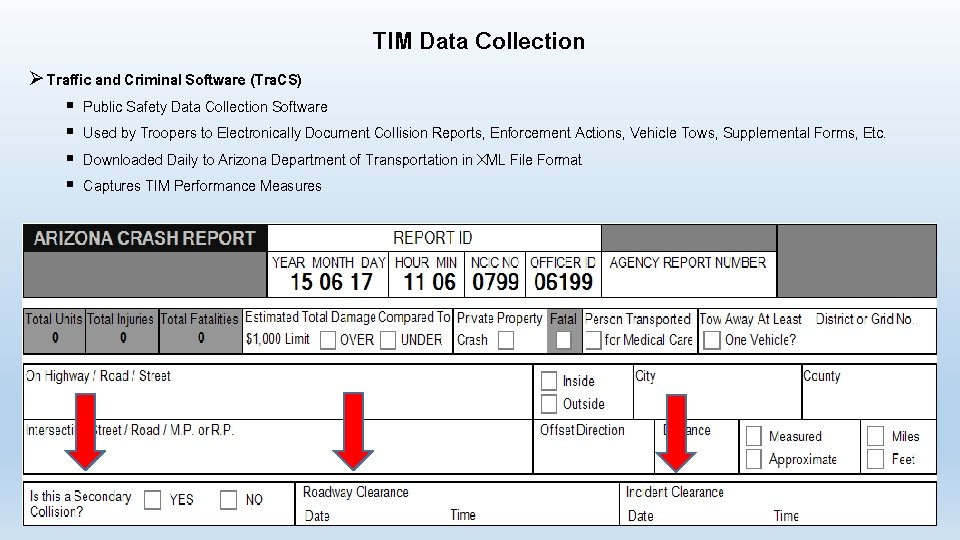
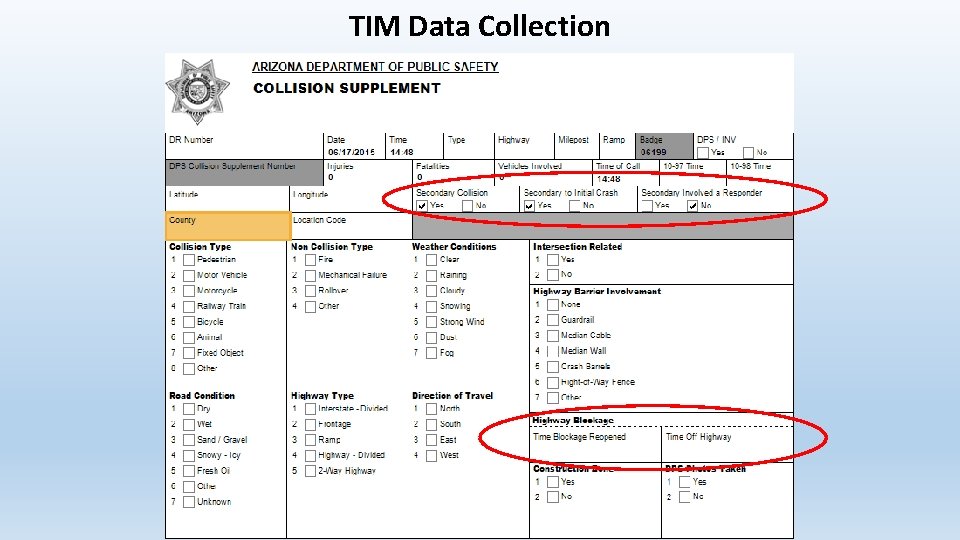
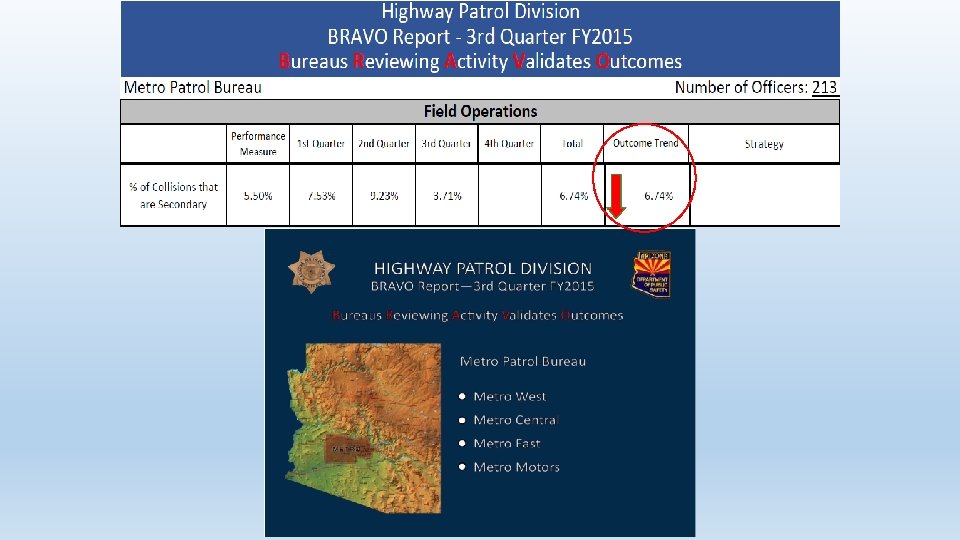
TIM Performance Measures – Collected Statewide • Roadway Clearance Time = Time Blockage Reopened - "Time Blockage Reopened" is when collision debris and/or vehicles have been removed from the lanes of traffic. (actual time, not duration). • Incident Clearance Time = Time Off Highway - When all patrol, collision vehicles or major debris are removed from the view of traffic, includes tow trucks and fire. When the collision is no longer causing a visual distraction to traffic, usually vehicles parked on an on or off ramp would not be considered a distraction. Does not include follow-up off highway at the hospital or other locations, (actual time, not duration). • Secondary Collision - A secondary collision is defined as a crash within an incident scene or within a traffic queue resulting from an original incident. The original incident does not have to be a collision, could be a disabled motorist, vehicles on the side of the road, or any other unusual circumstance related to traffic backup or change in traffic flow such as unusual construction backups; as long as it played a roll in distracting the driver or the causation in the collision. If the queue is a normal, every day occurrence without an original incident then a crash may not be secondary, this is a grey area. Any crash involving a first responder (LE, Fire, EMS, ADOT, or Towing) in route to a crash, regardless of location, is considered secondary.
TIM Performance Measures – Collected by AZ DPS • Response Time – the elapsed time between when response vehicles were dispatched and when response vehicles arrive at the incident scene. • Incident Duration - the elapsed time between when an incident occurred to when the response vehicles depart at the scene. • Secondary to Initial Crash - Was this secondary to an initial crash? If so answer Yes (Y). If this crash was secondary to some other incident that was not a crash answer No (N). • Secondary Involved a Responder - Did the secondary crash involve a first responder (LE, Fire, EMS, ADOT, or Towing)? If so answer Yes (Y). Otherwise answer No (N ).
TIM Data Collection Ø Traffic and Criminal Software (Tra. CS) § Public Safety Data Collection Software § Used by Troopers to Electronically Document Collision Reports, Enforcement Actions, Vehicle Tows, Supplemental Forms, Etc. § Downloaded Daily to Arizona Department of Transportation in XML File Format § Captures TIM Performance Measures
TIM Data Collection
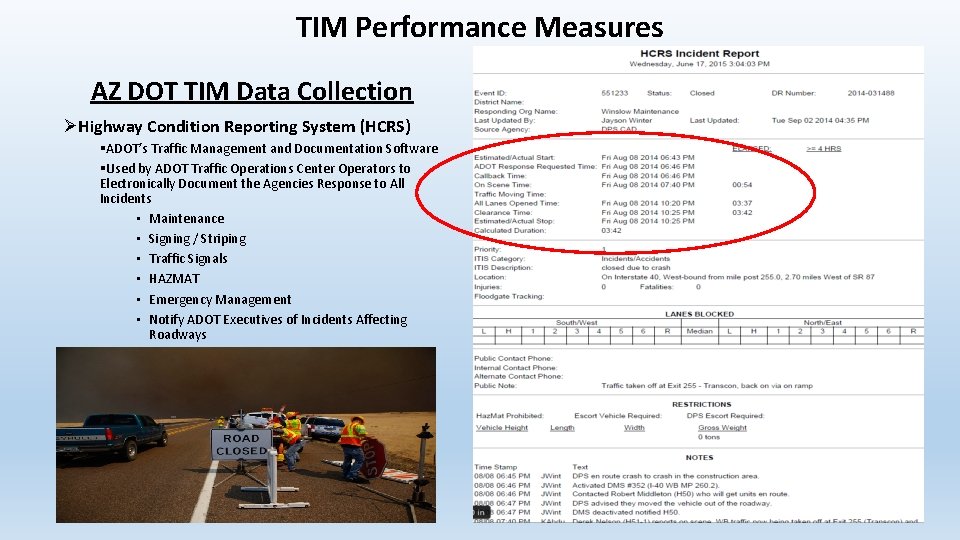
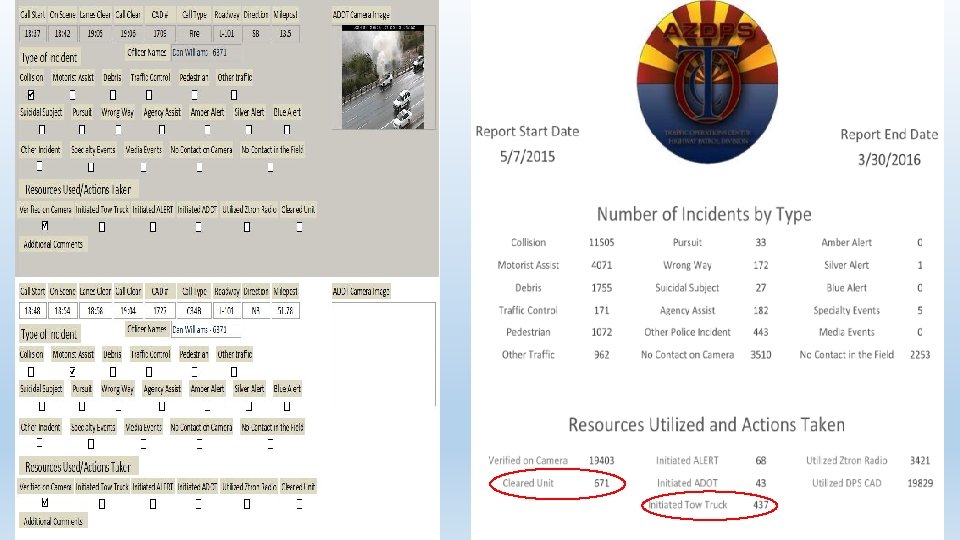
TIM Performance Measures AZ DOT TIM Data Collection ØHighway Condition Reporting System (HCRS) §ADOT’s Traffic Management and Documentation Software §Used by ADOT Traffic Operations Center Operators to Electronically Document the Agencies Response to All Incidents • Maintenance • Signing / Striping • Traffic Signals • HAZMAT • Emergency Management • Notify ADOT Executives of Incidents Affecting Roadways
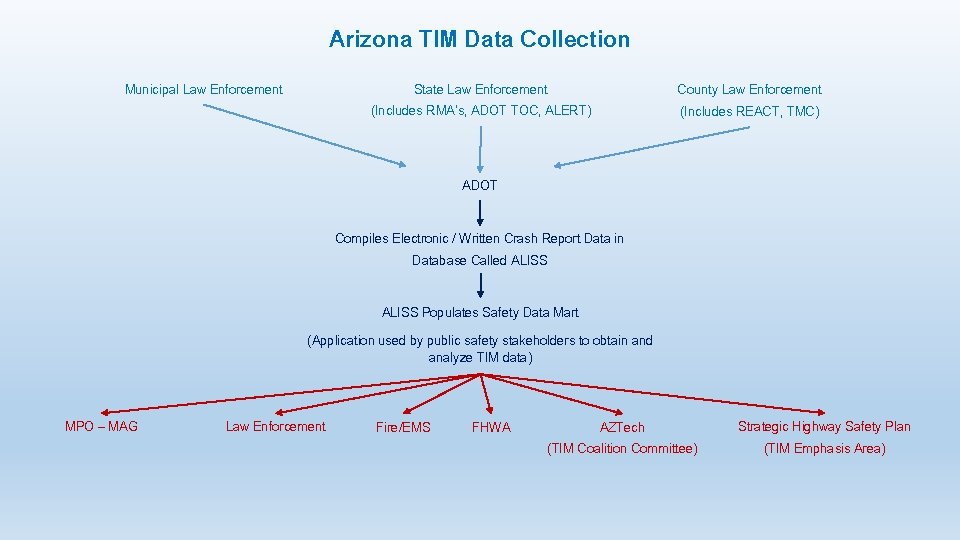
Arizona TIM Data Collection State Law Enforcement (Includes RMA’s, ADOT TOC, ALERT) Municipal Law Enforcement County Law Enforcement (Includes REACT, TMC) ADOT Compiles Electronic / Written Crash Report Data in Database Called ALISS Populates Safety Data Mart (Application used by public safety stakeholders to obtain and analyze TIM data) MPO – MAG Law Enforcement Fire/EMS FHWA AZTech (TIM Coalition Committee) Strategic Highway Safety Plan (TIM Emphasis Area)
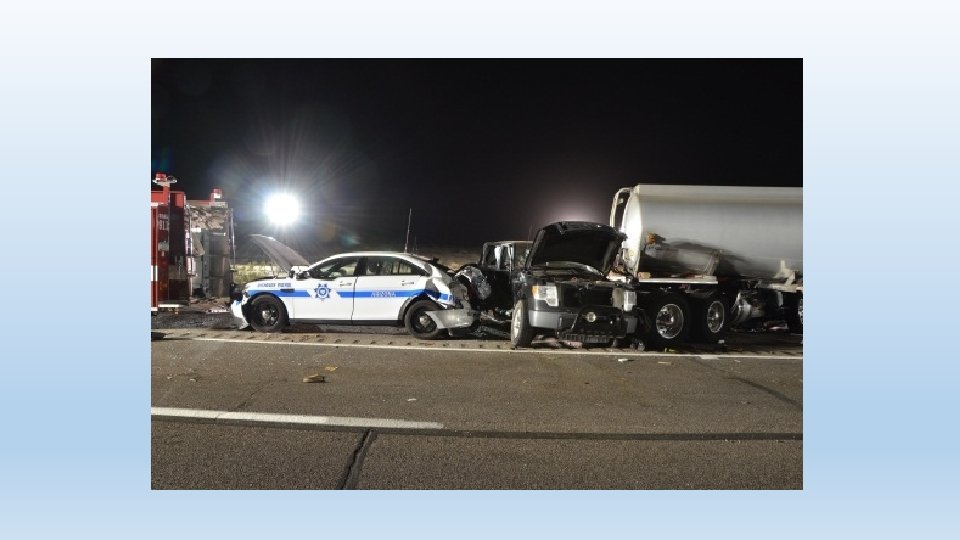
Secondary Collisions Involving First Responders • On the state highway system in Arizona, we found the following: • 2012, there were 68 • 2013, there were 66 • 2014, there were 62 • Prior to collecting this measure many of these were unnoticed due to the minor nature • The difference between a major and minor responder involved crash is typically feet or seconds
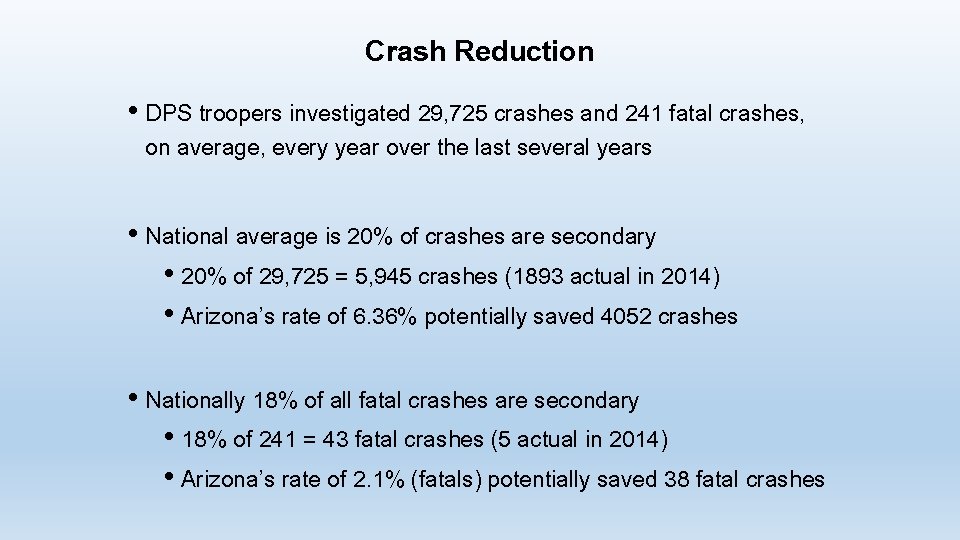
Crash Reduction • DPS troopers investigated 29, 725 crashes and 241 fatal crashes, on average, every year over the last several years • National average is 20% of crashes are secondary • 20% of 29, 725 = 5, 945 crashes (1893 actual in 2014) • Arizona’s rate of 6. 36% potentially saved 4052 crashes • Nationally 18% of all fatal crashes are secondary • 18% of 241 = 43 fatal crashes (5 actual in 2014) • Arizona’s rate of 2. 1% (fatals) potentially saved 38 fatal crashes
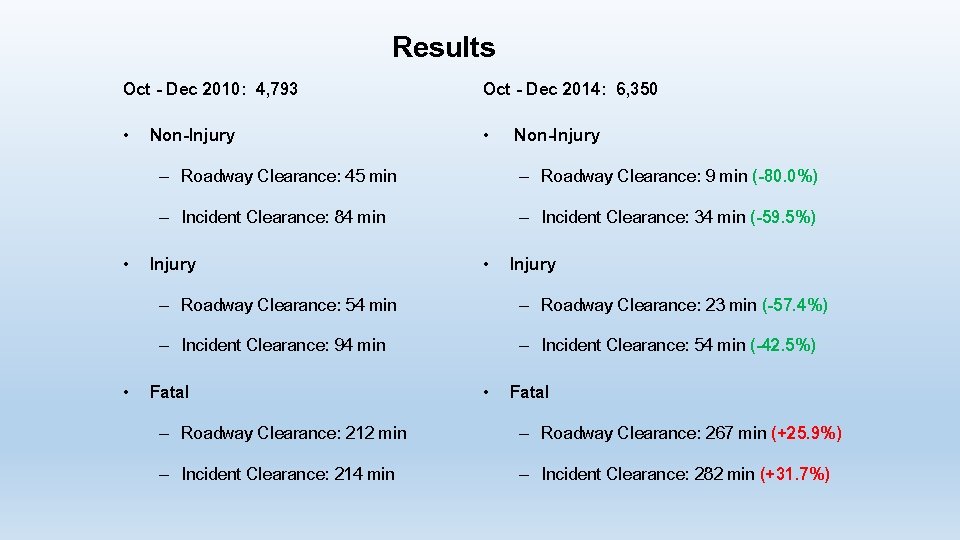
Results Oct - Dec 2010: 4, 793 Oct - Dec 2014: 6, 350 • Non-Injury • Non-Injury – Roadway Clearance: 45 min – Roadway Clearance: 9 min (-80. 0%) – Incident Clearance: 84 min – Incident Clearance: 34 min (-59. 5%) • Injury – Roadway Clearance: 54 min – Roadway Clearance: 23 min (-57. 4%) – Incident Clearance: 94 min – Incident Clearance: 54 min (-42. 5%) • Fatal – Roadway Clearance: 212 min – Roadway Clearance: 267 min (+25. 9%) – Incident Clearance: 214 min – Incident Clearance: 282 min (+31. 7%)
TIM Performance Measures How do Arizona stakeholders apply TIM data? • Arizona State Troopers • Appropriately trained, equipped, deployed, and focused on patrol activities which emphasize TIM strategies. • Division Policy/Priority - Active Management of Traffic Incidents Troopers shall actively manage traffic incidents to enhance public and Trooper safety. Active management includes securing an incident scene from secondary incident, removing lane obstructions when feasible, and returning travel lanes to operation as quickly as is appropriate. Obstructed traffic lanes and incidents adjacent to the roadway which create a distraction represent a substantial danger to first responders and other motorists. Traffic Incident Management concepts are applicable statewide on urban and rural highways.
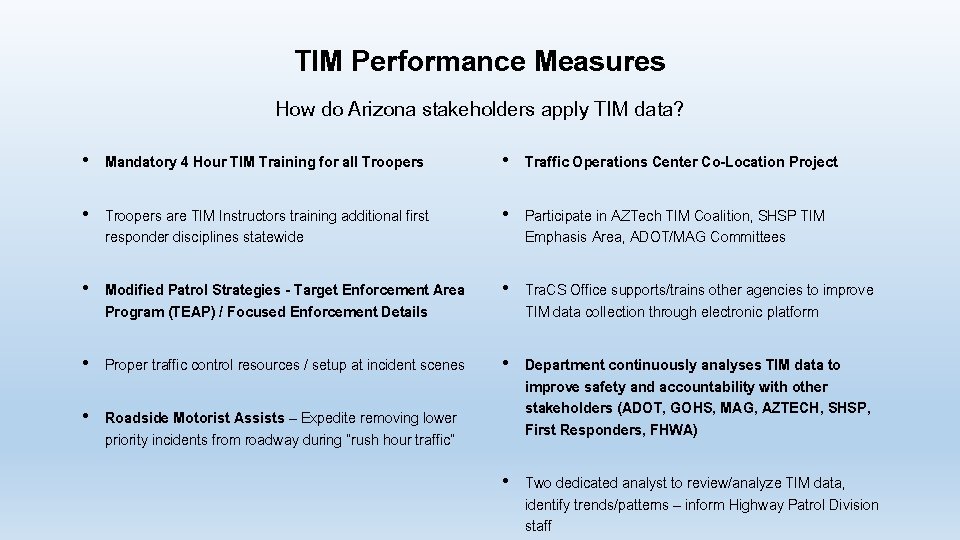
TIM Performance Measures How do Arizona stakeholders apply TIM data? • Mandatory 4 Hour TIM Training for all Troopers • Traffic Operations Center Co-Location Project • Troopers are TIM Instructors training additional first responder disciplines statewide • Participate in AZTech TIM Coalition, SHSP TIM Emphasis Area, ADOT/MAG Committees • Modified Patrol Strategies - Target Enforcement Area Program (TEAP) / Focused Enforcement Details • Tra. CS Office supports/trains other agencies to improve TIM data collection through electronic platform • Proper traffic control resources / setup at incident scenes • Department continuously analyses TIM data to improve safety and accountability with other stakeholders (ADOT, GOHS, MAG, AZTECH, SHSP, First Responders, FHWA) • Roadside Motorist Assists – Expedite removing lower priority incidents from roadway during “rush hour traffic” • Two dedicated analyst to review/analyze TIM data, identify trends/patterns – inform Highway Patrol Division staff
TIM Saves Injuries, Time and Money • By reducing secondary crashes, we reduce: • Crash occurrence (fewer injuries/fatals and less property damage) • Struck-by incidents • Time spent on crash investigations • Motorist delay • Effective strategies an agency can deploy • Quick clearance, moving traffic stops, collisions, obstructions • Mobile reporting (auto-populating forms) • Scene measurement technology • Traffic Operations Centers (TOC/TMC)
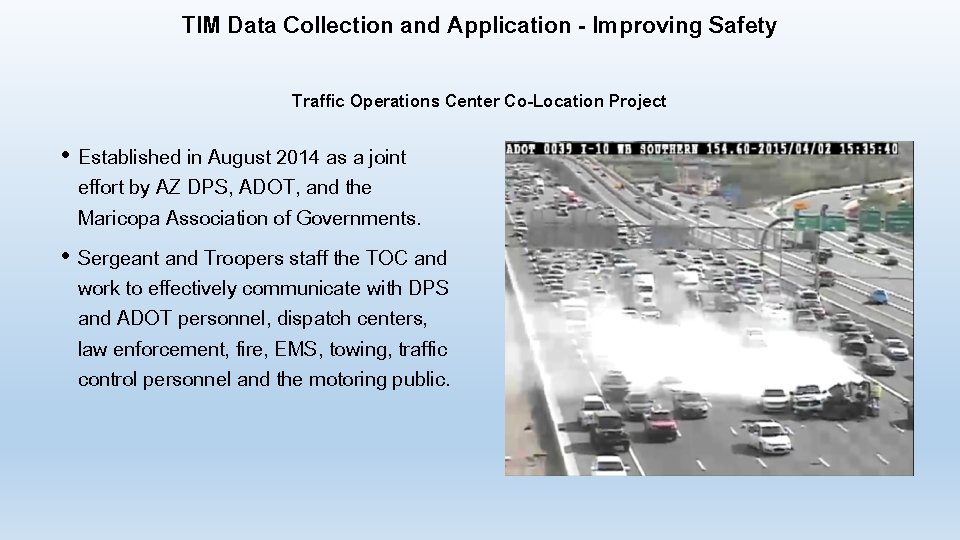
TIM Data Collection and Application - Improving Safety Traffic Operations Center Co-Location Project • Established in August 2014 as a joint effort by AZ DPS, ADOT, and the Maricopa Association of Governments. • Sergeant and Troopers staff the TOC and work to effectively communicate with DPS and ADOT personnel, dispatch centers, law enforcement, fire, EMS, towing, traffic control personnel and the motoring public.
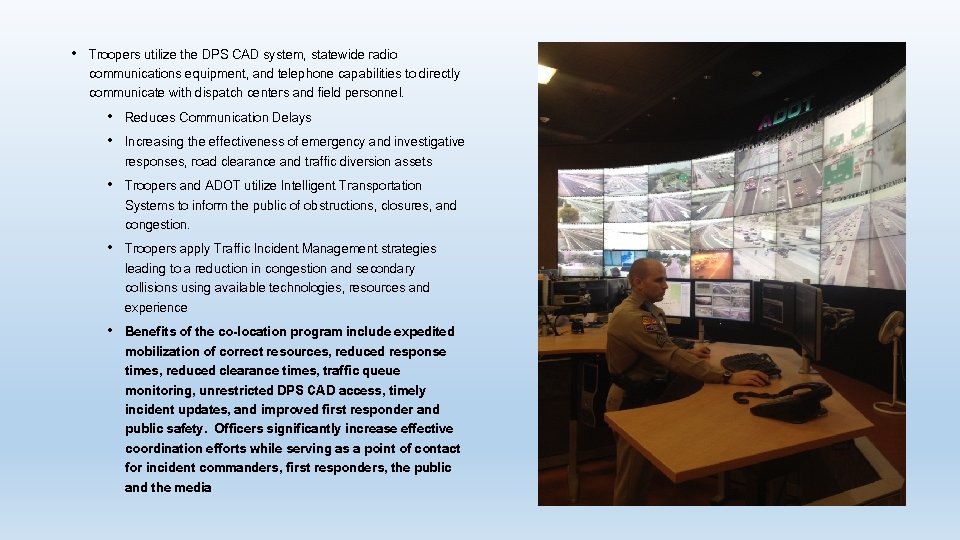
• Troopers utilize the DPS CAD system, statewide radio communications equipment, and telephone capabilities to directly communicate with dispatch centers and field personnel. • Reduces Communication Delays • Increasing the effectiveness of emergency and investigative responses, road clearance and traffic diversion assets • Troopers and ADOT utilize Intelligent Transportation Systems to inform the public of obstructions, closures, and congestion. • Troopers apply Traffic Incident Management strategies leading to a reduction in congestion and secondary collisions using available technologies, resources and experience • Benefits of the co-location program include expedited mobilization of correct resources, reduced response times, reduced clearance times, traffic queue monitoring, unrestricted DPS CAD access, timely incident updates, and improved first responder and public safety. Officers significantly increase effective coordination efforts while serving as a point of contact for incident commanders, first responders, the public and the media
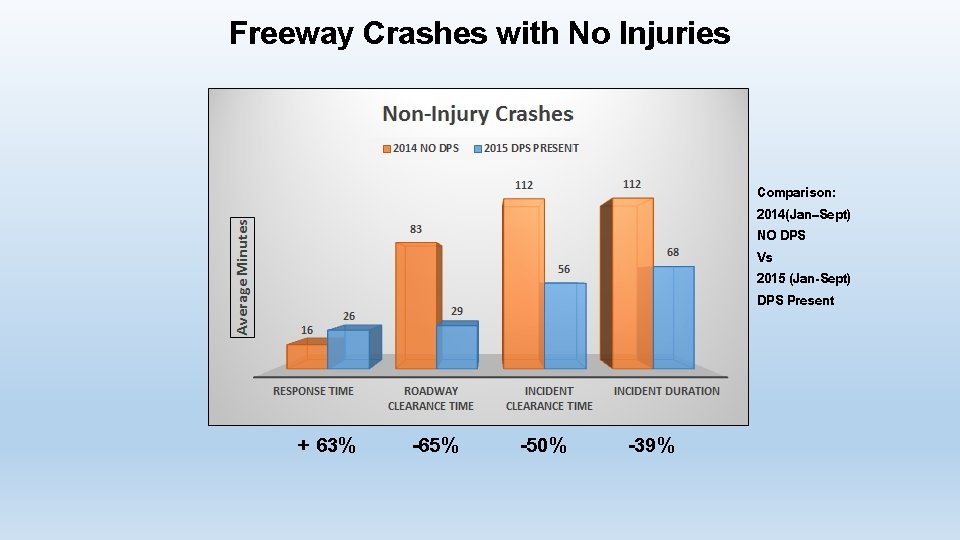
Freeway Crashes with No Injuries Comparison: 2014(Jan–Sept) NO DPS Vs 2015 (Jan-Sept) DPS Present + 63% -65% -50% -39%
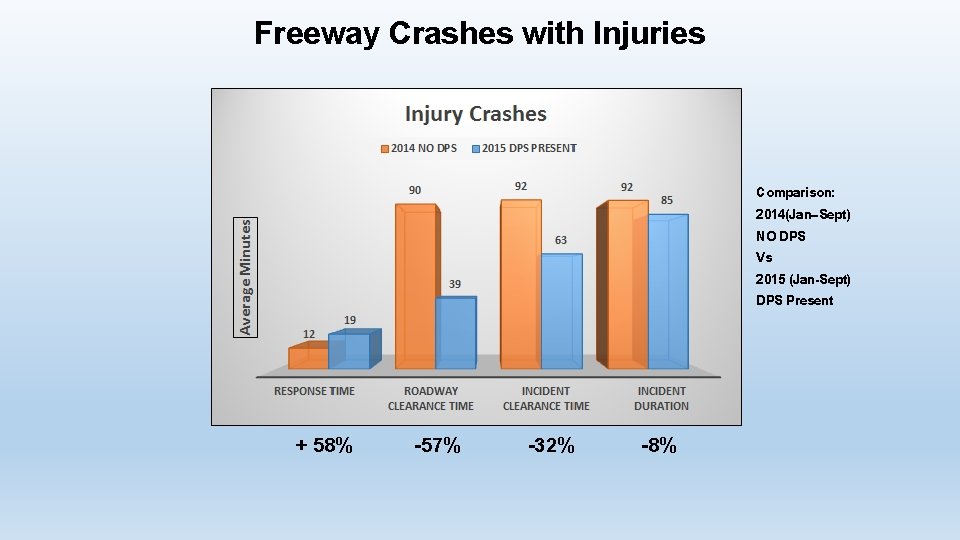
Freeway Crashes with Injuries Comparison: 2014(Jan–Sept) NO DPS Vs 2015 (Jan-Sept) DPS Present + 58% -57% -32% -8%
Fatal Crashes on Freeways Comparison: 2014(Jan–Sept) NO DPS Vs 2015 (Jan-Sept) DPS Present + 20% -48% -38% -23%
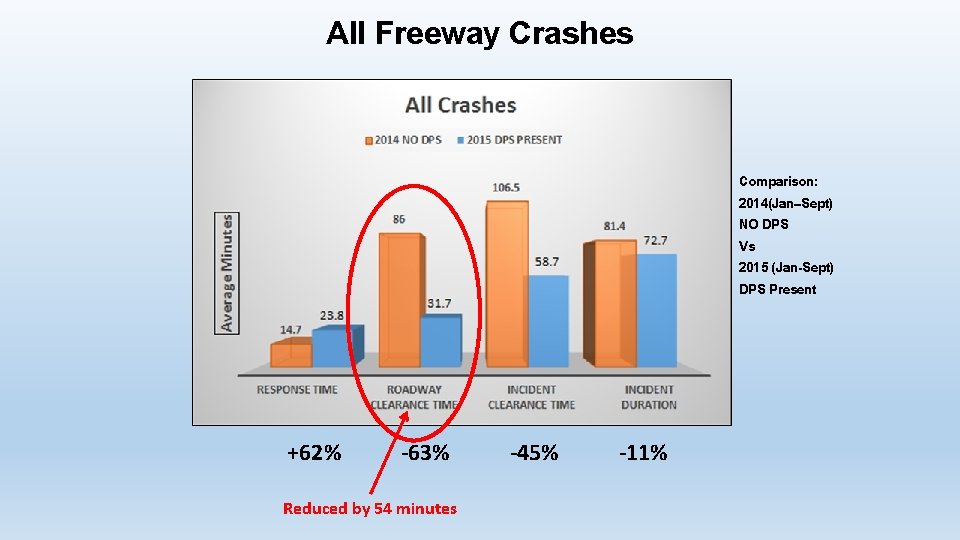
All Freeway Crashes Comparison: 2014(Jan–Sept) NO DPS Vs 2015 (Jan-Sept) DPS Present +62% -63% Reduced by 54 minutes -45% -11%
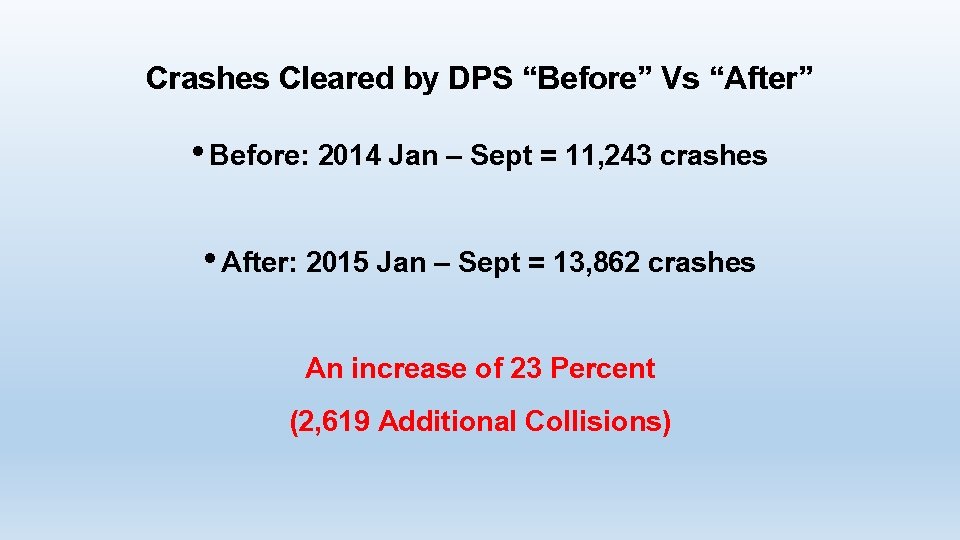
Crashes Cleared by DPS “Before” Vs “After” • Before: 2014 Jan – Sept = 11, 243 crashes • After: 2015 Jan – Sept = 13, 862 crashes An increase of 23 Percent (2, 619 Additional Collisions)
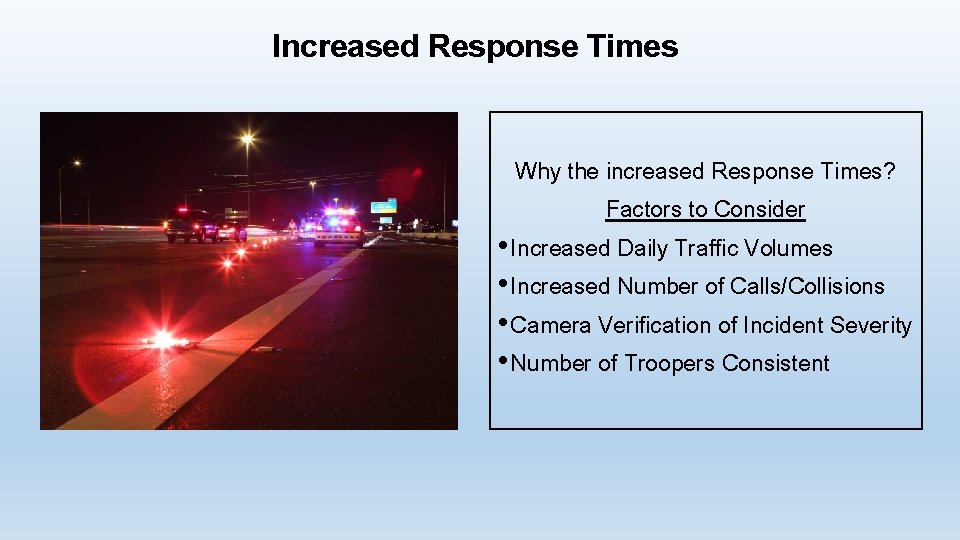
Increased Response Times Why the increased Response Times? Factors to Consider • Increased Daily Traffic Volumes • Increased Number of Calls/Collisions • Camera Verification of Incident Severity • Number of Troopers Consistent
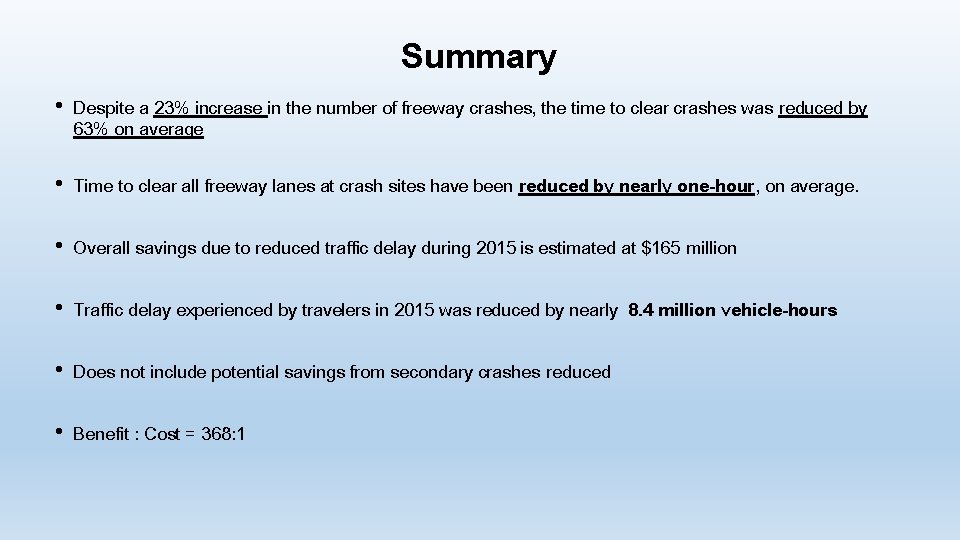
Summary • Despite a 23% increase in the number of freeway crashes, the time to clear crashes was reduced by 63% on average • Time to clear all freeway lanes at crash sites have been reduced by nearly one-hour, on average. • Overall savings due to reduced traffic delay during 2015 is estimated at $165 million • Traffic delay experienced by travelers in 2015 was reduced by nearly 8. 4 million vehicle-hours • Does not include potential savings from secondary crashes reduced • Benefit : Cost = 368: 1
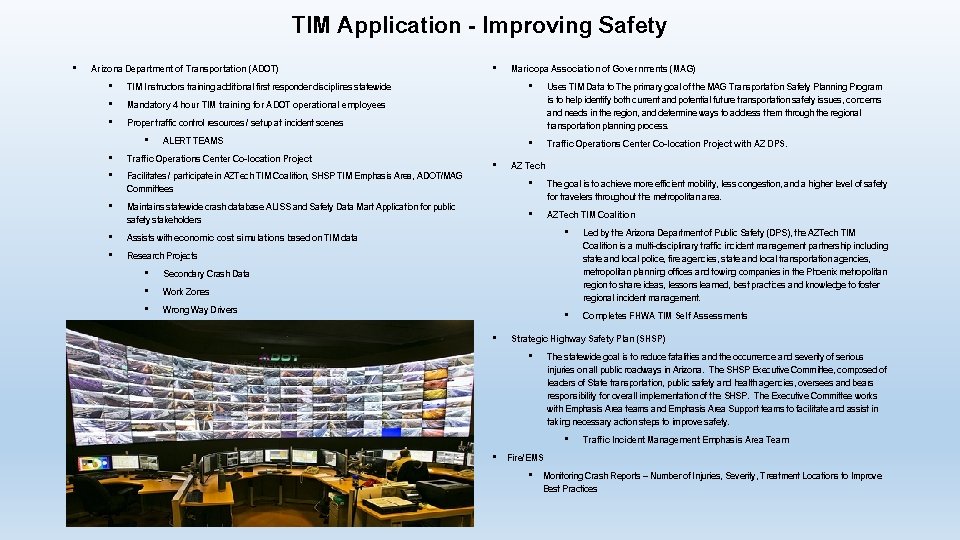
TIM Application - Improving Safety • Arizona Department of Transportation (ADOT) • TIM Instructors training additional first responder disciplines statewide • Mandatory 4 hour TIM training for ADOT operational employees • Proper traffic control resources / setup at incident scenes • ALERT TEAMS • Traffic Operations Center Co-location Project • Facilitates / participate in AZTech TIM Coalition, SHSP TIM Emphasis Area, ADOT/MAG Committees • Maintains statewide crash database ALISS and Safety Data Mart Application for public safety stakeholders • Assists with economic cost simulations based on TIM data • Research Projects • Secondary Crash Data • Work Zones • Wrong Way Drivers • Maricopa Association of Governments (MAG) • Uses TIM Data to The primary goal of the MAG Transportation Safety Planning Program is to help identify both current and potential future transportation safety issues, concerns and needs in the region, and determine ways to address them through the regional transportation planning process. • Traffic Operations Center Co-location Project with AZ DPS. • AZ Tech • The goal is to achieve more efficient mobility, less congestion, and a higher level of safety for travelers throughout the metropolitan area. • AZTech TIM Coalition • Led by the Arizona Department of Public Safety (DPS), the AZTech TIM Coalition is a multi-disciplinary traffic incident management partnership including state and local police, fire agencies, state and local transportation agencies, metropolitan planning offices and towing companies in the Phoenix metropolitan region to share ideas, lessons learned, best practices and knowledge to foster regional incident management. • Completes FHWA TIM Self Assessments • Strategic Highway Safety Plan (SHSP) • The statewide goal is to reduce fatalities and the occurrence and severity of serious injuries on all public roadways in Arizona. The SHSP Executive Committee, composed of leaders of State transportation, public safety and health agencies, oversees and bears responsibility for overall implementation of the SHSP. The Executive Committee works with Emphasis Area teams and Emphasis Area Support teams to facilitate and assist in taking necessary action steps to improve safety. • Traffic Incident Management Emphasis Area Team • Fire/EMS • Monitoring Crash Reports – Number of Injuries, Severity, Treatment Locations to Improve Best Practices
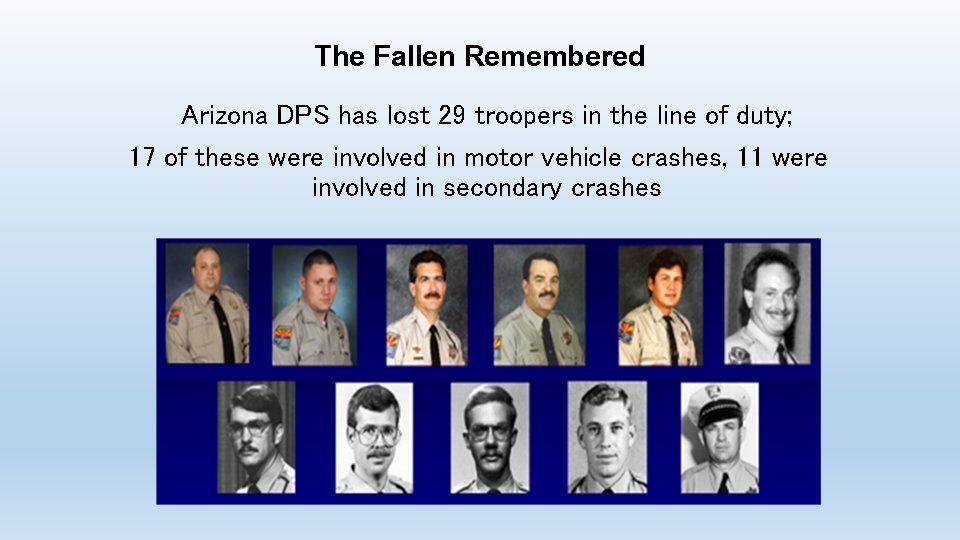
The Fallen Remembered Arizona DPS has lost 29 troopers in the line of duty; 17 of these were involved in motor vehicle crashes, 11 were involved in secondary crashes
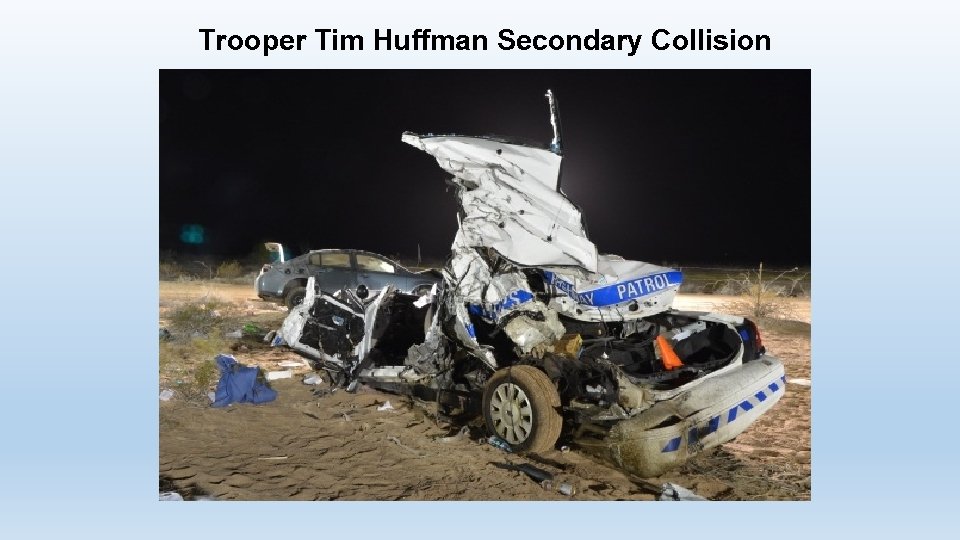
Trooper Tim Huffman Secondary Collision
What We Learned • Manage all incidents with TIM, not just the “big ones”, think “smaller” • Responders get hit frequently • We owe our employees, and the public, a robust TIM program • Build performance measures into your TIM program • Responders must understand the purpose of TIM and the performance measures • Data is of little value unless its counted and acted upon
TIM Performance Measures Collaborative Approach Leads to the Following Outcomes • Collect/Analyze/Apply TIM Data • Develop 4 E’s - Engineering, Education, Enforcement, EMS Strategies and Goals • Improves First Responder / Public Safety • Improves Communications • Safe Quick Clearance • Institutionalizes TIM Strategies, Training, Practices
Contact Information Sergeant John Paul Cartier Trooper Robb Brown Trooper David Duran DPS TOC Office #602 -712 -7688 Social Media Contacts Traffic Operations Center Location 2302 West Durango Street Phoenix, Arizona Control Room Telephone 602 -257 -1563 Twitter Account: Twitter. com @Arizona DOT Facebook: Search Arizona Department of Transportation or Facebook. com/AZDOT www. AZDOT. GOV www. AZ 511. gov DPS Control Room Console 602 -712 -6217 PIO Control Room Desk 602 -712 -6512