
Arithmetic Sequence Skill 37 Objectives Recognize write and

Arithmetic Sequence Skill 37
Objectives… • Recognize, write, and find the nth terms of arithmetic sequences. • Find nth partial sums of arithmetic sequences • Use arithmetic sequences to model and solve real-life problems. .
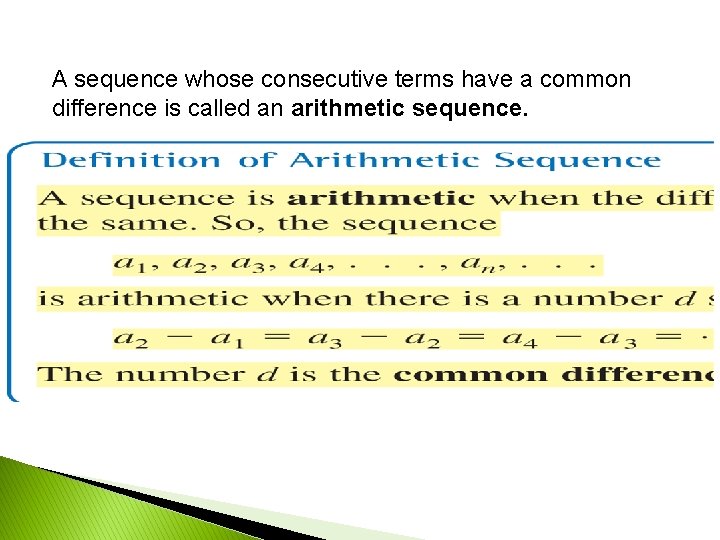
A sequence whose consecutive terms have a common difference is called an arithmetic sequence.

Example-Arithmetic Sequences Begin with n = 1.
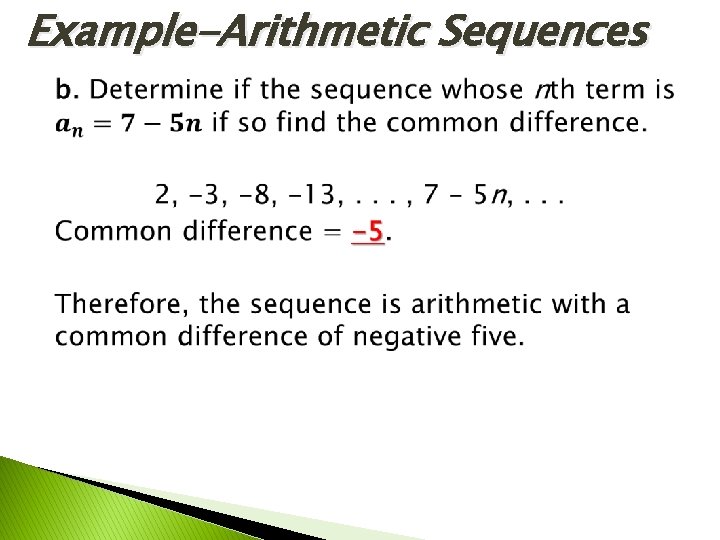
Example-Arithmetic Sequences
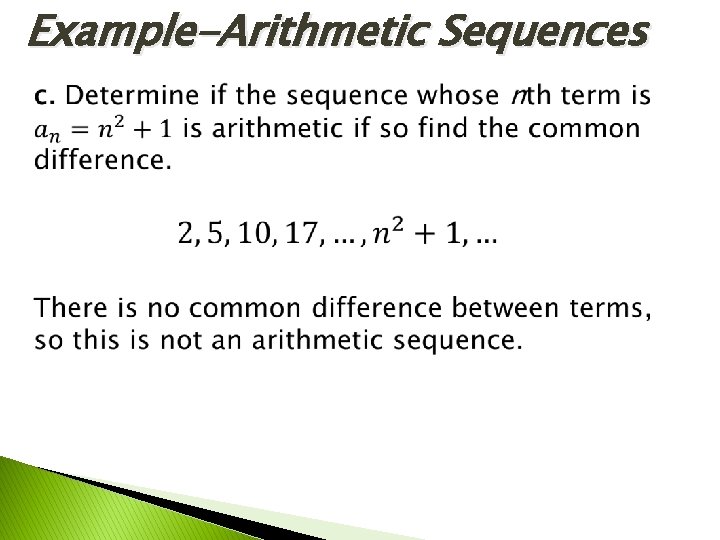
Example-Arithmetic Sequences
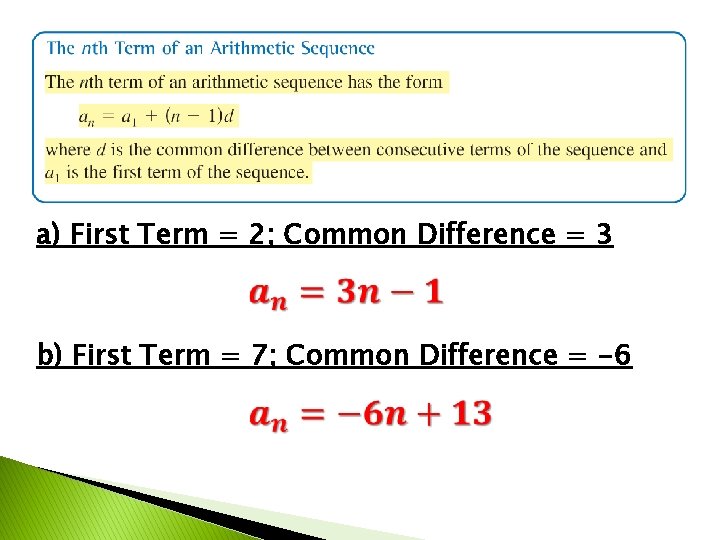
a) First Term = 2; Common Difference = 3 b) First Term = 7; Common Difference = -6
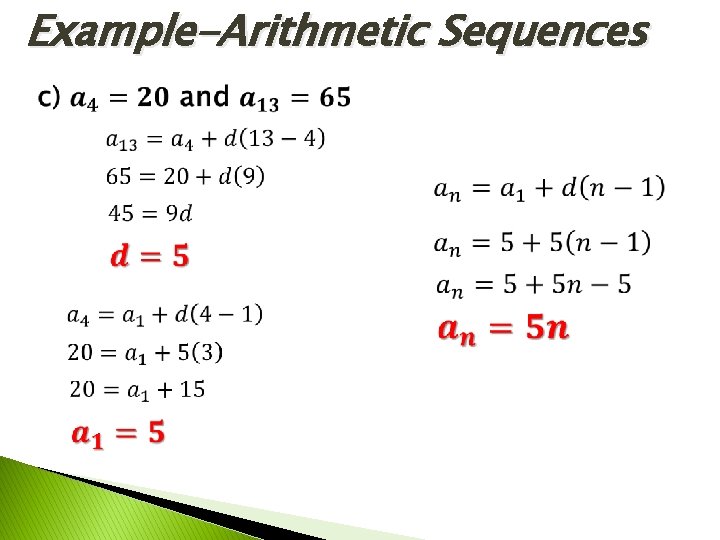
Example-Arithmetic Sequences
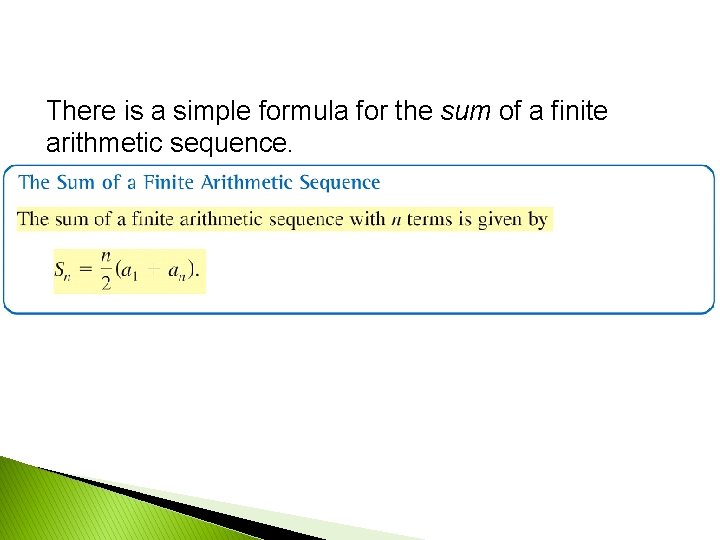
There is a simple formula for the sum of a finite arithmetic sequence.
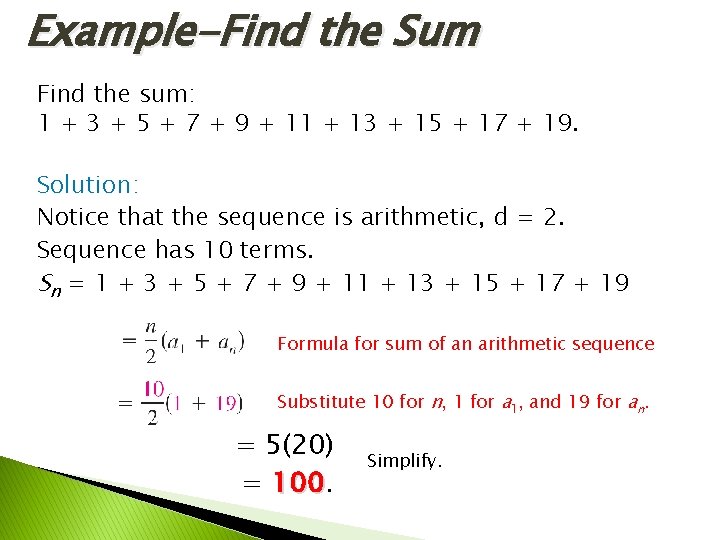
Example-Find the Sum Find the sum: 1 + 3 + 5 + 7 + 9 + 11 + 13 + 15 + 17 + 19. Solution: Notice that the sequence is arithmetic, d = 2. Sequence has 10 terms. Sn = 1 + 3 + 5 + 7 + 9 + 11 + 13 + 15 + 17 + 19 Formula for sum of an arithmetic sequence Substitute 10 for n, 1 for a 1, and 19 for an. = 5(20) = 100. Simplify.
The sum of the first n terms of an infinite sequence is called the nth partial sum. The nth partial sum of an arithmetic sequence can be found by using the formula for the sum of a finite arithmetic sequence.
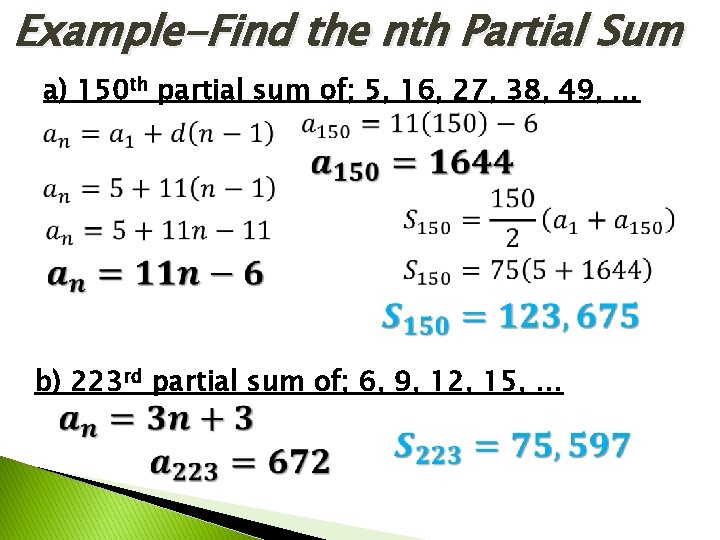
Example-Find the nth Partial Sum a) 150 th partial sum of; 5, 16, 27, 38, 49, … b) 223 rd partial sum of; 6, 9, 12, 15, …
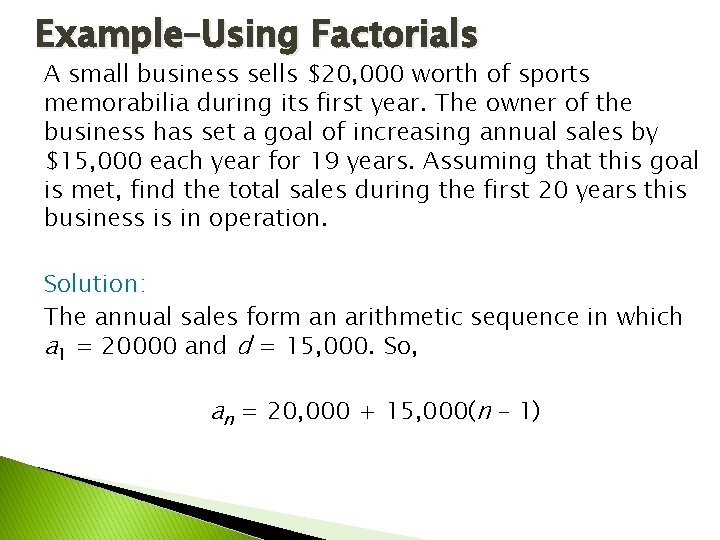
Example–Using Factorials A small business sells $20, 000 worth of sports memorabilia during its first year. The owner of the business has set a goal of increasing annual sales by $15, 000 each year for 19 years. Assuming that this goal is met, find the total sales during the first 20 years this business is in operation. Solution: The annual sales form an arithmetic sequence in which a 1 = 20000 and d = 15, 000. So, an = 20, 000 + 15, 000(n – 1)
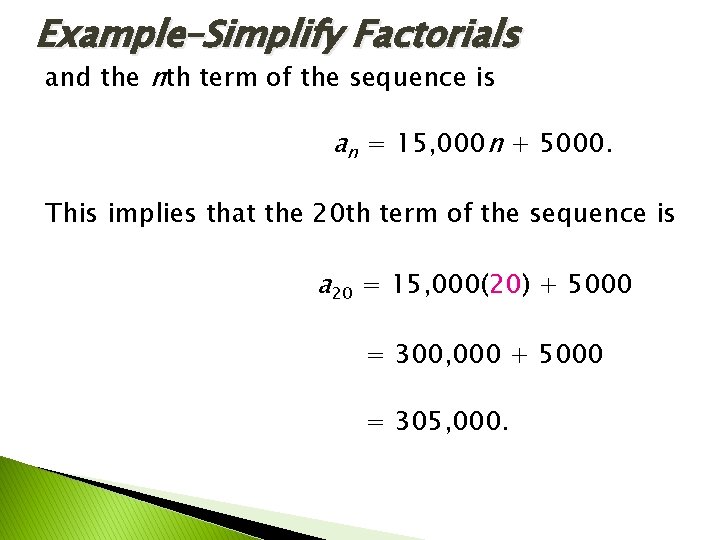
Example–Simplify Factorials and the nth term of the sequence is an = 15, 000 n + 5000. This implies that the 20 th term of the sequence is a 20 = 15, 000(20) + 5000 = 300, 000 + 5000 = 305, 000.
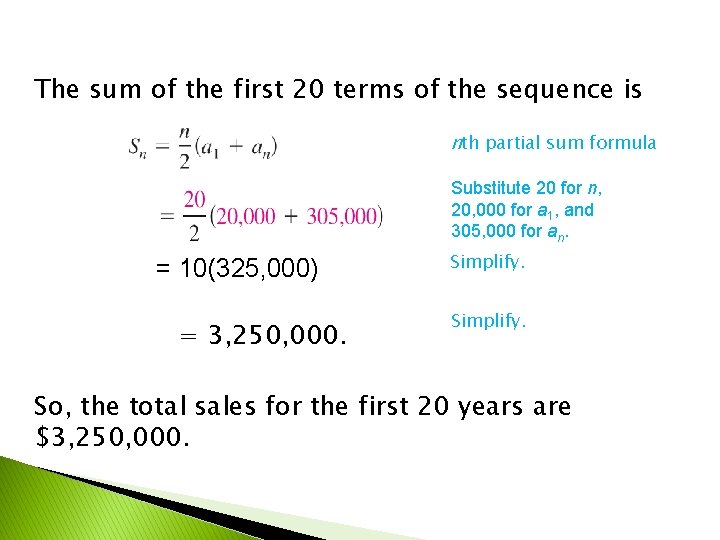
The sum of the first 20 terms of the sequence is nth partial sum formula Substitute 20 for n, 20, 000 for a 1, and 305, 000 for an. = 10(325, 000) = 3, 250, 000. Simplify. So, the total sales for the first 20 years are $3, 250, 000.
37 Arithmetic Sequences � Summarize � Videos � Homework ◦ Worksheet � Quiz Notes
- Slides: 16