
Arithmetic Progressions What is Arithmetic Progressions An Arithmetic

- Slides: 8
Arithmetic Progressions
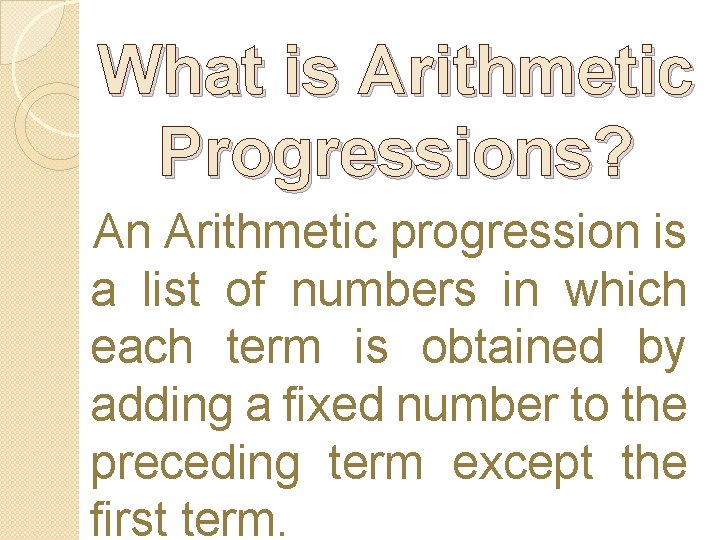
What is Arithmetic Progressions? An Arithmetic progression is a list of numbers in which each term is obtained by adding a fixed number to the preceding term except the first term.
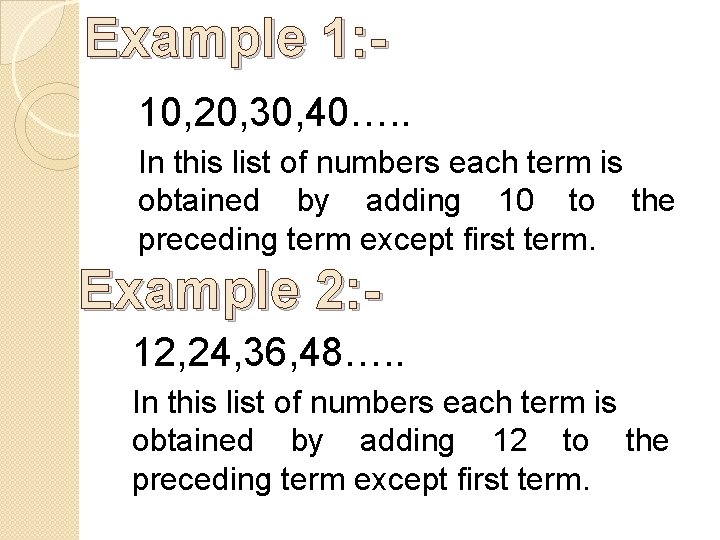
Example 1: 10, 20, 30, 40…. . In this list of numbers each term is obtained by adding 10 to the preceding term except first term. Example 2: 12, 24, 36, 48…. . In this list of numbers each term is obtained by adding 12 to the preceding term except first term.
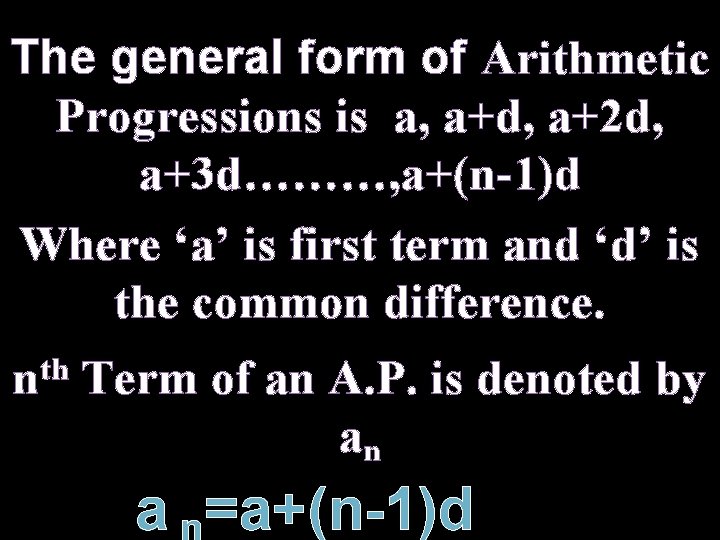
The general form of Arithmetic Progressions is a, a+d, a+2 d, a+3 d………, a+(n-1)d Where ‘a’ is first term and ‘d’ is the common difference. th n Term of an A. P. is denoted by an a =a+(n-1)d
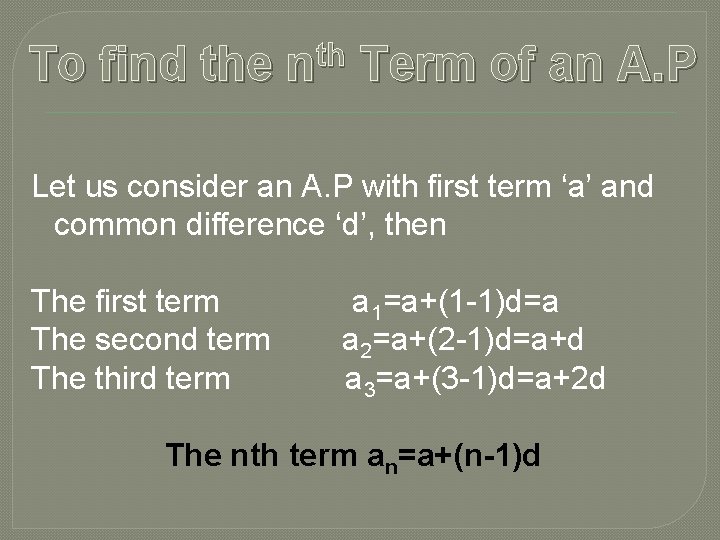
To find the th n Term of an A. P Let us consider an A. P with first term ‘a’ and common difference ‘d’, then The first term The second term The third term a 1=a+(1 -1)d=a a 2=a+(2 -1)d=a+d a 3=a+(3 -1)d=a+2 d The nth term an=a+(n-1)d
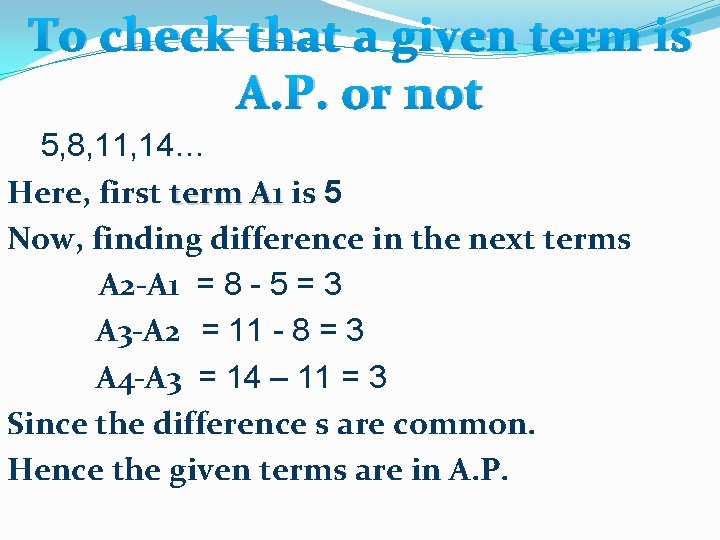
To check that a given term is A. P. or not 5, 8, 11, 14… Here, first term A 1 is 5 Now, finding difference in the next terms A 2 -A 1 = 8 - 5 = 3 A 3 -A 2 = 11 - 8 = 3 A 4 -A 3 = 14 – 11 = 3 Since the difference s are common. Hence the given terms are in A. P.
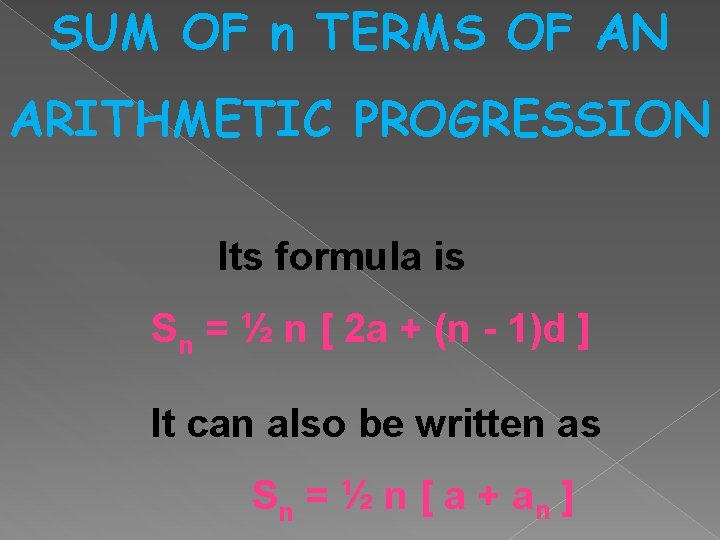
SUM OF n TERMS OF AN ARITHMETIC PROGRESSION Its formula is Sn = ½ n [ 2 a + (n - 1)d ] It can also be written as Sn = ½ n [ a + a n ]
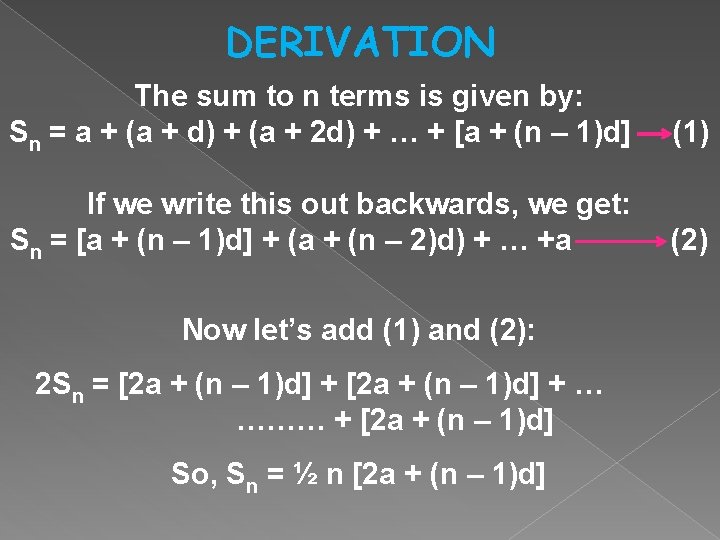
DERIVATION The sum to n terms is given by: Sn = a + (a + d) + (a + 2 d) + … + [a + (n – 1)d] (1) If we write this out backwards, we get: Sn = [a + (n – 1)d] + (a + (n – 2)d) + … +a (2) Now let’s add (1) and (2): 2 Sn = [2 a + (n – 1)d] + … ……… + [2 a + (n – 1)d] So, Sn = ½ n [2 a + (n – 1)d]