
Arithmetic Flags and Instructions Chapter 7 S Dandamudi


- Slides: 43
Arithmetic Flags and Instructions Chapter 7 S. Dandamudi 2005 Ó S. Dandamudi To be used with S. Dandamudi, “Introduction to Assembly Language Programming, ” Second Edition, Springer, 2005.
Outline • Status flags * * * • Application examples * Put. Int 8 * Get. Int 8 Zero flag Carry flag Overflow flag Sign flag Auxiliary flag Parity flag • Multiword arithmetic * * • Arithmetic instructions * Multiplication instructions * Division instructions 2005 Addition Subtraction Multiplication Division • Performance: Multiword multiplication Ó S. Dandamudi To be used with S. Dandamudi, “Introduction to Assembly Language Programming, ” Second Edition, Springer, 2005. 2
Status Flags • Six status flags monitor the outcome of arithmetic, logical, and related operations 2005 Ó S. Dandamudi To be used with S. Dandamudi, “Introduction to Assembly Language Programming, ” Second Edition, Springer, 2005. 3
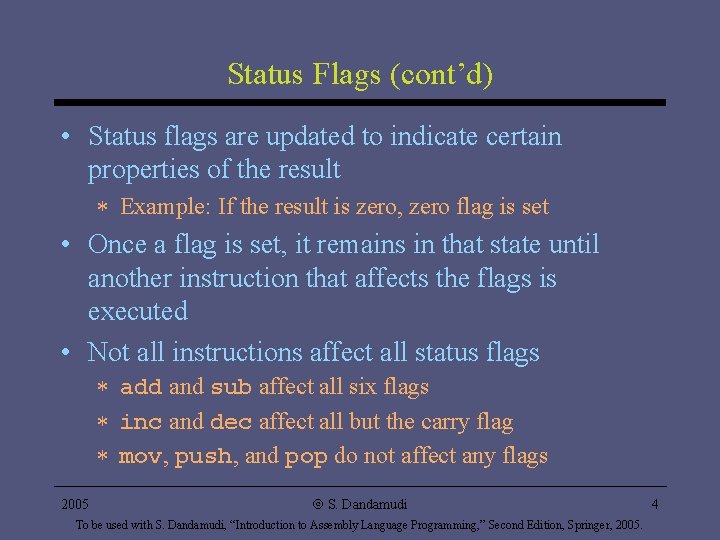
Status Flags (cont’d) • Status flags are updated to indicate certain properties of the result * Example: If the result is zero, zero flag is set • Once a flag is set, it remains in that state until another instruction that affects the flags is executed • Not all instructions affect all status flags * add and sub affect all six flags * inc and dec affect all but the carry flag * mov, push, and pop do not affect any flags 2005 Ó S. Dandamudi To be used with S. Dandamudi, “Introduction to Assembly Language Programming, ” Second Edition, Springer, 2005. 4
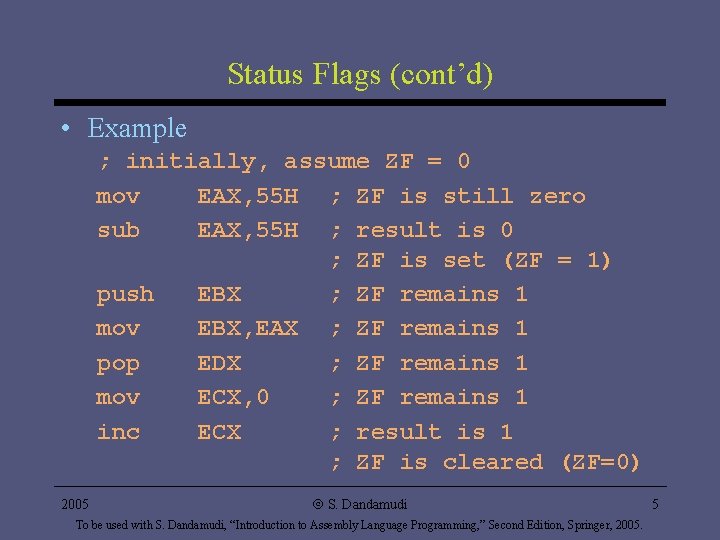
Status Flags (cont’d) • Example ; initially, assume ZF = 0 mov EAX, 55 H ; ZF is still zero sub EAX, 55 H ; result is 0 ; ZF is set (ZF = 1) push EBX ; ZF remains 1 mov EBX, EAX ; ZF remains 1 pop EDX ; ZF remains 1 mov ECX, 0 ; ZF remains 1 inc ECX ; result is 1 ; ZF is cleared (ZF=0) 2005 Ó S. Dandamudi To be used with S. Dandamudi, “Introduction to Assembly Language Programming, ” Second Edition, Springer, 2005. 5
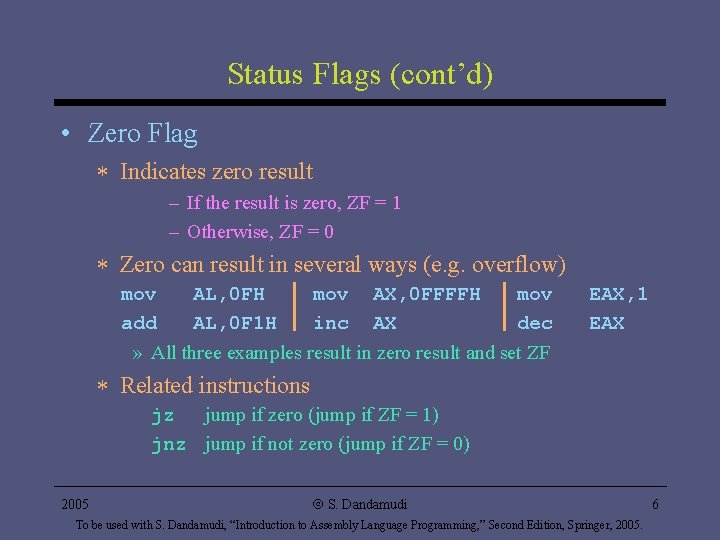
Status Flags (cont’d) • Zero Flag * Indicates zero result – If the result is zero, ZF = 1 – Otherwise, ZF = 0 * Zero can result in several ways (e. g. overflow) mov add AL, 0 FH AL, 0 F 1 H mov inc AX, 0 FFFFH AX mov dec EAX, 1 EAX » All three examples result in zero result and set ZF * Related instructions jz jump if zero (jump if ZF = 1) jnz jump if not zero (jump if ZF = 0) 2005 Ó S. Dandamudi To be used with S. Dandamudi, “Introduction to Assembly Language Programming, ” Second Edition, Springer, 2005. 6
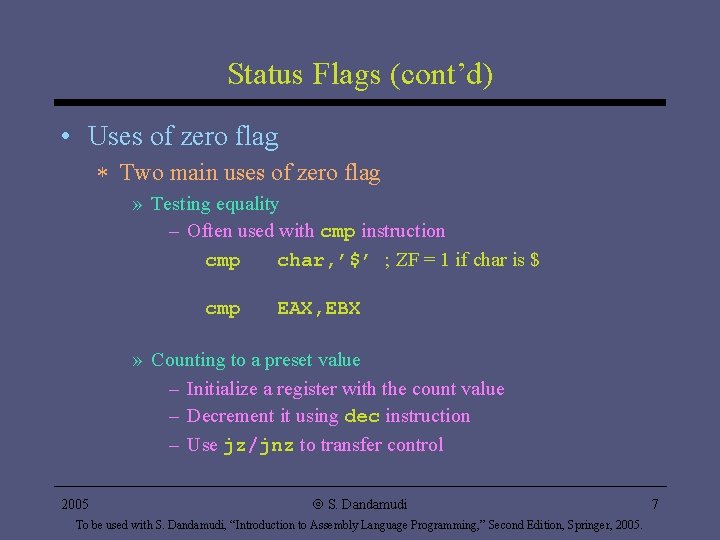
Status Flags (cont’d) • Uses of zero flag * Two main uses of zero flag » Testing equality – Often used with cmp instruction cmp char, ’$’ ; ZF = 1 if char is $ cmp EAX, EBX » Counting to a preset value – Initialize a register with the count value – Decrement it using dec instruction – Use jz/jnz to transfer control 2005 Ó S. Dandamudi To be used with S. Dandamudi, “Introduction to Assembly Language Programming, ” Second Edition, Springer, 2005. 7
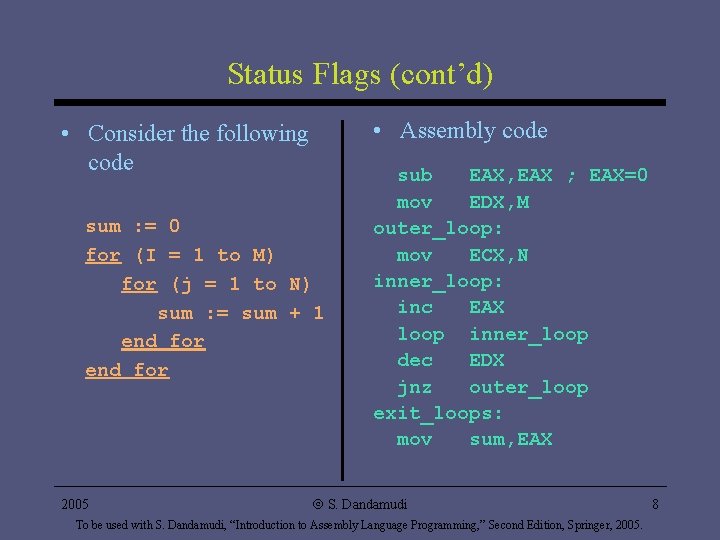
Status Flags (cont’d) • Assembly code • Consider the following code sum : = 0 for (I = 1 to M) for (j = 1 to N) sum : = sum + 1 end for 2005 sub EAX, EAX ; EAX=0 mov EDX, M outer_loop: mov ECX, N inner_loop: inc EAX loop inner_loop dec EDX jnz outer_loop exit_loops: mov sum, EAX Ó S. Dandamudi To be used with S. Dandamudi, “Introduction to Assembly Language Programming, ” Second Edition, Springer, 2005. 8
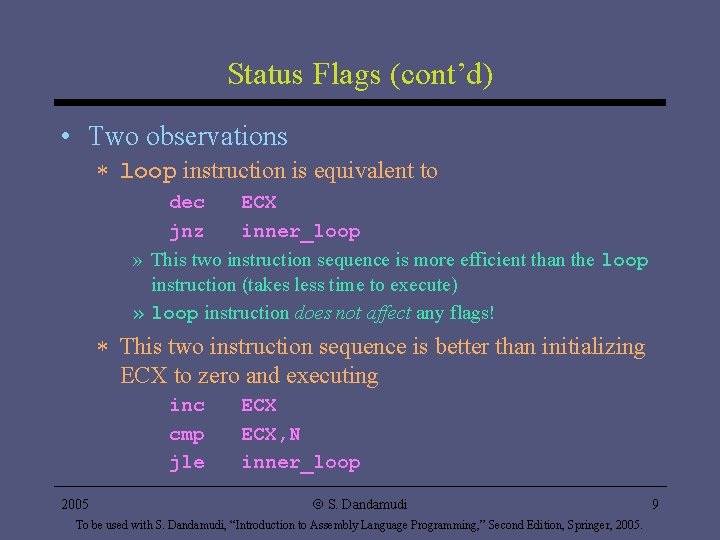
Status Flags (cont’d) • Two observations * loop instruction is equivalent to dec ECX jnz inner_loop » This two instruction sequence is more efficient than the loop instruction (takes less time to execute) » loop instruction does not affect any flags! * This two instruction sequence is better than initializing ECX to zero and executing inc cmp jle 2005 ECX, N inner_loop Ó S. Dandamudi To be used with S. Dandamudi, “Introduction to Assembly Language Programming, ” Second Edition, Springer, 2005. 9
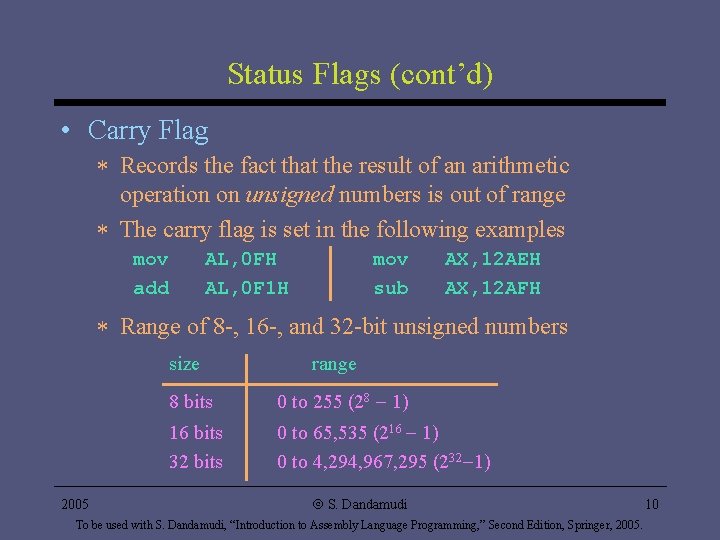
Status Flags (cont’d) • Carry Flag * Records the fact that the result of an arithmetic operation on unsigned numbers is out of range * The carry flag is set in the following examples mov add AL, 0 FH AL, 0 F 1 H mov sub AX, 12 AEH AX, 12 AFH * Range of 8 -, 16 -, and 32 -bit unsigned numbers size 2005 range 8 bits 0 to 255 (28 - 1) 16 bits 32 bits 0 to 65, 535 (216 - 1) 0 to 4, 294, 967, 295 (232 -1) Ó S. Dandamudi To be used with S. Dandamudi, “Introduction to Assembly Language Programming, ” Second Edition, Springer, 2005. 10
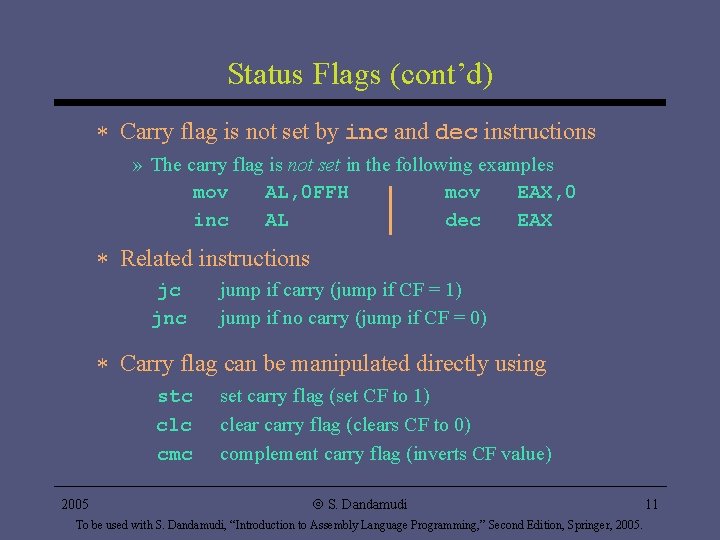
Status Flags (cont’d) * Carry flag is not set by inc and dec instructions » The carry flag is not set in the following examples mov AL, 0 FFH mov EAX, 0 inc AL dec EAX * Related instructions jc jnc jump if carry (jump if CF = 1) jump if no carry (jump if CF = 0) * Carry flag can be manipulated directly using stc clc cmc 2005 set carry flag (set CF to 1) clear carry flag (clears CF to 0) complement carry flag (inverts CF value) Ó S. Dandamudi To be used with S. Dandamudi, “Introduction to Assembly Language Programming, ” Second Edition, Springer, 2005. 11
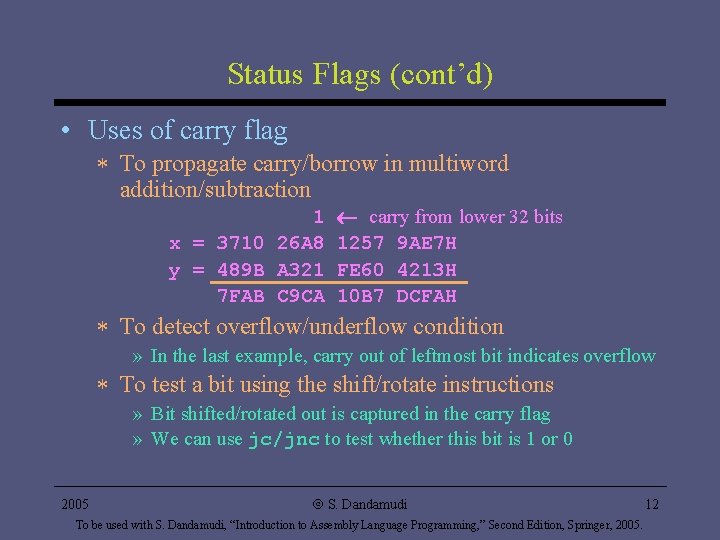
Status Flags (cont’d) • Uses of carry flag * To propagate carry/borrow in multiword addition/subtraction 1 x = 3710 26 A 8 y = 489 B A 321 7 FAB C 9 CA carry from lower 32 bits 1257 9 AE 7 H FE 60 4213 H 10 B 7 DCFAH * To detect overflow/underflow condition » In the last example, carry out of leftmost bit indicates overflow * To test a bit using the shift/rotate instructions » Bit shifted/rotated out is captured in the carry flag » We can use jc/jnc to test whether this bit is 1 or 0 2005 Ó S. Dandamudi To be used with S. Dandamudi, “Introduction to Assembly Language Programming, ” Second Edition, Springer, 2005. 12
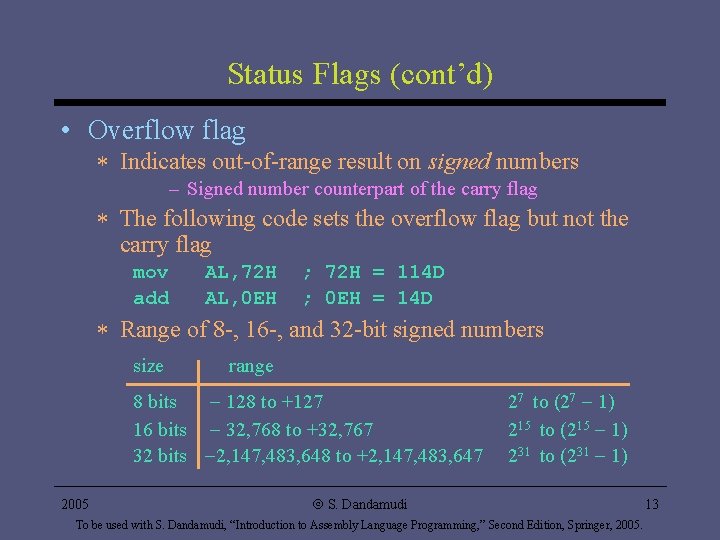
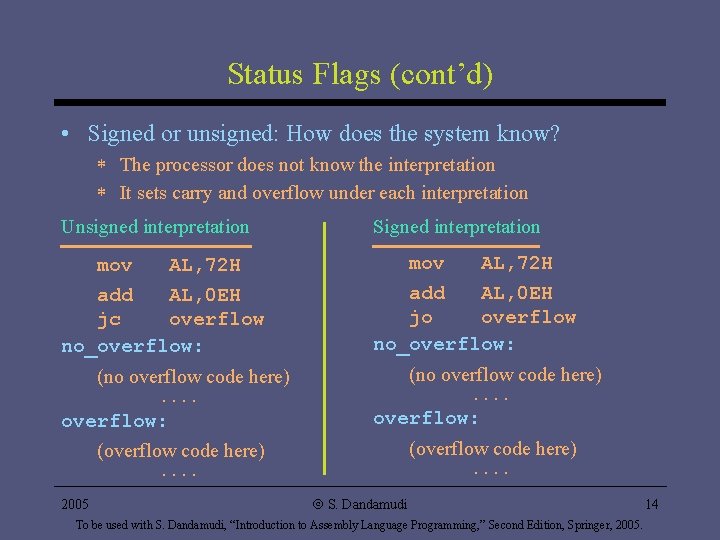
Status Flags (cont’d) • Overflow flag * Indicates out-of-range result on signed numbers – Signed number counterpart of the carry flag * The following code sets the overflow flag but not the carry flag mov add AL, 72 H AL, 0 EH ; 72 H = 114 D ; 0 EH = 14 D * Range of 8 -, 16 -, and 32 -bit signed numbers size range 8 bits - 128 to +127 16 bits - 32, 768 to +32, 767 32 bits -2, 147, 483, 648 to +2, 147, 483, 647 2005 27 to (27 - 1) 215 to (215 - 1) 231 to (231 - 1) Ó S. Dandamudi To be used with S. Dandamudi, “Introduction to Assembly Language Programming, ” Second Edition, Springer, 2005. 13
Status Flags (cont’d) • Signed or unsigned: How does the system know? * The processor does not know the interpretation * It sets carry and overflow under each interpretation Unsigned interpretation Signed interpretation mov AL, 72 H add AL, 0 EH jc overflow no_overflow: mov AL, 72 H add AL, 0 EH jo overflow no_overflow: (no overflow code here). . . . overflow: (overflow code here). . . . 2005 Ó S. Dandamudi To be used with S. Dandamudi, “Introduction to Assembly Language Programming, ” Second Edition, Springer, 2005. 14
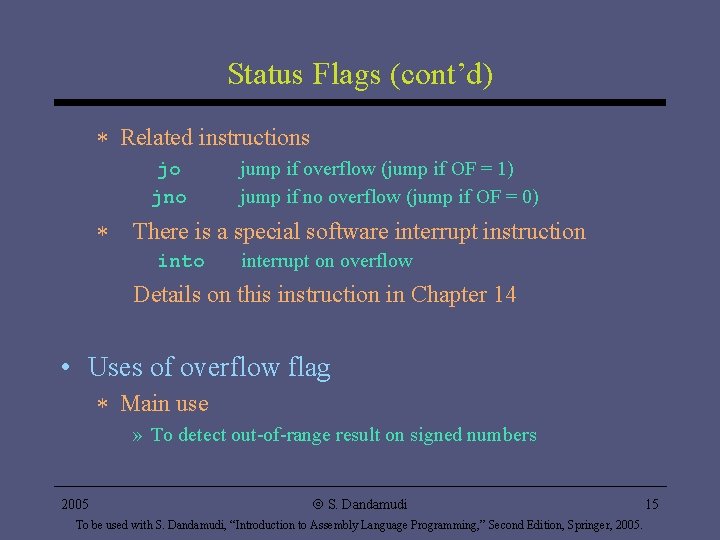
Status Flags (cont’d) * Related instructions jo jno jump if overflow (jump if OF = 1) jump if no overflow (jump if OF = 0) * There is a special software interrupt instruction into interrupt on overflow Details on this instruction in Chapter 14 • Uses of overflow flag * Main use » To detect out-of-range result on signed numbers 2005 Ó S. Dandamudi To be used with S. Dandamudi, “Introduction to Assembly Language Programming, ” Second Edition, Springer, 2005. 15
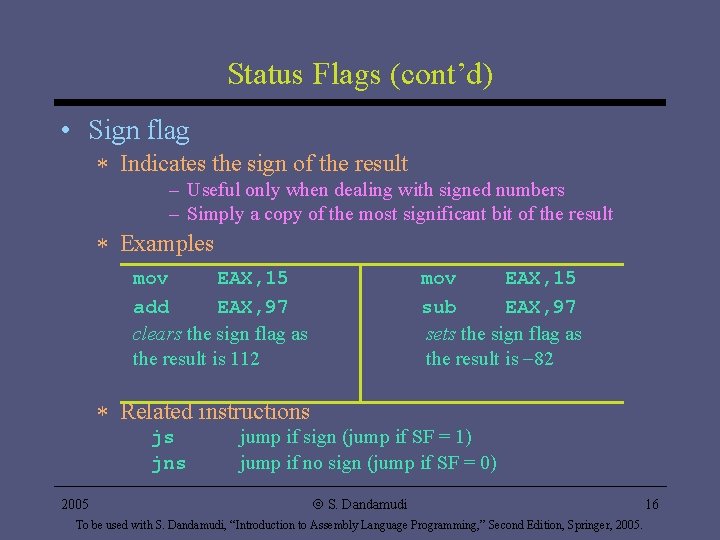
Status Flags (cont’d) • Sign flag * Indicates the sign of the result – Useful only when dealing with signed numbers – Simply a copy of the most significant bit of the result * Examples mov EAX, 15 add EAX, 97 clears the sign flag as the result is 112 mov EAX, 15 sub EAX, 97 sets the sign flag as the result is -82 * Related instructions js jns 2005 jump if sign (jump if SF = 1) jump if no sign (jump if SF = 0) Ó S. Dandamudi To be used with S. Dandamudi, “Introduction to Assembly Language Programming, ” Second Edition, Springer, 2005. 16
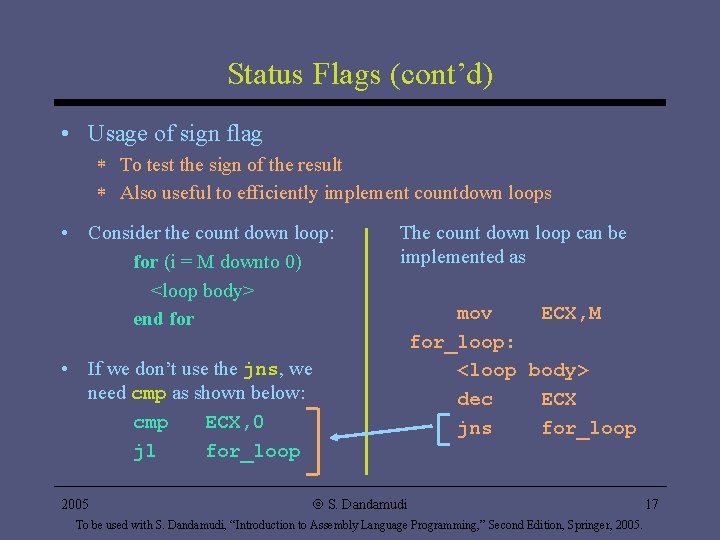
Status Flags (cont’d) • Usage of sign flag * To test the sign of the result * Also useful to efficiently implement countdown loops • Consider the count down loop: for (i = M downto 0) <loop body> end for The count down loop can be implemented as • If we don’t use the jns, we need cmp as shown below: cmp ECX, 0 jl for_loop 2005 mov ECX, M for_loop: <loop body> dec ECX jns for_loop Ó S. Dandamudi To be used with S. Dandamudi, “Introduction to Assembly Language Programming, ” Second Edition, Springer, 2005. 17
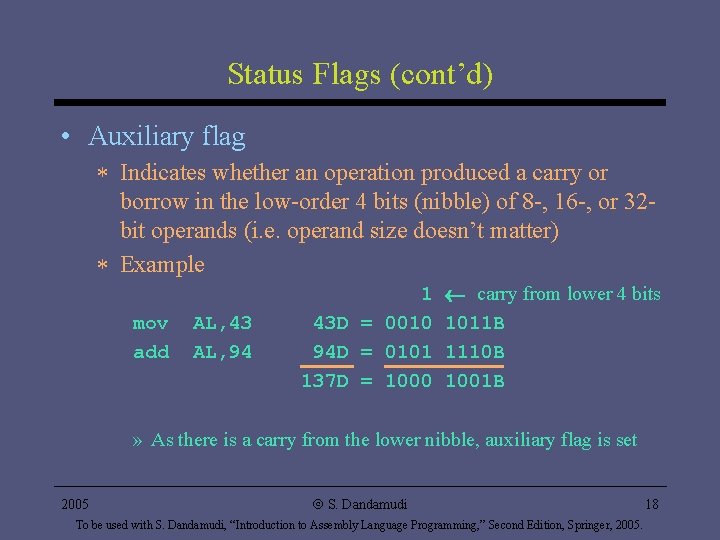
Status Flags (cont’d) • Auxiliary flag * Indicates whether an operation produced a carry or borrow in the low-order 4 bits (nibble) of 8 -, 16 -, or 32 bit operands (i. e. operand size doesn’t matter) * Example mov add AL, 43 AL, 94 1 43 D = 0010 94 D = 0101 137 D = 1000 carry from lower 4 bits 1011 B 1110 B 1001 B » As there is a carry from the lower nibble, auxiliary flag is set 2005 Ó S. Dandamudi To be used with S. Dandamudi, “Introduction to Assembly Language Programming, ” Second Edition, Springer, 2005. 18
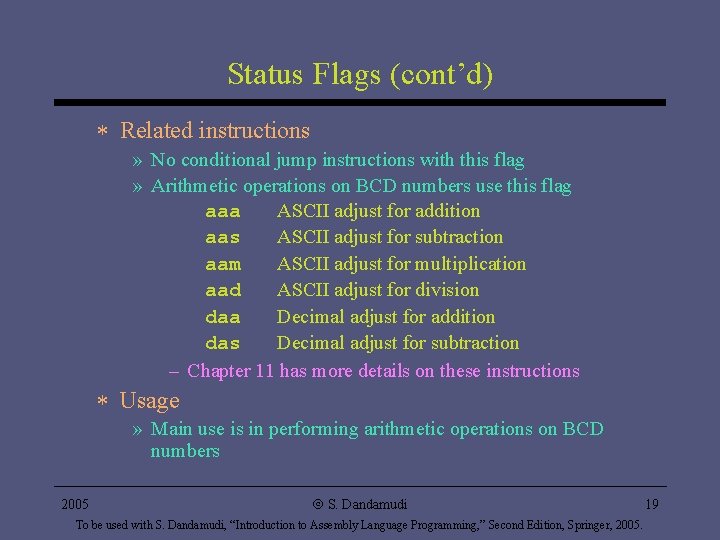
Status Flags (cont’d) * Related instructions » No conditional jump instructions with this flag » Arithmetic operations on BCD numbers use this flag aaa ASCII adjust for addition aas ASCII adjust for subtraction aam ASCII adjust for multiplication aad ASCII adjust for division daa Decimal adjust for addition das Decimal adjust for subtraction – Chapter 11 has more details on these instructions * Usage » Main use is in performing arithmetic operations on BCD numbers 2005 Ó S. Dandamudi To be used with S. Dandamudi, “Introduction to Assembly Language Programming, ” Second Edition, Springer, 2005. 19
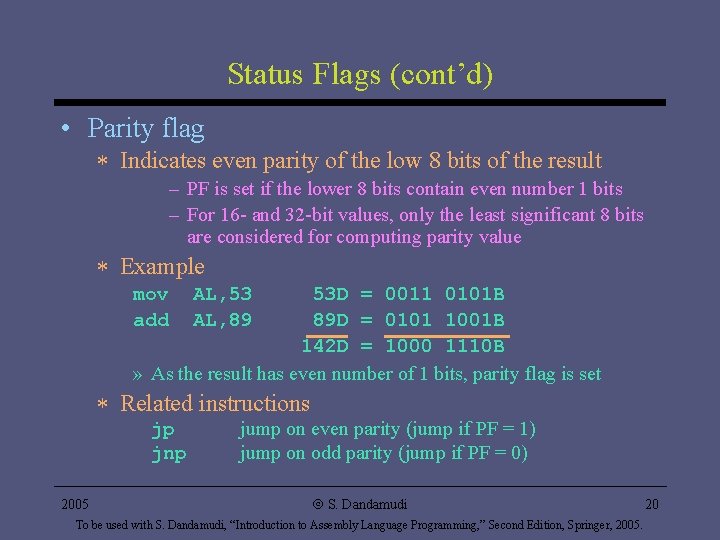
Status Flags (cont’d) • Parity flag * Indicates even parity of the low 8 bits of the result – PF is set if the lower 8 bits contain even number 1 bits – For 16 - and 32 -bit values, only the least significant 8 bits are considered for computing parity value * Example mov add AL, 53 AL, 89 53 D = 0011 0101 B 89 D = 0101 1001 B 142 D = 1000 1110 B » As the result has even number of 1 bits, parity flag is set * Related instructions jp jnp 2005 jump on even parity (jump if PF = 1) jump on odd parity (jump if PF = 0) Ó S. Dandamudi To be used with S. Dandamudi, “Introduction to Assembly Language Programming, ” Second Edition, Springer, 2005. 20
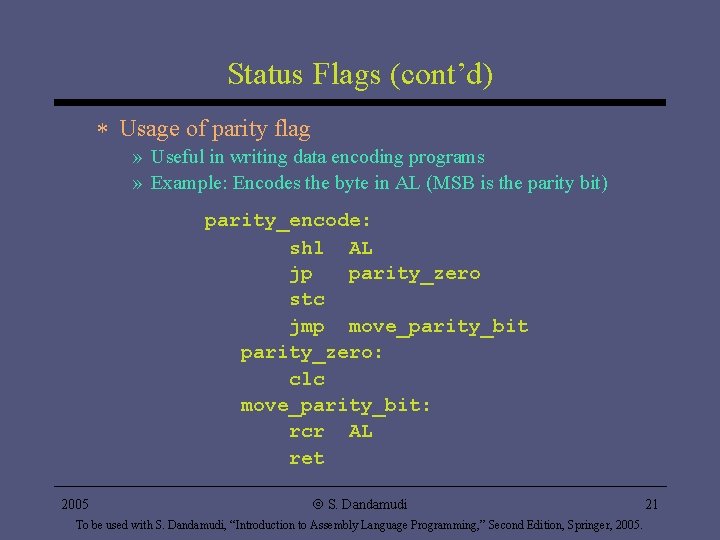
Status Flags (cont’d) * Usage of parity flag » Useful in writing data encoding programs » Example: Encodes the byte in AL (MSB is the parity bit) parity_encode: shl AL jp parity_zero stc jmp move_parity_bit parity_zero: clc move_parity_bit: rcr AL ret 2005 Ó S. Dandamudi To be used with S. Dandamudi, “Introduction to Assembly Language Programming, ” Second Edition, Springer, 2005. 21
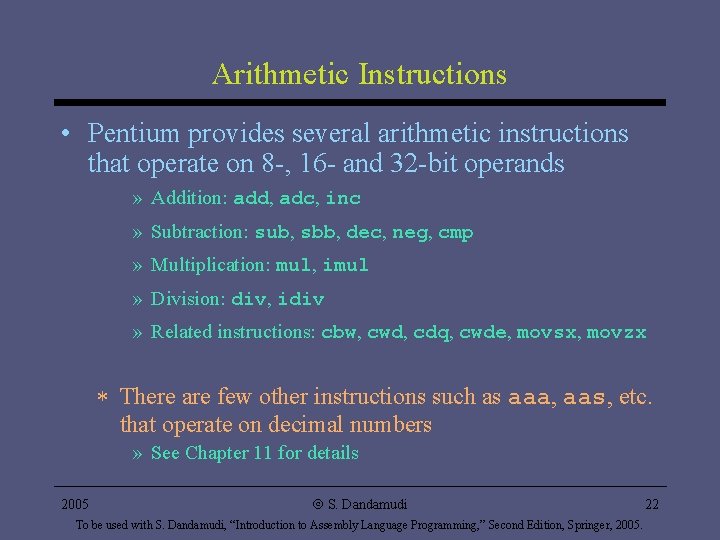
Arithmetic Instructions • Pentium provides several arithmetic instructions that operate on 8 -, 16 - and 32 -bit operands » Addition: add, adc, inc » Subtraction: sub, sbb, dec, neg, cmp » Multiplication: mul, imul » Division: div, idiv » Related instructions: cbw, cwd, cdq, cwde, movsx, movzx * There are few other instructions such as aaa, aas, etc. that operate on decimal numbers » See Chapter 11 for details 2005 Ó S. Dandamudi To be used with S. Dandamudi, “Introduction to Assembly Language Programming, ” Second Edition, Springer, 2005. 22
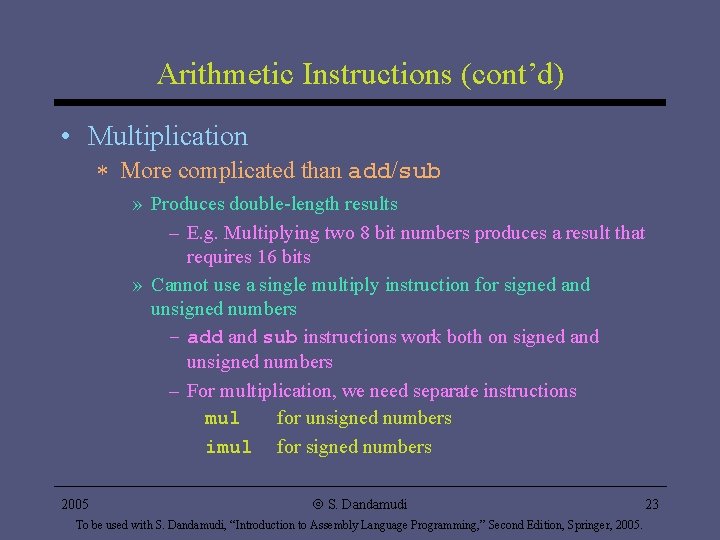
Arithmetic Instructions (cont’d) • Multiplication * More complicated than add/sub » Produces double-length results – E. g. Multiplying two 8 bit numbers produces a result that requires 16 bits » Cannot use a single multiply instruction for signed and unsigned numbers – add and sub instructions work both on signed and unsigned numbers – For multiplication, we need separate instructions mul for unsigned numbers imul for signed numbers 2005 Ó S. Dandamudi To be used with S. Dandamudi, “Introduction to Assembly Language Programming, ” Second Edition, Springer, 2005. 23
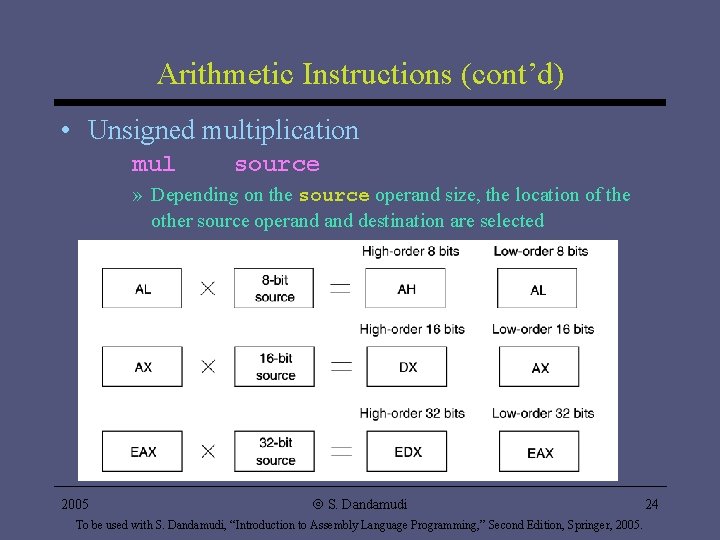
Arithmetic Instructions (cont’d) • Unsigned multiplication mul source » Depending on the source operand size, the location of the other source operand destination are selected 2005 Ó S. Dandamudi To be used with S. Dandamudi, “Introduction to Assembly Language Programming, ” Second Edition, Springer, 2005. 24
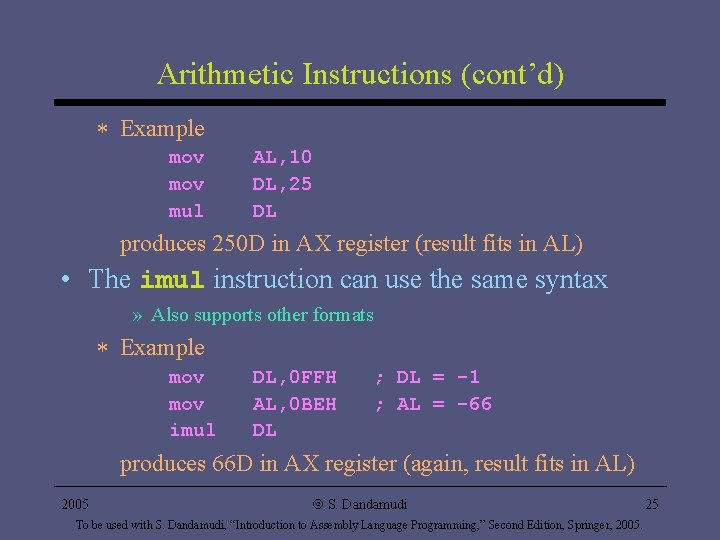
Arithmetic Instructions (cont’d) * Example mov mul AL, 10 DL, 25 DL produces 250 D in AX register (result fits in AL) • The imul instruction can use the same syntax » Also supports other formats * Example mov imul DL, 0 FFH AL, 0 BEH DL ; DL = -1 ; AL = -66 produces 66 D in AX register (again, result fits in AL) 2005 Ó S. Dandamudi To be used with S. Dandamudi, “Introduction to Assembly Language Programming, ” Second Edition, Springer, 2005. 25
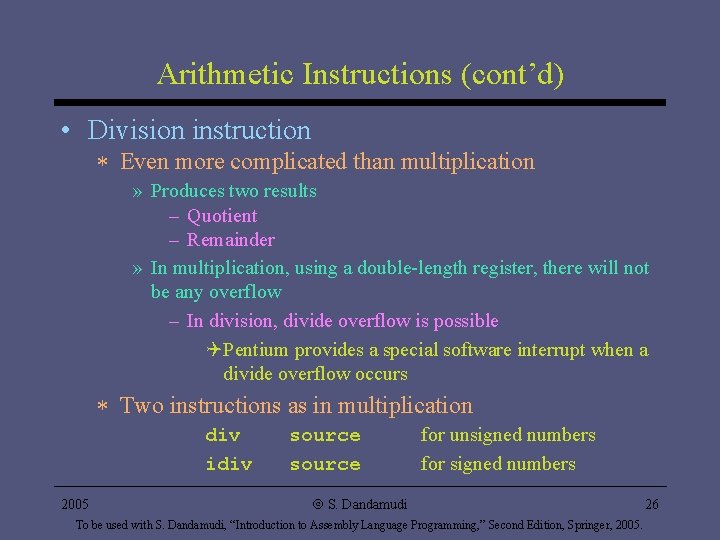
Arithmetic Instructions (cont’d) • Division instruction * Even more complicated than multiplication » Produces two results – Quotient – Remainder » In multiplication, using a double-length register, there will not be any overflow – In division, divide overflow is possible QPentium provides a special software interrupt when a divide overflow occurs * Two instructions as in multiplication div idiv 2005 source for unsigned numbers for signed numbers Ó S. Dandamudi To be used with S. Dandamudi, “Introduction to Assembly Language Programming, ” Second Edition, Springer, 2005. 26
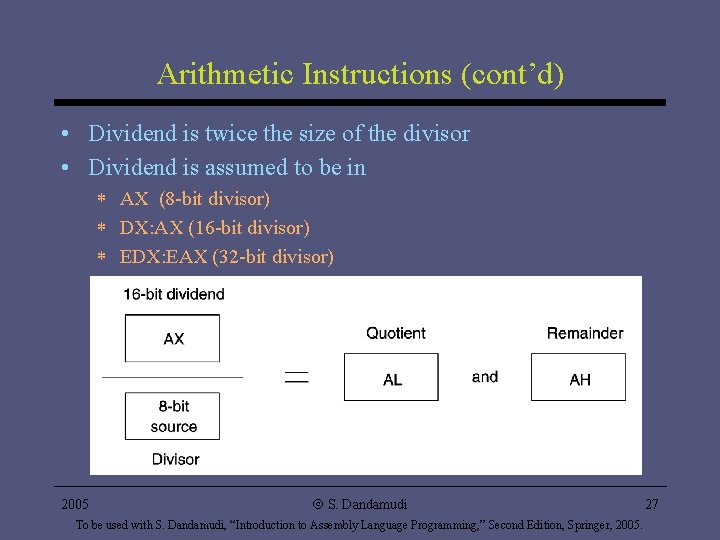
Arithmetic Instructions (cont’d) • Dividend is twice the size of the divisor • Dividend is assumed to be in * AX (8 -bit divisor) * DX: AX (16 -bit divisor) * EDX: EAX (32 -bit divisor) 2005 Ó S. Dandamudi To be used with S. Dandamudi, “Introduction to Assembly Language Programming, ” Second Edition, Springer, 2005. 27
Arithmetic Instructions (cont’d) 2005 Ó S. Dandamudi To be used with S. Dandamudi, “Introduction to Assembly Language Programming, ” Second Edition, Springer, 2005. 28
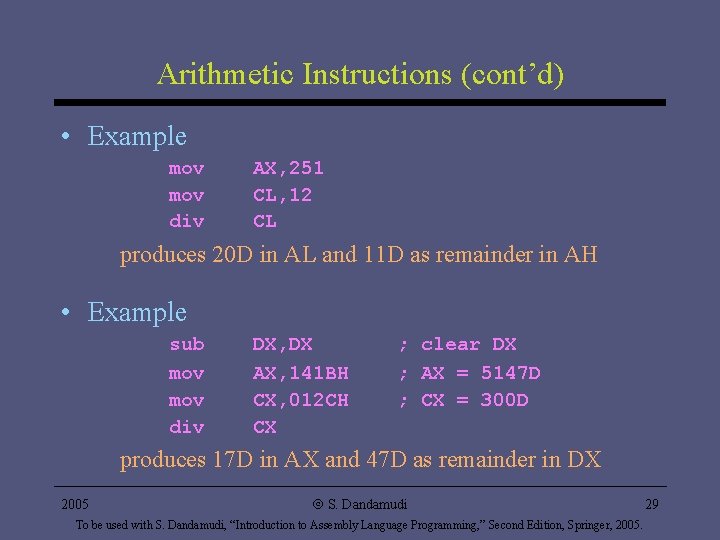
Arithmetic Instructions (cont’d) • Example mov div AX, 251 CL, 12 CL produces 20 D in AL and 11 D as remainder in AH • Example sub mov div DX, DX AX, 141 BH CX, 012 CH CX ; clear DX ; AX = 5147 D ; CX = 300 D produces 17 D in AX and 47 D as remainder in DX 2005 Ó S. Dandamudi To be used with S. Dandamudi, “Introduction to Assembly Language Programming, ” Second Edition, Springer, 2005. 29
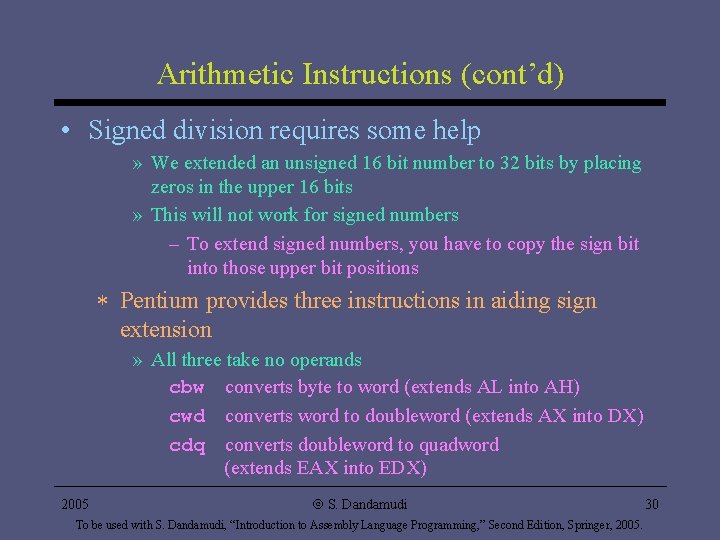
Arithmetic Instructions (cont’d) • Signed division requires some help » We extended an unsigned 16 bit number to 32 bits by placing zeros in the upper 16 bits » This will not work for signed numbers – To extend signed numbers, you have to copy the sign bit into those upper bit positions * Pentium provides three instructions in aiding sign extension » All three take no operands cbw converts byte to word (extends AL into AH) cwd converts word to doubleword (extends AX into DX) cdq converts doubleword to quadword (extends EAX into EDX) 2005 Ó S. Dandamudi To be used with S. Dandamudi, “Introduction to Assembly Language Programming, ” Second Edition, Springer, 2005. 30
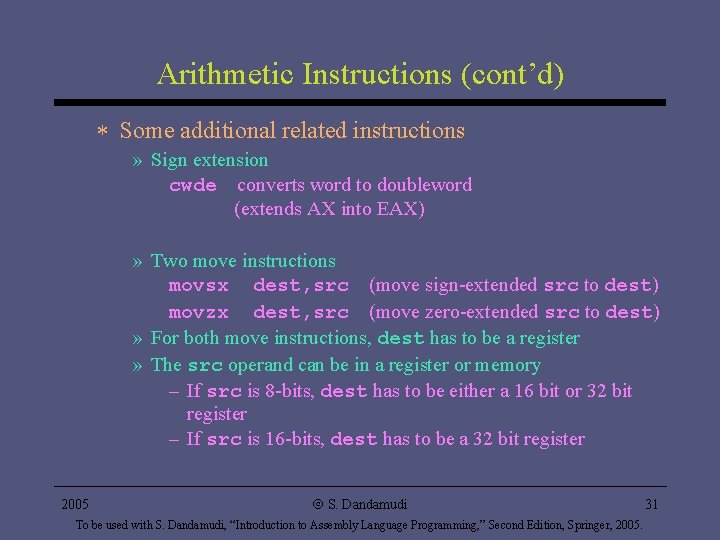
Arithmetic Instructions (cont’d) * Some additional related instructions » Sign extension cwde converts word to doubleword (extends AX into EAX) » Two move instructions movsx dest, src (move sign-extended src to dest) movzx dest, src (move zero-extended src to dest) » For both move instructions, dest has to be a register » The src operand can be in a register or memory – If src is 8 -bits, dest has to be either a 16 bit or 32 bit register – If src is 16 -bits, dest has to be a 32 bit register 2005 Ó S. Dandamudi To be used with S. Dandamudi, “Introduction to Assembly Language Programming, ” Second Edition, Springer, 2005. 31
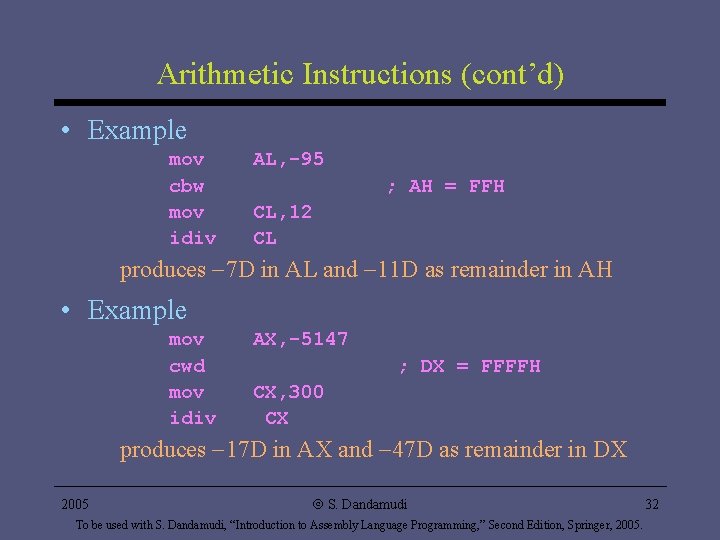
Arithmetic Instructions (cont’d) • Example mov cbw mov idiv AL, -95 ; AH = FFH CL, 12 CL produces -7 D in AL and -11 D as remainder in AH • Example mov cwd mov idiv AX, -5147 ; DX = FFFFH CX, 300 CX produces -17 D in AX and -47 D as remainder in DX 2005 Ó S. Dandamudi To be used with S. Dandamudi, “Introduction to Assembly Language Programming, ” Second Edition, Springer, 2005. 32
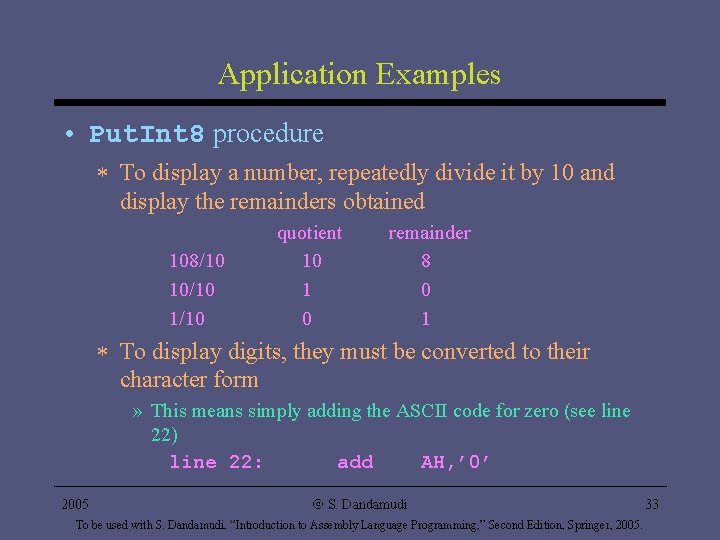
Application Examples • Put. Int 8 procedure * To display a number, repeatedly divide it by 10 and display the remainders obtained 108/10 10/10 1/10 quotient 10 1 0 remainder 8 0 1 * To display digits, they must be converted to their character form » This means simply adding the ASCII code for zero (see line 22) line 22: add AH, ’ 0’ 2005 Ó S. Dandamudi To be used with S. Dandamudi, “Introduction to Assembly Language Programming, ” Second Edition, Springer, 2005. 33
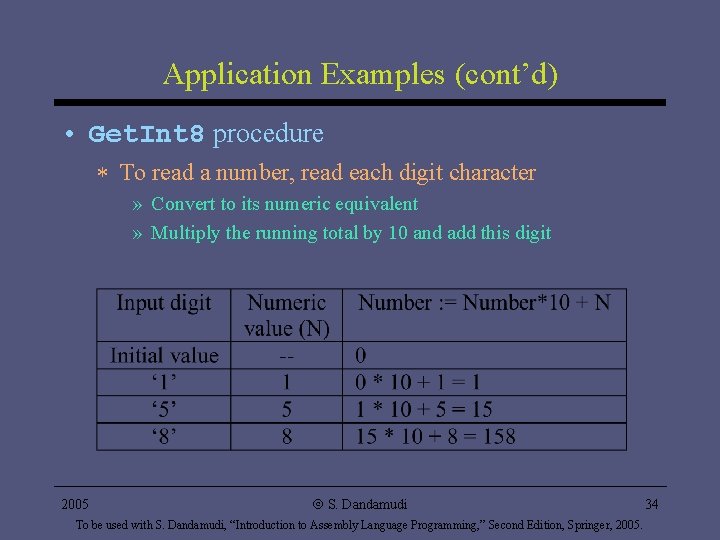
Application Examples (cont’d) • Get. Int 8 procedure * To read a number, read each digit character » Convert to its numeric equivalent » Multiply the running total by 10 and add this digit 2005 Ó S. Dandamudi To be used with S. Dandamudi, “Introduction to Assembly Language Programming, ” Second Edition, Springer, 2005. 34
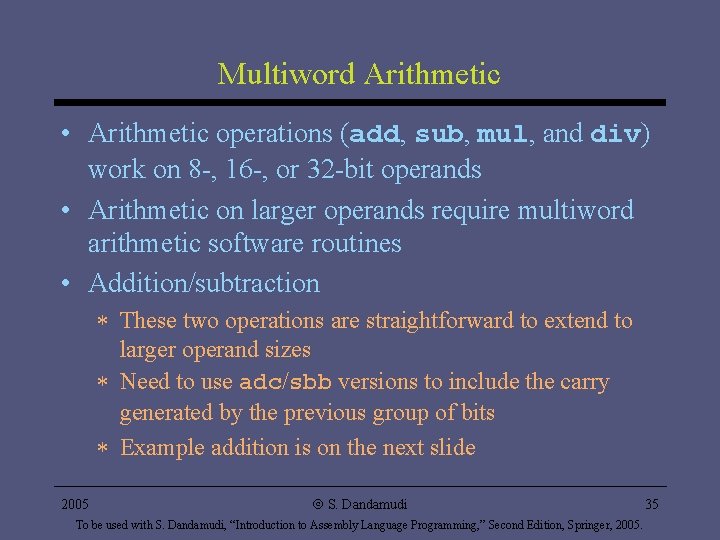
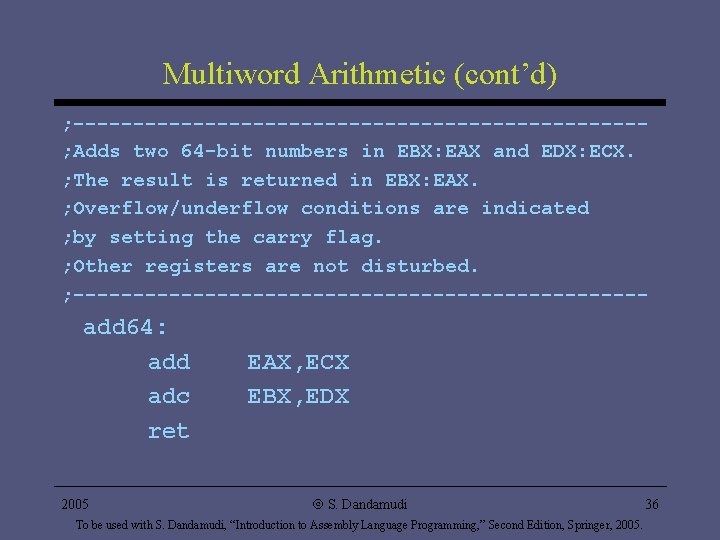
Multiword Arithmetic • Arithmetic operations (add, sub, mul, and div) work on 8 -, 16 -, or 32 -bit operands • Arithmetic on larger operands require multiword arithmetic software routines • Addition/subtraction * These two operations are straightforward to extend to larger operand sizes * Need to use adc/sbb versions to include the carry generated by the previous group of bits * Example addition is on the next slide 2005 Ó S. Dandamudi To be used with S. Dandamudi, “Introduction to Assembly Language Programming, ” Second Edition, Springer, 2005. 35
Multiword Arithmetic (cont’d) ; ------------------------; Adds two 64 -bit numbers in EBX: EAX and EDX: ECX. ; The result is returned in EBX: EAX. ; Overflow/underflow conditions are indicated ; by setting the carry flag. ; Other registers are not disturbed. ; ------------------------ add 64: add adc ret 2005 EAX, ECX EBX, EDX Ó S. Dandamudi To be used with S. Dandamudi, “Introduction to Assembly Language Programming, ” Second Edition, Springer, 2005. 36
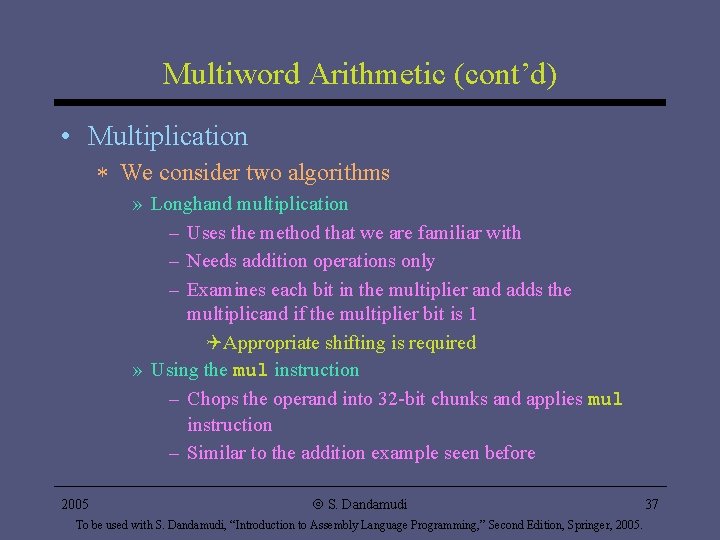
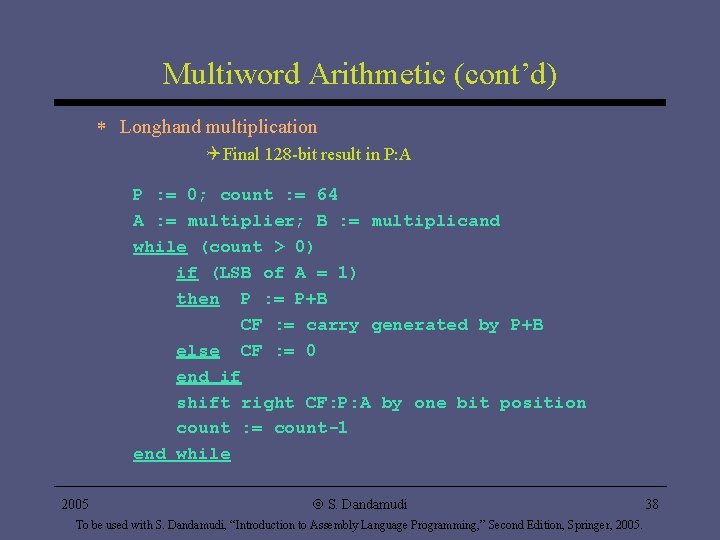
Multiword Arithmetic (cont’d) • Multiplication * We consider two algorithms » Longhand multiplication – Uses the method that we are familiar with – Needs addition operations only – Examines each bit in the multiplier and adds the multiplicand if the multiplier bit is 1 QAppropriate shifting is required » Using the mul instruction – Chops the operand into 32 -bit chunks and applies mul instruction – Similar to the addition example seen before 2005 Ó S. Dandamudi To be used with S. Dandamudi, “Introduction to Assembly Language Programming, ” Second Edition, Springer, 2005. 37
Multiword Arithmetic (cont’d) * Longhand multiplication Q Final 128 -bit result in P: A P : = 0; count : = 64 A : = multiplier; B : = multiplicand while (count > 0) if (LSB of A = 1) then P : = P+B CF : = carry generated by P+B else CF : = 0 end if shift right CF: P: A by one bit position count : = count-1 end while 2005 Ó S. Dandamudi To be used with S. Dandamudi, “Introduction to Assembly Language Programming, ” Second Edition, Springer, 2005. 38
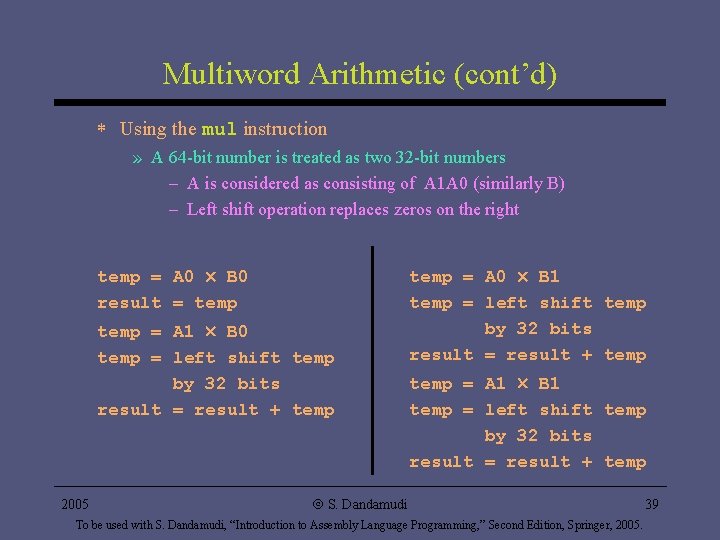
Multiword Arithmetic (cont’d) * Using the mul instruction » A 64 -bit number is treated as two 32 -bit numbers – A is considered as consisting of A 1 A 0 (similarly B) – Left shift operation replaces zeros on the right temp = A 0 B 0 result = temp = A 1 B 0 temp = left shift temp by 32 bits result = result + temp 2005 temp = A 0 B 1 temp = left shift temp by 32 bits result = result + temp = A 1 B 1 temp = left shift temp by 32 bits result = result + temp Ó S. Dandamudi To be used with S. Dandamudi, “Introduction to Assembly Language Programming, ” Second Edition, Springer, 2005. 39
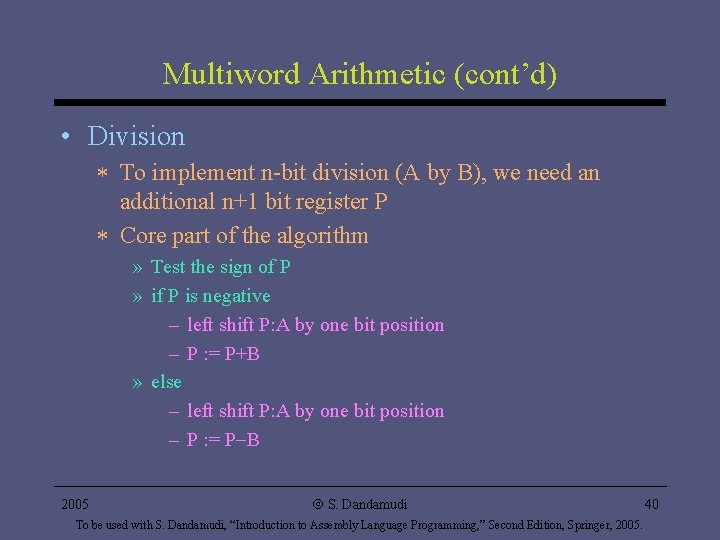
Multiword Arithmetic (cont’d) • Division * To implement n-bit division (A by B), we need an additional n+1 bit register P * Core part of the algorithm » Test the sign of P » if P is negative – left shift P: A by one bit position – P : = P+B » else – left shift P: A by one bit position – P : = P-B 2005 Ó S. Dandamudi To be used with S. Dandamudi, “Introduction to Assembly Language Programming, ” Second Edition, Springer, 2005. 40
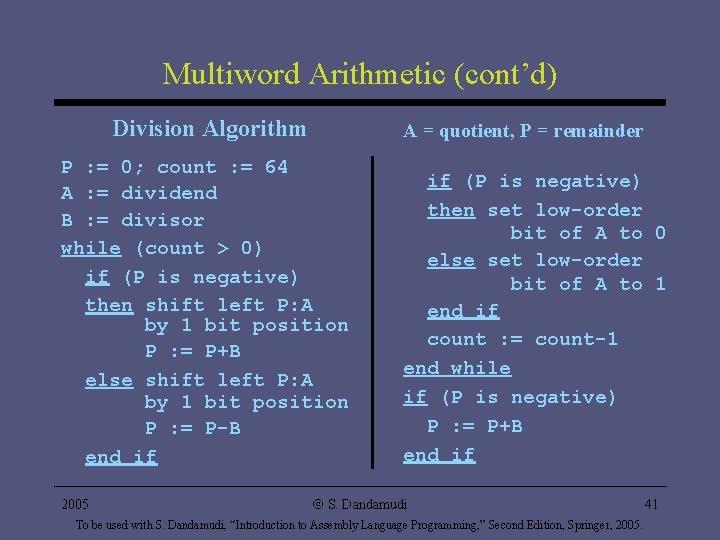
Multiword Arithmetic (cont’d) Division Algorithm A = quotient, P = remainder P : = 0; count : = 64 A : = dividend B : = divisor while (count > 0) if (P is negative) then shift left P: A by 1 bit position P : = P+B else shift left P: A by 1 bit position P : = P-B end if 2005 if (P is negative) then set low-order bit of A to 0 else set low-order bit of A to 1 end if count : = count-1 end while if (P is negative) P : = P+B end if Ó S. Dandamudi To be used with S. Dandamudi, “Introduction to Assembly Language Programming, ” Second Edition, Springer, 2005. 41
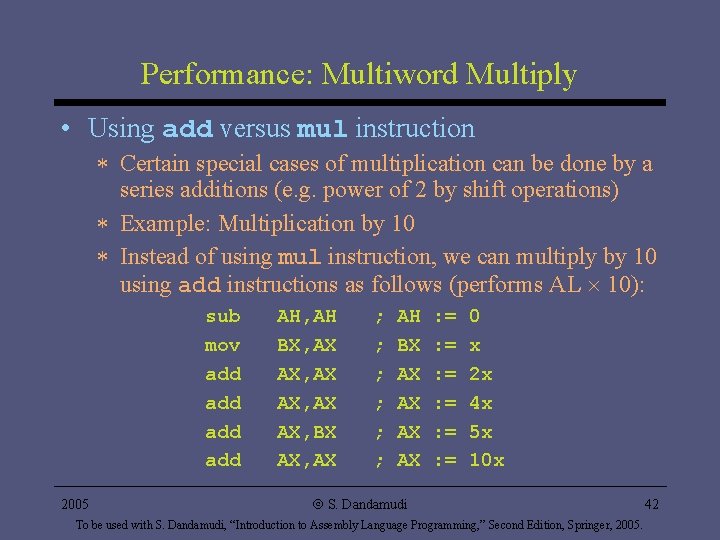
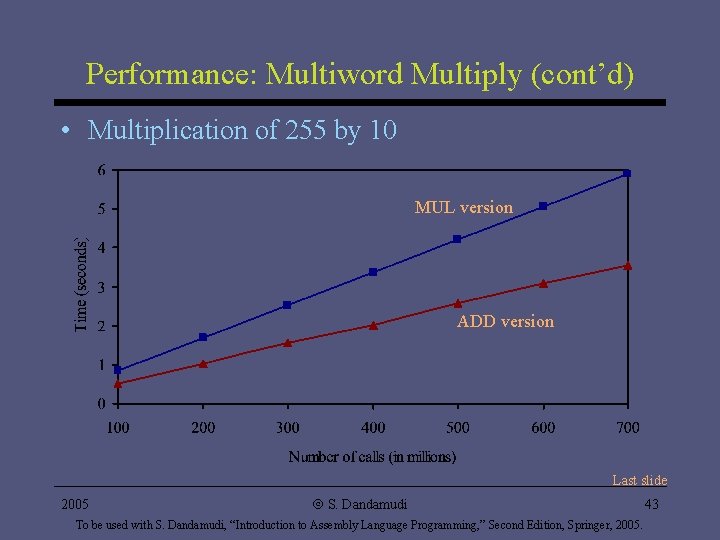
Performance: Multiword Multiply • Using add versus mul instruction * Certain special cases of multiplication can be done by a series additions (e. g. power of 2 by shift operations) * Example: Multiplication by 10 * Instead of using mul instruction, we can multiply by 10 using add instructions as follows (performs AL 10): sub mov add add 2005 AH, AH BX, AX AX, BX AX, AX ; ; ; AH BX AX AX : = : = : = 0 x 2 x 4 x 5 x 10 x Ó S. Dandamudi To be used with S. Dandamudi, “Introduction to Assembly Language Programming, ” Second Edition, Springer, 2005. 42
Performance: Multiword Multiply (cont’d) • Multiplication of 255 by 10 MUL version ADD version Last slide 2005 Ó S. Dandamudi To be used with S. Dandamudi, “Introduction to Assembly Language Programming, ” Second Edition, Springer, 2005. 43