
Aristotles Rhetorical Triangle Background The ancient Greek philosopher
Aristotle’s Rhetorical Triangle
Background • The ancient Greek philosopher Aristotle (384 -322 B. C. ) identified three basic kinds of appeals that arguments can make: emotional, ethical, and logical. • Aristotle’s types of appeals can help you break down an argument and thus begin to analyze it.
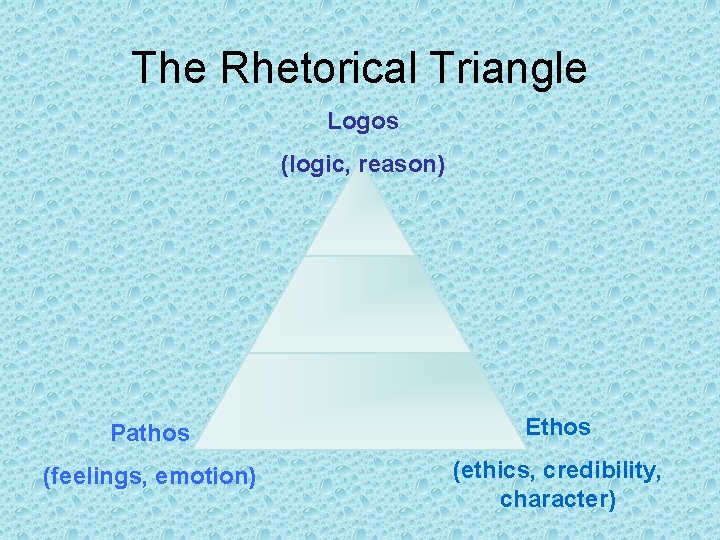
The Rhetorical Triangle Logos (logic, reason) Pathos Ethos (feelings, emotion) (ethics, credibility, character)
ETHOS: Ethical Appeal • “Character” in Greek • Ethical appeals try to convince you by pointing out credibility, moral character, and goodwill of the creator. • In an ethical appeal, the argument’s creator tries to prove that he/she knows the subject well, has a trustworthy character and has the best interests of readers- including YOU- at heart. • Warning: When you recognize that an argument is making an ethical appeal, ask yourself whether the creator successfully demonstrates that he/she actually has the knowledge, trustworthiness, and empathy for the reader that he/she claims to have.
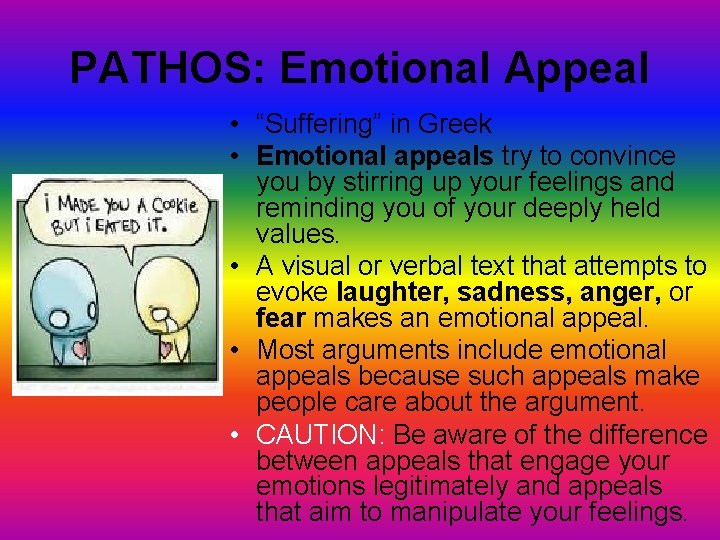
PATHOS: Emotional Appeal • “Suffering” in Greek • Emotional appeals try to convince you by stirring up your feelings and reminding you of your deeply held values. • A visual or verbal text that attempts to evoke laughter, sadness, anger, or fear makes an emotional appeal. • Most arguments include emotional appeals because such appeals make people care about the argument. • CAUTION: Be aware of the difference between appeals that engage your emotions legitimately and appeals that aim to manipulate your feelings.
LOGOS: Logical Appeal • “Word” in Greek • Logical appeals try to convince you by supplying fact-based evidence such as experimental data, observation, testimony, statistics, and personal experience. • Western culture tends to value “facts, ” so logical appeals are often viewed as particularly trustworthy. • CUIDADO: But remember, facts can be easily misinterpreted and sources can be unreliable. Thus, even an argument based on apparent facts requires critical investigation.
Now, back to the debate…
- Slides: 7