
Aristotles Five Pillars of Rhetoric Statis Theory Everythings
- Slides: 11
Aristotle’s Five Pillars of Rhetoric/ Statis Theory
Everything's an Argument
OLD, Ancient Stuff �Older than most other disciplines �Most of your other “classes” cover material since the Enlightenment �Rhetoric exists from Golden Age of Greece, fundamentally unchanged �Ancient Greeks sent to Aristotle, Cicero, Socrates to study, this is what they would study �Based on Argument as a scholarly discourse
Stasis Theory � Developed by Aristotle or Hermagoras � The first step in having a productive debate or discussion is to agree on the question being discussed. � These are the four basic stasis questions: Question of Fact or Conjecture: Does it exist? Did it happen? o Question of Definition: How can the act or event be defined? o Question of Quality: What is the character of the act? o Question of Policy: What should we do?
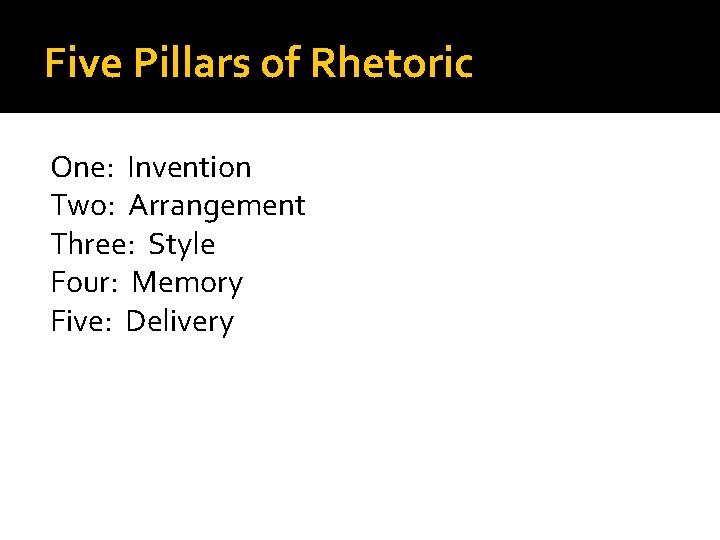
Five Pillars of Rhetoric One: Invention Two: Arrangement Three: Style Four: Memory Five: Delivery
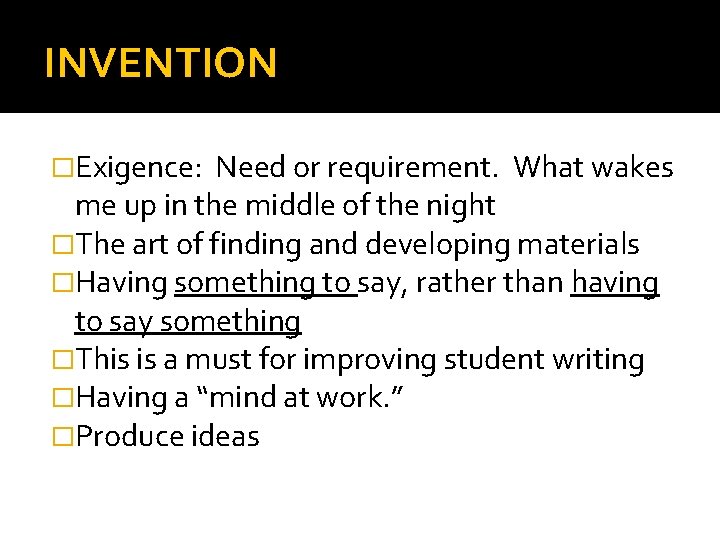
INVENTION �Exigence: Need or requirement. What wakes me up in the middle of the night �The art of finding and developing materials �Having something to say, rather than having to say something �This is a must for improving student writing �Having a “mind at work. ” �Produce ideas
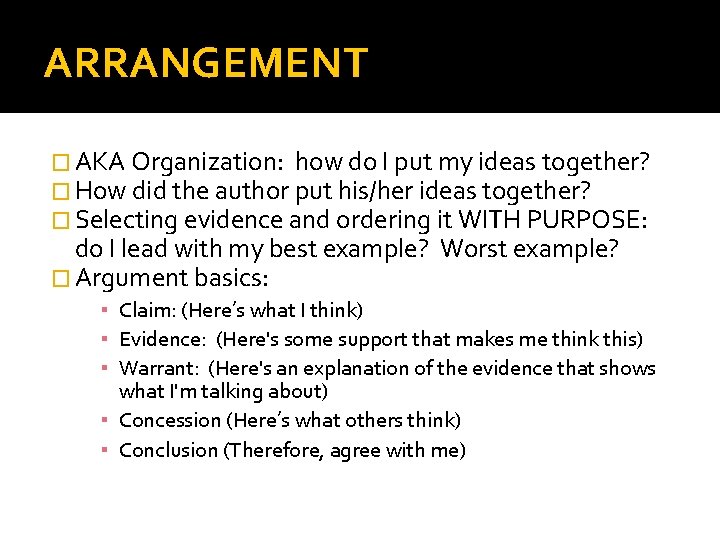
ARRANGEMENT � AKA Organization: how do I put my ideas together? � How did the author put his/her ideas together? � Selecting evidence and ordering it WITH PURPOSE: do I lead with my best example? Worst example? � Argument basics: ▪ Claim: (Here’s what I think) ▪ Evidence: (Here's some support that makes me think this) ▪ Warrant: (Here's an explanation of the evidence that shows what I'm talking about) ▪ Concession (Here’s what others think) ▪ Conclusion (Therefore, agree with me)
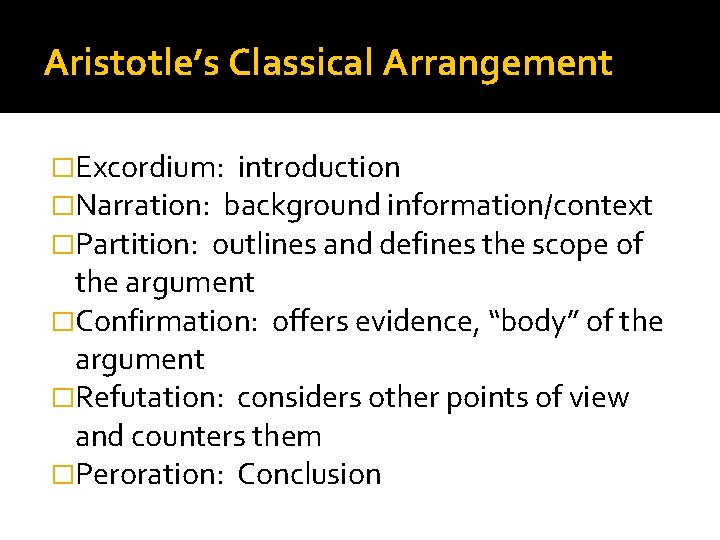
Aristotle’s Classical Arrangement �Excordium: introduction �Narration: background information/context �Partition: outlines and defines the scope of the argument �Confirmation: offers evidence, “body” of the argument �Refutation: considers other points of view and counters them �Peroration: Conclusion
STYLE �Tricks of the trade, a writer’s tool box �Figurative language, diction, syntax, formality, humor, allusion, anaphora, zuegma �Students know more about this canon than the others
MEMORY �Aristotle’s time, literally memorizing �Contemporary memory refers to what a student knows, can access, and use �“Mature Academic Perspective” handout �Cultural Literacy: Train the memory past “Google it. ” Go learn STUFF �It’s fun to know stuff; it’s fun to be smarter than other people �The Week
DELIVERY �In Aristotle’s time, the art of public speaking, enunciation, gestures, eye-contact �In our time, how text looks on the page �M. L. A. format for multi-draft writing �Delivery requirements for On-Demand Writing: one side of the paper only, one inch margins on all sides, ink, medium sized penmanship, standard use of letter height �Handwriting: We are all on the same team. You don't want me rooting against you