
Aristotles Ethics Aristotles Ethical Theory n Aristotle knows
- Slides: 14
Aristotle’s Ethics
Aristotle’s Ethical Theory n Aristotle knows: Life is an opportunity for eudaimonia – moral virtues of character – intellectual virtue of prudence – interpersonal virtues of justice and friendship – “virtuous life” • Theoretical/knowledge • Practical/leadership
The Good for Man = Eudaimonia final, sufficient in itself includes all good things = a fulfilling human life = rational, social and physical Defn = “rational activity with virtue (in a complete life)” (I. 7) n Not available to all— n n n – many too limited by opportunity for personal development (slaves, destitute poverty, illness, women) – many societies disordered (wrong values, wrong people in power) n “Human self-actualization” not just a function of intellect or success, but of virtue
Moral Virtues and Vices Areas of moral concern n n n Risk of harm and fear = courage vs. cowardice Bodily appetite, pleasure = temperance/intemperance The use of money, wealth = generosity vs. cheapness Concern for honor/esteem = magnanimity* vs. servility Persons/cooperation w/others = justice vs. injustice Reasoning re: ethics/politics – Megalopsychia is difficult to translate: dignity, proper pride, noble-mindedness, greatness, magnanimity are all possible Related social institutions* n n n Military and police, defense of country, law and order Marriage and family, physical pleasures Money and personal property, freedom to spend and gift Competitive offices & awards, public recognition and fame Legal, political and economic office, courts and trials by jury Higher education, leadership – B/c these institutions and functions = relevant to life/happiness anywhere, these = “universal human virtues”
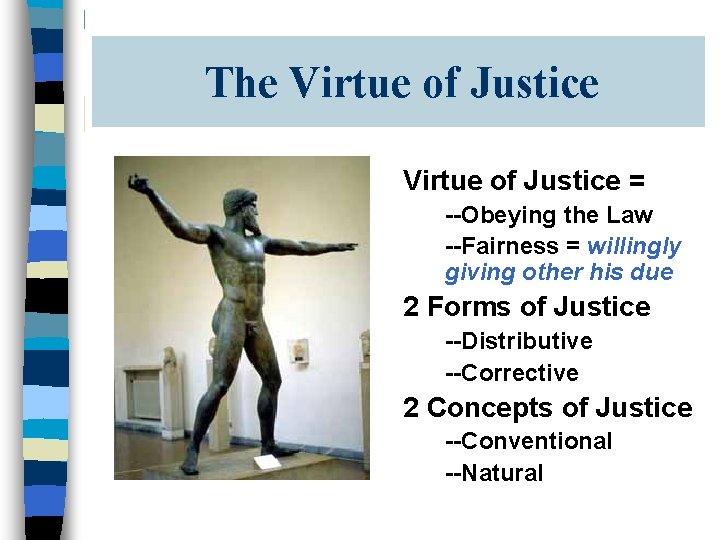
The Virtue of Justice = --Obeying the Law --Fairness = willingly giving other his due 2 Forms of Justice --Distributive --Corrective 2 Concepts of Justice --Conventional --Natural
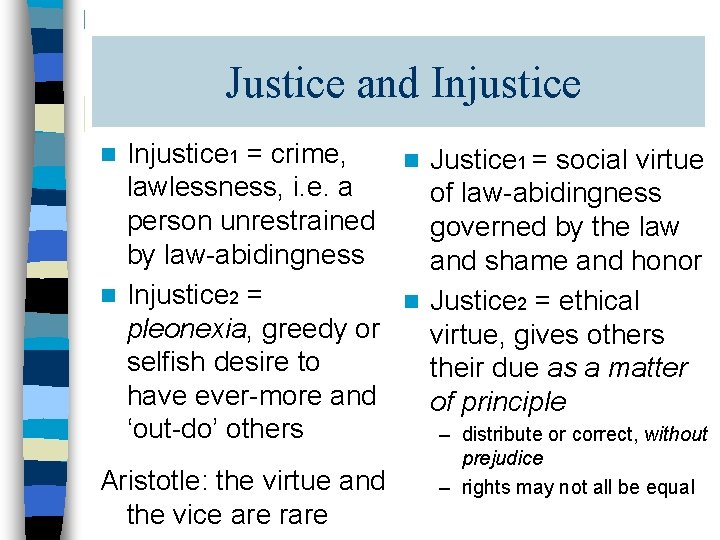
Justice and Injustice 1 = crime, n Justice 1 = social virtue lawlessness, i. e. a of law-abidingness person unrestrained governed by the law by law-abidingness and shame and honor n Injustice 2 = n Justice 2 = ethical pleonexia, greedy or virtue, gives others selfish desire to their due as a matter have ever-more and of principle ‘out-do’ others – distribute or correct, without n Aristotle: the virtue and the vice are rare prejudice – rights may not all be equal
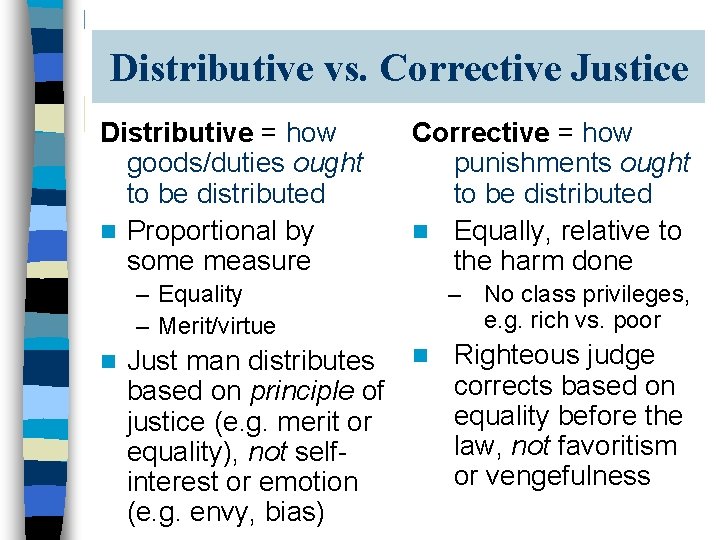
Distributive vs. Corrective Justice Distributive = how goods/duties ought to be distributed n Proportional by some measure – Equality – Merit/virtue n Corrective = how punishments ought to be distributed n Equally, relative to the harm done – No class privileges, e. g. rich vs. poor Just man distributes n Righteous judge corrects based on principle of equality before the justice (e. g. merit or law, not favoritism equality), not selfor vengefulness interest or emotion (e. g. envy, bias)
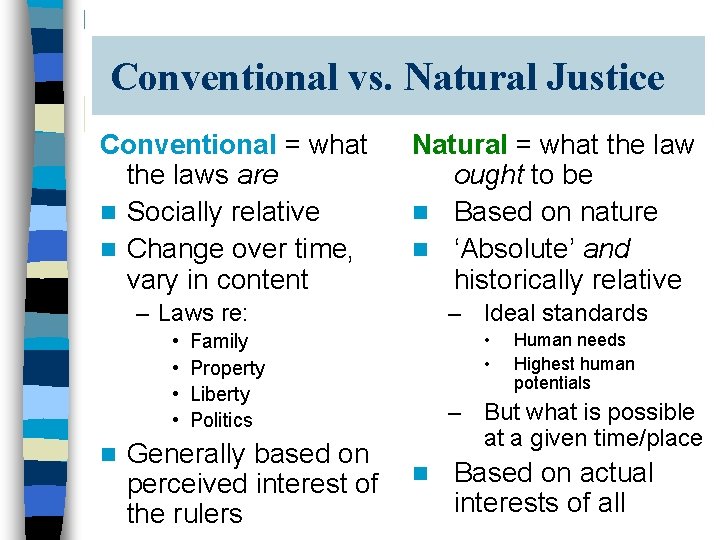
Conventional vs. Natural Justice Conventional = what the laws are n Socially relative n Change over time, vary in content Natural = what the law ought to be n Based on nature n ‘Absolute’ and historically relative – Laws re: • • n – Ideal standards • • Family Property Liberty Politics Generally based on perceived interest of the rulers Human needs Highest human potentials – But what is possible at a given time/place n Based on actual interests of all
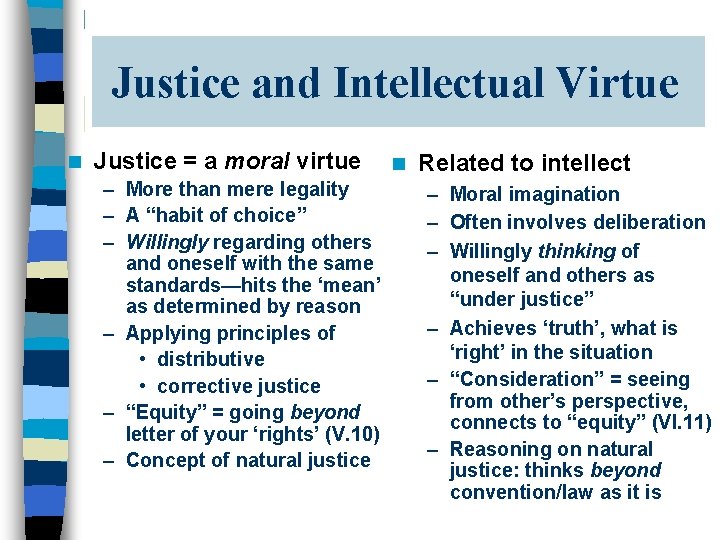
Justice and Intellectual Virtue n Justice = a moral virtue – More than mere legality – A “habit of choice” – Willingly regarding others and oneself with the same standards—hits the ‘mean’ as determined by reason – Applying principles of • distributive • corrective justice – “Equity” = going beyond letter of your ‘rights’ (V. 10) – Concept of natural justice n Related to intellect – Moral imagination – Often involves deliberation – Willingly thinking of oneself and others as “under justice” – Achieves ‘truth’, what is ‘right’ in the situation – “Consideration” = seeing from other’s perspective, connects to “equity” (VI. 11) – Reasoning on natural justice: thinks beyond convention/law as it is
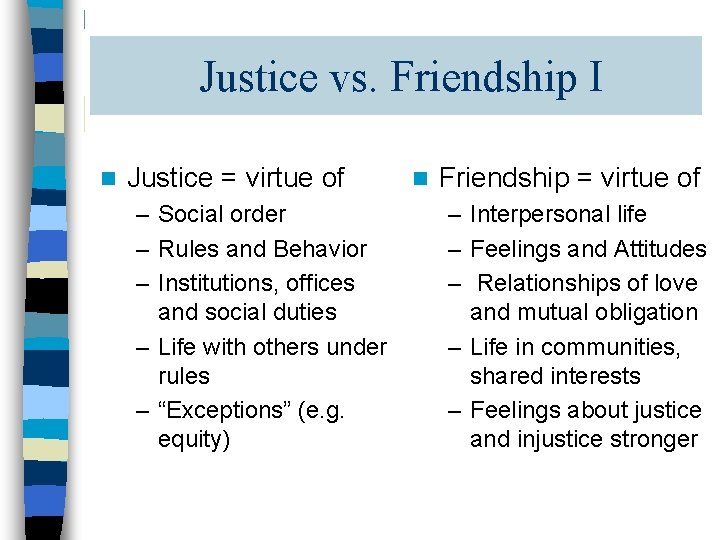
Justice vs. Friendship I n Justice = virtue of – Social order – Rules and Behavior – Institutions, offices and social duties – Life with others under rules – “Exceptions” (e. g. equity) n Friendship = virtue of – Interpersonal life – Feelings and Attitudes – Relationships of love and mutual obligation – Life in communities, shared interests – Feelings about justice and injustice stronger
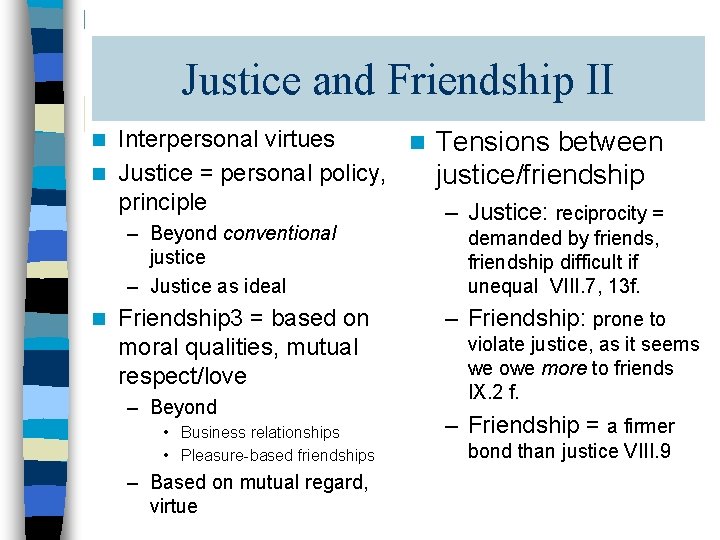
Justice and Friendship II Interpersonal virtues n Tensions between n Justice = personal policy, justice/friendship principle – Justice: reciprocity = n – Beyond conventional justice – Justice as ideal n Friendship 3 = based on moral qualities, mutual respect/love – Beyond • Business relationships • Pleasure-based friendships – Based on mutual regard, virtue demanded by friends, friendship difficult if unequal VIII. 7, 13 f. – Friendship: prone to violate justice, as it seems we owe more to friends IX. 2 f. – Friendship = a firmer bond than justice VIII. 9
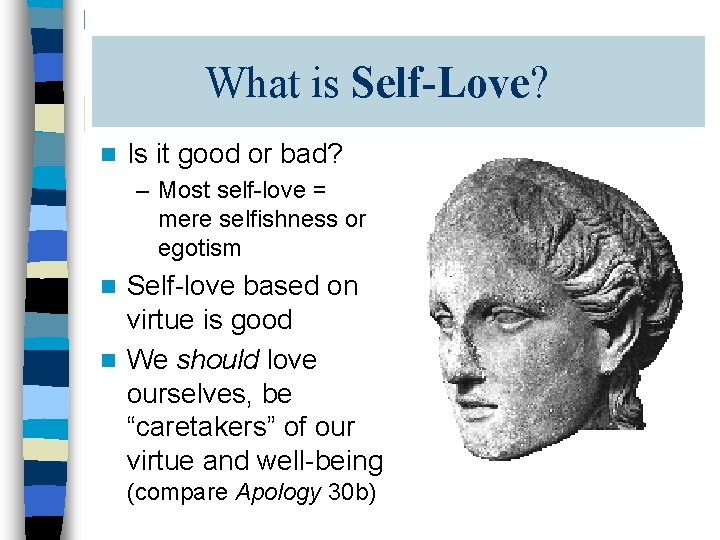
What is Self-Love? n Is it good or bad? – Most self-love = mere selfishness or egotism Self-love based on virtue is good n We should love ourselves, be “caretakers” of our virtue and well-being n (compare Apology 30 b)
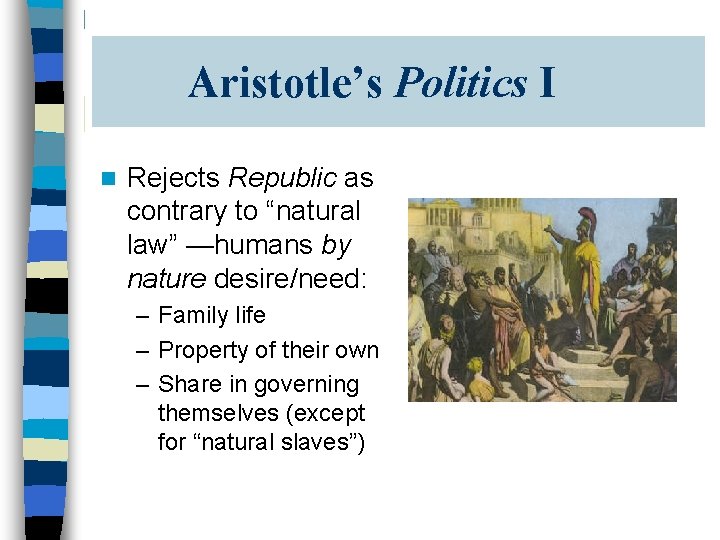
Aristotle’s Politics I n Rejects Republic as contrary to “natural law” —humans by nature desire/need: – Family life – Property of their own – Share in governing themselves (except for “natural slaves”)
Aristotle’s Politics II: “Rule by philosopher-kings is impossible; men need the rule of law. ” n GOOD GOVTS – Constitutional Monarchy = kingship w/in law – Constitutional Aristocracy = ‘Meritocracy’ – Constitutional Democracy (or Republic) = blend of others n BAD GOVTS – Tyranny = rule by fear (lawless)/chief value = domination – Oligarchy = govt by the rich/chief value = money – Democracy = rule by working class (least bad)/chief value = unrestricted liberty