
Aristotles Cosmology Aristotle separated the Universe into two
- Slides: 12
Aristotle’s Cosmology
• Aristotle separated the Universe into two parts. • The first one is Celestial Region. And the second one sublunary universe: Terrestrial Region. • There are different laws of nature in these two universes.
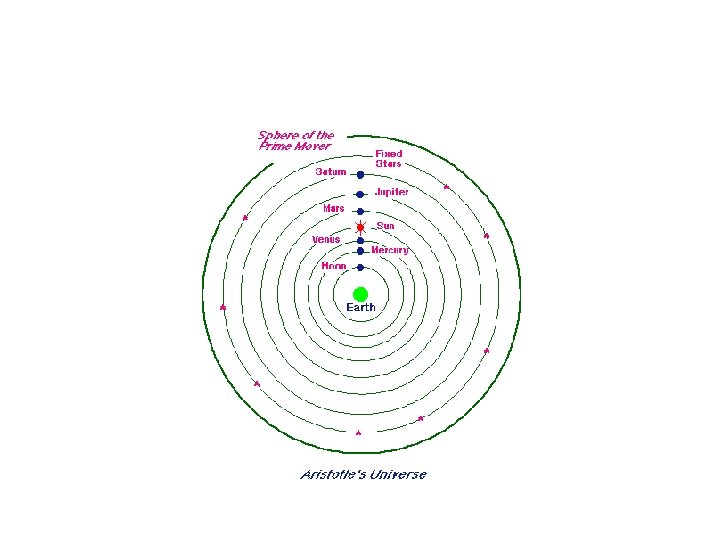
In Celestial Region • Planets and stars revolve around the World. • All celestial bodies are made of element aether. • The natural motion of the aether is the perfect circle. (Circle Dogma) • Aether doesn’t changeable. • Therefor it can’t transform into other elements. • There is no generation or corruption. • Celestial region influences terrestrial universe. • The motion is thus transferred to each next spheres.
Terrestrial Region • There are two kind of motion in terrestrial region. • 1 - Natural Motion • 2 - Violent Motion
Classical Element Theory • Aristotle developed Empedocles’ four elements theory more systematically. • Plato was the first philosopher using the term “element” for these substances. • Aristotle defined “element” in general his book On the Heaven. • “An element, we take, is a body into which other bodies may be analyzed, present in them potentially or in actuality (which is still disputable) and not itself divisible into bodies different in form. That, or something like it, is what all men in every case mean by element”.
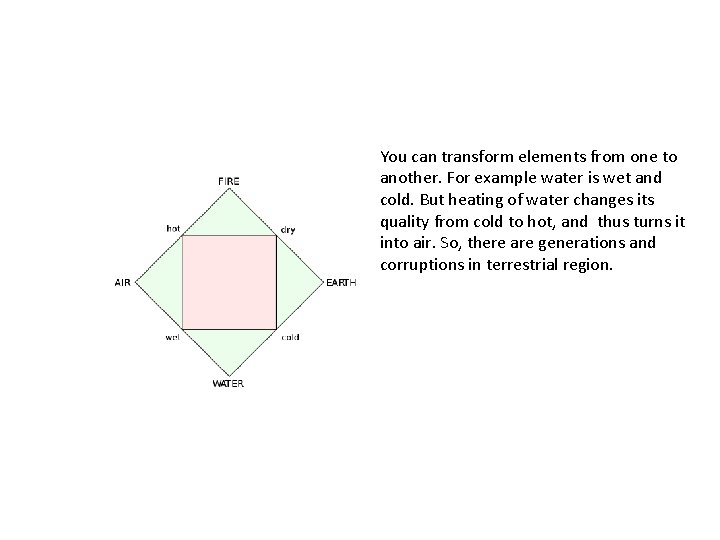
You can transform elements from one to another. For example water is wet and cold. But heating of water changes its quality from cold to hot, and thus turns it into air. So, there are generations and corruptions in terrestrial region.
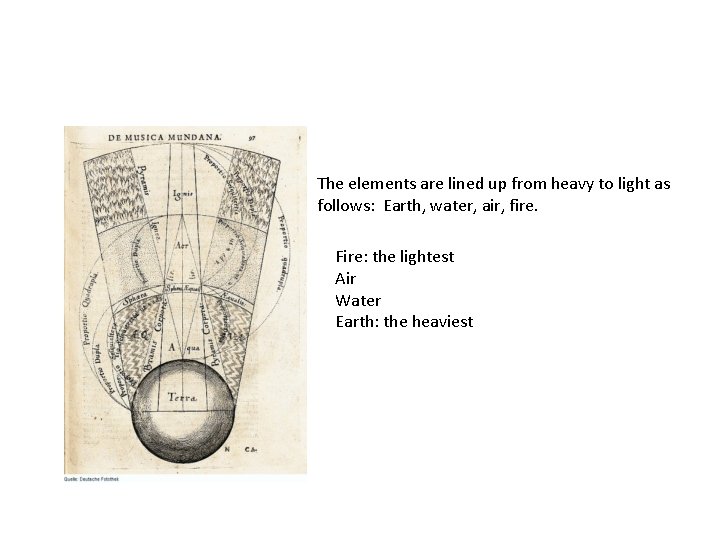
The elements are lined up from heavy to light as follows: Earth, water, air, fire. Fire: the lightest Air Water Earth: the heaviest
Natural Motion • First of all, all elements in terrestrial region tend to go its natural place. • Things want to reach their natural place. • Thus, heavy objects tend to go earth and light objects tend to go up. • Free fall is related to the weights of the bodies. (Today we know this law of motion is completely wrong. )
Violent Motion • What should we do if we would like to move a stone? • There is no movement in Aristotle’s philosophy of nature without force. • So, if you want to move an object, you must apply force to it.
• • There are two kinds of violent motion. First, “continuously violent motion”. This type of motion force applies continuously. For example, pulling the cart horse. The horse must constantly apply force to the cart to movement. If the link between the horse and the car is broken, the car will stop.
• Second, discontinuous violent motion. •