
Aristotle was the first person to classify living
- Slides: 6
Aristotle was the first person to classify living organisms and did so using a two-kingdom system involving a plant group and an animal group. The system used today is much more useful to scientists because the two-kingdom system did not: a. recognize the similarities within the plant group. b. separate living things based on characteristics and traits. c. allow for the placement of human beings in its classification. d. include many organisms such as those later discovered with microscopes.
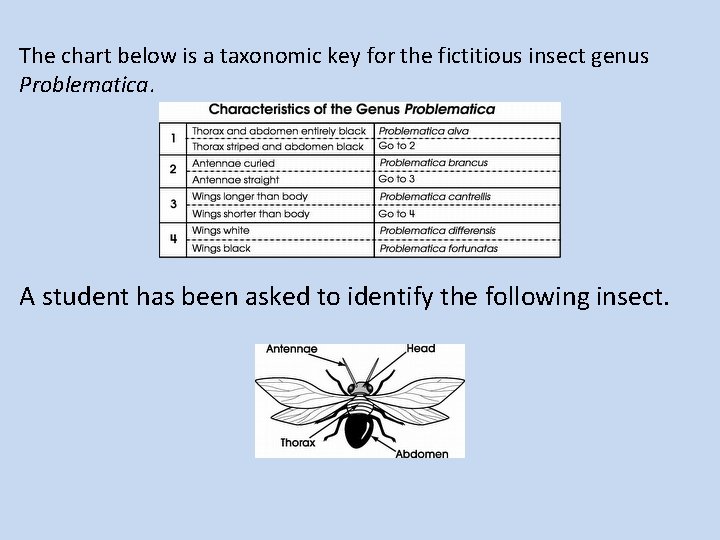
The chart below is a taxonomic key for the fictitious insect genus Problematica. A student has been asked to identify the following insect.
To which species does the insect belong? a. b. c. d. Problematica alva Problematica brancus Problematica cantrellis Problematica differensis
A student is studying several species that belong to the plant kingdom. Which two are most closely related? a. Ficus benjamina and Ficus lyrata b. Castilla elastica and Ficus elastica c. Bromus japonicus and Ipomoea violacea d. Fermaldia pandurata and Ficus pandurata
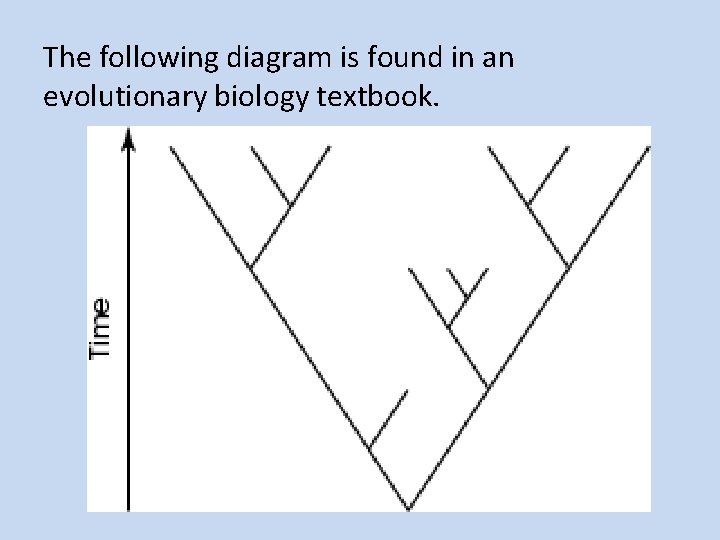
The following diagram is found in an evolutionary biology textbook.
This branching tree diagram is most likely used to represent theory that suggests a. new species arise throughout time following rounds of mass extinction. b. all species share a common ancestor and that change occurs through time. c. speciation occurs very quickly with long periods of no change in between. d. all species originated during the same period and some have subsequently gone extinct.