
Aristotle The Polis Book I PHIL 1003 2008
Aristotle The Polis: Book I PHIL 1003 2008 -09
Key Ethical & Political Terms: • • Nature Polis Hierarchy Virtue The Good Happiness (final end of man) Final Cause/End—Telos
What is the polis? 1. Greek city-state 2. Aristotle: a special kind of association
Definition of the polis • “Every state is a community of some kind, and every community is established with a view to some good; for everyone always acts in order to obtain that which they think good. ” • “…the state or political community, which is the highest of all, and which embraces all the rest, aims at good in a greater degree than any other, and at the highest good” (Pol. 1. 1). • “…a partnership of citizens in the constitution” (3. 3) • The state (polis) is NATURAL.
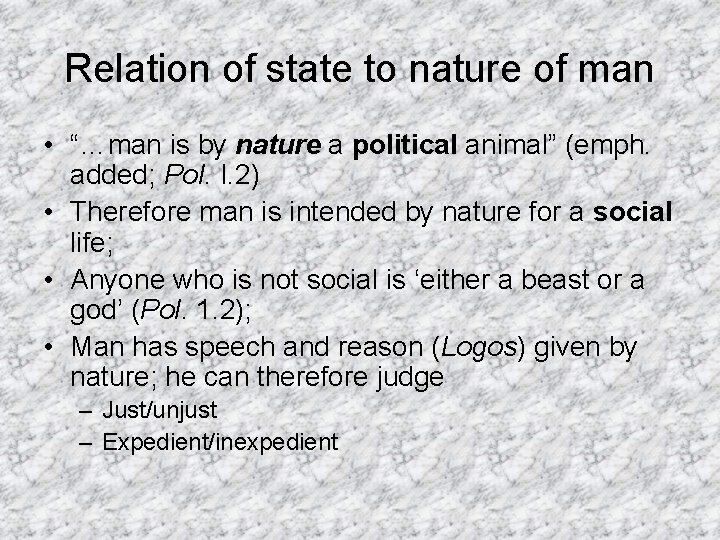
Relation of state to nature of man • “…man is by nature a political animal” (emph. added; Pol. I. 2) • Therefore man is intended by nature for a social life; • Anyone who is not social is ‘either a beast or a god’ (Pol. 1. 2); • Man has speech and reason (Logos) given by nature; he can therefore judge – Just/unjust – Expedient/inexpedient

Key characteristics of the polis • • • Community All-embracing Whole greater than sum of parts Hierarchical Aims at good in a greater degree Not just any good: – Polis aims at highest good—which is? ? ?
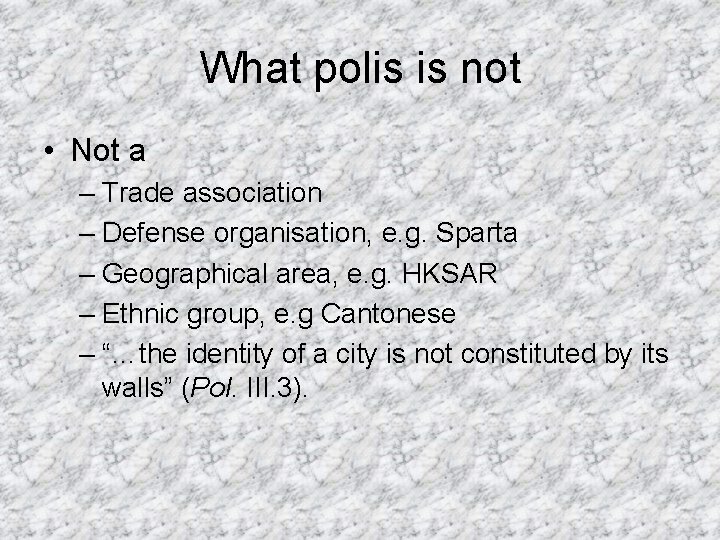
What polis is not • Not a – Trade association – Defense organisation, e. g. Sparta – Geographical area, e. g. HKSAR – Ethnic group, e. g Cantonese – “…the identity of a city is not constituted by its walls” (Pol. III. 3).
What are your affiliations? Family? Other community, e. g. church? State?

Two Ways to Understand Polis Historically: • Household: master rules wife, slaves, children • Villages: ruled by chief or king = monarchical; • City: equal citizens rule in turns as statesmen: constitutional rule; • Different kinds of rule in different organizations. Organically: Body-polis Analogy The polis is the body, the whole that is prior to the parts; The citizens are the interdependent parts; Whole could do w/out some parts, but parts cannot do w/out whole.
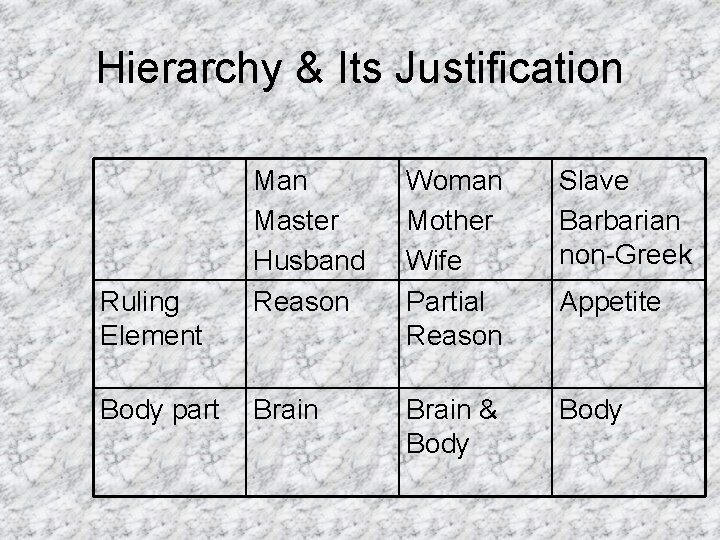
Hierarchy & Its Justification Ruling Element Body part Man Master Husband Reason Woman Mother Wife Partial Reason Slave Barbarian non-Greek Brain & Body Appetite
Aristotle’s view of slavery Politics, 1. 6 28 -30 October
Each person’s fundamental attributes are by nature. Natural attributes differ. Therefore: Hierarchy is natural.
So what is the role of NURTURE? EDUCATION? FAMILY?
Contrast egalitarian thought: “All men were created equal…” The ancient thinkers could never write this; they would never think this way!
- Slides: 14