
Aristotle Syllogisms All men are mortal Socrates is






![Transformation Substitution Theorem: If and are logically equivalent, then [ ] is logically equivalent](https://slidetodoc.com/presentation_image_h2/b0fd88b7597cc245d676dca803f9ed63/image-44.jpg "Transformation Substitution Theorem: If and are logically equivalent, then [ ] is logically equivalent")

- Slides: 45
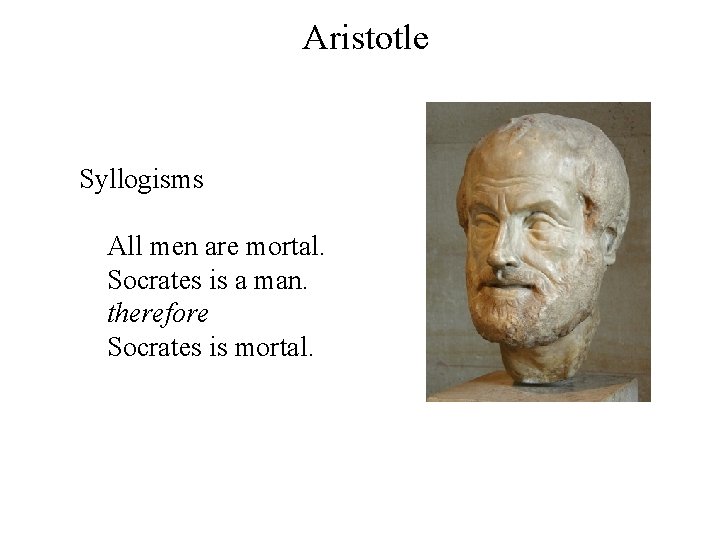
Aristotle Syllogisms All men are mortal. Socrates is a man. therefore Socrates is mortal.
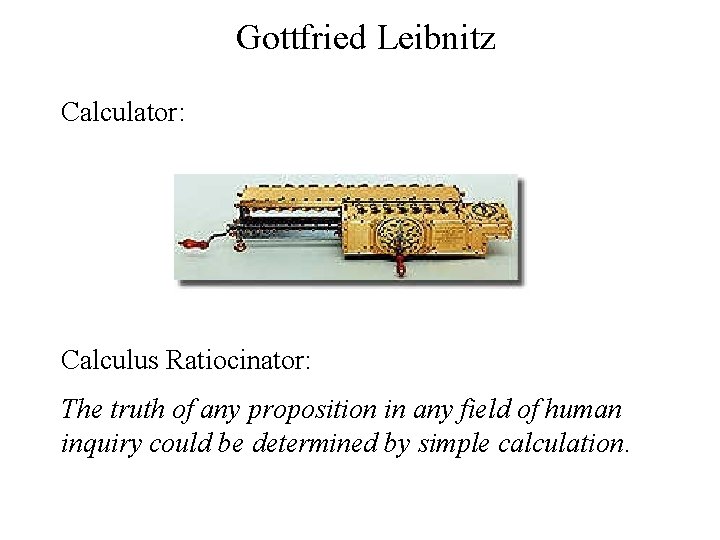
Gottfried Leibnitz Calculator: Calculus Ratiocinator: The truth of any proposition in any field of human inquiry could be determined by simple calculation.
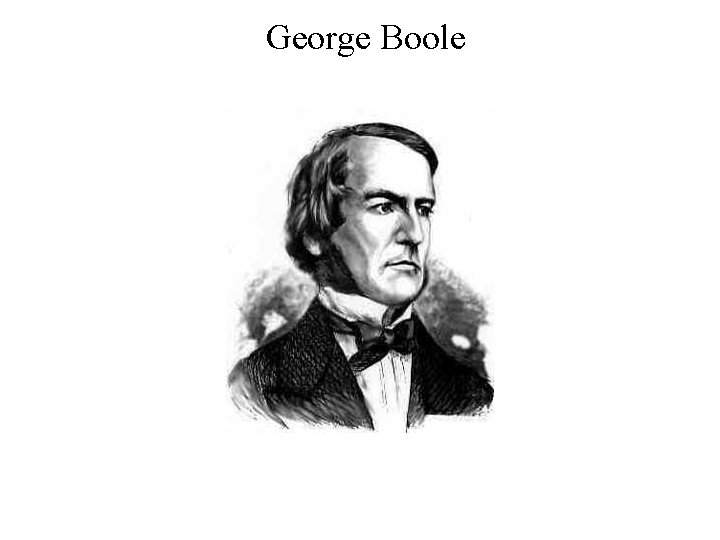
George Boole
Twentieth Century Philosophy: Russell and Whitehead Frege, Godel, Lowenheim, Skolem, Tarski … Computation: von. Neumann Newell and Simon - Logic Machine Robinson - Resolution principle …
Computational Logic Lecture 6 Relational Logic Semantics Michael Genesereth Autumn 2002 6
Propositional Logic Semantics A Propositional logic interpretation is an association between the propositional constants in a propositional language and the truth values T or F.
Outline Modeling the World Objects, Functions, Relations Data Models Semantics of Relational Logic Atomic Sentences Logical Sentences Quantified Sentences General Remarks Ontological Promiscuity Role of Logic
Objects An object is an entity presumed or hypothesized to exist in the world we are discussing. Primitive: a quark Composite: an engine, this class Real: Sun, Mike Imaginary: a unicorn, Sherlock Holmes Physical: Earth, Moon, Sun Abstract: Justice
Blocks World
Universe of Discourse 11
Different Universes Blocks: Stacks: Fragments:
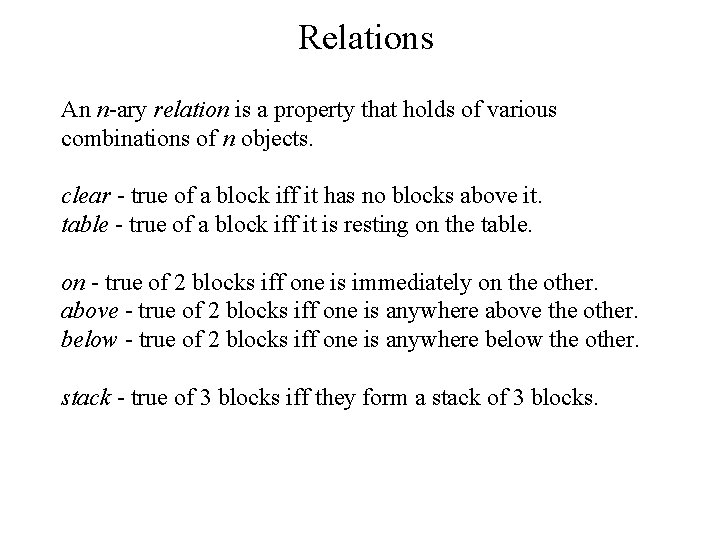
Relations An n-ary relation is a property that holds of various combinations of n objects. clear - true of a block iff it has no blocks above it. table - true of a block iff it is resting on the table. on - true of 2 blocks iff one is immediately on the other. above - true of 2 blocks iff one is anywhere above the other. below - true of 2 blocks iff one is anywhere below the other. stack - true of 3 blocks iff they form a stack of 3 blocks.
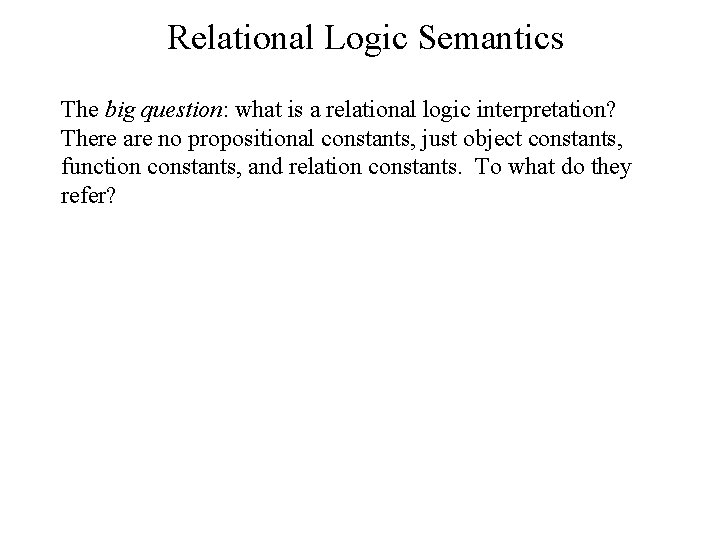
Relational Logic Semantics The big question: what is a relational logic interpretation? There are no propositional constants, just object constants, function constants, and relation constants. To what do they refer?
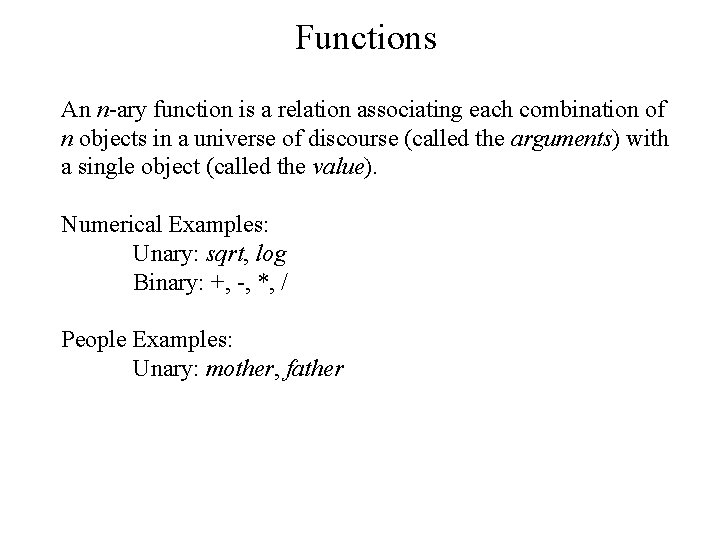
Functions An n-ary function is a relation associating each combination of n objects in a universe of discourse (called the arguments) with a single object (called the value). Numerical Examples: Unary: sqrt, log Binary: +, -, *, / People Examples: Unary: mother, father
Functions are total and single-valued - one and exactly one value for each combination of arguments. Partial - not defined for some combination of arguments Multivalued - more than one value for some argument combination NB: We ignore partial and multi-valued functions.
Ingredients for a Model Universe of Discourse - a set of object constants, one for each object under discussion. Functional Basis Set - a set of function constants, one for each function under discussion. Relational Basis Set - a set of relation constants, one for each relation under discussion. Note that, in some cases, we need more object constants than we can form from 26 letters and 10 digits. We can solve this problem by extending our alphabet. However, this won’t be necessary in this course.
Data A datum is a ground, atomic sentence in which all arguments are object constants. on(a, b) Intuitively, a datum is true if and only if the relation holds of the arguments. It can also be viewed as an instance of a relation. 18
Models A model is an arbitrary set of data. Intuitively, a model is the set of all data that are true in the world being considered. If a datum is not included in a model, it is assumed to be false in that model. 19
Outline Modeling the World Objects, Functions, Relations Data Models Semantics of Relational Logic Atomic Sentences Logical Sentences Quantified Sentences General Remarks Ontological Promiscuity Role of Logic
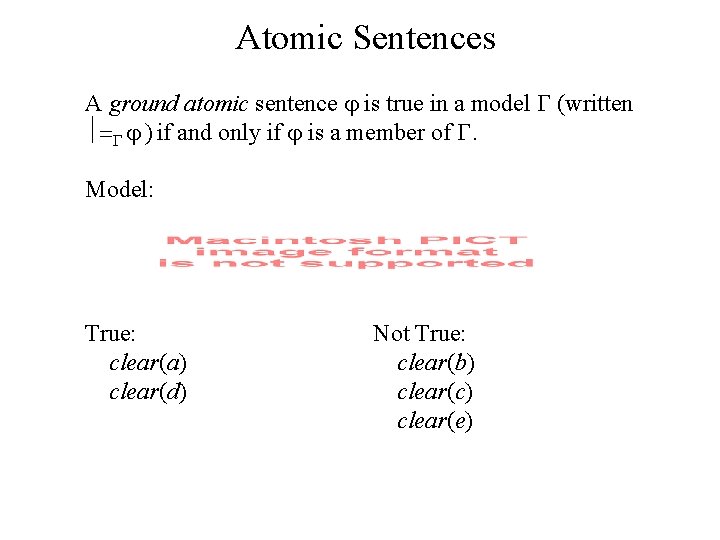
Atomic Sentences A ground atomic sentence is true in a model (written ) if and only if is a member of . Model: True: clear(a) clear(d) Not True: clear(b) clear(c) clear(e)
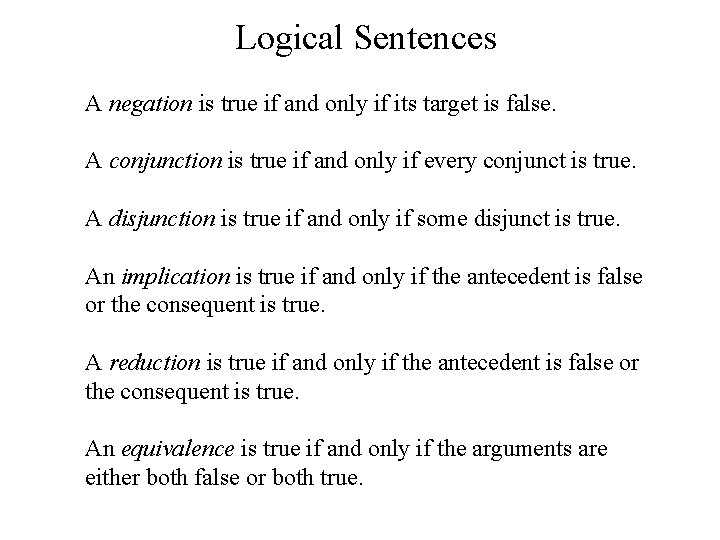
Logical Sentences A negation is true if and only if its target is false. A conjunction is true if and only if every conjunct is true. A disjunction is true if and only if some disjunct is true. An implication is true if and only if the antecedent is false or the consequent is true. A reduction is true if and only if the antecedent is false or the consequent is true. An equivalence is true if and only if the arguments are either both false or both true.
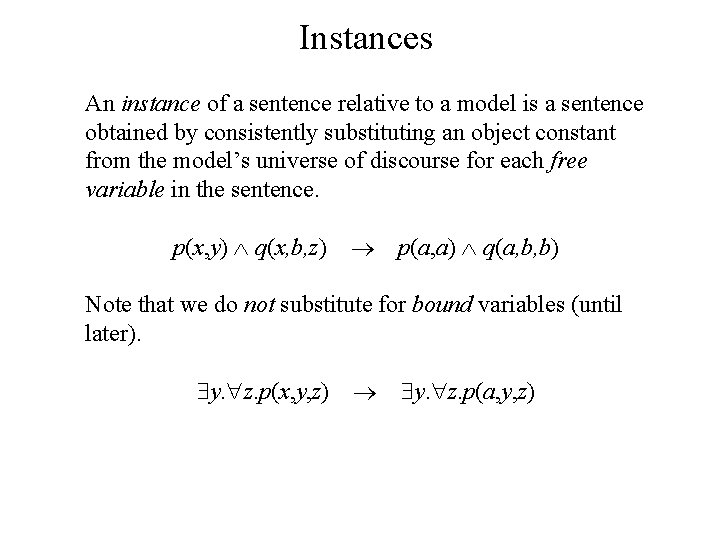
Instances An instance of a sentence relative to a model is a sentence obtained by consistently substituting an object constant from the model’s universe of discourse for each free variable in the sentence. p(x, y) q(x, b, z) p(a, a) q(a, b, b) Note that we do not substitute for bound variables (until later). y. z. p(x, y, z) y. z. p(a, y, z)
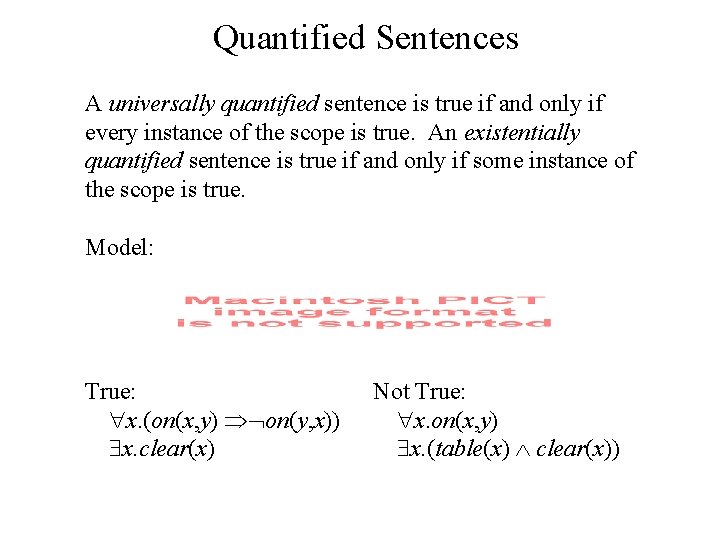
Quantified Sentences A universally quantified sentence is true if and only if every instance of the scope is true. An existentially quantified sentence is true if and only if some instance of the scope is true. Model: True: x. (on(x, y) on(y, x)) x. clear(x) Not True: x. on(x, y) x. (table(x) clear(x))
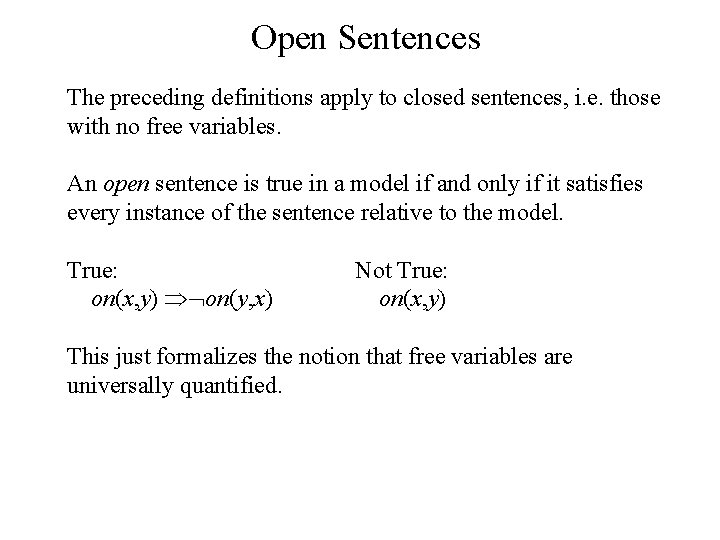
Open Sentences The preceding definitions apply to closed sentences, i. e. those with no free variables. An open sentence is true in a model if and only if it satisfies every instance of the sentence relative to the model. True: on(x, y) on(y, x) Not True: on(x, y) This just formalizes the notion that free variables are universally quantified.
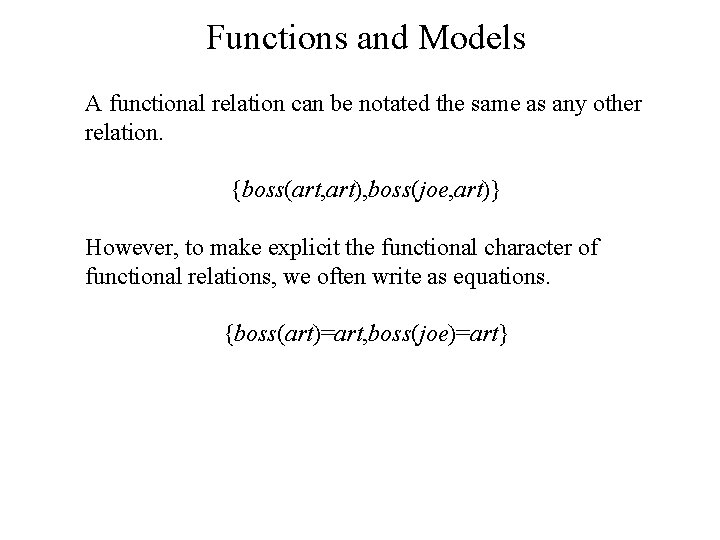
Functions and Models A functional relation can be notated the same as any other relation. {boss(art, art), boss(joe, art)} However, to make explicit the functional character of functional relations, we often write as equations. {boss(art)=art, boss(joe)=art}
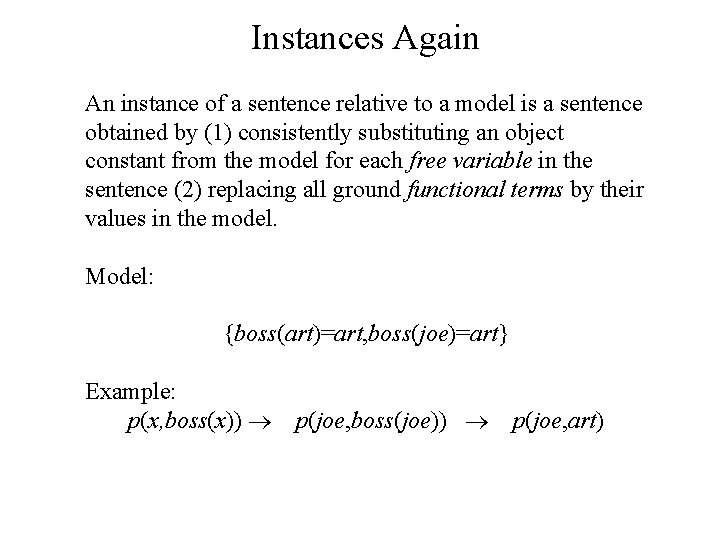
Instances Again An instance of a sentence relative to a model is a sentence obtained by (1) consistently substituting an object constant from the model for each free variable in the sentence (2) replacing all ground functional terms by their values in the model. Model: {boss(art)=art, boss(joe)=art} Example: p(x, boss(x)) p(joe, boss(joe)) p(joe, art)
Note The definition of semantics given here is not the same as that given in the notes or in standard logic textbooks. �However, it equivalent is to these other definitions in terms of its results. Moreover, it is significantly simpler than these other definitions and is more intuitive for people interested in building computer systems.
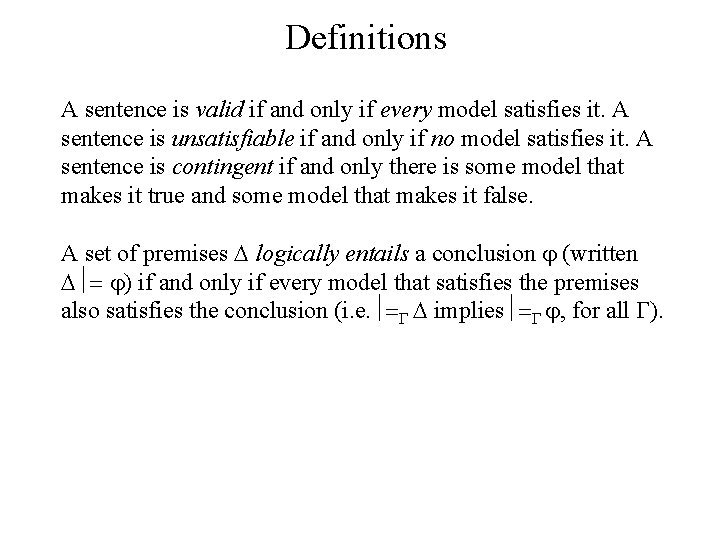
Definitions A sentence is valid if and only if every model satisfies it. A sentence is unsatisfiable if and only if no model satisfies it. A sentence is contingent if and only there is some model that makes it true and some model that makes it false. A set of premises logically entails a conclusion (written ) if and only if every model that satisfies the premises also satisfies the conclusion (i. e. implies , for all ).
Outline Modeling the World Objects, Functions, Relations Data Models Semantics of Relational Logic Atomic Sentences Logical Sentences Quantified Sentences General Remarks Ontological Promiscuity Role of Logic
Blocks World
Different Models There is only one world, so how can there be more than one model? Different people can have different beliefs. Different models correspond to different times. Different models correspond to different places. 32
Ontological Promiscuity Blocks: Stacks: Fragments:
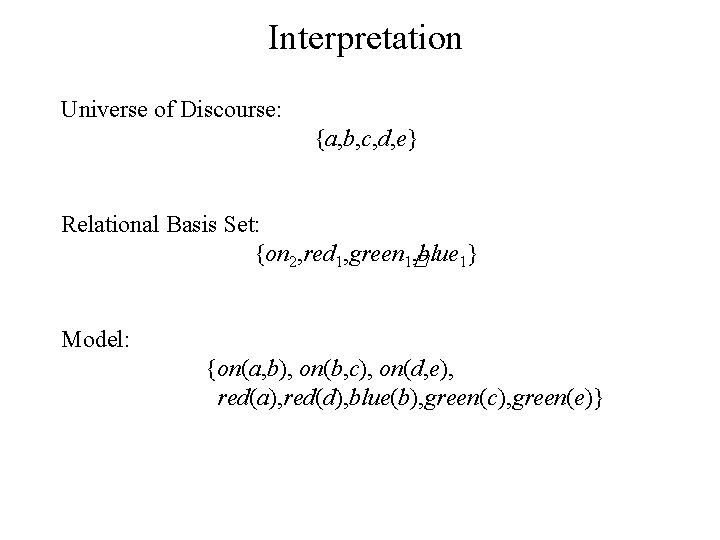
Interpretation Universe of Discourse: {a, b, c, d, e} Relational Basis Set: {on 2, red 1, green 1, blue � 1} Model: {on(a, b), on(b, c), on(d, e), red(a), red(d), blue(b), green(c), green(e)}
Reification 35
Universal Relation 36
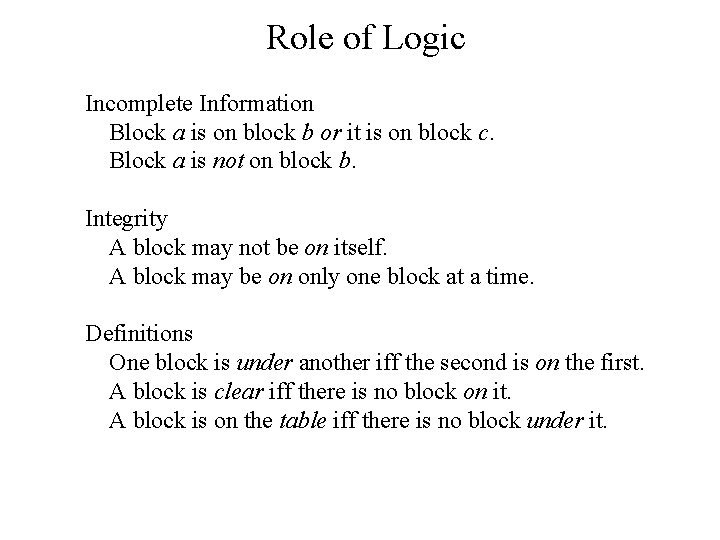
Role of Logic Incomplete Information Block a is on block b or it is on block c. Block a is not on block b. Integrity A block may not be on itself. A block may be on only one block at a time. Definitions One block is under another iff the second is on the first. A block is clear iff there is no block on it. A block is on the table iff there is no block under it.
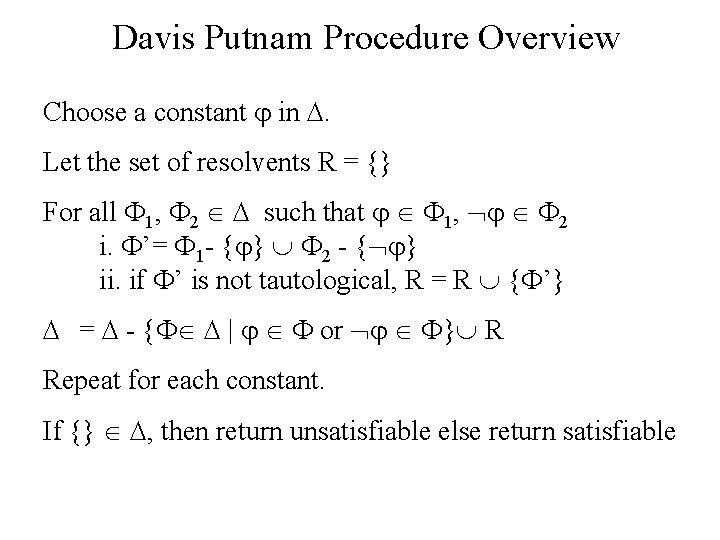
Davis Putnam Procedure Overview Choose a constant in . Let the set of resolvents R = {} For all 1, 2 such that 1, 2 i. ’= 1 - { } 2 - { } ii. if ’ is not tautological, R = R { ’} = - { | or } R Repeat for each constant. If {} , then return unsatisfiable else return satisfiable
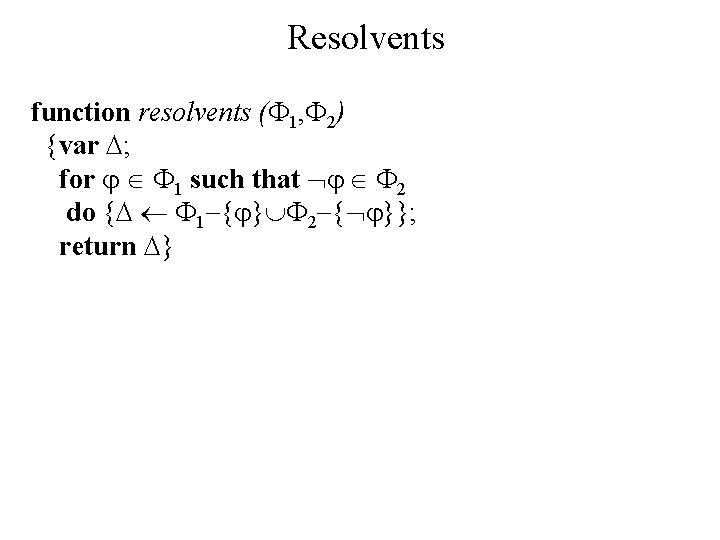
Resolvents function resolvents ( 1, 2) {var ; for 1 such that 2 do { 1 { } 2 { }}; return }
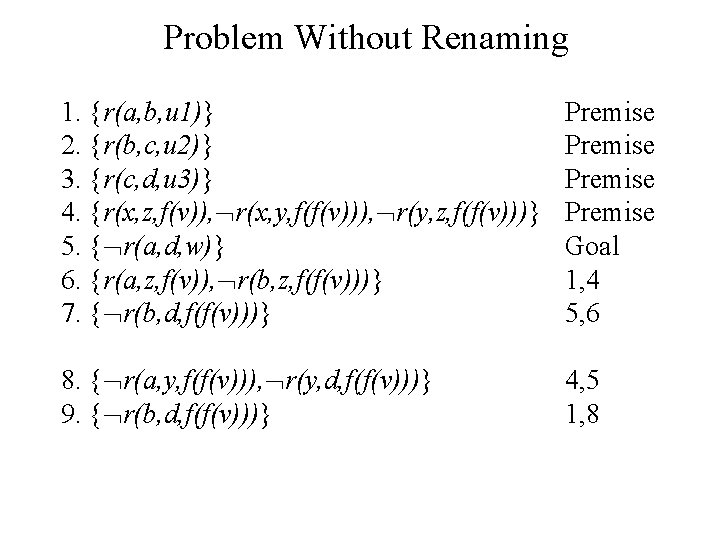
Problem Without Renaming 1. {r(a, b, u 1)} 2. {r(b, c, u 2)} 3. {r(c, d, u 3)} 4. {r(x, z, f(v)), r(x, y, f(f(v))), r(y, z, f(f(v)))} 5. { r(a, d, w)} 6. {r(a, z, f(v)), r(b, z, f(f(v)))} 7. { r(b, d, f(f(v)))} Premise Goal 1, 4 5, 6 8. { r(a, y, f(f(v))), r(y, d, f(f(v)))} 9. { r(b, d, f(f(v)))} 4, 5 1, 8
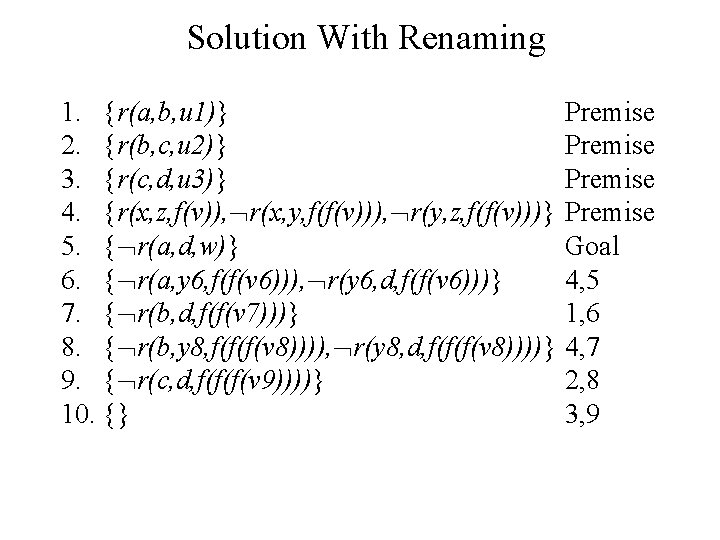
Solution With Renaming 1. {r(a, b, u 1)} 2. {r(b, c, u 2)} 3. {r(c, d, u 3)} 4. {r(x, z, f(v)), r(x, y, f(f(v))), r(y, z, f(f(v)))} 5. { r(a, d, w)} 6. { r(a, y 6, f(f(v 6))), r(y 6, d, f(f(v 6)))} 7. { r(b, d, f(f(v 7)))} 8. { r(b, y 8, f(f(f(v 8)))), r(y 8, d, f(f(f(v 8))))} 9. { r(c, d, f(f(f(v 9))))} 10. {} Premise Goal 4, 5 1, 6 4, 7 2, 8 3, 9
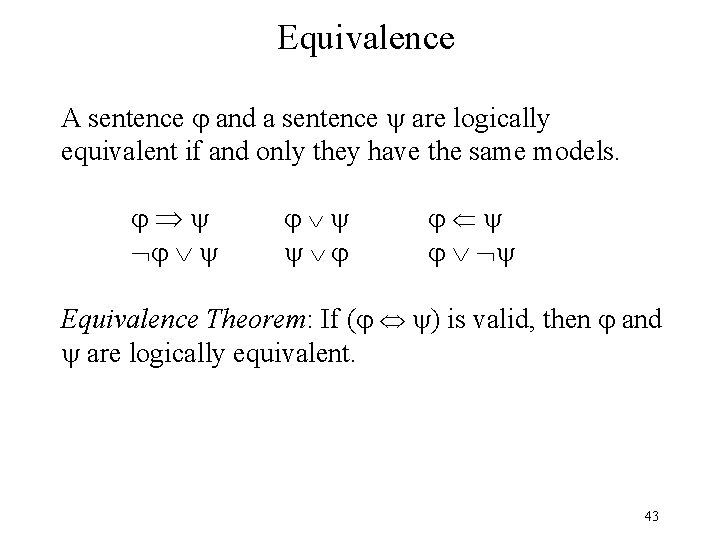
Equivalence A sentence and a sentence are logically equivalent if and only they have the same models. Equivalence Theorem: If ( ) is valid, then and are logically equivalent. 43
Transformation Substitution Theorem: If and are logically equivalent, then [ ] is logically equivalent to . Using known equivalences, it is sometimes possible to show conclusions from premises by transforming one or more of the premises into the conclusion. Example: p q p q q p q p 44