
Aristotle Politics Part II Sandrine Bertaux Assistant Professor
Aristotle, Politics Part II Sandrine Bertaux Assistant Professor of Humanities Hum 101 31 October 2018
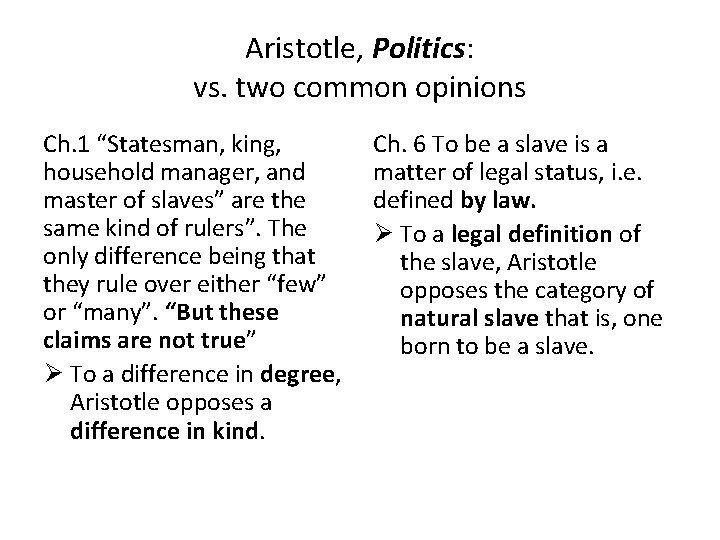
Aristotle, Politics: vs. two common opinions Ch. 1 “Statesman, king, household manager, and master of slaves” are the same kind of rulers”. The only difference being that they rule over either “few” or “many”. “But these claims are not true” Ø To a difference in degree, Aristotle opposes a difference in kind. Ch. 6 To be a slave is a matter of legal status, i. e. defined by law. Ø To a legal definition of the slave, Aristotle opposes the category of natural slave that is, one born to be a slave.
Outline of the Lecture • • Aristotle’s political naturalism Slavery in Ancient Greece Aristotle’s. Question: natural slave is the authority of the statesman the same in king Slaves and women
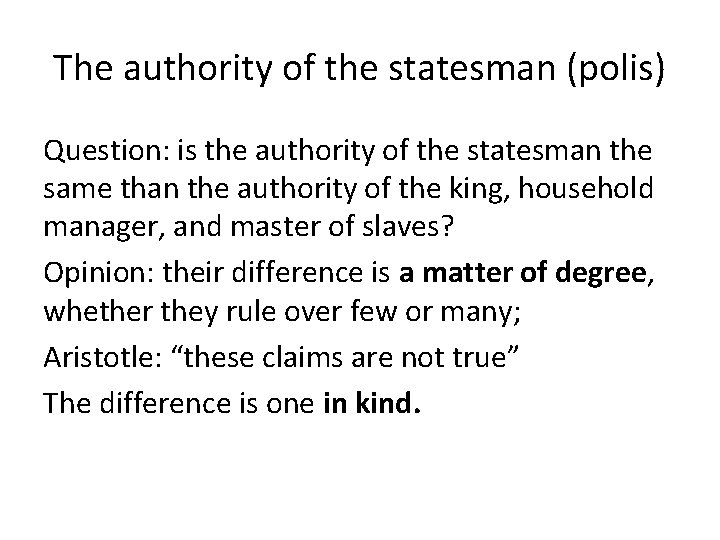
The authority of the statesman (polis) Question: is the authority of the statesman the same than the authority of the king, household manager, and master of slaves? Opinion: their difference is a matter of degree, whether they rule over few or many; Aristotle: “these claims are not true” The difference is one in kind.
Aristotle’s political naturalism • The polis prior in nature to the household; For Aristotle, the move from household, to village and to polis amounts to the development of human virtue and practical wisdom. • The polis is self-sufficient not only because it satisfies essential needs but because only the polis provides the condition for the fulfillment of the nature and function of humanity. • “For if the whole body is dead, there will no longer be a foot or a hand”.
“human being is a political animal” Outside the polis, he is either “a beast (poor specimen) or a god (superhuman)”. He is a political animal because he is equipped with rational speech that is with logos (speech/reason) rational speech allows distinctions: Beneficial or harmful, just or unjust: man is a moral agent
The naturalness of the household • Three natural subordinate relationships: The master rules over the slave The husband rules over the wife The father rules over the child
A differentiated humanity: Natural inferiority of women and slaves • “For free rules slaves, males rules female, and man rules child in different ways, because while the parts of the soul are present in all these people, they are present in a different way. • The deliberative part of the soul is entirely missing from a slave; a woman has it but it lacks authority; a child has it but it is incompletely developed. ”
A difference in kind: Ruler of the polis (statesman) • statesman rules over people who are naturally free and equal. Ruler of household • household manager rules over free (wife and children) and non-free. • He does not rule them the same way
Soul and body distinction • “Soul and body are the basic constituents of an animal: the soul is the natural ruler; the body the natural subject” • Soul rules the body; • Slave lacks deliberative part of the soul • Slave is just a body • Hellenistic period, body soma when unqualified designate a slave.
Slavery: a fact of life • Epics poems (Hesiod and Homer); painted vase; Herodotus or Thucydides, are full of slaves. • Slavery was a fact of life and taken for granted. Plato never addresses the question of slavery in his ideal city (Republic) Aristotle considers the master-slave relationship as a primary partnership alongside the male-female (for procreation) • Slaves perform many works (farming as in Hesiod; mines; domestic work; skilled work) • Most of them are “foreigners” in the sense of non. Greeks. Athenians do not enslave Athenians.
The slave in the polis • Excluded from political decision • Excluded from participating in war: cannot go to war Condition slaves share with women • Pericles’ funeral oration: soldiers – manliness– courage– male citizen –education • Women should remain silent • Significantly, Pericles emphasizes a “we” as “citizens and foreigners (metic)” but never mentions slaves
• Yet slaves: part of the community– they participate to religious festivals. • They are not clanless, lawless, homeless like cyclopes (Homer); • They are not “beasts” but a slave is not fully human either.
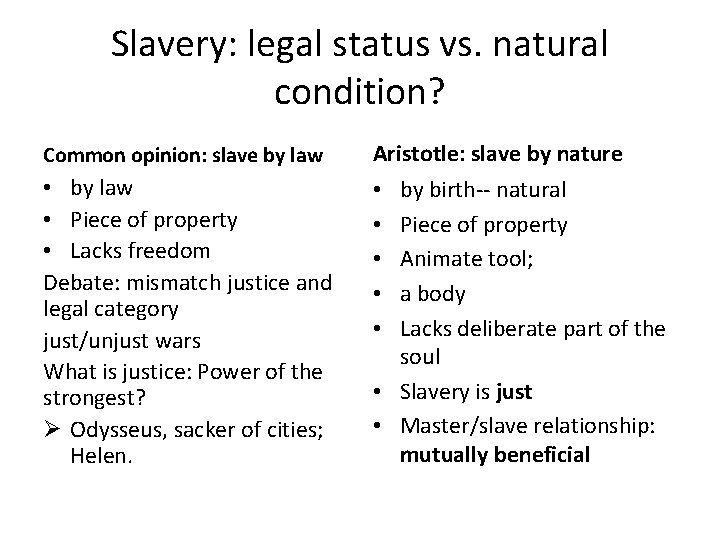
Slavery: legal status vs. natural condition? Common opinion: slave by law Aristotle: slave by nature • by law • Piece of property • Lacks freedom Debate: mismatch justice and legal category just/unjust wars What is justice: Power of the strongest? Ø Odysseus, sacker of cities; Helen. • • • by birth-- natural Piece of property Animate tool; a body Lacks deliberate part of the soul • Slavery is just • Master/slave relationship: mutually beneficial
Slaves and women • “There is a natural distinction, of course, between what is female and what is servile. ” • But this distinction is lost with Barbarians where women and slaves “occupy the same position”. • Why is it so? Ø Lack a ruler: Greeks have freedom; Barbarians ignore it. Ø That is why our poets say it is proper for Greeks to rule non-Greeks
Natural slave: individual and collective • Individual: • Lacks deliberative part of the soul Collective: Lacks proper rulership Political slavery of the Barbarians
Slaves and women Hesiod p. 71, l. 379 -408 Aristotle First, get a house, a woman, and an ox For ploughing- let the woman be a slave, Unmarried who can help you in the fields, • Aristotle citing Hesiod: • Hesiod is right when he said in his poem, “First and foremost: a house, a wife, and an ox for the plow. ” • “ for an ox is a poor man’s servant”
Historical legacy of Aristotle’s natural slave • Distinction Greeks/Barbarians; • Europeans in the New World (after 1492): native Americans and slave trade of Africans defended from Aristotle’s natural slave category.
- Slides: 18