
Aristotle Philosopher Educator Scientist Logician and rapper One

- Slides: 10
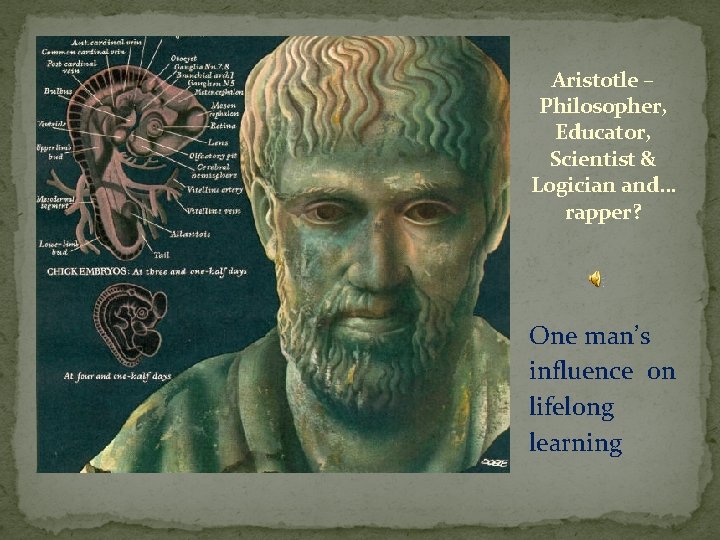
Aristotle – Philosopher, Educator, Scientist & Logician and… rapper? One man’s influence on lifelong learning
An introduction to Aristotle and his contributions to the field of adult education Established the first open university Founder of the learning academy, the Lyceum in Athens Aristotle 384 -322 B. C. Student of Plato, Tutor of Alexander (the Great) Promoted continuing education, in order to fully utilize life experiences Established first zoo and botanical gardens, pioneering research & scientific knowledge
Who was Aristotle? Born in Stagire, Macedonia in 384 B. C. , son of a physician at court of Amyntas, king of Macedonia. 366 B. C. , enrolled as student at Plato’s academy at age 18, where he stayed for 20 years. Plato regarded him as brilliant and called him nous, “the mind. ” 334 B. C. , established Lyceum in Athens at age 50, blending research, adult education and an open university concept. 343 B. C. , King Philip of Macedon appointed Aristotle tutor of his son, Alexander, who went on to become Alexander the Great. 322 B. C. , broke with Alexander’s rule of Greece, moved into exile and died that year in Chalcis, Euboea at 61.
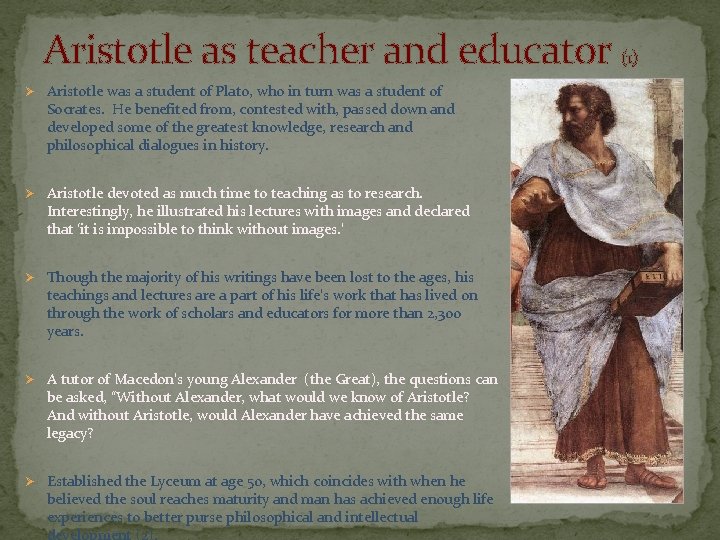
Aristotle as teacher and educator (1) Ø Aristotle was a student of Plato, who in turn was a student of Socrates. He benefited from, contested with, passed down and developed some of the greatest knowledge, research and philosophical dialogues in history. Ø Aristotle devoted as much time to teaching as to research. Interestingly, he illustrated his lectures with images and declared that ‘it is impossible to think without images. ’ Ø Though the majority of his writings have been lost to the ages, his teachings and lectures are a part of his life’s work that has lived on through the work of scholars and educators for more than 2, 300 years. Ø A tutor of Macedon’s young Alexander (the Great), the questions can be asked, “Without Alexander, what would we know of Aristotle? And without Aristotle, would Alexander have achieved the same legacy? Ø Established the Lyceum at age 50, which coincides with when he believed the soul reaches maturity and man has achieved enough life experiences to better purse philosophical and intellectual development (2).
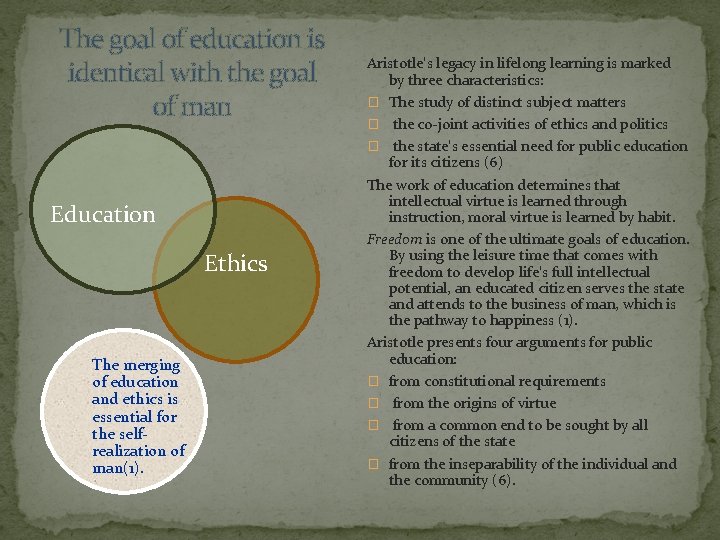
The goal of education is identical with the goal of man Education Ethics The merging of education and ethics is essential for the selfrealization of man(1). Aristotle’s legacy in lifelong learning is marked by three characteristics: � The study of distinct subject matters � the co-joint activities of ethics and politics � the state’s essential need for public education for its citizens (6) The work of education determines that intellectual virtue is learned through instruction, moral virtue is learned by habit. Freedom is one of the ultimate goals of education. By using the leisure time that comes with freedom to develop life’s full intellectual potential, an educated citizen serves the state and attends to the business of man, which is the pathway to happiness (1). Aristotle presents four arguments for public education: � from constitutional requirements � from the origins of virtue � from a common end to be sought by all citizens of the state � from the inseparability of the individual and the community (6).
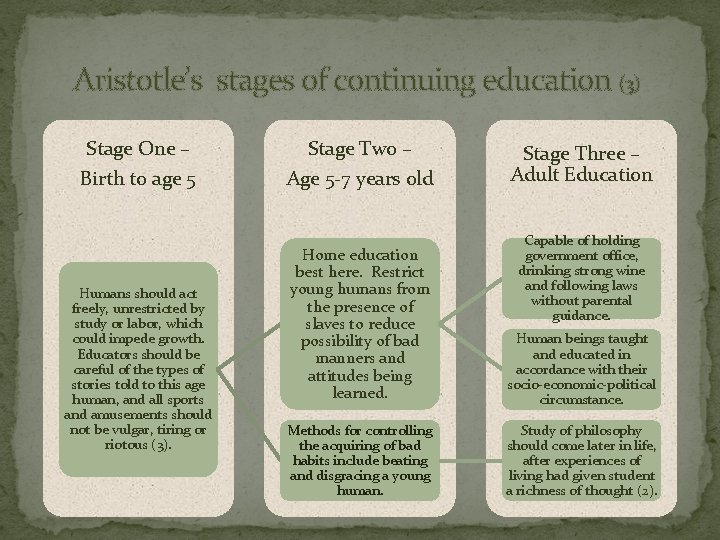
Aristotle’s stages of continuing education (3) Stage One – Stage Two – Birth to age 5 Age 5 -7 years old Humans should act freely, unrestricted by study or labor, which could impede growth. Educators should be careful of the types of stories told to this age human, and all sports and amusements should not be vulgar, tiring or riotous (3). Stage Three – Adult Education Capable of holding government office, drinking strong wine and following laws without parental guidance. Home education best here. Restrict young humans from the presence of slaves to reduce possibility of bad manners and attitudes being learned. Human beings taught and educated in accordance with their socio-economic-political circumstance. Methods for controlling the acquiring of bad habits include beating and disgracing a young human. Study of philosophy should come later in life, after experiences of living had given student a richness of thought (2).
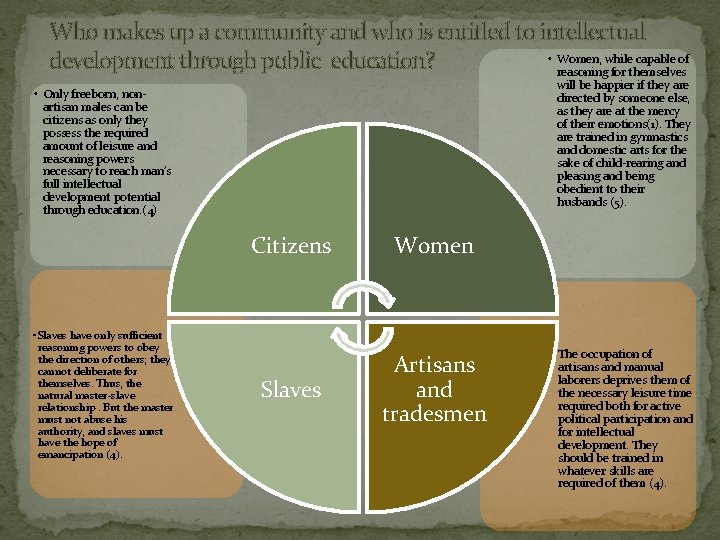
Who makes up a community and who is entitled to intellectual • Women, while capable of development through public education? reasoning for themselves will be happier if they are directed by someone else, as they are at the mercy of their emotions(1). They are trained in gymnastics and domestic arts for the sake of child-rearing and pleasing and being obedient to their husbands (5). • Only freeborn, nonartisan males can be citizens as only they possess the required amount of leisure and reasoning powers necessary to reach man’s full intellectual development potential through education. (4) • Slaves have only sufficient reasoning powers to obey the direction of others; they cannot deliberate for themselves. Thus, the natural master-slave relationship. But the master must not abuse his authority, and slaves must have the hope of emancipation (4). Citizens Women Slaves Artisans and tradesmen • The occupation of artisans and manual laborers deprives them of the necessary leisure time required both for active political participation and for intellectual development. They should be trained in whatever skills are required of them (4).
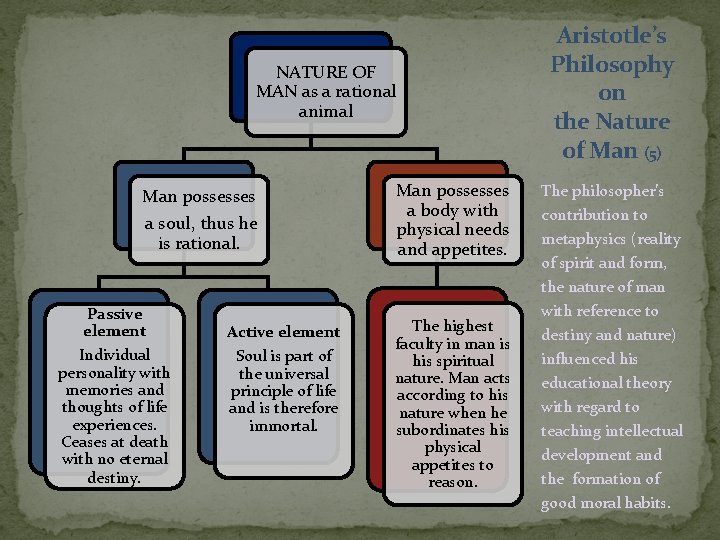
NATURE OF MAN as a rational animal Man possesses a soul, thus he is rational. Passive element Individual personality with memories and thoughts of life experiences. Ceases at death with no eternal destiny. Active element Soul is part of the universal principle of life and is therefore immortal. Man possesses a body with physical needs and appetites. The highest faculty in man is his spiritual nature. Man acts according to his nature when he subordinates his physical appetites to reason. Aristotle’s Philosophy on the Nature of Man (5) The philosopher’s contribution to metaphysics (reality of spirit and form, the nature of man with reference to destiny and nature) influenced his educational theory with regard to teaching intellectual development and the formation of good moral habits.
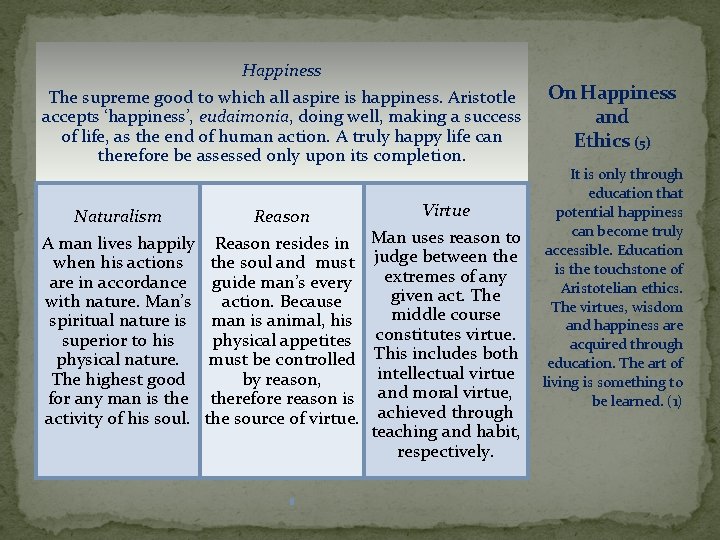
Happiness The supreme good to which all aspire is happiness. Aristotle accepts ‘happiness’, eudaimonia, doing well, making a success of life, as the end of human action. A truly happy life can therefore be assessed only upon its completion. Naturalism A man lives happily when his actions are in accordance with nature. Man’s spiritual nature is superior to his physical nature. The highest good for any man is the activity of his soul. Reason resides in the soul and must guide man’s every action. Because man is animal, his physical appetites must be controlled by reason, therefore reason is the source of virtue. Virtue Man uses reason to judge between the extremes of any given act. The middle course constitutes virtue. This includes both intellectual virtue and moral virtue, achieved through teaching and habit, respectively. On Happiness and Ethics (5) It is only through education that potential happiness can become truly accessible. Education is the touchstone of Aristotelian ethics. The virtues, wisdom and happiness are acquired through education. The art of living is something to be learned. (1)
References 1. ) Hummel, C. (1993). Aristotle (384 -322 B. C. ). Prospects: the quarterly review of comparative education. UNESCO: International Bureau of Education, 23, 1/2, 1993, p. 39 -51. Paris: UNESCO. 2. ) Lewis, R. B. (1981). The philosophical roots of lifelong learning. Abstract retrieved September 24, 2010 from ERIC database, (ED 213356). 3. ) Mattimore-Knudson, R. (1981). Forum: Aristotle’s view of the andragogy/pedagogy issue. Journal of Extension, March/April, 1981, p. 29 -31. 4. ) Educational Encyclopedia: Aristotle. Retrieved September 24, 2010 from http: //www. answers. com/topic/aristotle. 5. ) The life of Aristotle. Retrieved September 24, 2010 from http: //www. cals. ncsu. edu/ageexed/acee/aristotle. html. 6. ) Education for a common end. Retrieved September 24, 2010 from http: //education. stateuniversity. com/pages/1763/Aristotle-384 -322 -BC-E. html.