
Aristotle on the relation between the soul and
Aristotle on the relation between the soul and the body (Hylomorphism) Theories of Cognition from Thomas Aquinas to Descartes
Aristotle’s position in philosophy of mind: hylomorphism from the ancient Greek words: • hýle = matter • morphé = form
Ø What is hylomorphism? • In Aristotle’s philosophy, hylomorphism is in the first place a general ontological thesis according to which all physical substances are compounds of matter and form (i. e. , all physical substances are “hylomorphic” substances). Ø What are physical substances? • Physical substances are “things”, such as Angela Merkel, my cats Camilla and Michela, my edition of the Summa theologiae on the shelf, the blackboard
• In general, substances are for Aristotle entities, which (to some extent) exist independently from other entities. • The opposite category is that of accidents, such as qualities, quantities, relations etc. (blond, elegant, smart, tall, short, younger than. . . , faster than … etc. ); accidents do not exist independently, but only exist “in others”, namely in substances.
• According to Aristotle, physical substances are substances which (a) can be perceived by our senses and (b) are subjects to natural changes (they come into being or decay, change qualities, grow, move from one place to another etc. ) → Physical substances are corporeal substances, i. e. bodies. • Are there non-physical (incorporeal) substances for Aristotle? Yes, e. g. in the heavens, where they work as motors of the celestial bodies. But we don’t care.
Ø What is hylomorphism as a thesis about the soul? According to Aristotle, physical (corporeal) substances are of two kinds: • non-living bodies, such as water, air, fire, earth (minerals, stones etc. ) and human artifacts (swords, canvases, houses etc. ). • living bodies such as plants and animals, i. e. living beings; also humans are living beings and belong to the class of animals. As any other physical substances, living beings are hylomorphic substances, i. e. they are compounds of matter and form.
In living beings (i. e. living bodies), the form is called by Aristotle soul (psyché). • First definition of the soul in Aristotle’s De anima (II. 1, 412 a 19 -21): “… the soul must be a substance in the sense of the form of a natural body having life potentially in it. ”
Ø But what does it mean for the soul to be the form of a living being? Ø And what is the matter to this form? Aristotle suggests the example of an axe (DA II. 1, 412 b 11 -15): “Suppose that a tool, e. g. an axe, were a natural body, then being an axe would have been its essence, and so its soul; if this disappeared from it, it would have ceased to be an axe. ”
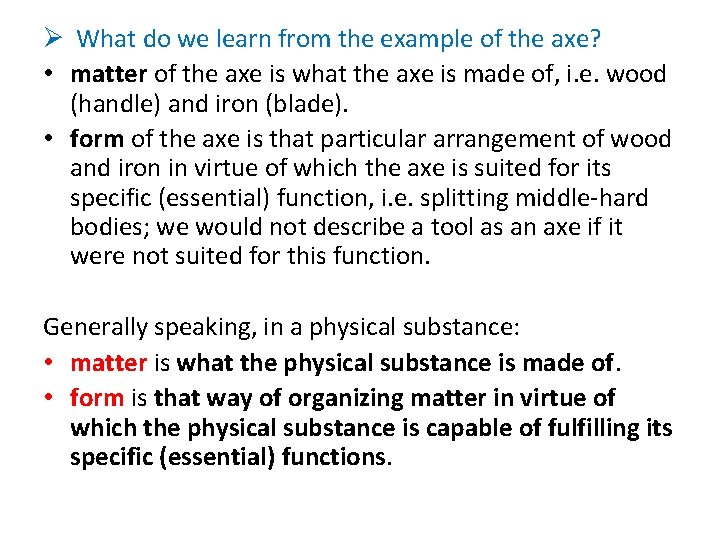
Ø What do we learn from the example of the axe? • matter of the axe is what the axe is made of, i. e. wood (handle) and iron (blade). • form of the axe is that particular arrangement of wood and iron in virtue of which the axe is suited for its specific (essential) function, i. e. splitting middle-hard bodies; we would not describe a tool as an axe if it were not suited for this function. Generally speaking, in a physical substance: • matter is what the physical substance is made of. • form is that way of organizing matter in virtue of which the physical substance is capable of fulfilling its specific (essential) functions.
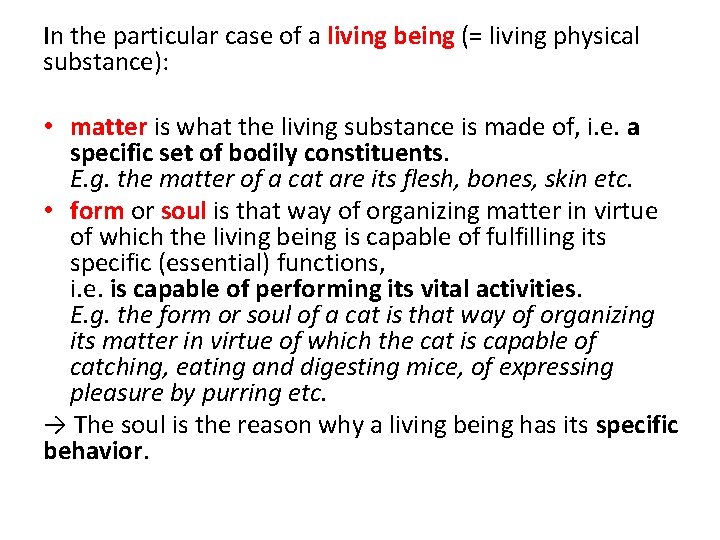
In the particular case of a living being (= living physical substance): • matter is what the living substance is made of, i. e. a specific set of bodily constituents. E. g. the matter of a cat are its flesh, bones, skin etc. • form or soul is that way of organizing matter in virtue of which the living being is capable of fulfilling its specific (essential) functions, i. e. is capable of performing its vital activities. E. g. the form or soul of a cat is that way of organizing its matter in virtue of which the cat is capable of catching, eating and digesting mice, of expressing pleasure by purring etc. → The soul is the reason why a living being has its specific behavior.
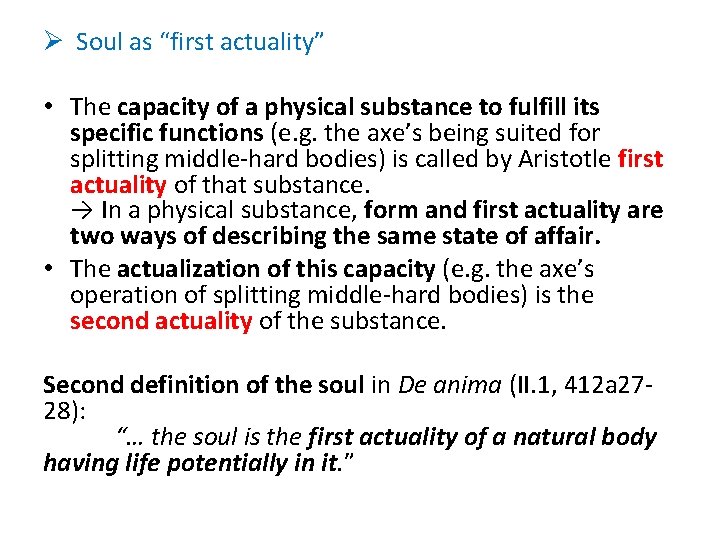
Ø Soul as “first actuality” • The capacity of a physical substance to fulfill its specific functions (e. g. the axe’s being suited for splitting middle-hard bodies) is called by Aristotle first actuality of that substance. → In a physical substance, form and first actuality are two ways of describing the same state of affair. • The actualization of this capacity (e. g. the axe’s operation of splitting middle-hard bodies) is the second actuality of the substance. Second definition of the soul in De anima (II. 1, 412 a 2728): “… the soul is the first actuality of a natural body having life potentially in it. ”
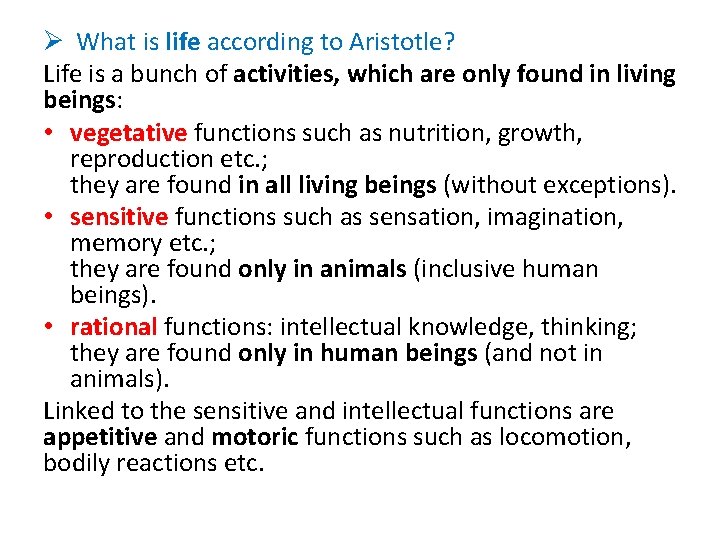
Ø What is life according to Aristotle? Life is a bunch of activities, which are only found in living beings: • vegetative functions such as nutrition, growth, reproduction etc. ; they are found in all living beings (without exceptions). • sensitive functions such as sensation, imagination, memory etc. ; they are found only in animals (inclusive human beings). • rational functions: intellectual knowledge, thinking; they are found only in human beings (and not in animals). Linked to the sensitive and intellectual functions are appetitive and motoric functions such as locomotion, bodily reactions etc.
Ø Life requires bodily organs • According to Aristotle, living beings perform their vital activities through parts of their body called organs (stomach, eyes etc. ). (As we will see later, rational functions are an exception: they are not performed through an organ. ) • An organ is a part of the body which grounds the capacity of performing a vital function (stomach: digestion; eyes: sight etc. ). Aristotle calls such a capacity a power of the soul. • The body of a living being is a unified system of organs which grounds the different powers of the soul (i. e. the different capacities of performing vital functions that are specific for a living being).
Third definition of the soul in De anima (II. 1, 412 b 4 -6): “If we have to give a general formula applicable to all kinds of soul, we must describe it as the first actuality of a natural organic body. ” • The soul of a living being is a unified system of powers which are localized in different organs of the body. • The soul is a complex unity: it has (at least) as many parts as vital powers are to be found in the body.
• The relation between the powers (as parts of the soul) and their organs (as parts of the body) is a form-matter relation equivalent to the comprehensive soul-body relation. Example of the eye (DA II. 1, 412 b 18 -22): “Suppose that the eye were an animal, [then the power of] sight would have been its soul, […] the eye being merely the matter of sight; when [the power of] sight is removed, the eye is no longer an eye, except in name ― no more than the eye of a statue or of a painted figure. ” NB: the rational power (intellect) of human beings is an exception to this general rule.
For instance, the soul of a human being encompasses: • vegetative powers = capacities of performing vegetative activities such as nutrition, growing, reproduction etc. • sensitive powers = capacities of performing perceptual activities and activities related to them, such as imagination, memory, bodily appetites • rational power (intellect) = capacity of performing rational (intellectual) activities such as understanding, judging, reasoning etc.
Ø What’s the mind in Aristotelian hylomorphism? If we consider the mind according to our everyday language, i. e. as a general label for cognitive functions, volitions, emotional behavior etc. , then for Aristotle: • the mind is just a subset of the soul’s functions; • (1) some of them are based on the sensitive powers of the soul; • (2) some of them are based on the rational powers of the soul, also called intellect (noûs). NB: “mind” and “mental” are not concepts we find in Aristotle’s texts.
Mental functions, which are based on the sensitive powers of the soul are: • • • sense perception; imagination; memory; emotions; appetites etc. All these functions are essentially embodied, i. e. they are based on powers of the soul that are grounded in organs of the body.
Mental functions based on the rational powers of the soul are: • understanding essences (= what things are); • rational judgments; • rational inferences. For Aristotle, these functions are not embodied, i. e. they are based on powers of the soul that are not grounded in organs of the body. “… intellect or the power of thinking … seems to be a different kind of soul, differing as what is eternal from what is perishable; it alone is capable of being separated. All the other parts of soul … are … incapable of separate existence” (DA II. 2, 413 b 24 -29)
Ø Why does the intellect need to be disembodied? Aristotle’s answer (DA III. 4, 429 a 16 -27) focuses on the specific cognitive functions of the intellect (i. e. understanding of essences): “[The intellect] must be potentially identical in character with its object without being the object. […] Therefore, since everything is a possible object of understanding, the intellect […] must be pure from all admixture; for the co-presence of what is alien to its nature is an obstacle and a block […] Thus, that [power] in the soul which is called intellect […] cannot reasonably be regarded as blended with the body: if so, it would acquire some quality, e. g. warmth or cold, or even have an organ like the sensitive faculty: as it is, it has none. ”
Ø Is the mind body-dependent for Aristotle? • Yes, with regard to the sensitive functions: they require embodiment. • No, with regard to the intellectual/rational functions: they exclude embodiment. • Nevertheless, the intellectual/rational functions require the sensitive functions: the intellect can only grasp its objects in contents of sense perceptions, i. e. in sensorial images (phantasms). See DA III. 7 and III. 8.
Ø Ontological status of the soul in Aristotelian hylomorphism: As the form of a living being the soul is: • in the body, • not (a part of) the body, • not separable from the body: “[…] we can dismiss as unnecessary the question whether the soul and the body are one: it is as though we were to ask whether the wax and its shape are one, or generally the matter of a thing and that of which it is the matter. ” (DA II. 1, 412 b 58) • But the intellect is separable (DA III. 5)
Aristotle’s psychology (hylomorphism) is: • neither materialism • nor dualism • but a middle way between them Materialism: the soul is (reduced to) the body or a part of the body (see e. g. Democritus, Epicurus, Hobbes). Dualism: soul and body are two separate substances of different kind (see e. g. Plato, Augustine, Descartes)
Is Aristotle’s psychology (hylomorphism) a kind of naturalism? • Yes, the human soul as a whole is not considered to be a kind of soul qualitatively different from the soul of other living beings, or at least from the soul of animals; you can see this for instance with regard to the question as to whether the soul is separable. • Nevertheless, the human intellect seems to be an exception, i. e. a power of the soul qualitatively different from the other powers of the soul. In his theory of the intellect, Aristotle seems to weaken his naturalistic approach to the mind-body problem.
Memento! Aristotle does not approach the topic of the soul from a theological (or a religious) point of view, but from a purely philosophical (or scientific) point of view. Even his idea that the human intellect is separable from the body and can therefore survive death is not based on religious assumptions (for instance on divine revelation), but on the epistemological argument presented on slide n. 20: if the intellect has to understand all possible things, it cannot be embodied (= implemented in an organ of the body). In other words, the limits of Aristotle’s naturalism are not based on religious assumptions, but on philosophical arguments.
- Slides: 25