
Aristotle on eudaimonia and function and virtue Michael
- Slides: 10
Aristotle on eudaimonia, and function and virtue Michael Lacewing enquiries@alevelphilosophy. co. uk (c) Michael Lacewing
The good • ‘What is the good for human beings? ’ – What is it that we are aiming at? – What would provide a successful, fulfilling, good life? • Good: the purpose for which we do things, the point of doing them – Some activities (making drugs, diagnosis) are done for the sake of others (health) • Is there some end for whose sake we do everything else?
Eudaimonia • The good for a human life – ‘Happiness’ – ‘living well and faring well’: flourishing • Eudamonia v happiness – Eudaimonia is not a state of mind, but relates to the activity of living – It is not subjective, but objective – It is not easily changed, but relates to a life as a whole
What is eudaimonia? • Not pleasure: animals share in this, but there is more to a human life • Not wealth: money is a means to an end • Honour? But what do you want to be honoured for? • The virtues? Not just having them, but exercising them. What about being virtuous but very unfortunate?
Final ends • Final end: an end that we desire for its own sake, not for some further purpose • Is there just one ‘final end’? Is eudaimonia or anything else our only good? • Some final ends, e. g. pleasure, knowledge, we seek both for their own sake and for the sake of something else, viz. eudaimonia – These other final ends are constituent parts of eudaimonia • But only eudaimonia we seek for its own sake and no other purpose
Eudaimonia and function • Eudaimonia: living well, our final end – But what is this? • Ergon: something’s function or characteristic form of activity (functioning rather than purpose) • An x is a good x when it performs its characteristic activity well – Good eyes see well; good knives cut well; good plants flourish (c) Michael Lacewing
Virtue • Arête: a quality that aids the fulfilment of a thing’s ergon – An excellence or ‘virtue’ – The focus of an eye; the sharpness of a knife (c) Michael Lacewing
The ‘function argument’ • Being rational – guided by reasons – is the characteristic activity of human beings – Not reasoning but doing things for reasons – This is a psychological property, an activity of the ‘soul’ (psyche) • So our virtues will be properties than enable us to do this well • So eudaimonia consists in activity of the soul which exhibits the virtues by being in accordance with (‘good’ or ‘right’) reason (orthos logos) (c) Michael Lacewing
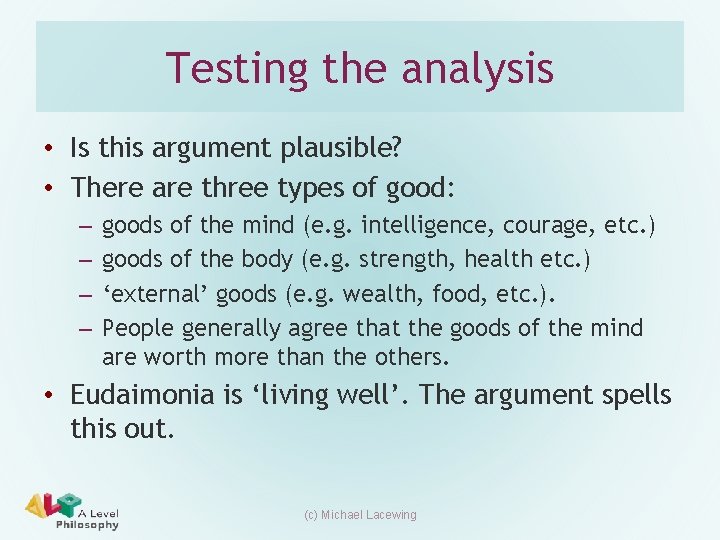
Testing the analysis • Is this argument plausible? • There are three types of good: – – goods of the mind (e. g. intelligence, courage, etc. ) goods of the body (e. g. strength, health etc. ) ‘external’ goods (e. g. wealth, food, etc. ). People generally agree that the goods of the mind are worth more than the others. • Eudaimonia is ‘living well’. The argument spells this out. (c) Michael Lacewing
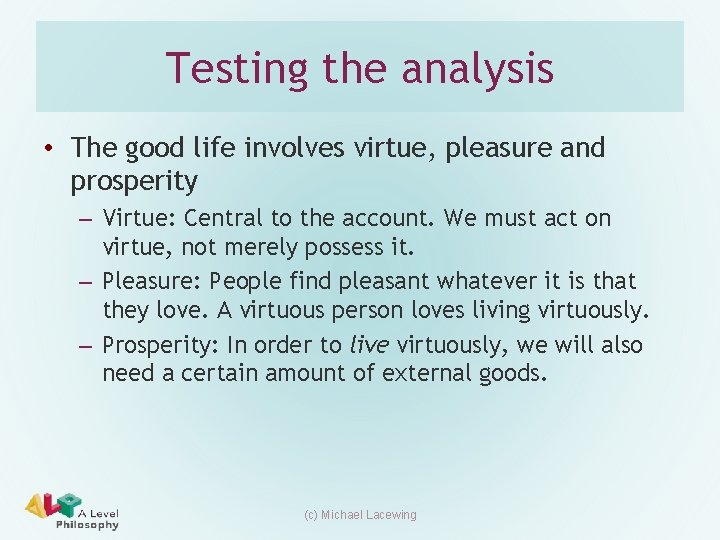
Testing the analysis • The good life involves virtue, pleasure and prosperity – Virtue: Central to the account. We must act on virtue, not merely possess it. – Pleasure: People find pleasant whatever it is that they love. A virtuous person loves living virtuously. – Prosperity: In order to live virtuously, we will also need a certain amount of external goods. (c) Michael Lacewing