
Aristotle 384 322 BCE Greek philosopher Student of
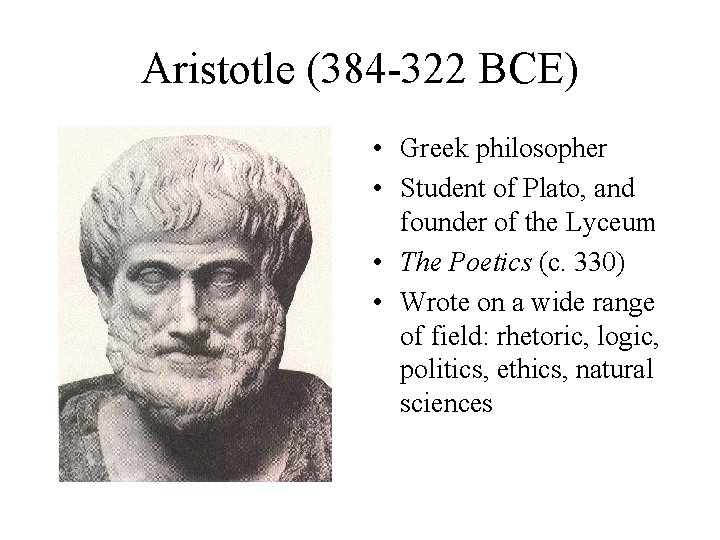
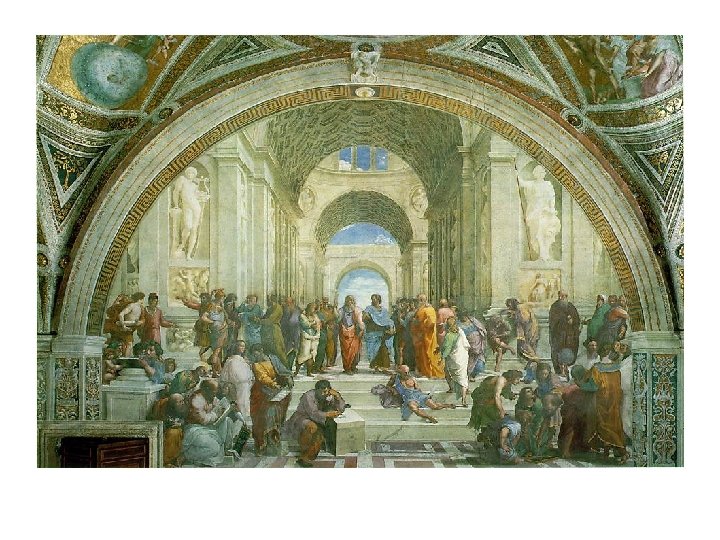
Aristotle (384 -322 BCE) • Greek philosopher • Student of Plato, and founder of the Lyceum • The Poetics (c. 330) • Wrote on a wide range of field: rhetoric, logic, politics, ethics, natural sciences
The Poetics • One of the first books of literary criticism • Formal expectations concerning tragedy (parts on comedy are lost) • Archetypal text: Sophocles’ Oedipus the King. • Heavily influential on later drama, especially French Baroque theater • Further reading: Corneille, “Of the Three Unities of Action, Time, and Place”
Summary of The Poetics (I-II) • Aristotle discusses differences among literary genres (I). • He distinguishes between epic poetry, lyric poetry, tragedy, and comedy. (formalism) • These genres are, according to him, an imitative or mimetic art (II). • Each differs from the others in how it reproduces life (medium [type of language/song], objects [moral dimension], and manner [words/actions]).
Summary of The Poetics (III) • Comedy represents persons as worse than they typically are in life. • Tragedy represents them as better. • Drama is distinguished from other arts in that it is the imitation of action (rather than being merely narrative). (III)
Summary of The Poetics (IV-V) • Aristotle’s remarks about imitation are partly a reaction to Plato’s idealism, which proposes that an unchanging idea rules above and beyond the corrupted vision of objects and relations that we have in our experience of the world. (IV-V) • For Aristotle, genres are dynamic; they develop through the innovations of great poets; they are not attempts to capture the essence of an unchanging idea. (IV-V)
Summary of The Poetics (VI) • Aristotle defines tragedy as “an imitation of an action that is serious, complete, and of a certain magnitude; in language embellished with every type of artistic ornament…; in the form of action, not of narrative; through pity and fear effecting the proper purgation of these emotions” (51)—Aristotle’s last point is termed catharsis. (VI)
Summary of The Poetics (VII-XIII) • Good plots are judged by completeness, order, composition, and magnitude (scope). These categories lead, in the following section, to the famous unities of time, place, and action. Plots should not be overly particular (a characteristic of history); they should hang together by necessity. The effectiveness of tragic plots is founded upon reversal (peripeteia) and recognition (anagnorisis)—both often related to hamartia in the hero (in many cases, hubris). (VII-XIII)
Generating Catharsis (XIII) • “It follows plainly…that the change of fortune presented must not be the spectacle of a virtuous man brought from prosperity to adversity: for this moves neither pity nor fear; it merely shocks us. Nor, again, that of a bad man passing from adversity to prosperity: for nothing can be more alien to the spirit of tragedy” (55).
Generating Catharsis (XIII) • “Nor, again, should the downfall of an utter villain be exhibited. A plot of this kind would, doubtless, satisfy the moral sense, but it would inspire neither pity nor fear; for pity is aroused by unmerited misfortune, fear by the misfortune of a man like ourselves” (55).
Generating Catharsis (XIII) • “There remains…the character between these two extremes—that of a man who is not eminently good and just, yet whose misfortune is brought about not by vice or depravity, but by some error or frailty. ”
Summary of The Poetics (XV) • Tragic characters must satisfy four conditions: – (a) they must be good; – (b) they must perform actions suitable to their positions; – (c) they must be realistically portrayed; – (d) they must be consistent. (XV)
Generalizations • Tragic heroes are flawed (Shakespeare) or commit errors of judgment. • Tragic heroes eventually understand this flaw. • Tragic heroes stand on one side of an unsolvable conflict. • Tragic heroes suffer justly. • Literary heroes are complex. • Tragic heroes are greater than the common person even though their abilities may be no greater than the common person.
Review of Antigone • • Who are the major characters? What types of abstract conflicts are possible? Differentiate between law and Law. What is the function of the chorus?
Plot • Oedipus’ sons Polynices and Eteocles battle each other for the kingship of Thebes. • Both brothers die in combat. Polynices, however, is denied burial because he was fighting against the “legitimate” powers of Thebes. • Antigone determines to bury him; Ismene refuses to help.
Plot • Creon is now ruler (tyrant) of Thebes; he declares it illegal to bury Polynices. • A sentry enters to reveal that someone has performed burial rites on the body. • Creon is enraged; later the sentry returns to accuse Antigone of the crime. • She is brought in and does not deny her action. She and Ismene are sentenced to death.
Chorus • What attitudes are expressed in the chorus? • Are they admirable or reprehensible? • Is it possible to treat the chorus as a neutral body which is merely commenting on events? • What distinguishes the chorus from any actor on the stage?
Creon’s Values • Creon’s speech (lines 194 -206) points towards a value system. • What is your understanding and reaction to his values? • Do Creon’s values deviate from modern expectations?
Ancient Greek Political Forms • • monarchy tyranny dictatorship aristocracy oligarchy democracy republicanism thalossocracy
Creon’s Impiety? • Is Creon impious (lines 317 -344)? • If so, how does this impiety compare with that of Oedipus? • cf. lines 870 -874
Choric Interludes • The chorus (lines 376 -415) • What is the purpose of this section? • What picture of the human being does it offer us? • Note the sentry’s attitudes (lines 435, 486 ff. ) • terms: strophe and antistrophe
State, Freedom, Duty • Antigone (lines 499 -524) raises the question of responsibility to the state, and the notion, for us, of rights and responsibilities living in the state. • Discuss the terms freedom, responsibility, and duty in a general way first; then reflect on these terms in light of the passage.
Duty • Creon’s speech to Haemon (lines 713 -722) • What parallels are suggested between the family and the state? • Do these make sense in the modern world? • term: stichomythia (lines 813 -849)

Haemon’s Appeal • What motivates Haemon’s criticisms? • How does the chorus react to Haemon? • What does their reaction (and Haemon’s reasoning) reveal about these men? • lines: 773 -776
Antigone and Motive • What motivates Antigone’s actions? • How might we construe her motive so that she remains a tragic hero instead of being unjustly punished? • Note her additional remarks on law, lines 9951005.
Political Aspects (Knox) • Knox remarks that the conflict is more than overtly political: • “Now, in the face of death, oblivious to the presence of Creon and the chorus, with no public case to make, no arguments to counter, she can at last identify the driving force behind her action, the private, irrational imperative which was at the root of her championship of the rights of family and the dead against the demands of the state” (48 -9).
Another Passage from Knox • “Why did the gods not save her, since they approved her action? Was it because her motives, even those she openly proclaimed, were too narrow—her total indifference to the city and its rights an offense to heaven? ” (53).
Role of Tiresias • Does Tiresias transcend the purely human dimension of drama? • Could his function be performed otherwise (that is, in an non-supernatural way)? • Does his report strengthen Antigone’s case? (p. 111)?
Representation of Violence • Why isn’t the violence acted out in Greek drama (off-stage violence)? • How can violence be depicted? • What seems to be the relation between modern violence and that in Antigone?
Defining Justice • What does the word justice mean in the context of a play? • Can the events of the play in any sense be construed as illustrating justice or involving justice? • What blocks the representation of justice? • Does the concept of justice as it appears in this work differ substantially from how we understand this concept in modern life?
Antigone as Hero • Having completed the play, why is Antigone the heroine? • What is her tragic dimension? • Is this based upon an error or flaw?
Creon’s Status • Why is the play not called the Creon? • What blocks him from being the hero of the work? • Argue, by providing evidence, that Creon is in fact the tragic hero. What needs to be operative for this update to work? • To consider: lines 1218 ff. and 1441 ff.
Attitudes towards the State • Knox: “the particular action that Creon tries to justify by this general appeal, the exposure of Polynice’s corpse, may have caused the audience some uneasiness, but on his main point, that loyalty to the city takes precedence over any private loyalty, to friend or family, they would have agreed with him” (37). • Discuss the problems of duty to authority in our modern context—think about similarities and differences.
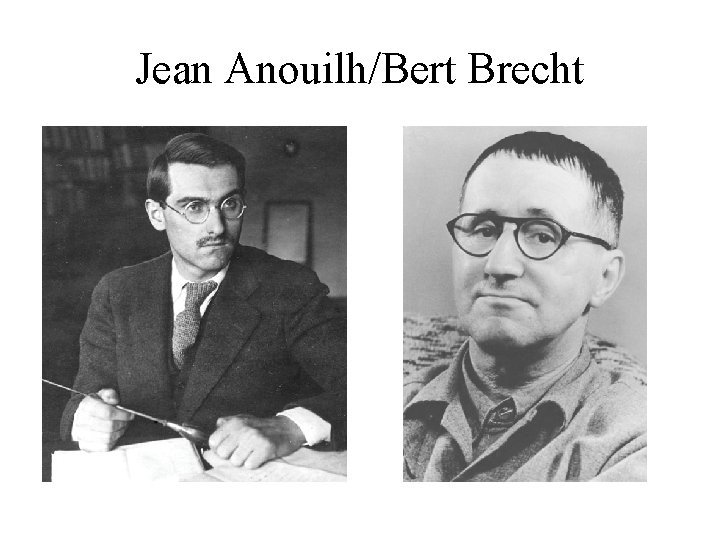
Jean Anouilh/Bert Brecht
Updating Antigone • Why is the play still relevant to modern conflicts? • If you were producing this play, how might you make it “contemporary”? • What problems arise from “updating” this or any old play?
Closing Ideas • “Antigone, as a heroine of the resistance to tyrannical power, has deservedly become one of the Western world’s great symbolic figures; she is clearly presented, in her famous speech, as a champion of a higher morality against the overriding claims of state necessity” (Mack, et al 650). • Note that this morality need not be in support of left-wing or liberal causes.
For next time • Read: The Misanthrope (Molière), Acts I-II
- Slides: 37