
Aristotle 384 322 BCE Contributions Major political thinker
Aristotle (384 -322 BCE)
Contributions Major political thinker; First theorist of democracy (Plato hated democracy); Biologist; used scientific method to analyze political institutions; Database of 158 constitutions, all but one lost: the Constitution of Athens Developed logic (the ‘organon’, or tool).
Aristotle 384 born in Stagira (in Macedonia) Son of a court physician, Nicomachus; 367 -347 studied in Plato’s Academy, Athens 347 Plato dies; Aristotle leaves Athens for Assos, Mytilene and Macedonia; In Asia Minor he studied marine organisms described in his biological works 342 tutored the Macedonian prince, Alexander; little discernible influence 335 returned to Athens; Could not become an Athenian citizen b/c his parents were not Athenian.
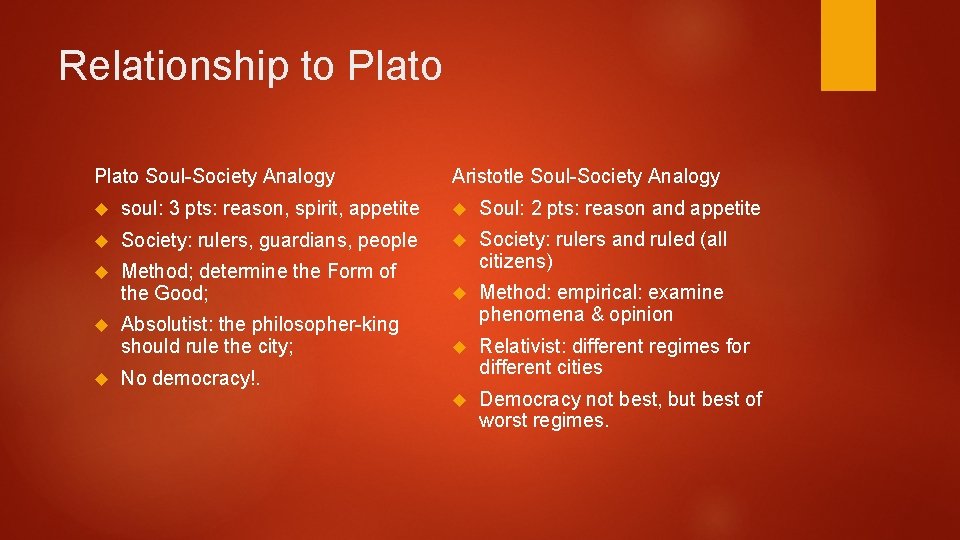
Relationship to Plato Soul-Society Analogy Aristotle Soul-Society Analogy soul: 3 pts: reason, spirit, appetite Soul: 2 pts: reason and appetite Society: rulers, guardians, people Method; determine the Form of the Good; Society: rulers and ruled (all citizens) Absolutist: the philosopher-king should rule the city; Method: empirical: examine phenomena & opinion Relativist: different regimes for different cities Democracy not best, but best of worst regimes. No democracy!.
Happiness Greeks debated: what is good life, or what is happiness? Man on the street’s answer: wealth, fame, beauty. But what is man? What is his function (goal/telos), I. e. what is natural for him? Key premise: man has reason, and his telos (final end) is to use that reason; Happiness is an activity of the soul (the reasoning part of our being) in accordance with virtue (Nicomachean Ethics). Even contemplation, the highest life for man, is an activity (Pol. 7. 3).
Aristotle’s Biology informs Aristotle’s view of human happiness, the good life and telos; Major idea: teleology (study of purpose); we understand things by their purpose or end; Telos = goal or end; the end of an acorn is to become an oak; that is natural for acorns. This can be done for man and society as well as organisms, i. e. what is the final end of man?
Aristotle the biologist Major Works in Zoology: Parts of Animals History of Animals Movements of Animals Recall that Aristotle’s father was a physician; Aristotle studied marine organisms and other animals!

Aristotle’s Hierarchy of Beings 3 kinds of soul: Vegetative: plants Sensitive: animals Rational: man These ideas still used in the 17 th century by Descartes. What is unique to man is reasoning ability and his highest good/goal/telos is to exercise that ability. Plants and animals have different goals than man because they have different natures/souls.
Virtue Everything has a virtue Virtue means acting well, in accordance with one’s nature; Slaves, plants, animals, humans all have virtues, just as they have goods; Man’s particular virtue to act from reason, and unless he is a philosopher, to act for his community.
Aristotle’s Political Thought Father of political science: his Lyceum, a rival to Plato’s Academy, launched first scientific study of politics; Political science is the master science as it directs all the others, e. g. music, mathematics and gymnastic;
Aristotle’s Political Thought Database: constitutions of 158 Greek cities (all lost) except for: Constitution of Athens: political history and description of contemporary constitution; Aristotle classifies regimes according to which interests are dominant (the rich, the poor, the middle class); Analyzes diseases of political regimes, by looking at parts of regimes and their variations, by analogy to biology.
Major Political Ideas of Aristotle Philosophical inquiry should examine the Good, the highest life for man What is the telos or purpose of man? He “is by nature a political animal. ” Polis (city-state) provides the highest life for man, by enabling him to fulfill his purpose. Another end for man is the life of contemplation (i. e. philosophy) because man is the reasoning animal; Philosophy is a kind of activity, and hence not passive. The
Major Political Ideas, cont. The best regime promotes the good of all, not just of one class, group or section of the population. A city is not a mere alliance for defense or a trading association; it has a higher purpose or end; Hierarchy is natural. Plato’s advocacy of communism is misguided; private property is best, but not too much, and not from trade (agricultural economy is best). Limits on property, population and economic activity are desirable.
Aristotle’s Ideal City Describes the necessary natural resources, planning, economic and religious activities, community life; Stipulates right conditions for marriage and procreation; Separates economic from political activity; Analyzes the purpose of the state, does not simply take it as a given; Stipulates that education is for good of city so it should be a common (not private) endeavour; Stipulates the best kind of music for citizens to hear.
- Slides: 14