
ARGUS Toward Scalable Replication Systems with Predictable Tails
ARGUS : Toward Scalable Replication Systems with Predictable Tails using Programmable Data Planes Sean Choi, Seo Jin Park, Muhammad Shahbaz, Balaji Prabhakar and Mendel Rosenblum

Replication is Crucial • Increases Write Availability and Fault Tolerance Client Master • Localized Data Access Replicate • Distributed. Replicate Databases, Consensus Systems, … Backup 2
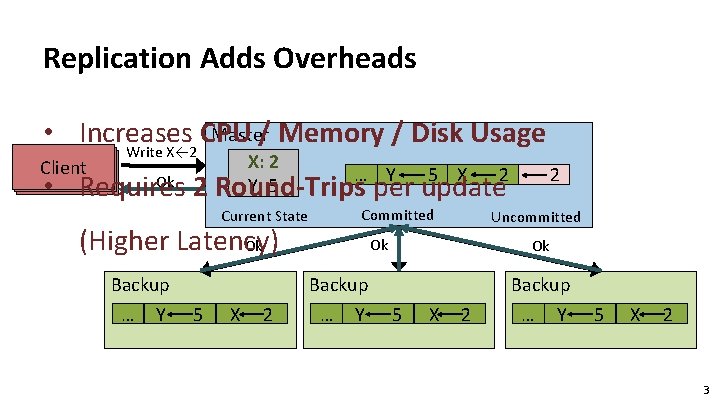
Replication Adds Overheads Master • Increases CPU / Memory / Disk Usage Write X← 2 X Client • Requires 2 Ok X: 12 2 X 5 X …… Y Y: 5 Round-Trips per 1 update Current State (Higher Latency) Ok Backup … Y 5 X 2 Committed Uncommitted Ok Backup … Y 2 Ok 5 X 2 Backup … Y 5 X 2 3
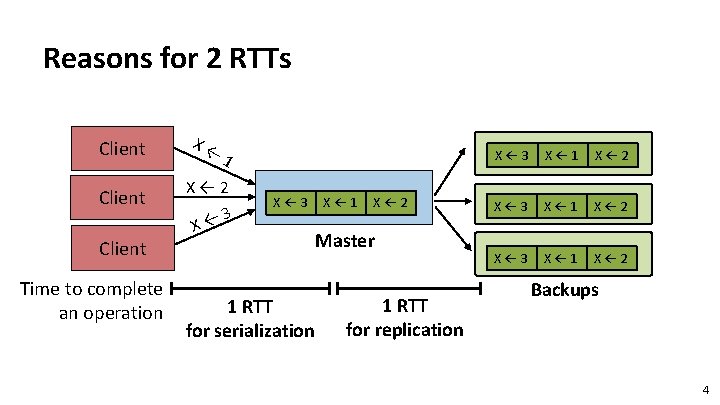
Reasons for 2 RTTs Client X← 2 3 ← X Client Time to complete an operation 1 X← 3 1 RTT for serialization X← 1 X← 2 Master 1 RTT for replication X← 3 X← 1 X← 2 Backups 4
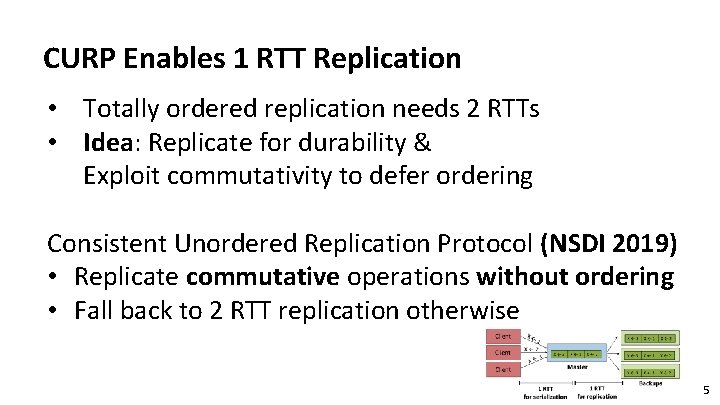
CURP Enables 1 RTT Replication • Totally ordered replication needs 2 RTTs • Idea: Replicate for durability & Exploit commutativity to defer ordering Consistent Unordered Replication Protocol (NSDI 2019) • Replicate commutative operations without ordering • Fall back to 2 RTT replication otherwise 5
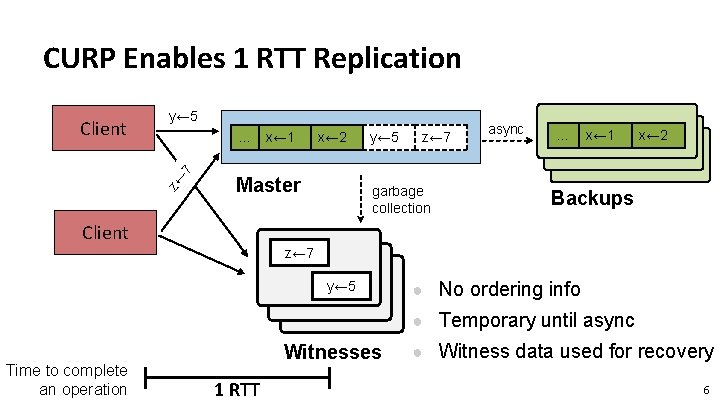
CURP Enables 1 RTT Replication y← 5 … z← 7 Client x← 1 x← 2 Master y← 5 z← 7 garbage collection async … x← 1 x← 2 Backups Client z← 7 y← 5 ● No ordering info ● Temporary until async Time to complete an operation Witnesses 1 RTT ● Witness data used for recovery 6
Shortcomings of CURP in User Space CURP witness is implemented in user space 1. High latency due to network/OS layers 2. Tail-at-Scale (More witness -> Worse tail latency) 3. Added host resource usage 7
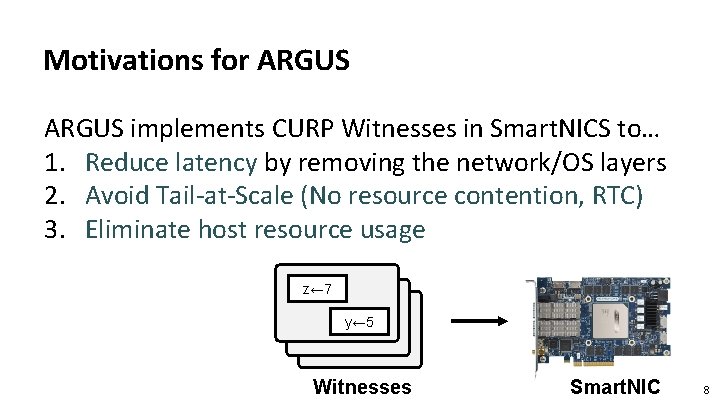
Motivations for ARGUS implements CURP Witnesses in Smart. NICS to… 1. Reduce latency by removing the network/OS layers 2. Avoid Tail-at-Scale (No resource contention, RTC) 3. Eliminate host resource usage z← 7 y← 5 Witnesses Smart. NIC 8
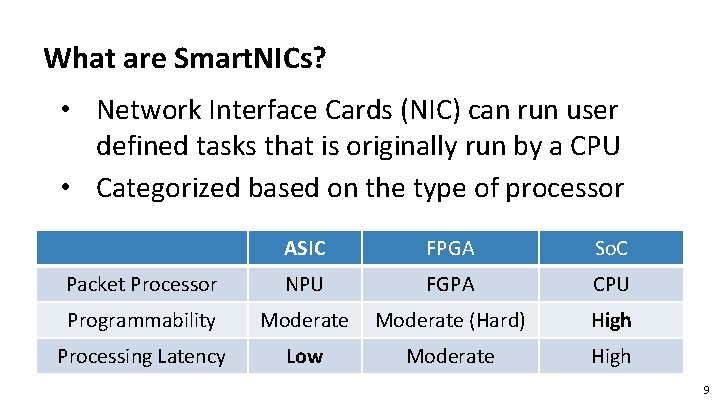
What are Smart. NICs? • Network Interface Cards (NIC) can run user defined tasks that is originally run by a CPU • Categorized based on the type of processor ASIC FPGA So. C Packet Processor NPU FGPA CPU Programmability Moderate (Hard) High Processing Latency Low Moderate High 9
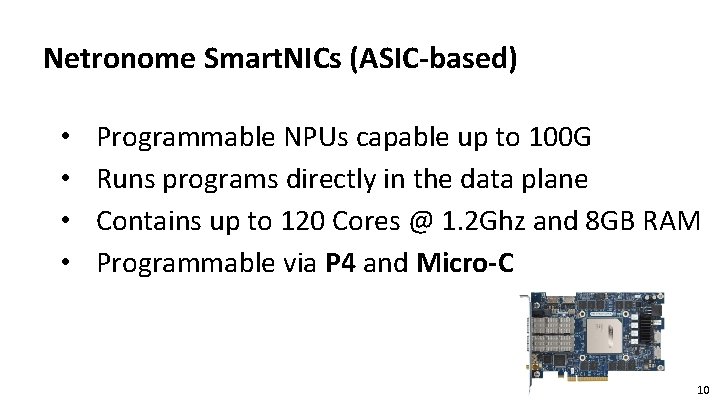
Netronome Smart. NICs (ASIC-based) • • Programmable NPUs capable up to 100 G Runs programs directly in the data plane Contains up to 120 Cores @ 1. 2 Ghz and 8 GB RAM Programmable via P 4 and Micro-C 10
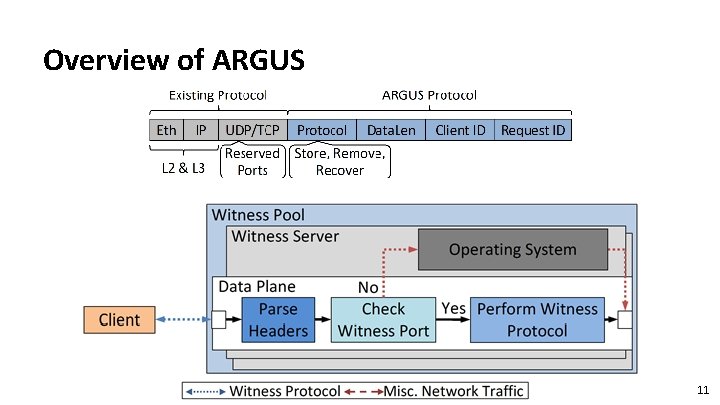
Overview of ARGUS 11
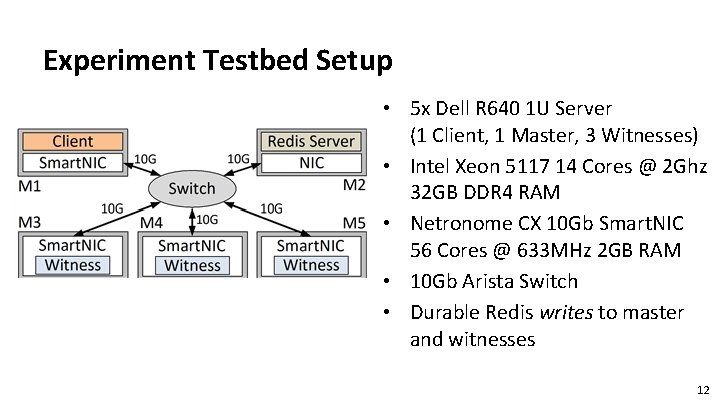
Experiment Testbed Setup • 5 x Dell R 640 1 U Server (1 Client, 1 Master, 3 Witnesses) • Intel Xeon 5117 14 Cores @ 2 Ghz 32 GB DDR 4 RAM • Netronome CX 10 Gb Smart. NIC 56 Cores @ 633 MHz 2 GB RAM • 10 Gb Arista Switch • Durable Redis writes to master and witnesses 12
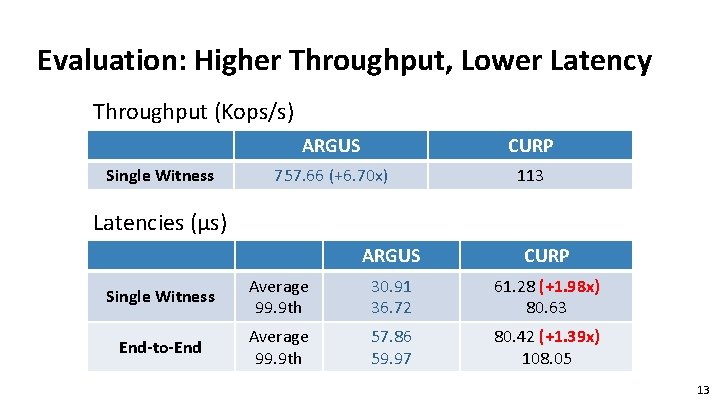
Evaluation: Higher Throughput, Lower Latency Throughput (Kops/s) Single Witness ARGUS CURP 757. 66 (+6. 70 x) 113 Latencies (μs) ARGUS CURP Single Witness Average 99. 9 th 30. 91 36. 72 61. 28 (+1. 98 x) 80. 63 End-to-End Average 99. 9 th 57. 86 59. 97 80. 42 (+1. 39 x) 108. 05 13
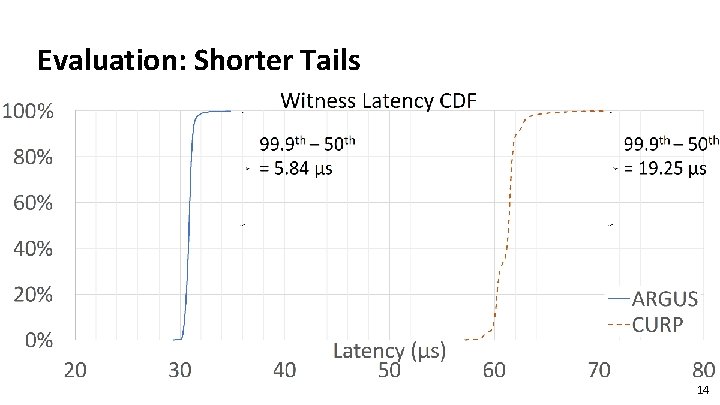
Evaluation: Shorter Tails 14
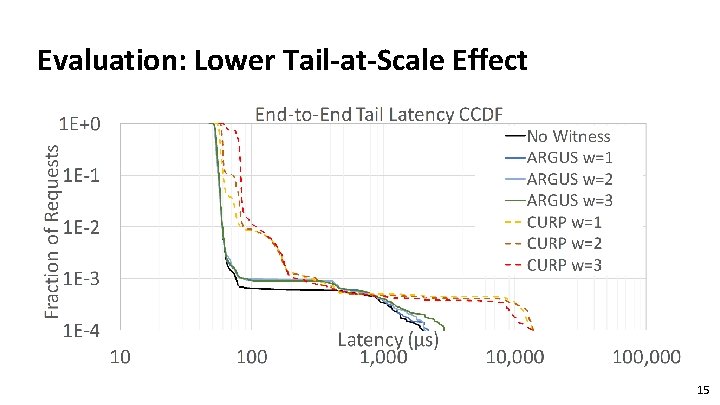
Evaluation: Lower Tail-at-Scale Effect 15
Future Work • Client-side replication on Smart. NICs • Test lightweight reliable data-transfer protocols • Try other domain-specific hardware accelerators 16
Conclusion • ARGUS shows significant improvements in replication throughput, latency and tail latency • All the while saving host CPU & Memory usage! 17
- Slides: 17