
Arguments for CrossLayer Optimizations in Bluetooth Scatternets Bhaskaran
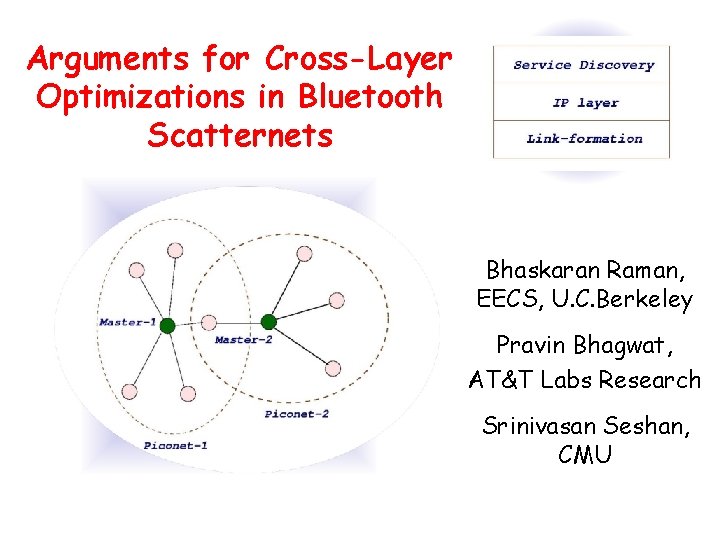
Arguments for Cross-Layer Optimizations in Bluetooth Scatternets Bhaskaran Raman, EECS, U. C. Berkeley Pravin Bhagwat, AT&T Labs Research Srinivasan Seshan, CMU
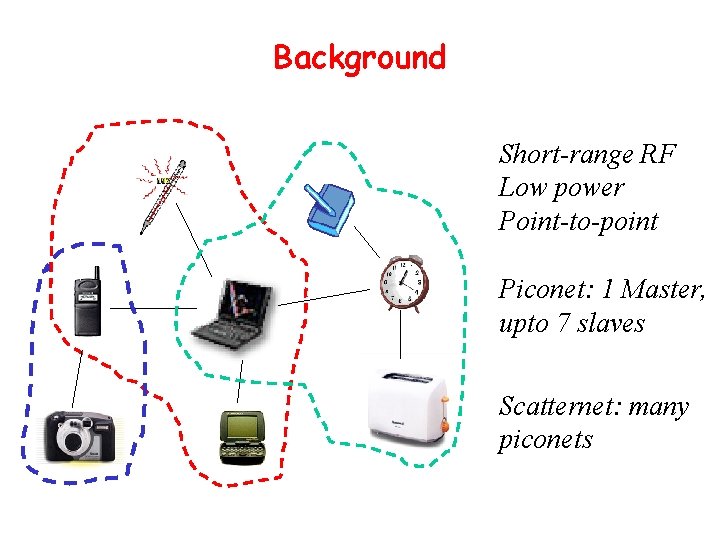
Background Short-range RF Low power Point-to-point Piconet: 1 Master, upto 7 slaves Scatternet: many piconets
Outline • • • Application scenarios Characteristics Requirements Current approaches Arguments for cross-layer optimizations Quantitative evaluation Summary and Conclusions
Application Scenarios • Lego-computing – Assemble your computing environment using wireless devices • Communication among personal devices – Pager, cell-phone, laptop, watch, camera • Laboratory environments – Labscape project (University of Washington)
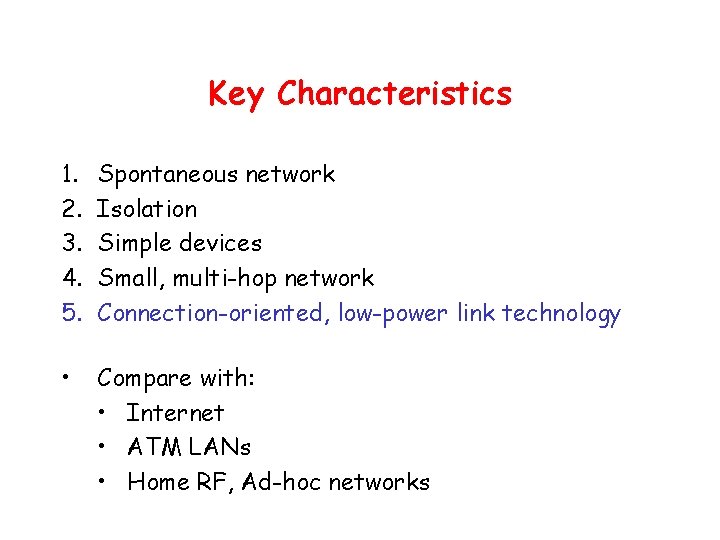
Key Characteristics 1. 2. 3. 4. 5. Spontaneous network Isolation Simple devices Small, multi-hop network Connection-oriented, low-power link technology • Compare with: • Internet • ATM LANs • Home RF, Ad-hoc networks
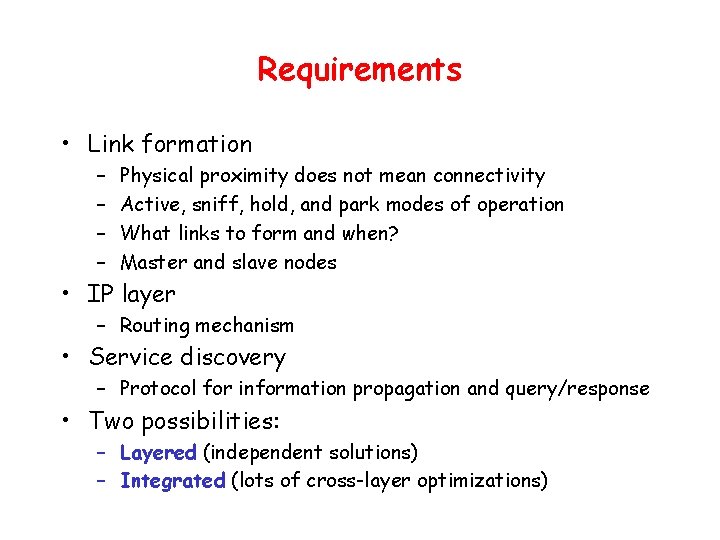
Requirements • Link formation – – Physical proximity does not mean connectivity Active, sniff, hold, and park modes of operation What links to form and when? Master and slave nodes • IP layer – Routing mechanism • Service discovery – Protocol for information propagation and query/response • Two possibilities: – Layered (independent solutions) – Integrated (lots of cross-layer optimizations)
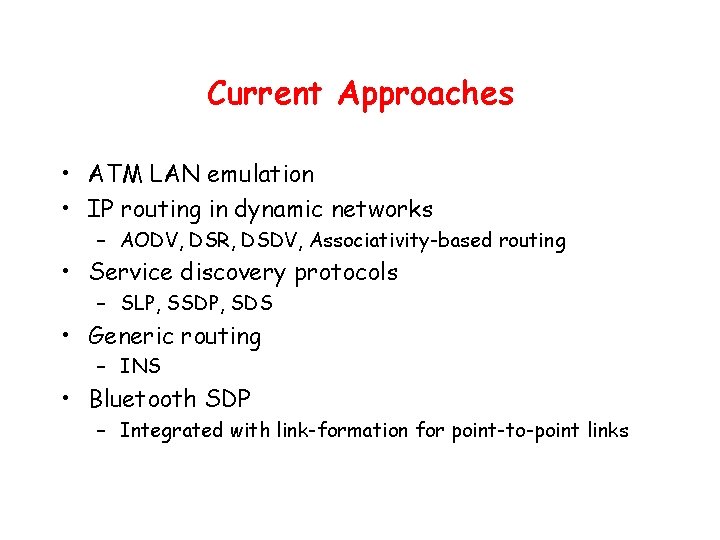
Current Approaches • ATM LAN emulation • IP routing in dynamic networks – AODV, DSR, DSDV, Associativity-based routing • Service discovery protocols – SLP, SSDP, SDS • Generic routing – INS • Bluetooth SDP – Integrated with link-formation for point-to-point links
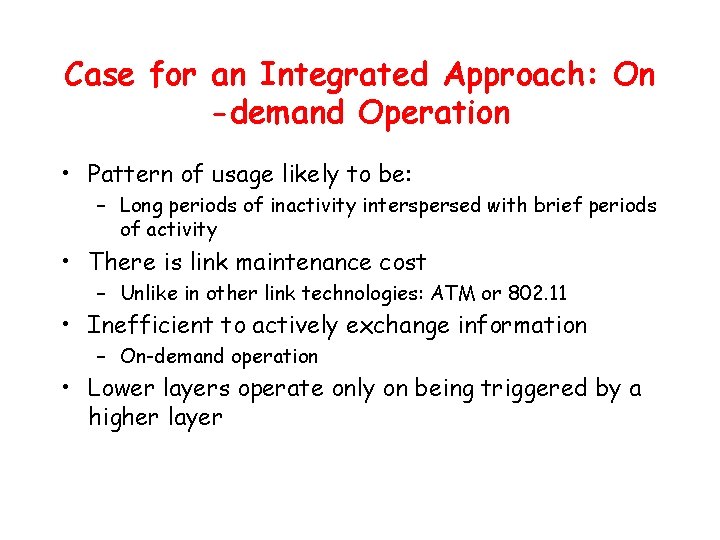
Case for an Integrated Approach: On -demand Operation • Pattern of usage likely to be: – Long periods of inactivity interspersed with brief periods of activity • There is link maintenance cost – Unlike in other link technologies: ATM or 802. 11 • Inefficient to actively exchange information – On-demand operation • Lower layers operate only on being triggered by a higher layer
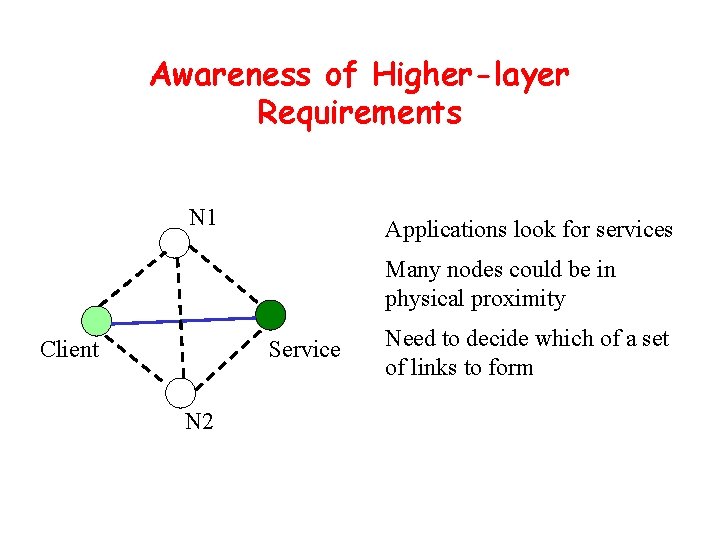
Awareness of Higher-layer Requirements N 1 Applications look for services Many nodes could be in physical proximity Client Service N 2 Need to decide which of a set of links to form
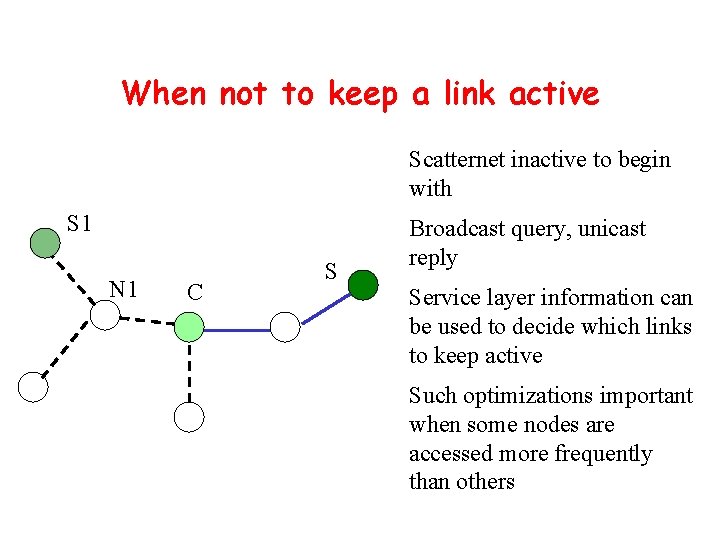
When not to keep a link active Scatternet inactive to begin with S 1 N 1 C S Broadcast query, unicast reply Service layer information can be used to decide which links to keep active Such optimizations important when some nodes are accessed more frequently than others
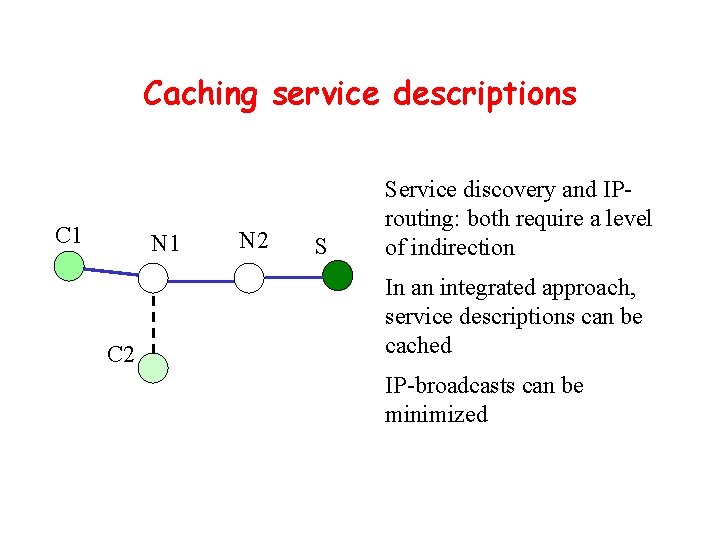
Caching service descriptions C 1 N 1 C 2 N 2 S Service discovery and IProuting: both require a level of indirection In an integrated approach, service descriptions can be cached IP-broadcasts can be minimized
Scope of Operation • In traditional networks – Different protocol layers have different scopes of operation – Link layer: subnet – IP layer: inter/intra AS – Service discovery: administrative scope or wider • In Scatternets – All protocol layers have same scope of operation: the scatternet • Single protocol layer is a natural optimization
Shortcomings of an Integrated Approach • Layered modular design and implementation – Easy to build, verify correctness – Reuse of functionality • But, in scatternets – Cross-layer optimizations highly beneficial
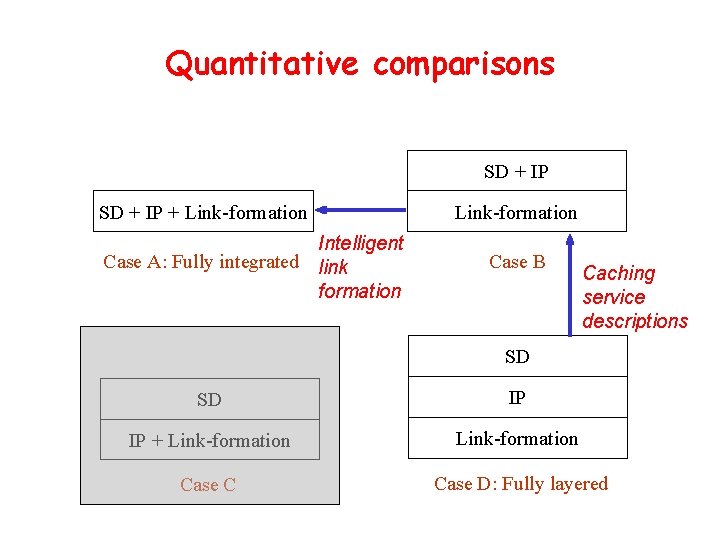
Quantitative comparisons SD + IP + Link-formation Intelligent Case A: Fully integrated link formation Link-formation Case B Caching service descriptions SD SD IP IP + Link-formation Case C Case D: Fully layered
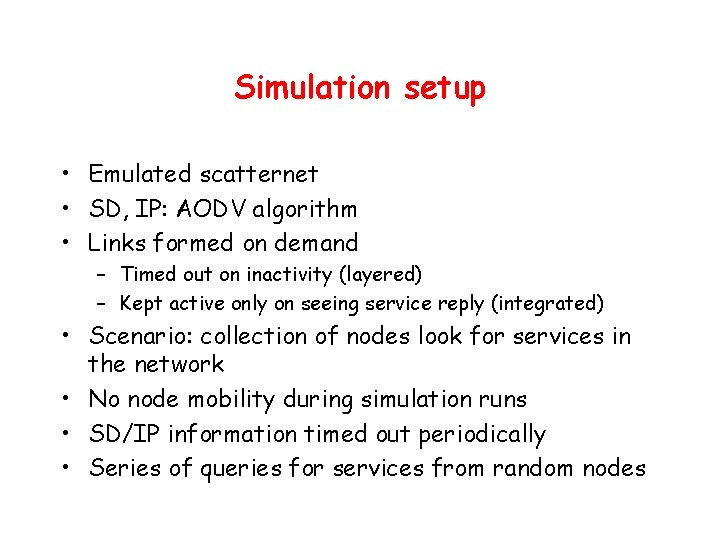
Simulation setup • Emulated scatternet • SD, IP: AODV algorithm • Links formed on demand – Timed out on inactivity (layered) – Kept active only on seeing service reply (integrated) • Scenario: collection of nodes look for services in the network • No node mobility during simulation runs • SD/IP information timed out periodically • Series of queries for services from random nodes
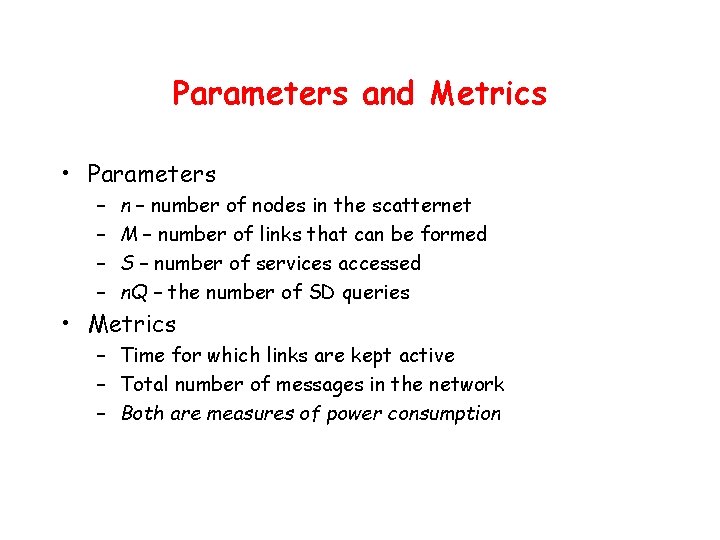
Parameters and Metrics • Parameters – – n – number of nodes in the scatternet M – number of links that can be formed S – number of services accessed n. Q – the number of SD queries • Metrics – Time for which links are kept active – Total number of messages in the network – Both are measures of power consumption
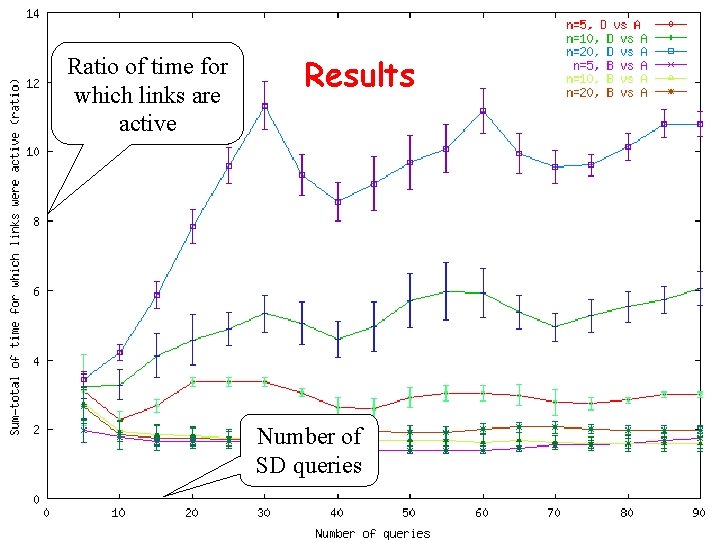
Ratio of time for which links are active Results Number of SD queries
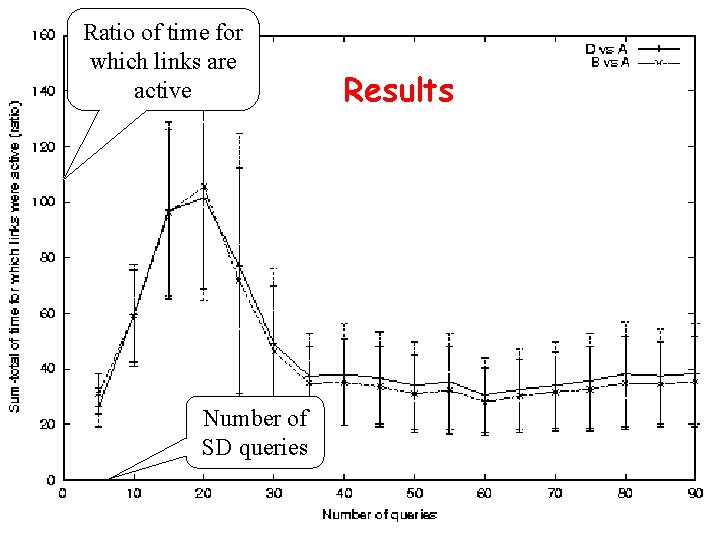
Ratio of time for which links are active Number of SD queries Results
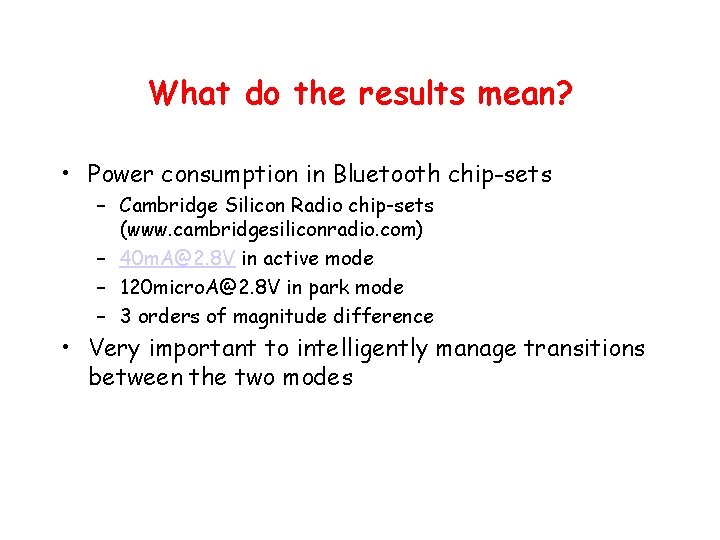
What do the results mean? • Power consumption in Bluetooth chip-sets – Cambridge Silicon Radio chip-sets (www. cambridgesiliconradio. com) – 40 m. A@2. 8 V in active mode – 120 micro. A@2. 8 V in park mode – 3 orders of magnitude difference • Very important to intelligently manage transitions between the two modes
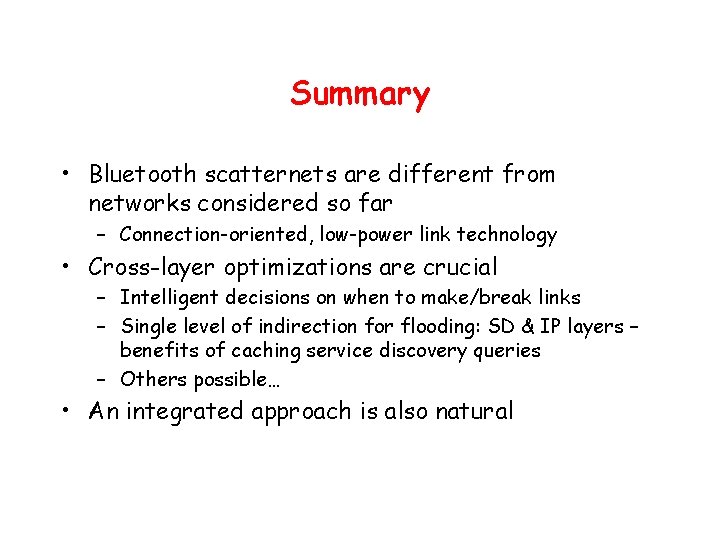
Summary • Bluetooth scatternets are different from networks considered so far – Connection-oriented, low-power link technology • Cross-layer optimizations are crucial – Intelligent decisions on when to make/break links – Single level of indirection for flooding: SD & IP layers – benefits of caching service discovery queries – Others possible… • An integrated approach is also natural
Conclusions • IP over Bluetooth imminent • Service discovery solutions and IP-routing solutions exist for similar small-scale ad-hoc networks – Do not gel well in a layered system – Important to preserve idleness • Optimizations can be extended to application layer – but will not be generic • Cross-layer techniques will probably be important for other similar link technologies in the future

http: //www. cs. berkeley. edu/~bhaskar (Presentation running under VMWare under Linux)
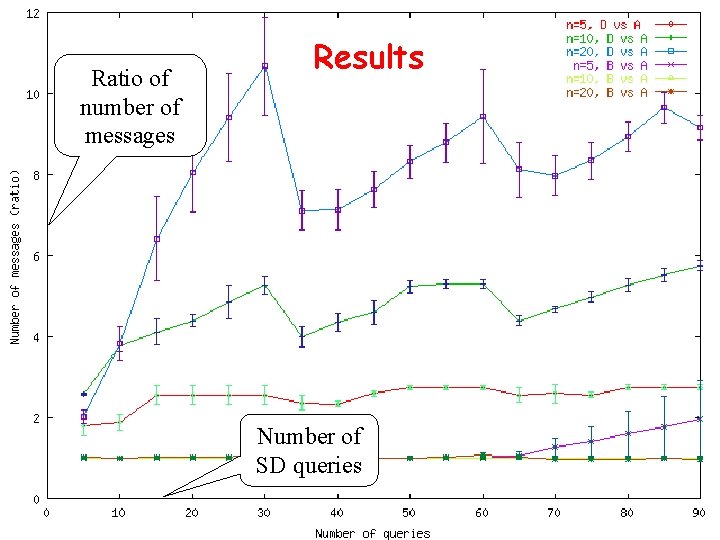
Ratio of number of messages Results Number of SD queries
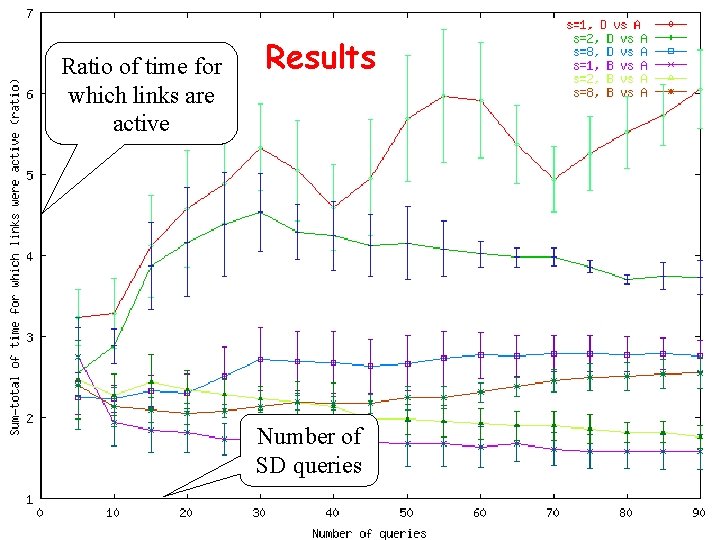
Ratio of time for which links are active Results Number of SD queries
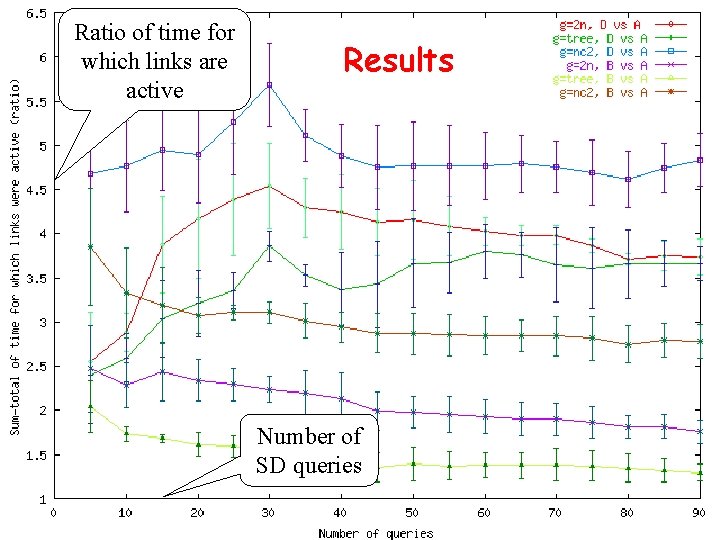
Ratio of time for which links are active Results Number of SD queries
- Slides: 25