
Argumentative Paragraphs Examples Example Claim Hybrid cars should
Argumentative Paragraphs Examples
Example Claim: Hybrid cars should replace gas-only cars. Main Reason #1: Hybrid vehicles are an effective strategy to fight pollution. Evidence: Each vehicle produced is going to stay on the road for roughly 12 to 15 years (Driving Trends). Support: Cars generally have a long lifespan, so the decision to switch to a hybrid car has a positive long-term impact on pollution levels.
Example Counterclaim and Rebuttal: Counterclaim: Instead of focusing on cars, which still encourages a culture of driving even if it cuts down on pollution, the nation should focus on building and encouraging use of mass transit systems. Rebuttal: While mass transit is an environmentally sound idea that should be encouraged, it is not feasible in many rural and suburban areas, or for people who must commute to work; thus hybrid cars are a better solution for much of the nation’s population.
Introduction
What is the Claim? Every pet owner knows that there are enormous responsibilities that go along with having a cat or dog. It must be fed and exercised, and it must be given love, attention, and protection. There’s another responsibility that not all pet owners think about, however: spaying or neutering, or “fixing. ” What does “fixing” a pet mean? Simply put, it means a quick, cheap surgery that will prevent a pet from ever becoming a mother or father. This surgery solves problems that pet owners know about, and some that they might not have considered before. In fact, all pet owners should be required to have their pets fixed because failure to do so overburdens shelters and leads to strays, causes pain and suffering to unwanted pets, and increases the health risks of pets and owners alike.
What is the Claim? Every pet owner knows that there are enormous responsibilities that go along with having a cat or dog. It must be fed and exercised, and it must be given love, attention, and protection. There’s another responsibility that not all pet owners think about, however: spaying or neutering, or “fixing. ” What does “fixing” a pet mean? Simply put, it means a quick, cheap surgery that will prevent a pet from ever becoming a mother or father. This surgery solves problems that pet owners know about, and some that they might not have considered before. In fact, all pet owners should be required to have their pets fixed because failure to do so overburdens shelters and leads to strays, causes pain and suffering to unwanted pets, and increases the health risks of pets and owners alike.
How is the Topic Introduced? Every pet owner knows that there are enormous responsibilities that go along with having a cat or dog. It must be fed and exercised, and it must be given love, attention, and protection. There’s another responsibility that not all pet owners think about, however: spaying or neutering, or “fixing. ” What does “fixing” a pet mean? Simply put, it means a quick, cheap surgery that will prevent a pet from ever becoming a mother or father. This surgery solves problems that pet owners know about, and some that they might not have considered before. In fact, all pet owners should be required to have their pets fixed because failure to do so overburdens shelters and leads to strays, causes pain and suffering to unwanted pets, and increases the health risks of pets and owners alike.
How is the Topic Introduced? Every pet owner knows that there are enormous responsibilities that go along with having a cat or dog. It must be fed and exercised, and it must be given love, attention, and protection. There’s another responsibility that not all pet owners think about, however: spaying or neutering, or “fixing. ” What does “fixing” a pet mean? Simply put, it means a quick, cheap surgery that will prevent a pet from ever becoming a mother or father. This surgery solves problems that pet owners know about, and some that they might not have considered before. In fact, all pet owners should be required to have their pets fixed because failure to do so overburdens shelters and leads to strays, causes pain and suffering to unwanted pets, and increases the health risks of pets and owners alike.
What are the Main Reasons? Every pet owner knows that there are enormous responsibilities that go along with having a cat or dog. It must be fed and exercised, and it must be given love, attention, and protection. There’s another responsibility that not all pet owners think about, however: spaying or neutering, or “fixing. ” What does “fixing” a pet mean? Simply put, it means a quick, cheap surgery that will prevent a pet from ever becoming a mother or father. This surgery solves problems that pet owners know about, and some that they might not have considered before. In fact, all pet owners should be required to have their pets fixed because failure to do so overburdens shelters and leads to strays, causes pain and suffering to unwanted pets, and increases the health risks of pets and owners alike.
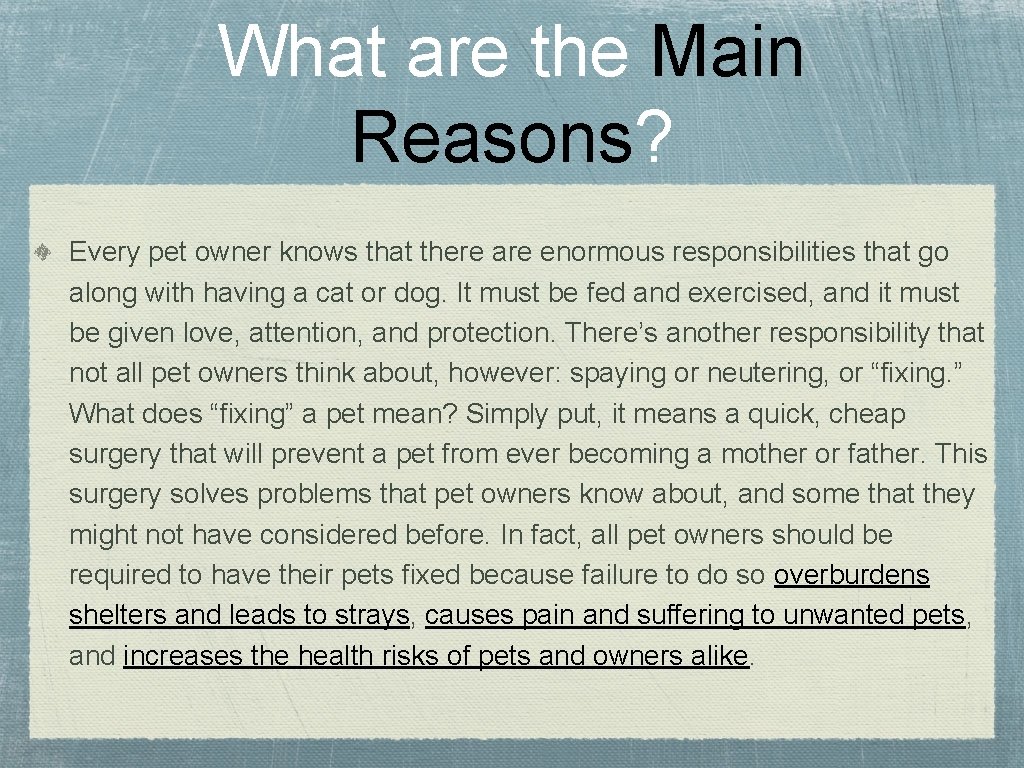
What are the Main Reasons? Every pet owner knows that there are enormous responsibilities that go along with having a cat or dog. It must be fed and exercised, and it must be given love, attention, and protection. There’s another responsibility that not all pet owners think about, however: spaying or neutering, or “fixing. ” What does “fixing” a pet mean? Simply put, it means a quick, cheap surgery that will prevent a pet from ever becoming a mother or father. This surgery solves problems that pet owners know about, and some that they might not have considered before. In fact, all pet owners should be required to have their pets fixed because failure to do so overburdens shelters and leads to strays, causes pain and suffering to unwanted pets, and increases the health risks of pets and owners alike.

Lead-in TLCD Paragraph Writing Transition Concrete Detail
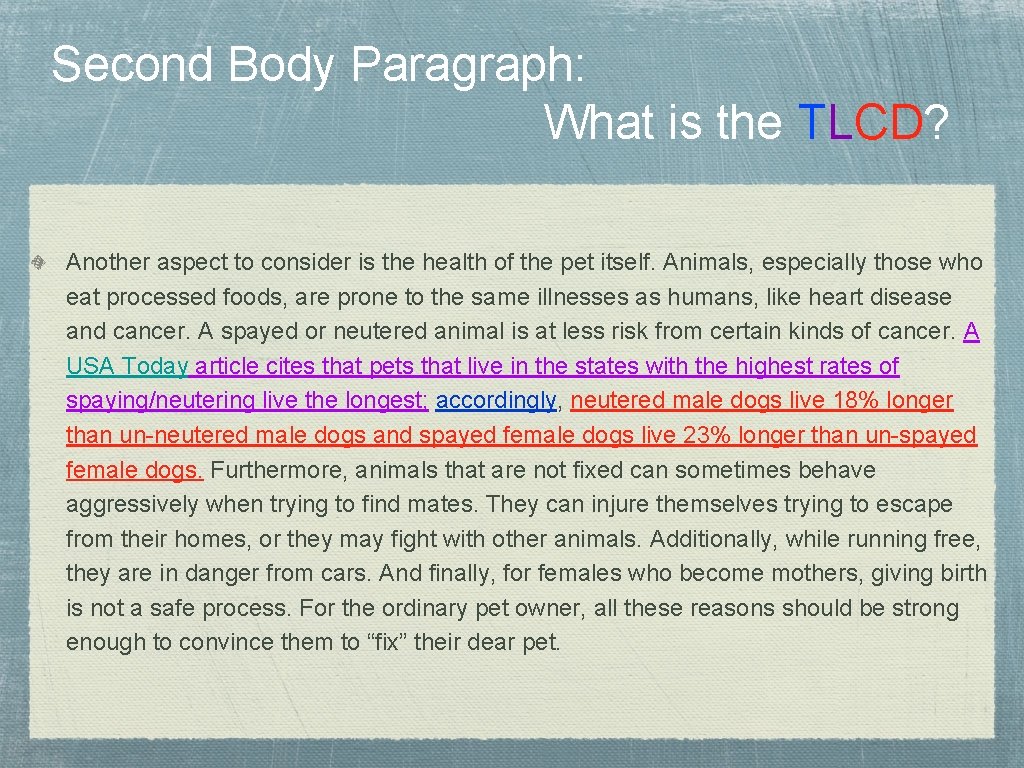
TLCD 1. When you use quotes/evidence, you must first use a transition. 2. Secondly, you must first provide the context of the quote/evidence so your reader doesn’t get lost. This is called the lead-in. 3. Then you are ready to provide the actual quote/evidence which is your Concrete Detail (CD).
First Body Paragraph
First Body Paragraph: What is the TLCD? Everybody loves a cute new puppy or kitten. But those cute babies soon get bigger, and right now, there simply aren’t enough homes for them all. Therefore, some unwanted animals go to shelters, but these shelters have “limited funds and limited space, and they cannot keep all the animals they collect” (Esmonde). If a cat or dog is not adopted within a certain time period, that animal is euthanized. Besides, not all unwanted animals go to a shelter. What happens to a stray left out on the street? Pets aren’t wild animals. They cannot find fresh water or hunt their own food, especially in a city. They cannot understand traffic laws, so they often get struck by cars. They are susceptible to common illnesses—which can then spread to other animals, including pets. They are not tame, so they may attack other animals or people. In either case, the life of most unwanted animals is not long, but it is full of misery and pain, and it’s also dangerous to other animals or people who they meet. By not “fixing” one’s own animal, a pet owner will almost certainly be adding to this problem.
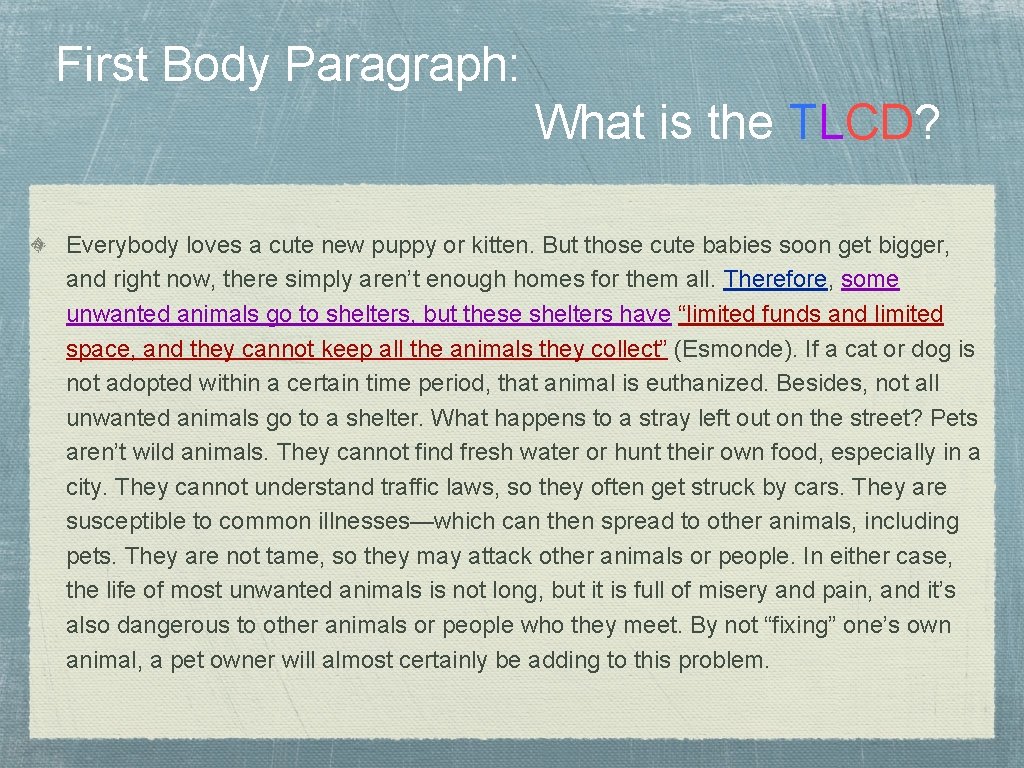
First Body Paragraph: What is the TLCD? Everybody loves a cute new puppy or kitten. But those cute babies soon get bigger, and right now, there simply aren’t enough homes for them all. Therefore, some unwanted animals go to shelters, but these shelters have “limited funds and limited space, and they cannot keep all the animals they collect” (Esmonde). If a cat or dog is not adopted within a certain time period, that animal is euthanized. Besides, not all unwanted animals go to a shelter. What happens to a stray left out on the street? Pets aren’t wild animals. They cannot find fresh water or hunt their own food, especially in a city. They cannot understand traffic laws, so they often get struck by cars. They are susceptible to common illnesses—which can then spread to other animals, including pets. They are not tame, so they may attack other animals or people. In either case, the life of most unwanted animals is not long, but it is full of misery and pain, and it’s also dangerous to other animals or people who they meet. By not “fixing” one’s own animal, a pet owner will almost certainly be adding to this problem.
First Body Paragraph: How is the evidence supported? Everybody loves a cute new puppy or kitten. But those cute babies soon get bigger, and right now, there simply aren’t enough homes for them all. Therefore, some unwanted animals go to shelters, but these shelters have “limited funds and limited space, and they cannot keep all the animals they collect” (Esmonde). If a cat or dog is not adopted within a certain time period, that animal is euthanized. Besides, not all unwanted animals go to a shelter. What happens to a stray left out on the street? Pets aren’t wild animals. They cannot find fresh water or hunt their own food, especially in a city. They cannot understand traffic laws, so they often get struck by cars. They are susceptible to common illnesses—which can then spread to other animals, including pets. They are not tame, so they may attack other animals or people. In either case, the life of most unwanted animals is not long, but it is full of misery and pain, and it’s also dangerous to other animals or people who they meet. By not “fixing” one’s own animal, a pet owner will almost certainly be adding to this problem.
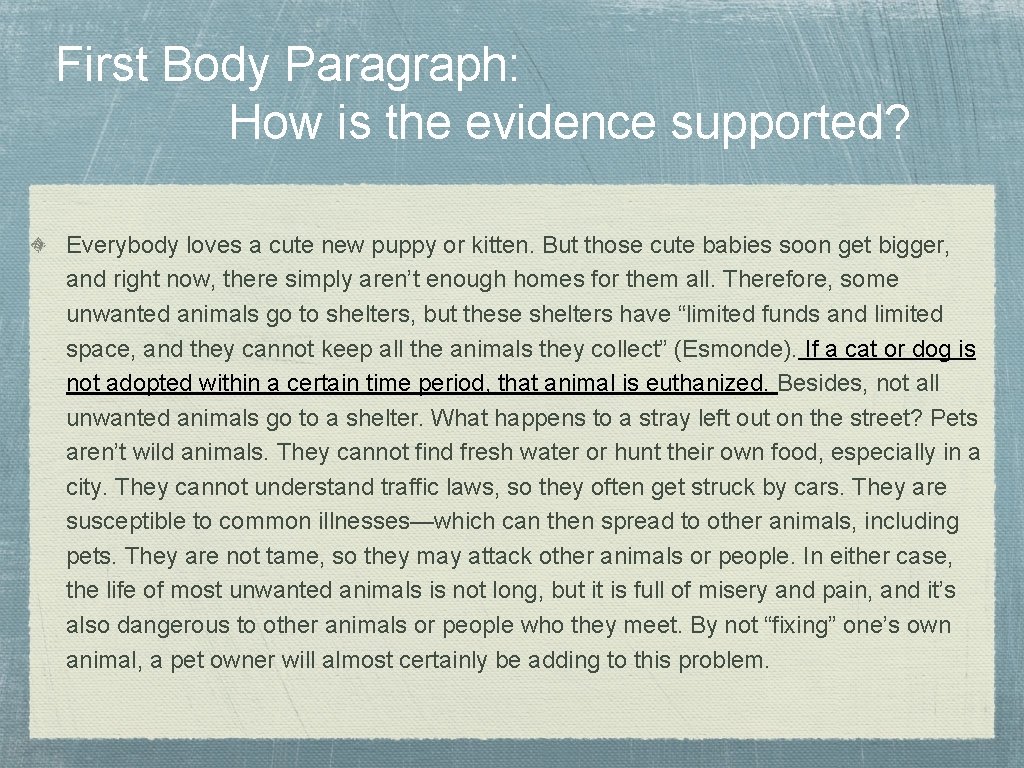
First Body Paragraph: How is the evidence supported? Everybody loves a cute new puppy or kitten. But those cute babies soon get bigger, and right now, there simply aren’t enough homes for them all. Therefore, some unwanted animals go to shelters, but these shelters have “limited funds and limited space, and they cannot keep all the animals they collect” (Esmonde). If a cat or dog is not adopted within a certain time period, that animal is euthanized. Besides, not all unwanted animals go to a shelter. What happens to a stray left out on the street? Pets aren’t wild animals. They cannot find fresh water or hunt their own food, especially in a city. They cannot understand traffic laws, so they often get struck by cars. They are susceptible to common illnesses—which can then spread to other animals, including pets. They are not tame, so they may attack other animals or people. In either case, the life of most unwanted animals is not long, but it is full of misery and pain, and it’s also dangerous to other animals or people who they meet. By not “fixing” one’s own animal, a pet owner will almost certainly be adding to this problem.
Second Body Paragraph
Second Body Paragraph: What is the TLCD? Another aspect to consider is the health of the pet itself. Animals, especially those who eat processed foods, are prone to the same illnesses as humans, like heart disease and cancer. A spayed or neutered animal is at less risk from certain kinds of cancer. A USA Today article cites that pets that live in the states with the highest rates of spaying/neutering live the longest; accordingly, neutered male dogs live 18% longer than un-neutered male dogs and spayed female dogs live 23% longer than un-spayed female dogs. Furthermore, animals that are not fixed can sometimes behave aggressively when trying to find mates. They can injure themselves trying to escape from their homes, or they may fight with other animals. Additionally, while running free, they are in danger from cars. And finally, for females who become mothers, giving birth is not a safe process. For the ordinary pet owner, all these reasons should be strong enough to convince them to “fix” their dear pet.
Second Body Paragraph: What is the TLCD? Another aspect to consider is the health of the pet itself. Animals, especially those who eat processed foods, are prone to the same illnesses as humans, like heart disease and cancer. A spayed or neutered animal is at less risk from certain kinds of cancer. A USA Today article cites that pets that live in the states with the highest rates of spaying/neutering live the longest; accordingly, neutered male dogs live 18% longer than un-neutered male dogs and spayed female dogs live 23% longer than un-spayed female dogs. Furthermore, animals that are not fixed can sometimes behave aggressively when trying to find mates. They can injure themselves trying to escape from their homes, or they may fight with other animals. Additionally, while running free, they are in danger from cars. And finally, for females who become mothers, giving birth is not a safe process. For the ordinary pet owner, all these reasons should be strong enough to convince them to “fix” their dear pet.
Third Body Paragraph
Third Body Paragraph: What is the counterclaim and rebuttal? Of course, some people will not agree. “I don’t want to give my animal an unnecessary surgery, ” they will say. “Surgery is risky, too, and it’s certainly expensive. ” That idea shows ignorance. Spaying or neutering should be done as soon as you get your pet— when he or she is young and healthy—and it is almost 100% safe. Your animal is in much more danger if not fixed, for the urge to run away from home will put your pet in extremely dangerous situations. And almost all cities have a fund to help pay for the surgery. Just ask at a vet or the local Humane Society. The cost can be as low as fifteen dollars (“I have an animal”).
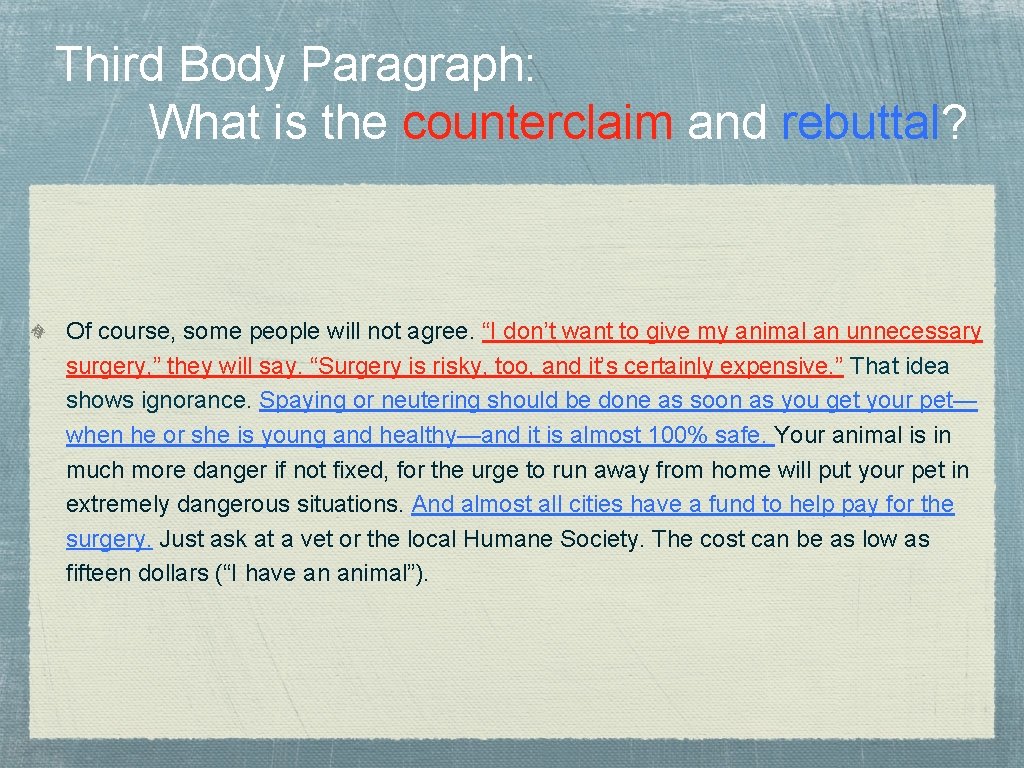
Third Body Paragraph: What is the counterclaim and rebuttal? Of course, some people will not agree. “I don’t want to give my animal an unnecessary surgery, ” they will say. “Surgery is risky, too, and it’s certainly expensive. ” That idea shows ignorance. Spaying or neutering should be done as soon as you get your pet— when he or she is young and healthy—and it is almost 100% safe. Your animal is in much more danger if not fixed, for the urge to run away from home will put your pet in extremely dangerous situations. And almost all cities have a fund to help pay for the surgery. Just ask at a vet or the local Humane Society. The cost can be as low as fifteen dollars (“I have an animal”).
Fourth Body Paragraph
Fourth Body Paragraph: counterclaim and rebuttal? What is the Others might feel that this surgery will change their pet’s personality. They might think that a “fixed” dog might not be a good watchdog, for example. Or they may simply say “I like my pet the way he/she is” (Rita_alabama). This shows a basic misunderstanding of what the effects of spaying or neutering are. A pet’s personality, like a human’s personality, is his or her own, and it won’t change after a “fixing. ” It’s true that some behaviors will change. A pet won’t want to mark objects with urine as much, and females won’t go into heat every few months (“I have an animal”). A watchdog will still be vigilant, but it probably won’t want to fight with other dogs as much. This simple surgery solves many behavior problems that can frustrate pet owners. The best solution is simply to get your pet “fixed” as soon as you get it home, as young as possible. That way, fewer bad habits will form.

Fourth Body Paragraph: counterclaim and rebuttal? What is the Others might feel that this surgery will change their pet’s personality. They might think that a “fixed” dog might not be a good watchdog, for example. Or they may simply say, “I like my pet the way he/she is” (Rita_alabama). This shows a basic misunderstanding of what the effects of spaying or neutering are. A pet’s personality, like a human’s personality, is his or her own, and it won’t change after a “fixing. ” It’s true that some behaviors will change. A pet won’t want to mark objects with urine as much, and females won’t go into heat every few months (“I have an animal”). A watchdog will still be vigilant, but it probably won’t want to fight with other dogs as much. This simple surgery solves many behavior problems that can frustrate pet owners. The best solution is simply to get your pet “fixed” as soon as you get it home, as young as possible. That way, fewer bad habits will form.
Conclusion
Conclusion: In the conclusion, how is thesis/claim mentioned? How are the main reasons restated? What is the call to action? There’s really no valid reason not to spay or neuter your pet. Whether considering the burden placed on shelters, the potential suffering of unborn animals, the health and comfort of one’s own pet, or the convenience as a pet owner, the facts all show that spaying or neutering is the way to go. It’s not only the convenient choice, but also the morally right choice, and one that all pet owners should make.
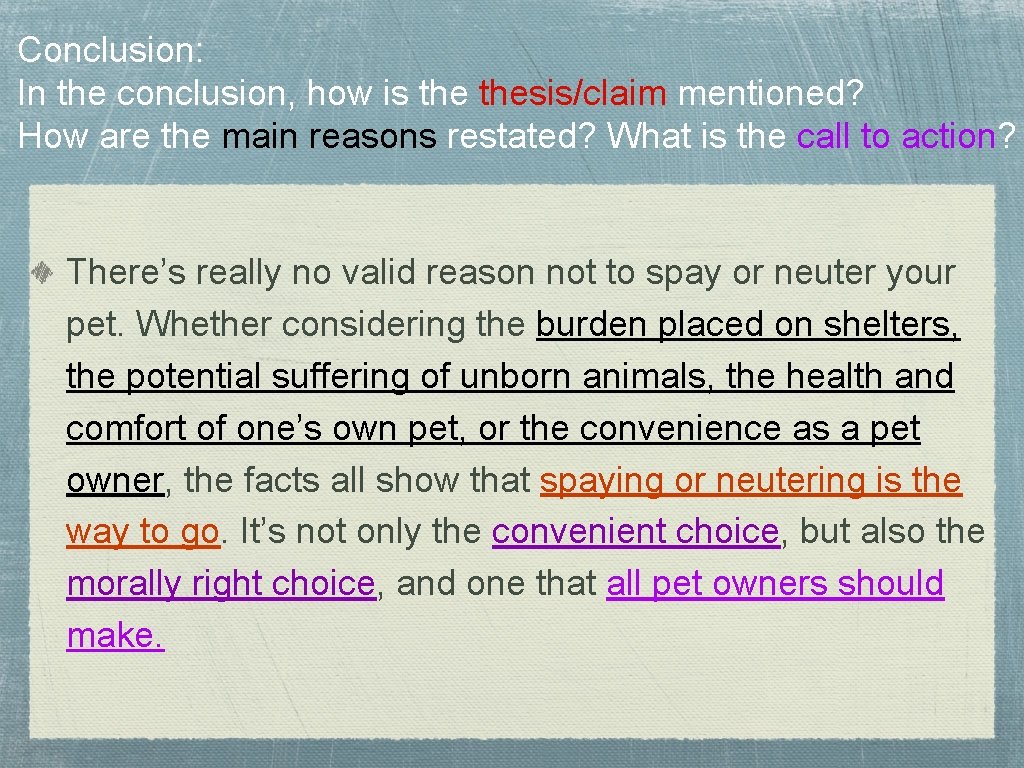
Conclusion: In the conclusion, how is thesis/claim mentioned? How are the main reasons restated? What is the call to action? There’s really no valid reason not to spay or neuter your pet. Whether considering the burden placed on shelters, the potential suffering of unborn animals, the health and comfort of one’s own pet, or the convenience as a pet owner, the facts all show that spaying or neutering is the way to go. It’s not only the convenient choice, but also the morally right choice, and one that all pet owners should make.
In-text Citations
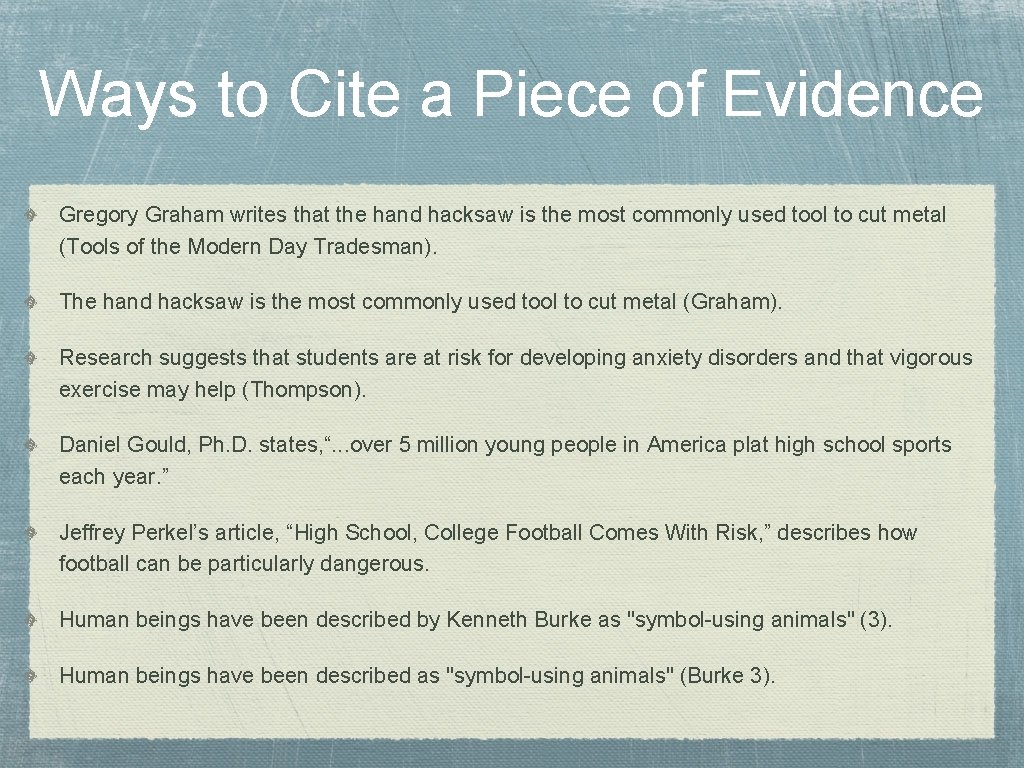
Ways to Cite a Piece of Evidence Gregory Graham writes that the hand hacksaw is the most commonly used tool to cut metal (Tools of the Modern Day Tradesman). The hand hacksaw is the most commonly used tool to cut metal (Graham). Research suggests that students are at risk for developing anxiety disorders and that vigorous exercise may help (Thompson). Daniel Gould, Ph. D. states, “. . . over 5 million young people in America plat high school sports each year. ” Jeffrey Perkel’s article, “High School, College Football Comes With Risk, ” describes how football can be particularly dangerous. Human beings have been described by Kenneth Burke as "symbol-using animals" (3). Human beings have been described as "symbol-using animals" (Burke 3).
Opener/Attention Getter/Hook
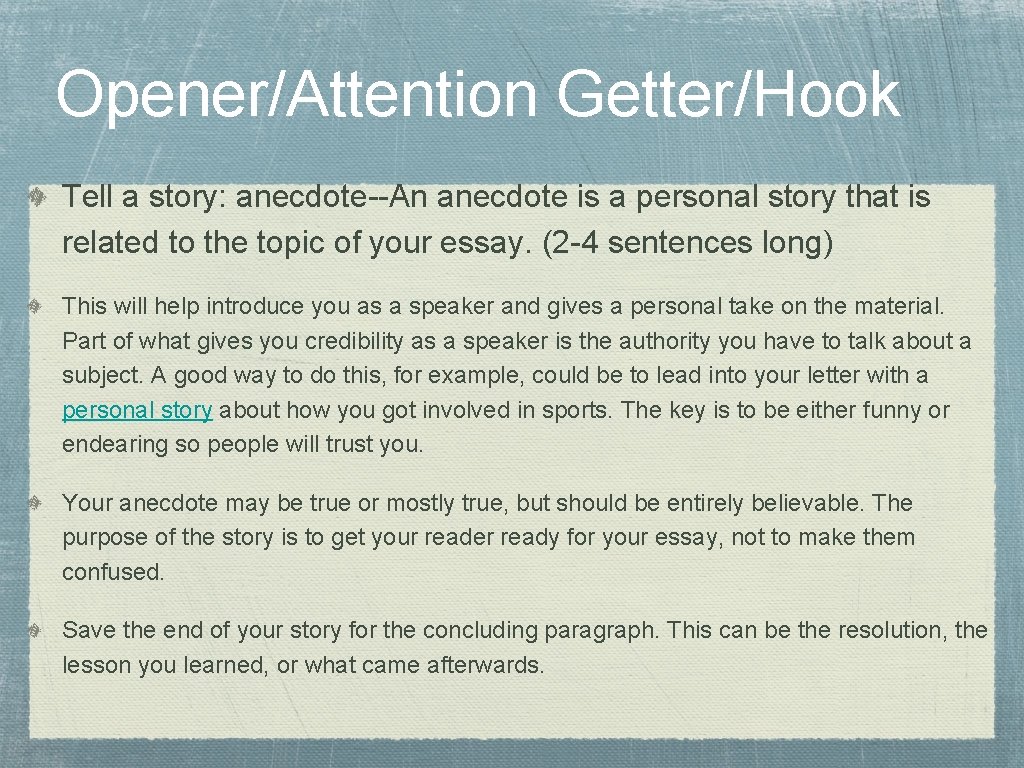
Opener/Attention Getter/Hook Tell a story: anecdote--An anecdote is a personal story that is related to the topic of your essay. (2 -4 sentences long) This will help introduce you as a speaker and gives a personal take on the material. Part of what gives you credibility as a speaker is the authority you have to talk about a subject. A good way to do this, for example, could be to lead into your letter with a personal story about how you got involved in sports. The key is to be either funny or endearing so people will trust you. Your anecdote may be true or mostly true, but should be entirely believable. The purpose of the story is to get your reader ready for your essay, not to make them confused. Save the end of your story for the concluding paragraph. This can be the resolution, the lesson you learned, or what came afterwards.
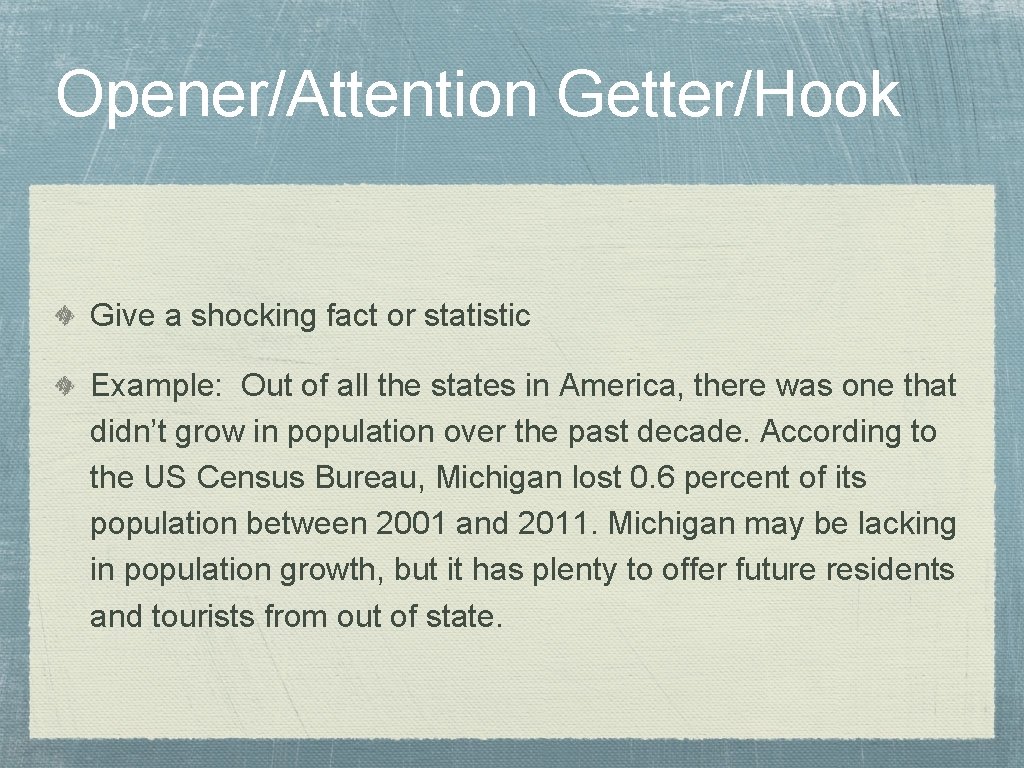
Opener/Attention Getter/Hook Give a shocking fact or statistic Example: Out of all the states in America, there was one that didn’t grow in population over the past decade. According to the US Census Bureau, Michigan lost 0. 6 percent of its population between 2001 and 2011. Michigan may be lacking in population growth, but it has plenty to offer future residents and tourists from out of state.
Opener/Attention Getter/Hook Use a well-known quotation Sometimes, someone else says it best. Famous quotes are an interesting and thoughtprovoking way to begin an essay. There an abundance of websites that organize quotes by author and subject. Imagine you were stuck on writing the introduction of an essay about the importance of volunteering. Hop online to find an interesting quote that might be a great attention grabber. If the person who said the quote is well known, that can also help your reader to better identify with your subject. Example: “How wonderful it is that nobody need wait a single moment before starting to improve the world. ” Most would think that a young girl hiding from Nazi soldiers would be the last person worried about improving the rest of the world, but in the midst of crisis, Anne Frank jotted down those exact words. She saw the urgency of improving the world, and she can serve as an inspiration to the rest of us.
Opener/Attention Getter/Hook Ask a though-provoking question/rhetorical question Rhetorical question example: Just how similar is our current economic crisis to that of the 1930 s?
Opener/Attention Getter/Hook New twist on the familiar Take a common story, quote, saying, or anecdote and change it. This will give your audience a new perspective on the familiar as well as grab their attention. If you handle the twist skillfully enough, you can actually make quite an impression. Let’s say you were giving a presentation on nutrition in America. You could say something like, “To eat, or not to eat. That is the question. ” The bolder the twist, the better the reaction will be. However, you must make sure it makes sense and fits into your material. One of the best ways is to simply find popular aphorisms online and try switching the wording around.

Ready to Apply It?
- Slides: 38